Free email delivery
Please sign up for email delivery in the subscription area to the right.
No salesman will call, at least not from us. Maybe from someone else.
In Memoriam: Keith Axelson – by Lys Axelson.
 Most people aren’t aware that Keith was an accomplished pianist at a young age winning contests playing classical music. Or that he was run over as a boy sustaining serious injuries that kept him in the hospital for a lengthy time wearing a body cast and nearly losing his leg. Or that he went into WWII as a teen where his unit, The 81st Infantry Division, was involved in one of the bloodiest assaults in the Pacific Theatre on Anguar Island. There he was wounded twice in combat leaving him disabled for life. Later he was awarded the Purple Heart with an Oak Leaf Cluster as well as the Bronze Star for good conduct. He was lucky to come home. He was a lifelong patriot and very proud of his service to America. Most don’t know of these chapters of his life.
After the war, he was trained as a Commercial Artist at Trade Tech in Los Angeles, then proceeded on to graduate from Otis Art Institute where he met and married his first wife, Ruth, and had two children. He worked in two large art studios before moving on to open his own studios and ultimately freelancing until he retired.
He was a self educated naturalist learning about the natural world through his innate curiosity, fastidious note and journal keeping as well as reading everything that interested him. His vast wealth of knowledge will be missed by many.
He was often called an “Eco Warrior” as he wrote thousands of letters persuading numerous government agencies, clubs, U.S. Presidents, Senators and individuals to protect important ecosystems and surrounding important areas. His other concerns ranged from nuclear testing to Wind Farms to Desert Motorcycle Racing. We can all thank him for his steadfast opinions and dedication to preserving the natural world. If not for his persistent bombardment of numerous Federal and State agencies many of the places that we know and love would be damaged or gone forever.
He was an award winning nature photographer known for his unaltered artistic black and white photos that frequently won contests that included color photos in the same category. Publications included L.A. Magazine, Audubon Magazine and Sierra Magazine. In the late 80’s he was invited by Canon to show an exhibition at the Ginza in Japan.
Building his own 8″ telescope in the 60’s entailed grinding his own optics. A self taught astronomer, he had the ability to read printed star charts to locate any object in the sky. He studied and tracked pulsars and photographed comets as well as other astronomical events, planets and stars.
His expertise as a top notch world class birder goes virtually uncontested. He had an ability to remember the tiniest field marks to distinguish between different birds. He was not a “lister” so his actual list count is not known, though he could tell anyone where in the world he had seen a bird in question. He was a world traveler visiting all continents and important birding islands and countries.
On a light note, he was a self proclaimed coffee fiend, indulging in a cup at any time of the day or night.
He lives on, after 92 years of spectacular life, in his son Kit, daughter Lys, grandson Blake and all that took the time to know him. He will sorely be missed.
In Memoriam: Keith Axelson
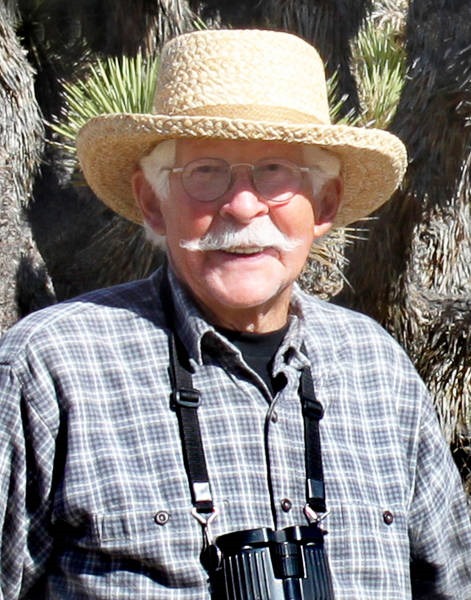 A few months ago we lost Keith Axelson. My apologies for waiting so long to write something in his memory, but it wasn’t easy.
Keith was the one of the founders of the Santa Monica Bay Audubon Society. Yes, the first issue of our newsletter, “Audubon imprint”, rolled off the presses in June 1976. Keith was the designer and editor. This, you young whippersnappers, was before personal computing. It would be more than 10 years before the Apple II and what we call “layout” programs were even farther in the future. So, Keith used a typewriter (Google it). He typed all the articles, took that copy to the printer, then cut the galleys (printed copy) apart and literally pasted them onto a template that he had designed, and sent it to a commercial printing house where they photographed it and then printed 800 or so copies for us to mail out. 10 times a year!
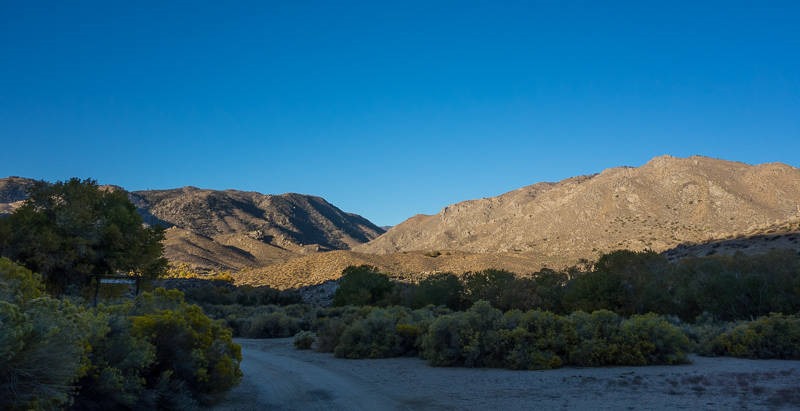
Sunset at Sageland Ranch.
And of course he contributed mightily to the conservation aspects of our young chapter. He and his second wife, Pam, organized The Desert Seminar that blew everyone’s minds when they saw the interest in desert conservation. This interest is behind our chapter’s connection with Butterbredt Spring – a seemingly odd place to sponsor for a chapter on the coast of the Pacific Ocean. Keith started the Butterbredt Christmas Count, and when he retired from his business as a graphic artist, he bought a defunct gun club property “off the grid” a few miles from the spring and rebuilt it as his home in 1995 – Sageland Ranch. Since that time he was our Man on the Butterbredt Spring beat, keeping track of cattle rampages, off-road vehicle damages, and leading more than 100 trips in and out of the spring.
Sometime in 1978, early on in this process, I was Shanghaied into being the treasurer and met all the smart, wise, experienced people running the chapter. That’s another story. However, as treasurer I was as involved as anyone in the Great Newsletter Expense debate of 1981. In addition to taking a great deal of time and effort, publishing a 4, 6, 8 page (and sometimes even longer) newsletter cost the chapter more than it could really afford. Keith did not want to compromise the quality and depth of the newsletter, but we had no choice. We had to cut back. Keith trained me as best he could because he resigned as editor and we muddled on. To add to our problems, our president ran off to South America (really!). Interesting times.
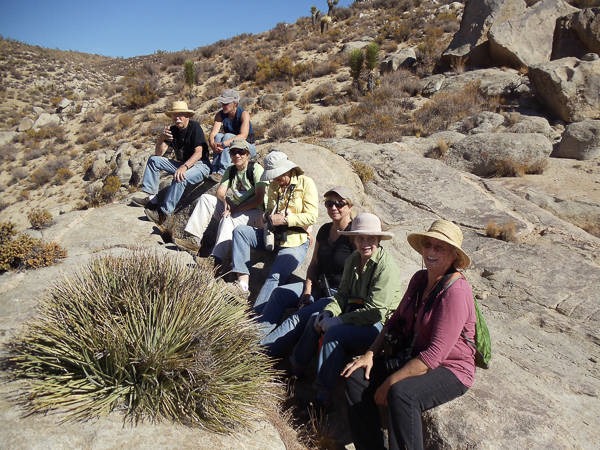
Keith and his Women – one of the many birding trips to Butterbredt Spring.

Butterbredt Christmas Counters trying to find a bird in the bush.
Keith the birder – where to start? He was a really good birder. For instance, every Christmas Count he would find at least one Slate-colored Junco among the Oregons. One might think he was making it up, but only if you didn’t know him. Did he know the territory? Yes – does anyone remember the Lane Guides? Before the internet the authoritative guide to finding birds was the Lane series. In my 1985 copy of A Birder’s Guide to Southern California Keith is the author of the Butterbredt Loop.
One of the things I discovered last December were the diaries Keith kept at Sageland Ranch. He wrote very detailed almost daily notes on the wildlife around him. Perhaps this explains why he was such a good birder – he was paying attention.
One thing we all knew about Keith was that he held strong views. I don’t think there was anything for which he had less than a strong view. For instance, he was against the capture of the last California Condors. Most of us were for it. We had some interesting discussions (!). But, holding a position did not mean he wouldn’t listen. The newsletter published articles for and against.
Butterbredt Spring is the long-running center of our conservation efforts. It was also the center of a cattle ranch. The cattle were regularly visiting the spring and wreaking havoc. Most of us held ‘strong views’ about cattle and conservation. Keith managed to persuade the ranch manager to help us fence off the spring, and run a pipe down the canyon to carry water to a trough for the cattle. This was no small accomplishment. Keith even lived long enough to see the spring declared an Important Bird Area (in cooperation with the ranch), see the improved BLM attitude regarding off-road vehicles staying out, and in the last few years see it become the property of California State Parks. The struggle to keep the spring viable is not over, but I think he was pleased at the progress.
Keith was also a very good, artistic photographer. He never, as far as I know, converted to digital. Again, strong views.
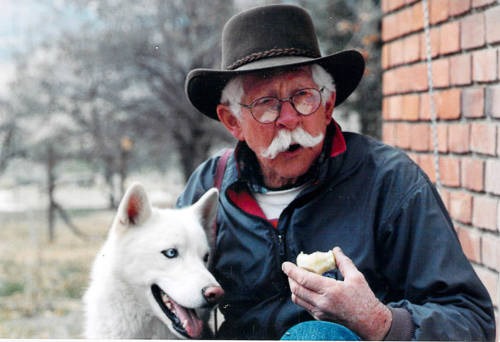
Keith’s Strong Views favored cats waaaaay over dogs, and when we were forced to bring our new rescue husky on the Halloween camping trip, he was a good sport about it. I noticed a certain resemblance between our new un-named dog and our host, so I said we might name him after Keith. “You wouldn’t dare!” was the response. So we named him Axel.
In 1986 Alice and I joined Keith, his daughter Lys and her husband, on a trip to New Zealand and eastern Australia. We had a great time, Keith’s strong views on food notwithstanding. In spite of being there for the first time, Keith was able to organize an excellent itinerary and we saw loads of birds. In retrospect, I am sorry that when Keith and Lys went on to Okinawa we did not accompany them, and not just because we missed the Okinawa Rail. One of the things I found out about Keith was at his funeral, when his best friend Andrew talked about Keith’s service in WW II. Keith never talked about it. But the fact is that the fighting on Okinawa was among the most destructive of the war. Keith received a Purple Heart and a Bronze Star. You think you know a guy.

Somewhere in Australia: Alice, Lys, and Keith.

New Zealand – Just a little kid, really.

New Zealand – Keith photographing a very tiny flower; Lys taking advantage.
And so it goes. Thank you Keith for all the things you did for our chapter, for me when I became the editor, and for doing so much for the environment in our part of the world.
Thanks to Lys Axelson for tuning up my memories in this article.
Iridescence can be seen only when light hits feathers at just the right angle. By adjusting where they are relative to their audience, males can “turn on” their bright colors. Magnificent Riflebirds seem to use this feature with particular precision, even choosing display sites that put their audience in exactly the right place to see the show in the best light. Filmed and photographed by Tim Laman, Ed Scholes and Eric Liner.
There are currently seventy-two short films in the entire Birds-of-Paradise Project playlist, ranging from 26 seconds to 8:29. In the upcoming weeks, we will present some of our favorites.
A film from the Cornell Lab of Ornithology. If no film or link appears in this email, go to the blog to view it by clicking on the blog title above. If the film stops & starts in an annoying manner, press pause (lower left double bars ||) to let it buffer and get ahead of you. [Chuck Almdale]

One of the Ballona Salt Marsh channels (Leslie Davidson ’07)
The Los Angeles Audubon Society is seeking volunteers to help us connect local school children with nature. Our high quality environmental education programs help to raise awareness among elementary and middle school students about the wonderful natural habitats found within our own city limits, at the Ballona Wetlands and at Kenneth Hahn State Recreation Area. Over 3,000 budding naturalists participated in our field trips during the 2016-2017 school year.
Training for the Ballona Wetlands program commences on Thursday, September 13th and continues on the five following Thursdays until October 18th. Each training session run from 9 am to noon.
Training for the Kenneth Hahn State Recreation Area on Friday, September 21stand continues on the five following Fridays until October 26th. Each training session run from 9 am to noon.
No experience is necessary; just a love of the outdoors and a willingness to work with children. For more information please contact Cindy Hardin at cindyhardin@laaudubon.org or at 310-301-0050.
Thanks so much.
Cindy Hardin
We complete the final episode of the PBS explanation of evolution.
In my opinion, if you think deeply upon the wide-ranging implications of the quotation from Theodosius Dobzhansky, presented at the very beginning of the first episode, it will give you greater insight into the workings of biology, including everything humans have ever done, do now, and ever will do, than anything else you might ever read or learn.
“Nothing in Biology Makes Sense Except in the Light of Evolution”
— Theodosius Dobzhansky, 1973
This is an installment of the PBS – It’s OK to be Smart series. If no film or link appears in this email, go to the blog to view it by clicking on the blog title above. If the film stops & starts in an annoying manner, press pause (lower left double bars ||) to let it buffer and get ahead of you.
Watch all 18 minutes of this 12-part series at once and avoid the Dropbox ads here.
[Chuck Almdale]



 SANTA MONICA BAY AUDUBON SOCIETY BLOG