Free email delivery
Please sign up for email delivery in the subscription area to the right.
No salesman will call, at least not from us. Maybe from someone else.
Genetic Testing Goes Mainstream
My apologies to you is this topic is distressingly off-bird-topic. We do run blogs of a general science nature – those videos we post every 4-5 days, for example – and this topic fits well within that category. But most of our readers have read about genetic testing; many have sent in their DNA for testing, or are thinking about it but want to know more before they plunk down $80-$1000. This is for you as a public service.
You are likely already well aware of the enormous effects of recent advances in DNA analysis on all biological fields. The familial relationships of bird orders, families, genera and species are reshuffled yearly; new field guides are out-of-date before they’re printed. All people with European ancestry have neanderthals in their family tree. Disorders are daily discovered to have genetic mutations as their cause. Stem cells, designer DNA, evolution, insurance discrimination, eugenics – the list goes on.
In 2017, more than seven million people, mostly in the United States, sent their DNA to testing companies. Are you one of them? Are you one of the many millions more thinking about it?
In any case, you should read this series of reports from Science News, to which we provide links. Science News, in publication for over 100 years, is a widely-read and respected bimonthly devoted entirely to science. [Chuck Almdale]
Special Report: Genetic Testing Goes Mainstream
This links to the entire collection of reports.
For an individual report, links are provided farther below.
Consumers are jumping on the genetic testing bandwagon. Many don’t know what’s in store. What you can expect to learn from consumer genetic testing. Review of experiences with companies offering health-focused and ancestry-based readouts. A close look at genetic privacy policies. The usefulness of prenatal genome testing. The risks of direct-to-consumer telomere testing. A video explanation of DNA recombination shows how heredity works.
The following chart doesn’t appear in the on-line articles, but was included in the magazine version of Comparative Review (final item below). If the chart is garbled in your email, read it on the blog. Additional testing services Veritas and Genos, not included below, are discussed in The Comparison of Results article (see link below).
| National Geographic Geno 2.0 | Living DNA | Family Tree DNA | 23andMe | Ancestry DNA | |
| Cost | $200 | $159 | $79** | $99 | $99 |
| Ethnicity Estimates | Yes | Yes | Yes | Yes | Yes |
| Relative Matching | Coming Soon | Yes | Yes | Yes | |
| Neanderthal Results | Yes | Yes | |||
| Analysis of Y Chromosome | Yes | Yes | Yes | Yes | |
| Mitochondrial DNA Analysis | Yes | Yes | Yes | Yes | |
| Family Tree Building | Yes | Yes | |||
| Pros | Specialized for looking into the deep past | Offers detailed ethnicity estimates for people of British or Irish descent | Incorpor-ates DNA results into family trees | Explains results well | Allows DNA results to be combined with traditional genealog-ical records |
| Cons | Provides no ancestry information within the last 500 years | Can’t link relatives to a family tree | Doesn’t explain results well; website is hard to navigate | Can’t link relatives to a family tree | Provides no information about ancient ancestry |
| ** Y chromosome and mitochondrial DNA analysis costs extra | |||||
What is DNA recombination? – YouTube Video | Science News
DNA recombination can be a confusing concept, especially in how it can influence consumer genetic test results. If you’re wondering why you and your sibling seem to have very different ancestors, this explanation, using lego blocks, makes it all clear.
Consumer DNA testing promises more than it delivers.
Here’s what to expect from consumer DNA tests.
Writer: Tina Hesman Saey
Published by Science News 5/26/18
The Comparison of Results
What genetic tests from 23andMe, Veritas and Genos really told me about my health. What you need to know before signing up for at-home DNA testing.
Writer: Tina Hesman Saey
Published by Science News 5/26/18
Privacy and Consumer Genetic Testing Don’t Always Mix
Protections are spotty at best and vary by testing company.
Writer: Cassie Martin
Published online by Science News 6/5/18
Why Using Genetic Genealogy to Solve Crimes Could Pose Problems
Some worry that authorities could violate people’s rights using the method.
Writer: Tina Hesman Saey
Published online by Science News 6/7/18
Risks and Riddles
What consumer DNA data can and can’t tell you about your risk for certain diseases. Consumers face lots of choices and unanswered questions.
Writer: Tina Hesman Saey
Published by Science News 6/9/18
A Peek into the Womb
Guidelines call for limits to whole genome testing for fetuses.
Writer: Laura Sanders
Published by Science News 6/9/18
Finding Family
DNA testing can bring families together, but gives mixed answers on ethnicity. Ethnicity estimates vary widely depending on which company is doing the testing. DNA testing helped one man find his biological family in southern Maryland and his Irish roots.
Writer: Tina Hesman Saey
Published by Science News 6/23/18
Telomeres
At-home telomere (the “cap” at each end of each chromosome) testing is not a reliable marker of aging, researcher says. Companies pledge to tell you your cellular age from a drop of blood. Don’t be so sure.
Writer: Cory Vanchieri
Published by Science News 6/23/18
Comparative review of 5 DNA testing companies
What author Saey actually learned about her family after trying 5 DNA ancestry tests. Results can vary widely depending on which company you use.
Writer: Tina Hesman Saey
Published by Science News 6/23/18
Iridescent feathers appear black or dull one moment, then flash into glittering color as light hits them at just the right angle. The colors are produced as the feather’s microscopic structure reflects some colors while eliminating others. The Ribbon-tailed Astrapia presents an outstanding example of how iridescence can transform the look of a bird almost instantly. Filmed and photographed by Tim Laman.
There are currently seventy-two short films in the entire Birds-of-Paradise Project playlist, ranging from 26 seconds to 8:29. In the upcoming weeks, we will present some of our favorites.
A film from the Cornell Lab of Ornithology. If no film or link appears in this email, go to the blog to view it by clicking on the blog title above. If the film stops & starts in an annoying manner, press pause (lower left double bars ||) to let it buffer and get ahead of you. [Chuck Almdale]
We continue the PBS explanation of evolution in twelve short episodes, suitable for all.
This is an installment of the PBS – It’s OK to be Smart series. If no film or link appears in this email, go to the blog to view it by clicking on the blog title above. If the film stops & starts in an annoying manner, press pause (lower left double bars ||) to let it buffer and get ahead of you.
Watch all 18 minutes of this 12-part series at once and avoid the Dropbox ads here.
[Chuck Almdale]
The Tiny Key to Ageing | PBS BrainCraft Video
You’ll never grow younger and you can’t stay the same. What’s left?
This is an installment of the PBS – BrainCraft series. If no film or link appears in this email, go to the blog to view it by clicking on the blog title above. If the film stops & starts in an annoying manner, press pause (lower left double bars ||) to let it buffer and get ahead of you. [Chuck Almdale]
A Really Cool June – Malibu Lagoon, 24 June, 2018

View down north channel to Adamson House (Lillian Johnson 6-24-18)
The weather was quite pleasant for a December field trip: overcast, cool, a slight breeze riffling the lagoon. Several birders, lacking sufficient warm clothing, left early. Some might complain, I suppose, insisting, “But it’s June! It’s supposed to be hot and sunny!” Not I. Some might grumble and call it, “June Gloom.” I call it, “A welcome respite from intolerable heat.” But then I long ago gave up lying for hours in the baking sun, trying to develop the healthy glow of a deep tan. Live and learn.

Funny bunny – is it sitting on eggs? (Grace Murayama 5-27-18)
About twenty birders showed up, most of them new to the lagoon and its birds. I suspect that the regulars, knowing the avian paucity they would encounter, stayed away. I warned those present not to expect a lot, as June is the cruelest month with few birds and low diversity. On the other hand, it can only improve as we move towards winter.
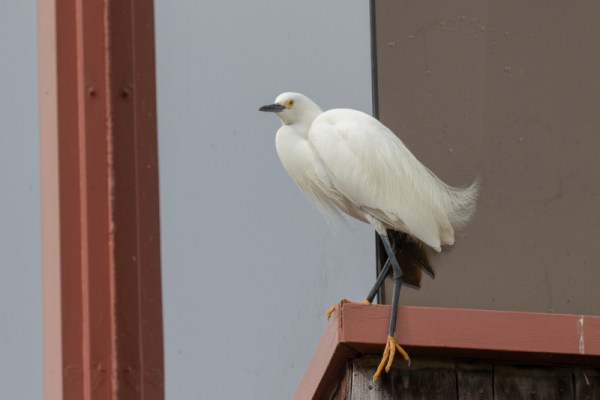
Everyone always wants to see the famous Western Roof-Egret
(Randy Ehler 5-27-18)
There were plenty of Barn Swallows cruising lagoon and beach, sipping water while on the wing, nabbing any insect foolish enough to leave the safety of the sand. I doubt that Swallows can easily process brackish water, as sea birds can safely drink sea water. However, as the lagoon is quite calm and stirring and mixing of the water may be minimal, it could be that salty water, more dense than fresh water, sinks and stays at the bottom, leaving the lighter fresh water at the surface.

Looking over the west channel to the Malibu Colony (L. Johnson 6-24-18)
The mullet were jumping. That Ph.D. is still available to anyone who can determine exactly why they jump. I’ve enquired of several fish people (shades of “The Shape of Water”) why they do this, and always receive the same set of possibilities: displaying to the opposite sex, displaying to the same sex, catching aerial insects, avoiding predators, dislodging skin parasites, gulping oxygen, it’s good exercise and stimulates the skin and circulation, it’s just plain fun. My money is on the last.

Heliotrope doesn’t follow the sun (L. Johnson 6-24-18)
Heliotrope is currently growing in numerous locations. Of Greek origin, the name means the sun (Helios) + to follow (trepein). Wikipedia says the flowers don’t actually follow the sun, as will sunflowers of many sorts. Did you know that heliotrope is a sign of – in the “language of flowers” (whatever that is) – eternal love, prophetic dreams, healing, wealth and invisibility? (Power Flowers) I’ll bet not. Possessing the power of invisibility rings true in the sense that the plant might kill you and you “shuffle off this mortal coil.” All parts of the plant are “poisonous…cause gastric distress in humans and animals…has slow acting liver toxin which causes liver damage (atrophic hepatosis)… sometimes has a high death rate in cattle…might cause photosensitization…sudden hemolytic jaundice as a response to the toxin and eventually death.” Just because something is natural doesn’t make it either good or safe to eat. (Poisonous Plants – Heliotrope)

Crow eating Killdeer chick (G. Murayama 6-22-18)
Song Sparrows were out and about. Several looked like recent fledglings: indistinct breast streaks, hopping on the open pathway where any crow could snatch them up instead of properly skulking in the bushes, and no tails. They looked like “crombec sparrows.”
For those keeping track, the crombecs – small, nearly tailless African warblers reminiscent of nuthatches – were recently split from the Sylviidae family of Old World Warblers, and – with a few other African warblers – given their own family Macrosphenidae. Hooray! Another new family of birds!
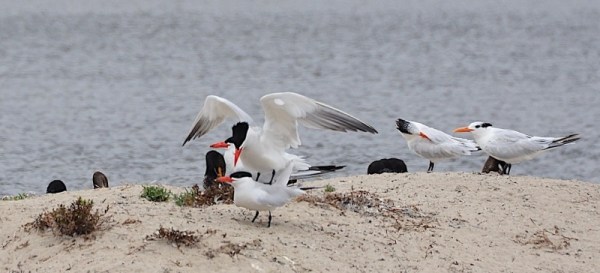
Mating Caspian Terns, Royal Tern on far right (G. Murayama 6-22-18)
As in May, the beach was unbreached and lagoon water was very high, above sea level at the 8:26 AM high tide. I’d guess that about 8-12” of sand clearance remains. Sand height is lowest towards the east side of the lagoon, and here the sand was smooth and vegetation appeared wave-washed. Full moon is on Wednesday, June 27 at 9:53 PM, and I wouldn’t be surprised if waves come over the beach at this time. When this happens, backwash from the lagoon occasionally cuts a channel back to the sea. So the lagoon water level may rise, or it may drop, which just about covers it. Take your pick.
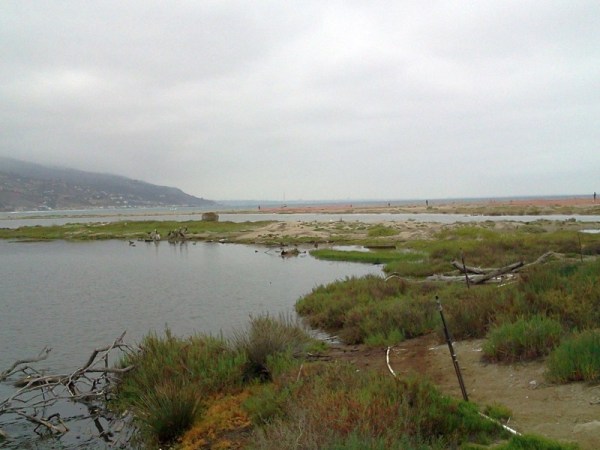
South edge of Malibu Lagoon, Santa Monica disappearing into the far foggy distance (L. Johnson 6-24-18)
Snowy Plovers have been busy. Another pair is sitting on two eggs, under the protection of the metal mobile enclosure. The two chicks we saw last month on May 27, which then had just started to fly short distances, appear (to me) to still be there, as two of the four birds present looked like juveniles.

Western Snowy Plover mom on nest inside enclosure (G. Murayama 6-22-18)
When the birding group came right up to the edge of the protective fence, the adult ran away from the nest and through the orange plastic fencing. I backed the group off about 20 ft. and she returned. The eggs are a pale gray-olive-green color with dark spots and very difficult to see even through a spotting scope. The eggs’ smooth curvature – unlike all the other objects on the beach – is what gives them away, and not the color.
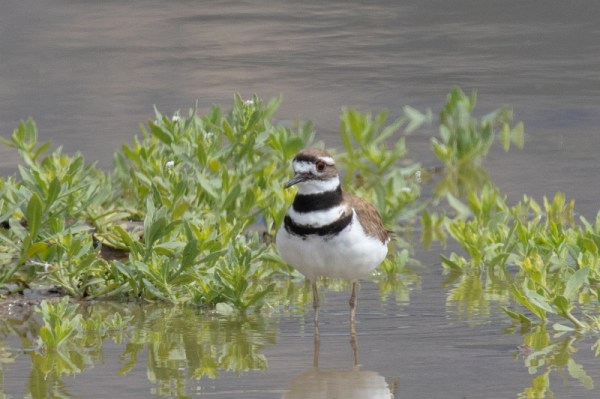
Killdeer nesting at the lagoon (Randy Ehler 5-27-18)
Willets were in all varieties of plumage, from smooth winter gray to almost reddish-brown and heavily barred. They mostly slept, accompanied by a few nodding Whimbrels.

Five days later the Willets and Whimbrels still hadn’t moved
(G. Murayama 6-29-18)
Least Terns repeatedly dropped to the sand, quickly to rise, catch a small fish, then fly about, fish in mouth and calling. The small group of Terns slowly grew throughout the morning, from none at all to four species totalling eleven birds. All the Heermann’s Gulls were adults, and we wondered how their breeding season at Isla de la Rasa in the Sea of Cortez went for them.
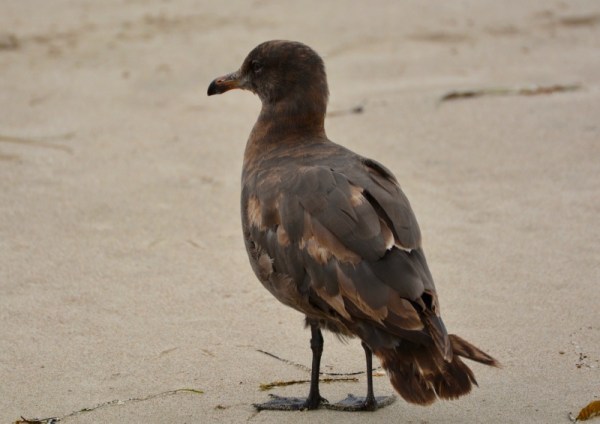
Young Heermann’s Gulls are not entirely absent, as this chocolate-brown bird, seen at Zuma Beach in west Malibu, demonstrates
(G. Murayama, 6-22-18)
I don’t know that it warrants the term “mobbing” – usually reserved for a mixed flock harassing a predator such as a small owl or cat – but two vigorous mockingbirds took turns diving on a crow which occupied their favorite perch, the electric pole at the NE corner of the Malibu Colony, a few feet from the footpath. The crow finally left. Some 10-20 minutes later we spotted two birds soaring very high. They turned out to be a crow, repeatedly diving onto the back of a Red-tailed Hawk. Can one crow constitute a “mob?”
We briefly discussed the fact that small birds will attack a larger bird they consider a predator, and they nearly always get away with it because they are faster and more maneuverable. Dropping down on their foe from behind to peck them on back or head is their favorite tactic. I’m not sure if I’ve ever seen finches or sparrows attack a mockingbird, but mockers will attack jays and crows (then again, mockers will attack anything), jays and crows will attack hawks, and hawks will attack eagles. Sort of a reverse pecking order.

Least Terns with metal leg bands on right leg (G. Murayama 6-22-18)
Birds new for the season were: Pied-billed Grebe, Sanderling, California Gull, Red-tailed Hawk, Black Phoebe, Red-winged and Brewer’s Blackbirds, Brown-headed Cowbird.
Many thanks to our photographers: Randy Ehler, Lillian Johnson, Larry Loeher & Grace Murayama.

Song Sparrow at work
(Larry Loeher 5-27-18)
Our next two scheduled field trips: Malibu Lagoon 8:30 & 10am, 22 July; Malibu Lagoon 8:30 & 10am, 26 August.
Our next program: Luke Tiller will present “Tails from the Platform: Hawks, Hawkwatchers and Hawkwatching”: Tuesday, 2 October, 7:30 p.m., Chris Reed Park, 1133 7th St., NE corner of 7th and Wilshire Blvd. in Santa Monica.
NOTE: Our 10 a.m. Parent’s & Kids Birdwalk meets at the shaded viewpoint just south of the parking area. Watch for Willie the Weasel. He’ll be watching for you and your big floppy feet.
Links: Unusual birds at Malibu Lagoon
9/23/02 Aerial photo of Malibu Lagoon
Prior checklists:
2017: Jan-June, July-Dec
2016: Jan-June, July-Dec 2015: Jan-May, July-Dec
2014: Jan-July, July-Dec 2013: Jan-June, July-Dec
2012: Jan-June, July -Dec 2011: Jan-June, July-Dec
2010: Jan-June, July-Dec 2009: Jan-June, July-Dec.
The 10-year comparison summaries created during the project period, despite numerous complaints, remain available on our Lagoon Project Bird Census Page. Very briefly summarized, the results unexpectedly indicate that avian species diversification and numbers improved slightly during the period Jun’12-June’14.
Many thanks to Lillian Johnson, and Lu Plauzoles for their contributions to the checklist below. [Chuck Almdale]
| Malibu Census 2018 | 1/28 | 2/25 | 3/25 | 4/22 | 5/27 | 6/24 |
| Temperature | 67-76 | 55-62 | 55-62 | 63-67 | 61-66 | 62-68 |
| Tide Lo/Hi Height | H+5.99 | H+5.21 | L-.16 | L-.15 | H+3.86 | H+3.50 |
| Tide Time | 0609 | 0459 | 1213 | 1028 | 0912 | 0826 |
| Cinnamon Teal | 1 | |||||
| Northern Shoveler | 2 | |||||
| Gadwall | 30 | 8 | 12 | 5 | 12 | 4 |
| American Wigeon | 36 | 4 | 8 | |||
| Mallard | 12 | 6 | 12 | 4 | 15 | 12 |
| Northern Pintail | 1 | |||||
| Green-winged Teal | 6 | 1 | 6 | |||
| Surf Scoter | 2 | |||||
| Bufflehead | 6 | 8 | 1 | |||
| Red-breasted Merganser | 3 | 4 | 6 | |||
| Ruddy Duck | 13 | 9 | 4 | |||
| Pied-billed Grebe | 1 | 2 | 1 | 2 | ||
| Eared Grebe | 2 | |||||
| Western Grebe | 25 | |||||
| Clark’s Grebe | 1 | |||||
| Rock Pigeon | 8 | 8 | 10 | 1 | 3 | 2 |
| Eurasian Collared-Dove | 1 | 2 | ||||
| Mourning Dove | 2 | 4 | 1 | 2 | ||
| Anna’s Hummingbird | 1 | 1 | 1 | 1 | ||
| Allen’s Hummingbird | 5 | 1 | 2 | 3 | ||
| Sora | 1 | |||||
| American Coot | 125 | 85 | 75 | 2 | 4 | |
| Black-bellied Plover | 22 | 25 | 10 | 9 | 1 | |
| Snowy Plover | 19 | 34 | 12 | 9 | 3 | 4 |
| Semipalmated Plover | 4 | |||||
| Killdeer | 4 | 10 | 12 | 7 | 4 | 8 |
| Whimbrel | 8 | 13 | 9 | 3 | 6 | 3 |
| Marbled Godwit | 18 | 30 | 7 | 30 | ||
| Ruddy Turnstone | 1 | 6 | 1 | |||
| Sanderling | 30 | 20 | 20 | 45 | 7 | |
| Least Sandpiper | 1 | 3 | 1 | 12 | ||
| Western Sandpiper | 10 | 4 | ||||
| Willet | 9 | 14 | 6 | 6 | 4 | 18 |
| Bonaparte’s Gull | 2 | |||||
| Heermann’s Gull | 5 | 3 | 1 | 5 | ||
| Ring-billed Gull | 35 | 70 | 10 | 1 | ||
| Western Gull | 95 | 92 | 120 | 18 | 112 | 75 |
| California Gull | 1550 | 550 | 20 | 4 | ||
| Herring Gull | 2 | |||||
| Glaucous-winged Gull | 5 | 3 | ||||
| Least Tern | 9 | 2 | ||||
| Caspian Tern | 2 | 8 | 11 | 4 | ||
| Forster’s Tern | 2 | |||||
| Royal Tern | 12 | 15 | 17 | 2 | 1 | |
| Elegant Tern | 3 | 30 | 130 | 4 | ||
| Black Skimmer | 1 | |||||
| Pacific Loon | 1 | 1 | 3 | |||
| Brandt’s Cormorant | 2 | 1 | 1 | 7 | ||
| Double-crested Cormorant | 73 | 37 | 27 | 18 | 15 | 7 |
| Pelagic Cormorant | 2 | 3 | ||||
| Brown Pelican | 6 | 14 | 37 | 32 | 68 | 5 |
| Great Blue Heron | 2 | 1 | 2 | 1 | 1 | 2 |
| Great Egret | 1 | 3 | 2 | 3 | 3 | |
| Snowy Egret | 8 | 8 | 6 | 1 | 4 | 5 |
| Green Heron | 1 | |||||
| Black-crowned Night-Heron | 4 | 2 | ||||
| Turkey Vulture | 1 | 1 | 4 | |||
| Osprey | 2 | 1 | 1 | |||
| Red-tailed Hawk | 1 | 1 | ||||
| Merlin | 1 | |||||
| Peregrine Falcon | 2 | 1 | ||||
| Nanday Parakeet | 4 | 4 | ||||
| Black Phoebe | 3 | 1 | 4 | 1 | 2 | |
| Say’s Phoebe | 3 | 3 | ||||
| Cassin’s Kingbird | 1 | |||||
| Western Kingbird | 2 | |||||
| American Crow | 3 | 5 | 4 | 2 | 2 | 4 |
| Common Raven | 2 | |||||
| Tree Swallow | 3 | |||||
| Violet-green Swallow | 6 | 2 | ||||
| Rough-winged Swallow | 3 | 5 | ||||
| Cliff Swallow | 5 | 8 | 1 | |||
| Barn Swallow | 15 | 4 | 10 | 15 | ||
| Oak Titmouse | 1 | |||||
| Bushtit | 20 | 35 | 6 | 1 | 20 | 27 |
| Marsh Wren | 1 | 2 | 2 | |||
| Bewick’s Wren | 3 | 2 | ||||
| Blue-gray Gnatcatcher | 8 | 6 | 2 | |||
| Ruby-crowned Kinglet | 3 | |||||
| Western Bluebird | 1 | |||||
| Northern Mockingbird | 2 | 1 | 3 | 2 | 2 | 2 |
| European Starling | 15 | 10 | 23 | |||
| House Finch | 20 | 8 | 24 | 4 | 5 | |
| Lesser Goldfinch | 1 | 8 | 2 | |||
| Spotted Towhee | 1 | 2 | ||||
| California Towhee | 1 | 2 | 1 | 2 | ||
| Savannah Sparrow | 1 | 2 | 1 | |||
| Song Sparrow | 4 | 5 | 2 | 10 | 5 | 5 |
| White-crowned Sparrow | 8 | 25 | 28 | |||
| Dark-eyed Junco | 2 | |||||
| Western Meadowlark | 2 | 4 | ||||
| Red-winged Blackbird | 6 | 15 | 1 | 7 | ||
| Brown-headed Cowbird | 2 | 2 | ||||
| Brewer’s Blackbird | 1 | |||||
| Great-tailed Grackle | 1 | 2 | 15 | 4 | 4 | 3 |
| Orange-crowned Warbler | 2 | 1 | 3 | 1 | ||
| Common Yellowthroat | 2 | 4 | 2 | 1 | ||
| Yellow-rumped(Aud) Warbler | 12 | 20 | 12 | |||
| Wilson’s Warbler | 1 | |||||
| Totals by Type | Jan | Feb | Mar | Apr | May | Jun |
| Waterfowl | 109 | 40 | 52 | 9 | 27 | 16 |
| Water Birds – Other | 211 | 142 | 172 | 52 | 88 | 21 |
| Herons, Egrets & Ibis | 11 | 12 | 14 | 4 | 9 | 10 |
| Quail & Raptors | 6 | 2 | 2 | 0 | 5 | 1 |
| Shorebirds | 112 | 155 | 88 | 90 | 56 | 41 |
| Gulls & Terns | 1704 | 727 | 179 | 57 | 269 | 95 |
| Doves | 8 | 10 | 15 | 3 | 4 | 4 |
| Other Non-Passerines | 6 | 6 | 6 | 3 | 1 | 1 |
| Passerines | 121 | 146 | 189 | 37 | 66 | 69 |
| Totals Birds | 2288 | 1240 | 717 | 255 | 525 | 258 |
| Total Species | Jan | Feb | Mar | Apr | May | Jun |
| Waterfowl | 9 | 7 | 9 | 2 | 2 | 2 |
| Water Birds – Other | 8 | 7 | 8 | 3 | 4 | 4 |
| Herons, Egrets & Ibis | 3 | 3 | 4 | 3 | 4 | 3 |
| Quail & Raptors | 4 | 2 | 2 | 0 | 2 | 1 |
| Shorebirds | 9 | 9 | 10 | 8 | 6 | 6 |
| Gulls & Terns | 7 | 4 | 9 | 4 | 8 | 7 |
| Doves | 1 | 2 | 3 | 2 | 2 | 2 |
| Other Non-Passerines | 2 | 3 | 2 | 1 | 1 | 1 |
| Passerines | 22 | 21 | 27 | 15 | 12 | 11 |
| Totals Species – 90 | 65 | 58 | 74 | 38 | 41 | 37 |



 SANTA MONICA BAY AUDUBON SOCIETY BLOG