Free email delivery
Please sign up for email delivery in the subscription area to the right.
No salesman will call, at least not from us. Maybe from someone else.
Good Sleep = Good Gut? | PBS BrainCraft Video
Those microbes living in your gut work night and day for you. Send them something nutritious, not that rubbish you were about to eat.
This is an installment of the PBS – BrainCraft series. If no film or link appears in this email, go to the blog to view it by clicking on the blog title above. If the film stops & starts in an annoying manner, press pause (lower left double bars ||) to let it buffer and get ahead of you. [Chuck Almdale]
Fall Migration Begins – Malibu Lagoon, 22 July, 2018
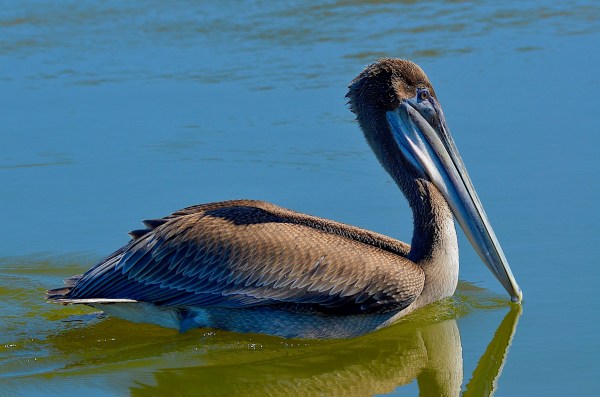
Young Brown Pelican (L. Loeher 7-22-18)
Parking was jammed on Pacific Coast Highway and in the park’s car lot, an early indication that we were part way through yet another week – or longer – of triple-digit temperatures. The beach was crowded; surfers covered what few waves leisurely rolled in. At 11am our car claimed it was only 79° but it felt hotter. A half-hour later it was 104° as we crept through Woodland Hills in the San Fernando Valley. But enough about global warming.
About 40 people showed up for the 8:30am walk and another 30 for the 10am parents and kids walk. Several were new to birding. This is a good trip for new birders because: we take our time, we loan binoculars, free checklist!, ask all the questions you want, short walking distance, nice views, most of the birds (ducks, waders, shorebirds) don’t move quickly and you can get a good look even while you fiddle with your binoculars. And you can quit birding and go swimming whenever you want.
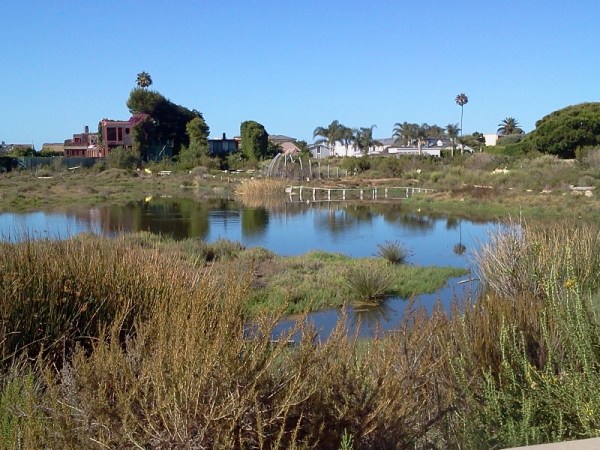
View across channel to picnic area and colony (L. Johnson 7-22-18)
Just as we were getting started, thirty Red-winged Blackbirds dropped into the reed bed next to us. A wide variety of plumages were noted.
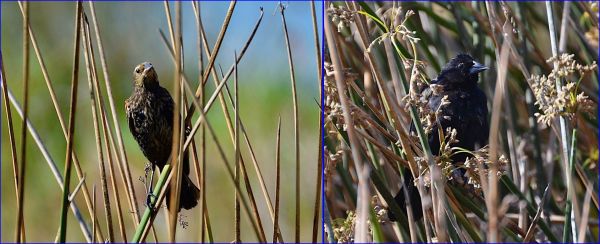
Red-winged Blackbirds (G. Murayama 7-22-18)
The mighty Mullet still roam the depths of the lagoon, jumping often enough to keep themselves (and us) amused. There were few ducks on the water, just several families composed mostly of young ducklings of various sizes. A single coot was present; in June there weren’t any, so we could say their population increased infinitely. But we won’t.
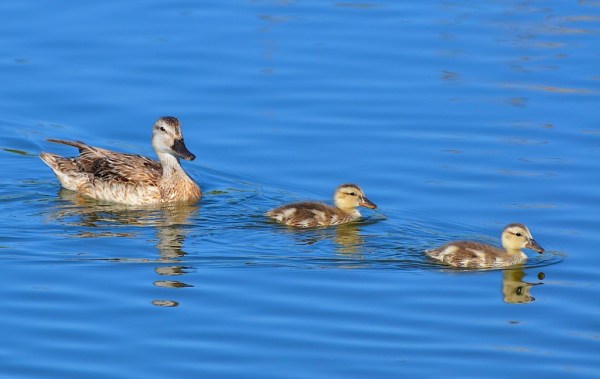
Gadwall family (L. Loeher 7-22-18)
Many Black-bellied Plovers still had black, or partially black, bellies. They looked tired, rarely moving. They’d probably just flown a long distance. They nest in the high Arctic from northwestern Alaska through the Canadian archipelago. Many fly to southern South America for the winter, but there are always several dozen at the lagoon on any winter’s day.
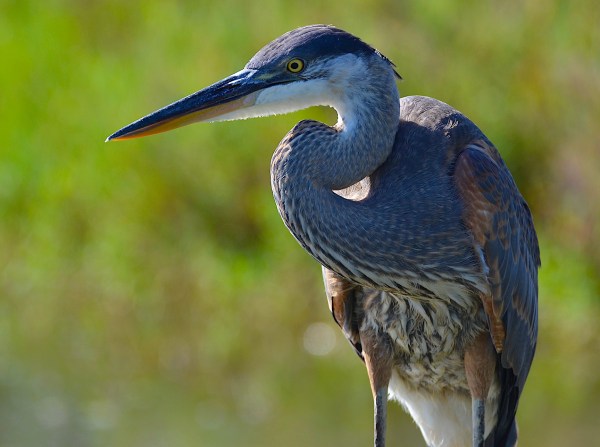
Great Blue Heron (L. Loeher 7-22-18)
Below is the most recent aerial photo of the lagoon I could find. The view is from above Santa Monica Bay, looking due north. Taken only four months after the dedication of the reconfigured lagoon, it shows a lot of brown algae floating on the water’s surface. Before the reconfiguration such algae was a common phenomenon during warm months, and the air often smelled of its rot. My recollection is that little algae appeared in 2014, and we have seen very little or none of it at all during the past four summers. In my opinion, its absence is an indication that the lagoon water quality has improved, and the reconfiguration was, in this regard, successful. Sorry to say, I did not properly document its presence or absence following the reconfiguration.

Malibu Lagoon, Sept. 29, 2013 (CaliforniaCoastline.Org)
In the foreground is the western 1/3rd of Surfrider Beach, famed in film and song. At low tides many rocky areas are exposed, good for tide-pool exploration. The extreme eastern end of Malibu Colony residential area is in the lower left. The beach end of the footpath from the parking lot curves around it. Right of the path-end is a then-denuded low hill, with the 2nd viewing point just behind it. This hill is now covered with vegetation, as are the sandy islands and the northern side of of the lagoon. The green area in upper left corner is a tiny portion of a small private golf course, with the parking and meeting areas just to its right. Another viewing area lies on the south point of then-bare land just west of the Pacific Coast Highway (PCH) bridge over Malibu Creek/Malibu Lagoon. A shopping center lies north of PCH and west of the creek. The Adamson House property, mostly out-of-view, lies east of the lagoon, south of PCH.
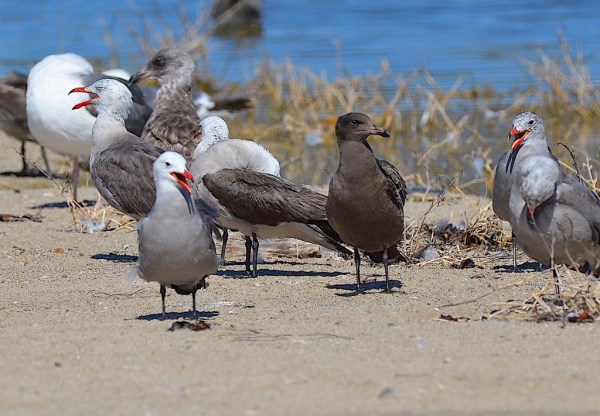
Heermann’s Gulls, juvenile on right (L. Loeher 7-22-18)
Heermann’s Gulls are one of the few species who travel north after breeding. Well, some of them do. They breed early on Isla de la Rasa in the Sea of Cortez, spread out in their post-breeding dispersal, and can be found in diminishing numbers as far north as Seattle. They’ve suffered immense nesting failures in recent years, so we attempt to note the presence of sub-adult birds on our beaches. The picture above shows a juvenile bird, born this spring, with a slightly pale base to the dark bill and chocolate-brown plumage with pale scalloped markings barely visible on its shoulders. Below is a 2nd-year bird, now mostly gray, with bright red on the base of the bill. Heermann’s Gulls are “four-year” gulls; they take four years to reach their adult plumage and breeding age.
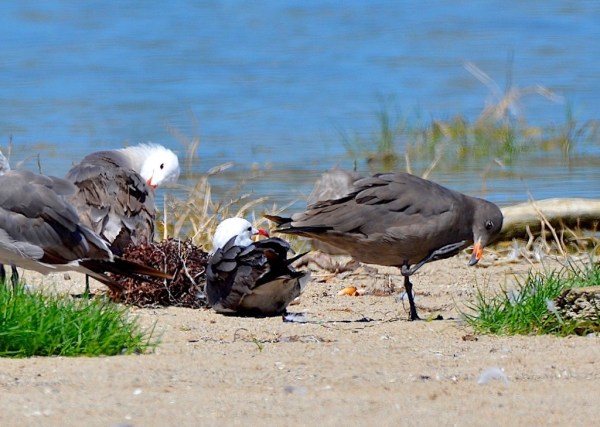
Heermann’s Gulls, 2nd year bird on right (L. Loeher 7-22-18)
The Hooded Orioles were finally seen by nearly everyone. They were in the trees and climbing Bougainvillea bush at the edge of Malibu Colony above the picnic area, which I suspect is where they nested. I’m sure they’ve been there for months but I (for one) kept missing them.

Whimbrel assortment – striped heads and decurved bills (L. Loeher 7-22-18)
Nearby, resting very quietly, was a Black-crowned Night-Heron. There are eight species of Night-Herons (including the Boat-billed Heron of Central & South America) and they all have several obvious features in common: squat and chunky build, large eyes, and daytime roosting out-of-sight in tree canopy or reed bed. Their large eyes are better adapted to darkness than the smaller eyes of the rest of the herons and egrets. They are more crepuscular-herons than night-herons, preferring to feed during the twilight of dawn and dusk. Black-crowned Night-Heron has a nearly worldwide distribution: southern Canada to Tierra del Fuego, Eurasia, Africa, and Indonesia. The ranges of the seven other species are more limited. The White-eared Night-Heron is the most restricted, living only on Hainan Island and adjacent southeastern China.
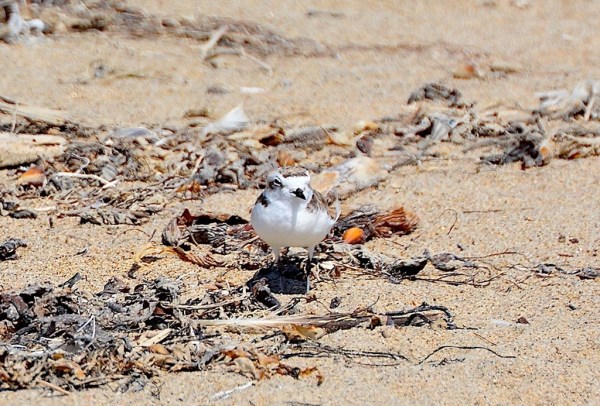
Western Snowy Plover (G. Murayama 7-22-18)
Our Western Snowy Plovers now number nine (thanks to SNPL mavens Grace Murayama and Larry Loeher). Nesting season appears to now be over, and we could find no banded birds among them. As you will note from the trip list below, their numbers are rising from three birds in May and four in June, counts which included recently-hatched birds.
Birds new for the season were: Allen’s Hummingbird, Black-crowned Night-Heron, American Robin, European Starling, Hooded Oriole.
Many thanks to our photographers: Lillian Johnson, Larry Loeher & Grace Murayama.

Song Sparrow at work
(Larry Loeher 5-27-18)
Our next two scheduled field trips: Malibu Lagoon 8:30 & 10am, 22 July; Malibu Lagoon 8:30 & 10am, 26 August.
Our next program: Luke Tiller will present “Tails from the Platform: Hawks, Hawkwatchers and Hawkwatching”: Tuesday, 2 October, 7:30 p.m., Chris Reed Park, 1133 7th St., NE corner of 7th and Wilshire Blvd. in Santa Monica.
NOTE: Our 10 a.m. Parent’s & Kids Birdwalk meets at the shaded viewpoint just south of the parking area. Watch for Willie the Weasel. He’ll be watching for you and your big floppy feet.
Links: Unusual birds at Malibu Lagoon
9/23/02 Aerial photo of Malibu Lagoon
Prior checklists:
2017: Jan-June, July-Dec 2018: Jan-June
2016: Jan-June, July-Dec 2015: Jan-May, July-Dec
2014: Jan-July, July-Dec 2013: Jan-June, July-Dec
2012: Jan-June, July -Dec 2011: Jan-June, July-Dec
2010: Jan-June, July-Dec 2009: Jan-June, July-Dec.
The 10-year comparison summaries created during the project period, despite numerous complaints, remain available on our Lagoon Project Bird Census Page. Very briefly summarized, the results unexpectedly indicate that avian species diversification and numbers improved slightly during the period Jun’12-June’14.
Many thanks to Lillian Johnson, and Chris Lord for their contributions to the checklist below. [Chuck Almdale]
| Malibu Census 2018 | 2/25 | 3/25 | 4/22 | 5/27 | 6/24 | 7/22 |
| Temperature | 55-62 | 55-62 | 63-67 | 61-66 | 62-68 | 70-79 |
| Tide Lo/Hi Height | H+5.21 | L-.16 | L-.15 | H+3.86 | H+3.50 | H+3.31 |
| Tide Time | 0459 | 1213 | 1028 | 0912 | 0826 | 0733 |
| Northern Shoveler | 2 | |||||
| Gadwall | 8 | 12 | 5 | 12 | 4 | 15 |
| American Wigeon | 4 | 8 | ||||
| Mallard | 6 | 12 | 4 | 15 | 12 | 12 |
| Northern Pintail | 1 | |||||
| Green-winged Teal | 1 | 6 | ||||
| Bufflehead | 8 | 1 | ||||
| Red-breasted Merganser | 4 | 6 | ||||
| Ruddy Duck | 9 | 4 | ||||
| Pied-billed Grebe | 2 | 1 | 2 | |||
| Western Grebe | 25 | |||||
| Rock Pigeon | 8 | 10 | 1 | 3 | 2 | 6 |
| Eurasian Collared-Dove | 1 | 2 | ||||
| Mourning Dove | 2 | 4 | 1 | 2 | 2 | |
| Anna’s Hummingbird | 1 | 1 | 1 | |||
| Allen’s Hummingbird | 1 | 2 | 3 | 1 | ||
| Sora | 1 | |||||
| American Coot | 85 | 75 | 2 | 4 | 1 | |
| Black-bellied Plover | 25 | 10 | 9 | 1 | 17 | |
| Snowy Plover | 34 | 12 | 9 | 3 | 4 | 9 |
| Semipalmated Plover | 4 | |||||
| Killdeer | 10 | 12 | 7 | 4 | 8 | 8 |
| Whimbrel | 13 | 9 | 3 | 6 | 3 | 113 |
| Marbled Godwit | 30 | 7 | 30 | |||
| Ruddy Turnstone | 6 | 1 | ||||
| Sanderling | 20 | 20 | 45 | 7 | ||
| Least Sandpiper | 3 | 1 | 12 | |||
| Western Sandpiper | 10 | 4 | ||||
| Willet | 14 | 6 | 6 | 4 | 18 | 2 |
| Bonaparte’s Gull | 2 | |||||
| Heermann’s Gull | 3 | 1 | 5 | 28 | ||
| Ring-billed Gull | 70 | 10 | 1 | |||
| Western Gull | 92 | 120 | 18 | 112 | 75 | 95 |
| California Gull | 550 | 20 | 4 | 2 | ||
| Glaucous-winged Gull | 3 | |||||
| Least Tern | 9 | 2 | ||||
| Caspian Tern | 2 | 8 | 11 | 4 | 1 | |
| Forster’s Tern | 2 | |||||
| Royal Tern | 15 | 17 | 2 | 1 | ||
| Elegant Tern | 3 | 30 | 130 | 4 | 11 | |
| Black Skimmer | 1 | |||||
| Pacific Loon | 1 | 3 | ||||
| Brandt’s Cormorant | 1 | 1 | 7 | |||
| Double-crested Cormorant | 37 | 27 | 18 | 15 | 7 | 16 |
| Pelagic Cormorant | 2 | 3 | ||||
| Brown Pelican | 14 | 37 | 32 | 68 | 5 | 5 |
| Great Blue Heron | 1 | 2 | 1 | 1 | 2 | 3 |
| Great Egret | 3 | 2 | 3 | 3 | 3 | |
| Snowy Egret | 8 | 6 | 1 | 4 | 5 | 10 |
| Green Heron | 1 | |||||
| Black-crowned Night-Heron | 4 | 2 | 1 | |||
| Turkey Vulture | 1 | 4 | ||||
| Osprey | 1 | 1 | ||||
| Red-tailed Hawk | 1 | |||||
| Merlin | 1 | |||||
| Peregrine Falcon | 1 | |||||
| Nanday Parakeet | 4 | 4 | ||||
| Black Phoebe | 1 | 4 | 1 | 2 | 3 | |
| Say’s Phoebe | 3 | |||||
| Cassin’s Kingbird | 1 | |||||
| Western Kingbird | 2 | |||||
| American Crow | 5 | 4 | 2 | 2 | 4 | 4 |
| Common Raven | 2 | |||||
| Tree Swallow | 3 | |||||
| Violet-green Swallow | 6 | 2 | ||||
| Rough-winged Swallow | 3 | 5 | 1 | |||
| Cliff Swallow | 5 | 8 | 1 | 3 | ||
| Barn Swallow | 15 | 4 | 10 | 15 | 25 | |
| Oak Titmouse | 1 | |||||
| Bushtit | 35 | 6 | 1 | 20 | 27 | 60 |
| Marsh Wren | 2 | 2 | ||||
| Bewick’s Wren | 2 | |||||
| Blue-gray Gnatcatcher | 6 | 2 | ||||
| Western Bluebird | 1 | |||||
| American Robin | 1 | |||||
| Northern Mockingbird | 1 | 3 | 2 | 2 | 2 | 2 |
| European Starling | 10 | 23 | 13 | |||
| House Finch | 8 | 24 | 4 | 5 | 8 | |
| Lesser Goldfinch | 8 | 2 | ||||
| Spotted Towhee | 2 | |||||
| California Towhee | 2 | 1 | 2 | 1 | ||
| Savannah Sparrow | 1 | 2 | 1 | |||
| Song Sparrow | 5 | 2 | 10 | 5 | 5 | 2 |
| White-crowned Sparrow | 25 | 28 | ||||
| Dark-eyed Junco | 2 | |||||
| Western Meadowlark | 4 | |||||
| Hooded Oriole | 4 | |||||
| Red-winged Blackbird | 15 | 1 | 7 | 30 | ||
| Brown-headed Cowbird | 2 | 2 | ||||
| Brewer’s Blackbird | 1 | |||||
| Great-tailed Grackle | 2 | 15 | 4 | 4 | 3 | 4 |
| Orange-crowned Warbler | 1 | 3 | 1 | |||
| Common Yellowthroat | 4 | 2 | 1 | |||
| Yellow-rumped(Aud) Warbler | 20 | 12 | ||||
| Wilson’s Warbler | 1 | |||||
| Totals by Type | Feb | Mar | Apr | May | Jun | Jul |
| Waterfowl | 40 | 52 | 9 | 27 | 16 | 27 |
| Water Birds – Other | 142 | 172 | 52 | 88 | 21 | 22 |
| Herons, Egrets & Ibis | 12 | 14 | 4 | 9 | 10 | 17 |
| Quail & Raptors | 2 | 2 | 0 | 5 | 1 | 0 |
| Shorebirds | 155 | 88 | 90 | 56 | 41 | 149 |
| Gulls & Terns | 727 | 179 | 57 | 269 | 95 | 137 |
| Doves | 10 | 15 | 3 | 4 | 4 | 8 |
| Other Non-Passerines | 6 | 6 | 3 | 1 | 1 | 1 |
| Passerines | 146 | 189 | 37 | 66 | 69 | 161 |
| Totals Birds | 1240 | 717 | 255 | 525 | 258 | 522 |
| Total Species | Feb | Mar | Apr | May | Jun | Jul |
| Waterfowl | 7 | 9 | 2 | 2 | 2 | 2 |
| Water Birds – Other | 7 | 8 | 3 | 4 | 4 | 3 |
| Herons, Egrets & Ibis | 3 | 4 | 3 | 4 | 3 | 4 |
| Quail & Raptors | 2 | 2 | 0 | 2 | 1 | 0 |
| Shorebirds | 9 | 10 | 8 | 6 | 6 | 5 |
| Gulls & Terns | 4 | 9 | 4 | 8 | 7 | 5 |
| Doves | 2 | 3 | 2 | 2 | 2 | 2 |
| Other Non-Passerines | 3 | 2 | 1 | 1 | 1 | 1 |
| Passerines | 21 | 27 | 15 | 12 | 11 | 15 |
| Totals Species – 95 | 58 | 74 | 38 | 41 | 37 | 37 |
Your Biological Clock at Work | PBS BrainCraft Video
This sleep cycle is a good average: your circadian rhythm can shift somewhat depending on your sleep/wake schedule. If you wake consistently at 9 am, then your blood pressure with go up closer to 8:45 am and everything else will be shifted as well. It’s tied to sunlight A LOT but since we have artificial light, there’s wiggle room within that.
This is an installment of the PBS – BrainCraft series. If no film or link appears in this email, go to the blog to view it by clicking on the blog title above. If the film stops & starts in an annoying manner, press pause (lower left double bars ||) to let it buffer and get ahead of you. [Chuck Almdale]
Addendum – Genetic Testing Goes Mainstream
Among the readership responses and inquiries to our 7/11/18 post Genetic Testing Goes Mainstream, was this one from G. Moriarty:
Thanks for this very useful guide to some genetic testing options. One aspect that is not addressed is the security of the information garnered. Are there privacy considerations to be aware of?
I thought this an excellent question but had no answer. I just discovered that Science News has two additional articles (and probably more) addressing this issue, published online only. They are listed below and I have now added them to the original posting. [Chuck Almdale]
Privacy and Consumer Genetic Testing Don’t Always Mix
Protections are spotty at best and vary by testing company.
Writer: Cassie Martin
Published online by Science News 6/5/18
Why Using Genetic Genealogy to Solve Crimes Could Pose Problems
Some worry that authorities could violate people’s rights using the method.
Writer: Tina Hesman Saey
Published online by Science News 6/7/18
In Memoriam: Keith Axelson – your comments welcome

Our original Sanderling logo.
Lu Plauzoles writes: I think we should remember that he was birding at Malibu Lagoon on the regular SM Bay Audubon walk on August 27th, just 2 weeks before his passing. I was leading, since Chuck Almdale was out of town and I was surprised to see Keith, albeit a bit diminished from his usual rambunctious self. He was staying at Mary’s, which was no exceptional event, even though we’d heard from her that he was having some “physical challenges.” He was still asking why people in the group had not come up recently to Sageland, his ranch near Onyx.
We of the SMBAS ilk will carry his clean, inspired chapter logo of the Sanderling into the future. May we all be birding our home patch 2 weeks before we fade/fly off away!

Not Telescope Peak, possibly Butterbredt Peak. Certainly high up somewhere.
Andrew Nawrocky writes: It was nice talking with you today and reminiscing about Keith. Yes, he was unique, and in some ways influenced all of us.
He was active almost to the very end. Even at his more advanced age he showed a lot of energy and stamina. In June of 2008, Keith at age 83, climbed Telescope Peak with me. As you know, it’s the highest point within Death Valley Park at 11,049 feet of elevation. No easy task. He was very proud of that achievement, as he should have been. As if to mark that event, there was a Golden Eagle soaring above us.



 SANTA MONICA BAY AUDUBON SOCIETY BLOG