Free email delivery
Please sign up for email delivery in the subscription area to the right.
No salesman will call, at least not from us. Maybe from someone else.
Sure, the female black widow has a terrible reputation. But who’s the real victim here? Her male counterpart is a total jerk — and might just be getting what he deserves
This is another installment of the PBS Deep Look series; this installment is adapted from the “It’s OK to be Smart” series. If no film or link appears in this email, go to the blog to view it by clicking on the blog title above. If the film stops & starts in an annoying manner, press pause (lower left double bars ||) to let it buffer and get ahead of you.
After viewing this video, follow the new link which will appear over to “It’s OK to be Smart” for even more fascinating information on slime molds. [Chuck Almdale]
Sepulveda Basin Field Trip, 3/10/2018
It was a hearty band of birders that braved the rain forecast, but somehow we got a window of 3 hours and suffered only a few drizzles.
The Gray Flycatcher did not show, possibly discouraged by the crowd of archers so near its favorite tree. We also had only one raptor fly by too quickly to i.d. There were Canada Geese all over the lawns, so one had to step carefully. Things got better at the lake where we found many American White Pelicans and Mallards. Apart from the Mallards there was only one other species of native duck – a lone male Hooded Merganser. Surprising.

[American White Pelican – Chuck Bragg]
There were the usual suspects – Yellow-rumps, wrens, sparrows and towhees.

[Song Sparrow – Grace Murayama]

[Spotted Towhee – Grace Murayama]
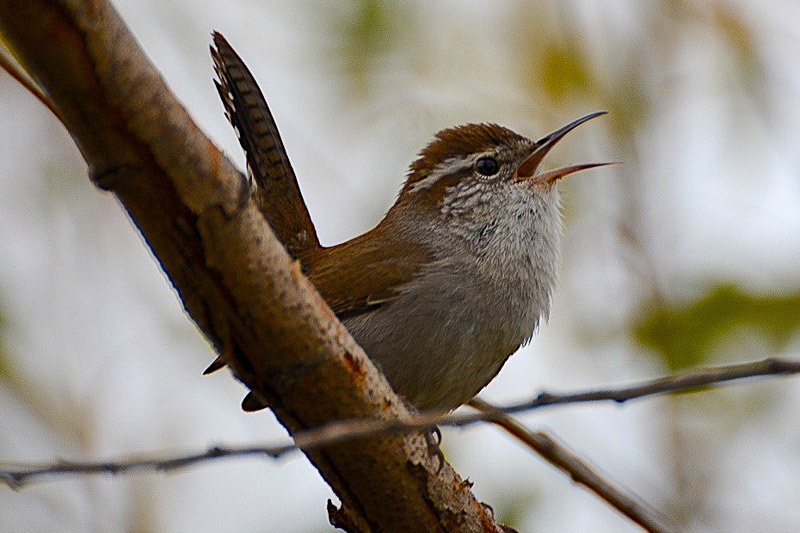
[Bewick’s Wren – Grace Murayama]
We found a nuclear family of Muscovy Ducks – there was one offspring (we think – it was huge). Note the difference between the adult (top) and juvenile concerning the carbuncle-like wattles on the head.
Muscovies originated in Mexico, Central and South America. Feral populations can be found as far north as Canada. The ones we saw are probably from domesticated stock.


[Muscovy Ducks – Grace Murayama]
The truly spectacular sightings of the day were swallows and hummingbirds. Down at the end of the lake we found several hundred Tree Swallows (and some Violet-greens) madly circulating between the lake and an underpass with a creek running through it. We didn’t see any insect swarms, but there must have been something. Ten minutes after we got there the swallows had dispersed. A mystery.
The hummingbirds were more obliging. There were both Allen’s and Anna’s, and also an obvious Rufous male (all red back). The Rufous was not a good photographic subject, staying low and dodging around in the undergrowth. The other two posed for us every 100 feet or so, giving us several opportunities for great looks.
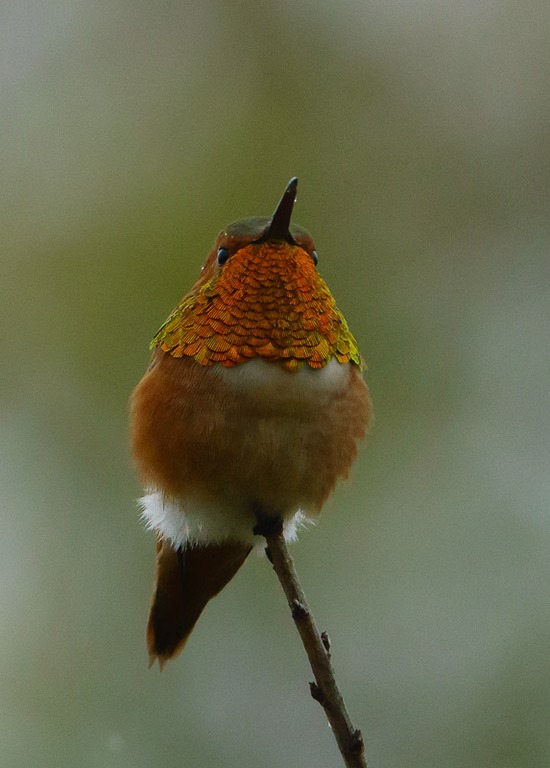
[Allen’s Hummingbird – Chuck Bragg]
We all know that when we watch hummingbirds while the sun is out the colors come and go as the bird turns, or as we move to different angles. This is because hummingbird colors are almost always iridescent – meaning they refract light like a prism. The feathers themselves have black pigments but are structured in different ways to refract different colors. It’s all a trick of the light and the intensity of the color depends on the angle and intensity of the light source. When you get the male Allen’s Hummingbird in bright sunlight and at the right angle, the throat can look like it’s on fire. The photo above was taken on a very cloudy day. In fact, you can see tiny raindrops on the bill and head. You can also see the entire gorget (throat feathers) in color. But there’s no sun, you say. How is this possible?
The answer is that on an overcast day the light is coming from all over, reflected through the clouds. Yes, it’s less light, but it is no long a point source. Therefore you get some light from every angle, and that shows us the colors of all the feathers, albeit subdued. With the sun out you get more intense color but only from the feathers properly oriented to the sun.
So, if you are thinking of staying home on a cloudy day, rethink! The lowly California Scrub Jay’s blue feathers are iridescent, for instance. Would the blue feathers look more blue on an overcast day? Or would more feathers look blue? Let us know.

[Anna’s Hummingbird – Chuck Bragg]
A word about the Anna’s Hummingbird above. The lower mandible is obviously misshapen; whether it is a birth defect or the result of a fight or accident we don’t know. The important thing is that this is an adult male, so the bill has not kept him from getting enough calories. Those narrow trumpet-shaped flowers, like wild tobacco or golden currant, could be problematic. But there he is!
Thanks to Grace for her photos, and for trying valiantly to nab the Rufous Hummingbird. Thanks to Becky and Dan for helping us find the trails. Thanks to those who persevered in the face of rain.
When we added up the list, we got 44 species! Not bad for 3 hours in threatening weather. Sepulveda should be even better in a month or so as the migrants begin coming through and everyone puts on their spring clothing.
The List: Pied-billed Grebe, Double-crested Cormorant, American White Pelican, Canada Goose, Egyptian Goose, Muscovy Duck, Mallard, Hooded Merganser, Great Blue Heron, Great Egret, Green Heron, Black-crowned Night-Heron, Turkey Vulture, Osprey, American Coot, Mourning Dove, Anna’s Hummingbird, Rufous Hummingbird, Allen’s Hummingbird, Belted Kingfisher, Nuttall’s Woodpecker, Downy Woodpecker, Black Phoebe, Cassin’s Kingbird, American Crow, Western Bluebird, House Wren, Blue-gray Gnatcatcher, Bushtit, Tree Swallow, Violet-green Swallow, Northern Rough-winged Swallow, Lesser Goldfinch, House Finch, Orange-crowned Warbler, Yellow-rumped Warbler, Common Yellowthroat, Song Sparrow, White-crowned Sparrow, Lark Sparrow, Spotted Towhee, California Towhee, Red-winged Blackbird, Great-tailed Grackle.
At NHMLA, our scientists go out into the field to observe and collect specimens for the museum, around the world and right here in Los Angeles. Field work is amazing, but it can also be dangerous and full of surprises. NHMLA curators share their stories of police encounters, volcanoes, malaria, flipped vehicles, and an unexpected sighting of rare chocolate snails.
This comes from the Natural History Museum of Los Angeles County. If no film or link appears in this email, go to the blog to view it by clicking on the blog title above. If the film stops & starts in an annoying manner, press pause (lower left double bars ||) to let it buffer and get ahead of you. [Chuck Almdale]
The head wires of the King-of-Saxony are unlike any other feathers in the world. They’ve lost their normal feather structure and become a conspicuously awkward ornament. It may seem difficult to explain the evolution of head wires by the process of natural selection. In fact, they’ve evolved because of sexual selection—an extreme example of female mate choice affecting basic anatomy. Filmed and photographed by Tim Laman.
There are currently seventy-two short films in the entire Birds-of-Paradise Project playlist, ranging from 26 seconds to 8:29. In the upcoming weeks, we will present some of our favorites.
A film from the Cornell Lab of Ornithology. If no film or link appears in this email, go to the blog to view it by clicking on the blog title above. If the film stops & starts in an annoying manner, press pause (lower left double bars ||) to let it buffer and get ahead of you. [Chuck Almdale]
For Pacific Mole Crabs It’s Dig or Die | Deep Look Video
Pacific mole crabs, also known as sand crabs, make their living just under the surface of the sand, where they’re safe from breaking waves and hungry birds. Some very special physics help them dig with astonishing speed.
This is another installment of the PBS Deep Look series; this installment is adapted from the “It’s OK to be Smart” series. If no film or link appears in this email, go to the blog to view it by clicking on the blog title above. If the film stops & starts in an annoying manner, press pause (lower left double bars ||) to let it buffer and get ahead of you.
After viewing this video, follow the new link which will appear over to “It’s OK to be Smart” for even more fascinating information on slime molds. [Chuck Almdale]



 SANTA MONICA BAY AUDUBON SOCIETY BLOG