Free email delivery
Please sign up for email delivery in the subscription area to the right.
No salesman will call, at least not from us. Maybe from someone else.
Online Resource: Bird Skulls at SkullSite.org
As with feathers, we frequently find bird skulls and other bones on the ground. A moderately-experienced birder should be able to figure out what phylogenetic order or family of birds it belongs to, but getting down to species can be tough, or impossible, without a big collection of bones to which you can refer.
Here’s where SkullSite.org http://skullsite.com/ steps in.
With over 1600 species of birds on display, you’ll have a chance of identifying that skull, assuming you don’t get distracted by all the other interesting things they offer, such as the Order & Family Overview and How to Clean a Skull (essential information in today’s hurly-burly world).
Even if you’re not trying to identify a particular skull, the site is easy to navigate, informative and fun.
There’s a small selection (more to come!) of 3-D views of complete skeletons. These you can rotate through 360°.

Two views of Parrot Crossbill (Loxia pytyopsittacus) skeleton
There’s another small selection of 3-D skulls.
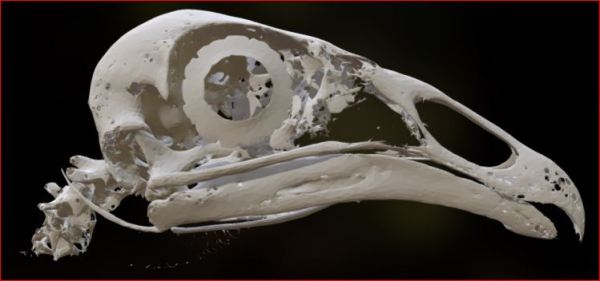
Coragyps atratus (Black Vulture)
These can be rotated to any angle (not just 360°) and zoomed in. The view below is downward from above the vulture’s left eye socket. You can download these skulls onto your 3-D printer (What! You don’t have one? Maybe your local school does.) to create your very own plastic skull replica.

Zoomed-in view from above Black Vulture’s left eye socket.
Skull searches can be done in various ways: common or scientific name, bill length (7 options), bill type (10 options), or by narrowing down through the phylogeny tree.
This last option may be the easiest for most people if they’re looking for a particular species. For example, you get to to American Crow via Passerformes > Corviidae, then scroll down to Corvus brachyrhynchos (American Crow). Each intermediate step lists all or most of the kinds of birds one might find. Click on the bird’s name and a secondary page appears with additional information such as dimensions), links and views of the skull(s) from different angles.
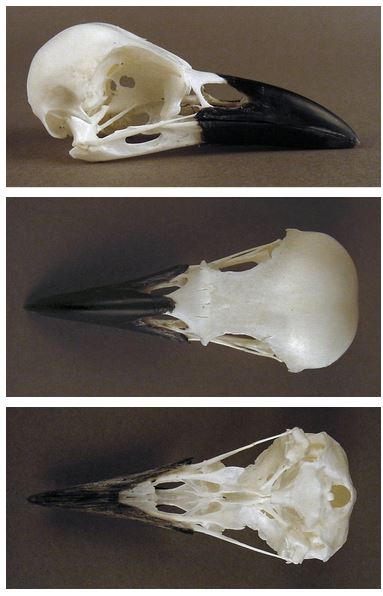
Corvus brachyrhynchos (American Crow) three views of the skull
One caveat: the museum is located in the Netherlands, so they are certainly not biased towards birds found only in North America.
I’ll leave you with one more skull view set, this time of the Sora (Porzana carolina) such as the one we spotted during our Malibu Lagoon bird walk in February. I hope you check out the site, which is an ever-growing work-in-progress, and enjoy what you see. [Chuck Almdale]

Porzana carolina (Sora) skull views
Online Resource: The Feather Atlas
Found a feather you can’t identify?
OK, maybe you can’t identify any feather, beyond saying, “It’s quite likely to be from a bird.” No matter.
Go to the Feather Atlas at: http://www.fws.gov/lab/featheratlas/index.php.
Keep in mind that the Migratory Bird Treaty Act makes it illegal to possess any feather, even if you found it by the roadside. Exceptions do exist for legally hunted waterfowl and other migratory “gamebirds.” (I suppose “gamebird” refers to wild chicken-like birds such as pheasant, grouse, quail, or ptarmigan, not to the denizens of darkened gambling casinos.)
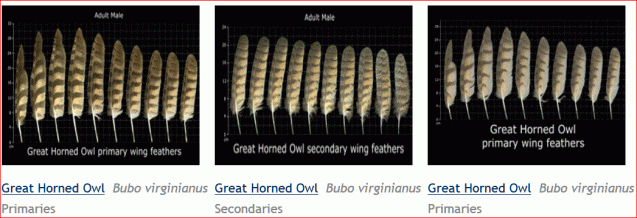
There you will find umpteen thousand photos of feathers. You can search through them by basic patterns – mottled, spotted, barred, dark tip, colorful iridescence, etc. Then add basic color – brown, white, black & white, green, etc. It then takes you to the similar feathers. All feathers displayed are flight feathers from wing or tail. There are no little body feathers. Top (or outer) sides are displayed as they have the important patterns; occasionally an underside is displayed.
Feathers displayed are all from the right side of the body, which you can tell because if they curve, they curve clockwise from base to tip (see photos below). If your feather curves counter-clockwise, it’s from the left side. The feathers are displayed against a scale measured in centimeters – essential information. If your 20-centimeter feather looks just like one that’s 14-centimeter, it’s not a match. Keep looking. Depending on what you’re looking for, you might get only a few similar feathers, or many hundreds.
Here’s some samples.
From “Barred” + “Brown”
From “Dark Tip” + “Black & White”
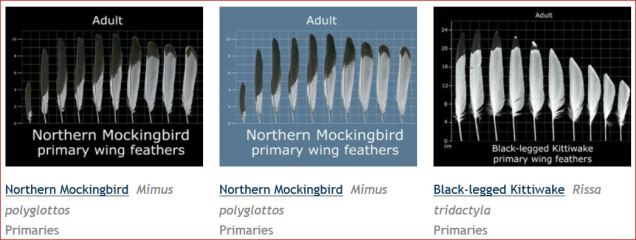
For those of us who don’t happen to have a large collection of stuffed and expertly-identified birds stashed in the back room, this can be a handy tool. So far, it’s U.S. birds only.
There’s tons of other information on the site. Have fun! [Chuck Almdale]
What a Tooth Reveals About Autism | PBS BrainCraft Video
About one percent of all people have Autism Spectrum Disorder, and their brain neurons can have fewer synapses, discovered by tinkering with tooth pulp cells. Drugs can be developed to make the neurons develop more synapses.
This is an installment of the PBS – BrainCraft series. If no film or link appears in this email, go to the blog to view it by clicking on the blog title above. If the film stops & starts in an annoying manner, press pause (lower left double bars ||) to let it buffer and get ahead of you. [Chuck Almdale]
With rows of Dr. Seuss-like flowers hidden deep inside, the corpse flower plays dead to lure some unusual pollinators.
This is another installment of the PBS Deep Look series; this installment is adapted from the “It’s OK to be Smart” series. If no film or link appears in this email, go to the blog to view it by clicking on the blog title above. If the film stops & starts in an annoying manner, press pause (lower left double bars ||) to let it buffer and get ahead of you.
After viewing this video, follow the new link which will appear over to “It’s OK to be Smart” for even more fascinating information on slime molds. [Chuck Almdale]
Winter’s Icy Blasts Chills Birds and Birders Alike: Malibu Lagoon, 25 February, 2018
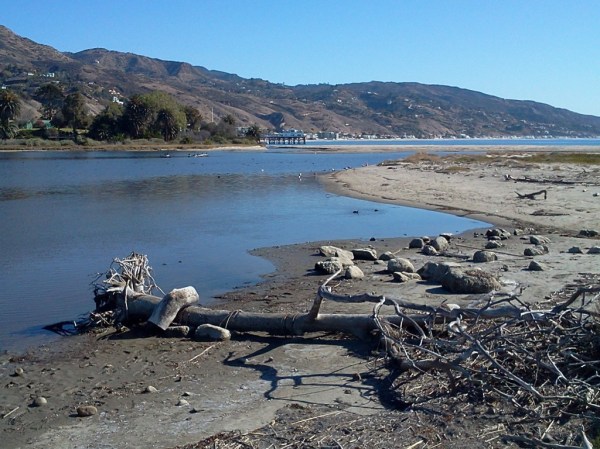
Looking eastward along south edge of lagoon, Malibu Pier in distance
(L. Johnson 2-25-18)
No more of this nonsense about nice weather! Unlike January when temperatures spent far too much time above 80°, February was relatively normal for the season of Mudslide (our equivalent of Winter). We even had several inches of rain during the days following our walk, depending on where you lived, of course. Coastal ranges, such as our Santa Monica Mountains, might get 4” of rain, while downtown L.A. gets ½”. So it goes. On Birdwalk Sunday temperatures ranged 55-62°F, 8:30 AM to 11 AM. The locals braced for this plunge into the icebox by wearing the usual earflapped hats, down jacket over down vest over flannel shirt over thermal T-shirt, thermal pants and mukluk-style furry boots. You know, the bare minimum for inclement weather of this magnitude.
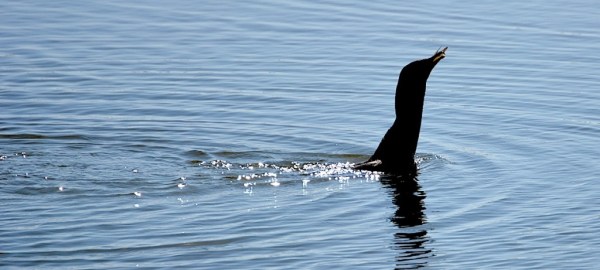
Double-crested Cormorant struggles to swallow a fish (G. Murayama 2-25-18)
It seemed the ducks knew the horrors weather had in store for us, as only 40 were present, down from January’s 109. Coots, cormorants and gulls dropped as well. In fact, we had only 54% of January’s total (see numbers in chart below). Total species present was also down.
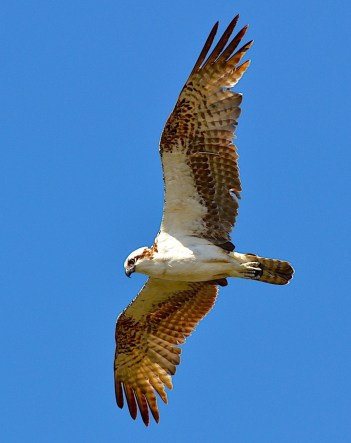
Osprey (Larry Loeher 2-25-18)
The Osprey was there and is now on the verge of becoming an expected resident. It was spotted, in fact, carrying what looked like sticks (aka nesting material!) towards the Malibu Colony a bit to the west of the lagoon. Tall trees of eucalyptus and cypress are fairly common in the Malibu area. Considering the number of jumping mullet we see, the lagoon could probably support an Osprey pair through the nesting season. The only problem might be the lagoon breaches following rainstorms, which take a lot of water and undoubtedly some fish out of the lagoon and channels.
The Belding’s race of Savannah Sparrow used to be regular at the lagoon when we had pickleweed, as this subspecies reportedly will not nest where this plant is absent. Pickleweed has returned around much of the lagoon, and very occasionally a Belding’s Sparrow appears. The photo below was enlarged to the point of blurriness, but you can make out the bright yellow lores, bold breast stripes, dark fore-cap, dark line behind the eye and dark stripes on brown back. And for those wondering, the little reddish stem-ends where the plant concentrates salt are edible and do taste like pickles, even when they’re coated with dust. Don’t tell anyone I said so. But then, I love to eat durian (“The King of Fruits!” wrote Alfred Russel Wallace, co-formulator with Charles Darwin of the Theory of Evolution), so what do I know?
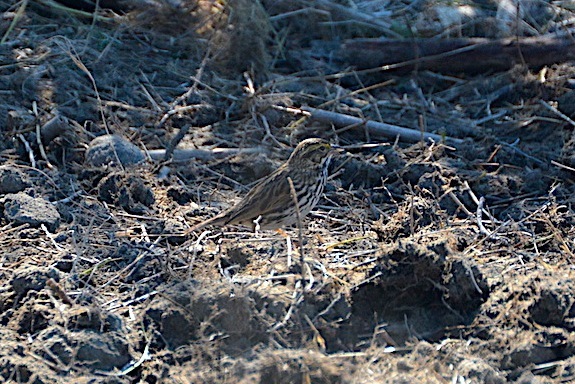
Belding’s Savannah Sparrow at edge of the brush (G. Murayama 2-25-18)
I didn’t put it on the list but we probably had a Sage Thrasher. Muriel Kotin heard an unfamiliar thrasher-song emanating from the brush around the parking lot, and Grace Murayama saw what looked like a “small roadrunner” shoot across the footpath to the beach. I’m guessing it was a Sage Thrasher: they’ve been widely reported around the area in all sorts of habitats over the past few weeks, a highly unusual event; while California Thrashers live just a bit inland, we’ve seen them at the lagoon only four times in 338 visits.
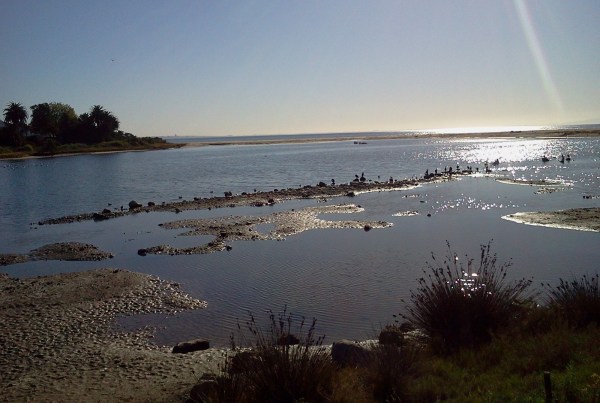
View from near PCH bridge towards southeast across Malibu lagoon
(Lillian Johnson 2-25-18)
Far more certain was the Sora, spotted by many and photo’d as it ran across the mudflat at the east end of the north channel, scooting from one patch of reeds to another.
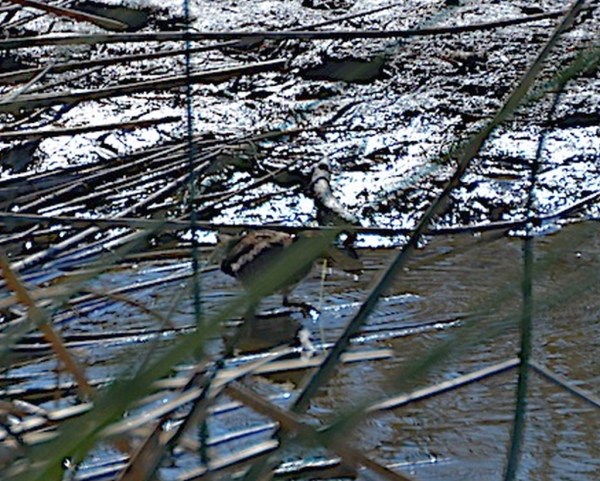
The Sora hoofs it towards the reeds (G. Murayama 2-25-18)
Before the June 2012 lagoon reconfiguration began, Sora were nearly year-round residents, but they left when their reedy habitat disappeared. Reeds slowly reappeared – completely unassisted by humans as far as I know – and migrating Soras stayed briefly during Nov-Dec 2015 and Oct. 2016. The reed beds continue to expand, and in a few more years the Soras may become more frequent and numerous.

Great Egret stalks a lizard in the parking lot
(Grace. Murayama 2-25-18)
Marsh Wrens, another reed obligate, have been slightly speedier about reintroducing themselves. There were 1-2 present Sep-Nov 2015, three years after the reconfiguration, singletons present Nov-Dec 2016, 2 in Sep. 2017, and 1-3 birds present Nov. 2017 through Feb. 2018.
Chapter board members, photographers, and Snowy Plover aficionados Larry Loeher and Grace Murayama patiently watched and re-re-re-recounted the wintering colony of these birds, and finally settled on 34 birds. One banded bird was seen. The birds were feisty, chasing one another from (human) footprint to footprint.
We found a Merlin – a small falcon – cleverly hiding on the tiptop of a cypress tree. It didn’t seem to be doing anything except resting. A couple passed by pushing a baby carriage. As they appeared curious as to why all these peculiar-looking people were staring intently at the top of a tree, I suggested they look through my telescope to see the bird. “Like a Peregrine Falcon, but smaller.” I offered. Always helpful, I added, “It’s called a Merlin, like Merlin the Magician.”
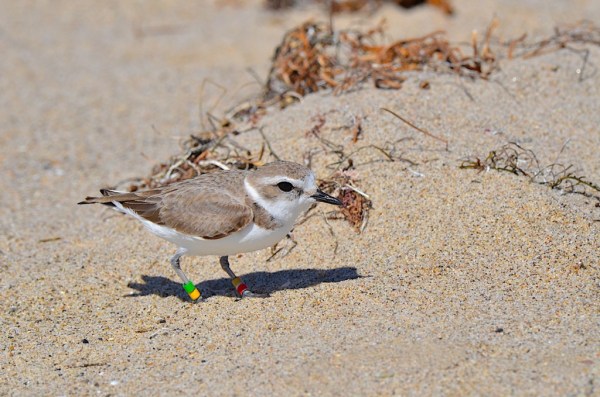
Snowy Plover banded NR-GY in 2017 at Vandenberg AFB (L. Loeher 2-25-18)
By 11 AM the tide was far out and several rocky reefs were exposed, attracting the gulls and larger shorebirds. Except for several small groups of Willets and Marbled Godwits who dropped into the lagoon, nearly all the birds were on the rocks. The Ruddy Turnstones, for example, were working the sea-washed rocks beyond the gull flocks, and the Royal Terns were strewn widely along the stony shore. While the birds were few, the kids on the family walk enjoyed the tide pools; one young man found an octopus with tentacles at least a foot long!!
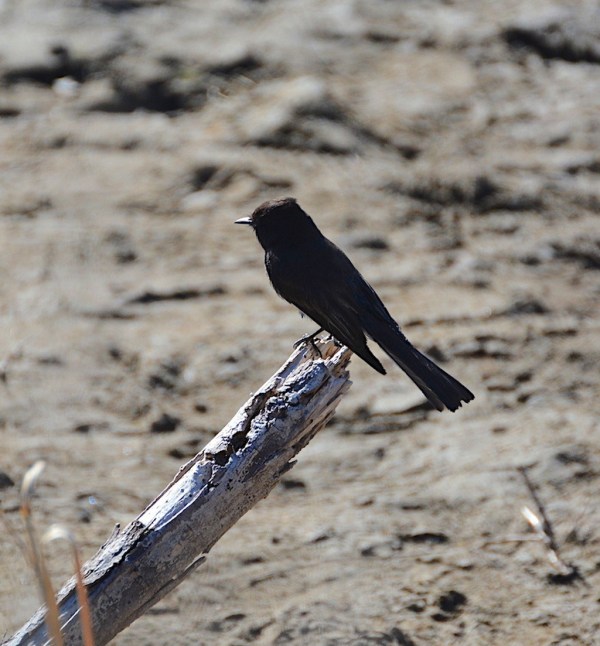
Black Phoebe shagging flies on the beach (G. Murayama 2-25-18)
Among the various passerines present, the Oak Titmouse was in the picnic area foliage near the colony, the Blue-gray Gnatcatchers were clustered into a group visiting the brush near the beach end of the footpath, and the White-crowned Sparrows and Yellow-rumped Warblers were all over the place. At trip’s end, as we were clambering into our car to leave, four Nanday Parakeets flew noisily by, heading towards the beach.
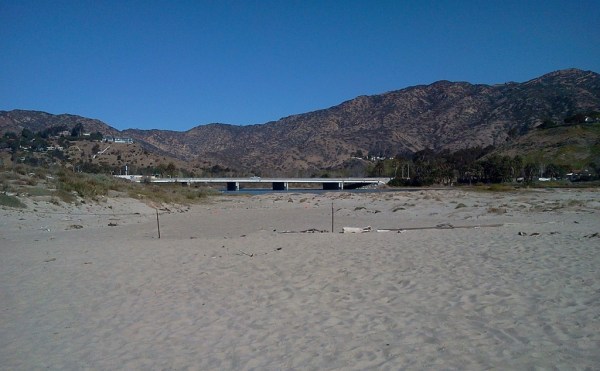
Looking north towards the PCH bridge, lots of sand between ocean and lagoon
(L. Johnson 2-25-18)
Birds new for the season were: Sora, Pelagic Cormorant, Nanday Parakeet, Oak Titmouse, Savannah Sparrow
Many thanks to our photographers: Lillian Johnson, Larry Loeher & Grace Murayama.
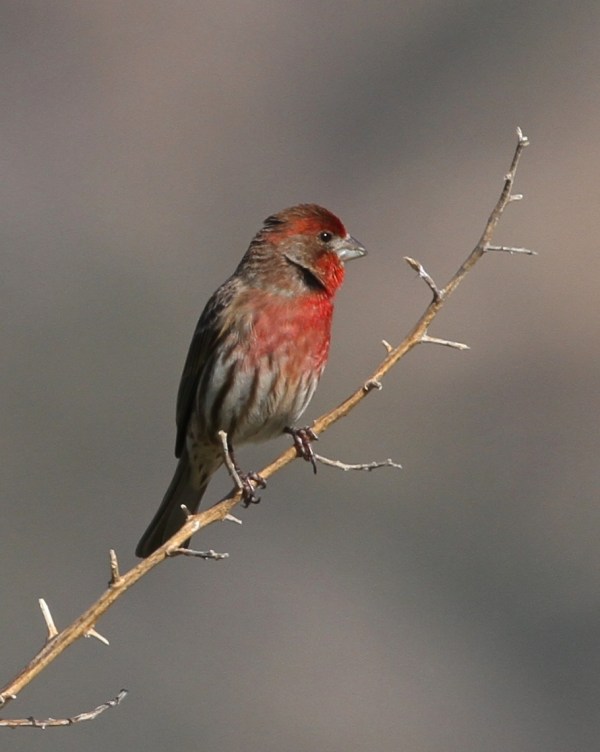
Male House Finch
(J. Waterman 1-28-18)
Our next three scheduled field trips: Sepulveda Basin, 8:30am 10 March; Malibu Lagoon 8:30 & 10am, 25 March; Malibu Creek State Park, 8am, 14 April.
Our next program: The Natural History of Santa Cruz Island, with Larry Loeher – Evening Meeting: Tuesday, Mar. 6, 7:30 p.m., Chris Reed Park, 1133 7th St., NE corner of 7th and Wilshire Blvd. in Santa Monica.
NOTE: Our 10 a.m. Parent’s & Kids Birdwalk meets at the shaded viewpoint just south of the parking area. Watch for Willie the Weasel. He’ll be watching for you and your big floppy feet.
Links: Unusual birds at Malibu Lagoon
9/23/02 Aerial photo of Malibu Lagoon
Prior checklists:
2017: Jan-June, July-Dec
2016: Jan-June, July-Dec 2015: Jan-May, July-Dec
2014: Jan-July, July-Dec 2013: Jan-June, July-Dec
2012: Jan-June, July -Dec 2011: Jan-June, July-Dec
2010: Jan-June, July-Dec 2009: Jan-June, July-Dec.
The 10-year comparison summaries created during the project period, despite numerous complaints, remain available on our Lagoon Project Bird Census Page. Very briefly summarized, the results unexpectedly indicate that avian species diversification and numbers improved slightly during the period Jun’12-June’14.
Many thanks to Lillian Johnson, Allen & Muriel Kotin, Grace Murayama, and Chris Tosdevin for their contributions to the checklist below. [Chuck Almdale]
| Malibu Census 2017-18 | 9/24 | 10/22 | 11/26 | 12/24 | 1/28 | 2/25 |
| Temperature | 68-75 | 72-82 | 56-63 | 57-68 | 67-76 | 55-62 |
| Tide Lo/Hi Height | L+1.86 | H+5.38 | L+2.94 | L+2.8 | H+5.99 | H+5.21 |
| Tide Time | 0559 | 1050 | 0946 | 0654 | 0609 | 0459 |
| Canada Goose | 1 | |||||
| Cinnamon Teal | 1 | |||||
| Gadwall | 1 | 1 | 5 | 30 | 8 | |
| American Wigeon | 1 | 3 | 15 | 36 | 4 | |
| Mallard | 27 | 15 | 2 | 22 | 12 | 6 |
| Northern Pintail | 1 | 3 | ||||
| Green-winged Teal | 6 | 1 | ||||
| Surf Scoter | 2 | 2 | ||||
| Bufflehead | 1 | 6 | 8 | |||
| Red-breasted Merganser | 4 | 8 | 3 | 4 | ||
| Ruddy Duck | 4 | 2 | 13 | 9 | ||
| Pied-billed Grebe | 3 | 5 | 8 | 5 | 1 | 2 |
| Eared Grebe | 1 | 2 | ||||
| Western Grebe | 9 | 15 | 5 | |||
| Clark’s Grebe | 2 | 2 | 1 | |||
| Rock Pigeon | 5 | 6 | 10 | 6 | 8 | 8 |
| Mourning Dove | 2 | 2 | 2 | 2 | 2 | |
| Vaux’s Swift | 40 | |||||
| Anna’s Hummingbird | 1 | 1 | 1 | 1 | ||
| Allen’s Hummingbird | 6 | 2 | 1 | 3 | 5 | 1 |
| Sora | 1 | |||||
| American Coot | 62 | 140 | 60 | 72 | 125 | 85 |
| American Avocet | 1 | |||||
| Black-bellied Plover | 89 | 135 | 115 | 28 | 22 | 25 |
| Snowy Plover | 34 | 25 | 31 | 35 | 19 | 34 |
| Semipalmated Plover | 1 | |||||
| Killdeer | 8 | 10 | 4 | 3 | 4 | 10 |
| Whimbrel | 54 | 45 | 36 | 10 | 8 | 13 |
| Marbled Godwit | 45 | 80 | 135 | 57 | 18 | 30 |
| Ruddy Turnstone | 7 | 6 | 11 | 12 | 1 | 6 |
| Sanderling | 7 | 10 | 13 | 11 | 30 | 20 |
| Baird’s Sandpiper | 3 | |||||
| Least Sandpiper | 4 | 3 | 10 | 6 | 1 | 3 |
| Western Sandpiper | 2 | 1 | ||||
| Spotted Sandpiper | 4 | |||||
| Willet | 55 | 120 | 85 | 11 | 9 | 14 |
| Bonaparte’s Gull | 1 | |||||
| Heermann’s Gull | 11 | 64 | 5 | 4 | 5 | |
| Mew Gull | 1 | 1 | ||||
| Ring-billed Gull | 1 | 4 | 25 | 42 | 35 | 70 |
| Western Gull | 96 | 145 | 105 | 97 | 95 | 92 |
| California Gull | 98 | 385 | 560 | 1550 | 550 | |
| Herring Gull | 1 | 2 | ||||
| Glaucous-winged Gull | 2 | 5 | ||||
| Caspian Tern | 1 | |||||
| Royal Tern | 52 | 47 | 4 | 21 | 12 | 15 |
| Elegant Tern | 4 | |||||
| Pacific Loon | 1 | 1 | 1 | |||
| Common Loon | 4 | |||||
| Brandt’s Cormorant | 1 | 2 | 2 | 2 | ||
| Double-crested Cormorant | 36 | 45 | 32 | 32 | 73 | 37 |
| Pelagic Cormorant | 1 | 2 | ||||
| American White Pelican | 2 | |||||
| Brown Pelican | 17 | 17 | 45 | 5 | 6 | 14 |
| Great Blue Heron | 5 | 4 | 8 | 5 | 2 | 1 |
| Great Egret | 3 | 8 | 1 | 1 | 3 | |
| Snowy Egret | 10 | 4 | 8 | 18 | 8 | 8 |
| Cattle Egret | 5 | |||||
| Green Heron | 3 | 2 | 2 | |||
| Black-crowned Night-Heron | 2 | 1 | 1 | 3 | ||
| Turkey Vulture | 1 | |||||
| Osprey | 1 | 1 | 2 | 1 | ||
| Cooper’s Hawk | 1 | |||||
| Red-tailed Hawk | 1 | |||||
| Belted Kingfisher | 1 | |||||
| Nuttall’s Woodpecker | 1 | |||||
| American Kestrel | 1 | |||||
| Merlin | 1 | 1 | ||||
| Peregrine Falcon | 2 | |||||
| Nanday Parakeet | 4 | |||||
| Black Phoebe | 5 | 6 | 3 | 4 | 3 | 1 |
| Say’s Phoebe | 2 | 2 | 4 | 3 | 3 | 3 |
| Cassin’s Kingbird | 1 | |||||
| Western Kingbird | 1 | |||||
| American Crow | 6 | 5 | 5 | 4 | 3 | 5 |
| Rough-winged Swallow | 2 | |||||
| Barn Swallow | 1 | |||||
| Oak Titmouse | 1 | 1 | ||||
| Bushtit | 1 | 15 | 48 | 10 | 20 | 35 |
| House Wren | 1 | 1 | ||||
| Marsh Wren | 2 | 3 | 1 | 1 | 2 | |
| Bewick’s Wren | 3 | 2 | 4 | 3 | 3 | 2 |
| Blue-gray Gnatcatcher | 15 | 7 | 8 | 6 | ||
| Ruby-crowned Kinglet | 4 | 1 | 3 | |||
| Northern Mockingbird | 2 | 2 | 1 | 2 | 2 | 1 |
| European Starling | 25 | 8 | 50 | 15 | 10 | |
| American Pipit | 4 | |||||
| House Finch | 8 | 16 | 40 | 41 | 20 | 8 |
| Lesser Goldfinch | 2 | 1 | 1 | 8 | ||
| Spotted Towhee | 1 | |||||
| California Towhee | 1 | 2 | 1 | 2 | ||
| Brewer’s Sparrow | 1 | |||||
| Savannah Sparrow | 8 | 1 | ||||
| Song Sparrow | 3 | 4 | 2 | 9 | 4 | 5 |
| White-crowned Sparrow | 20 | 45 | 27 | 8 | 25 | |
| Golden-crowned Sparrow | 1 | |||||
| Dark-eyed Junco | 1 | |||||
| Western Meadowlark | 1 | 3 | 3 | 2 | 2 | 4 |
| Red-winged Blackbird | 6 | |||||
| Brewer’s Blackbird | 1 | |||||
| Great-tailed Grackle | 3 | 6 | 12 | 6 | 1 | 2 |
| Orange-crowned Warbler | 5 | 2 | 1 | 1 | 2 | 1 |
| Nashville Warbler | 1 | |||||
| Common Yellowthroat | 8 | 5 | 9 | 5 | 2 | 4 |
| Yellow Warbler | 2 | |||||
| Yellow-rumped(Aud) Warbler | 12 | 3 | 12 | 12 | 20 | |
| Wilson’s Warbler | 1 | |||||
| Totals by Type | Sep | Oct | Nov | Dec | Jan | Feb |
| Waterfowl | 27 | 19 | 14 | 58 | 109 | 40 |
| Water Birds – Other | 118 | 223 | 164 | 126 | 211 | 142 |
| Herons, Egrets & Ibis | 23 | 19 | 25 | 26 | 11 | 12 |
| Quail & Raptors | 1 | 0 | 0 | 4 | 6 | 2 |
| Shorebirds | 314 | 434 | 441 | 173 | 112 | 155 |
| Gulls & Terns | 161 | 363 | 524 | 729 | 1704 | 727 |
| Doves | 7 | 8 | 12 | 8 | 8 | 10 |
| Other Non-Passerines | 47 | 3 | 1 | 5 | 6 | 6 |
| Passerines | 86 | 115 | 211 | 194 | 121 | 146 |
| Totals Birds | 784 | 1184 | 1392 | 1323 | 2288 | 1240 |
| Total Species | Sep | Oct | Nov | Dec | Jan | Feb |
| Waterfowl | 1 | 5 | 5 | 8 | 9 | 7 |
| Water Birds – Other | 4 | 10 | 7 | 8 | 8 | 7 |
| Herons, Egrets & Ibis | 5 | 5 | 6 | 3 | 3 | 3 |
| Quail & Raptors | 1 | 0 | 0 | 4 | 4 | 2 |
| Shorebirds | 14 | 9 | 10 | 9 | 9 | 9 |
| Gulls & Terns | 5 | 7 | 5 | 9 | 7 | 4 |
| Doves | 2 | 2 | 2 | 2 | 1 | 2 |
| Other Non-Passerines | 3 | 2 | 1 | 3 | 2 | 3 |
| Passerines | 24 | 19 | 19 | 22 | 22 | 21 |
| Totals Species – 107 | 59 | 59 | 55 | 68 | 65 | 58 |



 SANTA MONICA BAY AUDUBON SOCIETY BLOG