Free email delivery
Please sign up for email delivery in the subscription area to the right.
No salesman will call, at least not from us. Maybe from someone else.
HELP US IDENTIFY THE FLOWERS.
An intrepid group of 10 birders braved the beautiful mild June weather on Mt. Piños. It was hard getting beyond the parking lot, since we found dozens

Red Mariposa Lily, Calochortus venustus (Grace Murayama 6-11-16)

Long Leaf Paintbrush, Castilleja subinclusa?; one possibility among five species, plus additional hybrids (Read Howarth 6-11-16)
of gorgeous red mariposa lilies all over the area across the road, complemented by stands of orange paintbrush and many dandelion puffballs.

A native Dandelion puffball,
Agoseris sp. (Read Howarth 6-11-16)
There were more lilies than anyone (Mary) could remember. But there must be progress, and birding, so we tore ourselves away to climb Mt. Piños. Mary led the way to show us stops at our old reliable

Mylitta Crescent female, Phyciodes mylitta, breeds on thistles
(Grace Murayama 6-11-16)
places along the road. At the biggest trail head, we were stumped momentarily by a blue bird with an orange chest. It couldn’t be a western bluebird, since it had white wing bars and a sharply demarcated orange chest; further research proved it was a Lazuli Bunting!

Male Western Bluebird waits for a flyby fly (Read Howarth 6-11-16)
Some Western Bluebirds flew along to help us tell the difference. An American Robin and a Chipping Sparrow pecked at the trail, and a Band-tailed Pigeon sat guard on a tree, occasioning wishful thinking that it was a Clark’s Nutcracker (Someone saw one, but I didn’t).

California Fremontia, Fremontodendron californicum (Larry Loeher 6-11-16)
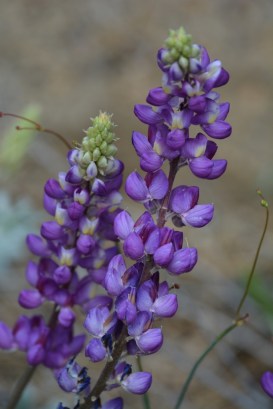
Purple Lupine, Lupinus sp.
(Grace Murayama 6-11-16)
All the way up the hill were lupines in full bloom; blue, purple and cream colored. Also bright yellow fremontia in almost full bloom; about 10 or so red snow plants poked up as we reached the top. At the top, the iris field was about a third in bloom. At the picnic area, there was much bird singing: bluebirds, sparrows galore, and some chipmunks.

Fox Sparrows have beautiful songs
(Read Howarth 6-11-16)
At the McGill campground, we were entertained by a Fox Sparrow in full voice, a pygmy nuthatch flew by and several Green-tailed Towhees also contributed their songs. Numerous Purple Finches were heard, and finally one was clearly spotted. A White-headed Woodpecker made an appearance, and so then it was OK to leave.
If you want to help refine our flower ID’s, this page on Calflora may help.
[Liz Galton]
Bird species seen
Red-tailed Hawk
Band-tailed Pigeon
White-headed Woodpecker
Western Wood-Pewee
Black Phoebe
Western Scrub-Jay
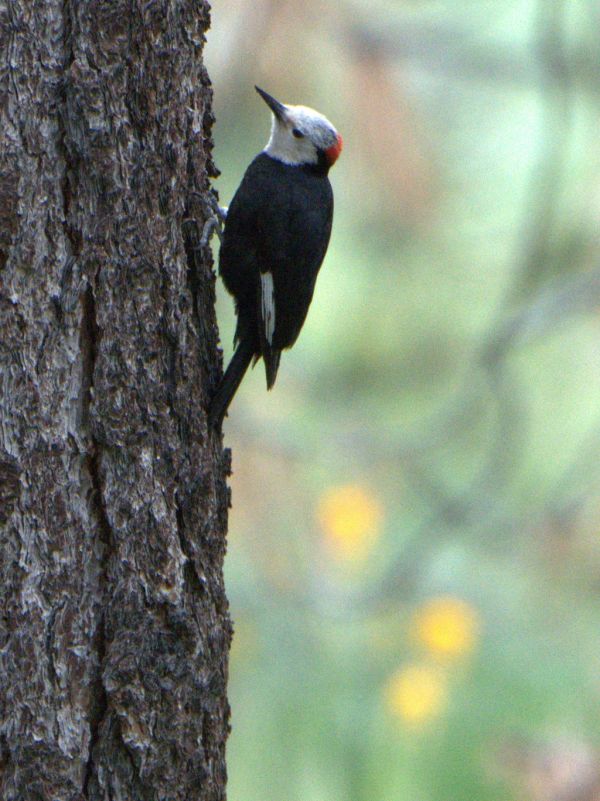
Male White-headed Woodpecker likes high altitudes (Read Howarth 6-11-16)
Steller’s Jay
Clark’s Nutcracker
Violet-green Swallow
Pygmy Nuthatch
Western Bluebird
American Robin
Green-tailed Towhee
Chipping Sparrow
Fox Sparrow
Dark-eyed Junco
Lazuli Bunting
Purple Finch
18 species

California Fremontia, Fremontodendron californicum (Larry Loeher 6-11-16)
Science & Cinema at LMU
 Biology and film students at Loyola Marymount University are pioneering a new way to communicate scientific concepts to general audiences by creating visually captivating films that are scientifically accurate. The course is the brainchild of LMU Biology Professor Heather Watts and filmmaker Patrick Scott, an instructor with the School of Film and Television. In this video, Dr. Watts and Scott explain their concept for “Biology, Film and Science,” and how it’s transforming the way their students learn critical interdisciplinary and interpersonal skills in the process.
Each week, teams of film and biology students tackle a new biology concept and a new film technique, and collaborate to produce a piece that is both engaging and scientifically rigorous. The video, “Animal Movement: Science Communication with Dr. Watts & P.Scott,” shows the students actually creating their films. As biology major Brandy Kwak said, “We spend billions of dollars on science, and it’s so important that people know about it.”
The class is held in LMU’s new Life Sciences Building, which was built on the design principle of erasing the barriers between academic disciplines. I’d say they have succeeded.
Do you wish you could start college all over again?
Full Strawberry Moon Update – June 20, 4:02 AM PDT
Here’s another update from SMBAS Blog on that large, disc-like, shining object which has frequently and mysteriously appeared in our nighttime sky this year (known to many as the moon).
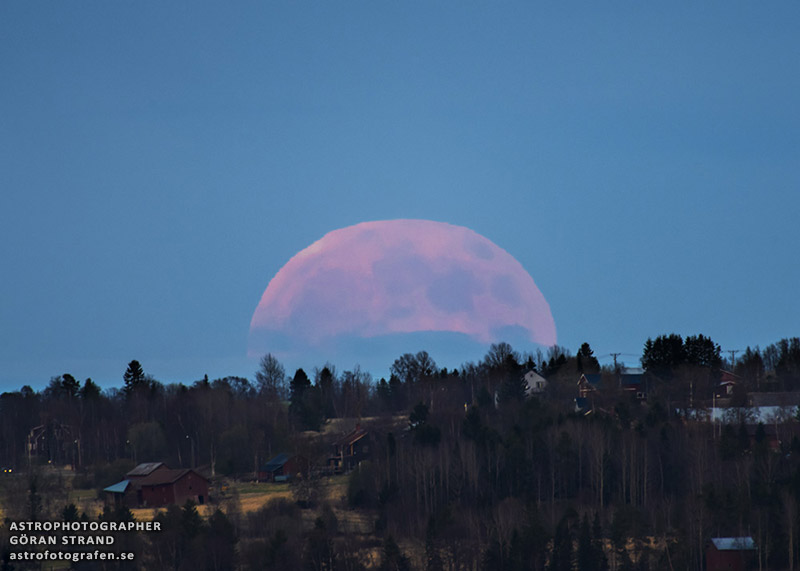
Full Strawberry Moon (Gören Strand 6/23/13 reproduced on apod.NASA.gov)
[Note: I found the above beautiful photo, by professional astrophotographer Göran Strand, on the NASA website. See many other of Göran’s astonishing photos at http://www.astrofotografen.se. On Friday the 13th, 2014, strangely enough, the moon rising over our Mt. Piños campsite was the same lovely rose-pink color.]
June 20, 4:02 a.m. PDT — Full Strawberry Moon. Known to every Algonquin tribe; strawberry picking peaks during this month. Europeans called it the Rose Moon or Honey Moon. [Top 10 Amazing Moon Facts]

Santa Monica’s Summer Solstice Sunset over the Santa Monica Mountains
(Bob Gurfield 6/21/14)
Long-time SMBAS member, prominent kayaker and alert reader, Bob Gurfield, reminded us of the fact that “Those of us who rise when the sun comes up should know that the latest (and earliest) sunrises do not occur on the solstices.”

Santa Monica’s Winter Solstice Sunset over the ocean (Bob Gurfield 12/21/13)
With use of information from Time and Date we constructed the following chart detailing sunrises & sunsets for three locales – Los Angeles, Anchorage and Bogota (Colombia). Note that the “earliest’ time (either sunrise or sunset) always precedes the solstice. The closer you are to the equator, the longer the period of this earliest-to-latest date spread. For example, around the summer solstice, Bogota, Colombia has 57 days between its earliest sunrise and latest sunset, Los Angeles has 16 days, Anchorage has only 3 days. Also note that the longest-to-shortest-day spread is very small near the equator; the difference for Bogota is only 32 minutes, 5 seconds. This is why in the tropics winter & summer are replaced by wet and dry seasons.
| Sunrises & | Los Angeles | Anchorage | Bogota |
| Sunsets | California | Alaska | Colombia |
| Latitude | 34° 3′ 8” N | 61° 13′ 5″ N | 4° 36′ 0″ N |
| Earliest Sunset | 12/04/13 – 1643 | 12/16/13 – 1540 | 11/09/13 – 1738 |
| Winter Solstice | 12/21/13 – 0911 | 12/21/13 – 0811 | 12/21/13 – 1211 |
| Latest Sunrise | 1/07/14 – 0659 | 12/25/13 – 1015 | 2/03/14 – 0612 |
| Earliest Sunrise | 6/12/14 – 0541 | 6/19/14 – 0420 | 5/22/14 – 0542 |
| Summer Solstice | 6/21/14 – 0351 | 6/21/14 – 0251 | 6/21/14 – 0551 |
| Latest Sunset | 6/28/14 – 2008 | 6/22/14 – 2342 | 7/18/14 – 1813 |
| Earliest Sunset | 12/04/14 – 1643 | 12/16/14 – 1540 | 11/10/14 – 1748 |
| Winter Solstice | 12/21/14 – 1503 | 12/21/14 – 1403 | 12/21/14 – 1803 |
| Latest Sunrise | 1/07/14 – 0659 | 12/26/14 – 1015 | 2/03/15 – 0612 |
| Longest Day | |||
| 6/21/2014 | 14h 25m 34s | 19h 21m 31s | 12h 23m 29s |
| Shortest Day | |||
| 12/21/2014 | 9h 53m 03s | 5h 27m 41s | 11h 51m 24s |
| Difference | 4h 32m 31s | 13h 53m 50s | 0h 32m 05s |
Nowhere do the latest sunrise and sunset or earliest sunrise and sunset occur on the solstices (except perhaps exactly at the North or South Pole). The reason for this is that the earth’s axis is not aligned with the minor axis of the earth’s orbit around the sun. Over time the earth’s ecliptic precesses a tiny bit each year so that every 134,000 years the orbit makes a complete rotation with respect to the positions of the stars. [This is not the same as the ‘precession of the equinoxes.’] http://en.wikipedia.org/wiki/Apsidal_precession
The Old Farmer’s Almanac has a page for each full moon. One tip: cut your hay on the 1st, 27th or 28th, and make haw while the sun shines.
The next significant full moon will occur on July 19, 3:56 PM PDT. Keep an eye on this spot for additional late-breaking news on this unprecedented event.
This information comes to you courtesy of: http://www.space.com/31699-full-moon-names-2016-explained.html
written by Joe Rao. Joe Rao serves as an instructor and guest lecturer at New York’s Hayden Planetarium. He writes about astronomy for Natural History magazine, the Farmer’s Almanac and other publications, and he is also an on-camera meteorologist for News 12 Westchester, N.Y.
But that’s waaay too long to type in, and besides, you don’t need to go there because SMBAS has done the work for you!
[Chuck Almdale]
Anacapa Island Nesting Season
Birds have it tough. About 90% die within their first year, with mortality heaviest on nestlings and unhatched birds. Many birds hide their nests in foliage or holes, but ground-nesting birds have a special challenge: their nest is right on the ground, where any bird soaring overhead or reptile or mammal wandering by can find it. Dense vegetation or grass may conceal small nests, enabling nesting success. Seabirds created other solutions.
To minimize nest predation, seabirds usually nest on small islands, where mammal and reptile predators are few or absent. Many take the addition step of nesting on small ledges of steep cliffs. Such birds may build no nest at all, laying their eggs directly on the bare rock. In such cases, the egg is sharply tapered at one end: if it moves, it rolls in a tight circle rather than off the ledge.
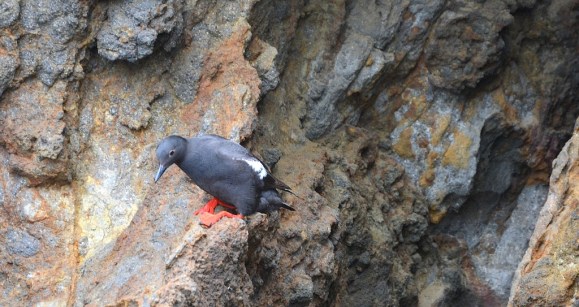
Pigeon Guillemot (G. Murayama 6-14-16)
Other seabirds, such as this Pigeon Guillemot, nest in rocky crevices, cavities or self-excavated burrows in dirt. Such sites can be defended by the adult. If the island is free of mammals and reptiles, some birds may nest openly on the ground. When they are large, as are Western Gulls, and can protect the nest from raptors, they have little to worry about. Still, when chicks are hatched, it helps if they are cryptically plumaged, as they are less likely to be spotted by predators if they wander from the adult’s protection.
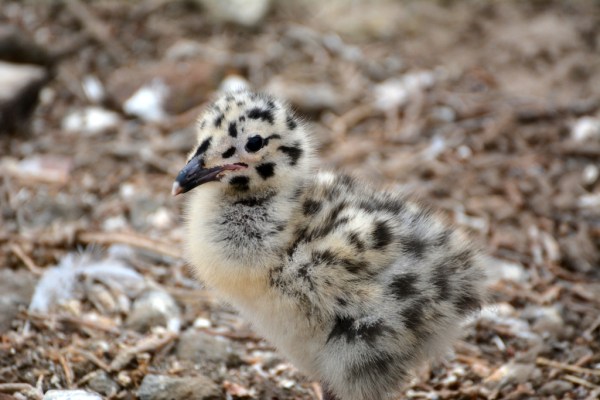
Western Gull cryptic chick (G. Murayama 6-14-16)
Western Gulls typically lay three eggs (one to five eggs is possible) in a nest built of grass or brush pieces. They nest in colonies; nests may be closely grouped, but not so close that adults in adjoining nests can peck one another. Unlike non-colonial birds which may maintain large territories, the gull’s territory consists only of how far they can peck without leaving their nest.
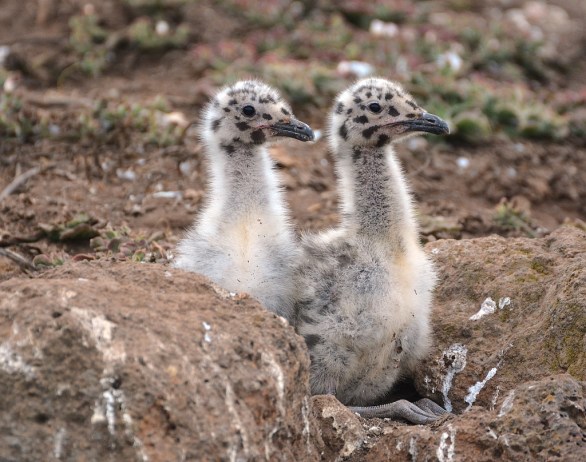
Chick pair (G. Murayama 6-14-16)
In about a month the eggs hatch, after which the chicks are fed a diet of invertebrates, small vertebrates, carrion, and eggs and chicks of other birds. While embryos can survive brief temperatures up to 114°F, adult birds may soak their belly feathers in water to cool heated eggs. Western Gulls are one of the many species that lay more eggs than they can be expected to successfully fledge; later-born chicks are “insurance” against loss of early chicks, and do not often survive.
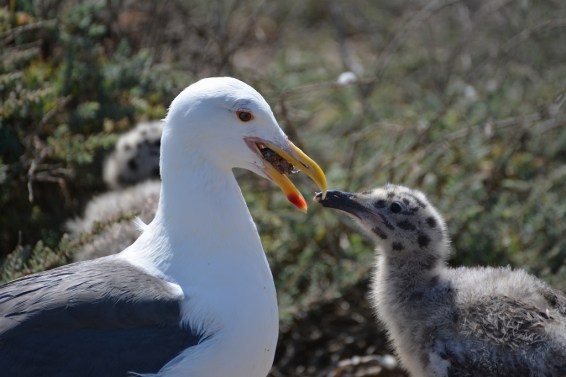
Up comes lunch (G. Murayama 6-14-16)
The hungry chicks peck at red spot on the adult’s lower mandible in order to trigger food regurgitation by the parent. Food is brought up from the internal carrying pouch, called the crop. This is not the stomach, and digestion within it is minimal. Chicks often grab more than them can swallow; the meal moves in and down as it is digested.
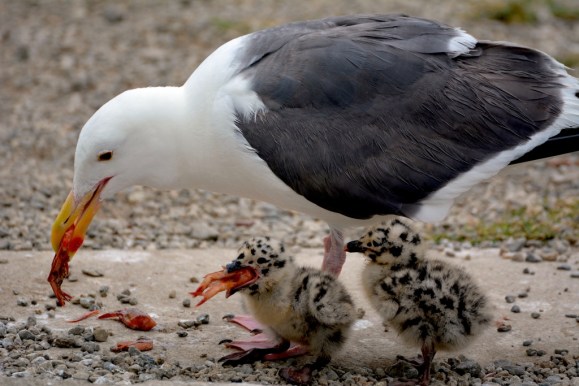
Western Gull feeding chicks (G. Murayama 6-14-16)
Chicks fledge in six to seven weeks, and may leave their home island in another three to four weeks, at which point they may begin appearing at mainland beaches like Surfrider Beach. Western Gulls reach adult plumage in their fourth spring, and begin breeding between ages four to eight. They can live to age sixteen. Along our coast they are frequently seen prying mussels off rocks, dropping them onto rocks from thirty to fifty feet up, then dropping to eat the exposed flesh from the broken shell. Other local gull species seem unable to learn this trick.

Island Tree Mallow gives the gulls something to admire (G. Murayama 6-14-16)
Western Gulls breed from NW Washington to central Baja California. Their winter range extends slightly, reaching the top of Vancouver Island and nearby Canadian mainland, and to the southern tip of Baja. They are extremely reliable at Malibu Lagoon, present on 99% of our visits.
Many thanks to Grace Murayama for her photos from Anacapa which inspired this message.
[Chuck Almdale]
From our South African connection
Many of our members will remember Laurel Serieys who, partly sponsored by SMBAS, completed her PhD at UCLA and often presented us with inside information on the felines of the Santa Monica Mountains. She then left for South Africa and is conducting similar research there. Below is an email she recently sent to Chuck And Lillian Almdale with a plea for assistance in her current project which is facing a competitive crowd-funding deadline. SMBAS does not fund outside our general area, but we thought a number of our members might be interested in contributing to this project. The link is toward the bottom of the text.
Hi Chuck and Lillian-
I hope you are well. How is the Audubon group going? Have you found any other good students at UCLA to support?
Things are well for me in Africa- I am loving it so much that I actually don’t want to leave! It’s really captivating me to work here, and it seems my life may be taking an unexpected detour.
To help fund my work here to wrap up the last leg of the fieldwork, I am running a crowd-funding campaign. There’s a couple caveats to this effort:
The project is part of a cluster of cat-related studies, and the project with the most donors (not the most money) gets a bonus of $1000 on June 10! We are in the lead, but barely! So I am calling on all potential supporters to donate, no matter how small, it will get us very far!
The project funding is all or none- we reach our goal within 2 weeks or we don’t get any of the cash. So every donation is crucial.
Would you mind circulating amongst the group and just let them know- any amount no matter how small could easily turn into $1000?
Thank you so much for your ongoing support!
Please let me know if you need more info- I’d be so grateful!
Much love to you guys!
Cheers
Laurel



 SANTA MONICA BAY AUDUBON SOCIETY BLOG