Free email delivery
Please sign up for email delivery in the subscription area to the right.
No salesman will call, at least not from us. Maybe from someone else.
The woman who brought Monsanto to its knees
Happy Birthday, Rachel Carson
“We are accustomed to look for the gross and immediate effects and to ignore all else. Unless this appears promptly and in such obvious form that it cannot be ignored, we deny the existence of hazard.”
This quote is not about Donald Trump’s climate change denials; it is from SILENT SPRING, published in 1962, challenging the notion made popular by the chemical industries of the postwar 50s that “better living through chemistry” was the answer for us all. Rachel Carson was the first scientist to call national attention to the danger caused by the indiscriminate use of pesticides by demonstrating their damage–from the insects they directly targeted all the way up the food chain to mammals, including people. The world almost lost bald eagles, falcons and many other species because of it. Carson declared, “A chemical war is never won, and all life is caught in its crossfire.” She was among the first to point out that to save a species, first its habitat must be saved. And she was alone in pointing it out with a literary style and poetry that caught the world’s attention.

Carson began her career as a biologist, writing for what would become US Fish and Wildlife Service. This after receiving her doctorate in biology from Johns Hopkins University at a time when women in science were accused of going to grad school, not to earn a doctorate but to marry one. For USFS, she wrote a scientific paper her boss said was unsuitable for a science publication– but would be perfect for a magazine. Atlantic Monthly was happy to oblige. She followed the article up with many more, and published three books of writings about the sea and its wildlife. Her biology work continued, and she became more and more convinced that pesticides were killers, but not just of “pests.”
SILENT SPRING first appeared in serialized form in the The New Yorker Magazine. It caused an immediate uproar in the agribusiness industry which closed ranks to mount a loud public campaign against Rachel Carson personally. When Houghton Mifflin released the book three months later, it hit the bestseller list. Carson’s science was less a target then she herself was. She was labeled hysterical by the chemical industry, which also criticized her for being childless. But President Kennedy took serious notice, and he went on to create the Environmental Protection Agency. Monsanto, maker of DDT, even sponsored a ride at Disneyland, “Adventure thru inner Space” to win over the public. But Carson prevailed, and years later DDT was banned, allowing affected species to begin on the years-long road to recovery.

Carson’s efforts spearheaded the modern ecology movement, but she never lived to see it. Eighteen months after the publication of SILENT SPRING, she was dead of cancer at 56. Her legacy and her tireless fight continue to keep her relevant, and a quick look at the environment today reminds us that her struggle against unchecked pesticides by agribusiness needs to carry on. Representative Tom Coburn of Oklahoma even now blames her for the spread of malaria, although she never called for a ban on DDT, only for its careful use, and mosquitos have now proved resistant to DDT, something she warned against. Coburn recently blocked a congressional bill to honor her.
“But most of all I shall remember the Monarchs”
Carson wrote this to a friend at the end of her life. I believe she would’ve been horrified to learn that Monsanto is still killing the wildlife she loved, especially Monarch Butterflies. If you’d like to carry on the fight in her absence, there’s something easy you can do–sign this petition calling for the elimination of Monsanto’s indiscriminate use of the pesticide ROUND UP, believed by scientists and admitted by Monsanto to be responsible for the disappearance of milkweed (the only plant Monarch Butterflies can lay their eggs in), and therefore, a large contributor to the looming extinction of the species.
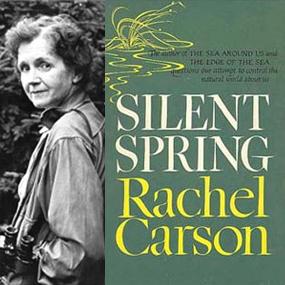
On this Memorial Day holiday weekend, you might be looking to grab a good beach read. Well, don’t grab SILENT SPRING. As ornithologist Connor Mark Jamison states, it can be “dense and technical.” Instead grab one of her earlier sea books, full of wonder and and razor-sharp prose. UNDER THE SEA WIND follows three marine inhabitants, including a Sanderling in a vivid, harrowing account. And if you find yourself on Santa Monica bay reading it—you may glance up to see a pelican, a cormorant or a peregrine falcon— which at one time were considered lost to DDT.
Carson is the hero in the survival of untold numbers of species devastated by pesticides.
She’s long been mine. Happy Birthday, Rachel
Field Trip Report Malibu Lagoon May 22, 2016
It may have been early in the month for our 4th Sunday, but for us it seemed quite late in the migration cycle. On a comfortable but gray Sunday we saw very few birds, especially in the wader category. One new arrival was a solitary Brant. Don’t let this rather low total (41 species) discourage you from visiting our favorite hot spot. Since that outing a number of interesting birds have shown up at the Lagoon, including a colorful female Wilson’s Phalarope, southward bound I’m told, spotted by Grace Murayama last week (June 8th). See you June 26th! [Lucian]
Brant (Branta bernicla) 1
Gadwall (Anas strepera) 8
Mallard (Anas platyrhynchos) 4
Red-breasted Merganser (Mergus serrator) 1
Pied-billed Grebe (Podilymbus podiceps) 1
Double-crested Cormorant (Phalacrocorax auritus) 7
Brown Pelican (Pelecanus occidentalis) 14
Great Blue Heron (Ardea herodias) 2
Great Egret (Ardea alba) 1
Snowy Egret (Egretta thula) 2
Osprey (Pandion haliaetus) 1
Black-bellied Plover (Pluvialis squatarola) 6
Killdeer (Charadrius vociferus) 6 ( Incl. 4 immature)
Willet (Tringa semipalmata) 16
Heermann’s Gull (Larus heermanni) 8
Ring-billed Gull (Larus delawarensis) 26
Western Gull (Larus occidentalis) 23
California Gull (Larus californicus) 3
Caspian Tern (Hydroprogne caspia) 9
Royal Tern (Thalasseus maximus) 48
Elegant Tern (Thalasseus elegans) 10
Rock Pigeon (Feral Pigeon) (Columba livia (Feral Pigeon)) 1
Mourning Dove (Zenaida macroura) 2
Allen’s Hummingbird (Selasphorus sasin) 2
Black Phoebe (Sayornis nigricans) 1
Western Scrub-Jay (Aphelocoma californica) 2
American Crow (Corvus brachyrhynchos) 4
Northern Rough-winged Swallow (Stelgidopteryx serripennis) 6
Barn Swallow (Hirundo rustica) 4
Cliff Swallow (Petrochelidon pyrrhonota) 4
Bushtit (Psaltriparus minimus) 2
Bewick’s Wren (Thryomanes bewickii) 1
Northern Mockingbird (Mimus polyglottos) 2
European Starling (Sturnus vulgaris) 2
Common Yellowthroat (Geothlypis trichas) 1
Song Sparrow (Melospiza melodia) 2
Red-winged Blackbird (Agelaius phoeniceus) 4
Brewer’s Blackbird (Euphagus cyanocephalus) 12
Great-tailed Grackle (Quiscalus mexicanus) 3
House Finch (Haemorhous mexicanus) 7
House Sparrow (Passer domesticus) 3
Species Total: 41
Full Flower Moon Update – May 21, 2:14 PM PDT
Here’s another update from SMBAS Blog on that large, disc-like, shining object which has frequently and mysteriously appeared in our nighttime sky this year (the Illuminati speak of it as the moon).

Full Flower Moon (Tara Sutphen)
May 21, 2:14 p.m. PDT — Full Flower Moon. Flowers are abundant everywhere at this time. May’s full moon was also known as the Full Corn Planting Moon or the Milk Moon. [Gallery: The Fantastic Full Moon]
The Old Farmer’s Almanac has a page for each full moon. One tip: set your eggs on the 16th, 17th or 25-27th. Mark your calendar.
The next significant full moon will occur on June 20, 4:02 a.m. PDT. Keep an eye on this spot for additional late-breaking news on this unprecedented event.
Have a nice moon photo? Send it to us at: misclists [AT] verizon [DOT] net, along with name to credit and time/location of photo. [Infographic: Moon Phases & Lunar Cycles]
This information comes to you courtesy of: http://www.space.com/31699-full-moon-names-2016-explained.html
written by Joe Rao. Joe Rao serves as an instructor and guest lecturer at New York’s Hayden Planetarium. He writes about astronomy for Natural History magazine, the Farmer’s Almanac and other publications, and he is also an on-camera meteorologist for News 12 Westchester, N.Y.
But that’s waaay too long to type in, and besides, you don’t need to go there because SMBAS has done the work for you!
[Chuck Almdale]
Locals Only: Will You Save a Heron Chick?
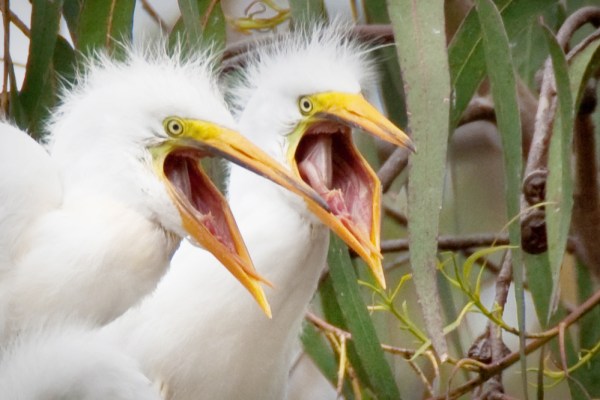 Photo Credit: Mike Baird
If you live on the westside within driving or walking distance of Marina Del Rey, you can witness an amazing urban wildlife display at 13900 Marquesas Way where a heron rookery of at least 30 nests stands. And a stranded Great Egret, Snowy Egret or Black Crowned NIght Heron chick is probably in the road waiting for you to rescue it before it gets mown down by a car: something that is happening on a daily, if not hourly basis. (This morning, seven dead chicks were discovered). To save a chick, simply provide your text number for an alert, swing by the marina (parking available), and further instructions will be provided. Night time drive-bys are also needed. The road is small and quiet. It’s quick–it’s easy–and you’ll be saving a heron chick who would otherwise die in the street. There are people on hand to help. This is a short term act of heroism, as the chicks will fledge and leave the nest soon to go out into the world, provided they can survive today,with your help. 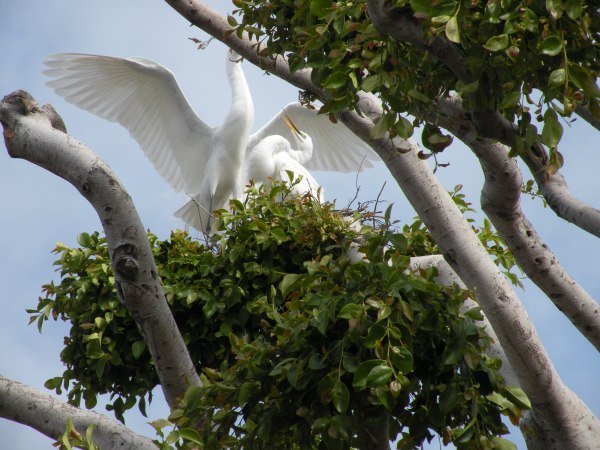
Photo Credit: Laurel Jones
VOLUNTEER HERON HEROES NEEDED NOW
Please help save the next generation CONTACT GILDA: Rescue@vusi.tv
A Cotillion* of Elegant Terns: Malibu Lagoon Apr. 24, 2016
The creaking calls of the large flock of Elegant Terns nearly drowned out the sounds of traffic from Pacific Coast Highway, and a few of the thirty birders present wondered if such numbers were unusual. Well, yes – and no. Forty years ago they were uncommon north of San Diego and, once or twice a year, you might see a few birds at the lagoon.

Elegant Terns in flight, Pepperdine University in distance (R. Ehler 4/24/16)
On 10-21-79, I found three Elegants on my very first Malibu Lagoon census. Twenty-two years later, on 3-25-01, they finally hit double digits with 10 whole birds. Only two years later, on 4-27-03, they hit triple digits at 250 birds. Then 700 birds on 4-26-09, and a whopping 3,100 birds on 4-26-15. To date, we’ve seen 12,423 terns of all species at the lagoon, of which 79% (9,795) have been Elegant. And 67% (6,585) of those were in April. Today’s count of 1,800 Elegant Terns is unusual, but considering the progression over time, not unexpected.

One of three islands covered with Elegant Terns – a thirteen photo panorama
(C. Bragg 4/24/16)
Elegant Terns have long nested primarily on Isla Rasa in Mexico’s Sea of Cortez, but in May 1959, 31 pairs were found nesting in the salt works area of southern San Diego Bay. They began nesting at Bolsa Chica in Orange County in 1987, and in Los Angeles Harbor in 1988. Post-breeding, in late summer and fall, they migrate up the coast as far as northern California, with irregular appearances as far north as southwest Washington. All these migrants spend the winter in Mexico, but, as made apparent by their appearances at the lagoon, they do a lot of springtime moving around before settling down to breed. Since 1979, our lagoon records show the following winter totals: Nov. 16 birds, Dec. 0, Jan. 1, Feb. 1, Mar. 391. The single bird(s) recorded Jan & Feb 2010 could have been a misidentified Royal Tern, a wintering species which was present on both dates.
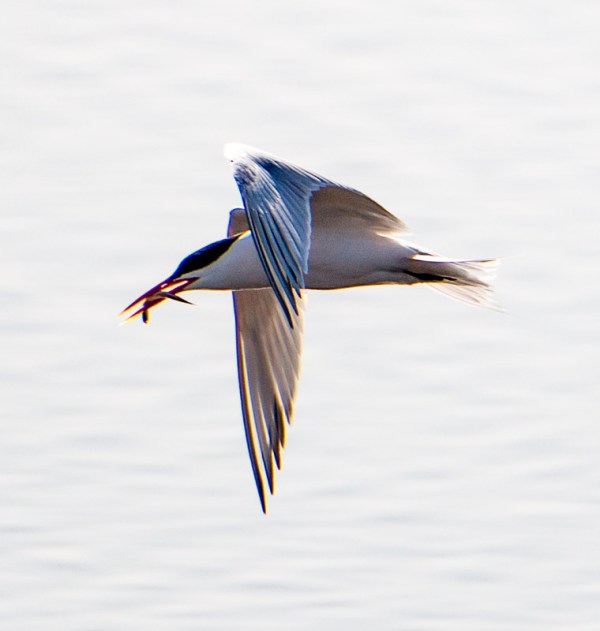
Lucky tern, unlucky fish (R. Juncosa 4/24/16)
We don’t get a lot of Black-necked Stilts at the lagoon: 29 total birds in 7 sightings, including today’s 19 birds. Ray Juncosa captured them with some very interesting effects of lighting. Stilts, along with Avocets, are in their own family, Recurvirostridae (Latin – bent backwards bill). Our stilt ranges from the U.S. to the West Indies, Peru & Brazil, plus Hawaii, where it used to be considered a separate species, the Hawaiian Stilt. The five other Stilt species and ranges are: Black-winged – Eurasia & Africa; Pied – Indonesia to New Zealand; the critically endangered Black – South Island of New Zealand; White-backed – so. South America; Banded – Australia.

Black-necked Stilts, a study (R. Juncosa 4/24/16)
The “semipalmated” foot is partially webbed between the toes. The Semipalmated Plover is a regular Spring & Fall migrant visitor at the lagoon, but no one ever actually sees the webbing. Of the “stints” or “peeps” in the Calidris genus, two are also semipalmated – the Western (Calidris mauri) (Greek – “a gray speckled sandpiper” + mauri [Ernesto Mauri, Italian naturalist]) and the aptly named Semipalmated Sandpiper (C. pusilla) ( Latin – very small).
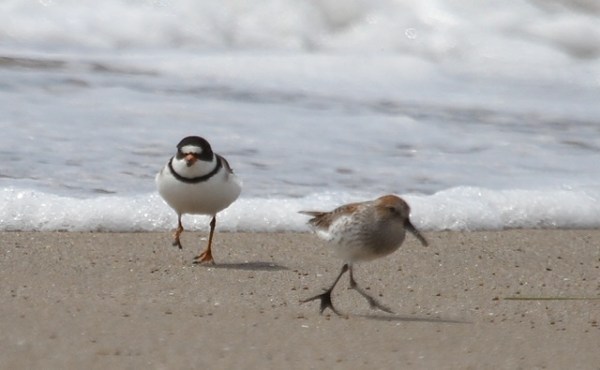
Somehow the semipalmated foot moved from the Semipalmated Plover (left) to the Western Sandpiper (J. Waterman 4/24/16)
I could find nothing in book or on web about differences in webbing between the Western and Semipalmated Sandpipers (SeSa), so I checked with Kimball Garrett of the L.A. Co. Museum of Natural History. He replied, in short, “No difference.” “Then why,” you (dear reader) may inquire, “is one called semipalmated and the other isn’t?” The answer, I believe, is (as with “unusual” Elegant Tern presence) time-dependent. The SeSa was first described in 1766 by Linnaeus himself, based on a specimen from Santo Domingo, which he named Tringa (changed much later to Calidris) pusilla. The Western was described a century later in 1857, from a specimen from South Carolina. [Many Westerns winter on the SE U.S. coast.] The name Semipalmated was already taken, so Western it became.
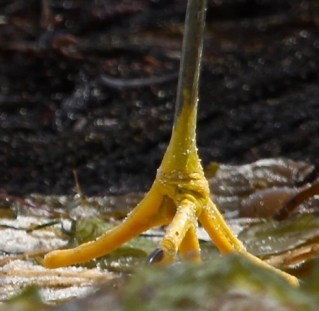
If you don’t know what this is, come birding with us. No, it’s not a plover or sandpiper foot.
(J. Waterman 4/24/16)
So what about the rarely seen webbed feet of the Semipalmated Plover (Charadrius semipalmatus)? I’ll spare you the gruesome details and say simply that it has visible – but short – webbing between all three toes. The very similar Ringed Plover (C. hiaticula) of Eurasia & Africa has visible webbing between middle and outer toe, and nearly invisible webbing between middle and inner toe. 10,000 Birds gives a great description, but the pictures of feet aren’t so hot. [Beware (!!) of Google Images – I’ve seen many misidentifications there.]
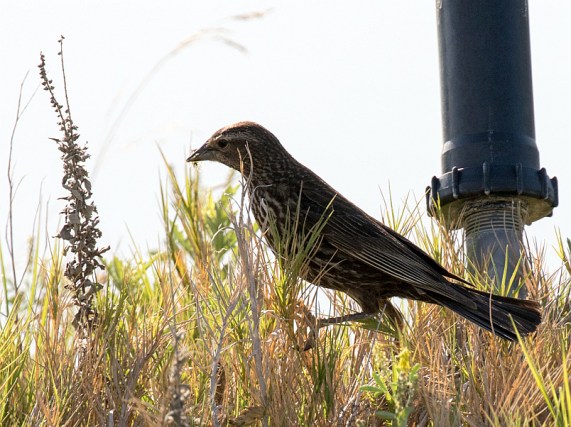
Many people mistake the female Red-winged Blackbird for a sparrow
(R. Ehler 4/24/16)
We didn’t have any Snowy Plovers; probably all have left for their various breeding grounds farther north. Grace Murayama snapped this nice photo of an adult Snowy on 4/13.

The last Snowy Plover of Springtime (G. Murayama 4/13/16)
Bonaparte’s Gull is another species whose lagoon presence has changed significantly over the years. We used to get them in large numbers: 3-15-80 1,600 birds, 11-29-80 530, 12-12-82 1,095. Our last triple-digit count was 632 birds on 1-8-83, shortly after the first lagoon reconfiguration in late 1982. Since then, out of 180 census days, their numbers have reached double-digits only 6 times out of 62 sightings. I don’t know if their overall population has plummeted, or they just didn’t like the new (in 1983) lagoon and stopped coming.
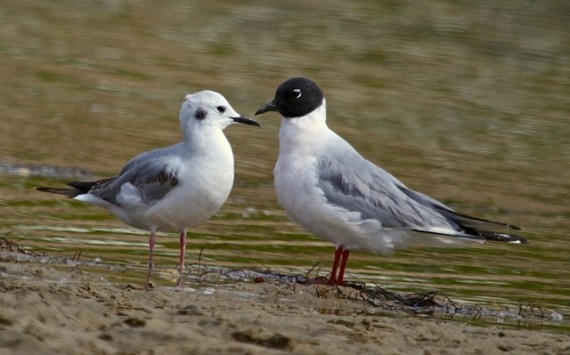
Bonaparte’s Gull – basic & alternate plumages (J. Waterman 4/24/16)
Birds new for the season were: Black-necked Stilt, Semipalmated Plover, Common Murre (by Malibu Pier), Belted Kingfisher, Violet-green Swallow, Black-headed Grosbeak, Red-winged Blackbird, Western Meadowlark, Brewer’s Blackbird, and Brown-headed Cowbird.
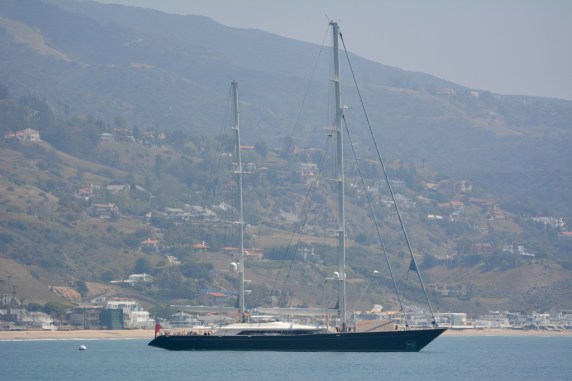
The foremast is about 170 ft high on this giganto-yacht moored off Malibu Pier
(G. Murayama 4/13/16)
As always, many thanks to our photographers: Chuck Bragg, Randy Ehler, Ray Juncosa, Grace Murayama and Joyce Waterman.
*Cotillion of Elegant Terns is the official collective noun for this species.
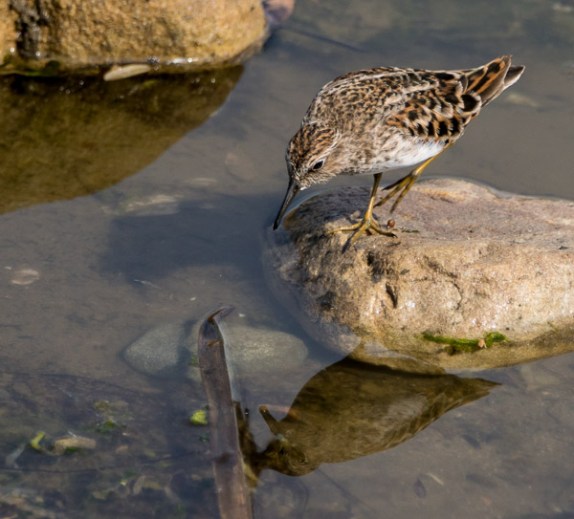
Least Sandpiper, like Narcissus, admires his own reflection (C. Bragg 4/24/16)
Our next four scheduled field trips: To be announced, 14 May; Malibu Lagoon 8:30 & 10am, 22 May; Mt. Piños, 11-12 June 8am; Malibu Lagoon 8:30 & 10am, 26 Jun.

American Robins infrequent the lagoon
(R. Ehler 4/24/16)
Our next program: Grunion, Tuesday, 3 May, 7:30 pm, at [note location change] Chris Reed Park, 1133 7th St., NE corner of 7th and Wilshire Blvd. in Santa Monica.
NOTE: Our 10 a.m. Parent’s & Kids Birdwalk meets at the shaded viewing area. Watch for Willie the Weasel. He’ll be watching for you and your big floppy feet.
Links: Unusual birds at Malibu Lagoon
9/23/02 Aerial photo of Malibu Lagoon
Prior checklists:
2015: Jan-May, July-Dec 2014: Jan-July, July-Dec
2013: Jan-June, July-Dec 2012: Jan-June, July-Dec
2011: Jan-June, July-Dec 2010: Jan-June, July-Dec
2009: Jan-June, July-Dec
The 10-year comparison summaries created during the project period, despite numerous complaints, remain available on our Lagoon Project Bird Census Page. Very briefly summarized, the results unexpectedly indicate that avian species diversification and numbers improved slightly during the period Jun’12-June’14. [Chuck Almdale]
| Malibu Census 2016 | 11/22 | 12/27 | 1/24 | 2/28 | 3/27 | 4/24 |
| Temperature | 64-80 | 48-61 | 48-64 | 57-70 | 55-65 | 60-67 |
| Tide Lo/Hi Height | L+0.24 | H+6.07 | H+5.90 | L+1.38 | H+3.43 | H+3.63 |
| Tide Time | 1241 | 0945 | 0855 | 0654 | 1228 | 1143 |
| Brant | 3 | 2 | ||||
| Canada Goose | 11 | 7 | ||||
| Gadwall | 4 | 13 | 3 | 20 | 14 | 4 |
| American Wigeon | 2 | 10 | 16 | 10 | ||
| Mallard | 25 | 2 | 15 | 22 | 16 | 18 |
| Northern Shoveler | 8 | 2 | 16 | 12 | 14 | |
| Northern Pintail | 2 | 4 | ||||
| Green-winged Teal | 11 | 8 | 8 | |||
| Lesser Scaup | 5 | |||||
| Surf Scoter | 1 | 2 | 17 | 16 | ||
| Bufflehead | 4 | 1 | 2 | 2 | ||
| Hooded Merganser | 2 | |||||
| Red-brstd Merganser | 2 | 17 | 3 | 3 | 2 | |
| Ruddy Duck | 110 | 1 | 10 | |||
| Red-throated Loon | 1 | 2 | ||||
| Pacific Loon | 2 | 1 | 2 | |||
| Common Loon | 2 | 1 | 1 | |||
| Pied-billed Grebe | 3 | 2 | 3 | 8 | 3 | |
| Horned Grebe | 1 | 1 | ||||
| Eared Grebe | 10 | 2 | 2 | 5 | 2 | |
| Western Grebe | 15 | 4 | 1 | 1 | ||
| Blk-vented Shearwater | 1 | |||||
| Brandt’s Cormorant | 2 | 1 | 4 | 2 | ||
| Dble-crstd Cormorant | 45 | 15 | 24 | 19 | 6 | 23 |
| Pelagic Cormorant | 2 | 1 | 2 | |||
| Brown Pelican | 11 | 10 | 30 | 43 | 28 | 77 |
| Great Blue Heron | 3 | 2 | 3 | 4 | 3 | |
| Great Egret | 1 | 2 | 2 | 1 | 5 | 2 |
| Snowy Egret | 8 | 30 | 21 | 7 | 7 | 4 |
| Blk-crwnd N-Heron | 1 | |||||
| Osprey | 1 | 1 | 1 | 3 | 1 | |
| Cooper’s Hawk | 1 | 1 | ||||
| Red-shouldered Hawk | 1 | |||||
| Red-tailed Hawk | 1 | |||||
| Sora | 1 | 2 | ||||
| American Coot | 60 | 10 | 40 | 65 | 53 | 4 |
| Black-necked Stilt | 19 | |||||
| Blk-bellied Plover | 33 | 30 | 12 | 32 | 8 | 20 |
| Snowy Plover | 28 | 12 | 4 | 3 | ||
| Semipalmated Plover | 8 | |||||
| Killdeer | 4 | 14 | 2 | 4 | 3 | 2 |
| Spotted Sandpiper | 2 | 5 | 1 | 1 | 1 | |
| Greater Yellowlegs | 1 | |||||
| Willet | 18 | 13 | 8 | 8 | 12 | 10 |
| Whimbrel | 5 | 1 | 3 | 4 | 21 | 2 |
| Marbled Godwit | 8 | 11 | 13 | 22 | 15 | 6 |
| Ruddy Turnstone | 9 | 2 | 5 | 1 | ||
| Surfbird | 1 | |||||
| Sanderling | 6 | |||||
| Least Sandpiper | 4 | 13 | 7 | |||
| Western Sandpiper | 4 | 35 | 1 | |||
| Long-billed Dowitcher | 2 | 2 | ||||
| Common Murre | 1 | 3 | ||||
| Bonaparte’s Gull | 2 | 1 | 3 | |||
| Heermann’s Gull | 11 | 4 | 1 | 2 | ||
| Mew Gull | 1 | |||||
| Ring-billed Gull | 95 | 60 | 30 | 90 | 15 | 1 |
| Western Gull | 140 | 80 | 13 | 160 | 45 | 60 |
| California Gull | 1430 | 620 | 400 | 650 | 130 | 15 |
| Thayer’s Gull | 1 | |||||
| Glaucous-wingd Gull | 1 | 1 | 4 | 1 | ||
| Caspian Tern | 3 | 19 | ||||
| Forster’s Tern | 3 | |||||
| Royal Tern | 23 | 11 | 25 | 31 | 18 | 2 |
| Elegant Tern | 5 | 1800 | ||||
| Rock Pigeon | 20 | 2 | 2 | 6 | 6 | 6 |
| Mourning Dove | 1 | 2 | 2 | 2 | 1 | |
| Anna’s Hummingbird | 2 | 3 | 1 | 2 | 1 | |
| Allen’s Hummingbird | 5 | 2 | 3 | 3 | 4 | 4 |
| Belted Kingfisher | 1 | 1 | ||||
| American Kestrel | 1 | 1 | ||||
| Merlin | 1 | |||||
| Peregrine Falcon | 1 | |||||
| Nanday Parakeet | 8 | 2 | ||||
| Black Phoebe | 10 | 12 | 3 | 8 | 6 | 4 |
| Say’s Phoebe | 1 | 2 | 1 | 1 | ||
| Cassin’s Kingbird | 1 | |||||
| Western Scrub-Jay | 1 | |||||
| American Crow | 3 | 1 | 6 | 23 | 6 | 4 |
| Common Raven | 1 | 1 | ||||
| Violet-green Swallow | 1 | |||||
| Rough-wingd Swallow | 10 | 10 | ||||
| Cliff Swallow | 1 | 6 | ||||
| Barn Swallow | 6 | 4 | ||||
| Oak Titmouse | 1 | 1 | ||||
| Bushtit | 28 | 40 | 4 | 5 | 4 | |
| House Wren | 2 | 1 | 1 | |||
| Marsh Wren | 1 | |||||
| Bewick’s Wren | 1 | 1 | ||||
| Blue-gray Gnatcatcher | 9 | 3 | ||||
| Ruby-crowned Kinglet | 10 | 6 | 1 | |||
| Western Bluebird | 1 | |||||
| Hermit Thrush | 1 | 3 | 1 | |||
| American Robin | 2 | 1 | ||||
| Northern Mockingbird | 6 | 2 | 1 | 3 | 4 | 6 |
| European Starling | 21 | 10 | 110 | 90 | 1 | 2 |
| Ornge-crwnd Warbler | 5 | |||||
| Common Yellowthroat | 7 | 1 | 1 | 5 | 5 | |
| Yellow-rumpd Warbler | 40 | 40 | 9 | |||
| Townsend’s Warbler | 1 | |||||
| Spotted Towhee | 2 | 1 | ||||
| California Towhee | 1 | 1 | 2 | 5 | 3 | |
| Savannah Sparrow | 1 | |||||
| Song Sparrow | 3 | 6 | 3 | 3 | 12 | 14 |
| Lincoln’s Sparrow | 1 | |||||
| White-crwnd Sparrow | 4 | 15 | 20 | 5 | 5 | |
| Black-headed Grosbeak | 1 | |||||
| Red-winged Blackbird | 5 | |||||
| Western Meadowlark | 5 | 4 | 2 | |||
| Brewer’s Blackbird | 6 | |||||
| Great-tailed Grackle | 4 | 3 | 2 | 1 | 9 | 3 |
| Brwn-headed Cowbird | 2 | |||||
| Hooded Oriole | 1 | |||||
| House Finch | 4 | 3 | 1 | 6 | 21 | 16 |
| Lesser Goldfinch | 1 | |||||
| Totals by Type | Nov | Dec | Jan | Feb | Mar | Apr |
| Waterfowl | 169 | 58 | 61 | 118 | 74 | 22 |
| Water Birds – Other | 152 | 48 | 104 | 146 | 100 | 106 |
| Herons, Egrets & Ibis | 13 | 34 | 26 | 12 | 15 | 6 |
| Quail & Raptors | 2 | 4 | 2 | 4 | 2 | 1 |
| Shorebirds | 113 | 83 | 50 | 86 | 113 | 76 |
| Gulls & Terns | 1703 | 775 | 472 | 939 | 219 | 1903 |
| Doves | 21 | 2 | 4 | 8 | 8 | 7 |
| Other Non-Passerines | 7 | 6 | 4 | 13 | 7 | 5 |
| Passerines | 164 | 156 | 150 | 168 | 105 | 95 |
| Totals Birds | 2344 | 1166 | 873 | 1494 | 643 | 2221 |
| Total Species | Nov | Dec | Jan | Feb | Mar | Apr |
| Waterfowl | 10 | 10 | 8 | 11 | 7 | 2 |
| Water Birds – Other | 11 | 9 | 9 | 10 | 9 | 4 |
| Herons, Egrets & Ibis | 4 | 3 | 3 | 3 | 3 | 2 |
| Quail & Raptors | 2 | 4 | 2 | 2 | 2 | 1 |
| Shorebirds | 9 | 10 | 6 | 10 | 11 | 10 |
| Gulls & Terns | 7 | 7 | 5 | 9 | 8 | 8 |
| Doves | 2 | 1 | 2 | 2 | 2 | 2 |
| Other Non-Passerines | 2 | 3 | 2 | 3 | 3 | 2 |
| Passerines | 20 | 21 | 12 | 19 | 22 | 20 |
| Totals Species | 67 | 68 | 49 | 69 | 67 | 51 |



 SANTA MONICA BAY AUDUBON SOCIETY BLOG