Free email delivery
Please sign up for email delivery in the subscription area to the right.
No salesman will call, at least not from us. Maybe from someone else.
World WHAT Day?
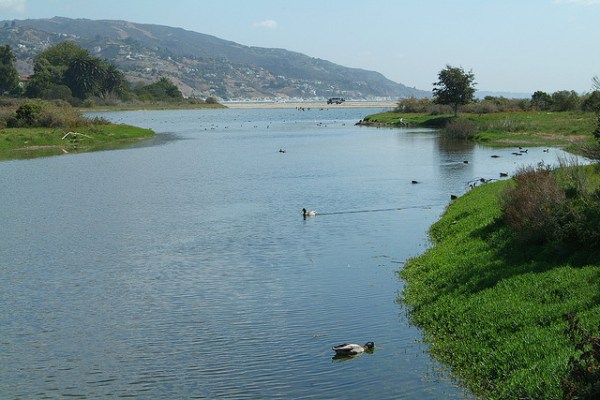
Malibu Lagoon
I’m sure you’ve all sent out your ‘Happy World Wetlands Day’ cards and booked your dinner reservations to celebrate… No? Only me? Well, today is in fact World Wetlands Day and the United States is signatory to the Ramsar Convention (named for the city in which the global wetlands conservation agreement was signed).
If you live in Los Angeles, you might have noticed we don’t have a lot of wetlands anymore; California has destroyed 90% of its to development, but locally on Santa Monica Bay we do have the Ballona Wetlands and the smaller Malibu lagoon. These sites are of vital importance to migrating shorebirds. Bird migration, the seasonal movement of birds from their breeding grounds to their wintering grounds, is one of the most spectacular, physically demanding, and mysterious wildlife events. Wetlands are one of the only places these birds can stop and refuel on their epic journeys.
For the second year, Santa Monica Bay Audubon has participated in the Point Blue Pacific Flyway Shorebird Survey and Migratory Shorebird Project at Malibu Lagoon to track and monitor birds stopping at our local wetlands. Check out these links:
http://www.migratoryshorebirdproject.org/index.php?page=home-en
http://data.prbo.org/apps/pfss/index.php?page=maps
Here are some record-setters that make migrations and wetland stops so amazing according to a National Audubon list:
■ THE LARGEST CONGREGATION O SHOREBIRDS Over one million shorebirds, mostly Western Sandpipers and Dunlins have been recorded in a single spring day on Alaska’s Copper River Delta. In fact, practically the entire North American population of Western Sandpipers stops thereto rest and refuel on a diet that consists almost entirely of tiny clams.
■ THE LONGEST NONSTOP FLYER Bar-tailed Godwits make the longest nonstop migration of any shorebird species traveling 6500 miles from Alaska to New Zealand, one way, without stopping.
■ THE FARTHEST TRAVELER Pectoral Sandpipers make the longest migratory flights of all birds They winter in southern South America but breed as far North as Central Siberia.
■ THE FASTEST FLYERS When migrating with good tail winds, shorebirds can fly up to 60 miles per hour.
■ TIMED TO DINE Eighty-percent of Red Knots in the Western Hemisphere time their arrival at the Delaware Bay, from the southern tip of Argentina, just in time to dine on millions of horseshoe crab eggs. The eggs have been stirred up to the beach surface by tides and the masses of egg-laying horseshoe crabs.
■ RAVENOUS EATERS In order to gain enough weight to continue their migration to the Arctic, Sanderlings eat one horseshoe crab egg every 5 seconds for 14 hours each day until they have rested and fed enough to continue migrating.
Our Favorite Bird Has Its Own Conference
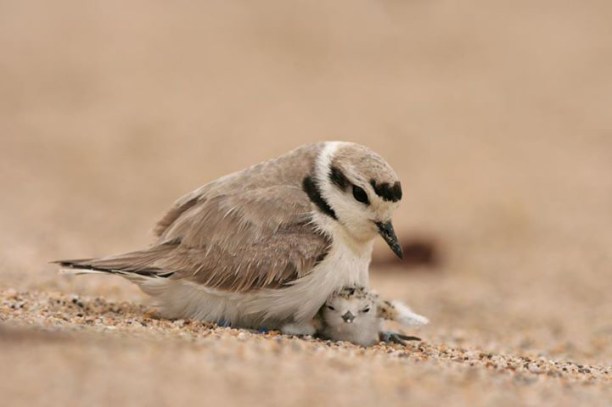
In addition to armed take-overs of bird refuges, copious amounts of rain, and new brew pubs still opening up, Oregon was host this year to the annual Range Wide Western Snowy Plover Conference, in Portland. This conference takes place annually in one of the six regions along the eastern Pacific where Snowy Plovers call home. It is attended by biologists, and others involved in Snowy Plover recovery, monitoring and research. From Tijuana to Los Angeles is Region Six, and here in Region Six we have a goal each year of 500 breeding pairs of Snowy Plovers. The good news is we are very near that goal at 484, which is impressive considering the challenges in this locale that other more remote areas don’t face, such as millions of beach-visits by people (and sometimes, their dogs), rampant coastal development, and military bases on breeding sites. Los Angeles County, including all the plover habitats along our own stretch here on Santa Monica Bay, has a local goal of zero breeding pairs. That’s right, a big fact zero–and we are proudly meeting that goal every year because this area is very important. So why are the Snowy Plover roosting sites along Santa Monica Bay considered so important when they are home to no chicks or breeding pairs?
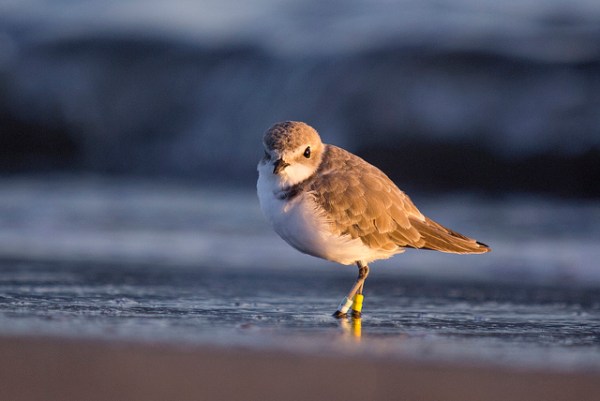 Because here on the bay, our sandy beaches provide important winter roosting sites. We don’t allow driving on our beaches as in many other areas up and down the coast. We generally don’t allow dogs. We don’t host vast influxes of people all at once on the beach for clamming season, and we have cooperative life guards who look our for the plovers and alert the public to their presence. Other ecological reason contribute to the importance of the bay as a winter roost as well, so although this area does not provide habitat to plover chicks, when they get a bit older, they will likely spend some time here in fall and winter when they need safe space to forage and rest.
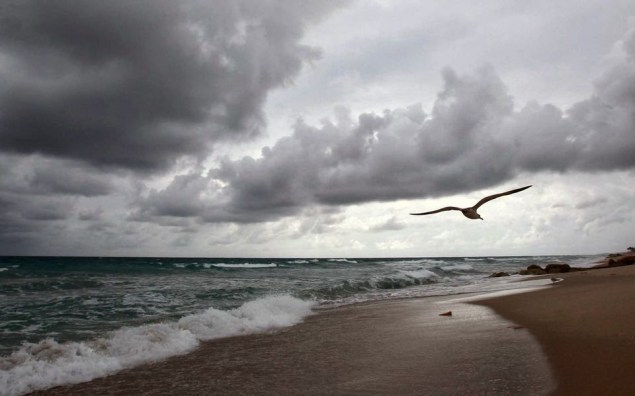
So when the temperature is in the sixties and the sky is grey or drizzly, grab your camera because it’s a great beach day–to see our wintering snowy plovers. You’ll usually find them at Zuma Beach, Malibu Lagoon, Santa Monica Beach near the Annenberg Beach House, Dockweiler Beach and Redondo Beach. To find out more:
https://losangelesaudubon.org/index.php/conservation-a-restoration-mainmenu-82/species-projects-mainmenu-105/threatened-snowy-plover-project-mainmenu-94
Credits: Jenny Erbes, top photo, text by Laurel Hoctor Jones
Malibu Die-off?
Occasionally at our monthly Malibu Lagoon walks, a birder brings us somewhat mystifying and somewhat unbelievable stories about birds. This morning, the story was mystifying but very believable since the bearer, a Malibu artist of note, also had pictures of her tale. It turns out that Dominique Sanders had gone down to Point Dume beach with her daughter but instead of tide pooling, had found dozens, if not hundreds of dead birds semi-submerged in, and stacked on the sand. And not small ones, either! (my note: these appear to be mostly Brandt’s Cormorants.)

Cormorant in sand. Copyright 2016 D. Sanders Pt. Dume 1/23/2016

Pallet of cormorants Copyright D. Sanders 2016 Pt. Dume 1/23/2016
She tells us that a friend of hers saw a number of dead birds on the same beach already last week. This beach is one of those State/County supervised beaches, however, apparently there has not been active patrolling of that spot in the past week.
Just so you don’t take this as a necropsy article, we have also included her excellent picture of two intergrade American/Black Oystercatchers, one of which is catching a…mussel.

Intergrade American/Black Oystercatchers Copyright D. Sanders Pt.Dume 1/23/2016
Field Trip Report Jan. 24, 2016 Malibu Lagoon
We welcomed at least 7 first-timers today to our “home” at Malibu Lagoon and even though the weather and very high tide did not make for large numbers of birds, there were some special sightings. We hope those first timers come back to see more birds next month.
Chris Lord’s Black-vented Shearwater was exceptional; usually these birds are at least a quarter-mile off the coast. A Merlin was repeatedly sighted, above the Adamson House as well as near the Malibu Colony tract. Late in the walk we spotted a Lincoln’s Sparrow at the Adamson lookout. Weather was brilliantly clear, with a light breeze. Temps started at 58 degrees F and ended at 70 by noon.

Horned Grebe, Winter plumage A. Douglas, Malibu Lagoon 1/24/16
49 species
Gadwall 3
American Wigeon 10
Mallard 15
Northern Shoveler 16
Northern Pintail 4
Green-winged Teal 8
Bufflehead 2
Red-breasted Merganser 3
Pied-billed Grebe 3
Horned Grebe 1
Eared Grebe 2
Black-vented Shearwater 1 Actually entered the lagoon, landed near a large gull flock then took off towards ocean. Chris Lord’s sighting.
Brandt’s Cormorant 1
Double-crested Cormorant 24
Pelagic Cormorant 2
Brown Pelican 30
Great Blue Heron 3
Great Egret 2
Snowy Egret 21
Osprey 1
American Coot 40
Black-bellied Plover 12
Snowy Plover 12
Killdeer 2
Willet 8
Whimbrel 3
Marbled Godwit 13
Heermann’s Gull 4
Ring-billed Gull 30
Western Gull 13
California Gull 400
Royal Tern 25
Rock Pigeon (Feral Pigeon) 2
Mourning Dove 2
Anna’s Hummingbird 1
Allen’s Hummingbird 3
Merlin 1
Black Phoebe 3
Say’s Phoebe 1
American Crow 6
House Wren 1
Northern Mockingbird 1
European Starling 110
Common Yellowthroat 1
White-crowned Sparrow 20
Song Sparrow 3
Lincoln’s Sparrow 1
Great-tailed Grackle 2
House Finch 1
Full Wolf Moon Update – January 23, 2016, 5:45 p.m. PST
Here’s another update from SMBAS Blog on that large, disc-like, shining object which has frequently and mysteriously appeared in our nighttime sky this year (known to many as the moon).

Wolf Moon (Paul Lungren – calendar.perfectduluthday.com)
Jan. 23, 5:45 p.m. PST — Full Wolf Moon. Amid the zero cold and deep snows of midwinter, the wolf packs howled hungrily outside Indian villages. January’s full moon was also known as the Old Moon or the Moon after Yule. In some tribes, this was the Full Snow Moon, but most applied that name to next month’s moon. The moon’s monthly perigee – its closest point to Earth – is on the 14th at 6:11 p.m. PST. [Infographic: Moon Phases & Lunar Cycles]
The Old Farmer’s Almanac has a page for each full moon. Here’s some advice on when to set your eggs.
The next significant full moon will occur on February 22, 10:19 a.m. PST. Keep an eye on this spot for additional late-breaking news on this unprecedented event.
This information comes to you courtesy of: http://www.space.com/24262-weird-full-moon-names-2014-explained.html written by Joe Rao. Joe Rao serves as an instructor and guest lecturer at New York’s Hayden Planetarium. He writes about astronomy for Natural History magazine, the Farmer’s Almanac and other publications, and he is also an on-camera meteorologist for News 12 Westchester, N.Y.
But that’s waaay too long to type in, and besides, you don’t need to go there because SMBAS has done the work for you!
[Chuck Almdale]



 SANTA MONICA BAY AUDUBON SOCIETY BLOG