Free email delivery
Please sign up for email delivery in the subscription area to the right.
No salesman will call, at least not from us. Maybe from someone else.
Maja Block – A Fond Farewell
With a sad heart, we must report the death of one of our earliest members, Maja Block.
The following is a letter from her son Kevin, to all of Maja’s friends and fellow birders.
She will be dearly missed. [Lillian and Mary]
****************************
March 1, 2015
Dear Friends, family and loved ones:
It is with great sadness that I am letting you know of the passing of our amazing mother.

Maya, Mark and Kevin
My mother passed peacefully as the sun was just rising on the horizon on the morning of Wednesday, February 18. My sister and I were with her, throughout the night, holding her hands and she knew she was loved and not alone as she made her transition.
The last few years had been difficult for her as she could no longer do many of the things that she loved to do like hike, watch birds and visit with her many dear friends across the United States and the world. If you are receiving this letter, it is because you knew her and knew what an extraordinary woman she was. Political activist, survivor, naturalist, gardener and cook, singer and dancer, poet and artist, adventurer and intrepid explorer. She was independent, kind, warm and funny. To be her friend was to know that you were loved and cared for in the most thoughtful way. She loved to sing and cook and share her fruit from her garden with her friends. She loved a good laugh and was always up for an adventure. She taught me to have a deep and abiding reverence for this beautiful world.
To be her son was a gift and a privilege, as she was always, always there for me during the hard times and I was lucky enough to be able to return the favor with the help of my partner, Mark Gregg who took such good care of her and whom she considered to be her other son. In 2012 my sister and her husband joined us here on Maui, so my mother had her kids near her, which was a source of comfort to her.
My mother was practical about life and ultimately about death. She did not want to be fussed over so we ask that you remember her in your own special way, as you hike in the mountains, see a hawk spiraling lazily upward, see a particularly beautiful sunrise or have a bracing German beer with some weiswurst.
Memorial Gifts and Memorial:
Those who wish to memorialize her with a gift are asked to send a donation to the Santa Monica Bay Audubon Society in her name:
SMBAS
PO Box 35
Pacific Palisades, CA 90272
My mother had a rich, complicated, deep and fascinating life and it would take volumes to just begin to scratch the surface of her story. The extraordinary journey of her life began in Southern Germany in the town of Heidelberg and then later, in her teenage years, in Munich. She survived the bombings of the war and the famine that followed and has many wonderful stories of hiking in the Alps, teaching kindergarten and the closeness that her sister and her parents shared as they helped each other to survive this difficult time.

Maya
My mother came to the U.S. in 1952 and went to Berkeley and became a nurse, which she always described as a “calling” rather than a profession. She was married to my dad for fifteen years and my sister and I came into the picture in 1964 and 1965. She was a tireless, supportive, caring, and ferociously committed mom. My sister and I are well aware of how lucky we are to have had her as a role model. My mother served honorably as a school nurse and was a dedicated, hard worker. Her work ethic was a source of awe for those of us who tried to keep up with her. Later in her life, her love of nature blossomed. She particularly loved birds and loved traveling the world in search of new species. She went to Africa, all over the United States and spent her 70th birthday in Antarctica where she had a spiritual experience, alone on the deck of the ship with a passing iceberg.
Even though she traveled the world, my mother felt most at home in her comfortable, small house in LA with its beautiful garden and shockingly prodigious persimmons tree. It was there that she was truly in her element, taking care of my dog Alex, working on her tomatoes and roses and baking for her friends. And singing. Always singing.

Maja & Kevin birding
In 2009, my mother had aortic valve replacement surgery and suffered a stroke that paralyzed her on the left side. She never was able to walk again. My partner and my sister and I and our many friends here on Maui gave her a quiet and quality life and she enjoyed being with us and our animals. Despite her sadness about the failing of her body, my mother remained gentle and kind and sweet and gracious. She was also stubborn and opinionated and strong willed, but we loved that about her too. I can confidently say that all the best parts of me come from my mother.
We all have such wonderful memories of my mother and I urge you to reflect on her special way of living in the world. Her life was a hard one but you would never have known it from her graceful and gentle nature. Take a moment to think how you can incorporate her love of nature, her laughter and her joy into your day and know that each of you were special to her – her beloved friends and family.
I once asked my mom what she thought happens when you die and she told me that she imagined herself flying over the frozen mountains of some northern landscape, with icy fields and pine forests below, the snow glistening in the moonlight. She flies now effortlessly, no longer in pain and free at last.

Maja’s famous photo of a leucistic Anna’s Hummingbird
(Kern County Park near Pine Mtn. Club)
Malibu Lagoon Trip Report: 22 February, 2015
Here upon a Sunday dreary, birders gathered, bleak and bleary,
Sullen visages we, fearing that the rain would pour —
Is that a truck? No, merely thunder. Might the heavens break asunder?
From the rear then someone wondered, “Afore we venture on yon
Malibu’s near-halcyon* shore…might there be a coffee store?”
“Merely Starbucks, nothing more.”
* Halcyon: Genus of eleven old world species of kingfishers found from Japan to South Africa, including Gray-headed Kingfisher, featured in our upcoming Uganda show.
Also: (Greek) A mythical bird, long associated with the kingfisher, which nested on the sea. Beloved of the gods, they calmed the waves while it incubated and raised its young. Such days of peace and calm became known as “halcyon days.” – A Dictionary of Scientific Bird Names, Jobling.

Northern Shoveler pair (R.Ehler 2/22/15)
Grim forebodings notwithstanding, it was actually a nice morning with the smallest amount of rain possible for it to still be considered rain, not fog or mist. Fear of rain kept people home, apparently, and we had a smaller group of about 20 birders including some first-timers, friends of regular attendees.
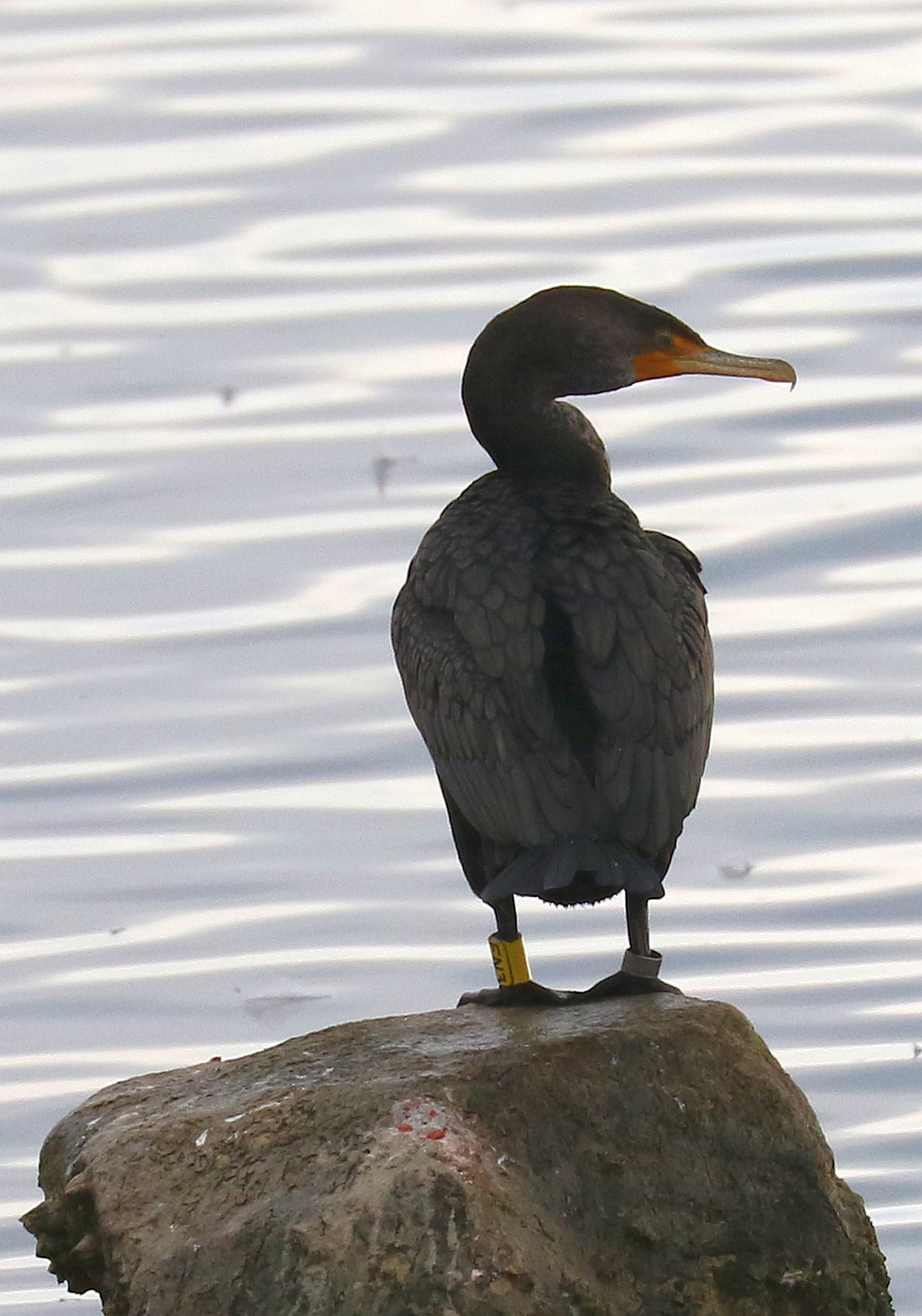
Double-crested Cormorant with rings on legs
(R.Ehler 2/22/15)
A Double-crested Cormorant on the rocks just south of the PCH bridge had rings on its legs. Right leg ring was of dull metal, left leg ring was bright yellow with EN3 on it. We had to scope it from far to the side in order to confirm the code: the picture doesn’t quite capture the letters. One (or more) birders thought that perhaps it had become oiled and captured for cleaning, with the rings placed before release. If so, the bird looked well.
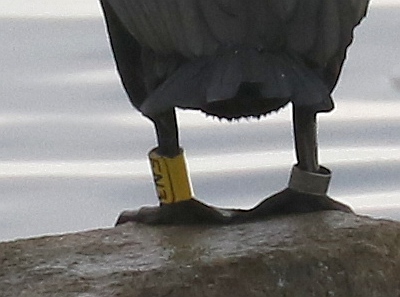
Closeup of rings EN3 on left leg of DC Cormorant (R.Ehler 2/22/15)
Long-billed Curlews are infrequent visitors at the lagoon, and we’ve recorded them only 17 times in 35 years. They prefer seeking invertebrates in grassy fields or on mudflats sufficiently soft to permit their shoving their long bills deeply in. I can’t remember a time when the lagoon was suitable for that. As a result, this species may rest briefly at the lagoon, but they don’t stay long. On the other hand, the smaller and similar Whimbrel is a regular winter resident in small numbers, with 244 appearances of one or more birds over the same 35 years.

Long-billed Curlew (R.Ehler 2/22/15)
Snowy Plovers were mysteriously absent, no explanation given. Neither were there any Sanderlings. Both species are normally present in February.

Gull flock with Malibu Canyon and PCH bridge in background
(R.Ehler 2/22/15)
We had plenty of time to search the several large flocks of gulls. Only one Heermann’s Gull was found; the rest may have left for their breeding grounds on islands near the south tip of Baja California, where really hot weather necessitates an early breeding season. Most were California Gulls, with about 5% each of Western and Ring-billed Gulls. Four Glaucous-winged Gulls were found, one of which was an adult bird in breeding (alternate) plumage, which we rarely see at the lagoon. Glaucous-wings breed in southwestern Alaska from Anchorage to Nome, and winter regularly to Portland, OR. They winter in small numbers in SoCal, but most are first-winter birds. This particular individual was a beautiful gull and it was nice to see it. Royal Tern numbers continued to grow as the morning wore on, and some of them were already in alternate plumage. The Elegant Terns are still off on their winter break, but they’ll probably be back next month.

Male Northern Pintail, no longer common at the lagoon (R.Ehler 2/22/15)
Some very nicely plumaged ducks tooled around the lagoon and channel (see pictures). Overhead the Osprey regularly glided by, but I never saw him catch a fish despite the presence of large and eminently desirable “jumping” mullet in the lagoon.
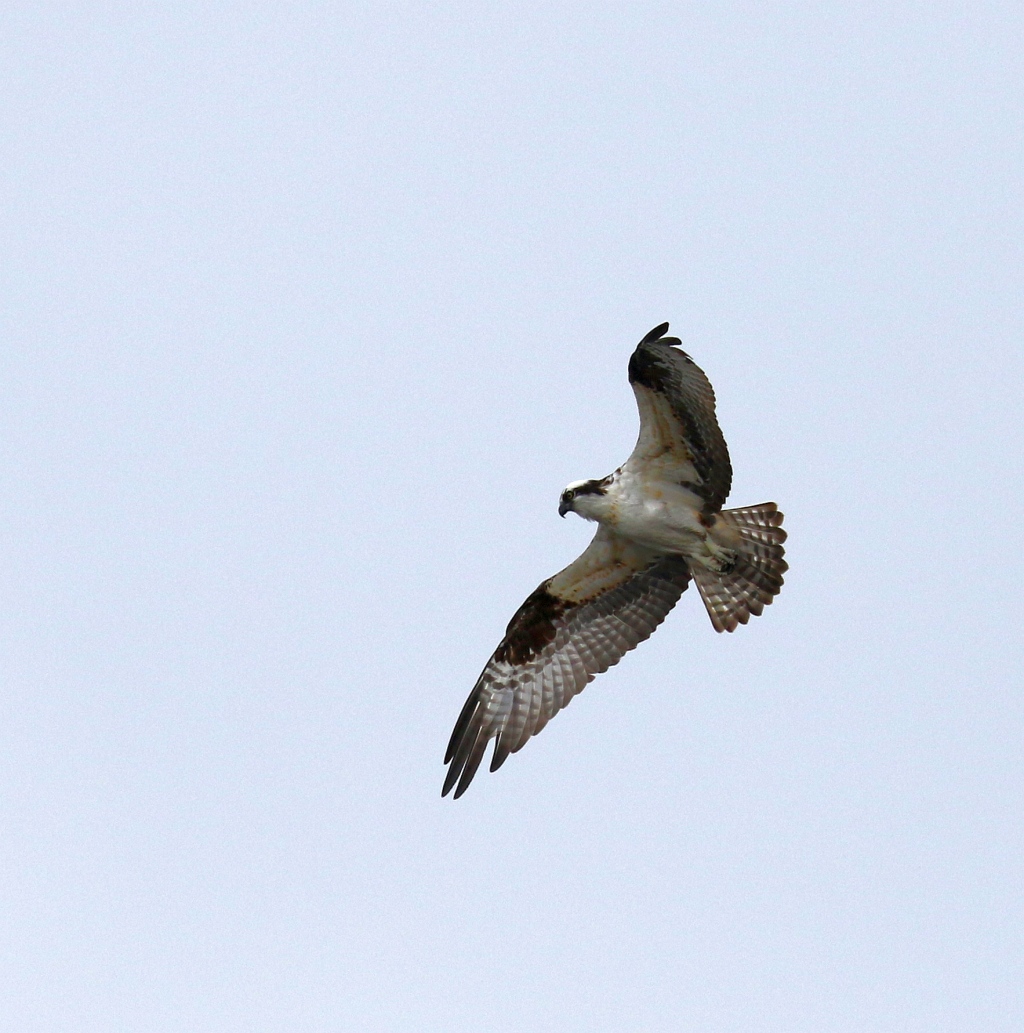
Osprey (R.Ehler 2/22/15)
Many thanks to Randy Ehler who contributed all of the photos today. Randy’s many photos have graced and vastly improved the appearance and interest of our reports, beginning with his contribution in October, 2013 of nine photos.
Birds new for the season were: Long-billed Curlew, Common Raven, Hermit Thrush, California Towhee. We don’t consistently get over to Adamson House during the winter when the lagoon outlet cuts through the beach, which may be why birds that are always around like Anna’s Hummingbird and House Finch have been missed.
Our next three scheduled field trips: Hiker Lu’s Santa Monica Explorama, 14 Mar, 8:30m; Malibu Lagoon, 22 Mar, 8:30 & 10am; Wilson, O’Melvany or Walker Ranch, 11 Apr, 8:30am.
Our next program: Tuesday, 3 Mar, 7:30 pm. Birds, Primates and other Animals of Uganda, presented by Edie Gralle. PLEASE NOTE THAT OUR MEETING PLACE HAS CHANGED TO DOUGLAS PARK, 2439 WILSHIRE BLVD.
NOTE: Our 10 a.m. Parent’s & Kids Birdwalk meets at the shaded viewing area. Watch for Willie the Weasel.
Links: Unusual birds at Malibu Lagoon
Aerial photo of Malibu Lagoon from 9/23/02.
Prior checklists:
2014: Jan-July, July-Dec
2013: Jan-June, July-Dec
2012: Jan-June, July-Dec
2011: Jan-June, July-Dec
2010: Jan-June, July-Dec
2009: Jan-June, July-Dec
The 10-year comparison summaries created during the project period remain available on our Lagoon Project Bird Census Page. Very briefly summarized, the results unexpectedly indicate that avian species diversification and numbers improved slightly during the period Jun’12-June’14. [Chuck Almdale]
| Trip List 2014-15 | 9/28 | 10/26 | 11/23 | 12/28 | 1/25 | 2/22 |
| Temperature | 68-75 | 62-72 | 60-70 | 39-61 | 73-81 | 55-63 |
| Tide Lo/Hi Height | H+5.35 | H+5.93 | H+6.41 | L+1.70 | L+1.32 | H+4.51 |
| Tide Time | 1149 | 1044 | 0849 | 0903 | 0705 | 1137 |
| Gadwall | 3 | 26 | 22 | 30 | ||
| American Wigeon | 10 | 18 | 18 | |||
| Mallard | 23 | 3 | 2 | 10 | 12 | 12 |
| Northern Shoveler | 4 | 25 | ||||
| Northern Pintail | 2 | 3 | ||||
| Green-winged Teal | 1 | 12 | 25 | 12 | ||
| Surf Scoter | 13 | 15 | ||||
| Bufflehead | 8 | 4 | 2 | |||
| Hooded Merganser | 4 | |||||
| Red-brstd Merganser | 25 | 25 | 4 | 2 | ||
| Ruddy Duck | 2 | 36 | 42 | 38 | 35 | |
| Red-throated Loon | 3 | 1 | ||||
| Pacific Loon | 6 | 1 | 3 | |||
| Common Loon | 1 | 1 | ||||
| Pied-billed Grebe | 11 | 3 | 1 | 8 | 2 | 1 |
| Horned Grebe | 2 | 2 | 4 | 2 | 1 | |
| Eared Grebe | 6 | 18 | 8 | 12 | 3 | |
| Western Grebe | 6 | 12 | 2 | 5 | 15 | |
| Brandt’s Cormorant | 1 | 2 | 130 | 1 | ||
| Dble-crstd Cormorant | 45 | 26 | 9 | 120 | 35 | 50 |
| Pelagic Cormorant | 3 | 1 | 1 | 1 | ||
| Brown Pelican | 42 | 26 | 32 | 95 | 50 | 28 |
| Great Blue Heron | 1 | 2 | 4 | 3 | 2 | 2 |
| Great Egret | 3 | 4 | 4 | 4 | 2 | |
| Snowy Egret | 15 | 20 | 20 | 18 | 16 | 26 |
| Blk-crwnd N-Heron | 1 | |||||
| Turkey Vulture | 1 | |||||
| Osprey | 1 | 1 | 1 | 1 | 1 | |
| White-tailed Kite | 1 | |||||
| Sharp-shinned Hawk | 1 | |||||
| Cooper’s Hawk | 1 | |||||
| Red-shouldered Hawk | 1 | 1 | 1 | |||
| Red-tailed Hawk | 3 | 1 | 1 | 1 | ||
| American Coot | 85 | 20 | 100 | 135 | 88 | 145 |
| American Avocet | 1 | |||||
| Blk-bellied Plover | 95 | 40 | 45 | 38 | 62 | 85 |
| Snowy Plover | 40 | 34 | 40 | 25 | 29 | |
| Killdeer | 18 | 1 | 1 | 17 | 12 | 12 |
| Spotted Sandpiper | 5 | 4 | 2 | 6 | 3 | 3 |
| Greater Yellowlegs | 1 | |||||
| Willet | 45 | 6 | 4 | 10 | 4 | 3 |
| Whimbrel | 9 | 1 | 1 | 1 | 4 | 4 |
| Long-billed Curlew | 1 | |||||
| Marbled Godwit | 4 | 5 | 3 | 12 | 12 | 10 |
| Ruddy Turnstone | 12 | 4 | 6 | 6 | 5 | |
| Sanderling | 10 | 32 | 32 | 28 | 8 | |
| Least Sandpiper | 2 | 1 | ||||
| Boneparte’s Gull | 2 | 2 | 1 | |||
| Heermann’s Gull | 4 | 5 | 1 | 18 | 17 | 1 |
| Ring-billed Gull | 3 | 60 | 65 | 150 | 90 | |
| Western Gull | 95 | 40 | 81 | 230 | 170 | 95 |
| California Gull | 1500 | 1650 | 1600 | |||
| Herring Gull | 1 | |||||
| Glaucous-wingd Gull | 3 | 5 | 4 | |||
| Forster’s Tern | 2 | 3 | ||||
| Royal Tern | 8 | 22 | 42 | 35 | ||
| Elegant Tern | 18 | 17 | 4 | |||
| Rock Pigeon | 15 | 6 | 6 | 4 | 5 | |
| Mourning Dove | 3 | 2 | ||||
| Vaux’s Swift | 3 | |||||
| Anna’s Hummingbird | 1 | 1 | ||||
| Allen’s Hummingbird | 6 | 3 | 4 | 2 | 3 | |
| Belted Kingfisher | 1 | |||||
| Nuttall’s Woodpecker | 1 | |||||
| American Kestrel | 1 | 1 | 1 | |||
| Peregrine Falcon | 1 | |||||
| Yel-chevroned Parakeet | 2 | |||||
| Willow Flycatcher | 1 | |||||
| Pac.Slope Flycatcher | 1 | |||||
| Black Phoebe | 12 | 2 | 1 | 2 | 1 | 2 |
| Say’s Phoebe | 3 | 2 | 2 | 1 | ||
| Cassin’s Kingbird | 1 | |||||
| Warbling Vireo | 2 | |||||
| Western Scrub-Jay | 1 | |||||
| American Crow | 6 | 7 | 8 | 4 | 6 | |
| Common Raven | 2 | |||||
| Rough-wingd Swallow | 3 | |||||
| Barn Swallow | 1 | |||||
| Cliff Swallow | 3 | |||||
| Oak Titmouse | 1 | 1 | ||||
| House Wren | 1 | |||||
| Blue-gray Gnatcatcher | 1 | |||||
| Ruby-crowned Kinglet | 1 | 2 | ||||
| Hermit Thrush | 2 | |||||
| Northern Mockingbird | 3 | 2 | 2 | 1 | 1 | |
| European Starling | 115 | 60 | 60 | 25 | 45 | 3 |
| Cedar Waxwing | 2 | |||||
| Ornge-crwnd Warbler | 3 | |||||
| Nashville Warbler | 2 | |||||
| Common Yellowthroat | 9 | 4 | 2 | 4 | 3 | 3 |
| Yellow Warbler | 3 | 1 | ||||
| Yellow-rumpd Warbler | 40 | 2 | 15 | 7 | 8 | |
| Townsend’s Warbler | 1 | |||||
| Spotted Towhee | 1 | |||||
| California Towhee | 4 | 1 | 1 | |||
| Savannah Sparrow | 3 | |||||
| Song Sparrow | 7 | 2 | 3 | 2 | 6 | |
| White-crwnd Sparrow | 15 | 15 | 35 | 4 | 12 | |
| Bobolink | 1 | |||||
| Western Meadowlark | 6 | 6 | 7 | 14 | 24 | 10 |
| Great-tailed Grackle | 1 | 3 | 1 | 5 | 4 | |
| House Finch | 22 | 4 | ||||
| Lesser Goldfinch | 15 | 3 | 1 | 2 | ||
| Totals by Type | Sep | Oct | Nov | Dec | Jan | Feb |
| Waterfowl | 26 | 5 | 64 | 141 | 138 | 154 |
| Water Birds – Other | 193 | 102 | 166 | 516 | 187 | 247 |
| Herons, Egrets & Ibis | 20 | 26 | 28 | 25 | 18 | 30 |
| Quail & Raptors | 7 | 4 | 2 | 5 | 2 | 2 |
| Shorebirds | 240 | 127 | 135 | 144 | 139 | 119 |
| Gulls & Terns | 128 | 66 | 151 | 1839 | 2035 | 1825 |
| Doves | 15 | 6 | 0 | 6 | 7 | 7 |
| Other Non-Passerines | 13 | 3 | 1 | 4 | 3 | 3 |
| Passerines | 242 | 150 | 76 | 114 | 106 | 61 |
| Totals Birds | 884 | 489 | 623 | 2794 | 2635 | 2448 |
| Total Species | Sep | Oct | Nov | Dec | Jan | Feb |
| Waterfowl | 2 | 2 | 4 | 9 | 9 | 10 |
| Water Birds – Other | 7 | 8 | 8 | 11 | 9 | 11 |
| Herons, Egrets & Ibis | 4 | 3 | 3 | 3 | 2 | 3 |
| Quail & Raptors | 5 | 4 | 2 | 5 | 2 | 2 |
| Shorebirds | 10 | 9 | 10 | 10 | 9 | 8 |
| Gulls & Terns | 5 | 5 | 6 | 7 | 7 | 6 |
| Doves | 1 | 1 | 0 | 1 | 2 | 2 |
| Other Non-Passerines | 5 | 1 | 1 | 1 | 2 | 1 |
| Passerines | 27 | 15 | 8 | 12 | 16 | 14 |
| Totals Species – 103 | 66 | 48 | 42 | 59 | 58 | 57 |
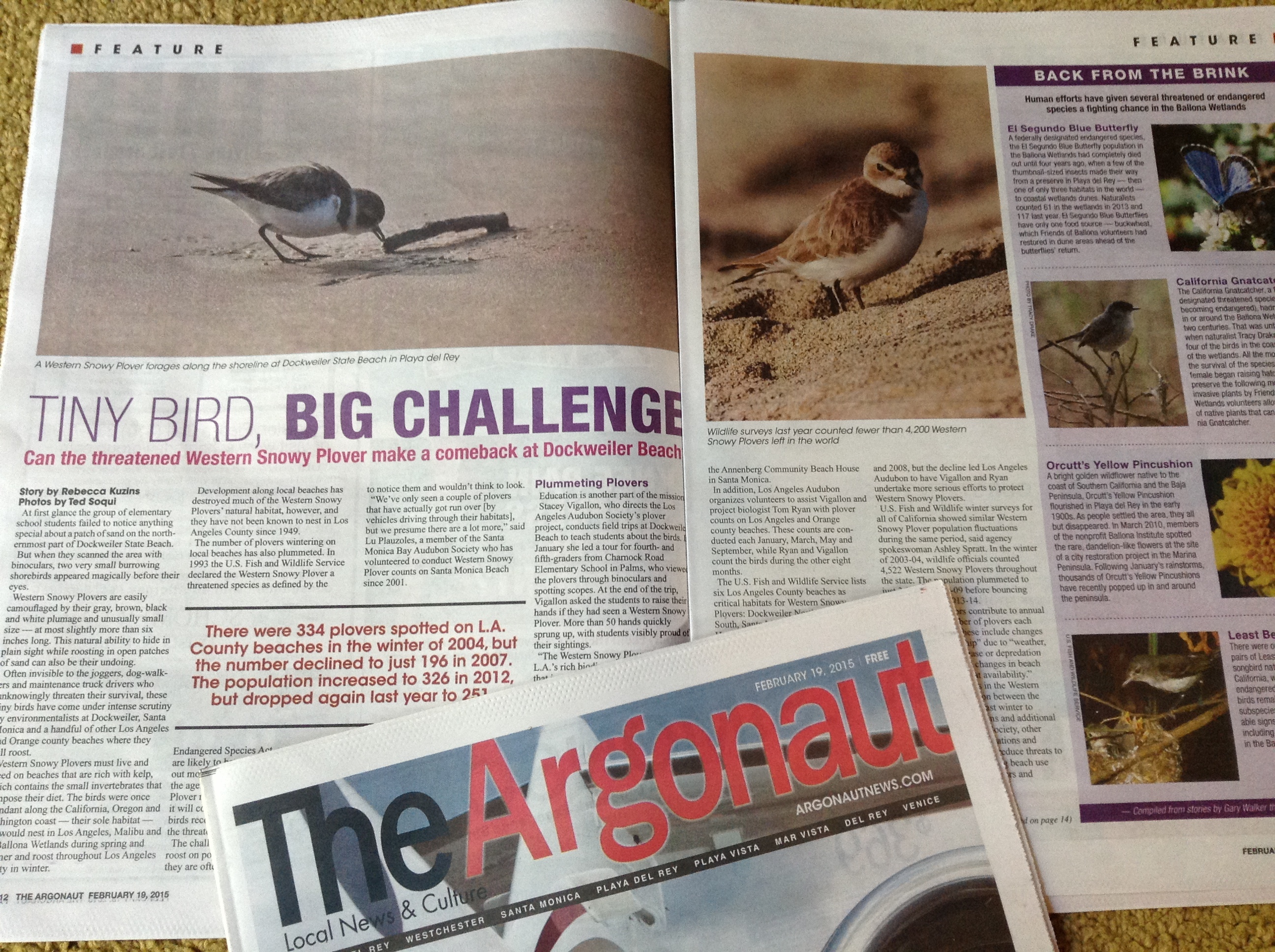
Hot off the (real) Press!
An extensive, carefully-written article about our Western Snowy Plovers, is featured on the front page and covering most of three pages of today’s Argonaut newspaper. Thank you Rebecca Kuzins, a frequent participant in our monthly Malibu Lagoon walks.
On the web you can find the article at http://argonautnews.com/tiny-bird-big-challenge/
LucienP
King Tides On The Bay
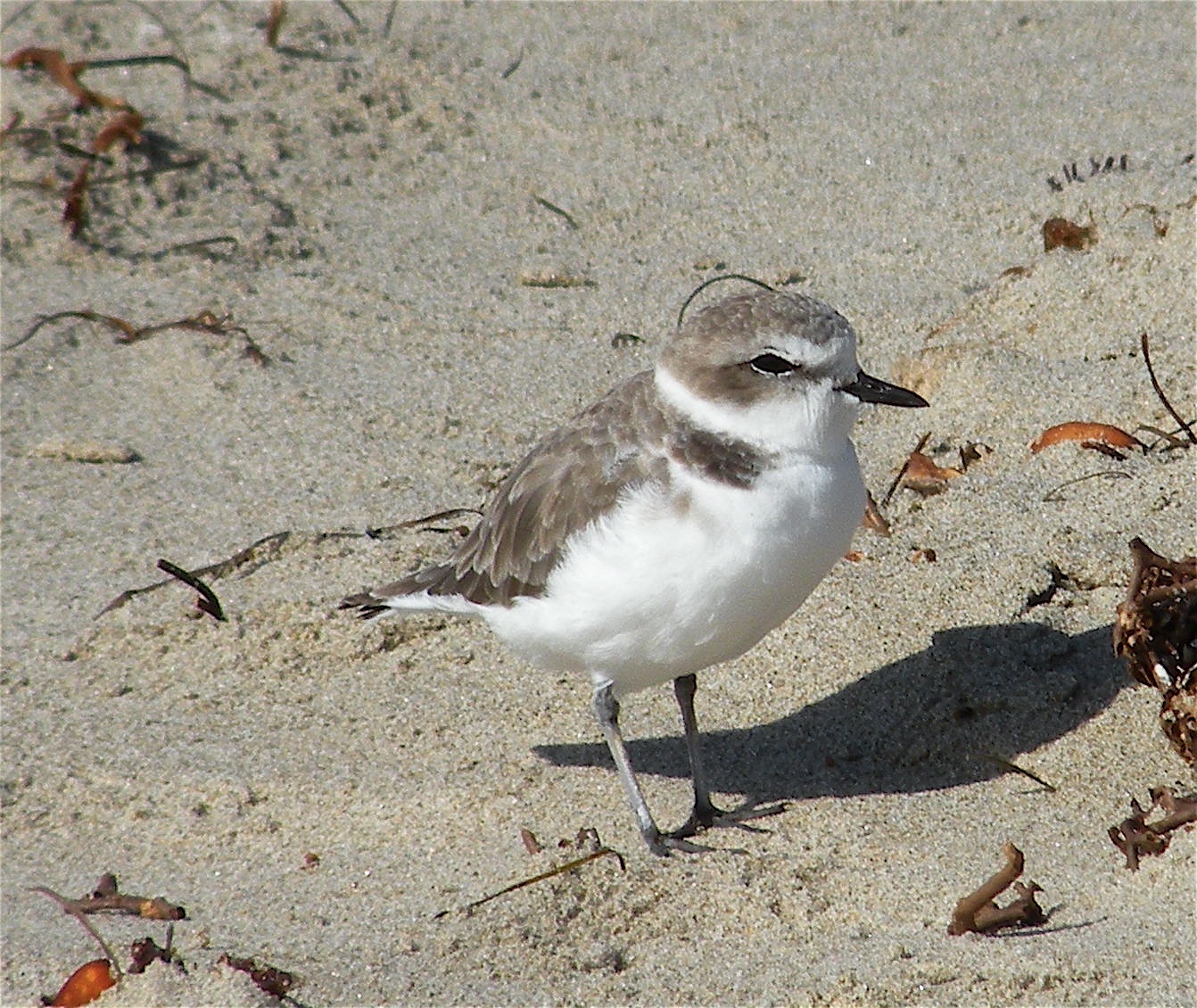
On Santa Monica Bay, local avian stars such as snowy plovers and terns are going to be among the first to lose nesting, foraging and roosting habitat with rising sea levels, especially in places like Venice Beach and Malibu Lagoon.But there’s something simple you dan do.
Help document the impact of riding tides
Just snap a pic on your cell and forward it to the link below if you are going to be out on any beach in the next few days near high tide.
http://california.kingtides.net
Over time, a photographic database of the impact of rising tides will help determine what steps to take to mitigate lose of shoreline.
Laurel Hoctor Jones, Education Chair
Salton Sea Area Trip Report: 7-8 February, 2015
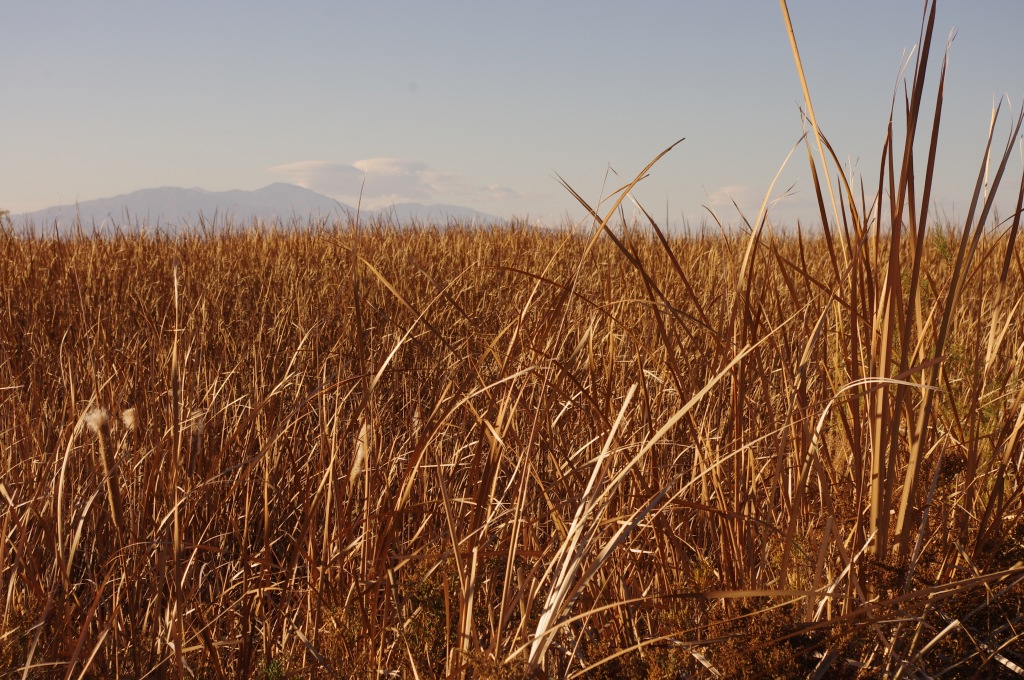
Reeds and mountains (D. Roberts 2/8/15)
It was a great trip. The weather was near-perfect – no one would have complained if it were 5° lower – and no rain to turn the caliche roads to mud and tires into slicks. Our radios worked, no cases of food poisoning or scorpion stings, no one was seriously late, and many state, USA or life birds were found. Zone-tailed Hawk, Crested Caracara and Crissal Thrasher were the only notable misses. It’s best to look for Crissal very early in the morning, difficult to do when you cannot be simultaneously everywhere.

The Davis Rd. salt works and/or salt bath spa (D. Roberts 2/8/15)
My general impression of the birdlife of the south end of the Salton Sea (SESS) is that overall numbers declined since 2012, but diversity is holding steady, or even up a little. We still had large numbers of certain species: Snow & Ross’s Geese, Northern Shoveler, Northern Pintail, Cattle Egret, White-faced Ibis, Ring-billed Gull and California Gull. Although our “counts” are extremely rough approximations, even these species seemed somewhat fewer. Other species definitely seemed reduced in numbers, for example: American White Pelican, Black-necked Stilt, Common Raven, and Red-winged Blackbird. Then again, most of those species are found in flocks – miss one flock and you miss most of that species. Perhaps such variances mean nothing at all.
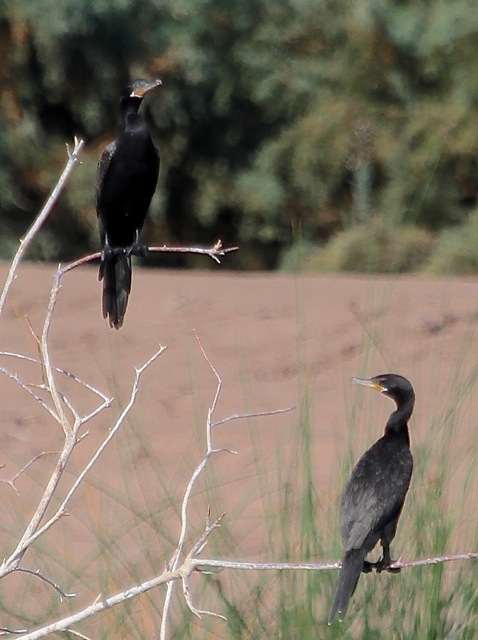
Neotropic Cormorants – Note white border to gular pouch (J. Waterman 2/7/15)
We checked out two new areas. A few miles east of Brawley is the New River Wetlands Project, with scrub surrounding a pond about 100m X 300m. A large flock of Great Egrets roosted in some nearby trees. The Crested Caracara reported to be in the vicinity did not appear; later we learned it prefers late afternoon. While Marsh Wrens madly burbled in the reeds, we studied cormorants roosting on water-snags, trying to figure out which – if any – was a Neotropic. After much scratching of heads, Joyce cleverly noted that several had a varying amount of narrow white border to their orange gular pouches, a field mark I had forgotten. [Neotropic Cormorants are casual visitors to SE Calif; I last saw one here in 1986.]
We found some of our target birds at the Wister Unit parking lot: Gambel’s Quail, Verdin, Abert’s Towhee and the only Inca Doves of the trip. An immense amount of brush as well as the nature trail is gone from the west side of Davis Rd. for reasons we couldn’t guess, leaving a barren moonscape. A stop at the old salt works spa produced our first Burrowing Owl sitting on a concrete box-like affair, while a short distance away we found a large mixed flock of Rough-winged, Tree, Barn and Cliff Swallows resting on overhead wires and poking about in a muddy field. Many of the Tree Swallows were blindingly iridescent blue.

Burrowing Owl at his burrow (J. Waterman 2/7/15)
The Roseate Spoonbill, a major target bird for California, proved to be at the end of Garst Rd. as reported, albeit at a vast distance, tiny even in our best scopes. Its off-white, very pale pink plumage was spotted by David, I don’t know how. I suspect that some of our 16 birders – even after many minutes of viewing – remained unconvinced. I was fortunate to see it crane its neck, giving me a glimpse of its large gray spoonish bill.
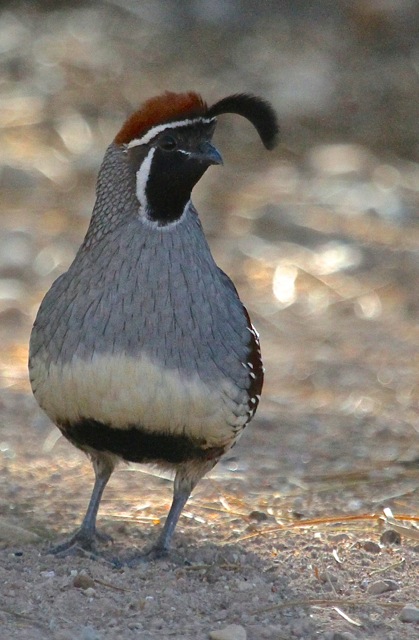
Gambel’s Quail (J. Waterman 2/7/15)
The Salton Sea Park HQ at the west end of Sinclair Rd. is a great place for lunch. Bathrooms, shaded picnic tables, water, and viewing platforms to check out the geese, many of which are real – not cutout figures, pivoting on poles in the breeze. Several seed feeders bring birds in close, particular Abert’s Towhees, Gambel’s Quail and various doves. Verdin build their globular nests in the mesquite trees. I bumped into birding compatriot Roy Poucher who kindly mentioned that a Yellow-footed Gull was out on the sea-edge, within walking distance, and after lunch we make the trek.
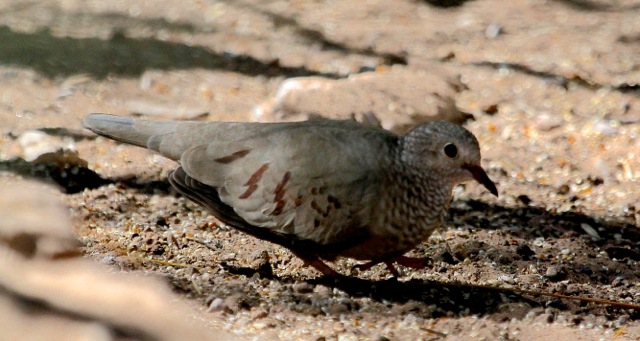
Common Ground Dove – note scaly breast & brown-spotted wings
(J. Waterman 2/7/15)
As usual with rare gulls, they’re buried amongst thousands of similar gulls. David and I scoped the shoreline, starting from opposite ends of a long line of gulls disappearing into the distance in both directions, almost all Ring-bills with a few scattered Herring. Much to my surprise, I found it not far away, its large size and dark gray back obvious – well, sort of obvious– among hordes of lighter gulls. But it was lying down. So we all watched, wishing it would rise.

The Yellow-footed Gull stands among lesser mortals (J. Waterman 2/7/15)
It wouldn’t move, so we clambered down the stone embankment, the gulls beconing restive as we reached the edge of their comfort zone. Our target gull stood up, we all admired its bright yellow legs and congratulated ourselves on our good fortune, and left.
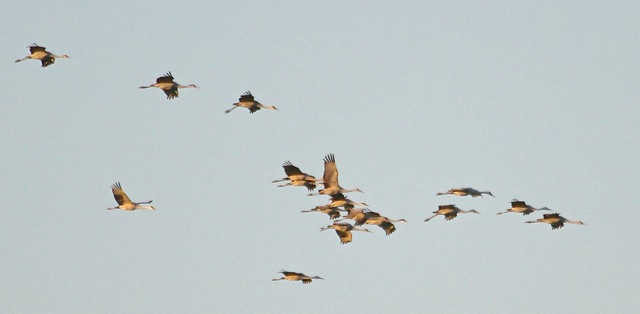
Sandhill Cranes (J. Waterman 2/7/15)
At Unit One – the Sonny Bono unit at the SW corner of the sea – we found a single White-fronted Goose within a large flock of Snow and Ross’s Geese, with Sandhill Cranes field-gleaning in the distance. Sundown approached. We made it back to Keystone Rd. SE of Brawley by 4:30, with plenty of time to watch Cattle Egrets and White Pelicans soar past enroute to the sea, gulls and ducks and White-faced Ibis splash down in the embanked pond nearby, and especially for the ululating of the Sandhill Cranes as they spiraled down to the water. It was, as always, a magical moment.
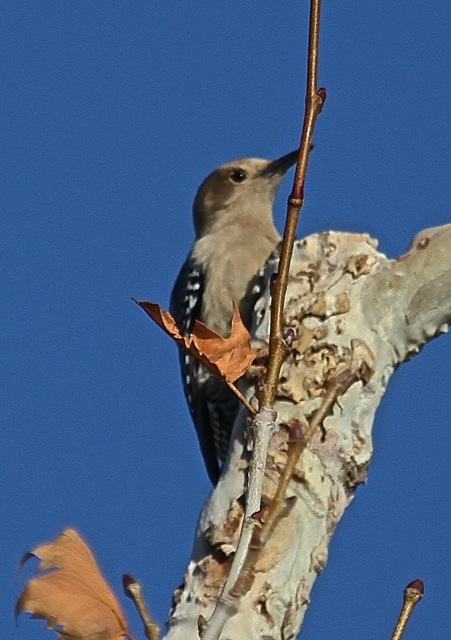
Gila Woodpecker (J. Waterman 2/7/15)
Sunday morning began with a drive through the tree-filled SW Brawley residential neighborhood, which yielded our first pair of Gila (Hee-laa) Woodpeckers. Cattle Call Park had more, plus Cedar Waxwings and other small birds. No Zone-tailed Hawks appeared. We checked out another new area, known locally as Carter & Fites, a small undeveloped brushy forest, mostly mesquite, where Crissal Thrashers could be found. Alas, none were. And not much else, either, except a few Phainopeplas, a Blue-gray Gnatcatcher, some Verdin, and a honeybee who was obsessed with my hearing aids.
We shot back over to the east side of Brawley to revisit the Neotropic Cormorants with Saturday’s late-arriving contingent. That done, we headed home via Hwy 111 on the now-closer east side of the sea, which led us to try for the Lesser Black-backed Gull at Salt Creek, halfway up the sea’s eastern edge. It was a virtual repeat of the prior day’s Yellow-footed Gull search, with two differences: the thousands of other gulls were mostly California, and I incautiously wore sandals to stroll upon what I thought to be a sandy
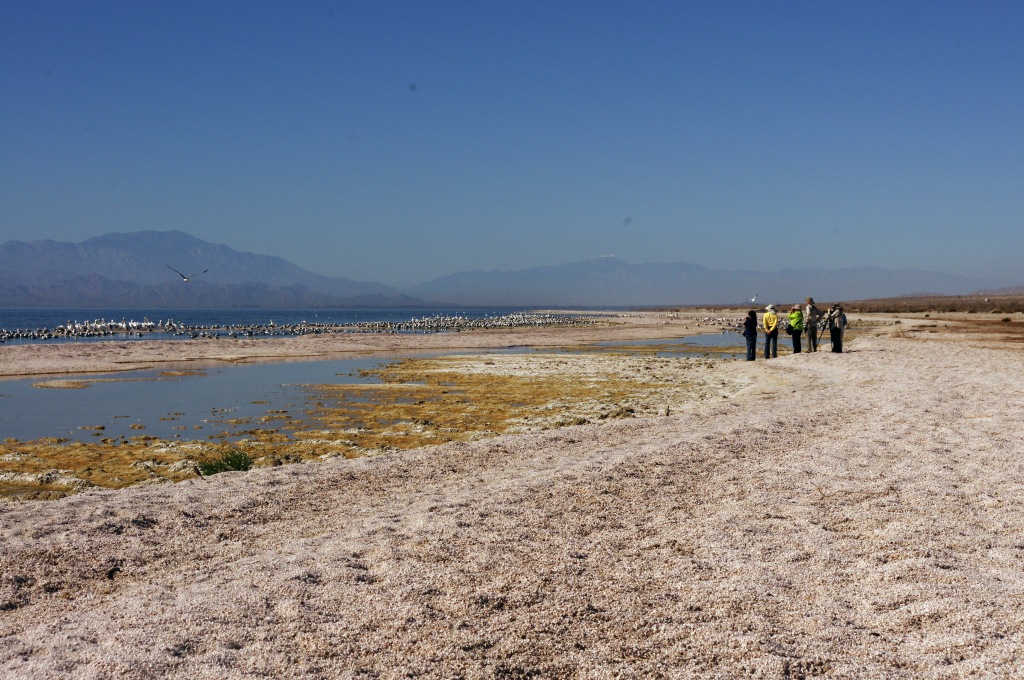
Birders on the shelly beach at Salt Creek (D. Roberts 2/8/15)
beach. Not. Sand. Tiny razor-sharp shells, trillions of them, knee-deep in places. Despite this, we actually found the gull, dark-backed among the pale gray gulls, heavily streaked on head and neck, bright light eye and yellow feet, dark wing-tipped below, a dead ringer for one of the pictures in Gulls of the Americas. I’ve searched for this annually reported gull at the sea several times before, often wondering if it was someone’s hypnogogic hallucination.
Celebratory date shakes all around.
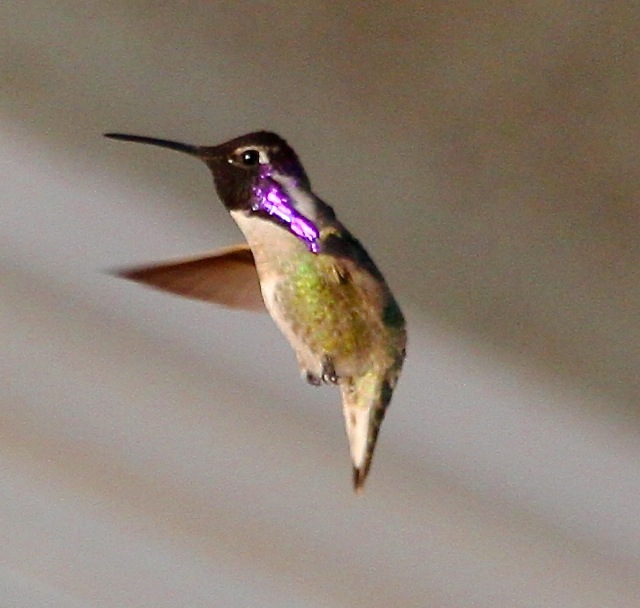
The gorget of the male Costa’s Hummingbird is purple with long side ‘extensions’ (J. Waterman 2/7/15)
Useful Resources:
Finding Birds at the Salton Sea and in Imperial County, California; Henry Detwiler & Bob Miller; 2012; $18.
Available at Buteo Books and elsewhere.
Southwest Birders Web Site
Links to prior trips: February 2012 February 2010
Trip list counts from 1 to 10 are reasonably accurate. All larger numbers are estimates intended only to reflect relative abundance. [Chuck Almdale]
H – Heard Only
In Bold – Bird of Special Interest
| Salton Sea Trip Lists | 2/7-8/15 | 2/11-2/12 | 2/6-7/10 |
| Greater White-fronted Goose | 1 | ||
| Snow Goose | 1000+ | 1000+ | 6000+ |
| Ross’s Goose | 200+ | 300+ | 500+ |
| Gadwall | 50 | 40 | 10 |
| Eurasian Wigeon | 1 | ||
| American Wigeon | 80 | 200 | 30 |
| Mallard | 30 | 100 | 60 |
| Blue-winged Teal | 2 | ||
| Cinnamon Teal | 4 | 25 | 4 |
| Northern Shoveler | 1000+ | 1000+ | 1000+ |
| Northern Pintail | 1000+ | 1000+ | 1000+ |
| Green-winged Teal | 200 | 400 | 30 |
| Redhead | 1 | 60 | 4 |
| Lesser Scaup | 1 | 3 | 100 |
| Bufflehead | 10 | 5 | |
| Common Goldeneye | 6 | ||
| Ruddy Duck | 70 | 80 | 300 |
| Gambel’s Quail | 40 | 30 | 16 |
| Pied-billed Grebe | 4 | 5 | |
| Horned Grebe | 1 | ||
| Eared Grebe | 80 | 50 | |
| Western Grebe | 3 | 2 | |
| Neotropic Cormorant | 3 | ||
| Double-crested Cormorant | 1000+ | 200 | 200 |
| American White Pelican | 100 | 1000+ | 300 |
| Brown Pelican | 50 | 100 | 20 |
| Great Blue Heron | 15 | 30 | 10 |
| Great Egret | 60 | 20 | 20 |
| Snowy Egret | 5 | 50 | 4 |
| Cattle Egret | 1000+ | 1000+ | 1000+ |
| Green Heron | 1 | ||
| Black-crowned Night-Heron | 1 | 20 | 1 |
| White-faced Ibis | 1000+ | 1000+ | 400 |
| Roseate Spoonbill | 1 | ||
| Turkey Vulture | 15 | 20 | 15 |
| Osprey | 1 | 1 | |
| White-tailed Kite | 5 | 1 | |
| Northern Harrier | 25 | 30 | 20 |
| Sharp-shinned Hawk | 1 | ||
| Cooper’s Hawk | 1 | 1 | |
| Zone-tailed Hawk | 1 | 1 | |
| Red-tailed Hawk | 40 | 40 | 25 |
| Ridgway’s Rail | H1 | ||
| Sora | H1 | 1 | |
| Common Gallinule | 1 | ||
| American Coot | 100 | 50 | 500 |
| Sandhill Crane | 400+ | 300 | 185 |
| Black-necked Stilt | 50 | 400 | 100 |
| American Avocet | 100 | 500 | 30 |
| Black-bellied Plover | 10 | 10 | |
| Killdeer | 100 | 100 | 100 |
| Mountain Plover | 60 | ||
| Spotted Sandpiper | 5 | 1 | |
| Greater Yellowlegs | 4 | 4 | 2 |
| Lesser Yellowlegs | 1 | ||
| Long-billed Curlew | 50 | 75 | 500 |
| Marbled Godwit | 30 | 30 | 40 |
| Least Sandpiper | 70 | 20 | 50 |
| Long-billed Dowitcher | 20 | 100 | 200 |
| Ring-billed Gull | 3000+ | 1000+ | 5000+ |
| Yellow-footed Gull | 1 | 4 | |
| California Gull | 1000+ | 500 | |
| Herring Gull | 20 | 10 | |
| Lesser Black-backed Gull | 1 | ||
| Glaucous-winged Gull | 2 | ||
| Caspian Tern | 5 | 60 | 30 |
| Forster’s Tern | 1 | ||
| Black Skimmer | 1 | ||
| Rock Pigeon | 60 | 50 | 10 |
| Eurasian Collared-Dove | 100 | 70 | 60 |
| Inca Dove | 2 | 2 | |
| Common Ground-Dove | 20 | 12 | 20 |
| White-winged Dove | 6 | 2 | 4 |
| Mourning Dove | 40 | 50 | 300 |
| Greater Roadrunner | 2 | 4 | 1 |
| Burrowing Owl | 3 | 1 | 9 |
| Anna’s Hummingbird | 3 | 2 | 2 |
| Costa’s Hummingbird | 5 | 1 | |
| Belted Kingfisher | 1 | 2 | 1 |
| Gila Woodpecker | 6 | 4 | 2 |
| Ladder-backed Woodpecker | 2 | ||
| Northern Flicker | 10 | 4 | 1 |
| American Kestrel | 20 | 20 | 20 |
| Peregrine Falcon | 1 | 1 | |
| Prairie Falcon | 1 | ||
| Black Phoebe | 35 | 12 | 10 |
| Say’s Phoebe | 10 | 6 | 3 |
| Vermilion Flycatcher | 1 | ||
| Western Kingbird | 2 | ||
| Loggerhead Shrike | 2 | 6 | 2 |
| Common Raven | 25 | 200 | 20 |
| Horned Lark | 100 | ||
| No. Rough-winged Swallow | 10 | ||
| Tree Swallow | 50 | 60 | 20 |
| Barn Swallow | 40 | 200 | |
| Cliff Swallow | 80 | ||
| Verdin | 10 | 9 | 3 |
| Marsh Wren | 2+H20 | H4 | 3 |
| Bewick’s Wren | 1 | ||
| Cactus Wren | 2 | ||
| Blue-gray Gnatcatcher | 2 | 3 | 2 |
| Ruby-crowned Kinglet | 8 | 2 | |
| Mountain Bluebird | 2 | ||
| American Robin | 2 | 20 | |
| Northern Mockingbird | 30 | 25 | 2 |
| European Starling | 150 | 100 | 50 |
| American Pipit | 30 | 40 | 100 |
| Cedar Waxwing | 5 | ||
| Phainopepla | 2 | ||
| Lapland Longspur | 1 | ||
| Orange-crowned Warbler | 2 | 3 | |
| Common Yellowthroat | 2 | ||
| Yellow-rumped Warbler | 40 | 31 | 20 |
| California Towhee | 2 | ||
| Abert’s Towhee | 20 | 10 | 12 |
| Chipping Sparrow | 1 | ||
| Savannah Sparrow | 1 | 4 | |
| Song Sparrow | H2 | 4 | 4 |
| White-crowned Sparrow | 50 | 60 | 50 |
| Red-winged Blackbird | 200 | 1000+ | 10,000+ |
| Tricolored Blackbird | 1 | ||
| Western Meadowlark | 20 | 60 | 200 |
| Yellow-headed Blackbird | 5 | 30 | |
| Brewer’s Blackbird | 40 | 40 | 200 |
| Great-tailed Grackle | 60 | 50 | 40 |
| Brown-headed Cowbird | 6 | 30 | 20 |
| House Finch | 30 | 100 | 30 |
| Lesser Goldfinch | 10 | 4 | |
| American Goldfinch | 7 | ||
| House Sparrow | 30 | 100 | 30 |
| Total Species – 130 | 100 | 103 | 92 |



 SANTA MONICA BAY AUDUBON SOCIETY BLOG