Free email delivery
Please sign up for email delivery in the subscription area to the right.
No salesman will call, at least not from us. Maybe from someone else.
Selasphorus Hummingbirds in Southern California
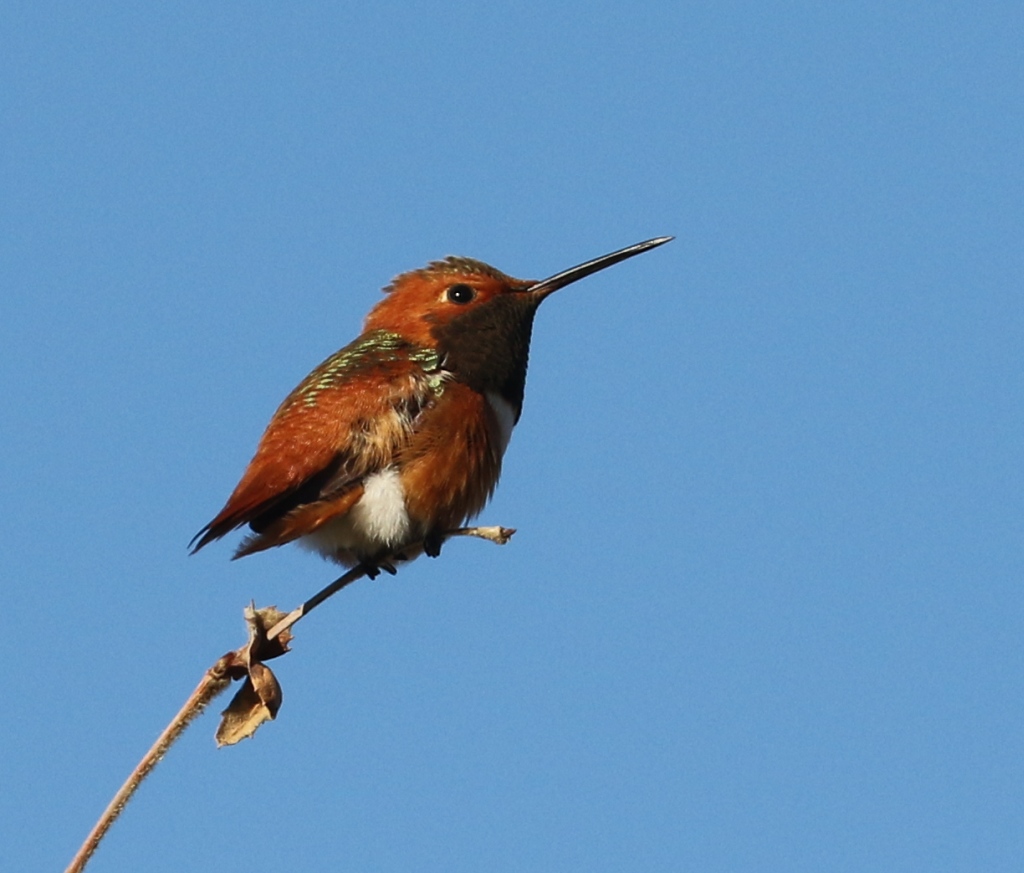
Less green on the back of this Allen’s Hummingbird
(R. Ehler 1/25/15)

Lots of green on the back of this Allen’s Hummingbird
(J. Waterman 1/25/15)
This could be a photo quiz, but isn’t. Instead, I’ll use these two photos of a Selasphorus hummingbird to make a comment. Local birders often refer to these rufous-flanked (-tailed, -backed, etc.) hummers as Selasphorus because 1) that’s their genus, and 2) they’re often impossible to tell apart in the field, especially the two most common in SoCal, Rufous and Allen’s. [Broad-tailed prefers the Rockies, while Volcano, Scintillant and Glow-throated are only in Central America.] There are differences between these two in their vocalizations, courtship displays and central tail feathers if you can witness them. Both males have rufous flanks and overlap considerably in the amount of green on the back. Allen’s subspecies sedantarius is resident along our coast, while both Rufous and Allen’s subspecies sasin migrate through to northern nesting grounds. Except during migration, any local selasphorus is likely to be an Allen’s. [Just to complicate things, Rufous begin migrating north as early as late January.] The point is that they are very hard to tell apart. I sent these two pictures to Kimball Garrett, bird collection manager at the Natural History Museum of L.A. County, as I wasn’t certain the “smaller-appearing” left (or first) bird wasn’t a Rufous. He replied, “Yes, both adult male Allen’s….Notice how the extent of visible green on the back varies with the [viewing] angle — this has tripped up lots of observers….Allen’s can appear to have very little green above if viewed from the sides (as there is rufous lateral and posterior to the green); I think a lot of late fall/early winter claims of Rufous are from inadequate views of typical male Allen’s.” These two photos might be of the same individual Allen’s – viewing angles, feather position and lighting differences play tricks on our eyes – but I strongly doubt it. Many thanks to Randy & Joyce for the photos.
[NOTE: This comment was originally part of the “Malibu Lagoon Trip Report: 25 January, 2015” blog.] [Chuck Almdale]
Malibu Lagoon Trip Report: 25 January, 2015
NOTE: The comment on Selasphorus hummingbirds was relocated to a separate blog.
“This seems really hot for January,” I said to Lillian upon arriving at the beach before 8:30am and it was already 73°. I then remembered thinking that exact same thing in previous Januarys. So I checked. [This is the sort of thing we retired accountants find amusing.] The Pt. Mugu temperatures below are from Weather Underground.
| Year | 1996 | 1997 | 1998 | 1999 | 2000 | 2001 | 2002 | 2003 | 2004 | 2005 |
| High | 62 | 59 | 64 | 57 | 59 | 59 | 55 | 81 | 60 | 68 |
| Low | 50 | 56 | 39 | 48 | 48 | 37 | 46 | 55 | 42 | 46 |
| Year | 2006 | 2007 | 2008 | 2009 | 2010 | 2011 | 2012 | 2013 | 2014 | 2015 |
| High | 68 | 55 | 59 | 57 | 57 | 75 | 59 | 61 | 66 | 85 |
| Low | 39 | 48 | 52 | 46 | 42 | 44 | 44 | 44 | 48 | 57 |
This distribution looked a little odd, so I ran a few calculations and got the following results. For those who may be a little fuzzy about “standard deviation,” your school years long vanished in the rear view mirror, it’s often called the “mean of the mean.” The “mean” being what most people call “average”, it’s a measure of how far away from the average of a data point collection do the individual data points wander. In the case of our set of temperature highs, they wander a long way.
| Temp. Range Distribution | |||||||||||||
| Mean | Standard Deviation | 35- 39 |
40- 44 |
45- 49 |
50- 54 |
55- 59 |
60- 64 |
65- 69 |
70- 74 |
75- 79 |
80- 84 |
85- 89 |
|
| High | 63.3 | 8.2 | 10 | 4 | 3 | 1 | 1 | 1 | |||||
| Low | 46.6 | 5.4 | 3 | 5 | 7 | 2 | 3 | ||||||
In the table above, the distribution of lows are roughly centered on the middle range of 45-49°F. If graphed, they would look like the typical “bell curve.” [Feel free to Google these phrases.] But the highs are whacky, or “skewed.” Half of the highs are in the lowest range of 55-59° with 3 outliers in the top ranges. Why, you ask? Very well, here’s my guess. Santa Anas! Hot winds out of the desert, raising temperatures high enough and often enough to skew the average upwards. If we eliminate the top three numbers, which were certainly Santa Ana conditions, the mean drops to 60.3° and the standard deviation drops to 4.0, which is a “heck of a drop” (a technical statistical term).
Now we’re not proving global warming (cue screams of terror) here, but this sort of thing does give us some insight into what over 99% of climatologists now find alarming. It’s not just that global temperature averages are creeping upward, which they are, but that the number of record highs are increasing while numbers of record lows are decreasing. Thus lows, means and highs are all shifting upwards. That’s something to think about the next time you stomp on the accelerator. Few of those old enough to be reading this blog will be greatly affected. But your kids, grandkids and great-grandkids will be around and will no doubt think of you often (e.g. “Why didn’t those lazy, greedy morons do something when they had the chance!”)
That said, it was a warm January day at the beach, hitting 73° before 8:30am and 81° before noon. I wonder if the high of 85° was a record?
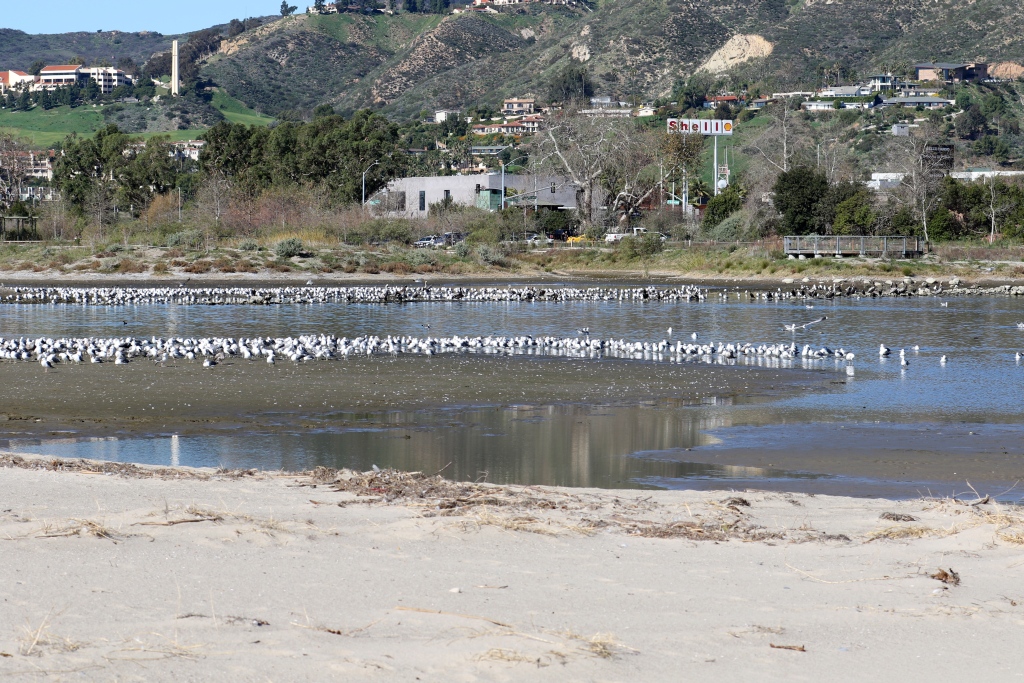
Gull flock, Pepperdine in background (R. Ehler 1/25/15)
Speaking of records, around forty birders showed up, possibly a record. We dallied, answering many questions, and by the time we reached the beach, many had wandered off in various directions.
And now it’s time for the puzzle!
The bird below is not rare at the lagoon, so you can put away that Field Guide to the Birds of Bezerkistan. Send us your guess and reasoning why. Honor and fame shall ever be yours!
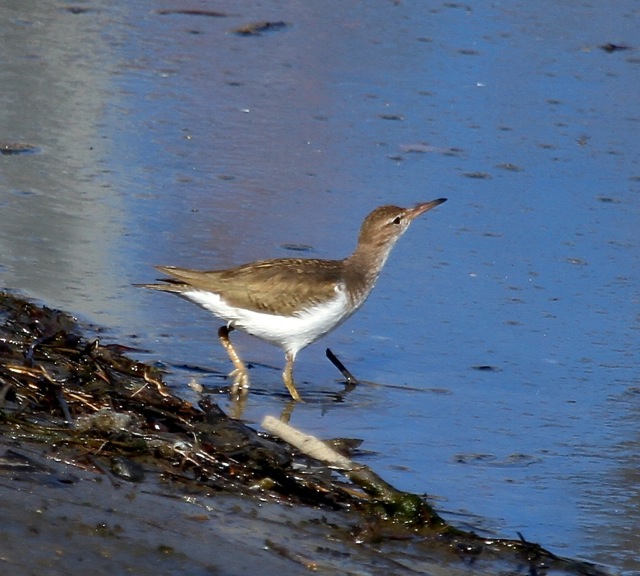
Mystery bird (J. Waterman 1/25/15)
Gull numbers were still high but diversity remained at six species, as the Boneparte’s was replaced by a Herring. The 42 Royal Terns set a new high, beating 32 Boyals on 2/28/10. More kept arriving as morning passed; my guess is that fishing was good offshore and they were coming in to rest.
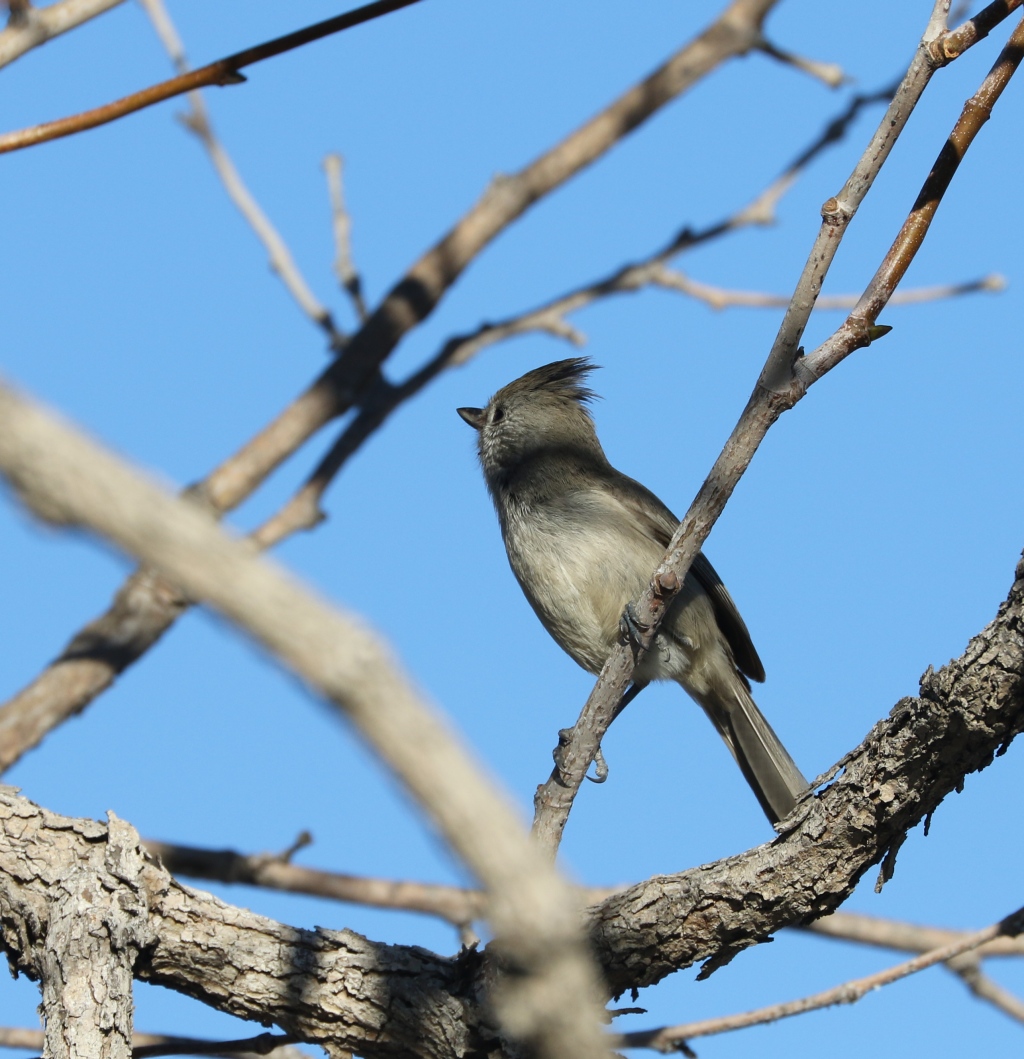
Oak Titmice are more often heard than seen (R. Ehler 1/25/15)
We don’t get a lot of Oak Titmice at the lagoon – only 15 visits totaling 19 birds – as the habitat is not great for them, but photographer Randy Ehler got proof that they do appear. (Encyclopaedia Britannica claims the plural is titmice, not titmouses.)
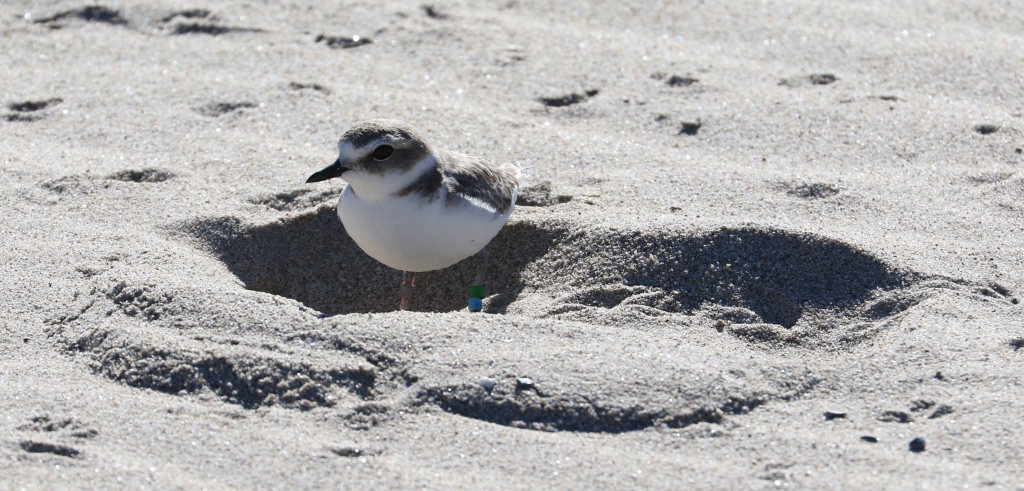
Dwarfed by a footpring – Snowy Plover GA:OY (R. Ehler 1/25/15)
Among the 24 Snowy Plovers on the beach we found banded bird: GA:OY (Left: green over aqua; Right: orange over yellow), his/her third appearance this year. That it fits easily into a human footprint shows just how small these birds are.
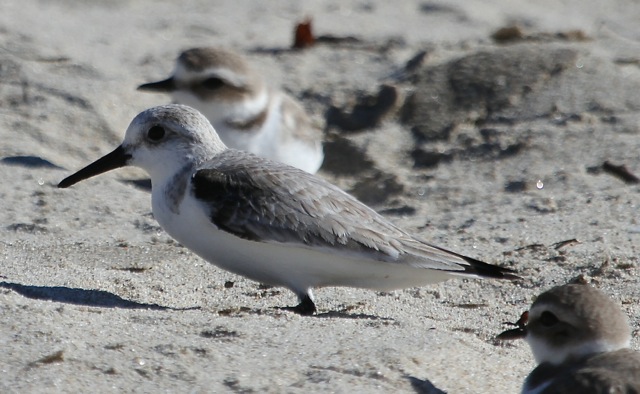
The Sanderling (foreground) is often mistaken for a Snowy Plover, their winter roost-mate (J. Waterman 1/25/15)
We had some good experiences with how sunlight affects our view of birds; e.g. they’re a lot more colorful and easy to see when the light is behind you. Photographers know this, of course, but birders are often surprised by it.
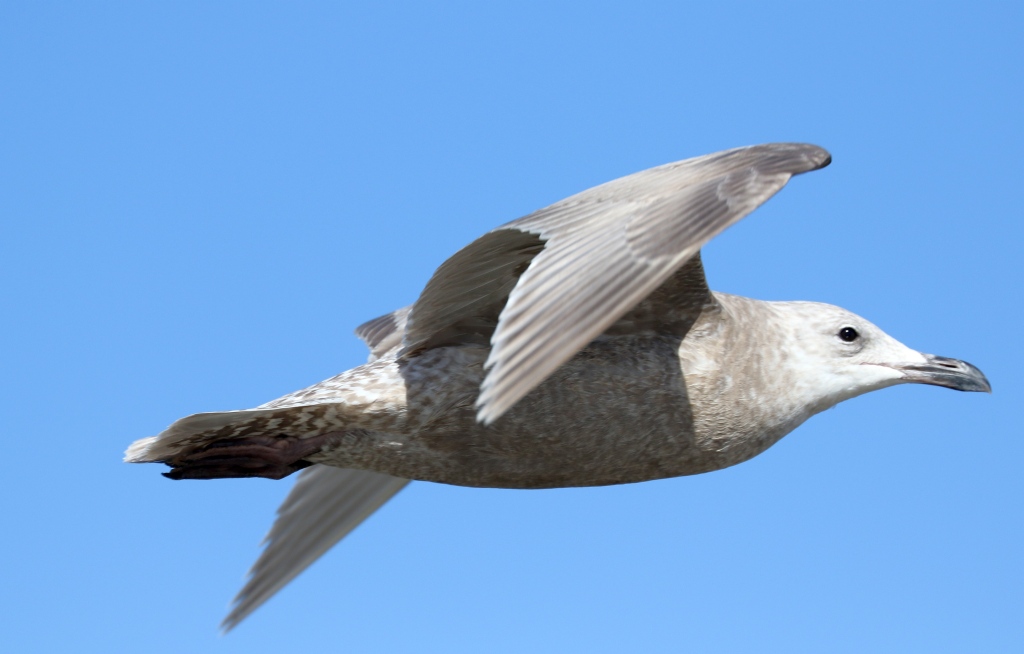
No dark wing-tips on this Glaucous-winged Gull, a winter visitor in small numbers
(Glaucous: having a powdery or waxy coating that gives a frosted appearance and tends to rub off. – Merriam-Webster) (R. Ehler 1/25/15)
Birds new for the season were: Pintail, Surf Scoter, Pelagic Cormorant, Herring Gull, Mourning Dove, Anna’s Hummingbird, Oak Titmouse, Blue-gray Gnatcatcher, Townsend’s Warbler, House Finch. We’ve not consistently gotten over to Adamson House the past few months, which may be why birds that are always around like Mourning Dove, Anna’s Hummingbird and House Finch have been missed.
Our next three scheduled field trips: Salton Sea Weekend, 7-8 Feb, 9am; Malibu Lagoon, 22 Feb, 8:30 & 10am; Hiker Lu’s Santa Monica Area Explorama, 14 Mar, 8:30am.
Our next program: Tuesday, 3 Feb., 7:30 pm. The Trancas Lagoon Restoration Project, presented by Clark Stevens. PLEASE NOTE THAT OUR MEETING PLACE HAS CHANGED TO DOUGLAS PARK, 2439 WILSHIRE BLVD.
NOTE: Our 10 a.m. Parent’s & Kids Birdwalk meets at the shaded viewing area. Watch for Willie the Weasel.
Links: Unusual birds at Malibu Lagoon
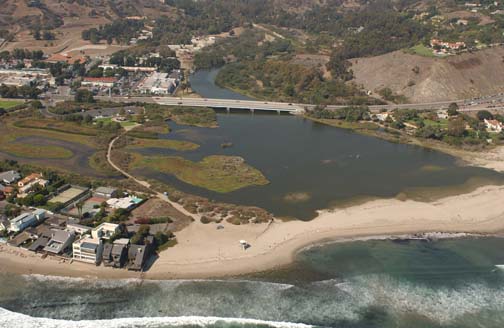
Aerial photo of Malibu Lagoon from 9/23/02.
Prior checklists:
2014: Jan-July, July-Dec
2013: Jan-June, July-Dec
2012: Jan-June, July -Dec
2011: Jan-June, July-Dec,
2010: Jan-June, July-Dec.
2009: Jan-June, July-Dec.
The 10-year comparison summaries created during the project period remain available on our Lagoon Project Bird Census Page. Very briefly summarized, the results unexpectedly indicate that avian species diversification and numbers improved slightly during the period Jun’12-June’14. [Chuck Almdale]
| Trip List 2014-15 | 8/25 | 9/28 | 10/26 | 11/23 | 12/28 | 1/25 |
| Temperature | 72-80 | 68-75 | 62-72 | 60-70 | 39-61 | 73-81 |
| Tide Lo/Hi Height | H+4.52 | H+5.35 | H+5.93 | H+6.41 | L+1.70 | L+1.32 |
| Tide Time | 0954 | 1149 | 1044 | 0849 | 0903 | 0705 |
| Gadwall | 2 | 3 | 26 | 22 | ||
| American Wigeon | 10 | 18 | ||||
| Mallard | 12 | 23 | 3 | 2 | 10 | 12 |
| Northern Shoveler | 4 | |||||
| Northern Pintail | 2 | |||||
| Green-winged Teal | 1 | 12 | 25 | |||
| Surf Scoter | 13 | |||||
| Bufflehead | 8 | 4 | ||||
| Hooded Merganser | 4 | |||||
| Red-brstd Merganser | 2 | 25 | 25 | 4 | ||
| Ruddy Duck | 2 | 36 | 42 | 38 | ||
| Red-throated Loon | 3 | |||||
| Pacific Loon | 6 | 1 | ||||
| Common Loon | 1 | |||||
| Pied-billed Grebe | 6 | 11 | 3 | 1 | 8 | 2 |
| Horned Grebe | 2 | 2 | 4 | 2 | ||
| Eared Grebe | 6 | 18 | 8 | 12 | 3 | |
| Western Grebe | 1 | 6 | 12 | 2 | 5 | |
| Brandt’s Cormorant | 2 | 1 | 2 | 130 | ||
| Dble-crstd Cormorant | 58 | 45 | 26 | 9 | 120 | 35 |
| Pelagic Cormorant | 1 | 3 | 1 | 1 | ||
| Brown Pelican | 29 | 42 | 26 | 32 | 95 | 50 |
| Great Blue Heron | 4 | 1 | 2 | 4 | 3 | 2 |
| Great Egret | 3 | 3 | 4 | 4 | 4 | |
| Snowy Egret | 12 | 15 | 20 | 20 | 18 | 16 |
| Blk-crwnd N-Heron | 4 | 1 | ||||
| Turkey Vulture | 1 | |||||
| Osprey | 1 | 1 | 1 | 1 | 1 | |
| White-tailed Kite | 1 | |||||
| Sharp-shinned Hawk | 1 | |||||
| Cooper’s Hawk | 1 | |||||
| Red-shouldered Hawk | 1 | 1 | 1 | |||
| Red-tailed Hawk | 3 | 1 | 1 | |||
| American Coot | 9 | 85 | 20 | 100 | 135 | 88 |
| Blk-bellied Plover | 93 | 95 | 40 | 45 | 38 | 62 |
| Snowy Plover | 39 | 40 | 34 | 40 | 25 | 29 |
| Semipalmated Plover | 3 | |||||
| Killdeer | 5 | 18 | 1 | 1 | 17 | 12 |
| Spotted Sandpiper | 5 | 5 | 4 | 2 | 6 | 3 |
| Greater Yellowlegs | 1 | |||||
| Willet | 14 | 45 | 6 | 4 | 10 | 4 |
| Whimbrel | 17 | 9 | 1 | 1 | 1 | 4 |
| Marbled Godwit | 1 | 4 | 5 | 3 | 12 | 12 |
| Ruddy Turnstone | 9 | 12 | 4 | 6 | 6 | 5 |
| Black Turnstone | 3 | |||||
| Sanderling | 2 | 10 | 32 | 32 | 28 | 8 |
| Least Sandpiper | 6 | 2 | 1 | |||
| Western Sandpiper | 1 | |||||
| Boneparte’s Gull | 2 | 2 | 1 | |||
| Heermann’s Gull | 10 | 4 | 5 | 1 | 18 | 17 |
| Ring-billed Gull | 3 | 60 | 65 | 150 | ||
| Western Gull | 89 | 95 | 40 | 81 | 230 | 170 |
| California Gull | 1500 | 1650 | ||||
| Herring Gull | 1 | |||||
| Glaucous-winged Gull | 3 | 5 | ||||
| Least Tern | 2 | |||||
| Forster’s Tern | 2 | 3 | ||||
| Royal Tern | 6 | 8 | 22 | 42 | ||
| Elegant Tern | 4 | 18 | 17 | 4 | ||
| Rock Pigeon | 5 | 15 | 6 | 6 | 4 | |
| Mourning Dove | 1 | 3 | ||||
| Vaux’s Swift | 3 | |||||
| Anna’s Hummingbird | 1 | 1 | 1 | |||
| Allen’s Hummingbird | 4 | 6 | 3 | 4 | 2 | |
| Belted Kingfisher | 1 | |||||
| Nuttall’s Woodpecker | 1 | |||||
| American Kestrel | 1 | 1 | 1 | |||
| Peregrine Falcon | 1 | |||||
| Yellow-chevroned Parakeet | 2 | |||||
| Willow Flycatcher | 1 | |||||
| Pac.Slope Flycatcher | 1 | |||||
| Black Phoebe | 9 | 12 | 2 | 1 | 2 | 1 |
| Say’s Phoebe | 3 | 2 | 2 | 1 | ||
| Cassin’s Kingbird | 1 | |||||
| Warbling Vireo | 2 | |||||
| Western Scrub-Jay | 1 | |||||
| American Crow | 4 | 6 | 7 | 8 | 4 | |
| Rough-wingd Swallow | 15 | 3 | ||||
| Barn Swallow | 45 | 1 | ||||
| Cliff Swallow | 3 | |||||
| Oak Titmouse | 1 | |||||
| House Wren | 1 | |||||
| Blue-gray Gnatcatcher | 1 | |||||
| Ruby-crowned Kinglet | 1 | 2 | ||||
| Wrentit | 1 | |||||
| Northern Mockingbird | 9 | 3 | 2 | 2 | 1 | |
| European Starling | 55 | 115 | 60 | 60 | 25 | 45 |
| Cedar Waxwing | 2 | |||||
| Ornge-crwnd Warbler | 3 | |||||
| Nashville Warbler | 2 | |||||
| Common Yellowthroat | 3 | 9 | 4 | 2 | 4 | 3 |
| Yellow Warbler | 3 | 1 | ||||
| Yellow-rumpd Warbler | 40 | 2 | 15 | 7 | ||
| Townsend’s Warbler | 1 | |||||
| Spotted Towhee | 1 | |||||
| California Towhee | 3 | 4 | 1 | |||
| Savannah Sparrow | 3 | |||||
| Song Sparrow | 8 | 7 | 2 | 3 | 2 | |
| White-crwnd Sparrow | 15 | 15 | 35 | 4 | ||
| Bobolink | 1 | |||||
| Western Meadowlark | 6 | 6 | 7 | 14 | 24 | |
| Great-tailed Grackle | 6 | 1 | 3 | 1 | 5 | |
| House Finch | 8 | 22 | 4 | |||
| Lesser Goldfinch | 6 | 15 | 3 | 1 | 2 | |
| Totals by Type | Aug | Sep | Oct | Nov | Dec | Jan |
| Waterfowl | 16 | 26 | 5 | 64 | 141 | 138 |
| Water Birds – Other | 106 | 193 | 102 | 166 | 516 | 187 |
| Herons, Egrets & Ibis | 23 | 20 | 26 | 28 | 25 | 18 |
| Quail & Raptors | 1 | 7 | 4 | 2 | 5 | 2 |
| Shorebirds | 198 | 240 | 127 | 135 | 144 | 139 |
| Gulls & Terns | 111 | 128 | 66 | 151 | 1839 | 2035 |
| Doves | 6 | 15 | 6 | 0 | 6 | 7 |
| Other Non-Passerines | 5 | 13 | 3 | 1 | 4 | 3 |
| Passerines | 172 | 242 | 150 | 76 | 114 | 106 |
| Totals Birds | 638 | 884 | 489 | 623 | 2794 | 2635 |
| Total Species | Aug | Sep | Oct | Nov | Dec | Jan |
| Waterfowl | 16 | 26 | 5 | 64 | 141 | 138 |
| Water Birds – Other | 106 | 193 | 102 | 166 | 516 | 187 |
| Herons, Egrets & Ibis | 23 | 20 | 26 | 28 | 25 | 18 |
| Quail & Raptors | 1 | 7 | 4 | 2 | 5 | 2 |
| Shorebirds | 198 | 240 | 127 | 135 | 144 | 134 |
| Gulls & Terns | 111 | 128 | 66 | 151 | 1839 | 2035 |
| Doves | 6 | 15 | 6 | 0 | 6 | 7 |
| Other Non-Passerines | 5 | 13 | 3 | 1 | 4 | 3 |
| Passerines | 172 | 242 | 150 | 76 | 114 | 106 |
| Totals Species – 104 | 638 | 884 | 489 | 623 | 2794 | 2630 |
Poisonous Plants
Poisonous plants are in!….Very in! Alnwick Castle in Northumberland (used as Hogwarts in the first two Harry Potter movies) now has a two-acre poison garden…everything in it is poisonous.  As an aside, I pronounced every letter in Alnwick, but was corrected by those who “Brit-speak”… seems it is pronounced Ann-ic (rhymes with panic) and has silent L, W, and K. Back to the Castle…the poisonous plants are used as a educational and suggestion-making resource for visitors and some of the plants have a license from the Home Office to be “in public.”
There are many web sites – Witches’ gardens, (U.S. & Australia), Live Science’s Top 10 Poisonous Plants (their #1 is Narcissus, #10 is Wisteria), University of California’s
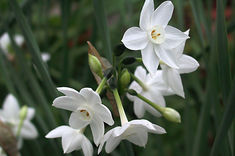
Narcissus – #1 on LiveScience (LiveScience.com
Safe and Poisonous Garden Plants (common name order & scientific name order)… what fun… Univ. of Cal. rates the plants 1 to 4 with 4 being rashes and 1 being serious illness or death – toast! – our beloved coral trees on San Vicente Boulevard rate as a 1….and there are 3 Deadly Nightshade genera and a Death Camas on the list (which are all 1’s).
My favorite site is GreenBuzzz’s Nine Most Toxic Plants for Humans.
For example: #1 is The Calamitous Castor Bean Plant which can be seen in an occasional garden and in Malibu Creek State Park; #4 is The popular, poisonous Oleander plant, found all over Los Angeles and on freeway dividers; #6 is The not-so-jolly Jimson weed plant, also know as the Devil’s Trumpet found in many gardens….. you get the idea…

Oleander – Just because it’s “natural” doesn’t mean it’s safe to eat
(GreenBuzzz)
So… take this number 1-800-222-1222 – the National Poison Control Center, keep an eye on pets, friends, and grandchildren and think twice about some of those “pretty plants” in your house and garden. [Ellen Vahan]
Antelope Valley Raptor Search Report: 10 January, 2015
Driving in the Antelope Valley can be hairy: drivers who know where they’re going rocket up behind us as we poop along, scanning for perched raptors and Mountain Plovers standing motionless in barren fields. Pulling off onto a dirt shoulder – if any – can be risky; rain turns the soil into glue which clogs your tire treads, your tires become slicks, and suddenly you’re bogged. We were lucky as the soil was nearly dry after the prior week’s rains.
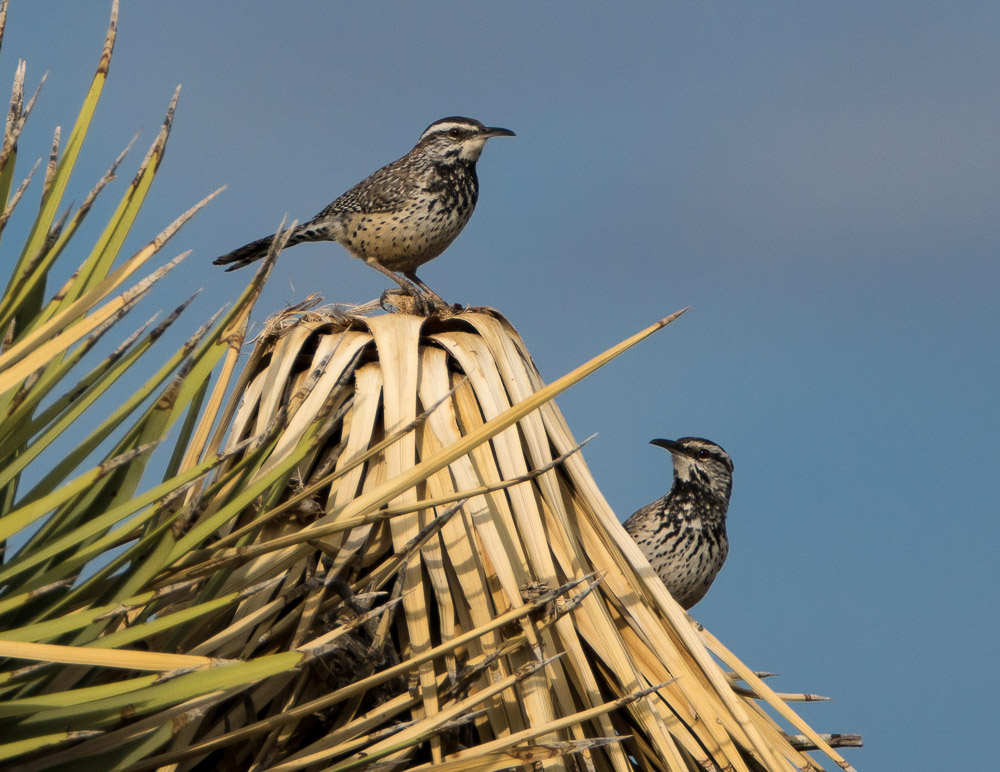
Cactus Wren pair in a Joshua Tree (C. Bragg 1/10/15)
It was still cool and quiet at our first stop just south of Palmdale Airport (birthplace of many UFO’s) at 10th St. East and Blackbird Lane. [I think the blackbirds referred to are not the feathered sort.] We found a few Sparrows including a singing Black-throated and Golden-crowned, a Northern Flicker, some House Finches, the first of many families of Ravens, and a cooperative family of Cactus Wrens, but no LeConte’s Thrashers. The leafless trees of Desert Aire Golf Course were barren of birds as well, and the settling ponds on 40th St. E. were tumbleweed dry. Not an auspicious beginning.
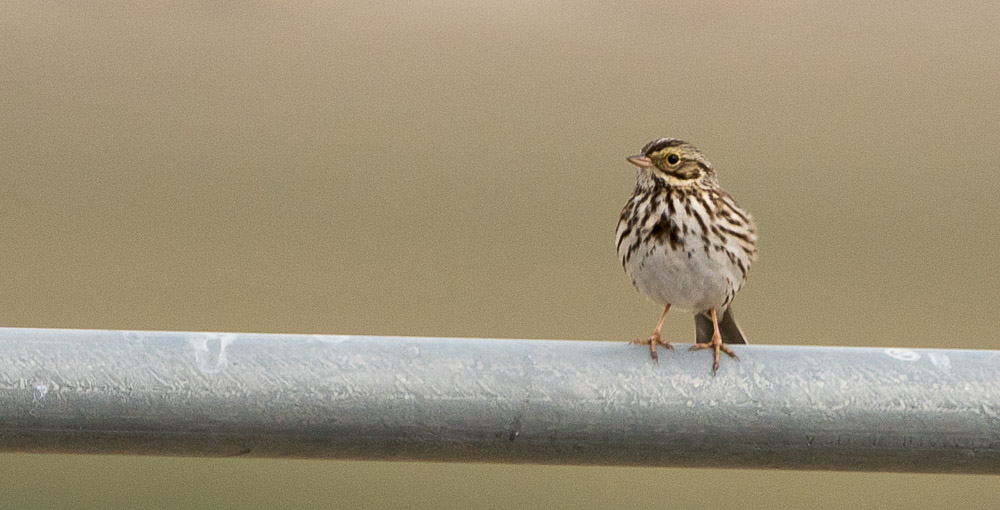
Savannah Sparrow (note yellow lores) on a rolling irrigator (C. Bragg 1/10/15)
As an aside, my recollection is that Crows are nearly non-existent in the valley, but we did see a few hanging around the McDonald’s parking lot were we got coffee (aka rest stop).
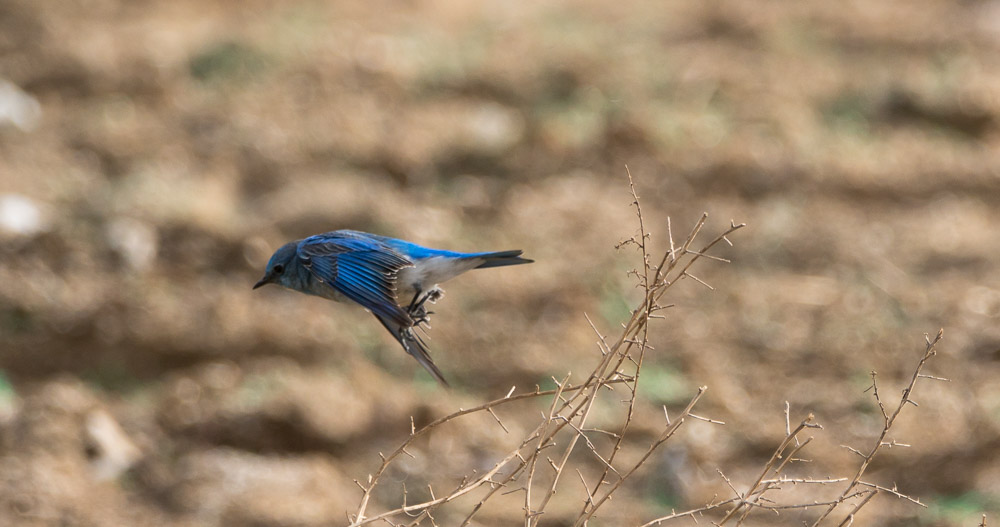
Mountain Bluebird in hot pursuit of an insect (C. Bragg 1/10/15)
Rounding the bend from 40th onto Ave. N, things picked up. We spotted the first of several sightings of Mountain Bluebirds, then flocks of Horned Larks and Savannah Sparrows in the short grass. We couldn’t find any Mountain Plovers around 50th & Ave. L, where they’d been reported – in fact we never did find any anywere. We walked along the edge of Little Rock Wash just south of its intersection with Ave. K, but apparently the pair of LeConte’s Thrashers that used to nest there have moved. The vegetation looked thirsty.
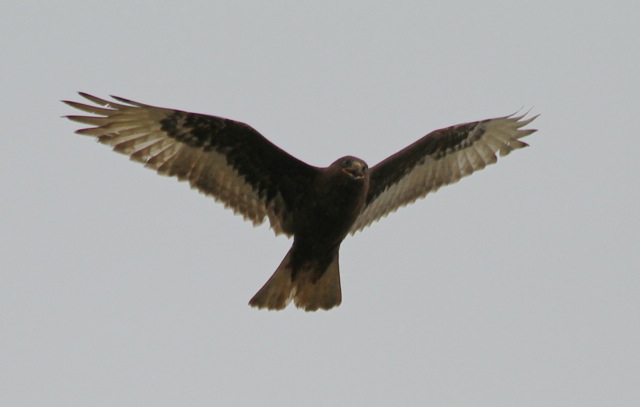
Dark phase Ferruginous Hawk flew directly overhead (J. Waterman 1/10/15)

Dark phase Ferruginous Hawk (C. Bragg 1/10/15)
We hit pay dirt out at 110th St. E and Ave. J, as the reported Ferruginous Hawks were in relative abundance, with a dozen in the air, on the ground, on the irrigation equipment, on phone poles. The reason? Voles! They were picking off any vole who foolishly showed its head. I watched one dark morph Ferruginous Hawk rise from its perch on a rolling irrigator wheel, glide out 75 yards, snatch a vole in its talons and glide back to its wheel. An added treat were more Horned Larks, Savannah Sparrows, a few Red-tailed Hawks, a Northern Harrier and over 100 pensive-looking Killdeer.

A Stunning Light Phase Ferruginous Hawk
(C. Bragg 1/10/15)
By the time we reached Apollo Lake for lunch, it had started to rain. A covered picnic area gave us shelter and a good spot to scan the lake, where we picked up most of the trip’s water birds, including Double-crested Cormorant, 4 species of goose, 7 of duck, Pied-billed Grebe, American Coot, Ring-billed & California Gulls, a hungry flock of Dark-eyed Junco and the usual Great-tailed Grackles whistling from the lakeside trees. Those who needed to return to L.A. headed home, while the rest of us headed off towards the Poppy Preserve in search of Rough-legged Hawk.
Alas, none were found, but we did see a very nice Prairie Falcon and a few more American Kestrels. Continuing to Holiday Lake we crossed the California Aqueduct and spotted some Common Goldeneyes (Barrow’s Goldeneye are occasionally found among them, or so I’ve heard) and Ring-billed – I mean Ring-necked Ducks. [See the picture below.]
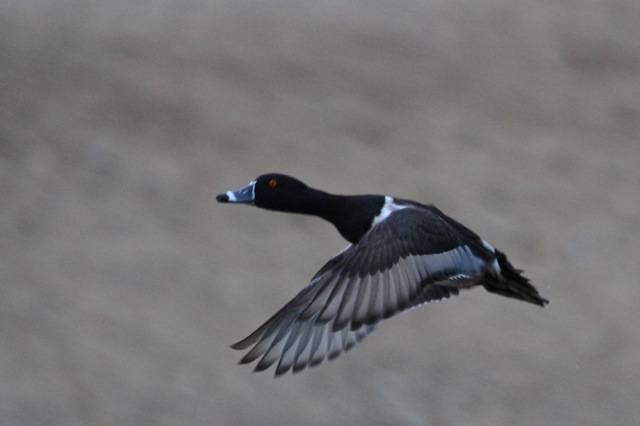
Ring-necked Duck: Did you see the ring? Look more closely. At the neck!
(J. Waterman 1/10/15)
Holiday Lake proved to be a desert mirage; I kept thinking I’d found it when it would disappear and reappear elsewhere, always a quarter-mile away. Just when some people were starting to complain – Oh ye of little faith! – I found it. A lot of reeds and not much water, another near-victim of the drought. Many flocks of Blackbirds, mostly Red-winged and a few Tricolored, kept falling and rising in and out of the golden reeds, rustling in the wind. What little water there was held a few ducks. The trees held no owls, although we did find pellets containing tiny skulls and bones.
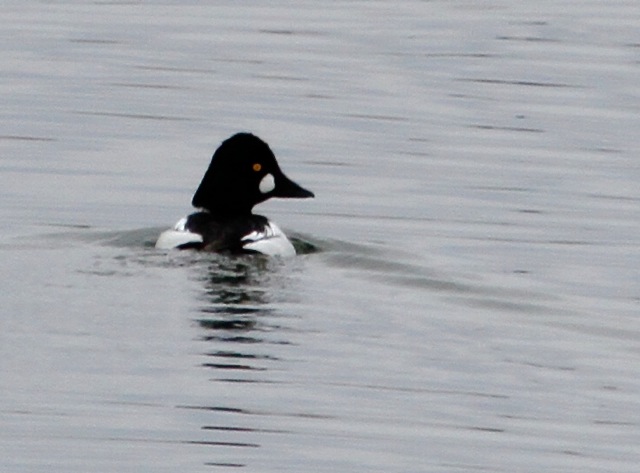
Common Goldeneyes like the California aqueduct (J. Waterman 1/10/15)
Re-crossing the aqueduct yielded more buffleheads, goldeneyes and Ring-necked Ducks plus an unexpected Common Loon. We continued down to Quail Lake and from an overlook scanned the outlet stream. No Barrow’s Goldeneyes, but lots of ducks trying to go to sleep. We headed home. [Chuck Almdale]
Prior Trip Reports: Jan 2014 Jan 2013 Jan 2012 Jan 2011 Jan 2010
Link to Antelope Valley Birding Locations
| Antelope Valley |
Raptor | Search | Trip | Lists | ||
| Species | 1/10/15 | 1/11/14 | 1/12/13 | 1/14/12 | 1/8/11 | 1/9/10 |
| Tundra Bean-Goose | 2 | |||||
| Gr. White-fronted Goose | 1 | |||||
| Snow Goose | 1 | 2 | ||||
| Ross’s Goose | 2 | 2 | 2 | X | ||
| Canada Goose | 20 | 15 | 10 | 10 | 6 | X |
| Gadwall | 1 | X | X | |||
| American Wigeon | X | |||||
| Mallard | 40 | 10 | 30 | 30 | X | X |
| Northern Shoveler | 20 | 30 | 10 | 6 | X | X |
| Green-winged Teal | 20 | X | X | |||
| Redhead | 1 | |||||
| Ring-necked Duck | 40 | |||||
| Greater Scaup | 1 | |||||
| Lesser Scaup | 30 | 1 | 30 | 3 | X | |
| White-winged Scoter | 1 | |||||
| Bufflehead | 30 | 20+ | 2 | 80 | 3 | X |
| Common Goldeneye | 50 | 2 | 20 | 1 | ||
| Hooded Merganser | 6 | |||||
| Common Merganser | 4 | |||||
| Red-breasted Merganser | 10+ | |||||
| Ruddy Duck | 8 | 40+ | 2 | 30 | X | X |
| California Quail | 9 | 110 | ||||
| Common Loon | 1 | |||||
| Pied-billed Grebe | 2 | 1 | 10 | X | X | |
| Horned Grebe | 1 | |||||
| Eared Grebe | 3 | 5 | X | |||
| Western Grebe | 2 | 2 | ||||
| Dble-crested Cormorant | 80 | 25 | 6 | 2 | X | |
| American White Pelican | 1 | 8 | ||||
| Great Blue Heron | 1 | 2 | X | |||
| Great Egret | X | |||||
| Black-crwnd Night-Heron | 1 | X | ||||
| Turkey Vulture | X | |||||
| Golden Eagle | 1 | |||||
| Northern Harrier | 2 | 1 | 5 | 3 | 3 | X |
| Cooper’s Hawk | 3 | 1 | 1 | 1 | X | 2 |
| Red-shouldered Hawk | X | |||||
| Red-tailed Hawk | 30 | 30+ | 50+ | 50+ | 12 | X |
| Ferruginous Hawk | 15 | 14 | 10 | 8 | 11 | 8 |
| Rough-legged Hawk | 1 | |||||
| Sora | 1H | |||||
| American Coot | 200 | 25 | 40 | 40 | X | X |
| Killdeer | 100 | 50 | 100 | 100 | 75+ | X |
| Mountain Plover | 10+ | 70 | 90 | X | ||
| Greater Yellowlegs | 1 | |||||
| Long-billed Curlew | 17 | X | ||||
| Ring-billed Gull | 100 | 5 | 10 | 30 | X | X |
| California Gull | 200 | 35 | 225 | 30 | X | X |
| Rock Pigeon | 300 | 35 | 35 | 80 | X | X |
| Eurasian Collared-Dove | 2 | 4 | 4 | 4 | X | |
| Mourning Dove | 50 | 1 | 6 | 4 | X | X |
| Great Horned Owl | 1 | |||||
| Anna’s Hummingbird | 2 | 2 | ||||
| Allen’s Hummingbird | X | |||||
| Red-breasted Sapsucker | X | |||||
| Downy Woodpecker | X | |||||
| Northern Flicker | 1 | 1 | 1 | 1H | ||
| American Kestrel | 4 | 4 | 15 | 15 | 2 | 6 |
| Merlin | 3 | 1 | 2 | |||
| Prairie Falcon | 1 | 1 | 6 | 4 | 1 | |
| Black Phoebe | 1 | X | X | |||
| Say’s Phoebe | 5 | 8 | 12 | 12 | 3 | X |
| Cassin’s Kingbird | X | |||||
| Loggerhead Shrike | 6 | 2 | 15 | 15 | 2 | 6 |
| Western Scrub-Jay | 2 | X | ||||
| American Crow | 5 | 4 | 5 | |||
| Common Raven | 100 | 100+ | 100+ | 150+ | 5 | X |
| Horned Lark | 300 | 600+ | 1500+ | 1500+ | 1400+ | X |
| Rock Wren | X | |||||
| Marsh Wren | X | |||||
| Bewick’s Wren | 1H | X | ||||
| Cactus Wren | 6 | 2 | 8 | X | ||
| Blue-gray Gnatcatcher | 1 | |||||
| Ruby-crowned Kinglet | X | |||||
| Mountain Bluebird | 40 | 500+ | 1 | 20 | 18 | 100+ |
| Le Conte’s Thrasher | 2 | 1 | ||||
| Sage Thrasher | 4 | |||||
| Northern Mockingbird | 2 | 2 | 1 | 1 | ||
| European Starling | 500 | 25 | 25 | 45 | flocks | X |
| American Pipit | 150 | 150 | 30 | 120+ | ||
| Yellow-rumped Warbler | 4 | 12 | 16 | X | ||
| Spotted Towhee | 1 | |||||
| California Towhee | X | |||||
| Brewer’s Sparrow | 2 | |||||
| Lark Sparrow | X | X | ||||
| Black-throated Sparrow | 2 | |||||
| Bell’s Sparrow | 2 | 2 | 20 | 2 | ||
| Savannah Sparrow | 10 | 75 | 75 | 50 | 26 | X |
| Song Sparrow | 4 | 1 | 1 | X | ||
| Lincoln’s Sparrow | 1 | |||||
| White-crowned Sparrow | 200 | 100 | 100 | 300+ | 6 | X |
| Golden-crowned Sparrow | 1 | 1 | ||||
| Dark-eyed Junco | 50 | 14 | X | |||
| Red-winged Blackbird | 200 | 60 | X | X | ||
| Tricolored Blackbird | 10 | 500 | X | |||
| Western Meadowlark | 100 | 100+ | 100 | 80 | flocks | X |
| Brewer’s Blackbird | 1000 | 150 | 150 | 60 | 20 | X |
| Great-tailed Grackle | 4 | X | ||||
| House Finch | 1000 | 200 | 200 | 300+ | 3 | X |
| Lesser Goldfinch | 1 | X | ||||
| American Goldfinch | 4 | X | ||||
| House Sparrow | 20 | 60 | 60 | 30 | X | X |
| Total Species 102 | 58 | 41 | 46 | 60 | 67 | 56 |
| X = Present, not counted | ||||||
| + = more than | ||||||
| flocks = large numbers, not counted |
Water-conserving rain barrels, nearly free!
If you have a garden in which you’ve been trying to save water, this is the great deal that comes up every once in a while. You buy rain barrels at a reduced rate, you install them at your house. Often a local official comes to check that you have installed them. In some towns such as Santa Monica, you have to confirm your continued use of the barrels annually.
The really good part is that a week or two after you have installed the barrels, you get reimbursed for your expense! I installed three barrels three years ago and I haven’t used the municipal water for my numerous potted plants since. It also provides enough water for my compost box most years.
You will probably have to do a little modification on some of your roof /gutter downspouts, but I bet you’ll be surprised how much fog drip you will also collect in the non-rainy season.
Here is the link to follow: Note you must pre-order and pre-pay no later than the Wednesday prior to the event you’d like to attend. If they have extra barrels on hand, they bring them to the event. http://www.rainbarrelsintl.com/events-order.asp?id=76
Thank you to Grace M. for the alert



 SANTA MONICA BAY AUDUBON SOCIETY BLOG