Free email delivery
Please sign up for email delivery in the subscription area to the right.
No salesman will call, at least not from us. Maybe from someone else.
Part II: The First Americans of Ballona—Food and Plant Uses
This is the second in a 3-part series of articles on the Tongva people by Cindy Hardin, LA Audubon Outdoor Education Director, and Jane Beseda, Director at Large, Santa Monica Bay Audubon Society.
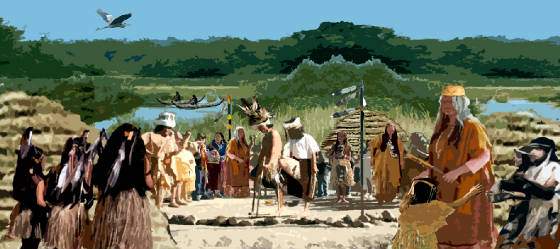
The Tongva cooked outside over open fires as a communal activity. To shade them as they worked, each group of kiiys (dwellings), had a large structure without walls, called a ramada by the Spanish. Like the kiiy, the ramada was framed with willow branches, with the roof covered by tules.

Replica of Tongva granary
Each cluster of dwellings also had a raised storehouse, or granary, for acorns. The granary was a large basket woven from young, pliable willow branches and lined with the leaves of the Bay Laurel tree. The leaves served two purposes: they kept the acorns dry, and the pungent laurel acted as a natural insect repellant. To protect the acorns from other contamination, the Tongva placed the granaries about six feet above ground on stands made of poles.
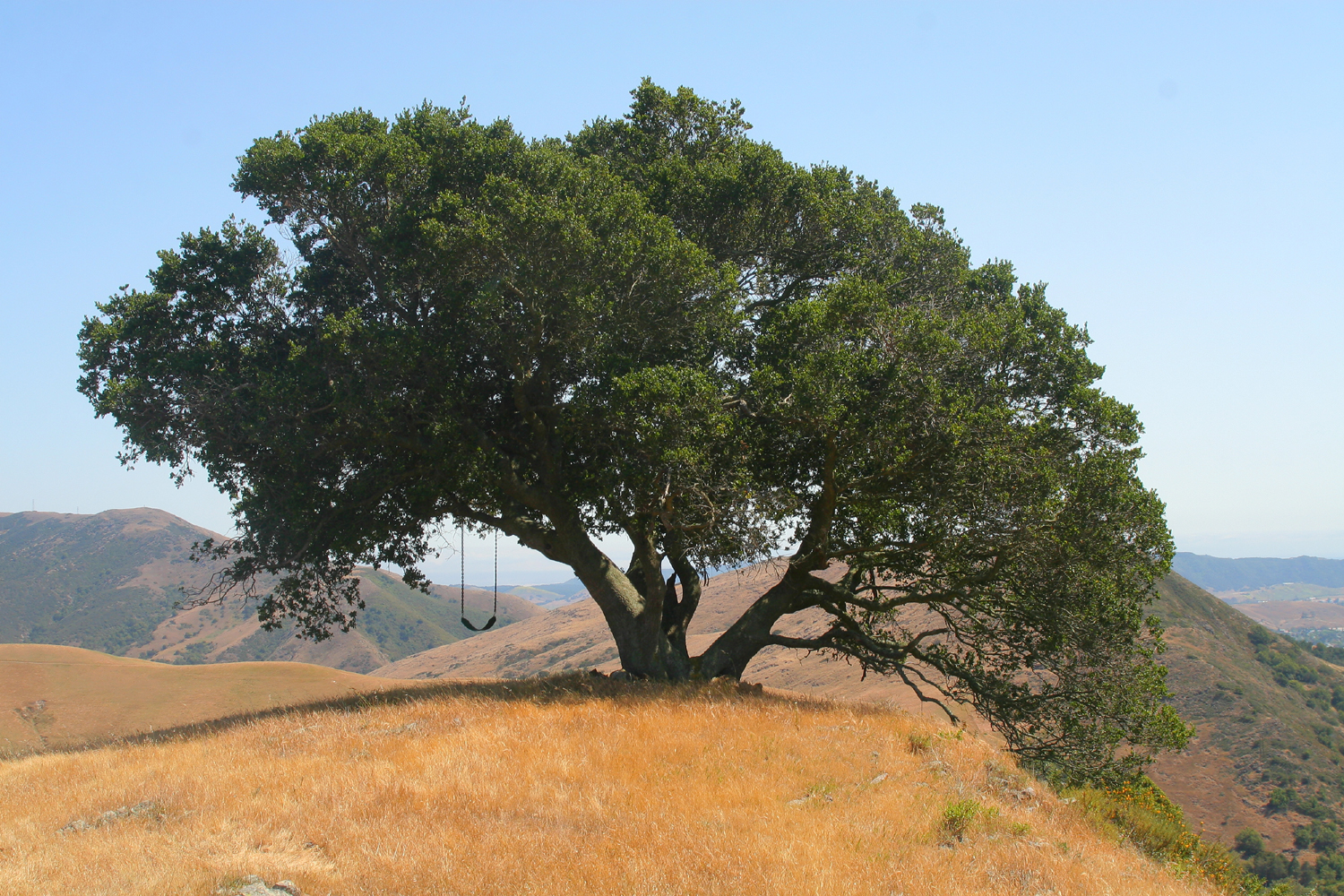
Coast Live Oak
(G. LoCascio)
The acorns of various species of California oak, particularly the Coast Live Oak, provided the source for acorn mush, the staple of the Tongva diet. Acorn gathering was a group activity which occurred annually in the fall when the acorns were ripe. Foraging groups from the village of Sa-angna walked to the nearby Baldwin Hills, which are visible from Ballona, where Coast Live Oak grew in profusion.
The Tongva carried the nuts back to their villages in burden baskets that held up to 200 pounds. They wore basketry hats to ease the pressure of the carrying strap that went across the forehead. These hats were also used as measuring standards for acorns and seeds. After the acorns were gathered and shelled, they were pounded in a stone or wooden mortar. The bitter tannin in the meal was leeched out with water through several rinse cycles. Then the meal was boiled in tightly woven watertight baskets by dropping super-heated rocks of steatite, or soapstone, into the water. The rocks were moved constantly with looped stirring sticks, so as not to scorch the basket. The Tongva ate the mush cold.

The Black Walnut was another important plant resource. They ate the meat of the walnut, and used the inner shells to make a black dye. The Tongva were excellent basket weavers and used this dye to decorate their handiwork. They filled the empty shells with asphaltum, a sticky black substance that naturally seeps up from the ground in the Los Angeles area, as we can still see today at the La Brea Tar Pits and on our local beaches. They pressed pieces of abalone shell into the asphaltum, and used the walnut halves to gamble in a type of dice game.

Fishing with net.
(Photo: Bowers Museum Collection)
The sea was an abundant source of food. The Tongva caught small schooling fish with nets, and larger fish with hooks of abalone shell or bone. The fiber for both the nets and the fishing lines came from the milkweed plant. Although they did not hunt whale, occasionally one would wash up on shore, and they would harvest the meat. At low tide, they dug for clams, and collected shellfish and crustaceans, which they steamed in pits layered with hot coals and seaweed. Ballona Creek also teemed with fish and freshwater crustaceans. Steelhead Trout would head up the creek annually to spawn, as they did in all the local rivers and streams at that time.
The Tongva hunted land animals for their fur and meat, and kept dogs to help with the hunt. The region was full of wild game, including bear. Grizzly Bears were present in the Santa Monica Mountains, and would come down to take advantage of the steelhead spawning. Although the Grizzly disappeared from this area long ago, the Black Bear is still present in our local mountains.

Animal skin clothing.
(Photo: Gabrielino Tongva Springs Foundation)
Deer and elk were hunted from blinds, with their meat used for food and skins used for clothing. Arrows were fashioned from Elderberry branches, with arrowheads made of obsidian, a volcanic rock they obtained as trade goods from tribes to the north. Sometimes a hunter would dress in a full deerskin—head, antlers and all—and stand downwind from a herd of deer. Hunters would also rub their bodies with California sagebrush to camouflage their scent. This would allow them to get close enough to make a clean kill.
Smaller animals were also important to the diet. Burrowing animals were smoked out of their holes, and rabbits were herded into nets. According to village edict, a hunter or fisherman was required to share his catch with the rest of the group. This rule helped to prevent hoarding and enhance group survival.
The Tongva used native plants for first aid, many of which can be seen at the Pitzer College native garden. The John R. Rodman Arboretum began in 1984 as a movement to save surviving indigenous vegetation. The Arboretum gardens are spread through the campus and demonstrate that drought-tolerant and native landscaping can produce a beautiful and environmentally responsible setting. A list of Medicinal Plant Uses was compiled by Barbara Courtois, founder of the Ballona Audubon Education Program. In addition, a list of general uses of natural materials such as plants, minerals, and animals is included in the book California’s Chumash Indians, a project of the Santa Barbara Museum of Natural History Education Center.
Link to Part I: The First Americans Of Ballona – Origins and Daily Life
Link to Part III: The First Americans of Ballona – culture and Time of Change
See References at the end of Part III of this series of posts on “The First Americans of Ballona.”
Part I: The First Americans of Ballona—Origins and Daily Life
This is the first in a 3-part series of articles on the Tongva people by Cindy Hardin, LA Audubon Outdoor Education Director, and Jane Beseda, Director at Large, Santa Monica Bay Audubon Society.

“Wiyot’s Children,” Gabrielino Indian Village of Sa-angna
Playa del Rey, California, Ballona Wetlands
(Painting: Mary Leighton Thomson)
The Tongva First Americans, also known as Gabrielinos, who populated the Ballona Wetlands area, arrived from the east when desertification made the formerly lush Great Basin a less hospitable place in which to live. This westward migration occurred between 9,000 BPE (before present era) and 2500 BPE. The Tongva are distantly related to the Comanche and the Hopi Pueblo indigenous populations. Their name means “People of the Earth.”
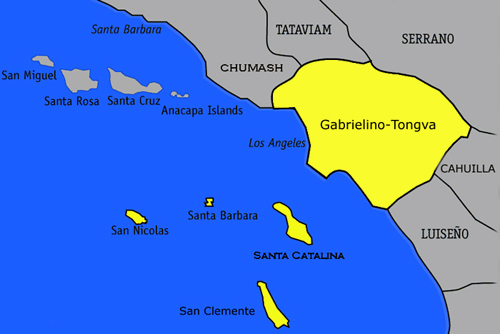
The Tongva inhabited the Greater Los Angeles area as far east as the base of Mount Wilson, 40 miles inland. Their territory was bounded by Malibu to the north and Laguna Beach to the south. They also occupied some of the Channel Islands, including Santa Catalina, San Clemente and San Nicolas. You can still hear their language in place names such as Pacoima, Tujunga, Topanga, Azusa, Cahuenga, and Cucamonga.
The Tongva’s appearance and costume were distinctive. The people were somewhat short and sturdy by European standards. They were also lighter-skinned than the indigenous people further to the south in Mexico and Central America. They had brown or reddish hair, and no baldness. The Tongva washed their hair with urine to kill lice, and this practice might have accounted for their light hair color. Some Spanish explorers wrote of them as the “blonde” people of the area. The women used red ochre, a type of clay that is heavy in iron, as sunscreen.

Hair and clothing shown in display of trade goods.
(Photo: Bowers Museum Collection)
Women wore their hair loose and long. The men also wore their hair long, but wound the top part into a bun, fastened with pins of bone or wood. Only the men wore hairpins, as this was done to keep the hair out of their eyes when hunting or fishing.
Women wore knee-length skirts or front-and-back aprons of skins, grasses, shredded bark or strings made from yucca fiber. During the warmer months, men went naked or wore loin cloths, and the children wore no clothing. During cooler months, the Tongva wore garments and wraps of animal skins, often made of rabbit. All went barefoot except when traveling in cactus country or rough mountain areas.

Tongva woman at her shelter covered with tule mats on the banks of Los Angeles River.
(Photo: Bowers Museum Collection)
The Ballona village site of Sa’angna, is formally designated as Area CA-LAN-62. The actual location is believed to have been east of the saltmarsh along the base of the Westchester bluffs in what is now Playa Vista. At that time, Centinela Creek flowed freely and was a source of fresh water for the settlement. The village of about 100 people was approximately 1500 feet long and consisted of several clusters of 4 to 5 houses, or kiiy (pronounced “key”), spaced 15-20 feet apart. (Spelling variants include ki, pronounced “key,” and kich, pronounced “kish.”) These houses, which the Spanish called jacals, served mainly as sleeping quarters for an extended family.
The kiiy were dome-shaped and framed with bent poles. The branches of the Arroyo Willow, which is still abundant at Ballona, were used to make the frame. Tule grass, a type of bulrush found in freshwater habitats, was dried and used to cover the frame. Tules were also dried and woven together to serve as floormats inside the kiiy. A hole at the top of the dwelling let out the smoke from a fireplace in the center of the structure. The replica of a kiiy located at the entrance to Ballona wetlands is much smaller than the actual kiiy used by the Tongva, which were 3 to 4 times larger and served as sleeping quarters for an extended family.
The Tongva were a friendly tribe, paddling out to greet the first Spanish ships with gifts of nuts, berries, acorns, and seafood. Conflict between villages over failure in gift-giving at ceremonies, abduction of women, poaching and trespassing, or hurtful sorcery sometimes resulted in war. But the decision to go to war was taken very seriously, and all members of the community were involved. Most conflicts were resolved by “song fights,” the days-long singing of insulting songs in vile language, accompanied by much stamping and tramping of the ground.
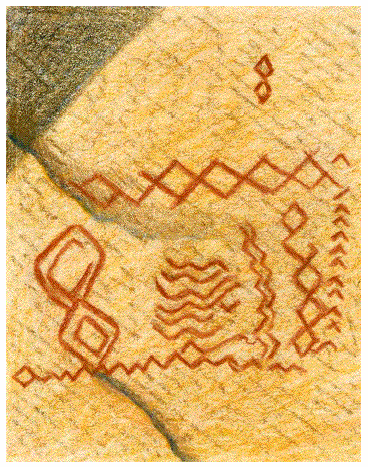
Pictograph.
(Redrawn image by Sue Ann Sinay, after Miller, 1991).
Tongva pictographs are very rare today, having been destroyed by the development of Greater Los Angeles. There are paintings at a few sites in the San Gabriel Mountains and in the northwestern part of the San Fernando Valley, but none are public. A replica of their rock art is on display at The Southwest Museum.
The purpose and function of Tongva pictographs may have been similar to that of the Luiseno, since both have diamond patterns and wavy lines. Luiseno boys and girls painted with red hematite on rocks during their puberty ceremony. During the ceremonies, sand paintings were created to illustrate the Luiseno conception of the universe, the night sky, sacred beings, and the spiritual component of the human personality. At the end of the ceremony, the sand paintings were destroyed, and girls raced to a rock where they painted angular and diamond shaped designs. Perhaps the young Tongva women also painted these symbols during their puberty ceremony.
Link to Part II: The First Americans of Ballona – Food and Plant Uses
Link to Part III: The First Americans of Ballona – Culture and Time of Change
See references at the end of Part III of this series of posts on “The First Americans of Ballona.”
Sepulveda Basin Trip Report: 9 November, 2013
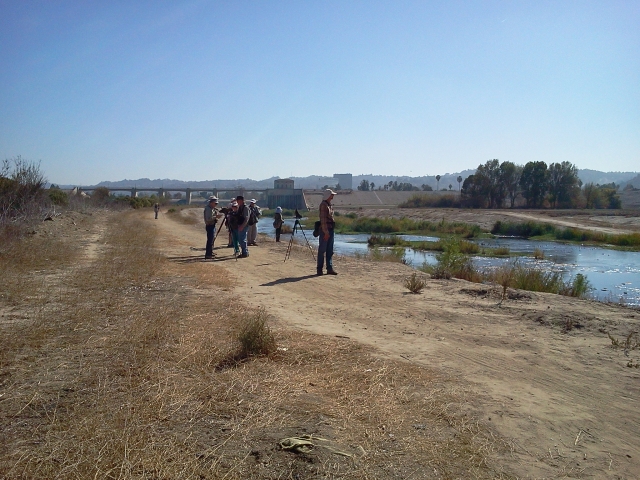
Los Angeles River looking southeast towards Sepulveda flood control dam (L. Johnson 11/9/13)
We haven’t visited this area as a club for a couple of years. A deficit in chapter members was, to my great surprise, offset by a large number of San Fernando Valley and Pasadena birders.
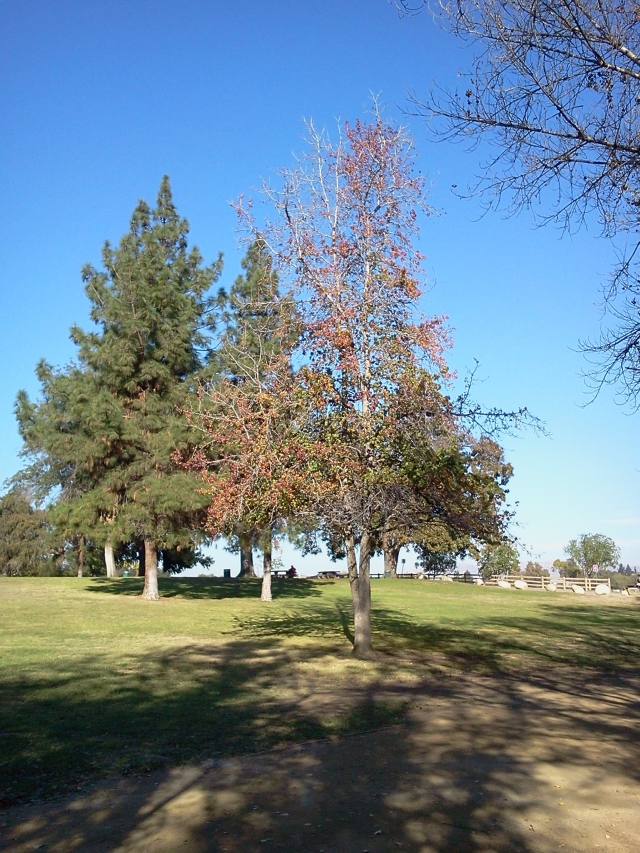
Sycamore in Fall
(L. Johnson 11/9/13)
While waiting for potential late arrivals, we checked the lawn & trees near the parking lot and turned up a variety of Sparrows – Chipping, Lark, Savannah, Song, White-crowned and Dark-eyed Junco. Western Meadowlarks – the 1st of two small flocks – meandered through grass, as Ruby-crowned Kinglets, Lesser & American Goldfinches, House Finches and some of the ever-present wintering Yellow-rumped Warblers worked the leafy trees. A small flock of Yellow-chevroned Parakeets alerted us with their calls as they vanished beyond the trees. By the time we set off for the pond, it was already warm enough to shed jackets, due to late fall Santa Ana conditions.
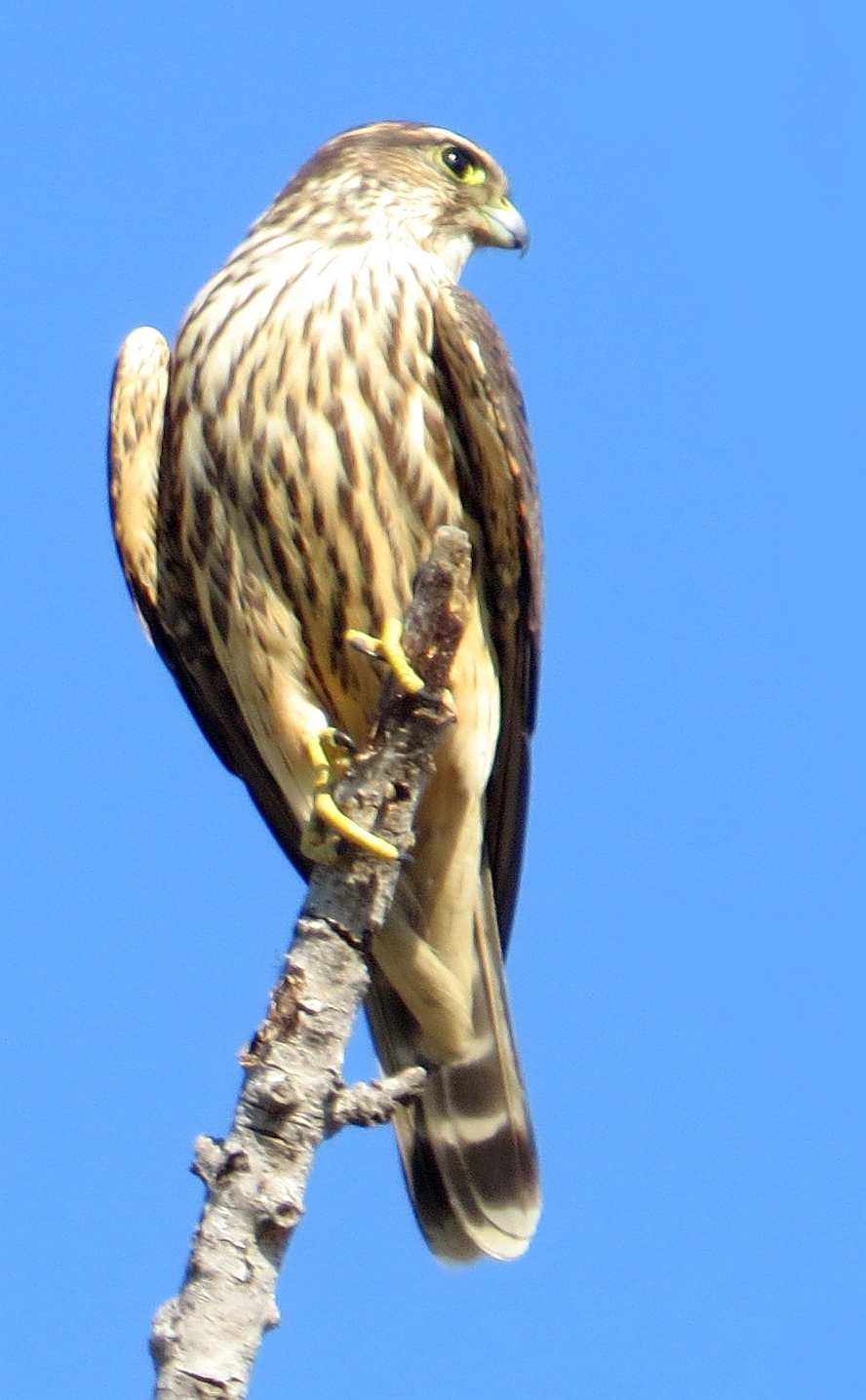
Merlin (T. Hinnebusch 11/9/13)
The pond held the usual suspects: five species of herons, three of grebe, three of duck, coots, White Pelican and Double-crested Cormorant and Osprey, while the surrounding bushes had more Song Sparrows, California Towhees, Common Yellowthroats, Bushtits and the first of 2 Blue-grey Gnatcatchers. The best bird though – and really the best bird of the day – was a Merlin which flew in and perched nearby in the leafless top of a small tree, staying for several minutes, affording everyone fine views and sufficient time to determine that it indeed was a Merlin and why it wasn’t something else.
We frequently heard, yet could not see, Soras calling from the dense lake-edge reeds. Overhead, on thermals from the warming day, rode adult and juvenile Turkey Vultures, and a very dark Red-tailed Hawk.

Dark Red-tail Hawk (T. Hinnebusch 11/9/13)
About half the group continued past Burbank Blvd. to the Los Angeles River. The Army Corp of Engineers did indeed whack down many bushes and trees, including the magnificent Eucalyptus, locally famous as host to warblers and vireos, including migrating eastern birds who’ve wandered off-track. Strangely, most trees bordering Haskell Creek remained, giving cover to birds and homeless denizens alike.
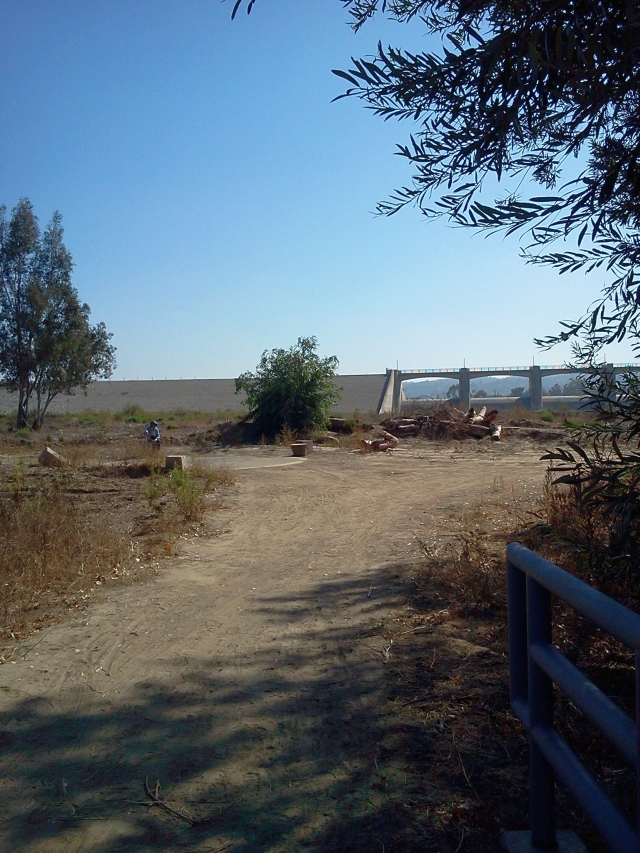
Where the large bird-friendly Eucalyptus used to be
(L. Johnson 11/9/13)
From time to time odd birds like Bobolinks appear at the river. We searched for the Red-throated Pipit – a bird whose breeding range extends from Asia into the edge of far western Alaska, who very occasionally migrates south through the Americas instead of Siberia and China, and who had been seen earlier in the week – but saw only the plain-backed American Pipits patrolling the ploughed field on the river’s south side. Oh well, so it goes.
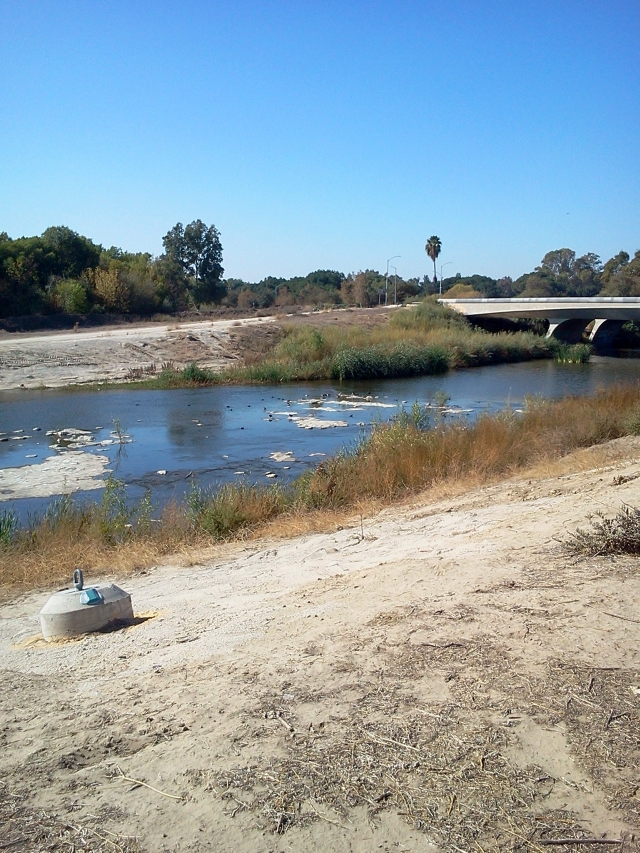
Birds in the Los Angeles River at Balboa Blvd.(L. Johnson 11/9/13)
In the river were Spotted & Least Sandpipers and several White-faced Ibis keeping the ducks company. An Osprey made several plunges into the river, but arose fishless. We had earlier seen several sizable carp in Haskell Creek; perhaps they were in the river as well. Absent (perhaps oddly) were Orange Bishops which one frequently sees in the mid-river reeds and shrubbery.
By the time we staggered back to the cars, the day was hot, we were thirsty, and no one felt like visiting Lake Balboa. [Chuck Almdale]
| Sepulveda Wildlife Area | Trip List 11/9/13 | ||
| Canada Goose | 7 | Yellow-chevroned Parakeet | 8 |
| Gadwall | 2 | Merlin | 1 |
| American Wigeon | 8 | Black Phoebe | 20 |
| Mallard | 50 | Say’s Phoebe | 4 |
| Pied-billed Grebe | 20 | Cassin’s Kingbird | 3 |
| Eared Grebe | 6 | Western Scrub-Jay | 2 |
| Western Grebe | 1 | American Crow | 10 |
| Double-crested Cormorant | 30 | Barn Swallow | 6 |
| American White Pelican | 12 | Bushtit | 8 |
| Great Blue Heron | 4 | Bewick’s Wren | 1 |
| Great Egret | 4 | Blue-gray Gnatcatcher | 2 |
| Snowy Egret | 2 | Ruby-crowned Kinglet | 6 |
| Green Heron | 3 | Northern Mockingbird | 5 |
| Black-crowned Night-Heron | 5 | California Thrasher | 1 |
| White-faced Ibis | 2 | American Pipit | 12 |
| Turkey Vulture | 8 | Common Yellowthroat | 6 |
| Osprey | 2 | Yellow-rumped Warbler | 40 |
| Cooper’s Hawk | 1 | Spotted Towhee | 2 |
| Red-tailed Hawk | 2 | California Towhee | 8 |
| Sora | 4 H | Chipping Sparrow | 10 |
| American Coot | 10 | Lark Sparrow | 5 |
| Killdeer | 3 | Savannah Sparrow | 10 |
| Spotted Sandpiper | 2 | Song Sparrow | 10 |
| Least Sandpiper | 15 | White-crowned Sparrow | 30 |
| California Gull | 10 | Dark-eyed Junco | 8 |
| Rock Pigeon | 15 | Red-winged Blackbird | 4 |
| Mourning Dove | 8 | Western Meadowlark | 15 |
| Anna’s Hummingbird | 3 | House Finch | 30 |
| Allen’s Hummingbird | 10 | Lesser Goldfinch | 4 |
| Belted Kingfisher | 1 | American Goldfinch | 30 |
| Nuttall’s Woodpecker | 2 | House Sparrow | 6 |
| Northern Flicker | 4 | Total Species | 63 |
Traditional Holloween Butterbredt Weekend: 26-27 October, 2013
Drought conditions in the desert this year were obvious in the blackened shrubbery, dry earth and in the astonishingly, extremely low counts of expected bird species. Although water has been available at sources such as Butterbredt, Sageland, Tunnel Spring on Kelso Valley Rd., the usually abundant flocks of White-crowned Sparrows, Bell’s Sparrows, California Quail, for instance, simply were not found. Foraging cattle, now gone, helped eliminate what little seeds and vegetation that had grown, food for birds and mammals. Nor were there the raptors who are their predators. No eagles, (think wind turbines), one Red-tailed Hawk, one Cooper’s Hawk, no Great Horned Owls lurking in the cottonwoods at Butterbredt or Sageland. In fact, small mammals seemed strangely scarce. I was happy to spot a bush bunny as I was leaving and one or two chipmunks at our camp site.
Nevertheless, we collected a count of 32 bird species, and some of those, quite rare. Tops was the White-throated Sparrow at Keith Axelson’s, seen well for a short time on Friday, but never again. A day earlier, Keith reported, Golden-crowned Sparrows and a Slate-colored Junco were among a large party of juncos, which by Saturday were reduced to about five birds under his feeders. Pine Siskins and Lesser Goldfinches had also deserted, leaving only two House Finches and a few juncos on the nyjer seeds. Keith’s recently spotted Sharp-shinned hawk never showed up. Worst news, the four species of sapsuckers, Red-bellied, Red-naped, Williamson’s, and one other “mystery” species, seen briefly by Keith, Lys and her friend shortly before we arrived, never appeared again at their Chinese Elm food tree. In conclusion, we guessed that the missing birds had been migrating and, perhaps, had decided to escape before stormy, cold weather arrived on Saturday.
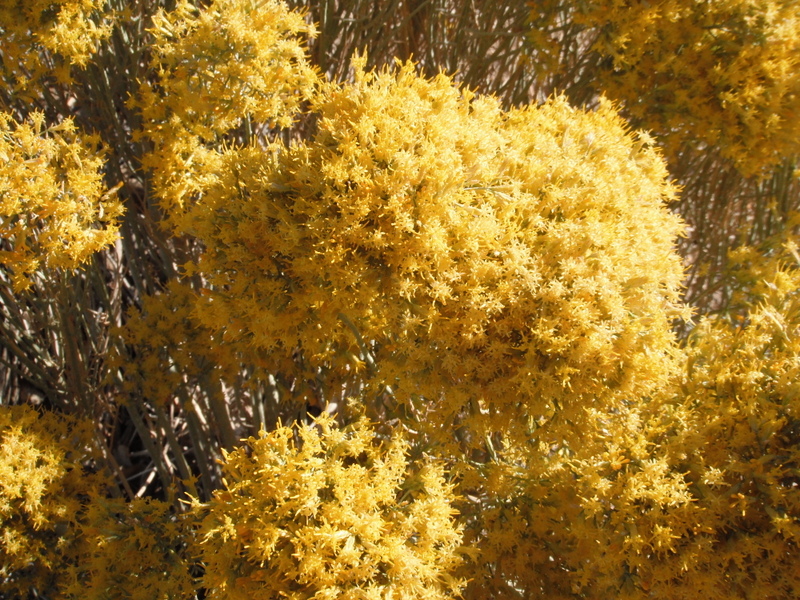
A banquet for butterflies (Roxie Seidner 10/26/13)
Regardless of these factors, our trip was beautiful. Glowing golden Rabbit Brush carpeted the slopes among Joshua Trees, apparently immune to drought. Gold and green highlighted the Cottonwoods, which harbored many cheeping Yellow-rumped Warblers, quite a few Ruby-crowned Kinglets, some Bushtits and, surprisingly, more than six Northern Flickers in the different locations we visited. Feathers under the trees suggested they had supplied prey for some raptor. Only one Rock Wren seen, three Bewick’s Wrens, one Mourning Dove, (no Eurasian Collared Doves –previously well established at Sageland). In balance, Chuck Bragg spotted a Blue-gray Gnatcatcher for us down at Butterbredt before leaving, and we did watch three Red-breasted Sapsuckers, seemingly squabbling, in the trees at Keith’s. Another great surprise were Lys’ catching the sounds of Cedar Waxwings, a large flock checking the mistletoe berries along with Western Bluebirds, in the big Cottonwood at the ranch. They did not stay long but had not been seen there for several years. Another pleasant surprise on our Sunday walk up Axelson Creek, was in fact the only bird found – a beautiful Hermit Thrush lurking in the undergrowth.
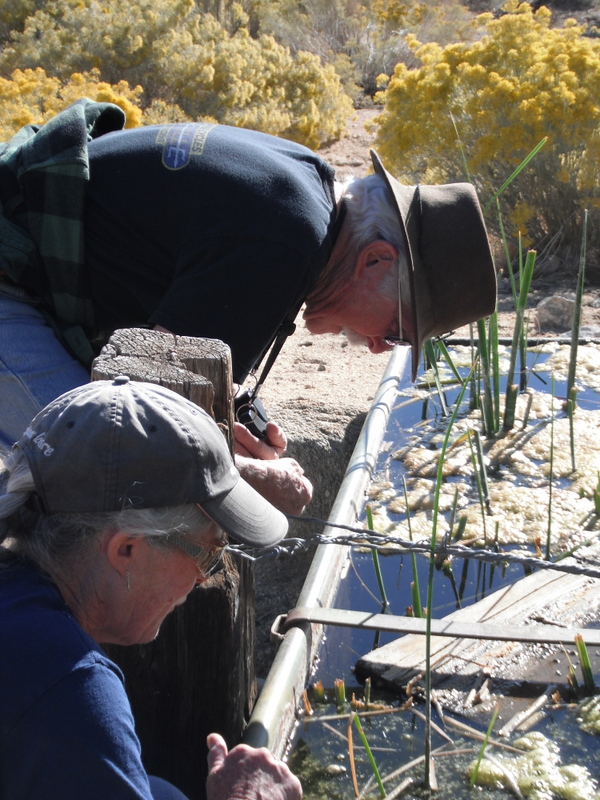
Water trough elicits rigorous observation
(Roxie Seidner 10/26/13)
There was evidence that a flash flood had raced through Butterbredt Spring but had not struck Sageland. Roads were beautifully graded. The cattle trough was full of water and plants. Just, no birds around!

Red Admiral Butterfly (C. Bragg 10/26/13)
In contrast to past trips and current expectations were huge flights of Painted Lady butterflies, seen everywhere, on the rabbit brush flowers and, especially, flying in masses ahead of us on our drive up Butterbredt Canyon road Saturday. Monarchs also floated among the crowd, and even a very unexpected Queen butterfly, a Red Admiral, an occasional Yellow Sulfur, and a Blue or two. I know, butterflies are not the object of the trip, but interesting and beautiful.

“I’m lost in a daydream – and there’s a mouse in my eye.”
Pumpkins by Kay (C. Bragg 10/26/13)
Having fun, great food, pumpkin carving and amazing judging and displays, jokes, stories of sightings, mishaps, past times, and, of course BIRDS are the objective. But:
Having an experience few city-dwellers are ever privileged to see, the huge black desert sky, its brilliant stars, the milky way, towering over us as we sleep, almost every year, myself, for some 28 years; each one is different – and the people, and stories remembered, are treasures. This is a tradition of our chapter and, hopefully, more of our members will discover and enjoy it. Mary Prismon
| Butterbredt Trip List | October 26-27, 2013 | ||
| California Quail | 50+ | Bewick’s Wren | 3 |
| Turkey Vulture | 1 | Cactus Wren | 2 |
| Cooper’s Hawk | 1 | Blue-gray Gnatcatcher | 1 |
| Red-tailed Hawk | 1 | Ruby-crowned Kinglet | 5 |
| Mourning Dove | 1 | Western Bluebird | 4 |
| Greater Roadrunner | 1 | Hermit Thrush | 1 |
| Anna’s Hummingbird | 1 | California Thrasher | 1 |
| Red-breasted Sapsucker | 3 | European Starling | 4 |
| Nuttall’s Woodpecker | 1 | Cedar Waxwing | 15 |
| Northern Flicker | 7 | Yellow-rumped Warbler | 50+ |
| Black Phoebe | 1 | California Towhee | 2 |
| Loggerhead Shrike | 3 | Sage Sparrow | 1 |
| Western Scrub-Jay | 6 | White-throated Sparrow | 1 |
| Common Raven | 2 | White-crowned Sparrow | 5 |
| Bushtit | 3 | Dark-eyed Junco | 6 |
| Rock Wren | 1 | House Finch | 2 |
| Total Species | 32 |
Malibu Lagoon Trip Report: 27 October, 2013
Lucy’s Warbler – a drab warbler occasionally seen in the eastern SoCal deserts, but far more common in Arizona – had been seen the previous day along the colony fence line. We searched all the bushes all around the park, turning up plenty of other warblers in the process but, alas, Lucy-less we remained.

Black-crowned Night-Heron, longer than he usually looks
(Randy Ehler 10/27/13)
And other birds there were, in force: total birds of 1671 is the 3rd-highest October count (top is 1901 on 10/23/05); 75 species tied for 3rd place (behind 78 on 9/26/10 and 76 on 9/26/04, with 75 on 4/21/91). That’s out of 289 visits for which we have records.
Migration always helps, doesn’t it? – thus the high previous numbers for September and April. But perhaps the foggy sky and cool temperature were also a factor. Most of the ducks were back and, as previously mentioned, warblers were relatively numerous. Waves seemed flat and surfers were scant on the dropping tide, but birders were happy.
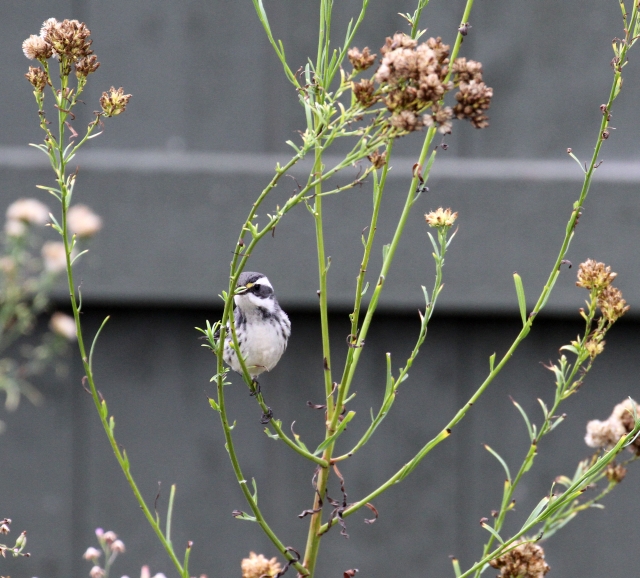
Black-throated Gray Warbler – note yellow lores
(Randy Ehler 10/27/13)
No one saw all these birds, so if you were there and missed something, so did we all. Those who lead the Parents & Kids walk tend to move quickly to the beach in order to be back at the parking lot by 10am, so they often see birds we slower-moving people miss, just as we’ll see something they missed.
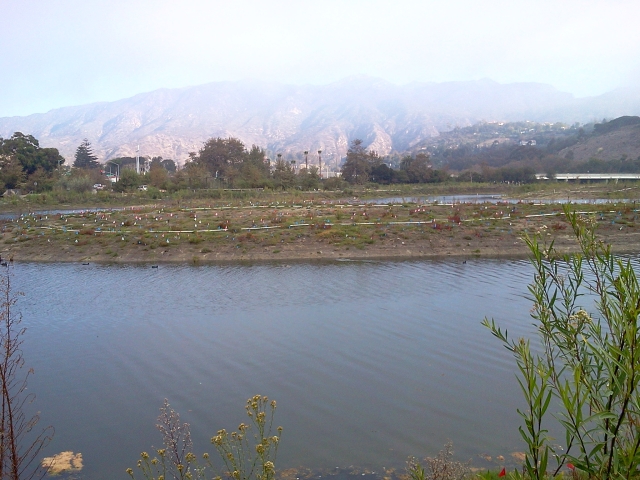
View across lagoon channel island to Malibu – Where did all the algae go? (L. Johnson 10/27/13)
There are some new information signs (see slide show). At the start of the beach path is a 3-D topographical feature showing the entire Malibu Creek watershed. Turn the obscurely located handle to make it rain and watch the water flow out to sea (in miniature).

Western Meadowlark – Six of these Autumn migrant visitors prowled the lagoon channel islands
(Monica Minden 10/17/13)
Birds new for the season were: Green-winged Teal, Lesser Scaup, Ruddy Duck, White-faced Ibis, Red-shouldered Hawk, Peregrine Falcon, Sanderling, Pectoral Sandpiper, Dunlin, Caspian Tern, Northern Flicker, Bewick’s Wren, Ruby-crowned Kinglet, American Pipit, Black-throated Gray & Townsend’s Warblers, White-crowned Sparrow, and Western Meadowlark.
The offshore rocks had been taken over by Brant’s and Pelagic Cormorants. Three falcon species at the lagoon in one day is really unusual: we’ve had many sightings of a single species, Kestrel & Peregrine 3 times, Kestrel & Merlin once, and Merlin & Peregrine once, but all three have occurred only once before, on 1/23/00. The Brant (geese) continue – it’s possible that these birds have been at the lagoon since last April, although not always seen.
Noticeably poorly represented are the small sandpipers (aka ‘peeps’): one each of Least, Pectoral and Dunlin doesn’t amount to much. A small group of Sanderlings were in the low-tide-exposed rocks and running through the kelp wrack with the Snowy Plovers. Stalwart Snowy Plover counter Lu Plauzoles toted 58 birds, a tricky task when they’re scurrying across the sand. Snowy GG:AR was back in the flock: present in July’13 but missing in Aug. and Sept. This bird was banded in Summer 2011 at Oceano Dunes near Pismo Beach, and first showed up at the lagoon on 9/25/11.
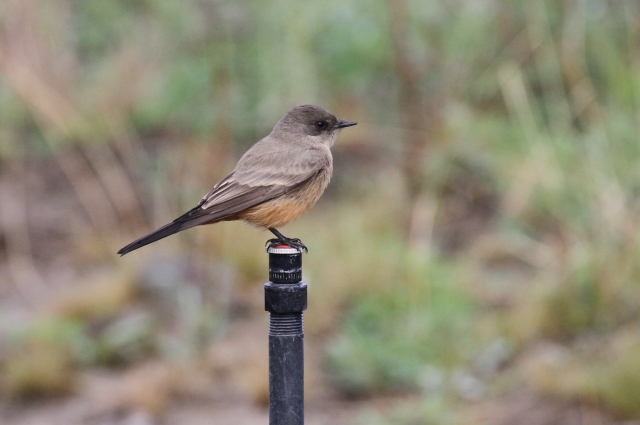
Say’s Phoebe, regular winterer (Randy Ehler 10/27/13)
Our next three scheduled field trips: Sepulveda Basin, 9 Nov, 8:30am; Malibu Lagoon, 24 Nov, 8:30 & 10am; Carrizo Plain, 7 Dec, 9am.
Our next program: Tuesday, 5 Nov., 7:30 pm. Carrizo Plain History, Geology & Ecology, presented by Craig Deutsche.
NOTE: Our 10 a.m. Parent’s & Kids Birdwalk meets at the shaded viewing area near the parking lot.
Links: Unusual birds at Malibu Lagoon
Aerial photo of Malibu Lagoon from 9/23/02.
Prior checklists: July-Dec’11, Jan-June’11, July-Dec ’10, Jan-June ’10, Jul-Dec ‘09, and Jan-June ‘09.
Comments on Bird Lists Below
Total Birds: October total birds of 1671 are 41% above the 6-year Oct. average, continuing the improvement begun in June’13; most categories saw significant increases except for shorebirds (sandpipers).
Summary of total birds from the 6-year average so far: Jun’12 +36%, Jul’12 -9%, Aug’12 -9%, Sep’12 +12%, Oct’12 +3%, Nov’12 -5%, Dec’12 +30%, Jan’13 -20%, Feb’13 -29%, Mar’13 -30%, Apr’13 -34%, May’13 -37%, Jun’13 -24%, Jul’13 +83%, Aug’13 +37%, Sep’13 +23%, Oct’13 +41%. Up & down, yakatty-yak.
Species Diversity: October 2013 with 75 species was moderately (+19%) above the 6-year average of 63.
Summary of species diversity from the 6-year average so far: Jun’12 -10%, Jul’12 +10%, Aug’12. -6%, Sep’12 -20%, Oct’12 +5%, Nov’12 +2%, Dec’12 -4%, Jan’13 +2%, Feb’13 -8%, Mar’13 +9%, Apr’13 -2%, May’13 +3%, Jun’13 +13%, Jul’13 0%, Aug’13 +11%, Sep’13 -14%, Oct’13 +19%. Up, down, up, down, etc.
10-year comparison summaries are available on our Lagoon Project Bird Census Page. [Chuck Almdale]
| Malibu Census | 2008 | 2009 | 2010 | 2011 | 2012 | 2013 | |
| October 2008-2013 | 10/26 | 10/25 | 10/24 | 10/23 | 10/28 | 10/27 | |
| Temperature | 60-74 | 60-65 | 59-64 | 72-78 | 55-65 | ||
| Tide Lo/Hi Height | H+5.9 | L+3.5 | H+6.02 | H+5.40 | H+5.93 | L+2.91 | Ave. |
| Tide Time | 0813 | 0941 | 0952 | 0718 | 0845 | 1127 | Birds |
| Brant | 3 | 0.5 | |||||
| Wood Duck | 1 | 0.2 | |||||
| Gadwall | 4 | 4 | 2 | 6 | 8 | 14 | 6.3 |
| Eurasian Wigeon | 1 | 0.2 | |||||
| American Wigeon | 3 | 10 | 1 | 16 | 10 | 6.7 | |
| Mallard | 8 | 24 | 10 | 25 | 10 | 35 | 18.7 |
| Blue-winged Teal | 4 | 2 | 1.0 | ||||
| Cinnamon Teal | 2 | 0.3 | |||||
| Northern Shoveler | 15 | 25 | 8 | 12 | 18 | 30 | 18.0 |
| Green-winged Teal | 4 | 2 | 4 | 1.7 | |||
| Lesser Scaup | 1 | 0.2 | |||||
| Bufflehead | 2 | 0.3 | |||||
| Red-brestd Merganser | 1 | 0.2 | |||||
| Ruddy Duck | 8 | 18 | 7 | 4 | 25 | 10.3 | |
| Pacific Loon | 1 | 0.2 | |||||
| Common Loon | 1 | 1 | 0.3 | ||||
| Pied-billed Grebe | 1 | 10 | 3 | 4 | 2 | 8 | 4.7 |
| Horned Grebe | 2 | 0.3 | |||||
| Eared Grebe | 1 | 6 | 5 | 3 | 4 | 10 | 4.8 |
| Western Grebe | 1 | 20 | 6 | 10 | 5 | 35 | 12.8 |
| Clark’s Grebe | 1 | 0.2 | |||||
| Blk-vented Shearwater | 12 | 2.0 | |||||
| Brandt’s Cormorant | 1 | 3 | 12 | 2.7 | |||
| Dble-crestd Cormorant | 20 | 25 | 15 | 32 | 45 | 40 | 29.5 |
| Pelagic Cormorant | 1 | 4 | 0.8 | ||||
| Brown Pelican | 55 | 8 | 40 | 12 | 6 | 43 | 27.3 |
| Great Blue Heron | 6 | 4 | 3 | 3 | 2 | 4 | 3.7 |
| Great Egret | 1 | 2 | 2 | 6 | 3 | 2.3 | |
| Snowy Egret | 16 | 15 | 2 | 26 | 6 | 15 | 13.3 |
| Blck-crowned N-Heron | 4 | 6 | 1 | 1 | 2.0 | ||
| White-faced Ibis | 1 | 0.2 | |||||
| Osprey | 1 | 1 | 0.3 | ||||
| Cooper’s Hawk | 1 | 0.2 | |||||
| Red-shouldered Hawk | 1 | 0.2 | |||||
| Red-tailed Hawk | 1 | 2 | 1 | 0.7 | |||
| American Kestrel | 1 | 1 | 0.3 | ||||
| Merlin | 1 | 1 | 0.3 | ||||
| Peregrine Falcon | 1 | 1 | 1 | 0.5 | |||
| Virginia Rail | 2 | 0.3 | |||||
| Sora | 1 | 4 | 1 | 1 | 1.2 | ||
| American Coot | 140 | 266 | 100 | 370 | 250 | 395 | 253.5 |
| Black-bellied Plover | 114 | 100 | 700 | 75 | 85 | 179.0 | |
| Snowy Plover | 58 | 61 | 5 | 62 | 58 | 40.7 | |
| Killdeer | 2 | 5 | 15 | 12 | 6 | 6.7 | |
| Black Oystercatcher | 2 | 0.3 | |||||
| Spotted Sandpiper | 3 | 4 | 3 | 3 | 3 | 4 | 3.3 |
| Willet | 16 | 40 | 26 | 10 | 7 | 28 | 21.2 |
| Whimbrel | 6 | 28 | 2 | 11 | 7.8 | ||
| Marbled Godwit | 12 | 25 | 9 | 7.7 | |||
| Ruddy Turnstone | 12 | 5 | 10 | 15 | 17 | 9.8 | |
| Black Turnstone | 2 | 3 | 2 | 1.2 | |||
| Sanderling | 1 | 145 | 200 | 15 | 60.2 | ||
| Western Sandpiper | 5 | 1 | 6 | 2.0 | |||
| Least Sandpiper | 12 | 16 | 14 | 1 | 7.2 | ||
| Pectoral Sandpiper | 1 | 0.2 | |||||
| Dunlin | 4 | 2 | 2 | 1 | 1.5 | ||
| Short-billed Dowitcher | 20 | 3.3 | |||||
| Long-billed Dowitcher | 30 | 2 | 1 | 5.5 | |||
| Wilson’s Snipe | 1 | 0.2 | |||||
| Heermann’s Gull | 45 | 12 | 41 | 14 | 8 | 40 | 26.7 |
| Ring-billed Gull | 27 | 14 | 97 | 18 | 39 | 12 | 34.5 |
| Western Gull | 65 | 82 | 52 | 80 | 6 | 85 | 61.7 |
| California Gull | 6 | 123 | 8 | 120 | 60 | 290 | 101.2 |
| Herring Gull | 1 | 1 | 1 | 0.5 | |||
| Glaucous-wingd Gull | 1 | 1 | 0.3 | ||||
| Caspian Tern | 1 | 1 | 0.3 | ||||
| Forster’s Tern | 1 | 22 | 10 | 5.5 | |||
| Royal Tern | 1 | 1 | 11 | 3 | 2.7 | ||
| Elegant Tern | 2 | 11 | 4 | 2 | 20 | 6.5 | |
| Rock Pigeon | 3 | 6 | 45 | 4 | 20 | 14 | 15.3 |
| Mourning Dove | 1 | 10 | 1 | 2 | 3 | 2.8 | |
| Anna’s Hummingbird | 3 | 1 | 10 | 2 | 1 | 2 | 3.2 |
| Allen’s Hummingbird | 5 | 2 | 6 | 2 | 7 | 4 | 4.3 |
| Belted Kingfisher | 1 | 1 | 2 | 1 | 0.8 | ||
| Northern Flicker | 1 | 0.2 | |||||
| Black Phoebe | 3 | 6 | 8 | 10 | 8 | 17 | 8.7 |
| Say’s Phoebe | 1 | 1 | 2 | 1 | 4 | 1.5 | |
| Western Scrub-Jay | 1 | 2 | 2 | 1 | 1.0 | ||
| American Crow | 8 | 5 | 18 | 4 | 9 | 5 | 8.2 |
| Tree Swallow | 1 | 0.2 | |||||
| Oak Titmouse | 1 | 1 | 0.3 | ||||
| Bushtit | 15 | 20 | 10 | 7.5 | |||
| Bewick’s Wren | 5 | 2 | 1 | 1 | 1.5 | ||
| House Wren | 1 | 1 | 2 | 1 | 1 | 1 | 1.2 |
| Marsh Wren | 2 | 0.3 | |||||
| Ruby-crowned Kinglet | 2 | 1 | 5 | 1.3 | |||
| Northern Mockingbird | 1 | 3 | 2 | 2 | 2 | 1.7 | |
| European Starling | 35 | 12 | 60 | 10 | 35 | 25.3 | |
| American Pipit | 1 | 25 | 4.3 | ||||
| Orange-crwnd Warbler | 1 | 3 | 0.7 | ||||
| Yellow-rumped Warbler | 20 | 3 | 15 | 8 | 25 | 35 | 17.7 |
| Blk-throated G. Warbler | 1 | 1 | 0.3 | ||||
| Townsend’s Warbler | 2 | 0.3 | |||||
| Common Yellowthroat | 3 | 3 | 10 | 9 | 5 | 11 | 6.8 |
| Wilson’s Warbler | 7 | 1.2 | |||||
| Spotted Towhee | 1 | 1 | 1 | 0.5 | |||
| California Towhee | 2 | 2 | 5 | 1.5 | |||
| Savannah Sparrow | 1 | 8 | 1 | 1.7 | |||
| Song Sparrow | 3 | 6 | 1 | 4 | 3 | 13 | 5.0 |
| White-crownd Sparrow | 6 | 4 | 10 | 18 | 4 | 28 | 11.7 |
| Red-winged Blackbird | 5 | 40 | 7.5 | ||||
| Western Meadowlark | 1 | 1 | 1 | 6 | 1.5 | ||
| Brewer’s Blackbird | 2 | 1 | 2 | 0.8 | |||
| Great-tailed Grackle | 4 | 8 | 8 | 7 | 4.5 | ||
| House Finch | 4 | 4 | 5 | 4 | 6 | 3.8 | |
| Lesser Goldfinch | 5 | 1 | 4 | 22 | 5.3 | ||
| Totals by Type | 10/26 | 10/25 | 10/24 | 10/23 | 10/28 | 10/27 | Ave. |
| Waterfowl | 46 | 86 | 28 | 48 | 57 | 122 | 65 |
| Water Birds-Other | 231 | 341 | 170 | 440 | 315 | 547 | 341 |
| Herons, Egrets | 26 | 20 | 13 | 31 | 15 | 24 | 22 |
| Raptors | 0 | 2 | 3 | 5 | 1 | 4 | 3 |
| Shorebirds | 93 | 455 | 164 | 797 | 400 | 237 | 358 |
| Gulls & Terns | 149 | 244 | 203 | 233 | 149 | 461 | 240 |
| Doves | 4 | 16 | 46 | 6 | 20 | 17 | 18 |
| Other Non-Pass. | 9 | 3 | 17 | 6 | 9 | 7 | 9 |
| Passerines | 119 | 66 | 76 | 157 | 133 | 252 | 134 |
| Totals Birds | 677 | 1233 | 720 | 1723 | 1099 | 1671 | 1187 |
| 2008 | 2009 | 2010 | 2011 | 2012 | 2013 | ||
| Total Species | 10/26 | 10/25 | 10/24 | 10/23 | 10/28 | 10/27 | Ave. |
| Waterfowl | 8 | 7 | 5 | 6 | 6 | 8 | 6.7 |
| Water Birds-Other | 8 | 9 | 7 | 12 | 8 | 8 | 8.7 |
| Herons, Egrets | 3 | 3 | 4 | 3 | 4 | 5 | 3.7 |
| Raptors | 0 | 2 | 3 | 4 | 1 | 4 | 2.3 |
| Shorebirds | 7 | 14 | 5 | 13 | 12 | 13 | 10.7 |
| Gulls & Terns | 9 | 7 | 6 | 5 | 8 | 8 | 7.2 |
| Doves | 2 | 2 | 2 | 2 | 1 | 2 | 1.8 |
| Other Non-Pass. | 3 | 2 | 3 | 3 | 3 | 3 | 2.8 |
| Passerines | 21 | 17 | 14 | 17 | 21 | 24 | 19.0 |
| Totals Species – 106 | 61 | 63 | 49 | 65 | 64 | 75 | 62.8 |



 SANTA MONICA BAY AUDUBON SOCIETY BLOG