Free email delivery
Please sign up for email delivery in the subscription area to the right.
No salesman will call, at least not from us. Maybe from someone else.
Malibu Lagoon Trip Report: 27 October, 2013
Lucy’s Warbler – a drab warbler occasionally seen in the eastern SoCal deserts, but far more common in Arizona – had been seen the previous day along the colony fence line. We searched all the bushes all around the park, turning up plenty of other warblers in the process but, alas, Lucy-less we remained.

Black-crowned Night-Heron, longer than he usually looks
(Randy Ehler 10/27/13)
And other birds there were, in force: total birds of 1671 is the 3rd-highest October count (top is 1901 on 10/23/05); 75 species tied for 3rd place (behind 78 on 9/26/10 and 76 on 9/26/04, with 75 on 4/21/91). That’s out of 289 visits for which we have records.
Migration always helps, doesn’t it? – thus the high previous numbers for September and April. But perhaps the foggy sky and cool temperature were also a factor. Most of the ducks were back and, as previously mentioned, warblers were relatively numerous. Waves seemed flat and surfers were scant on the dropping tide, but birders were happy.
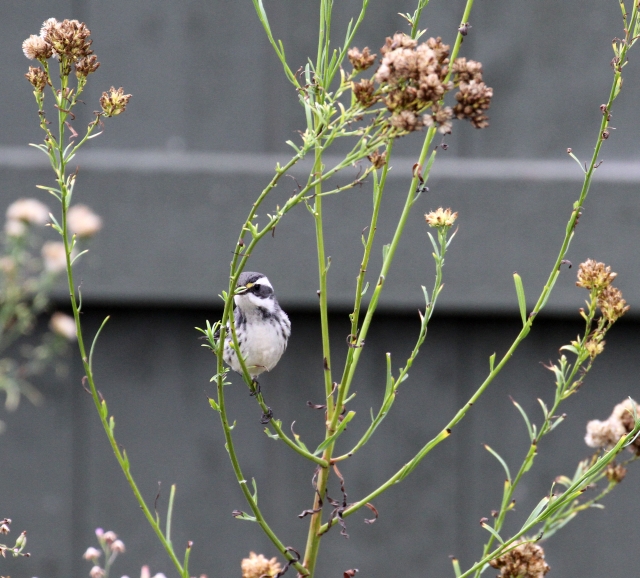
Black-throated Gray Warbler – note yellow lores
(Randy Ehler 10/27/13)
No one saw all these birds, so if you were there and missed something, so did we all. Those who lead the Parents & Kids walk tend to move quickly to the beach in order to be back at the parking lot by 10am, so they often see birds we slower-moving people miss, just as we’ll see something they missed.
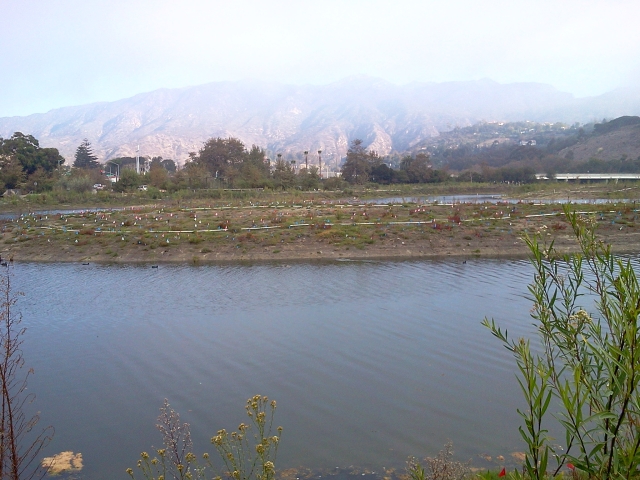
View across lagoon channel island to Malibu – Where did all the algae go? (L. Johnson 10/27/13)
There are some new information signs (see slide show). At the start of the beach path is a 3-D topographical feature showing the entire Malibu Creek watershed. Turn the obscurely located handle to make it rain and watch the water flow out to sea (in miniature).

Western Meadowlark – Six of these Autumn migrant visitors prowled the lagoon channel islands
(Monica Minden 10/17/13)
Birds new for the season were: Green-winged Teal, Lesser Scaup, Ruddy Duck, White-faced Ibis, Red-shouldered Hawk, Peregrine Falcon, Sanderling, Pectoral Sandpiper, Dunlin, Caspian Tern, Northern Flicker, Bewick’s Wren, Ruby-crowned Kinglet, American Pipit, Black-throated Gray & Townsend’s Warblers, White-crowned Sparrow, and Western Meadowlark.
The offshore rocks had been taken over by Brant’s and Pelagic Cormorants. Three falcon species at the lagoon in one day is really unusual: we’ve had many sightings of a single species, Kestrel & Peregrine 3 times, Kestrel & Merlin once, and Merlin & Peregrine once, but all three have occurred only once before, on 1/23/00. The Brant (geese) continue – it’s possible that these birds have been at the lagoon since last April, although not always seen.
Noticeably poorly represented are the small sandpipers (aka ‘peeps’): one each of Least, Pectoral and Dunlin doesn’t amount to much. A small group of Sanderlings were in the low-tide-exposed rocks and running through the kelp wrack with the Snowy Plovers. Stalwart Snowy Plover counter Lu Plauzoles toted 58 birds, a tricky task when they’re scurrying across the sand. Snowy GG:AR was back in the flock: present in July’13 but missing in Aug. and Sept. This bird was banded in Summer 2011 at Oceano Dunes near Pismo Beach, and first showed up at the lagoon on 9/25/11.
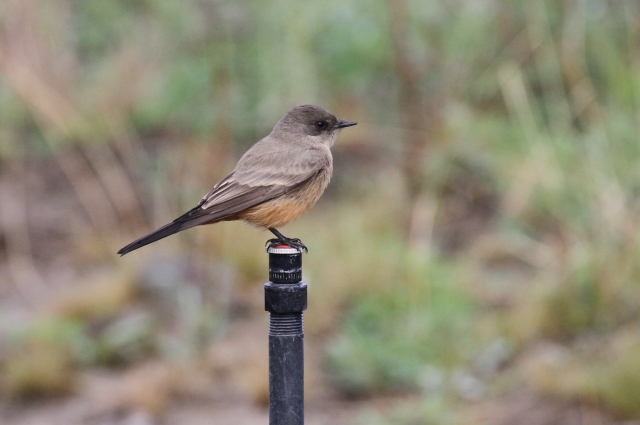
Say’s Phoebe, regular winterer (Randy Ehler 10/27/13)
Our next three scheduled field trips: Sepulveda Basin, 9 Nov, 8:30am; Malibu Lagoon, 24 Nov, 8:30 & 10am; Carrizo Plain, 7 Dec, 9am.
Our next program: Tuesday, 5 Nov., 7:30 pm. Carrizo Plain History, Geology & Ecology, presented by Craig Deutsche.
NOTE: Our 10 a.m. Parent’s & Kids Birdwalk meets at the shaded viewing area near the parking lot.
Links: Unusual birds at Malibu Lagoon
Aerial photo of Malibu Lagoon from 9/23/02.
Prior checklists: July-Dec’11, Jan-June’11, July-Dec ’10, Jan-June ’10, Jul-Dec ‘09, and Jan-June ‘09.
Comments on Bird Lists Below
Total Birds: October total birds of 1671 are 41% above the 6-year Oct. average, continuing the improvement begun in June’13; most categories saw significant increases except for shorebirds (sandpipers).
Summary of total birds from the 6-year average so far: Jun’12 +36%, Jul’12 -9%, Aug’12 -9%, Sep’12 +12%, Oct’12 +3%, Nov’12 -5%, Dec’12 +30%, Jan’13 -20%, Feb’13 -29%, Mar’13 -30%, Apr’13 -34%, May’13 -37%, Jun’13 -24%, Jul’13 +83%, Aug’13 +37%, Sep’13 +23%, Oct’13 +41%. Up & down, yakatty-yak.
Species Diversity: October 2013 with 75 species was moderately (+19%) above the 6-year average of 63.
Summary of species diversity from the 6-year average so far: Jun’12 -10%, Jul’12 +10%, Aug’12. -6%, Sep’12 -20%, Oct’12 +5%, Nov’12 +2%, Dec’12 -4%, Jan’13 +2%, Feb’13 -8%, Mar’13 +9%, Apr’13 -2%, May’13 +3%, Jun’13 +13%, Jul’13 0%, Aug’13 +11%, Sep’13 -14%, Oct’13 +19%. Up, down, up, down, etc.
10-year comparison summaries are available on our Lagoon Project Bird Census Page. [Chuck Almdale]
| Malibu Census | 2008 | 2009 | 2010 | 2011 | 2012 | 2013 | |
| October 2008-2013 | 10/26 | 10/25 | 10/24 | 10/23 | 10/28 | 10/27 | |
| Temperature | 60-74 | 60-65 | 59-64 | 72-78 | 55-65 | ||
| Tide Lo/Hi Height | H+5.9 | L+3.5 | H+6.02 | H+5.40 | H+5.93 | L+2.91 | Ave. |
| Tide Time | 0813 | 0941 | 0952 | 0718 | 0845 | 1127 | Birds |
| Brant | 3 | 0.5 | |||||
| Wood Duck | 1 | 0.2 | |||||
| Gadwall | 4 | 4 | 2 | 6 | 8 | 14 | 6.3 |
| Eurasian Wigeon | 1 | 0.2 | |||||
| American Wigeon | 3 | 10 | 1 | 16 | 10 | 6.7 | |
| Mallard | 8 | 24 | 10 | 25 | 10 | 35 | 18.7 |
| Blue-winged Teal | 4 | 2 | 1.0 | ||||
| Cinnamon Teal | 2 | 0.3 | |||||
| Northern Shoveler | 15 | 25 | 8 | 12 | 18 | 30 | 18.0 |
| Green-winged Teal | 4 | 2 | 4 | 1.7 | |||
| Lesser Scaup | 1 | 0.2 | |||||
| Bufflehead | 2 | 0.3 | |||||
| Red-brestd Merganser | 1 | 0.2 | |||||
| Ruddy Duck | 8 | 18 | 7 | 4 | 25 | 10.3 | |
| Pacific Loon | 1 | 0.2 | |||||
| Common Loon | 1 | 1 | 0.3 | ||||
| Pied-billed Grebe | 1 | 10 | 3 | 4 | 2 | 8 | 4.7 |
| Horned Grebe | 2 | 0.3 | |||||
| Eared Grebe | 1 | 6 | 5 | 3 | 4 | 10 | 4.8 |
| Western Grebe | 1 | 20 | 6 | 10 | 5 | 35 | 12.8 |
| Clark’s Grebe | 1 | 0.2 | |||||
| Blk-vented Shearwater | 12 | 2.0 | |||||
| Brandt’s Cormorant | 1 | 3 | 12 | 2.7 | |||
| Dble-crestd Cormorant | 20 | 25 | 15 | 32 | 45 | 40 | 29.5 |
| Pelagic Cormorant | 1 | 4 | 0.8 | ||||
| Brown Pelican | 55 | 8 | 40 | 12 | 6 | 43 | 27.3 |
| Great Blue Heron | 6 | 4 | 3 | 3 | 2 | 4 | 3.7 |
| Great Egret | 1 | 2 | 2 | 6 | 3 | 2.3 | |
| Snowy Egret | 16 | 15 | 2 | 26 | 6 | 15 | 13.3 |
| Blck-crowned N-Heron | 4 | 6 | 1 | 1 | 2.0 | ||
| White-faced Ibis | 1 | 0.2 | |||||
| Osprey | 1 | 1 | 0.3 | ||||
| Cooper’s Hawk | 1 | 0.2 | |||||
| Red-shouldered Hawk | 1 | 0.2 | |||||
| Red-tailed Hawk | 1 | 2 | 1 | 0.7 | |||
| American Kestrel | 1 | 1 | 0.3 | ||||
| Merlin | 1 | 1 | 0.3 | ||||
| Peregrine Falcon | 1 | 1 | 1 | 0.5 | |||
| Virginia Rail | 2 | 0.3 | |||||
| Sora | 1 | 4 | 1 | 1 | 1.2 | ||
| American Coot | 140 | 266 | 100 | 370 | 250 | 395 | 253.5 |
| Black-bellied Plover | 114 | 100 | 700 | 75 | 85 | 179.0 | |
| Snowy Plover | 58 | 61 | 5 | 62 | 58 | 40.7 | |
| Killdeer | 2 | 5 | 15 | 12 | 6 | 6.7 | |
| Black Oystercatcher | 2 | 0.3 | |||||
| Spotted Sandpiper | 3 | 4 | 3 | 3 | 3 | 4 | 3.3 |
| Willet | 16 | 40 | 26 | 10 | 7 | 28 | 21.2 |
| Whimbrel | 6 | 28 | 2 | 11 | 7.8 | ||
| Marbled Godwit | 12 | 25 | 9 | 7.7 | |||
| Ruddy Turnstone | 12 | 5 | 10 | 15 | 17 | 9.8 | |
| Black Turnstone | 2 | 3 | 2 | 1.2 | |||
| Sanderling | 1 | 145 | 200 | 15 | 60.2 | ||
| Western Sandpiper | 5 | 1 | 6 | 2.0 | |||
| Least Sandpiper | 12 | 16 | 14 | 1 | 7.2 | ||
| Pectoral Sandpiper | 1 | 0.2 | |||||
| Dunlin | 4 | 2 | 2 | 1 | 1.5 | ||
| Short-billed Dowitcher | 20 | 3.3 | |||||
| Long-billed Dowitcher | 30 | 2 | 1 | 5.5 | |||
| Wilson’s Snipe | 1 | 0.2 | |||||
| Heermann’s Gull | 45 | 12 | 41 | 14 | 8 | 40 | 26.7 |
| Ring-billed Gull | 27 | 14 | 97 | 18 | 39 | 12 | 34.5 |
| Western Gull | 65 | 82 | 52 | 80 | 6 | 85 | 61.7 |
| California Gull | 6 | 123 | 8 | 120 | 60 | 290 | 101.2 |
| Herring Gull | 1 | 1 | 1 | 0.5 | |||
| Glaucous-wingd Gull | 1 | 1 | 0.3 | ||||
| Caspian Tern | 1 | 1 | 0.3 | ||||
| Forster’s Tern | 1 | 22 | 10 | 5.5 | |||
| Royal Tern | 1 | 1 | 11 | 3 | 2.7 | ||
| Elegant Tern | 2 | 11 | 4 | 2 | 20 | 6.5 | |
| Rock Pigeon | 3 | 6 | 45 | 4 | 20 | 14 | 15.3 |
| Mourning Dove | 1 | 10 | 1 | 2 | 3 | 2.8 | |
| Anna’s Hummingbird | 3 | 1 | 10 | 2 | 1 | 2 | 3.2 |
| Allen’s Hummingbird | 5 | 2 | 6 | 2 | 7 | 4 | 4.3 |
| Belted Kingfisher | 1 | 1 | 2 | 1 | 0.8 | ||
| Northern Flicker | 1 | 0.2 | |||||
| Black Phoebe | 3 | 6 | 8 | 10 | 8 | 17 | 8.7 |
| Say’s Phoebe | 1 | 1 | 2 | 1 | 4 | 1.5 | |
| Western Scrub-Jay | 1 | 2 | 2 | 1 | 1.0 | ||
| American Crow | 8 | 5 | 18 | 4 | 9 | 5 | 8.2 |
| Tree Swallow | 1 | 0.2 | |||||
| Oak Titmouse | 1 | 1 | 0.3 | ||||
| Bushtit | 15 | 20 | 10 | 7.5 | |||
| Bewick’s Wren | 5 | 2 | 1 | 1 | 1.5 | ||
| House Wren | 1 | 1 | 2 | 1 | 1 | 1 | 1.2 |
| Marsh Wren | 2 | 0.3 | |||||
| Ruby-crowned Kinglet | 2 | 1 | 5 | 1.3 | |||
| Northern Mockingbird | 1 | 3 | 2 | 2 | 2 | 1.7 | |
| European Starling | 35 | 12 | 60 | 10 | 35 | 25.3 | |
| American Pipit | 1 | 25 | 4.3 | ||||
| Orange-crwnd Warbler | 1 | 3 | 0.7 | ||||
| Yellow-rumped Warbler | 20 | 3 | 15 | 8 | 25 | 35 | 17.7 |
| Blk-throated G. Warbler | 1 | 1 | 0.3 | ||||
| Townsend’s Warbler | 2 | 0.3 | |||||
| Common Yellowthroat | 3 | 3 | 10 | 9 | 5 | 11 | 6.8 |
| Wilson’s Warbler | 7 | 1.2 | |||||
| Spotted Towhee | 1 | 1 | 1 | 0.5 | |||
| California Towhee | 2 | 2 | 5 | 1.5 | |||
| Savannah Sparrow | 1 | 8 | 1 | 1.7 | |||
| Song Sparrow | 3 | 6 | 1 | 4 | 3 | 13 | 5.0 |
| White-crownd Sparrow | 6 | 4 | 10 | 18 | 4 | 28 | 11.7 |
| Red-winged Blackbird | 5 | 40 | 7.5 | ||||
| Western Meadowlark | 1 | 1 | 1 | 6 | 1.5 | ||
| Brewer’s Blackbird | 2 | 1 | 2 | 0.8 | |||
| Great-tailed Grackle | 4 | 8 | 8 | 7 | 4.5 | ||
| House Finch | 4 | 4 | 5 | 4 | 6 | 3.8 | |
| Lesser Goldfinch | 5 | 1 | 4 | 22 | 5.3 | ||
| Totals by Type | 10/26 | 10/25 | 10/24 | 10/23 | 10/28 | 10/27 | Ave. |
| Waterfowl | 46 | 86 | 28 | 48 | 57 | 122 | 65 |
| Water Birds-Other | 231 | 341 | 170 | 440 | 315 | 547 | 341 |
| Herons, Egrets | 26 | 20 | 13 | 31 | 15 | 24 | 22 |
| Raptors | 0 | 2 | 3 | 5 | 1 | 4 | 3 |
| Shorebirds | 93 | 455 | 164 | 797 | 400 | 237 | 358 |
| Gulls & Terns | 149 | 244 | 203 | 233 | 149 | 461 | 240 |
| Doves | 4 | 16 | 46 | 6 | 20 | 17 | 18 |
| Other Non-Pass. | 9 | 3 | 17 | 6 | 9 | 7 | 9 |
| Passerines | 119 | 66 | 76 | 157 | 133 | 252 | 134 |
| Totals Birds | 677 | 1233 | 720 | 1723 | 1099 | 1671 | 1187 |
| 2008 | 2009 | 2010 | 2011 | 2012 | 2013 | ||
| Total Species | 10/26 | 10/25 | 10/24 | 10/23 | 10/28 | 10/27 | Ave. |
| Waterfowl | 8 | 7 | 5 | 6 | 6 | 8 | 6.7 |
| Water Birds-Other | 8 | 9 | 7 | 12 | 8 | 8 | 8.7 |
| Herons, Egrets | 3 | 3 | 4 | 3 | 4 | 5 | 3.7 |
| Raptors | 0 | 2 | 3 | 4 | 1 | 4 | 2.3 |
| Shorebirds | 7 | 14 | 5 | 13 | 12 | 13 | 10.7 |
| Gulls & Terns | 9 | 7 | 6 | 5 | 8 | 8 | 7.2 |
| Doves | 2 | 2 | 2 | 2 | 1 | 2 | 1.8 |
| Other Non-Pass. | 3 | 2 | 3 | 3 | 3 | 3 | 2.8 |
| Passerines | 21 | 17 | 14 | 17 | 21 | 24 | 19.0 |
| Totals Species – 106 | 61 | 63 | 49 | 65 | 64 | 75 | 62.8 |
Quiz Time! – Birds Large & Small
First: factoid-of-the-day.
Birds are usually measured in grams.
A nickel weighs 5 grams. Just to refresh your memory…1 gram is one thousandth of a kilogram (2.2 pounds) or… a box of 333 Ruby-throated Hummingbirds (@ 3 grams each) would equal a kilogram or a smaller box of only 150 Ruby-throats would equal a pound. Remember that next time you’re at See’s Candies looking for chocolate-covered treats!

Female Belted Kingfisher
(C. Bragg 11/25/12)

Island Scrub-Jay
(Stephen Francis Oct. ’07)
Now for the quiz! Which bird weighs more?
Belted Kingfisher or Western Scrub-Jay ?
American Goldfinch or Yellow Warbler ?
Mourning Dove or Yellow-billed Magpie ?
European Starling or Northern Mockingbird ?
Female Cooper’s Hawk or Female Peregrine Falcon ?
scroll down
scroll down
scroll down
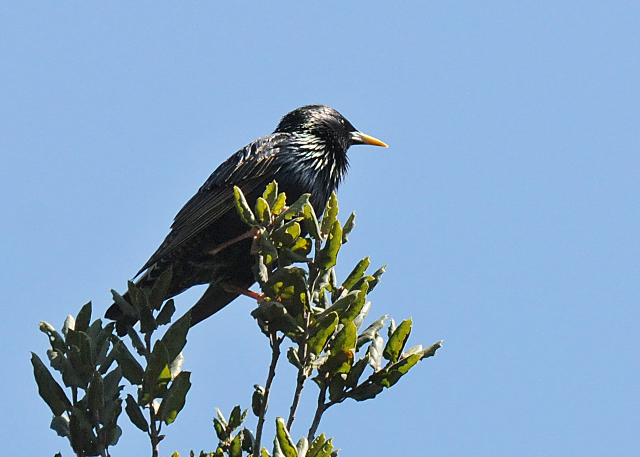
European Starling – noted cavity nester (J.Kenney 3/13/10)

Northern Mockingbird
(J.Kenney 3/13/10)
keep going
scroll down
scroll down
scroll down
scroll down
keep going
scroll down
scroll down
keep going
scroll down
ANSWERS
A – American Goldfinch (13 grams) vs. Yellow Warbler (9.3 grams)
[Ellen Vahan]
Local Fish Divers
There has been a lot of coastal fishing going on lately. Jim Kenney, Pacific Palisades resident, photographer and SMBAS member captured some of this activity.

Offshore Brown Pelican flock on 10/3/13 Palisadian-Post
(Jim Kenney photographer)
The gathering of seabirds in Santa Monica Bay went on for many weeks. Frequently commented on within the local birding community, it also made it into the local press.
Meanwhile, activity in Malibu Lagoon had picked up.
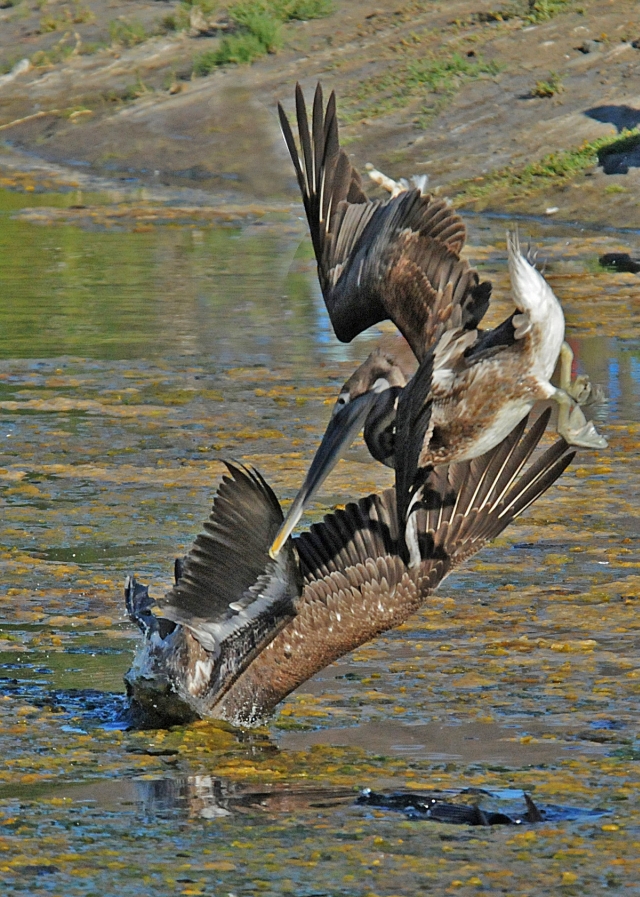
Brown Pelicans diving in Lagoon west channel
(J. Kenney 10/14/13)
Despite comments on the lagoon’s green algae to the contrary, underwater films (on EcoMalibu) have documented the active life under the water’s surface. The Brown Pelicans have independently discovered this fact. Their preferred prey are probably the large Mullet.
Jim Kenney reported: “One of these [pelicans] had a blue tag labeled P06. I sent it to Bird Rescue.”
Jay Holcomb of International Bird Rescue reported back: “P06 was rehabbed at our Northern California center and released on November 2, 2012 in Sausalito (under the Golden Gate Bridge) after being treated for fishing tackle injuries. Looks like its doing well. Thanks again!”
Things can get pretty testy when two of them spot the same fish.

Brown Pelicans dive lagoon’s west channel (J. Kenney 10/14/13)
They’re not the only ones finding food in the west channel. Fish too small for pelicans to bother with can be just right for an Eared Grebe.
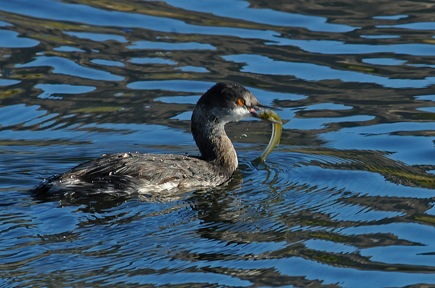
Eared Grebe in Malibu Lagoon west channel with fish
(J. Kenney 10/19/13)
Thanks, as always, to ace photographer Jim Kenney.
[Chuck Almdale]
Bolsa Chica Reserve Field Trip Report: 12 October, 2013
Another glorious day in Southern California…. a smiling group assembled in the parking lot to see what we could see. We had some of the usual suspects – our White-tailed Kite was there and eventually performed, as did a male Belted Kingfisher and many Forster’s Terns…. so when a kite does it (it being hovering over one spot in the water) it is called kiting, but do we call it “terning” or “kingfishering”, no… it is still called kiting… just commenting.
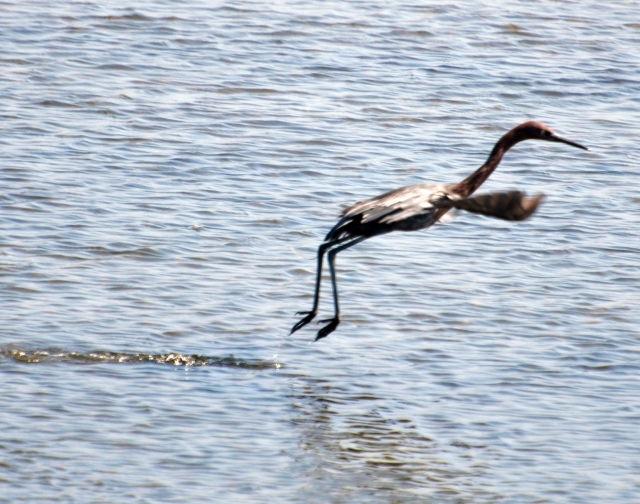
Reddish Egret – the dance of the hunt (A. Douglas 10/12/13)
Other than several flotillas of Ruddy Ducks with a Pied-billed Grebe or two trying to pass, we were duckless. We had a few Reddish Egrets; they did their happy dance that Nat. Geo. calls lurching and Mr. Sibley describes as running, jumping and spinning – they are distinctive and just fun to watch.
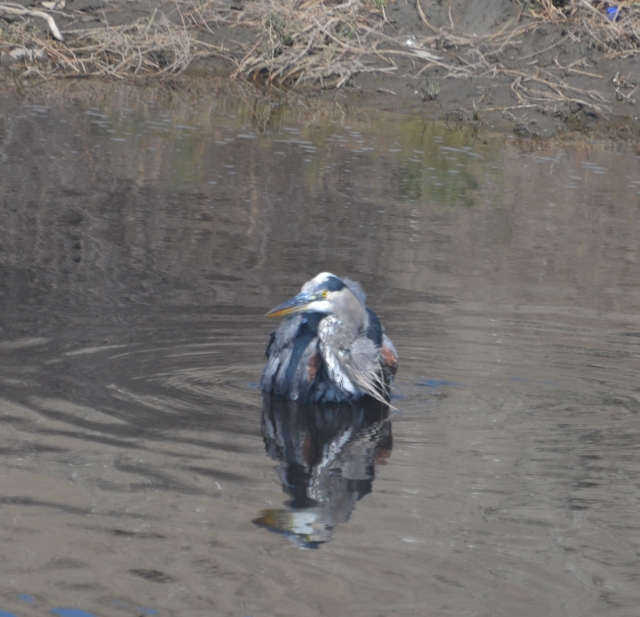
Great Blue Heron in deep water (A. Douglas 10/12/13)
The Great Blue Herons were sporting handsome dark plumes – breeding plumage already? One decided to take a dip, something not usually seen. We had American White Pelicans and Brown Pelicans, Plovers Semipalmated and Black Bellied,and Ruddy Turnstones turning over mud looking for lunch. Long-billed Curlews, Whimbrels, Marbled Godwits, Greater Yellowlegs and several Dunlin were in the mud as well. Interesting discussion about telling the difference between Short-billed and Long-billed Dowitchers – eye placement – have to see if it works the next time I see a Dowitcher (and if I can remember). (Short-billed has the eye above the line made by extending the bill and Long-billed is on or close to the line). My lesson for the day – thanks, Chuck!
The great part about shorebirds is that they are visible – no hiding behind leaves or branches, no warbler neck – the less great part is that they have a rather similar palate of colors…. white, grey, black and brown – have to love Yellowlegs, the orange legs of Turnstones and other color hints.
A lovely day in the sun and a saunter around the wetland….we have have birdier days there, but I, for one, was very glad to be there. [Ellen Vahan]
Link to prior Bolsa Chica field trips: October 2012, October 2011, October 2009.
Map to Bolsa Chica
| Bolsa Chica Reserve | 10/12 | 10/6 |
| Trip List | 2013 | 2012 |
| Brant | X | |
| American Wigeon | X | |
| Mallard | X | |
| Blue-winged Teal | X | |
| Cinnamon Teal | X | |
| Northern Shoveler | X | |
| Northern Pintail | X | |
| Green-winged Teal | X | |
| Ruddy Duck | X | X |
| Pied-billed Grebe | X | X |
| Eared Grebe | X | X |
| Western Grebe | X | X |
| Double-crested Cormorant | X | |
| American White Pelican | X | X |
| Brown Pelican | X | X |
| Great Blue Heron | X | X |
| Great Egret | X | X |
| Snowy Egret | X | X |
| Reddish Egret | X | X |
| Green Heron | X | |
| Black-crowned Night Heron | X | |
| Turkey Vulture | X | X |
| Osprey | X | X |
| White-tailed Kite | X | X |
| Northern Harrier | X | X |
| Red-tailed Hawk | X | X |
| American Coot | X | X |
| Black-bellied Plover | X | X |
| Semipalmated Plover | X | |
| Killdeer | X | X |
| Greater Yellowlegs | X | X |
| Willet | X | X |
| Lesser Yellowlegs | X | |
| Whimbrel | X | X |
| Long-billed Curlew | X | X |
| Marbled Godwit | X | X |
| Ruddy Turnstone | X | X |
| Red Knot | X | |
| Sanderling | X | X |
| Western Sandpiper | X | X |
| Least Sandpiper | X | X |
| Dunlin | X | X |
| Short Billed Dowitcher | X | X |
| Ring-billed Gull | X | X |
| Western Gull | X | X |
| California Gull | X | |
| Black Tern | X | |
| Forster’s Tern | X | X |
| Royal Tern | X | |
| Elegant Tern | X | X |
| Rock Pigeon | X | X |
| Mourning Dove | X | X |
| Anna’s Hummingbird | X | |
| Allen’s Hummingbird | X | |
| Belted Kingfisher | X | X |
| Nuttall’s Woodpecker | X | |
| Downy Woodpecker | X | |
| American Kestrel | X | X |
| Peregrine Falcon | X | |
| Black Phoebe | X | X |
| Say’s Phoebe | X | X |
| Loggerhead Shrike | X | |
| American Crow | X | X |
| Bushtit | X | |
| House Wren | X | |
| European Starling | X | X |
| American Pipit | X | |
| Common Yellowthroat | X | X |
| Yellow-rumped Warbler | X | |
| California Towhee | X | |
| Savannah (Belding’s) Sparrow | X | |
| Savannah Sparrow | X | X |
| Song Sparrow | X | |
| White-Crowned Sparrow | X | X |
| House Finch | X | X |
| Total Species – 75 | 51 | 69 |
Creatures from the Green Lagoon
EcoMalibu has now posted four films of the underwater life in the new channel. Fish, both in singletons and in schools, crabs, shrimp-like things – perhaps amphipods – and other stuff utterly alien to me, all swimming, floating or crawling around and through the algae under the water.
1. Aug. 7, 2013 Length 1:48 minutes
2. Aug. 12, 2013 Length 9:20 minutes
3. Aug. 26, 2013 Length 3:53 minutes
4. Sep. 9, 2013 Length 4:55 minutes
Link to EcoMalibu video page. Dragonfly videos, interviews and much more. Also a ton of information on the history of the lagoon and surrounding area.
Meanwhile, above the water, the Sierra Club Trail Crew did a third Saturday of weeding. This time we worked over the area between the parking lot and the main lagoon towards the PCH bridge. Some of the workers, including SMBAS member and permanant Trail Crewite Jim Kenney, made heavy inroads into thinning out the Mulefat between the path and the channel. A few others, including SMBAS member Mary Prismon and yours truly, pulled, dug, and pried out St. Augustine grass and ‘devilweed’ from the area alongside the brush bordering PCH. Based on this exercise, St. Augustine, in my book, has got a lot to answer for.
[Chuck Almdale]



 SANTA MONICA BAY AUDUBON SOCIETY BLOG