Free email delivery
Please sign up for email delivery in the subscription area to the right.
No salesman will call, at least not from us. Maybe from someone else.
It’s Official!
Malibu Lagoon has it’s official opening ceremony on Friday, 3 May at 11 AM.
It was a long and often acrimonious process, but now little remains to be done except watch the plants grow.
Santa Monica Bay Audubon Society has long supported this project, and we have been especially invited to attend. California State Parks asked if we could have members with telescopes on hand to help attendees see and learn about the birds. We have a couple of volunteers so far, but we need more. How about you? The more birders we have on hand, the better.
To volunteer, send an email to: webinfo49 [at] att.net.
To simply attend, just come.
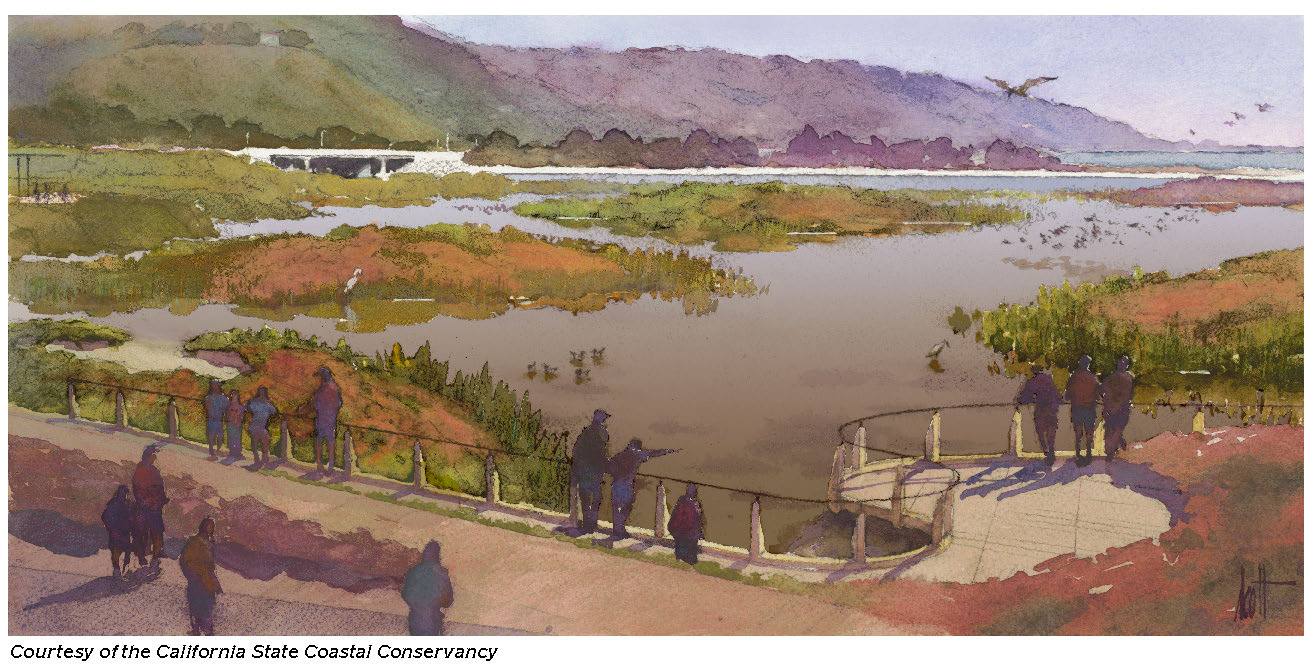
- The vegetation hasn’t grown back yet, but you get the idea. (RestoreMalibuLagoon . com)
Directions: Malibu Lagoon is at the intersection of Pacific Coast Highway and Cross Creek Road. Look around for people wearing binoculars. Parking in the official lagoon lot is $12+ or by annual pass. You may also park either along PCH west of Cross Creek Road, on Cross Creek Road, or on Civic Center Way north (inland) of the shopping center. Be careful – some parts of PCH are off-limits (read the signs carefully). Lagoon parking in the shopping center lot is not permitted.
Map to Meeting Place
Chuck Almdale]
Placerita Canyon Field Trip Report, April 13.
We had a good group (around 20) of birders for this trip. The weather was just about perfect too. The only exoskeletal life forms in the pomade were a couple of adults (with an enormous group of boy scouts) who were repairing a park kiosk with power tools. By power tools I mean a huge yellow pickup truck with an air compressor to drive the nail guns and so on. They managed to pack a dozen cars into the picnic area too. All this to fix about a dozen square feet of kiosk roof.
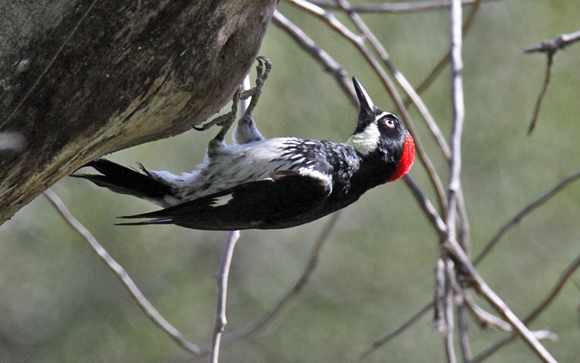
Acorn Woodpecker [Scott Baker]
Fortunately we were able to leave the noise behind as we went up the Waterfall Trail and the birds came out to see us. We had a lot of the usual suspects, foremost in number being Acorn Woodpeckers, followed closely by vocalizing House Wrens and Oak Titmice. The birds were apparently trying to drown out the people noise.
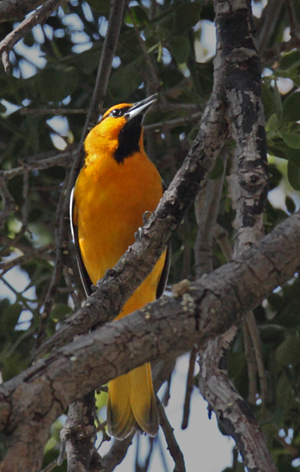
Bullock’s Oriole [Scott Baker]
The highlight of the walk had to be sighting 7 (seven!) different warblers! This is not the most you can see, but asking for more on one trip is just rude. We had to search carefully because most of them were Yellow-rumps, and one flitting warbler looks a lot like another until you pay attention. The biggest surprise was probably the Hermit Warbler – a gorgeous male in full breeding plumage. Those of us partial to Townsend’s Warblers had to wait until nearly the end of the trip to find one, and it was the lucky seventh species.
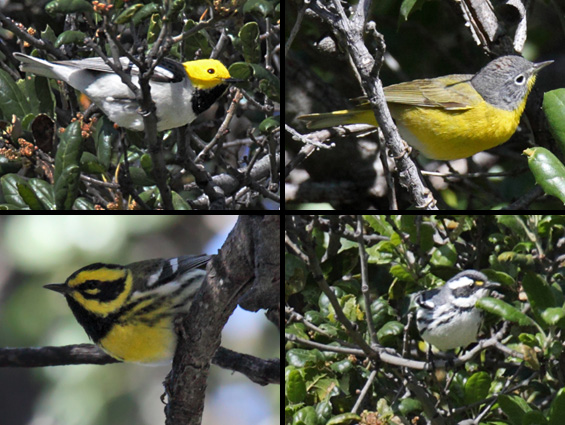
Warbler Collage. Clockwise from upper left: Hermit, Nashville, Black-throated Grey, Townsend’s [Scott
Baker]
After the walk we adjourned to the picnic area down at the Nature Center where a Cooper’s Hawk posed in a nearby tree as we ate our lunches.
Recommendation: go to Placerita on a weekday if you can to avoid the crowds.
Bird List:
Turkey Vulture
White-tailed Kite
Cooper’s Hawk
Red-tailed Hawk
Mountain Quail [H]
California Quail
Mourning Dove
White-throated Swift
Anna’s Hummingbird
Allen’s Hummingbird ♀ [probable]
Acorn Woodpecker
Nuttall’s Woodpecker
Northern Flicker
Grey Flycatcher
Pacific-slope Flycatcher
Ash-throated Flycatcher
Steller’s Jay
Western Scrub-Jay
Common Raven
Western Warbling-Vireo
Phainopepla
Western Bluebird
Northern Mockingbird
European Starling
White-breasted Nuthatch [H]
Bewick’s Wren
House Wren
Bushtit
Violet-green Swallow
Wrentit [H]
Oak Titmouse
Lesser Goldfinch
Purple Finch [H]
House Finch
Orange-crowned Warbler
Nashville Warbler
Yellow-rumped Warbler
Black-throated Grey Warbler
Townsend’s Warbler
Hermit Warbler
Wilson’s Warbler
Song Sparrow
White-crowned Sparrow
Golden-crowned Sparrow
Chipping Sparrow
Spotted Towhee
California Towhee
Western Tanager
Black-headed Grosbeak
Bullock’s Oriole
Brown-headed Cowbird
51 species
Special thanks to Scott Baker for all the photos!
Announcing dates for Grant Applications
College Students: Are you a full-time student? Do you qualify for one of our Field Study Grants? Here is the new Santa Monica Bay Audubon Small Grants Poster that explains the very basic requirements. Our application form is easily downloaded and printed: SMBAS sm grt APP , and it could quickly net you a tax-free grant for hundreds of dollars for your field study project! The application is short and we award direct grants at least twice a year. Don’t pass it up, and share the info with your colleagues. There are frequently multiple awards.
Help Monitor Least Terns at Venice Beach!
Los Angeles Audubon is looking for dedicated volunteers to help monitor the endangered California Least Tern at Venice Beach.

Least Tern chick
In Los Angeles County, this species returns to only two breeding colonies, one at Venice Beach and one at the Port of Los Angeles. Los Angeles Audubon works with project biologists and the California Department of Fish & Wildlife studying the tern colony in Venice by coordinating a community-based science monitoring program during the nesting season. Volunteers receive training and then help monitor the colony for one hour each week from mid-April to mid-August. This is a great opportunity for families looking for a way to learn about nature together, for students looking to gain some field experience in environmental science, or anyone who’d like to know more about urban wildlife.
If this sounds like something you’re interested in, then we’d love to meet you at one of the following training sessions:
April 27 (Saturday) – 8am to 9am
May 6th (Monday) – 630pm to 730pm
May 9th (Wednesday) – 630pm to 730pm
Training Location: The training sessions will take place at the Least Tern Colony enclosure on Venice Beach. The enclosure is located at the very southern end of Venice Beach near the Ballona Channel. There is metered parking along the channel where Pacific Ave turns into Via Marina, and there’s a public pay lot at the intersection of Via Marina and Captain’s Row. There’s technically free parking along Pacific Ave, but the spots get taken up fast.
Binoculars are essential to monitoring, so please bring them with you if you own them. If one of these dates doesn’t work for you but you’re still interested in helping, please let us know and we’ll see if we can arrange an alternative training session.
For questions and to register for a training session, please contact the Volunteer Coordinator at 323-481-4037 or tern@laaudubon.org.
We’ve been really lucky with
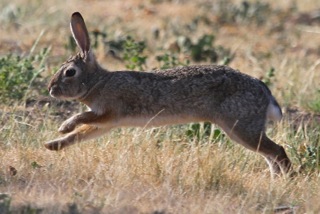
Rabbit (J. Waterman 4/6/13)
the weather for this hike; I can’t recall it ever being less than great. Twenty-two of us roamed around the Paramount movie ranch for about 20 minutes, during which time much of the morning fog burned off. Plenty of birds were singing and rabbits hopping; especially notable were White-breasted Nuthatches, House Finches, Western Bluebirds, Acorn Woodpeckers, House Wrens and a flock of five Nanday (aka Black-hooded) Parakeets. We shed a few garments back at the cars, then set off towards the Reagan Ranch portion of Malibu Creek State Park, which lies kitty-corner across Mulholland & Cornell Rds. from Paramount Ranch.
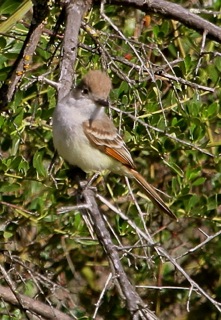
Ash-throated Flycatcher (J. Waterman 4/6/13)
Many of the flowers were not yet or just barely in bloom – probably the result of a dry winter with only 6.4” of rain since Oct 1st, 54% of normal. So the Lupine were barely in bloom, but the Buckwheat, Dudleaya, Horehound, Milkweed, Soap Plant, White and Black Sages, Golden Current, Penstemon, Milk Thistle, and Wooly Blue Curls – all of which we saw – were not in bloom.
On the other hand, the Ceanothus, Elderberry, Bedstraw, Fiddleneck, and many others were beautiful. As usual, it was hard to make progress hiking with so much to look at. The total plant list was 66 species (see below).
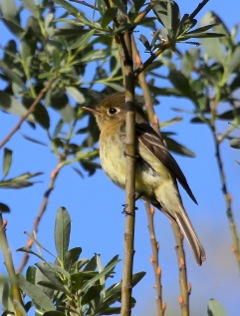
Pacific Slope Flycatcher (J. Waterman 4/6/13)
Our bird trip list came up to a respectable 59 species, of which only five species – California Quail, Bewick’s Wren, Wrentit, Phainopepla and Black-headed Grosbeak were heard and not seen. As in prior years, every tree seemed to hold a singing House Wren. House Finches were abundant, particularly around the Reagan Ranch buildings. We rediscovered for the umpteenth time that when you hear an unfamiliar bird song in the Santa Monica Mountains, it’ll be either an Oak Titmouse or a Bewick’s Wren; the former’s song is rich in tone while the latter’s song is usually a bit more buzzy.

Cooper’s Hawk (J. Waterman 4/6/13)
We spotted a Sharp-shinned Hawk soaring over the Reagan Ranch meadow, just before we got to the top of Cage Creek Trail. Or I should say, some of us did. I called out the bird, and some others said, “No, it’s a Cooper’s Hawk!” It turned out that the possible was the actual – we had both. It gave us a good opportunity to compare the tail shapes and head postures – the best field marks when flying – of these two similar species.
By noontime we found ourselves by Malibu Creek, the day had warmed, the birds weren’t so vocal anymore, and large crowds of humans now abounded. Our last trip flower is usually Chia, which we find only on a roadside hill near the Malibu Creek parking lot – but there were so few this year that we had a hard time finding them, and some missed them altogether.
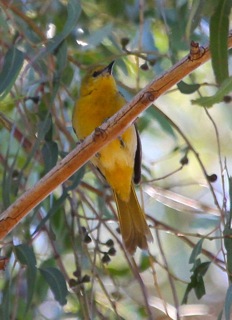
Hooded Oriole female (J. Waterman 4/6/13)
We couldn’t get all 22 people into the two shuttle cars we’d left, so we had to make two trips to get everyone back to Paramount, where most of us had lunch at the picnic tables under the large “ghost gum” eucalypts, while a sizable wedding party gathered under the large oak in the western town, drinking wine and getting dusty.
As always, the hike was led by Peggy Burhenn, Calif. State Parks docent specializing in native plants and wildflowers. We went back toour original one-way-with-car-shuttle route, as last year’s hike back up Cage Creek Trail nearly did many of us in. I’ve also been advised to mention that there are actually “several” small up and down slopes.
The lists below give a five-year comparison of this hike. There are significant differences from year-to-year, both in what we find and what is in bloom.
[Chuck Almdale]
| PLANT TRIP LISTS – PARAMOUNT TO MALIBU CREEK | |||||
| X – Seen NB – Not in Bloom * – Introduced Species | |||||
| 4/6 | 4/15 | 4/9 | 4/10 | 3/29 | |
| WHITE | 2013 | 2012 | 2011 | 2010 | 2009 |
| Ashy-leafed Buckwheat | X | NB | X | ||
| Big Pod Ceanothus | X | NB | X | X | |
| California Buckwheat | NB | X | X | NB | |
| California Everlasting | X | X | |||
| Cliff Aster | X | X | |||
| Coyote Brush | X | X | NB | NB | NB |
| Dodder | X | X | X | ||
| Dudleaya | NB | X | |||
| Elderberry | X | X | NB | X | X |
| Horehound* | NB | X | X | X | X |
| Lace Pod (green) | X | X | X | ||
| Lanceleaf Dudleaya | NB | ||||
| Linanthus | X | ||||
| Miner’s Lettuce | X | X | X | X | |
| Morning Glory | X | X | |||
| Mulefat | X | X | X | X | |
| Narrow-leafed Bedstraw | X | X | |||
| Narrow-leafed Milkweed | NB | ||||
| Onion – not specified | X | ||||
| Poison Hemlock | NB | NB | X | ||
| Poison Oak | X | X | |||
| Popcorn Flower | X | X | X | X | |
| Soap Plant | NB | X | X | ||
| White Nightshade | X | X | |||
| White Sage | NB | X | X | X | X |
| Wild Cucumber | X | X | X | X | X |
| Yucca | X | X | NB | X | X |
| YELLOW | |||||
| Burr Clover* | X | ||||
| Canyon Sunflower | X | ||||
| Collarless California Poppy | X | ||||
| Common Fiddleneck | X | X | X | X | X |
| Common Goldfields | X | ||||
| Deerweed | X | X | |||
| Golden Currant | NB | X | X | X | X |
| Golden Yarrow | X | X | X | ||
| Johnny Jump-up | X | X | X | X | X |
| Lomatium | X | ||||
| Microseris | X | ||||
| Mountain Dandelion | X | X | X | ||
| Mustard* | X | X | X | X | X |
| Pineapple Weed* | X | X | X | X | X |
| Stringose Lotus | X | X | |||
| Western Wallflower | X | X | X | ||
| ORANGE | |||||
| Bush/sticky Monkeyflower | X | X | X | NB | |
| California Poppy | X | X | X | ||
| Scarlet Pimpernel* | X | X | |||
| RED | |||||
| Chalk Live-forever | X | ||||
| Crimson Pitcher (Hummingbird) Sage | X | X | X | X | NB |
| Heart-leaved Penstemon | NB | ||||
| Indian Paintbrush | X | NB | X | ||
| PINK | |||||
| Bush Mallow | X | ||||
| Chinese Houses | X | X | X | X | X |
| Milk Thistle* | NB | X | X | NB | NB |
| Prickly Phlox | X | X | |||
| Purple Clarkia | X | ||||
| Purple Owl’s Clover | X | X | X | ||
| Purple Sage | X | X | X | X | X |
| Red-stem Filaree* | X | X | X | X | X |
| Spring Vetch* | X | X | X | X | |
| Tom Cat Clover | X | X | |||
| Wild Radish* | X | X | X | X | |
| Wild Sweet Pea | X | X | X | ||
| Wooly Aster | X | ||||
| PURPLE / BLUE | |||||
| Baby Blue Eyes | X | X | |||
| Bajada Lupine | X | ||||
| Black Sage | NB | X | X | X | |
| Blue Dicks | X | X | X | X | X |
| Blue Larkspur | X | X | |||
| Bush Lupine | X | X | X | X | X |
| California Peony | X | ||||
| Caterpillar Phacelia | X | X | X | X | X |
| Chia | X | X | X | X | |
| Common Vervain | X | X | |||
| Danny’s Skullcap | X | X | |||
| Dove Lupine | X | X | X | ||
| Fern-leaf Phacelia | X | X | X | ||
| Fiesta Flower | X | X | X | X | X |
| Green Bark Ceanothus | X | X | N | X | X |
| Henbit* | X | ||||
| Italian Thistle* | X | ||||
| Parry’s Phacelia | X | X | X | X | |
| Purple Nightshade | X | X | X | X | X |
| Sticky Phacelia | X | ||||
| Winter Vetch* | X | X | |||
| Wooly Blue Curls | NB | ||||
| BROWN | |||||
| Curly Dock | X | X | |||
| English Plantain* | NB | X | |||
| TREES, SHRUBS, OR | |||||
| NOT IN BLOOM | |||||
| Arroyo Willow | X | X | X | X | X |
| California Bay Laurel | X | X | X | ||
| California Bickelbush | X | ||||
| California Sagebrush | X | X | X | X | |
| Chamise | X | X | X | ||
| Coast Live Oak | X | X | X | X | X |
| Coffee Berry | X | X | |||
| Hog Fennel | X | X | |||
| Laurel Sumac | X | X | X | X | X |
| Mistletoe | X | X | X | X | |
| Mugwort | X | X | X | X | X |
| Poison Oak | X | X | X | ||
| Scrub Oak | X | X | |||
| Squaw Bush | X | X | |||
| Stinging Nettle | X | ||||
| Sugarbush | X | X | X | X | |
| Toyon | X | X | X | X | X |
| Valley Oak | X | X | X | X | |
| Western Sycamore | X | X | X | X | X |
| Whitethorn | X | ||||
| Wild Rose | X | X | X | X | |
| Total Plants – 108 | 66 | 73 | 60 | 70 | 56 |
z
| Paramount – Malibu Creek S.P. | 2013 | 2012 | 2011 | 2010 | 2009 |
| Bird Name | 4/6 | 4/15 | 4/9 | 4/10 | 3/29 |
| Canada Goose | 2 | 4 | 2 | ||
| Gadwall | X | ||||
| American Wigeon | X | ||||
| Mallard | 6 | 8 | 7 | 10 | X |
| Ring-necked Duck | 6 | ||||
| Bufflehead | X | ||||
| Ruddy Duck | X | ||||
| California Quail | 3H | 20 | 6 | 4H | |
| Pied-billed Grebe | X | ||||
| Great Blue Heron | 3 | 1 | 2 | ||
| Turkey Vulture | 4 | 3 | 4 | 2 | X |
| Northern Harrier | 1 | ||||
| Sharp-shinned Hawk | 1 | 1 | 1 | ||
| Cooper’s Hawk | 2 | 1 | 1 | X | |
| Red-shouldered Hawk | 3 | 1 | 6 | 2 | X |
| Red-tailed Hawk | 2 | 3 | 3 | 5 | X |
| American Coot | 9 | 4 | 4 | X | |
| Spotted Sandpiper | 1 | ||||
| California Gull | 20 | ||||
| Band-tailed Pigeon | 3 | 3 | 9 | ||
| Mourning Dove | 1 | 4 | 8 | 12 | |
| Barn Owl | 1 | ||||
| Vaux’s Swift | 20 | ||||
| White-throated Swift | 4 | 2 | 4 | 12 | X |
| Black-chinned Hummingbird | 1 | 1 | 1 | ||
| Anna’s Hummingbird | 5 | 1 | 2 | 4 | X |
| Allen’s Hummingbird | 2 | 1 | 1 | X | |
| Belted Kingfisher | 1 | X | |||
| Acorn Woodpecker | 12 | 9 | 8 | 11 | X |
| Nuttall’s Woodpecker | 4 | 5 | 2 | 2H | X |
| Downy Woodpecker | X | ||||
| Northern Flicker | 2 | 3 | 2 | X | |
| American Kestrel | X | ||||
| Black-hooded Parakeet | 5+4H | 3 | 1 | ||
| Hammond’s Flycatcher | 1 | ||||
| Pacific-slope Flycatcher | 1 | 1 | 2 | X | |
| Black Phoebe | 4 | 4 | 8 | 8 | X |
| Say’s Phoebe | 3 | 1 | 3 | 1 | |
| Ash-throated Flycatcher | 3+2H | ||||
| Cassin’s Kingbird | 9 | 3 | 4 | 2 | X |
| Western Kingbird | 1 | 4 | 3 | X | |
| Hutton’s Vireo | 1 | ||||
| Warbling Vireo | 2 | X | |||
| Western Scrub-Jay | 6+4H | 10+20H | 12 | 14 | X |
| American Crow | 12 | 15 | 20 | 6 | X |
| Common Raven | 9 | 2 | 4 | 5 | X |
| Tree Swallow | 10 | 6 | 4 | ||
| Violet-green Swallow | 20 | 20 | 12 | ||
| Northern Rough-winged Swallow | 15 | 25 | 35 | 24 | X |
| Cliff Swallow | 1 | 3 | 1 | 20 | X |
| Barn Swallow | 2 | X | |||
| Oak Titmouse | 4+15H | 2+20H | 9 | 4 | X |
| Bushtit | 5 | 8 | 8 | 4 | X |
| White-breasted Nuthatch | 3 | 2 | 2 | 2 | X |
| Canyon Wren | 1 | 1H | H | ||
| House Wren | 4+30H | 4+40H | 25 | 32 | X |
| Bewick’s Wren | 2H | 4 | 12 | 2 | X |
| Blue-gray Gnatcatcher | 3H | 1 | |||
| Ruby-crowned Kinglet | 1 | 2 | 2 | X | |
| Wrentit | 14H | 20H | 7H | H | X |
| Western Bluebird | 10 | 10 | 13 | 10 | X |
| Hermit Thrush | 1 | X | |||
| American Robin | 1 | ||||
| Northern Mockingbird | 6+3H | 2 | X | ||
| California Thrasher | 1+3H | 4H | H | ||
| European Starling | 10 | 1 | 6 | 12 | X |
| Phainopepla | 1H | ||||
| Orange-crowned Warbler | 1+2H | 1H | 5 | 6 | X |
| Common Yellowthroat | 2 | 1H | 6 | 2 | X |
| Yellow Warbler | 1+6H | H | |||
| Yellow-rumped Warbler | 4+2H | 6 | 6 | 10 | X |
| Black-throated Gray Warbler | X | ||||
| Townsend’s Warbler | X | ||||
| Spotted Towhee | 4+6H | 5+5H | 8 | 5 | X |
| California Towhee | 4+4H | 10 | 20 | 6 | X |
| Savannah Sparrow | 1 | ||||
| Song Sparrow | 5+4H | 7+6H | 13 | 7 | X |
| Lincoln’s Sparrow | X | ||||
| White-crowned Sparrow | 10 | 1 | X | ||
| Golden-crowned Sparrow | 2 | ||||
| Dark-eyed Junco | 7 | 10 | X | ||
| Black-headed Grosbeak | 4H | 8 | 3 | 4 | |
| Red-winged Blackbird | 5 | 12 | 20 | X | |
| Western Meadowlark | 5 | X | |||
| Brown-headed Cowbird | 2 | 1 | |||
| Hooded Oriole | 4 | 4 | 6 | ||
| Bullock’s Oriole | 5+3H | 6 | 3 | 6 | |
| Purple Finch | H | ||||
| House Finch | 20+30H | 90 | 60 | 20 | X |
| Lesser Goldfinch | 6+6H | 8 | 12 | 16 | X |
| American Goldfinch | 30 | ||||
| House Sparrow | X | ||||
| Total – 92 species | 59 | 62 | 52 | 60 | 58 |



 SANTA MONICA BAY AUDUBON SOCIETY BLOG