Free email delivery
Please sign up for email delivery in the subscription area to the right.
No salesman will call, at least not from us. Maybe from someone else.
Birders Take Their Lumps With Their Splits
In the past 30 years, about 1300 new avian species have been added to the world’s birdlist. Some were entirely new to science. Collectors in the Amazon basin keep turning up new antbirds, tapaculos and tyrant flycatchers, for example, but new species keep trickling in from all the world’s under-explored areas. However, the majority of new bird species are the result of “splitting” – raising already known and described subspecies up to full species status. This comes about from additional research: sometimes field studies, sometimes DNA analysis, sometimes both.
“Lumping” occurs when new research shows -or appears to show – that one or more birds with full species status are more properly considered as subspecies of a variable species. Several decades ago the Red-shafted, Yellow-shafted and Gilded Flickers of North America were “lumped” into the single Northern Flicker (Colaptes auratus) when found freely interbreeding in areas where their ranges overlapped. A few years later, the Gilded Flicker (Colaptes chrysoides) was “re-split” from the Northern Flicker, based on even newer research. Decades earlier, the Spotted and Eastern Towhees had each been “good” species; again, research found them interbreeding and they were lumped into the Rufous-sided Towhee (Pipilo erythrophthalmus), only to be re-split in 1995 back into Spotted (P. maculatus) and Eastern Towhees (Pipilo erythrophthalmus).
And so the pendulum swings: splitting to lumping to splitting, with a preponderance of the latter over the past half-century. But it now swings back to lumping, and with a vengeance utterly unexpected.
Recently, researchers in molecular genetics at the Carl von Linné Conservatory of Biological Systematics at Uppsala University in Sweden have admitted to an enormous, decades-long error. “We found a glitch in analysis program we used many decades,” says conservatory head Dr. Thorbald Thorbaldson. “Simple, but bringing a catastrophe. Several people resigned. One man became reindeer herder with the Lapps.”
Simply put, a decimal place was off by three orders of magnitude. DNA samples with a reported variance of – say – 2.7%, were actually only 0.0027% at variance. Dr. Thorbaldson: “Samples we thought quite different, indicating great evolutionary separation, are – well – not so different after all! Mildly speaking. With birds, it turns out there are far fewer “good species” and far more subspecies than we thought.”
How few? Sit down and hold your breath. Keep holding. Now read on.
“Careful reanalysis, ” reports Dr. Thorbaldson, “indicates there are probably 10 species of birds, with approximately 24,000 subspecies. Give or take a few, of course.”
Ten species? TEN? It makes you want to hang up your binoculars, take off your Tilley and anorak, climb back into bed and pull the blanket up over your head for a long, long while.

Obviously, the name of the ten species needed simplification, resulting in a certain uniformity. They are, alphabetically, with English translations of the scientific name in parentheses:
Hoopoe – Upupa omnimodia (universal hoopoe)
Sapayoa – Sapayoa incertaesedis (uncertain origin sapayoa)
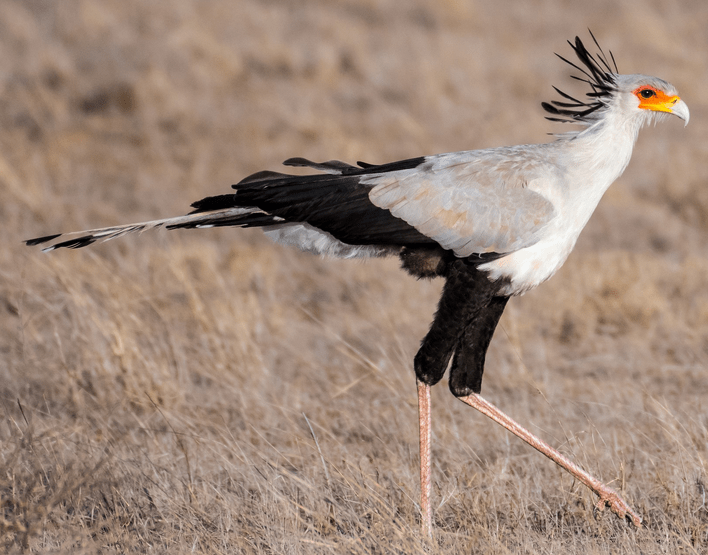
Secretary-bird – Venator terrafirma (solid-ground hunter)
The Budgie – Primosittacus familiaris (social first-parrot)
The Chicken – Gallus assus (roasted chicken)
The Cuckoo – Cuculus horacustodis (time-keeper cuckoo)
The Duck – Anas mundus (world duck)
The Peep – Charadrius tibicinus (piper waterbird)
The Railbird – Erepus palus (marsh creeper)
The Songbird – Passerina cantata (sparrow-like singer)
Many of the water birds – penguins, cormorants, tubenoses, and auks for example – were discovered to not be birds at all, but fish. Similarly, the swifts and hummingbirds are actually insects, most closely related to damselflies. The Secretary-bird (pictured above), which as anyone can see looks like a feathered dinosaur, turned out to be ancestral to all the hawks, falcons, owls, nightjars and such. The Hoopoe holds a similar position for many egret and stork-like birds. Finally, that long-term ornithological bugaboo, the Sapayoa (a small manakin-like bird endemic from southern Panama to northwest Ecuador) is still of indecipherable lineage. “We’re pretty sure it is a bird…at least some of us are,” explains Dr. Thorbaldson, “but, as always, it seems completely unrelated to anything else. We don’t know what it is, and frankly we’re (expletive deleted) tired of looking at it.”
For a quick look at how the birds used to be organized, take a look at this chart, courtesy of the University of Sheffield. If you find Crows, Jays or Ravens on the chart, please let me know, because I couldn’t.
If you found this article plausible, you may be interested in other installments in our Early Spring Monograph Series (ESMS):
2012: Canyonland Roadrunner Captured on Film
2011: New Hummingbird Species Discovered in Los Angeles County!
2010: The Western Roof-Owl: Bird of Mystery
and not to be overlooked,
2026: Save the endangered Pacific Northwest Tree Octopus from Extinction
[Chuck Almdale, on behalf of Society 401]
Malibu Lagoon Field Trip Report: 24 March, 2013
We finally got to see the new lagoon layout without the fences and equipment. There’s a lot more water surface, especially when the lagoon outlet is closed and the level is higher than the “peninsula,” as it was today. Tens of thousands of little flags of several colors were everywhere; if the color means anything, I don’t know what it is. The ground looks quite barren until you look closely, when you’ll see a tiny plant next to nearly all the flags. The flags mark these plants, so that when weeds inevitably pop up, they’ll be flagless, and doomed to removal. Doomed!
Starting at the viewing area closest to the PCH bridge (henceforth the north platform), we checked out the ducks which, except for the Mallards, Gadwalls and Ruddy Ducks, have mostly left for the north. Swallows are returning: we saw a dozen Rough-winged over the channel, with a single male Barn Swallow sweeping the beach. We spent a long time looking at a Merlin in a sycamore at the edge of the golf course, trying to see if it actually had a head or not, with but one very fuzzy photo to show for it.
Tide was quite high; waves crashing over the offshore rocks, with Surf Scoters, Pacific, Red-throated and Common Loons, Horned and Eared Grebes, all moving into breeding plumage, threading their way through the long line of surfers busily thrashing the waves.
A large mixed flock of Willets, Whimbrels and Marbled Godwits, flying in from the southeast, dropped in near the end of our walk, joining the few Brown Pelicans and Double-crested Cormorants resting on the sand islands. Many of the cormorants have developed their white “eyebrows” – the two crests that give them their name, lending them an Andy Rooney appearance. The Snowy Plover winter colony was out foraging in two separate groups: 16 – including PV:YB – in the high tide wrack, and 17 at lagoon-edge a hundred yards away. Among the few gulls we found a Herring Gull and a Glaucous-wing Gull, both in adult alternate plumage. Glaucous-winged in SoCal are usually first-year birds; finding one in adult breeding plumage is very uncommon, at least for me. I’m guessing it’s the 2nd one I’ve ever seen at the lagoon.
The lagoon outlet was closed, so we went to Adamson House, where we found most of the passerines: Oak Titmouse, Bewick’s Wren, Yellow-rumped Warblers, Song Sparrows, and California Towhees were poking around the trees and brush, while 4 Nanday Parakeets sat in the top of the big sycamore tree.
It’s now become pointless to separately census birds in the channel area as, after they awake, they freely move back and forth the rest of the day. I have the impression that the ducks spend the night in the channel on one or more of the new islands, then spread out as the day warms.
Merlins typically show up briefly in fall and spring, so I guess this was our spring bird. The Elegant Terns have been absent since October, but you never know when Nanday Parakeets will appear. They fly often and far from their nesting areas in the nearby canyons, foraging for food. Cassin’s Kingbird was last seen in Feb.’12, and both swallow species left last August. Brewer’s Blackbirds are irregular – they’re nearly always over at the shopping center food courts, snatching fries, burger bits and whatnot, but they don’t often make it to the lagoon, at least on Sunday mornings.
Our next three field trips: Paramount Ranch to Malibu Creek Flowers & Bird Hike, 6 April, 8am; Walker Ranch in Placerita Canyon, 13 April 8:30am; Butterbredt Spring Campout 27-28 April, 8am; Malibu Lagoon, 28 April, 8:30am.
Our next program: Tuesday, 5 Apr., 7:30 pm. Birds and Large Dangerous Mammals of Tanzania, with Chuck Bragg. Meeting place is at Christine Reed Park at Wilshire & Lincoln Blvds. in Santa Monica. The usual reminders will be emailed from the blog.
NOTE: Our 10 a.m. Parent’s & Kids Birdwalk resumes on 28 April, 2013. The parking lot is back to normal.
Links: Unusual birds at Malibu Lagoon
Aerial photo of Malibu Lagoon from 9/23/02.
Prior checklists: July-Dec’11, Jan-June’11, July-Dec ’10, Jan-June ’10, Jul-Dec ‘09, and Jan-June ‘09.
Comments on Bird Lists Below
Total Birds: March total birds of 673 are 30% below average; low numbers are mainly in the Western Grebes, Double-crested Cormorants, Brown Pelicans and California Gulls, with the shortfall in those 4 species totaling over 370 birds.
Species Diversity: March 2013 with 61 species was 9% above 56.2 6-year average, a minor variance.
Summary of species diversity from the 6-year average so far: June -10%, July +10%, Aug. -6%, Sep. -20%, Oct. +5%, Nov +2%, Dec -4%, Jan +2%, Feb -8%, +9%. Still, the only constant is change.
10-year comparison summaries are available on our Malibu Lagoon Bird Census Summaries Page.
[Chuck Almdale]
|
2008 |
2009 |
2010 |
2011 |
2012 |
2013 |
||
| Malibu Census 2012 |
23-Mar |
22-Mar |
28-Mar |
27-Mar |
25-Mar |
24-Mar |
|
| Temperature | 65-75 | 50-60 | 70-80 | 54-61 | 60-75 | ||
| Tide Lo/Hi Height | H +4.2 | H +4.8 | H +5.48 | L +0.05 | H +3.64 | H +4.90 | Ave. |
| Tide Time | 1059 | 0728 | 0840 | 1216 | 1146 | 0806 | Birds |
| Brant | 1 | 0.2 | |||||
| Canada Goose | 3 | 0.5 | |||||
| Gadwall | 26 | 18 | 16 | 32 | 18 | 13 | 20.5 |
| American Wigeon | 4 | 4 | 14 | 3 | 4.2 | ||
| Mallard | 10 | 16 | 12 | 30 | 24 | 28 | 20.0 |
| Cinnamon Teal | 6 | 4 | 1.7 | ||||
| Northern Shoveler | 13 | 2 | 8 | 18 | 2 | 7.2 | |
| Northern Pintail | 1 | 5 | 1.0 | ||||
| Green-winged Teal | 8 | 4 | 1 | 10 | 11 | 5.7 | |
| Lesser Scaup | 1 | 0.2 | |||||
| Surf Scoter | 10 | 18 | 8 | 5 | 6.8 | ||
| Red-brstd Merganser | 10 | 3 | 1 | 4 | 2 | 12 | 5.3 |
| Ruddy Duck | 8 | 11 | 15 | 20 | 55 | 18.2 | |
| Red-throated Loon | 2 | 2 | 0.7 | ||||
| Pacific Loon | 5 | 15 | 3 | 3.8 | |||
| Common Loon | 1 | 1 | 0.3 | ||||
| Pied-billed Grebe | 1 | 1 | 4 | 1.0 | |||
| Horned Grebe | 2 | 1 | 0.5 | ||||
| Eared Grebe | 1 | 0.2 | |||||
| Western Grebe | 220 | 12 | 27 | 20 | 1 | 46.7 | |
| Brandt’s Cormorant | 2 | 2 | 1 | 1 | 1 | 1.2 | |
| Dble-crstd Cormorant | 33 | 36 | 42 | 90 | 30 | 15 | 41.0 |
| Pelagic Cormorant | 1 | 1 | 0.3 | ||||
| Brown Pelican | 320 | 170 | 184 | 89 | 40 | 35 | 139.7 |
| Great Blue Heron | 1 | 1 | 2 | 1 | 1 | 1.0 | |
| Great Egret | 1 | 2 | 1 | 1 | 1 | 1.0 | |
| Snowy Egret | 3 | 10 | 7 | 5 | 12 | 5 | 7.0 |
| Green Heron | 1 | 0.2 | |||||
| Blk-crwnd N-Heron | 1 | 0.2 | |||||
| Turkey Vulture | 2 | 3 | 2 | 1.2 | |||
| Osprey | 1 | 1 | 0.3 | ||||
| Cooper’s Hawk | 1 | 1 | 0.3 | ||||
| Red-shouldered Hawk | 1 | 1 | 0.3 | ||||
| Red-tailed Hawk | 2 | 2 | 2 | 2 | 1 | 1.5 | |
| Merlin | 1 | 0.2 | |||||
| Peregrine Falcon | 1 | 0.2 | |||||
| Virginia Rail | 1 | 0.2 | |||||
| Sora | 1 | 1 | 1 | 4 | 1.2 | ||
| American Coot | 53 | 85 | 92 | 153 | 20 | 170 | 95.5 |
| Blk-bellied Plover | 45 | 24 | 25 | 7 | 16.8 | ||
| Snowy Plover | 25 | 36 | 25 | 42 | 14 | 33 | 29.2 |
| Killdeer | 4 | 3 | 1 | 2 | 2 | 2.0 | |
| Black Oystercatcher | 1 | 2 | 0.5 | ||||
| American Avocet | 2 | 7 | 1.5 | ||||
| Spotted Sandpiper | 1 | 1 | 1 | 1 | 1 | 1 | 1.0 |
| Greater Yellowlegs | 1 | 1 | 0.3 | ||||
| Willet | 13 | 4 | 4 | 3 | 3 | 16 | 7.2 |
| Whimbrel | 27 | 3 | 1 | 18 | 28 | 12.8 | |
| Marbled Godwit | 13 | 12 | 2 | 12 | 6.5 | ||
| Ruddy Turnstone | 7 | 12 | 2 | 3.5 | |||
| Sanderling | 64 | 6 | 11.7 | ||||
| Western Sandpiper | 15 | 2 | 2.8 | ||||
| Least Sandpiper | 2 | 14 | 20 | 20 | 9.3 | ||
| Boneparte’s Gull | 2 | 4 | 1.0 | ||||
| Heermann’s Gull | 3 | 4 | 4 | 1.8 | |||
| Ring-billed Gull | 43 | 25 | 2 | 50 | 8 | 25 | 25.5 |
| Western Gull | 68 | 70 | 48 | 100 | 30 | 35 | 58.5 |
| California Gull | 29 | 180 | 27 | 1100 | 12 | 30 | 229.7 |
| Herring Gull | 1 | 1 | 0.3 | ||||
| Glaucous-wingd Gull | 1 | 11 | 1 | 1 | 2.3 | ||
| Caspian Tern | 5 | 1 | 2 | 5 | 3 | 2.7 | |
| Forster’s Tern | 2 | 1 | 0.5 | ||||
| Royal Tern | 3 | 0.5 | |||||
| Elegant Tern | 22 | 47 | 4 | 2 | 12.5 | ||
| Black Skimmer | 3 | 0.5 | |||||
| Rock Pigeon | 4 | 4 | 4 | 2 | 25 | 6.5 | |
| Mourning Dove | 2 | 2 | 2 | 1.0 | |||
| Blk-hooded Parakeet | 4 | 0.7 | |||||
| Anna’s Hummingbird | 1 | 2 | 3 | 2 | 1 | 1.5 | |
| Rufous Hummingbird | 1 | 0.2 | |||||
| Allen’s Hummingbird | 5 | 2 | 3 | 4 | 5 | 3.2 | |
| Belted Kingfisher | 1 | 1 | 1 | 1 | 0.7 | ||
| Black Phoebe | 6 | 6 | 6 | 12 | 5 | 5.8 | |
| Say’s Phoebe | 1 | 1 | 0.3 | ||||
| Cassin’s Kingbird | 1 | 0.2 | |||||
| Western Kingbird | 2 | 2 | 16 | 3.3 | |||
| Western Scrub-Jay | 1 | 1 | 0.3 | ||||
| American Crow | 6 | 6 | 4 | 6 | 3 | 8 | 5.5 |
| Rough-wingd Swallow | 6 | 30 | 3 | 2 | 6 | 12 | 9.8 |
| Barn Swallow | 1 | 1 | 0.3 | ||||
| Oak Titmouse | 1 | 0.2 | |||||
| Bushtit | 2 | 4 | 4 | 4 | 5 | 3.2 | |
| Bewick’s Wren | 1 | 1 | 1 | 0.5 | |||
| House Wren | 1 | 0.2 | |||||
| Northern Mockingbird | 2 | 2 | 2 | 1 | 2 | 1.5 | |
| European Starling | 3 | 20 | 8 | 16 | 7.8 | ||
| Ornge-crwnd Warbler | 7 | 1.2 | |||||
| Yellow-rumpd Warbler | 2 | 5 | 8 | 1 | 2.7 | ||
| Common Yellowthroat | 2 | 2 | 1 | 3 | 1 | 1.5 | |
| Spotted Towhee | 1 | 0.2 | |||||
| California Towhee | 1 | 2 | 1 | 2 | 1.0 | ||
| Savannah Sparrow | 5 | 0.8 | |||||
| Song Sparrow | 6 | 6 | 8 | 12 | 13 | 8 | 8.8 |
| White-crwnd Sparrow | 2 | 3 | 5 | 1.7 | |||
| Red-winged Blackbird | 2 | 6 | 2 | 1.7 | |||
| Brewer’s Blackbird | 1 | 0.2 | |||||
| Great-tailed Grackle | 6 | 7 | 2.2 | ||||
| Brwn-headed Cowbird | 2 | 3 | 0.8 | ||||
| House Finch | 4 | 4 | 6 | 20 | 19 | 2 | 9.2 |
| Lesser Goldfinch | 3 | 4 | 4 | 1.8 | |||
| Totals by Type | 23-Mar | 22-Mar | 28-Mar | 27-Mar | 25-Mar | 24-Mar | Ave. |
| Waterfowl | 89 | 74 | 70 | 99 | 101 | 115 | 91 |
| Water Birds-Other | 631 | 307 | 354 | 376 | 91 | 234 | 332 |
| Herons, Egrets | 5 | 11 | 12 | 7 | 14 | 7 | 9 |
| Raptors | 7 | 3 | 2 | 6 | 0 | 6 | 4 |
| Shorebirds | 203 | 113 | 87 | 71 | 65 | 92 | 105 |
| Gulls & Terns | 152 | 313 | 133 | 1270 | 53 | 94 | 336 |
| Doves | 6 | 4 | 6 | 4 | 0 | 25 | 8 |
| Other Non-Pass. | 7 | 5 | 6 | 8 | 0 | 11 | 6 |
| Passerines | 47 | 91 | 53 | 94 | 62 | 89 | 73 |
| Totals Birds | 1147 | 921 | 723 | 1935 | 386 | 673 | 964 |
| 2008 | 2009 | 2010 | 2011 | 2012 | 2013 | ||
| Total Species | 23-Mar | 22-Mar | 28-Mar | 27-Mar | 25-Mar | 24-Mar | Ave. |
| Waterfowl | 10 | 11 | 7 | 6 | 8 | 6 | 8.0 |
| Water Birds-Other | 7 | 7 | 8 | 11 | 4 | 11 | 8.0 |
| Herons, Egrets | 3 | 2 | 4 | 3 | 3 | 3 | 3.0 |
| Raptors | 5 | 2 | 1 | 3 | 0 | 5 | 2.7 |
| Shorebirds | 12 | 12 | 9 | 7 | 7 | 6 | 8.8 |
| Gulls & Terns | 8 | 7 | 8 | 9 | 4 | 6 | 7.0 |
| Doves | 2 | 1 | 2 | 2 | 0 | 1 | 1.3 |
| Other Non-Pass. | 3 | 3 | 2 | 4 | 0 | 4 | 2.7 |
| Passerines | 13 | 15 | 14 | 18 | 9 | 19 | 14.7 |
| Totals Species | 63 | 60 | 55 | 63 | 35 | 61 | 56.2 |
Bobcat Trapping & Malibu Lagoon Update
Here Kitty, Kitty…
(Bobcat Trapping Endangers Desert Life)
It’s not widely known among desert wildlife lovers that they themselves may sometimes be one of the biggest threats to the wildlife they love. That’s certainly true in the case of the desert folks who love to post photos of the bobcats coming to visit their homes or drink from the birdbath in their yard. More…
The above article, written by “Steve” was published on 12/7/12 by The Sun Runner – The Magazine of the Real California Desert online magazine.
It was sent to us by Mary Prismon, SMBAS conservation co-chair.
*******************************
Malibu Lagoon Project Winding Down
The construction fences are down, the paths are open, the birds are busy and excited, most of the plants are in, but the parking lot may still be a bit small, and a shade structure is unfinished.
Some recent news: Native Seeds Spread at Malibu Lagoon.
By Jessica E. Davis, from Malibu Patch. 3/13/13
The official ribbon-cutting opening of the lagoon will be on Friday, 5/3. SMBAS will be there with telescopes to point out the birds to everyone. Join us. Time to be announced.
[Chuck Almdale]
Strong video
I just saw the film MIDWAY By Chris Jordan. http://vimeo.com/25563376
This is the most powerful and carefully-crafted piece on the destructive plastic of the Pacific gyre.
The message comes through quickly and viscerally in less than four minutes without any preaching.
We in the conservation community must relate items like this to current debate on the constant growth of the petroleum industry, such as the XL pipeline. Millions are ignorant of the widespread damage caused directly or indirectly by our addition to oil and its byproducts.
LucienP, Conservation Chair
You know it’s spring when…
The California Coast Live Oak starts to bloom! In less than 10 days, a dark-leaved almost skeletal tree that lost a lost of leaves in the last windstorm…is suddenly turning gold! No wonder this is such a “migrant trap”. Already, warblers and kinglets are coming here to sing…and feed. See the little holes in the gall? The tiny wasps have drilled their way out of their winter home. Every time I look out the window there’s a bird in this tree.
photos by LucienP

Coast Live oak catkins
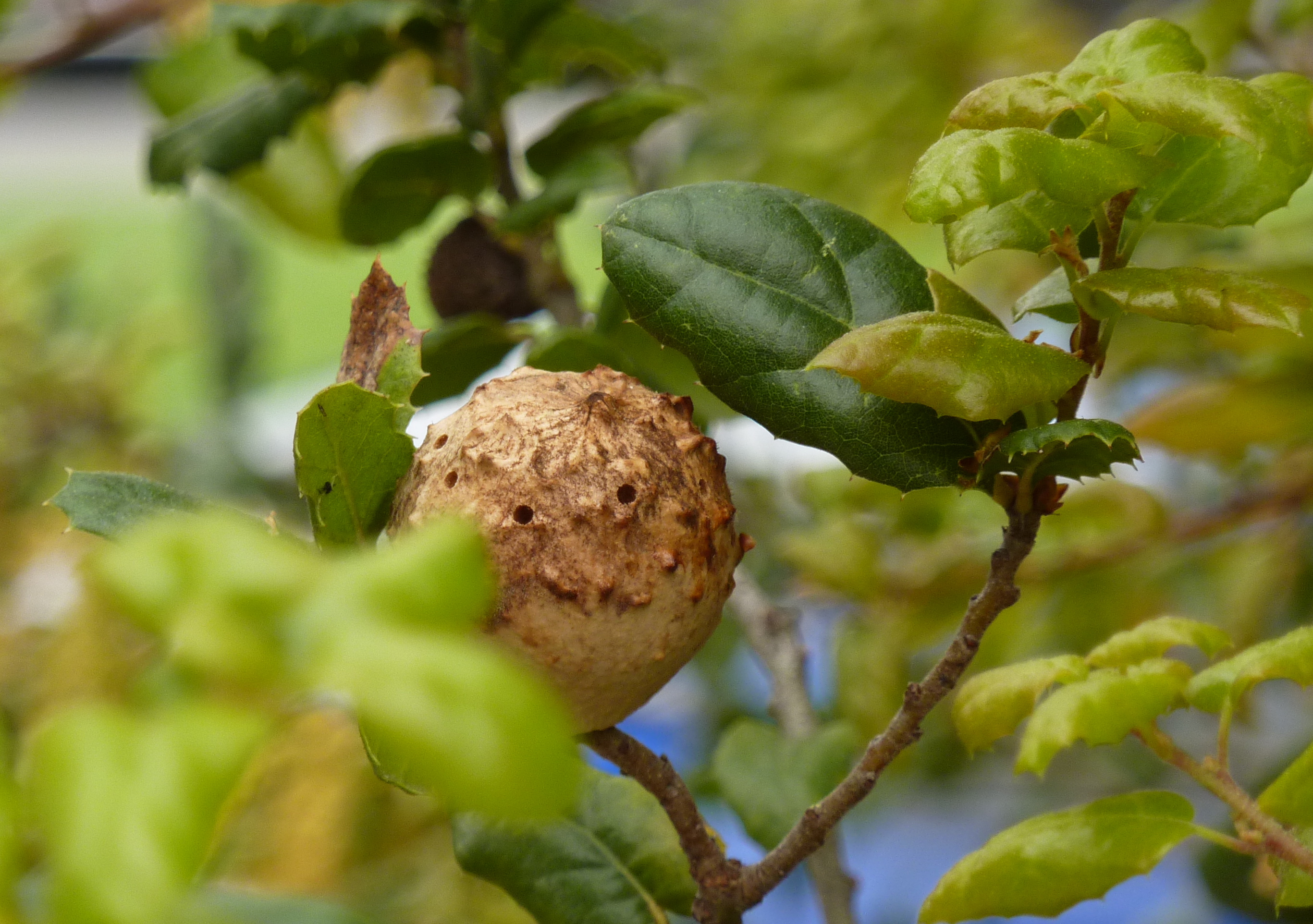
Oak gall houses small wasps during winter.
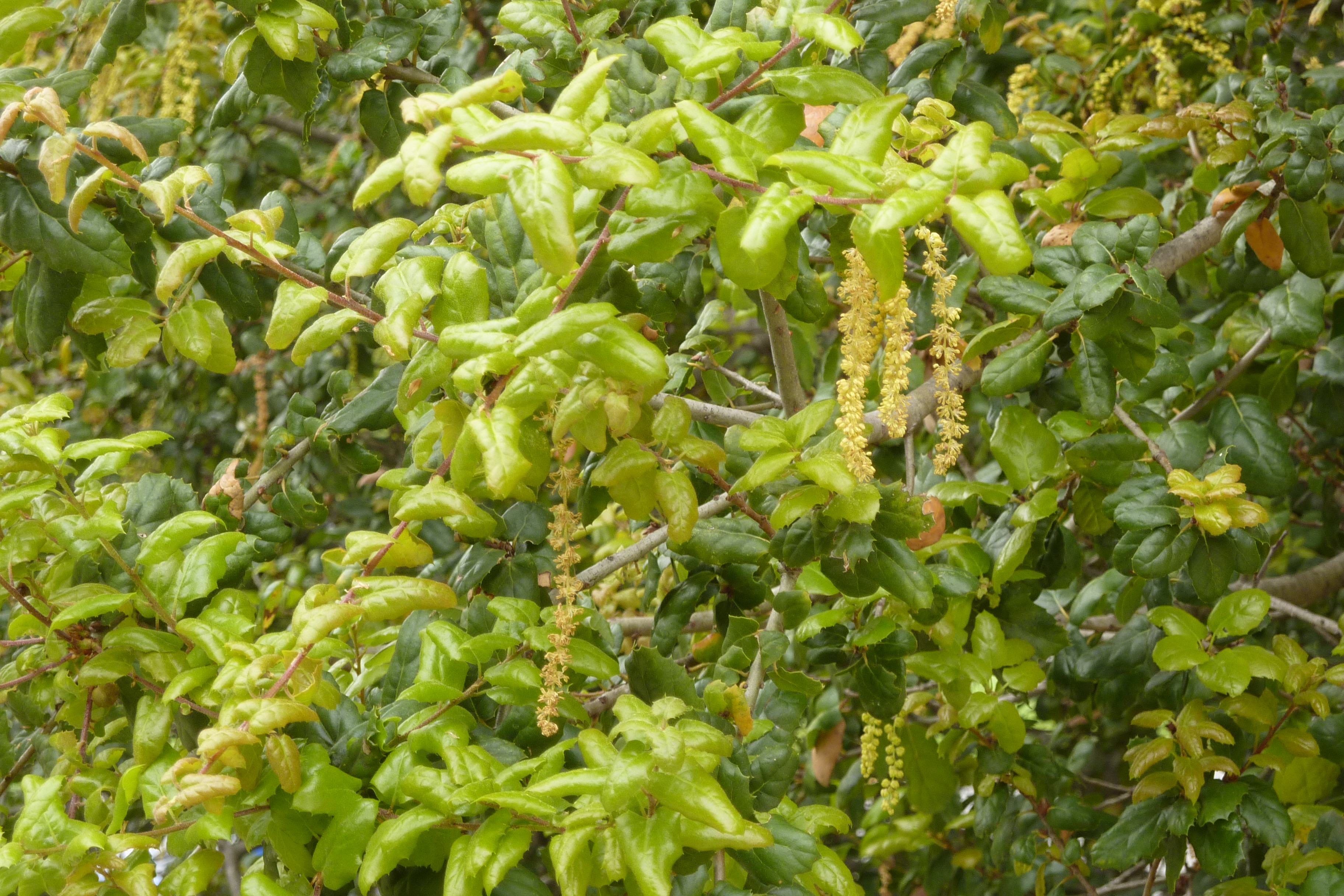
Catkins and new sprouts on Coast Live oak.



 SANTA MONICA BAY AUDUBON SOCIETY BLOG