Free email delivery
Please sign up for email delivery in the subscription area to the right.
No salesman will call, at least not from us. Maybe from someone else.
Malibu Lagoon Trip Report: 27 May, 2012
This is our last lagoon trip report before the scheduled start of the reconfiguration process, so we made a few changes to our usual trip report format. We’ve put a bunch of scenery shots in, and the bird list compares the months of May across the past six years. We’ll follow this format until after the project is

North channel view to west towards golf course (L. Johnson 5/27/12)
done; the data should be useful to compare during-project months to prior years. I keep my count numbers as honest as I can; there’s never any attempt to jack any number up or down. My obvious and mostly worthless prediction: count totals and species diversification will drop during the project, then rebound. No prediction how much the change will be. This is like J.P. Morgan’s stock market prediction: “The market will fluctuate.”
The slideshow shows what the area looked like this day, excepting Jim Kenney’s February scenic photo. The lagoon outlet closed within the past 7 days:, lagoon water level had risen so much that Snowy Plover enclosure fenceposts I’d stood next to 8 days earlier were now partially submerged.

Whimbrel on low tide rocks (J. Kenney 5/27/12)
The birds were pretty much what we’d expect for late May: a few migrant shorebirds (Whimbrel, Black-bellied Plover); some nesting birds (Mallard, Black Phoebe, Barn & Cliff Swallow, Northern Mockingbird, House Finch). The egrets are developing a large heronry next to Starbuck’s in the shopping center: Great Blue Heron, Great Egret, Snowy Egret and Black-crowned Night Heron are all nesting there. 15 Heermann’s Gulls had arrived from their breeding grounds on islands near the southern tip of Baja California; they were all 1st-year birds. One Belted Kingfisher perched on dead branches in front of Adamson House. We found a pair of Black Phoebes feeding 4 fledglings near the Adamson Boat House, as well as a female Mallard with 5 fluffy ducklings. No project activity is scheduled for this side of the lagoon. We didn’t see the young Killdeer spotted a month ago: it’ll be full-sized and flying by now, but it won’t yet have adult plumage.
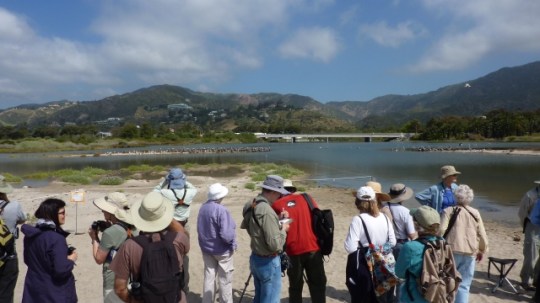
View from beach across lagoon (L. Plauzoles 5/27/12)
Our next three field trips: Mt. Piños Birds & Butterflies, June 16/17, 8 am; Malibu Lagoon, 24 June, 8:30 am; Malibu Lagoon, 22 July, 8:30 am.
Our next program: Tuesday, 2 October, 7:30 pm. The usual reminders will be emailed from the blog.
Picnic: The usual June chapter picnic is canceled.
NOTE: Our 10 a.m. Parent’s & Kids Birdwalk is canceled until the lagoon project is completed and the parking lot is again available.
Links: Unusual birds at Malibu Lagoon
Aerial photo of Malibu Lagoon from 9/23/02.
Prior checklists: July-Dec’11, Jan-June’11, July-Dec ’10, Jan-June ’10, Jul-Dec ‘09, and Jan-June ‘09.
Comments on list below: Of 75 total species appearing in May for 2007-12, no more than 62% of them have appeared on any one day, something to keep in mind if you wonder why what is there is much less than what could be there. Species low of 39 in 2010 is 17% below the highs of 47 for 2007, 2008 & 2012, not a huge drop. Total birds low of 413 in 2011 is 66% (787 birds) below the high of 1200 in 2007. Species making up most of this difference: Brown Pelicans – 549, Western Gulls – 109 and Heermann’s Gull – 61 (total of 719 birds, 91% of total difference).
NOTE: Right column averages of less than 1 bird/month are shown in tenths; all other averages are rounded to nearest whole number. [Chuck Almdale]
| Malibu Lagoon Census | 2007 | 2008 | 2009 | 2010 | 2011 | 2012 | |
| May 2007 – 2012 | 5/27 | 5/25 | 5/24 | 5/23 | 5/22 | 5/27 | |
| Temperature | 54-62 | 54-68 | 68-72 | ||||
| Tide Lo/Hi Height | H+3.4 | L+0.1 | H+3.7 | H+3.76 | L-.13 | L+0.38 | Ave. |
| Tide Time | 0742 | 0801 | 1042 | 0638 | 0816 | 0844 | Birds |
| Brant | 4 | 7 | 2 | ||||
| Gadwall | 6 | 8 | 12 | 12 | 3 | 5 | 8 |
| Mallard | 45 | 20 | 20 | 18 | 48 | 32 | 31 |
| Surf Scoter | 9 | 2 | |||||
| Red-brstd Merganser | 1 | 2 | 0.5 | ||||
| Ruddy Duck | 5 | 1 | 2 | 3 | 2 | ||
| Pacific Loon | 1 | 5 | 1 | ||||
| Common Loon | 2 | 0.3 | |||||
| Pied-billed Grebe | 3 | 3 | 2 | 3 | 2 | ||
| Western Grebe | 3 | 1 | 0.7 | ||||
| Brandt’s Cormorant | 5 | 1 | 1 | ||||
| Dble-crstd Cormorant | 7 | 5 | 28 | 7 | 46 | 15 | 18 |
| Pelagic Cormorant | 1 | 0.2 | |||||
| Brown Pelican | 630 | 231 | 70 | 124 | 81 | 265 | 234 |
| Great Blue Heron | 5 | 2 | 1 | 2 | 1 | 3 | 2 |
| Great Egret | 3 | 4 | 4 | 2 | 3 | 3 | |
| Snowy Egret | 12 | 9 | 7 | 12 | 3 | 14 | 10 |
| Green Heron | 1 | 0.2 | |||||
| Blk-crwnd N-Heron | 6 | 10 | 2 | 3 | 4 | ||
| Osprey | 1 | 0.2 | |||||
| Cooper’s Hawk | 1 | 0.2 | |||||
| Red-tailed Hawk | 1 | 1 | 1 | 1 | 0.7 | ||
| Peregrine Falcon | 1 | 0.2 | |||||
| American Coot | 25 | 6 | 32 | 8 | 25 | 30 | 21 |
| Blk-bellied Plover | 3 | 22 | 4 | ||||
| Killdeer | 1 | 1 | 4 | 2 | 3 | 2 | |
| Willet | 3 | 4 | 1 | ||||
| Whimbrel | 4 | 1 | 20 | 4 | |||
| Marbled Godwit | 1 | 0.2 | |||||
| Black Turnstone | 1 | 0.2 | |||||
| Western Sandpiper | 6 | 1 | |||||
| Dunlin | 1 | 0.2 | |||||
| Boneparte’s Gull | 26 | 2 | 1 | 1 | 5 | ||
| Heermann’s Gull | 61 | 1 | 20 | 17 | 15 | 19 | |
| Ring-billed Gull | 5 | 2 | 1 | 2 | 16 | 4 | |
| Western Gull | 119 | 56 | 65 | 68 | 10 | 85 | 67 |
| California Gull | 1 | 95 | 8 | 4 | 18 | ||
| Glaucous-wingd Gull | 1 | 1 | 0.3 | ||||
| Caspian Tern | 7 | 61 | 15 | 25 | 4 | 6 | 20 |
| Royal Tern | 2 | 1 | 2 | 5 | 2 | ||
| Elegant Tern | 15 | 23 | 40 | 9 | 12 | 35 | 22 |
| Rock Pigeon | 8 | 2 | 6 | 6 | 8 | 2 | 5 |
| Eur. Collared-Dove | 3 | 1 | 0.7 | ||||
| Mourning Dove | 1 | 4 | 6 | 1 | 2 | 2 | |
| White-throated Swift | 5 | 2 | 1 | ||||
| Anna’s Hummingbird | 6 | 2 | 2 | 1 | 1 | 2 | 2 |
| Allen’s Hummingbird | 4 | 8 | 6 | 4 | 5 | 5 | |
| Belted Kingfisher | 1 | 0.2 | |||||
| Western Wood-Pewee | 2 | 0.3 | |||||
| Pac.Slope Flycatcher | 1 | 0.2 | |||||
| Black Phoebe | 12 | 6 | 12 | 10 | 4 | 13 | 10 |
| American Crow | 8 | 4 | 6 | 4 | 3 | 5 | 5 |
| Common Raven | 1 | 2 | 0.5 | ||||
| Rough-wingd Swallow | 6 | 10 | 10 | 1 | 2 | 5 | |
| Violet-green Swallow | 6 | 2 | 1 | 1 | 2 | ||
| Barn Swallow | 12 | 6 | 1 | 8 | 8 | 2 | 6 |
| Cliff Swallow | 55 | 40 | 12 | 12 | 31 | 12 | 27 |
| Oak Titmouse | 1 | 0.2 | |||||
| Bushtit | 4 | 20 | 4 | 4 | 5 | ||
| Bewick’s Wren | 1 | 0.2 | |||||
| Northern Mockingbird | 3 | 5 | 6 | 4 | 2 | 6 | 4 |
| European Starling | 20 | 20 | 2 | 3 | 40 | 45 | 22 |
| Cedar Waxwing | 32 | 5 | |||||
| Common Yellowthroat | 4 | 2 | 2 | 3 | 2 | ||
| Spotted Towhee | 1 | 2 | 0.5 | ||||
| California Towhee | 1 | 1 | 5 | 1 | 1 | 2 | |
| Song Sparrow | 10 | 2 | 8 | 10 | 4 | 12 | 8 |
| Red-winged Blackbird | 20 | 6 | 4 | 2 | 10 | 7 | |
| Brewer’s Blackbird | 2 | 0.3 | |||||
| Great-tailed Grackle | 1 | 4 | 16 | 2 | 4 | ||
| Brwn-headed Cowbird | 2 | 1 | 3 | 1 | 1 | ||
| Hooded Oriole | 4 | 1 | 1 | 1 | |||
| Bullock’s Oriole | 2 | 1 | 1 | 0.7 | |||
| House Finch | 10 | 3 | 8 | 6 | 8 | 8 | 7 |
| Lesser Goldfinch | 2 | 1 | 2 | 4 | 2 | ||
| Totals by Type | 5/27 | 5/25 | 5/24 | 5/23 | 5/22 | 5/27 | Ave. |
| Waterfowl | 57 | 38 | 38 | 37 | 51 | 42 | 44 |
| Water Birds-Other | 668 | 252 | 132 | 148 | 152 | 313 | 278 |
| Herons, Egrets | 26 | 25 | 13 | 16 | 6 | 23 | 18 |
| Quail & Raptors | 1 | 1 | 1 | 1 | 3 | 1 | |
| Shorebirds | 10 | 1 | 5 | 5 | 5 | 51 | 13 |
| Gulls & Terns | 235 | 148 | 144 | 216 | 51 | 151 | 158 |
| Doves | 12 | 2 | 10 | 12 | 9 | 5 | 8 |
| Other Non-Pass. | 15 | 4 | 10 | 7 | 5 | 8 | 8 |
| Passerines | 176 | 139 | 79 | 106 | 131 | 127 | 126 |
| Totals Birds | 1200 | 610 | 432 | 548 | 413 | 720 | 654 |
| Total Species | 5/27 | 5/25 | 5/24 | 5/23 | 5/22 | 5/27 | Ave. |
| Waterfowl | 4 | 4 | 4 | 3 | 2 | 4 | 4 |
| Water Birds-Other | 5 | 6 | 5 | 7 | 3 | 4 | 5 |
| Herons, Egrets | 4 | 4 | 4 | 3 | 3 | 4 | 4 |
| Quail & Raptors | 1 | 1 | 1 | 1 | 3 | 0 | 1 |
| Shorebirds | 3 | 1 | 2 | 2 | 2 | 6 | 3 |
| Gulls & Terns | 7 | 9 | 7 | 6 | 6 | 7 | 7 |
| Doves | 3 | 1 | 2 | 2 | 2 | 3 | 2 |
| Other Non-Pass. | 3 | 2 | 2 | 2 | 2 | 3 | 2 |
| Passerines | 17 | 19 | 16 | 19 | 16 | 16 | 17 |
| Totals Species – 75 |
47 | 47 | 43 | 45 | 39 | 47 | 45 |
Maliboupourri
Being a collection of miscellany concerning Malibu Lagoon.
Jim Kenney, SMBAS member and major photographic contributor to our blogs and FaceBook photo albums, was recently interviewed by the Palisades Post about Malibu Lagoon and the reconfiguration project. Here’s a link to Libby Motika’s article “Malibu Lagoon: A Birds Paradise.” If you like the photo of the Snowy Egret in the article, here’s a link to two albums of Jim’s photographs, jam-packed with fascinating facts written by SMBAS members: one on passerine birds and one on non-passerine birds.
*************************************
The Malibu City Council is still looking for ways to exercise their – newly found, it seems to me – opposition to the reconfiguration, acording to a blog posted 5/30/12 on Malibu Patch. I posted a comment on this particular blog – about 8 comments down – mentioning that the City of Malibu had been intimately involved in the project decision process, and wondering why they are so opposed to it now.
*************************************
A message dated 5/28 from Bob Purvey of EcoMalibu. Their website has lots of information and interesting photos on it.
For the second time in a little over a year, the Obstructionist’s of the Malibu Lagoon Restoration and Enhancement Project had filed a court action with a petition seeking a stay of the project. The first petition seeking a stay had to be reviewed in depth. The review process caused a year’s delay to clean up the polluted waters in the Malibu Lagoon because the project is scheduled around the appropriate season, summer.
According to the laws of justice the Obstructionists had to show irreparable harm and “that ‘substantial questions’ would be raised on the appeal and must explain the underlying case in a manner that ‘facially’ demonstrates the merits of their issues.”
Yesterday, the petition was denied as appellants have not met that burden; specifically, they have not demonstrated that the appeal presents an exceptional situation presenting a substantial issue on appeal that, even facially, has merit. Now, the 99% will benefit.
*************************************
Over the past 15 years, Mark Abramson has worked with Heal the Bay, Santa Monica Baykeeper and most recently as Senior Watershed Advisor for Santa Monica Bay Restoration Foundation. He did a 25-minute presentation last December on the lagoon project, which has recently been put on YouTube. Well worth the watch! As mentioned in earlier blogs, Mark was a frequent attendee at the lagoon meetings. Bob Purvey, co-editor of this film, makes the following comments.
I am very excited about what I learned, in detail and first hand from Mark Abramson, while we edited the video of his PowerPoint presentation of the Malibu Lagoon Restoration and Enhancement Project.
This environmental restoration project is technically detailed and is the culmination of an extraordinary amount of hearts & minds that came together over the course of 23 years. I’m calculating from the first significant study: Dillingham and Manion’s 1989, Malibu Lagoon: A Baseline Ecological Survey and to most every study since.
As you may know now, Abramson is the manager of the project and he knows practically everything there is to know about it. He has nurtured this situation since he joined Heal the Bay and the Watershed effort in 1997.
Wow, and what a project. What gets me most excited is that the net result will be a baseline wildlife restoration that will set an example and as a sensitive habitat it will be protected by everybody. For all intensive purposes, the water will become cleansed and the enhanced habitat will work to keep it that way, inviting Steelhead Trout to return. The new avian islands will become havens for wildlife and invite the Bald Eagle to return.
Malibu’s headwaters at the Creek’s terminus will gain far more protection now that all the environmental groups and government agencies have successfully come together to create this model for restoration. The importance of this project is far greater than anyone of us and will have resounding impact on generations to come.
You will get great impressions from Mark’s presentation, but nothing will be like the real thing. Also, with a healthy imagination, I’m sure you’ll glance into the future when you see this presentation. It has to be one of the State’s most sensational projects ever.
On another note, I’d like to recognize the fact that many who have been supportive of the project have taken a beating from the opposition in the past year and now feel vindicated since the courts have decided to recognize the lack of merits in the opposition’s petition to stay the project.
Many withstood unbelievably offensive insults and threats, and stood ground. Bravo and Brava! The fights fought against many falsehoods and two media efforts to gain readership from the conflict, making out honest efforts to be controversial, were difficult on many and unfairly time consuming. But, as it may turnout, it will be time well spent because many became engaged and learned more about this precious Malibu eco-system as a result of the conflict. Surfers around the world are becoming better stewards of the environment because of it.
*******************************
Collected by [Chuck Almdale]
Malibu Surfers Discuss Lagoon Project at Meeting
We previously announced that Real Malibu 411 was holding a Public Informational Meeting at the Point Dume Clubhouse on Sunday. Jim Kenney, SMBAS member and major photographic contributor our blog, was in the audience at the meeting and submitted this report. [Chuck Almdale]
********************************
NOTE: This discussion will be held again on Thursday, May 24th, 7 p.m. at Duke’s Restaurant (PCH & Las Flores Cyn. Rd.)
********************************
The meeting was not well attended, with most, such as Bob Purvey, being in favor of the restoration. The main idea put forth by surfers Glenn Hening and Steve Woods, is that restoring the western channels would in no way effect the condition of the waves. They pointed out that wave excellence depends on the deposition of rocks and boulders brought [the creek] down after heavy storms. In 1969 a massive storm brought excellent conditions that lasted for 15 years. So….it’s the main channel, not the side channels that is in play. Andy Lyon, an outspoken restoration opponent, (not at this meeting) has claimed that the eastern (Adamson House) breach-point should not be the favored one. It was pointed out with historical photographs and personal experience, that nature is in charge and favors the eastern breach. This year was an example,,,,,it breached in the west, but gradually moved east. (It closed completely this week.) The 3rd speaker, Ken Seino, related his near death experience from the pollution brought down from Malibu Canyon. Anecdotal evidence lists three actual deaths from surfing off the lagoon. Ken probably had bacterial endocarditis, as did the others. Hening and Seino discussed the “possibility” that restoring the west channels would help relieve pollution in the surf, even though much of it comes from the watershed of Malibu Creek. One of the opposition was furious that no proof existed that restoring the west channels would in fact be helpful. Another opponent claimed that it is too much money for the project with no guarantees. [Jim Kenney]
******************
Editorial Comment:
The historical record shows that no matter where the lagoon is breached to the ocean, the outlet always moves to the east towards Adamson House. This is likely due to the direction of the current flow immediately offshore. In recent decades, the “late-night” breaches by persons unknown were done as far to the west, as close to the “cliff” of dirt, as possible. But over the following few months, the outlet moves eastward. I’ve seen this happen every year. The map below is from 1877, discovered by local historian Tony Shafer and among many items posted on a Malibu Patch blog by Ben Marcus on 10/24/11. The course of Malibu Creek once it passes west of the knoll where the Serra Retreat Center now sits is a bit different than now, flowing farther east and then farther west until it gets to the beach, where it takes a sharp turn to the east as it backs up behind the sand. There are 14 other interesting photos on local historian and standup paddler Marcus’ blog. Read the blog, while you’re at it, for a view that’s different from what you usually hear. [Chuck Almdale]
- 1877 Map of Malibu (courtesy of Tony Shafer, Ben Marcus & Malibu Patch)
Touring Malibu Lagoon with Matthew Horns 5/19/12
NOTE: Matthew is leading one more lagoon walk this coming Saturday, May 26 at 1 P.M. Lagoon reconfiguration is scheduled to start June 1.

State Parks Lagoon Restoration Plot Map
Our first major stop around the lagoon perimeter was midway down the west side of west channel, next to the depth gauge. The number scale on the lower portion of the gauge is covered by an encrustation of barnacles and ‘crud.’ Inside there is a device to record salinity, but we didn’t have access to it. Amid much discussion – Jane and I on birds, Matthew on water – he measured the dissolved oxygen level at about 130%. This seemed high to me.
Matthew explained: The lagoon channel is currently open and we were at high tide, so the channels were full of ocean water, which is highly oxygenated from ocean turbulence. Plus there were ocean diatoms (single-celled photosynthesizing organisms) busily converting carbon dioxide into food and oxygen, thus raising the oxygen level even higher. The diatoms were so numerous they turned the water a murky brown. Both these factors raise the oxygen levels well above what we get at low water. Unfortunately, the lagoon is closed to the ocean from 1/3rd to 1/2 of the year, primarily in the summer, preventing tidal inflows.
We saw numerous chunks of giant kelp leaves, washed in on the tide, floating in the usual surface detritus of wood pieces, innumerable bits of plastic and a pair of flip-flops. There were two dead pelicans: one completely submerged in west channel, one on the middle channel shore.
We took the next measurement out on the lagoon’s beach edge; results were about the same for the same reasons. I counted about 150 Brown Pelicans and at least as many gulls on the nearby sand islands. Elegant Terns flew above the lagoon, calling horsely. I told Matthew about the reasoning behind the virtual fence enclosure for the Snowy Plovers: in a nutshell, to provide them a human-free area where they can get some shut-eye during the 12-16 hours out of 24 hours they aren’t actively feeding. Unfortunately someone had swiped about half of the rope linking the fence posts.
A close look at the “cliff” of dirt at the west end of the beach showed that it was all landfill, as the bottom of it consisted of chunks of concrete and asphalt. Floating in the nearby detritus we found a blue egg, no doubt belonging to a Styrofoam Gull (see picture).

Blue egg of the Styofoam Gull with handy carrying loop; land fill and concrete behind. (J. Beseda 5/19/12)
We discussed dirt. Matthew told us: In the years since the 1983 lagoon project, soil has been developing on top of the remaining fill. Three general habitat types exist at the lagoon; aquatic, inter-tidal, and upland. In each of these habitats, unique physical characteristics develop within the soil. Also, equally important, unique biological communities of invertebrates, microorganisms, and other life forms become established. At the onset of grading operations, the top one-foot-deep layer of soil will be excavated from each habitat type and the soil will be stored in separate piles. At the close of grading operations, this soil will be re-spread over the ground surface in appropriate locations. This should “jump start” the process of natural ecosystem development after the project is completed.
The oxygen measurements we took from the middle of each footbridge again yielded about the same results for the same reasons. By this time, several hours had passed – most of it in conversation. Tide was falling; water flowed out of the lagoon and channels.
Bob Purvey brought his video camera and struggled to get good angles for a film. When it’s available we’ll provide a link to it so you can see us in action. (Inaction?) Matthew is leading one more lagoon walk this coming Saturday, 1 PM, May 26. Lagoon reconfiguration is scheduled to start June 1. The lagoon will remain open to foot traffic, and we expect to continue our SMBAS 4th-Sunday-of-the-Month 8:30 AM birdwalks. The parking lot will be closed and we won’t be doing our 10 AM parents & kids walk.

Almdale, Purvey & Horns (J. Beseda 5/19/12)
Surfrider Beach and MRSA
MRSA (Methicillin-Resistant Staphylococcus aureus) is present in the sand at Malibu’s Surfrider Beach. It is also present in the nearby ocean. It is also present at many – perhaps all – other beaches and adjacent ocean waters in L.A. County. It is also present at other American ocean beaches and waters. It has been present at all these locations for years. It may well be on your skin, right now.
According to the CDC, 20 to 25 percent of us have S.aureus (primarily in our nose) and about 2% of us have MRSA (also primarily in the nose). Many people have MRSA and never get sick, but they can transmit it. Other authoritative websites say 20-30% or 20-40% of us have S.aureus on our skin. Take your pick.
Studies (here’s one) (and another, and another, and another – see Google for more) seem to show that the bacteria in the sand and ocean comes from contact with human skin: the more humans present (and the warmer the water the more present we’ll be), especially if they’re blowing their noses, the more bacteria is present. This goes for not just MRSA, but for forms of FIB (fecal indicator bacteria) and S.aureus in general.
So, with that in mind, here’s some more on the ongoing discussion on the Malibu Lagoon Restoration Project.
Here’s a link to a short film featuring various people who are involved – probably, after all these years, way more than they’d like to be – people like Suzanne Goode from Calif. State Parks and Shelley Luce of the Santa Monica Bay Restoration Commission. It addresses the five most common ‘errors’ (to be polite) of belief concerning the restoration.
Here’s a link to what Heal the Bay has to say. It also has a link to the above film.
Finally, here’s two letters-to-the-editor from the May 10, 2012 issue of Malibu Surfside News (scroll down to page 15 for PDF), which will bring us back to the MRSA topic. By the way and for what it’s worth, I stopped body surfing at Will Rogers State Beach decades ago because I got sick and tired of the inevitable sinus infections which immediately followed. [Chuck Almdale]
Editor:
I am disappointed by the level of fear-mongering and misinformation in the May 3, 2012 letter written by Lawrence Stock and Lisa Plano. Stock and Plano’s letter incorrectly implies that the Malibu Lagoon Restoration Project will increase the danger of Staphylococcus infections to users of Surfrider Beach. This could not be further from the truth. In fact, bacteria-laden waters move freely from the western
arms of the lagoon into the creek and onto the beach during normal, everyday lagoon conditions.
The restoration project will separate the western arms of the lagoon from the main lagoon and creek channel with a physical barrier that will prevent water moving back and forth. The restoration project will then remove water from the western arms and thoroughly disinfect it, killing all bacteria including Staphylococcus aureus (staph bacteria) and methicillin-resistant S. aureus (MRSA), before the water is
discharged at the mean high tide line of the beach. If there are MRSA or staph in the sand, they are already constantly mobilized into the swimming zone by waves naturally breaking on the beach. Therefore if anything, the disinfected water released by the restoration project will dilute and decrease the concentrations of bacteria including staph and MRSA in the water and sand at Surfrider Beach.
Stock and Plano refer to a recent NOAA study but fail to mention an important point: that staph bacteria and MRSA were found at three California beaches and “beach prevalence was similar to that in homes.” The study finds that MRSA and staph concentrations are lowest at Surfrider Beach, and are at least 1000 times lower than concentrations that cause infections on normal human skin. The study also states that swimmers themselves are a source of the bacteria. In fact, one in three people carry staph on their skin, and community facilities where lots of people interact, such as hospitals and schools, are where the greatest concentrations of staph and MRSA are found (http://www. phac-aspc.gc.ca/id-mi/mrsa-eng.php). The website of the U.S. Centers for Disease Control states that “MRSA in the community is widespread and therefore, anyone is at risk…People may be more at risk in…athletic facilities, dormitories, military barracks, correctional facilities, and daycare centers” (http://www.cdc.gov/mrsa/riskfactors/index.html).
The Santa Monica Bay Restoration Commission, State Parks and the State Coastal Conservancy have worked extremely hard to design a project that will benefit people and wildlife now and for many generations to come. These agencies would never support a project that would endanger public health or well-being. I am frustrated and disappointed by attacks based on misinformation, and the seemingly
deliberate misleading of a concerned public. I look forward to celebrating a healthy, restored lagoon that is better for birds, better for fish and better for people after our project is completed. Shelley Luce, executive director SMBRC
*******************************************
Editor:
In response to a previous letter, staphylococcus is indeed in the sand at Surfrider. It is in the creek. It is in the lagoon. It is all over the place. It has been flowing out to the surfers at First Point for decades. Here is another attempt by the people opposing the restoration project to use fear mongering spin to try to convince the naive to believe that the project will be solely responsible for releasing dangerous levels of MRSA into the environment.
I cannot believe that in this letter the author says, “Scientific studies are currently being conducted investigating the connection of oceanborne MRSA and the risk of infections to swimmers and surfers.” Duh, really. Of course, there is. And how dare these doctors allude that the restoration project will expose surfers and swimmers to higher levels of MRSA than they are now. The creek is now flowing out to First Point after flowing through the same sands in the western channels and main channel that is full of MRSA.
Presently, swimmers and surfers are exposed to untreated creek water exiting the lagoon, which is full of MRSA that is in the sands of the lagoon and beach sand. The restoration’s custom built dewatering treatment facility will be taking the water that would have left the lagoon untreated and decontaminate it, making it safer than what is flowing out of the lagoon now.
Many years ago, I was on a surfing boat trip in Indonesia with the great Dusty Peak (Skylar Peak’s dad). One day, after surfing good waves at Lances Right, he told me he thinks he got a staph infection in his leg after surfing Surfrider. The infection never completely abated, complications persisted, and may have led to his unfortunate passing, which had nothing to do with the proposed restoration project.
Other surfers have died from surfing Surfrider who contracted the coxsackie B4 virus. My friend Ken Sieno is one of the few who survived the virus that attacks the right heart ventricle only because he had a pacemaker placed in his chest. Some of these deaths occurred while Tapia was still discharging and other victims died after Tapia stopped discharging. Meanwhile antiquated septic systems have continued to discharge into overly saturated leach fields that have direct hydraulic connections to creeks, lagoons and beaches, which caused me to get dysentery for five days last June after surfing First Point. Steve Woods



 SANTA MONICA BAY AUDUBON SOCIETY BLOG