Free email delivery
Please sign up for email delivery in the subscription area to the right.
No salesman will call, at least not from us. Maybe from someone else.
Malibu Lagoon Restoration – Important Update
To all SMBAS members and friends: Please read the following message from Bob Purvey. Bob is a writer, film producer, surfer, activist and long time Malibu resident. I don’t know Bob well, but I distinctly recall his presence at the very first Malibu Lagoon and Watershed meetings I attended back in the 90’s, and at innumerable meetings after that. His concern for the lagoon is long-term, ongoing, deep and well-informed. Please follow the weblinks supplied below, especially the one to the YouTube video by Aquatic Field Scientist Matthew Horns, who will be conducting Lagoon tours at 1 PM on Saturdays 5/19 & 5/26. [***See Biographical information on Horns in 2nd comment following this article.] Please also read the letter of Anthony I. Perez, Deputy Director of Parks Operations written to Ms. Agi Kessler, Chair of the Resolution Committee of the Los Angeles County Democratic Party (see link to PDF file below). [Chuck Almdale]
**************************
Dear Friends:
Last night I read an article on Surfline, which clearly takes sides in opposition to the Malibu Lagoon project without fully reviewing the facts and merits of the project. There are many serious misleading allegations in the Surfline article that I feel must be addressed immediately.
Surfline falsely likened the Malibu Lagoon project to a project planned at Trestles that had a freeway (toll road) going across San Mateo Creek, failed to address Steelhead Trout and their survivability, failed to address the persistent poor water quality issues and was planning to remove access to the surf spot.
Quite the contrary: The Malibu Lagoon Restoration and Enhancement Project plan, set to begin on June 1st, 2012, was started in 2000 with the Malibu Lagoon Task Force.
The Malibu Lagoon Task Force includes all the environmental organizations and the lagoon project has been properly planned after an extensive and exhaustive planning process. All the environmental organizations still stand strongly united in support of the project. There are two rogue groups known as Save the Lagoon and Wetland Defense Fund and a newly formed group known as the Surfer’s Coalition that are behind the disinformation campaign.
The Malibu Lagoon Restoration and Enhancement project has far reaching benefits. Please read the attached letter response from California State Parks Deputy Director Anthony Perez addressing the Los Angeles County Democratic Party’s short-sighted opposition of the lagoon project. His eloquent letter thoroughly corrects all the misleading half-truths the Democratic Party was misled by.
Seems like Surfline and the Los Angeles County Democratic Party are not the only one’s that have been misinformed. Glenn Hening, Surfrider Foundation’s Founder replies to this situation succinctly in a YouTube video.
I cannot blame anyone for wanting to protect Malibu and when faced with emotionally charged information that may appear threatening, one’s guard would be naturally raised. However, the facts of the matter must be shared so that one can make an informed decision on their own. The lagoon project is far too important to me as a long-standing Malibu surfer to allow any misinformation go unnoticed.
It’s nice to know that 99% of us will benefit from the Malibu Lagoon project: Scientist Matthew Horns explains why in his YouTube video tour recorded May 3, 2012.
Aquatic field scientist Matthew Horns has many years of expertise and experience in the Malibu Creek Watershed and Lagoon. In this 14-minute video tour of the Malibu Lagoon, Matt shows and tells us about the pollution problems plaguing the lagoon. He explains how depleted dissolved oxygen is the cause of many life-threatening problems and what the Malibu Lagoon Restoration and Enhancement project will do to resolve these problems in this magnificent and significant wildlife habitat. [Link to Bio of Matthew Horns.] [***See Biographical information on Horns in 2nd comment following this article.]
As a competitive surfer from Malibu since 1963 and considered one of the first professionals in the sport, I truly care about Malibu Surfrider Beach, which is why in 1992 I joined the Malibu Creek Watershed effort to clean up the water pollution at Surfrider and I am fully aware of the pollution problems and what is being done to resolve them.
I am therefore surprised and shocked that Surfline claims to have signatures on a petition opposing the project from such luminaries in the sport of surfing as Nat Young. I respect Nat immensely and consider him a good friend but in my opinion, it would have been a bit more responsible for Nat and any of the sport’s representatives to have taken a more pro-active position and reviewed the matter fully, but it seems that if Surfline‘s claim is true, then they may be the victim of the same emotionalism that is played on to convey the opposition’s message filled with half-truths.
I know they are half truths and I also know the merits of the project because I have been participating in the development of the project from the beginning. My friend Nat and some of my other friends have been duped and I hope Surfline and everyone who is questioning the Malibu Lagoon Project, first read State Park’s Deputy Director’s letter response to the Los Angeles County Democratic Party, which is attached. This letter serves to clarify the situation completely. Letter from Director Perez
Also, please review the 14-minute video tour given by Malibu Lagoon Field Scientist Matt Horns, which should help you to understand why I am convinced that the Malibu Lagoon Restoration and Enhancement project is worthy.
Bob Purvey
PS: Matt is conducting two more Saturday, 1 PM, tours on May 19 & May 26, 2012.
Please share this with your world.
Full Flower Moon 5/5/12 8:35 p.m. PDT
Here’s another update from SMBAS Blog on that large shining object which has frequently and mysteriously appeared in our nighttime sky this year (known to many as the moon).
May 5, 8:35 p.m. PDT — Full Flower Moon. Flowers are abundant everywhere at this time. May’s full moon was also known as the Full Corn Planting Moon or the Milk Moon. The moon will also be at perigee just 25 minutes after turning full, at 12:00 a.m. EDT on May 6, at a distance of 221,801 miles from Earth. Very high ocean tides can be expected from the coincidence of perigee with the full moon.
The next significant full moon will occur on June 4, 4:12 a.m. PDT. Keep an eye on this spot for additional breaking news on this unprecedented event.
This information comes to you courtesy of:
http://www.msnbc.msn.com/id/45911225/ns/technology_and_science-space/t/how-s-full-moons-got-their-strange-names/#.T16CDHlIXUx
But that’s way too long to type in, and besides, you don’t need to go there because SMBAS has done the work for you!
[Chuck Almdale]
Help Monitor Least Terns at Venice Beach!
The California Least Tern is listed as endangered by both Federal and California state authorities, and Los Angeles Audubon Society is looking for dedicated volunteers to help monitor them at Venice Beach.

Least Tern chick
In Los Angeles County, this species returns to only two breeding colonies, one at Venice Beach and one at the Port of Los Angeles. Los Angeles Audubon works with project biologists and the California Department of Fish & Game studying the tern colony in Venice by coordinating a community-based science monitoring program during the nesting season. Volunteers receive training and then help monitor the colony for one hour each week from mid-April to mid-August. This is a great opportunity for families looking for a way to learn about nature together, for students looking to gain some field experience in environmental science, or anyone who’d like to know more about urban wildlife.
If this sounds like something you’re interested in, then we’d love to meet you at one of the following training sessions:
Wednesday, May 2nd, 630pm to 730pm, or
Sunday, May 6th, 9am to 10am, or
Wednesday, May 9th, 630pm to 730pm
Training Location: Training sessions will take place at the Least Tern Colony enclosure on Venice Beach. The enclosure is located at the very southern end of Venice Beach near the Ballona Channel. There is metered parking along the channel where Pacific Ave turns into Via Marina, and there’s a public pay lot at the intersection of Via Marina and Captain’s Row. There’s technically free parking along Pacific Ave, but the spots get taken up fast.
Binoculars are essential to monitoring, so please bring them with you if you own them (if you don’t own any, we can lend you a pair for the season). If this date doesn’t work for you but you’re still interested in helping, please let me know and I’ll see if we can arrange an alternative training session.
Questions?: Please contact the Volunteer Coordinator at 323-481-4037 or tern [AT] laaudubon.org.
From: Stacy Vigallon
Butterbredt Spring Springtime Outing: 27-30 April, 2012

Bush Lupine (R. Seidner 4/27/12)
We had a very successful outing on our traditional spring-migrant trip to this spring which draws hoards of birds and birders. I stretched my part to four days: Friday night, Saturday, Sunday and Monday morning which allowed me to see (on a camera picture) the Hooded Warbler. It was discovered by a couple I met Monday at the Spring on my way home, who had camped there Sunday night. But, sadly, of course, nowhere was it to be found when I searched the trees Monday afternoon.
Our ranks were few, but fortified by visitors from the combined Tehachapi and Bakersfield Audubon chapters, and our own Chris Lord who came early and stayed late, Friday and Saturday, scouting all the slopes, canyons, trees and byways to provide a fortified final list of 70 species.

A lovely yellow flower (R. Seidner 4/27/12)
Other visitors on Saturday at Sageland Ranch, our camp site, hosted there by owner Keith Axelson, and itself a nature refuge, were various members of the local community, friends, birders and two members of the Student Conservation Association, a conservation and restoration oriented organization of young adults which SMBAS has been supporting since we found out about them. They devote huge amounts of time and energy to restoring damaged natural habitats all over the nation. It was very good to meet them, to observe how competently and cooperatively they work together under very primitive and strenuous conditions.
The annual wildflower show was somewhat minimal this year because of an unusually dry season, but we saw patches of the expected Deep Blue Lupine, and brilliant gold Bigelow Coreopsis with a few other smaller specimens.
Animals, however, were interesting, beginning with a fast stop for a beautifully marked Gopher Snake on the drive down Butterbredt Canyon road. Lys Axelson jumped out of the car and ushered it off, out of harm’s way on this busy off-road vehicle route. I personally saw two more snakes, none rattlers, one not identified and the other a Garter Snake, and three Greater Roadrunners while I was driving the Jawbone Canyon road home. There was a very interesting raptor also. I called it a Swainson’s Hawk, but of course, no one can verify that. The field marks fit, but the location and fact it was alone, and quickly out of sight, did not.

Hoary Bat (R. Seidner 4/27/12)
Most interesting creature was the Hoary Bat discovered by a fellow birder at Butterbredt. It was hanging, sleeping on a branch above the lower canyon trail, only a few feet above our heads and oblivious to our stares. We could see every identifying feature. Furthermore, sleeping in trees was indicated as its habit.
There were, of course, numerous lizards, including a fleeing Whip-tailed, various Skinks, many Black Fence Lizards among the rocks, one of which provided us views while being fed to the female American Kestrel by her mate at Sageland. The Kestrels are nesting in the box Keith set for them on his water tank, and he observes lizards apparently are the bird’s chief prey source.

Whiptail Lizard (R. Seidner 4/27/12)
Some of our prize birds of the trip were the Green-tailed Towhee Chris found under a Joshua Tree up on the canyon slope; great looks at MacGillivray’s Warblers, one perched up on brush for full views of its every feather at the water trough area at Butterbredt, and another in the spring area of Keith’s creek. Other favorites, beautiful male Western Tanagers, Yellow Warblers, almost all the western warblers, Bullock’s Orioles, Greater Roadrunners, male Costa’s Hummingbirds, and, especially the magnificent Scott’s Orioles coming to the feeder where we were having our meals.
I must mention the lone Golden Eagle that Chris, while he waited for our cars, watched from the pass on the Butterbredt Spring road, leave the cliff and sail away north. It was the only one of the trip. All are in very serious danger there, as roads have been graded along the ridge south and in Kelso Valley, and pads prepared for the installation of huge wind turbines. Stacks of metal sheaths for the turbines lay along the gated entry roads. These wind turbine installations seem nearly impossible to forestall, despite ample evidence presented that they are being located in very sensitive bird areas where at least eight federally protected Golden Eagles have been struck down in the LADWP Pine Tree unit not far west, without consequence to the operators. For us especially, who have valued these magnificent birds sighted there over the years, it is a very sad prospect.
I hope we will still see more very rewarding trips to our Butterbredt Sanctuary, however. The roads were in excellent shape, well graded, the weather near perfect. Our bird list follows. [Mary Prismon, leader]
Map of Butterbredt Spring area
Butterbredt Spring Trip April 27-30, 2012
68 species (plus one identifiable morph) in no particular order
Great Horned Owl
Sage Sparrow
Mourning Dove
Northern Raven
Red-tailed Hawk
Eurasian Collared-Dove
California Thrasher
Costa’s Hummingbird
Western Kingbird
Bullock’s Oriole
California Towhee
Scrub Jay
Western Tanager
Ladder-backed Woodpecker
Ruby-crowned Kinglet
Olive-sided Flycatcher
Nuttall’s Woodpecker
American Kestrel
Western Wood Pewee
Anna’s HummingBird
Say’s Phoebe
Chukar
Lincoln Sparrow
Red-winged Blackbird
Red-winged “Bicolored” Blackbird (at Keith’s)
California Quail
Common Yellowthroat
Pacific-slope Flycatcher
Lawrence’s Goldfinch
Sharp-shinned Hawk
Hammond’s Flycatcher
Lazuli Bunting
Mountain Quail
House Finch
Ash-throated Flycatcher
Western Screech-Owl
White-crowned Sparrow
Greater Roadrunner
Bushtit
Chipping Sparrow
Loggerhead Shrike
European Starling
Green-tailed Towhee *
Scott’s Oriole
Brewer’s Sparrow
Yellow Warbler
Western Meadowlark
Black-throated Sparrow
Wilson’s Warbler
Black-headed Grosbeak
Lesser Goldfinch
Nashville Warbler
Townsend’s Warbler
Brown-headed Cowbird
MacGillivray’s Warbler
Cassin’s Vireo
Warbling Vireo
Yellow-rumped Warbler
Cactus Wren
Spotted Towhee
Orange-crowned Warbler
Golden Eagle
American Coot
Bewick’s Wren
Western Bluebird
Mallard
Golden-crowned Sparrow
Hermit Warbler
Swainson’s Hawk
New Photos from Malibu Lagoon

Killdeer chick, as leggy as a Secretary-Bird (J.Waterman 4/21/12)
Joyce Waterman, who, with husband Doug, has supplied many photos to this blog over the past few years, took a couple of photos last Saturday, April 21, the day before our last lagoon walk.
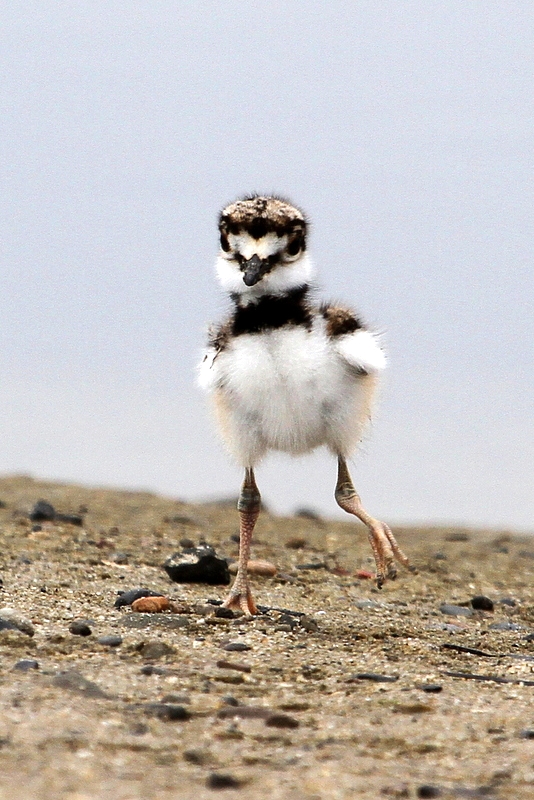
Killdeer chick, a little unsteady. (J.Waterman 4/21/12)
Unfortunately she sent them to me after I’d already posted the blog. They are so cute that I wanted everyone to see them. They have also been added to the trip report blog already posted, as well as to our special page of Lagoon Birds (which I’m sure everyone knows has been on our blogsite for well over a year).
These photos were taken at the same place we saw the Killdeer nest last year, which was on a small “island” (or bump) inland of the Snowy Plover enclosure. So…watch your step out there!
*****
*****
James Kinney, major photographic contributor to our blog, just sent this photo of a

With "eyebrows" much like some of our older chapter members, this Double-crested Cormorant displays the crests for which it was named. (J.Kenney 4/26/12)
bird we all saw on Sunday, a Double-crested Cormorant in alternate (breeding) plumage proudly displaying the crests for which it was named. [It reminds me of George Burns.] Most west coast birds have white crests whereas the crests of most east coast birds are black. There was at least one bird at the lagoon with black crests.
If you have not yet visited our chapter’s Facebook page, then you’ve missed the huge albums of James Kenney’s photos of local birds, many from Malibu Lagoon, currently totaling over 210 photos, each one annotated with loads of interesting information. It’s a public page so you don’t need to be a Facebook member or sign up to become one in order to visit.
*****
Finally, having nothing to do with the lagoon but everything to do with birding, here’s a link to a “News” story which recently showed up on BIRDCHAT, the U.S. chatline for birders. [If you don’t subscribe, think about signing up. It’s free. No salesman will call.] You’ll see why I put “News” in quotes. Have your bird book close at hand while you watch the video. This story is an “onion” – just when you think there are no more layers of stupidity to be revealed, you see that you are mistaken. No one escapes. [Chuck Almdale]



 SANTA MONICA BAY AUDUBON SOCIETY BLOG