Free email delivery
Please sign up for email delivery in the subscription area to the right.
No salesman will call, at least not from us. Maybe from someone else.
Malibu Lagoon Trip Report: 27 November, 2011
SMBAS Links: Website Blog Facebook
Your usual reporter wasn’t present, so this month’s data is supplied by Lucien Plauzoles. Temperatures were warm, about 70°, and there was a 10-15 mph breeze. Human turnout was good with 25 persons. The avian species count of 51 was a bit low for November, as the average is closer to 62. Nothing particularly unusual showed up, but the 9 Canada Geese were nice to see. The Black-bellied Plover count of 263 was down from last month’s estimate of 700, but that was an estimate of flocks continually coming and going.
The new arrivals were: 9 Canada Geese, 8 Bufflehead, 9 Red-breasted Merganser, 1 Cattle Egret, 1 American Kestrel, and 1 Glaucous-winged Gull.
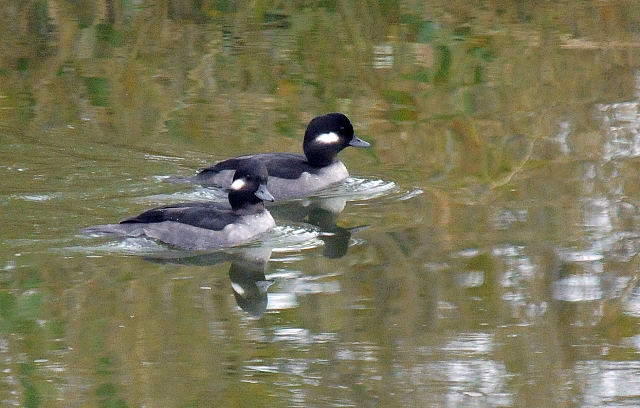
Two female Buffleheads cruising down the creek (J. Kenney 11/12/11)
Incidentally, on 6 Dec., 9:15am, Chuck & Ellen counted 67 Snowy Plovers gathered around the western life guard station, which appears to be an all-time high. This included two returning banded birds – GG:AR; NO:WW. GG:AR is a young bird, banded last summer at its nest site at Oceano Dunes (near Pismo Beach), and first showing up at Malibu in September. NO:WW, on the other hand, is an old-timer, first appearing at Malibu in October 2009, after being hatched at Vandenburg Air Force Base that summer. He (or she) apparently likes Malibu, as it was there in Nov. 09 – Feb. 10, Dec. 10 – Feb. 11, and now Nov. 11.
I presume that everyone had a wonderful time as I have heard no complaints. [Let’s keep it that way.]

Long term lagoon resident, Snowy Plover NO:WW, catches a few rays (C.Almdale)
Our next three field trips: Malibu Lagoon – 25 December (yes!, Christmas Day); Antelope Valley Raptors – 14 January; Malibu Lagoon – 22 January
Our next program: Tuesday, 7 February, 7:30 pm – Owls of Southern California, presented by Lance Benner.
The usual reminders will be emailed from the blog.
As a reminder to those coming to our 10 a.m. Parent’s & Kids Birdwalk, it meets at the beach trail footbridge closest to the parking lot.
Links: Unusual birds at Malibu Lagoon
Aerial photo of Malibu Lagoon from 9/23/02.
Prior checklists: Jan-June’11, July-Dec ’10, Jan-June ’10, Jul-Dec ‘09, and Jan-June ‘09.
[Chuck Almdale]
| Malibu Census 2011 |
24-Jul |
28-Aug |
25-Sep |
23-Oct |
27-Nov |
| Temperature |
65-72 |
72 – 81 |
61-69 |
59-64 |
70 |
| Tide Height |
+2.61 |
+5.03 |
+5.33 |
+5.40 |
+6.63 |
| Low/High &Time |
L:0947 |
H:0942 |
H:0830 |
H:0178 |
H:0945 |
| Canada Goose |
9 |
||||
| Gadwall |
10 |
6 |
4 |
||
| Eurasian Wigeon |
1 |
||||
| American Wigeon |
3 |
15 |
|||
| Mallard |
54 |
60 |
48 |
25 |
30 |
| Blue-winged Teal |
2 |
||||
| Northern Shoveler |
10 |
12 |
10 |
||
| Green-winged Teal |
2 |
4 |
|||
| Bufflehead |
8 |
||||
| Red-brstd Merganser |
9 |
||||
| Ruddy Duck |
2 |
5 |
8 |
3 |
|
| Pacific Loon |
1 |
||||
| Common Loon |
1 |
||||
| Pied-billed Grebe |
4 |
15 |
13 |
4 |
1 |
| Eared Grebe |
5 |
3 |
6 |
||
| Western Grebe |
10 |
6 |
|||
| Brandt’s Cormorant |
3 |
1 |
3 |
2 |
|
| Dble-crstd Cormorant |
31 |
48 |
47 |
32 |
31 |
| Pelagic Cormorant |
1 |
3 |
2 |
1 |
|
| Brown Pelican |
407 |
77 |
60 |
12 |
8 |
| Great Blue Heron |
6 |
3 |
2 |
3 |
2 |
| Great Egret |
4 |
2 |
2 |
2 |
3 |
| Snowy Egret |
11 |
15 |
23 |
26 |
30 |
| Cattle Egret |
1 |
||||
| Green Heron |
1 |
||||
| Blk-crwnd N-Heron |
11 |
4 |
12 |
||
| Osprey |
1 |
1 |
|||
| Red-tailed Hawk |
2 |
2 |
|||
| American Kestrel |
1 |
||||
| Merlin |
1 |
||||
| Peregrine Falcon |
1 |
1 |
|||
| Virginia Rail |
1 |
2 |
1 |
||
| Sora |
3 |
1 |
3 |
||
| American Coot |
20 |
75 |
410 |
370 |
57 |
| Blk-bellied Plover |
4 |
46 |
40 |
700 |
263 |
| Snowy Plover |
13 |
36 |
62 |
5 |
52 |
| Semipalmated Plover |
2 |
4 |
|||
| Killdeer |
2 |
8 |
6 |
15 |
5 |
| Black Oystercatcher |
2 |
||||
| Black-necked Stilt |
1 |
||||
| Spotted Sandpiper |
2 |
2 |
3 |
2 |
|
| Wandering Tattler |
1 |
||||
| Willet |
4 |
7 |
10 |
4 |
|
| Whimbrel |
41 |
26 |
28 |
||
| Marbled Godwit |
2 |
2 |
|||
| Ruddy Turnstone |
7 |
4 |
7 |
10 |
1 |
| Black Turnstone |
1 |
3 |
|||
| Sanderling |
15 |
3 |
308 |
||
| Western Sandpiper |
2 |
11 |
1 |
||
| Least Sandpiper |
1 |
6 |
3 |
16 |
15 |
| Dunlin |
2 |
||||
| Long-billed Dowitcher |
2 |
2 |
|||
| Red-necked Phalarope |
7 |
||||
| Heermann’s Gull |
41 |
24 |
15 |
14 |
|
| Ring-billed Gull |
1 |
7 |
18 |
60 |
|
| Western Gull |
107 |
146 |
66 |
80 |
50 |
| California Gull |
8 |
16 |
120 |
30 |
|
| Herring Gull |
1 |
||||
| Glaucous-wingd Gull |
1 |
||||
| Least Tern |
13 |
||||
| Caspian Tern |
3 |
12 |
|||
| Common Tern |
1 |
||||
| Forster’s Tern |
3 |
2 |
|||
| Royal Tern |
18 |
15 |
1 |
||
| Elegant Tern |
8 |
36 |
4 |
||
| Black Skimmer |
1 |
1 |
|||
| Rock Pigeon |
6 |
5 |
5 |
4 |
|
| Mourning Dove |
3 |
2 |
2 |
2 |
|
| Vaux’s Swift |
100 |
||||
| Anna’s Hummingbird |
3 |
4 |
3 |
2 |
2 |
| Allen’s Hummingbird |
3 |
2 |
2 |
||
| Belted Kingfisher |
2 |
1 |
2 |
1 |
|
| Nuttall’s Woodpecker |
1 |
||||
| Western Wood-Pewee |
1 |
||||
| Black Phoebe |
8 |
10 |
6 |
10 |
5 |
| Say’s Phoebe |
1 |
2 |
|||
| Cassin’s Kingbird |
1 |
||||
| Western Kingbird |
1 |
4 |
|||
| Western Scrub-Jay |
2 |
||||
| American Crow |
4 |
3 |
2 |
4 |
4 |
| Rough-wingd Swallow |
20 |
22 |
1 |
||
| Barn Swallow |
18 |
45 |
30 |
||
| Cliff Swallow |
25 |
2 |
|||
| Oak Titmouse |
2 |
||||
| Bushtit |
8 |
6 |
6 |
20 |
30 |
| Bewick’s Wren |
1 |
1 |
1 |
1 |
1 |
| House Wren |
1 |
1 |
|||
| Wrentit |
1 |
||||
| Northern Mockingbird |
2 |
3 |
2 |
2 |
1 |
| European Starling |
38 |
20 |
23 |
60 |
40 |
| Ornge-crwnd Warbler |
1 |
||||
| Yellow-rumpd Warbler |
8 |
2 |
|||
| Common Yellowthroat |
1 |
8 |
5 |
9 |
4 |
| Wilson’s Warbler |
1 |
2 |
|||
| California Towhee |
3 |
1 |
|||
| Savannah Sparrow |
1 |
||||
| Song Sparrow |
1 |
5 |
3 |
4 |
3 |
| White-crwnd Sparrow |
18 |
8 |
|||
| Bobolink |
1 |
||||
| Red-winged Blackbird |
17 |
32 |
18 |
||
| Brewer’s Blackbird |
2 |
||||
| Great-tailed Grackle |
3 |
5 |
12 |
8 |
4 |
| Brwn-headed Cowbird |
6 |
||||
| Hooded Oriole |
6 |
||||
| House Finch |
4 |
8 |
12 |
5 |
30 |
| Lesser Goldfinch |
4 |
2 |
1 |
2 |
|
| Totals by Type |
July |
Aug |
Sep |
Oct |
Nov |
| Waterfowl |
56 |
65 |
79 |
48 |
92 |
| Water Birds-Other |
463 |
221 |
542 |
440 |
115 |
| Herons, Egrets |
32 |
24 |
40 |
31 |
36 |
| Quail & Raptors |
0 |
3 |
1 |
5 |
1 |
| Shorebirds |
32 |
187 |
161 |
797 |
650 |
| Gulls & Terns |
175 |
248 |
124 |
233 |
143 |
| Doves |
9 |
7 |
7 |
6 |
0 |
| Other Non-Pass. |
6 |
7 |
106 |
6 |
3 |
| Passerines |
167 |
181 |
133 |
157 |
134 |
| Totals Birds |
940 |
943 |
1193 |
1723 |
1174 |
| Total Species |
July |
Aug |
Sep |
Oct |
Nov |
| Waterfowl |
2 |
2 |
5 |
6 |
9 |
| Water Birds-Other |
5 |
6 |
9 |
12 |
9 |
| Herons, Egrets |
4 |
4 |
5 |
3 |
4 |
| Quail & Raptors |
0 |
2 |
1 |
4 |
1 |
| Shorebirds |
8 |
14 |
12 |
13 |
8 |
| Gulls & Terns |
8 |
8 |
7 |
5 |
5 |
| Doves |
2 |
2 |
2 |
2 |
0 |
| Other Non-Pass. |
2 |
3 |
4 |
3 |
2 |
| Passerines |
19 |
18 |
23 |
17 |
13 |
| Totals Species – 106 |
50 |
59 |
68 |
65 |
51 |
Field Trip Report: Malibu Creek State Park; 12 Nov., 2011
SMBAS Links: Website Blog Facebook
Although rain had been predicted, it was cloudy on Saturday morning and we met in the park as planned. We began by birding some of the shrubbery around the edge of the lower parking lot. Although there did not appear to be many birds in the area we spotted some Purple Finches, which are always a treat to see. We left the parking lot, crossed Las Virgenes Creek and followed the Crags Road trail in the direction of the Visitors’ Center.
There were a few periods of light drizzle as we walk toward the Visitors’ Center and we took advantage of the cover provided by some of the large oaks along the trail. Despite the drizzle, we were able to see White-crowned Sparrows and Dark-eyed Juncos in the Coyotebush and other shrubs near the trail. We saw a flock of Western Bluebirds, an American Robin and a large number of House Finches in the trees on the top of the ridgeline. Although better weather would have meant better light for viewing and photography, the cool, damp weather apparently discouraged hikers and cyclists so the park was very quiet. Because it was quiet, we were able to hear the soft “pew” notes of the Western Bluebirds when they flew over and we heard many Yellow-rumped Warblers calling around us. We found (and heard) many of the species typical of this habitat, including Acorn Woodpecker, Band-tailed Pigeon, Oak Titmouse, White-breasted Nuthatch, Ruby-crowned Kinglet and Bewick’s Wren. There were a few species including Pied-billed Grebe, American Coot, Mallard and Bufflehead on Malibu Creek.
Two female Bufflehead cruising down the creek (J. Kenney 11/12/11)

Immature Cooper's Hawk spreads his tail (J. Kenney 11/12/11)
Weather conditions were not ideal for soaring raptors but a perched raptor proved interesting. Its posture and small size puzzled us at first so we spent some time discussing the equally-wide light and dark bands on the tail, which are typical of Accipiters. Since we wanted to see its wing-length, we walked a bit farther along the trail to a spot from which we could see that it, indeed, had the short wings of an accipiter. We did not see it fly since, as raptors often do, it disappeared while we were not looking at it.
In the Chinese Elms near the Visitors’ Center, we found a couple of active Nuttall’s Woodpeckers and two Red-breasted Sapsuckers, one of which was perched in the open so we were able to see it very well.
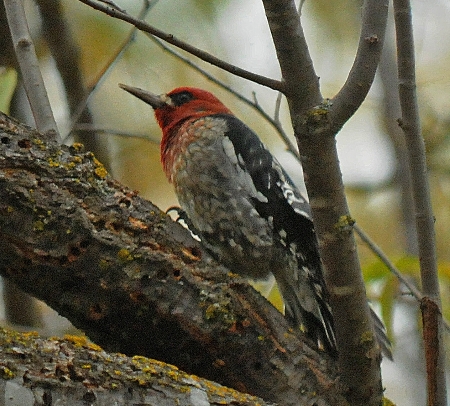
Red-Breasted Sapsucker in his usual spot near the Visitor Center (J. Kenney 11/12/11)
From there we went back to the parking lot and walked around the lower edge of the campground. Among the birds we saw were one Allen’s and one Anna’s Hummingbird that were foraging in the oaks near the amphitheatre. By then it was time for lunch so we decided to try the picnic area near the park entrance. That proved to be a good choice because there were a lot of birds in the area. While we ate, we saw 2 Loggerhead Shrikes, several American Kestrels, some Western Bluebirds, Dark-eyed Juncos, and White-tailed Kite that perched nearby and provided an auspicious end the day. [Cindy S.]
| Malibu Creek State Park | Trip List | 11/12/11 |
| Codes: F – Female, M – Male, | H – Heard, I – Immature, | [I] – Introduced |
| Mallard | Anas platyrhynchos |
20 |
| Bufflehead | Bucephala albeola |
F 2 |
| Pied-billed Grebe | Podilymbus podiceps |
1 |
| Double-crested Cormorant | Phalocrocorax auritus |
1 |
| Great Blue Heron | Ardea herodias |
1 |
| White-tailed Kite | Elanus leucurus |
2 |
| Cooper’s Hawk | Accipiter cooperii |
I 1 |
| Red-shouldered Hawk | Buteo lineatus |
3 |
| Red-tailed Hawk | Buteo jamaicensis |
4 |
| American Kestrel | Falco sparverius |
M 4 |
| American Coot | Fulica americana |
20 |
| Band-tailed Pigeon | Columba fasciata |
80 |
| Mourning Dove | Zenaida macroura |
2 |
| Black-hooded Parakeet [I] | Nandayus nenday |
H |
| Anna’s Hummingbird | Calypte anna |
M 1 |
| Allen’s Hummingbird | Selasphorus sasin |
F 1 |
| Acorn Woodpecker | Melanerpes formicivorus |
8 |
| Red-breasted Sapsucker | Sphyrapicus varius |
2 |
| Nuttall’s Woodpecker | Picoides nuttallii |
MF + 2 H |
| Downy Woodpecker | Picoides pubescens |
1 |
| Northern Flicker | Colaptes auratus |
(4 H) 5 |
| Black Phoebe | Sayornis nigricans |
6 |
| Say’s Phoebe | Sayornis saya |
3 |
| Loggerhead Shrike | Lanius ludovicianus |
2 |
| Western Scrub-Jay | Aphelocoma californica |
2 |
| American Crow | Corvus brachyrhynchos |
30 |
| Common Raven | Corvus corax |
8 |
| Oak Titmouse | Baeolophus inornatus |
(most H) 20 |
| Bushtit | Psaltriparus minimus |
15 |
| White-breasted Nuthatch | Sitta carolinensis |
6 |
| Bewick’s Wren | Thryomanes bewickii |
2 |
| House Wren | Troglodytes aedon |
1 |
| Ruby-crowned Kinglet | Regulus calendula |
4 |
| Western Bluebird | Sialia mexicana |
20 |
| American Robin | Turdus migratorius |
1 |
| Wrentit | Chamaea fasciata |
H 3 |
| Phainopepla | Phainopepla nitens |
(1 M+1 H) 2 |
| Yellow-rumped Warbler | Dendroica coronata |
(most H) 40 |
| Common Yellowthroat | Geothlypis trichas |
H 2 |
| Spotted Towhee | Pipilo maculatus |
8 |
| California Towhee | Pipilo crissalis |
12 |
| Lark Sparrow | Chondestes grammacus |
20 |
| Song Sparrow | Melospiza melodia |
(most H) 4 |
| White-crowned Sparrow | Zonotrichia leucophrys |
40 |
| Dark-eyed Junco | Junco hyemalis |
30 |
| Purple Finch | Carpodacus purpureus |
(F/imm) 6 |
| House Finch | Carpodacus mexicanus |
30 |
| total = 46 species |
“The Big Year” movie
I’m sure that by now everyone has heard of this movie, starring Jack Black, Steve Martin and Owen Wilson.
I was a bit reluctant to see it as I had heard it isn’t really a ‘birding movie’ – whatever that is – but is a relationship movie, which all-too-often means “chick flick,” with lots of soap suds and soggy handkerchiefs.
Lillian and I – with non-birding friend in tow – saw this move a couple of days ago and we all liked it. Yes, human relationships are important to the movie, but it definitely is also a ‘birding movie.’ I detected a number of sight and verbal gags that I think only a birder would get.
I’ve always wondered what Attu looked like, and I assuming that the scenes set there were actually filmed there. But maybe not. It looked spectacular and very much like the descriptions I’ve read about it. Back in my early years of birding I though about going there and picking up some of those great Asian birds blown in on the winds. Once I read about the Quonset hut housing and birding conditions, I decided I’d rather see the birds in Asia, where they belong, and never made it to Attu. [JoAnne, commenting later on our Facebook page, advises that ‘Attu’ was really Yukon Territory, as filming in Attu was far too expensive. Ah well. Still beautiful.]
There were lots of other great shots and scenery, places I’ve been and places I’ve heard about. The Brownsville Dump. Pelagic birding and grinding up ‘chum’ with “Annie Auklet” (aka Debra Shearwater). The pursuit of the Himilayan Snowcock in the Ruby Mtns. of Nevada was very reminiscent of our trip there just last year, except that our feet always stayed on the ground.
As someone said on BIRDCHAT, “It’s probably not the best film you will see this year, but it definitely is the best birding film you will ever see.” It’s funny, it’s bittersweet. There were ‘birding moments’ when I thought, “Oh yeah, right! I’ll just bet!” (Such as that particular woodpecker who will remain unnamed.) There were ‘relationship moments’ when I cringed and thought, “NO! Don’t do that! Big mistake!” (When it comes to movies, I’ve never been accused of the inability to ‘suspend disbelief.”)
Sad to say, there were only 10 of us in the theater on a Saturday afternoon. I hope these comments whetted your appetite for the movie. I recommend this film to all birders, novice or experienced, as well as to those who know and love birders but can’t figure out the obsession. I suggest that you see it soon, before it disappears from the theaters. [Chuck Almdale]
Malibu Lagoon Trip Report: 23 October, 2011
SMBAS Links: Website Blog Facebook
Fog and cool temperatures of 59° – 64° didn’t keep the surfers or the birders away. You could tell that that birding movie was now playing in the theaters as several passersby asked if we were working on a “Big Year.” No one was.
Birds always look a bit strange in the gray light which fog brings, and this had something to do with our difficulty with one duck. It started as a Cinnamon Teal, morphed into an American Wigeon, then morphed again into a Eurasian Wigeon, a rarity at the lagoon. It looked like a rufous morph female to me, according to my handy NGS Field Guide. A few minutes later, someone said that it had been reported on the web (LACoBirds@yahoogroups.com), and sure enough when I got home, there it was, a female EuWi reported 10/22 as having been seen on 10/21 by Cal Yorke & Guy McCaskie. My records show 3 previous EuWi at the lagoon, all singletons: a bird that stayed from 1/18/81 to at least 3/8/81, one on 11/24/91 and one on 4/24/94. So far this current bird has been there at least 3 days and chances are (based on this extremely small sample of 3 birds) 33% that it’ll stay around for a while. [Link to Cal Yorke’s 10/21 report, with pictures.]

Eurasian Wigeon - female (Callyn Yorke 10/21/11)
We had a few more new faces: Ken, Dawn, Grace & Daniel, and Femi. Clara, new last month, returned, busily recording her sightings onto a thin rectangular electronic device, which I’ve been told is some sort of telephone. News to me. What’s next? Recorded bird calls you can dial up?
Notable among the many birds were the flocks of Black-bellied Plover which kept coming in and flying out. I guesstimated 700 total but it could easily have been well over 1000. Down on the mud, hiding among the ‘Black-bellies’ were 3 Black Turnstone, which show up just about ½ as often as do Ruddy Turnstone, 10 of which were also present. If you go birding in England, our Ruddy Turnstone is known as “The Turnstone”. I don’t know who Mr. The was, but there are an awful lot of British birds named after him. And yes, as we are often asked, Turnstones are aptly named, as they often do flip over pebbles to see if anyone edible hides underneath. Two Dunlin also showed up, wandering among the plovers and Killdeer.
The recent rain (with perhaps some help from the Surfers’ Midnight Shovel Brigade) opened up a channel through the west end of the beach. The water level was very low and dropping with the tide, so a great deal of mud was exposed throughout the lagoon and channels. We did manage to find a couple of Virginia Rail and at least one Sora, who was very vocal, calling all morning at regular intervals. The beach channel prevented us from reaching the Snowy Plover winter roost site and doing a census, but I did manage to find 5 of them at great distance through the telescope.

Malibu winterer Snowy Plover GG:AR (Cal Yorke 10/21/11)
Also notable were raptors: 2 Red-tailed Hawk perched in a dead tree across the road from the Adamson House, 1 Osprey which flew up-canyon, then back down-canyon about ½ hour later, and one each of Peregrine Falcon and Merlin, both of which – at different times – did very fast flybys of the lagoon. Lagoon birds usually panic into flight when a Peregrine comes by, but they didn’t seem to notice this one.
Our next three field trips: Butterbredt Spring Campout – 29/30 October; Malibu Creek State Park – 12 November, Malibu Lagoon 27 November.
Our next program: Tuesday, 1 November – A Century of Change in Bird Life in Los Angeles, presented by Kimball Garrett.
Reminders will be emailed from the blog.
As a reminder to those coming to our 10 a.m. Parent’s & Kids Birdwalk, it meets at the beach trail footbridge closest to the parking lot.
Links: Unusual birds at Malibu Lagoon
Aerial photo of Malibu Lagoon from 9/23/02.
Prior checklists: Jan-June’11, July-Dec ’10, Jan-June ’10, Jul-Dec ‘09, and Jan-June ‘09.
[Chuck Almdale]
| Malibu Census 2011 |
24-Jul |
28-Aug |
25-Sep |
23-Oct |
| Temperature |
65-72 |
72 – 81 |
61-69 |
59-64 |
| Tide Height |
+2.61 |
+5.03 |
+5.33 |
+5.40 |
| Low/High &Time |
L:0947 |
H:0942 |
H:0830 |
H:0178 |
| Gadwall |
10 |
6 |
||
| Eurasian Wigeon |
1 |
|||
| American Wigeon |
3 |
|||
| Mallard |
54 |
60 |
48 |
25 |
| Blue-winged Teal |
2 |
|||
| Northern Shoveler |
10 |
12 |
||
| Green-winged Teal |
2 |
|||
| Ruddy Duck |
2 |
5 |
8 |
|
| Pacific Loon |
1 |
|||
| Common Loon |
1 |
|||
| Pied-billed Grebe |
4 |
15 |
13 |
4 |
| Eared Grebe |
5 |
3 |
||
| Western Grebe |
10 |
|||
| Brandt’s Cormorant |
3 |
1 |
3 |
|
| Dble-crstd Cormorant |
31 |
48 |
47 |
32 |
| Pelagic Cormorant |
1 |
3 |
2 |
1 |
| Brown Pelican |
407 |
77 |
60 |
12 |
| Great Blue Heron |
6 |
3 |
2 |
3 |
| Great Egret |
4 |
2 |
2 |
2 |
| Snowy Egret |
11 |
15 |
23 |
26 |
| Green Heron |
1 |
|||
| Blk-crwnd N-Heron |
11 |
4 |
12 |
|
| Osprey |
1 |
1 |
||
| Red-tailed Hawk |
2 |
2 |
||
| Merlin |
1 |
|||
| Peregrine Falcon |
1 |
1 |
||
| Virginia Rail |
1 |
2 |
||
| Sora |
3 |
1 |
||
| American Coot |
20 |
75 |
410 |
370 |
| Blk-bellied Plover |
4 |
46 |
40 |
700 |
| Snowy Plover |
13 |
36 |
62 |
5 |
| Semipalmated Plover |
2 |
4 |
||
| Killdeer |
2 |
8 |
6 |
15 |
| Black Oystercatcher |
2 |
|||
| Black-necked Stilt |
1 |
|||
| Spotted Sandpiper |
2 |
2 |
3 |
|
| Wandering Tattler |
1 |
|||
| Willet |
4 |
7 |
10 |
|
| Whimbrel |
41 |
26 |
28 |
|
| Marbled Godwit |
2 |
2 |
||
| Ruddy Turnstone |
7 |
4 |
7 |
10 |
| Black Turnstone |
1 |
3 |
||
| Sanderling |
15 |
3 |
||
| Western Sandpiper |
2 |
11 |
1 |
|
| Least Sandpiper |
1 |
6 |
3 |
16 |
| Dunlin |
2 |
|||
| Long-billed Dowitcher |
2 |
2 |
||
| Red-necked Phalarope |
7 |
|||
| Heermann’s Gull |
41 |
24 |
15 |
14 |
| Ring-billed Gull |
1 |
7 |
18 |
|
| Western Gull |
107 |
146 |
66 |
80 |
| California Gull |
8 |
16 |
120 |
|
| Herring Gull |
1 |
|||
| Least Tern |
13 |
|||
| Caspian Tern |
3 |
12 |
||
| Common Tern |
1 |
|||
| Forster’s Tern |
3 |
|||
| Royal Tern |
18 |
15 |
1 |
|
| Elegant Tern |
8 |
36 |
4 |
|
| Black Skimmer |
1 |
1 |
||
| Rock Pigeon |
6 |
5 |
5 |
4 |
| Mourning Dove |
3 |
2 |
2 |
2 |
| Vaux’s Swift |
100 |
|||
| Anna’s Hummingbird |
3 |
4 |
3 |
2 |
| Allen’s Hummingbird |
3 |
2 |
2 |
|
| Belted Kingfisher |
2 |
1 |
2 |
|
| Nuttall’s Woodpecker |
1 |
|||
| Western Wood-Pewee |
1 |
|||
| Black Phoebe |
8 |
10 |
6 |
10 |
| Say’s Phoebe |
1 |
2 |
||
| Cassin’s Kingbird |
1 |
|||
| Western Kingbird |
1 |
4 |
||
| Western Scrub-Jay |
2 |
|||
| American Crow |
4 |
3 |
2 |
4 |
| Rough-wingd Swallow |
20 |
22 |
1 |
|
| Barn Swallow |
18 |
45 |
30 |
|
| Cliff Swallow |
25 |
2 |
||
| Oak Titmouse |
2 |
|||
| Bushtit |
8 |
6 |
6 |
20 |
| Bewick’s Wren |
1 |
1 |
1 |
1 |
| House Wren |
1 |
1 |
||
| Wrentit |
1 |
|||
| Northern Mockingbird |
2 |
3 |
2 |
2 |
| European Starling |
38 |
20 |
23 |
60 |
| Ornge-crwnd Warbler |
1 |
|||
| Yellow-rumpd Warbler |
8 |
|||
| Common Yellowthroat |
1 |
8 |
5 |
9 |
| Wilson’s Warbler |
1 |
2 |
||
| California Towhee |
3 |
1 |
||
| Savannah Sparrow |
1 |
|||
| Song Sparrow |
1 |
5 |
3 |
4 |
| White-crwnd Sparrow |
18 |
|||
| Bobolink |
1 |
|||
| Red-winged Blackbird |
17 |
32 |
18 |
|
| Brewer’s Blackbird |
2 |
|||
| Great-tailed Grackle |
3 |
5 |
12 |
8 |
| Brwn-headed Cowbird |
6 |
|||
| Hooded Oriole |
6 |
|||
| House Finch |
4 |
8 |
12 |
5 |
| Lesser Goldfinch |
4 |
2 |
1 |
|
| Totals by Type |
July |
Aug |
Sep |
Oct |
| Waterfowl |
56 |
65 |
79 |
48 |
| Water Birds-Other |
463 |
221 |
542 |
440 |
| Herons, Egrets |
32 |
24 |
40 |
31 |
| Quail & Raptors |
0 |
3 |
1 |
5 |
| Shorebirds |
32 |
187 |
161 |
797 |
| Gulls & Terns |
175 |
248 |
124 |
233 |
| Doves |
9 |
7 |
7 |
6 |
| Other Non-Pass. |
6 |
7 |
106 |
6 |
| Passerines |
167 |
181 |
133 |
157 |
| Totals Birds |
940 |
943 |
1193 |
1723 |
| Total Species |
July |
Aug |
Sep |
Oct |
| Waterfowl |
2 |
2 |
5 |
6 |
| Water Birds-Other |
5 |
6 |
9 |
12 |
| Herons, Egrets |
4 |
4 |
5 |
3 |
| Quail & Raptors |
0 |
2 |
1 |
4 |
| Shorebirds |
8 |
14 |
12 |
13 |
| Gulls & Terns |
8 |
8 |
7 |
5 |
| Doves |
2 |
2 |
2 |
2 |
| Other Non-Pass. |
2 |
3 |
4 |
3 |
| Passerines |
19 |
18 |
23 |
17 |
| Totals Species – 100 |
50 |
59 |
68 |
65 |
Bolsa Chica Reserve Field Trip Report: 8 October, 2011
SMBAS Links: Website Blog Facebook
Bolsa Chica Ecological Reserve parallels Pacific Coast Hwy. between Seal Beach and Huntington Beach in Orange County. Bolsa Chica means “little pocket” in Mexican Spanish as once the area was all swamp with “little pockets” of dry land. Nowadays it’s a large sandy series of mostly man-made lagoons, restored a few years back when a direct channel was dug under the highway and through the beach out to the ocean. It’s a very good spot for all sorts of water birds, raptors, Belding’s race of the Savannah Sparrow, and the occasional oddity like the Lesser Sand (Mongolian) Plover than showed up there last summer.
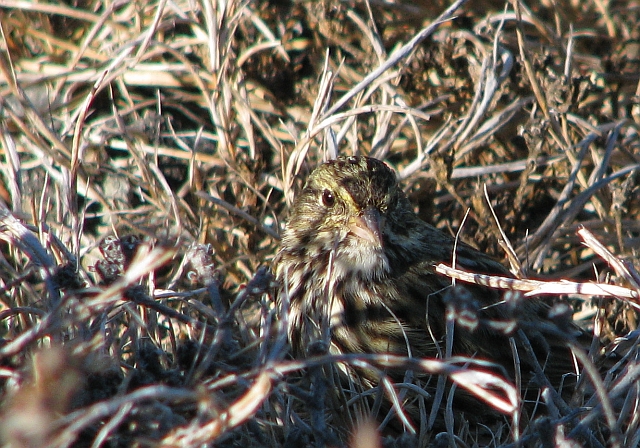
Savannah Sparrow - salt-marsh loving Belding's race (C. Almdale 10/8/11)
It was a Goldilocks day – not too cold, not too hot – just right.
The down side is that the birding stalwarts stayed out well past the lunch hour. There were lots of birds and new surprises kept appearing. We thought we had seen most of the Grebes (Western, Pied-Billed, and Horned) when up popped an Eared Grebe and its lunch… an eel which was fighting back. The hoped-for Reddish Egret was there – actually there were at least three of them, and we greatly enjoyed their prancing manner of foraging for fish. We had Terns: Forster’s, Royal, Elegant and the uncommon Common. The Osprey perching high in a tree with a large fish in its talons was having a tough time hopping down the branch with one slippery foot while hanging onto the fish with the other. We had Long-Billed Curlews – amazing how they can fly with that bill. We had a Downy Woodpecker in the east side forest fringe, and quite a few Belted Kingfishers. There were Greater Yellowlegs, Long-Billed Dowitchers and those wretched Willets which seem so bland until they fly and then I wonder what my problem was. The lucky ones saw the Parasitic Jaeger (aka the Arctic Skua) – a wanderer who is rarely seen here.
We had a total of 71 species ranging from Herons and Egrets to tiny peeps and we had lots of Belding’s Savannah Sparrows and a Loggerhead Shrike. We had a grand day – easy walking, visible birds and – it goes without saying – a great leader ( moi)! [Ellen Vahan]
Map to Meeting Place and planned (not actual) walking route.
| Bolsa Chica Reserve |
|
| 10/8/2011 | |
| X = present | |
| Brant |
1 |
| American Wigeon |
X |
| Mallard |
X |
| Blue-winged Teal |
8 |
| Ruddy Duck |
X |
| Pied-billed Grebe |
X |
| Horned Grebe |
X |
| Eared Grebe |
X |
| Western Grebe |
X |
| Brown Pelican |
X |
| Double-crested Cormorant |
X |
| Great Blue Heron |
X |
| Great Egret |
X |
| Snowy Egret |
X |
| Reddish Egret |
3 |
| Green Heron |
X |
| Black-crowned Night-Heron |
X |
| Turkey Vulture |
X |
| Osprey |
1 |
| White-tailed Kite |
2 |
| Northern Harrier |
1 |
| Cooper’s Hawk |
1 |
| Red-tailed Hawk |
X |
| Eurasian Kestrel |
1 |
| American Coot |
X |
| Black-bellied Plover |
X |
| Semipalmated Plover |
X |
| Killdeer |
X |
| American Avocet |
2 |
| Spotted Sandpiper |
1 |
| Greater Yellowlegs |
6 |
| Willet |
X |
| Long-billed Curlew |
X |
| Marbled Godwit |
X |
| Ruddy Turnstone |
X |
| Sanderling |
X |
| Western Sandpiper |
X |
| Least Sandpiper |
X |
| Dunlin |
6 |
| Long-billed Dowitcher |
X |
| Heermann’s Gull |
X |
| Ring-billed Gull |
x |
| Western Gull |
x |
| California Gull |
x |
| Common Tern |
2 |
| Forster’s Tern |
x |
| Royal Tern |
x |
| Elegant Tern |
x |
| Parasitic Jaeger |
1 |
| Rock Pigeon |
x |
| Mourning Dove |
x |
| Anna’s Hummingbird |
x |
| Belted Kingfisher |
3 |
| Downy Woodpecker |
1 |
| Black Phoebe |
x |
| Say’s Phoebe |
x |
| Cassin’s Kingbird |
x |
| Loggerhead Shrike |
1 |
| American Crow |
x |
| Tree Swallow |
X |
| Marsh Wren |
x |
| Northern Mockingbird |
X |
| European Starling |
x |
| Common Yellowthroat |
x |
| California Towhee |
x |
| Savannah Sparrow |
x |
| Savannah Sparrow – Belding’s |
x |
| Song Sparrow |
x |
| White-crowned Sparrow |
x |
| Western Meadowlark |
x |
| House Finch |
x |
| Total Birds |
70 |



 SANTA MONICA BAY AUDUBON SOCIETY BLOG