Free email delivery
Please sign up for email delivery in the subscription area to the right.
No salesman will call, at least not from us. Maybe from someone else.
Field Trip Report: Wind Wolves Preserve, 4 Dec., 2010
[This report is a bit longer than usual because we found the preserve to be an especially beautiful and interesting place.]
Wind Wolves Preserve is located on the north slope of the Tecuya Ridge, the mountains on the south end of the San Joachin Valley, about 15 miles west of the Tejon (Grapevine) Pass and the #5 freeway. It was acquired about 16 years ago by The Wildlands Conservancy (TWC), a privately funded foundation. Weekdays are primarily devoted to programs for school children, with the weekends open for public use. It is very popular with bike riders who ride back and forth across the mountains from Pine Mountain Club, or car-shuttle back.
We’d arranged to meet with docents at 9 AM, so we had to speed past many grassland birds, including a Roadrunner, on the 3 mile drive from Hwy 166 to the front gate. TWC’s Ecologist Dave Clendenen, Preserve Education Director Sherryl Clendenen and Preserve Naturalist Paige O’Mara met us at the trailhead, and then graciously drove us in their large van several miles further up the canyon to “The Willows”, a beautiful riparian area filled with enormous ancient cottonwoods

At "The Willows" (L.Johnson 12/4/10)
and streamside willows. I was particularly impressed by one spot where the stream ran through the crotch of a huge cottonwood limb which – still living – was half-buried in the ground, blocking the flow. We stopped once on our way up Emigdio Canyon to check out the Golden Eagle sitting on the canyon ridge, but apparently it didn’t like the looks of the biped-filled metal box far below it, and flew away before most of us clambered out the van doors.

Anna's Hummingbird at Fuschias (Dan Siegler 12/4/10)
Emigdio Canyon was the route favored by the Indians and early Spanish to descend northward into the San Joachin valley. The bottom of the aptly named “Grapevine” route we currently use was then filled with brambly grapevines, bears and other such wildlife; thus, relegating foot traffic to the steep sides of the pass. Emigdio pass was a far easier route. The Canyon became part of a Spanish land grant and passed through several hands before TWC bought it. Altitude at the preserve ranges from about 800 ft near the north-end entrance to about 6000 ft. at its southern border in the mountains.

White-crowned Sparrow (Dan Siegler 12/4/10)
We wandered around the willows area for several hours, spotting birds, a few chill-tolerant butterflies and flowers, deer on the hillsides and bobcat scat (white and conical) at our feet. Red-tailed and Ferruginous Hawks, American Kestrels and a Prairie Falcon flew overhead, occasionally diving on a prospective breakfast, and we eventually saw the eagle again, unmistakable with its long, broad wings, finger-like spread primaries, slowly gliding down the ridgeline. On the rocky cliffs above us we found at least 4 eagle nests: the local pair doesn’t use the same nest every year. Dave informed us that the area is very popular in the spring with nesting Lawrence’s Goldfinches: anyone seeking this species – beautiful but tricky to reliably locate – should try this location. We tracked down a call in the willows to a Hutton’s Vireo (listen to it), gleaning on the willow stems. This is another species frequently difficult to find, and I don’t think that all of us got onto it before it moved off.
The latter half of March appears to be the best time for wildflowers, although this is variable, depending on winter rains and springtime temperatures. Late April – early May is best for nesting birds, especially Bullock’s Orioles and the goldfinches.
After lunch, those of us who didn’t have to immediately return home dawdled
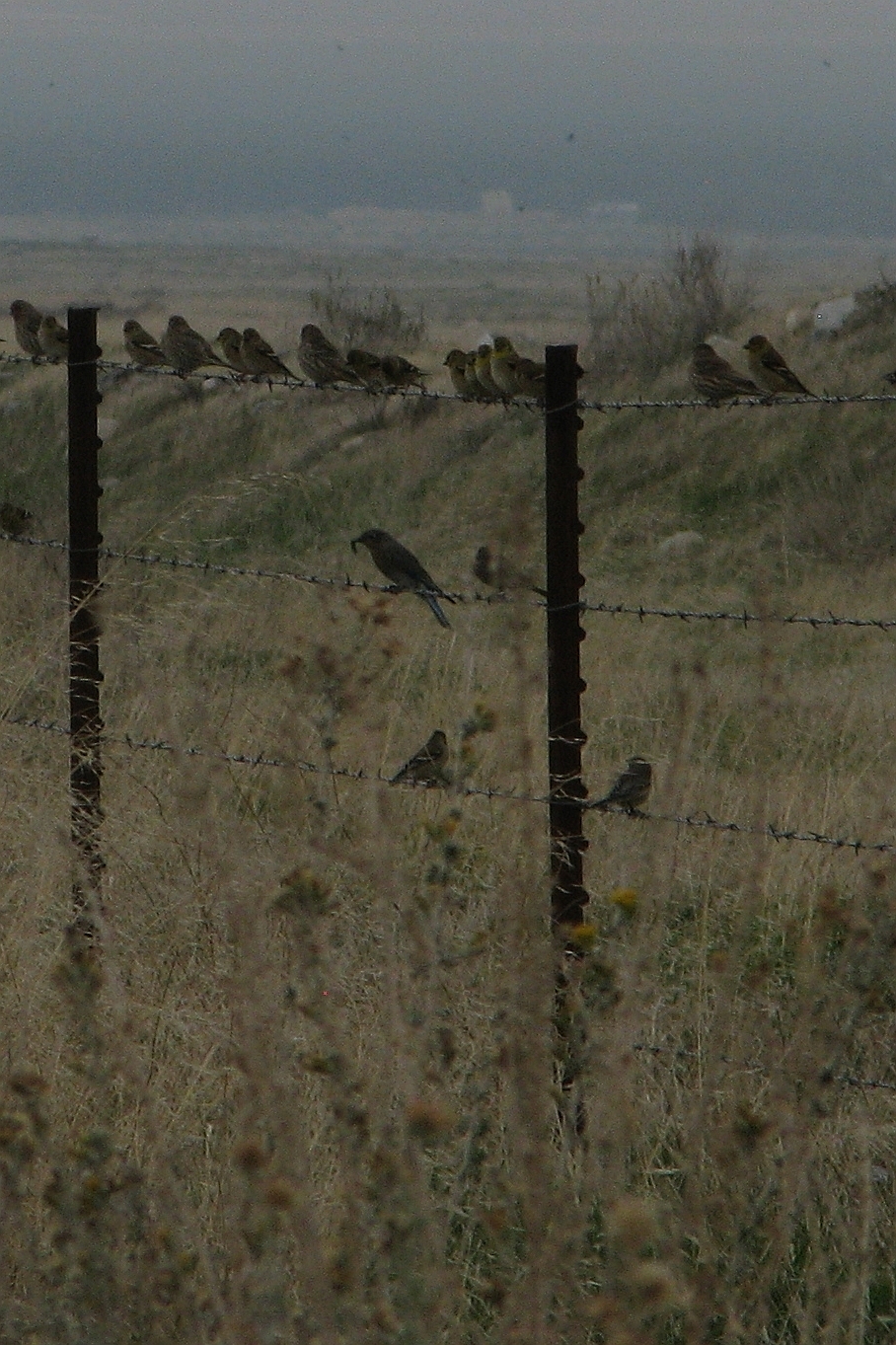
Mountain Bluebird, American Goldfinches & House Finches on fence (L.Johnson 12/4/10)
along the entrance road, adding species to the trip list. Most noteworthy were the enormous number of Mountain Bluebirds on the roadside fences and fields. We settled on a count of 200, but they were so numerous and constantly moving, that there could easily have been ten times that number. There were far more than any of us had ever seen anywhere before. We also saw the Roadrunner again, plus various blackbird species, Lark Sparrows and dozens of American Goldfinches.
Driving back down the #5, we decided to stop off at Quail Lake near Gorman and check the outlet channel for goldeneyes, as it had hosted a Barrow’s Goldeneye last winter. We didn’t find this species, but did find a small flock of diving ducks including Buffleheads and Common Goldeneyes among the Lesser Scaup. A chilly wind blowing down off the mountains finally drove us back into our cars.
We highly recommend Wind Wolves Preserve for hiking, birding, wildflowers & butterflies (in season) and biking. They also have campsites available (by reservation).
Thanks to everyone who came, and especially thanks to Dave, Sherryl & Paige for showing us around. Link to Wind Wolves Preserve website. [Chuck Almdale]
| Wind | Entrance | Quail | |
| TRIP LIST 12/4/10 |
Wolves | Road | Outlet |
| Lesser Scaup | 30 | ||
| Bufflehead | 20 | ||
| Common Goldeneye | 14 | ||
| Ruddy Duck | 3 | ||
| California Quail | 25 | ||
| Eared Grebe | 1 | ||
| Double-crested Cormorant | 3 | ||
| Northern Harrier | 6 | 2 | |
| Cooper’s Hawk | 1 | ||
| Red-tailed Hawk | 3 | ||
| Ferruginous Hawk | 1 | ||
| Golden Eagle | 1 | ||
| American Kestrel | 4 | 2 | |
| Prairie Falcon | 1 | ||
| Killdeer | 2 | ||
| Mourning Dove | 4 | 3 | |
| Greater Roadrunner | 1 | ||
| Anna’s Hummingbird | 2 | ||
| Nuttall’s Woodpecker | Heard | ||
| Northern Flicker | 2 | ||
| Black Phoebe | 4 | 7 | |
| Say’s Phoebe | 4 | 1 | |
| Loggerhead Shrike | 2 | ||
| Hutton’s Vireo | 1 | ||
| Common Raven | 12 | 15 | 3 |
| Bushtit | 15 | ||
| Rock Wren | 1 | ||
| Blue-gray Gnatcatcher | 1 | ||
| Ruby-crowned Kinglet | 6 | ||
| Mountain Bluebird | 200 | ||
| Hermit Thrush | Heard | ||
| American Robin | 3 | ||
| European Starling | 40 | ||
| American Pipit | 1 | ||
| Yellow-rumped Warbler | 4 | ||
| Spotted Towhee | 2 | ||
| California Towhee | 3 | ||
| Lark Sparrow | 8 | ||
| Savannah Sparrow | 20 | ||
| Song Sparrow | 1 | ||
| White-crowned Sparrow | 2 | 6 | |
| Golden-crowned Sparrow | 3 | ||
| Red-winged Blackbird | 1 | ||
| Western Meadowlark | 40 | ||
| Brewer’s Blackbird | 25 | ||
| House Finch | 12 | 18 | |
| Lesser Goldfinch | 8 | ||
| American Goldfinch | 70 | ||
| House Sparrow | 12 | ||
| Totals – 49 species | 28 | 21 | 9 |
Malibu Lagoon Field Trip Report: 28 November, 2010
You can predict surf conditions by counting cars parked on Pacific Coast Hwy. There were none: as a result, the sea was flat. One lonely surfer was zipped up and heading out. The lagoon, however, was filled with birds, if not with water. “Rumor” has it that a few weeks back, local surfers breached the beach with the usual midnight shovel brigade. The water ran out, exposing lots of mud and gravel and providing a large area for the gulls to rest away from the usually crowded beach. Most of the time, most of the birds come to the lagoon to rest and – just like humans – don’t like to be bothered when resting. Imagine you are a bird, lying on the ground, trying to get some shut-eye, and enormous bipeds, weighing about 200 times what you do, keep lumbering by. Even if they mean you no harm (most don’t), they don’t seem to pay much attention to where they’re going and they’ll step right on you if you let them. Ah well…
Cool, crisp, clear, a light breeze. We never took our jackets off. We went over by the highway bridge to check out the huge flock of gulls lounging on the gravel and bathing in the water. They were mostly Ring-bill and California with a scattering of Western and Heermann’s, plus two Bonaparte’s and a single first year Mew Gull. We rarely get Mew at the lagoon, although they can be found in good numbers near the sewer outfall at Dockweiler St. Beach. Does this mean that the lagoon has better water quality than our county’s main sewer outfall? Upstream of the bridge, we could see Ruddy Ducks, Buffleheads and a single Lesser Scaup, all busily diving. Even further upstream, the trees held eight Black-crowned Night-Herons, both adult and immature, while a Green Heron prowled the riverbank below.
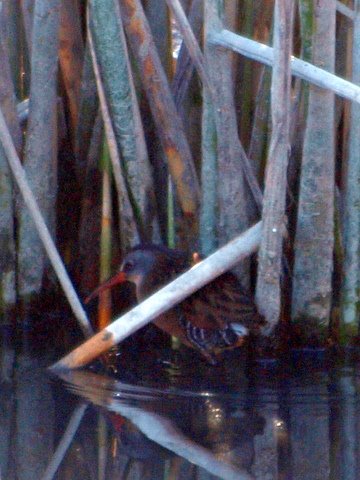
Virginia Rail (J. Waterman 11/28/10)
Pausing by a reed-bed en route back to the beach trail, we happened on an active Marsh Wren, accompanied by a Black Phoebe, a Sora, and a defiant Virginia Rail. It took about 10 minutes, but finally the entire group managed to get decent looks at this elusive little migrant, all stripy and rufous (see picture). Further along we found a Say’s Phoebe, hovering over the pickleweed, probably here for the winter. We also turned up another 6 Soras, scattered over 4 different reed beds.
The migrant passerines have mostly left; the wintering birds are arriving. An Osprey has been hanging around for a few days; the various ducks and shorebirds probably keep an eye on him in case he decides to add bird to his usual diet of fish. The duck population jumped up to 108 birds/10 species from October’s 28 birds/5 species. Offshore we found a Pacific and a Common Loon just outside the kelp bed near the rocks, as well as one Pelagic Cormorant and small flotillas of Surf Scoters and Western Grebes. Sanderlings swarmed over the kelp washed up at water’s edge , accompanied by a dozen Ruddy Turnstones and a single Black Turnstone, away from his usual preferred rocky shoreline.
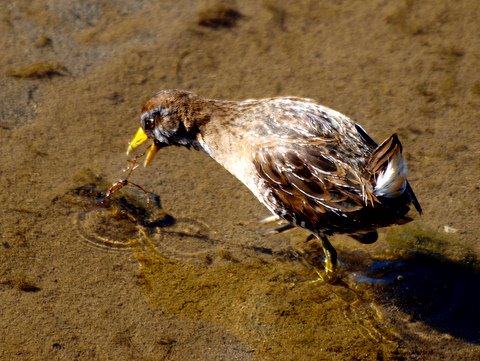
"I'm a Vegan, that's why I'm eating it!" (Sora, by J.Waterman 11/28/10)
A lot of Snowy Plovers were roosting in the beach footprints, unlike October, when they had fled from the high tides. Snowies usually move to the water’s edge or the wrack line when the tide recedes from high and their invertebrate food is more plentiful. The rest of the time they roost in small depressions in the sand, and occasionally chase one another. We counted 58 individuals (there were 63 on Thanksgiving Day), including one bird banded Left: aqua over yellow; Right: aqua over aqua. Point Reyes Bird Observatory informs us that this bird was banded at Salinas National Wildlife Refuge and fledged from there in July, 2010. [If you have ever wondered about Snowy Plovers and why SMBAS is so interested in them, you should listen to PRBO’s brief podcast entitled “Snowy Plover Conservation.” You can find information on their “Snowy Plover Soap Opera” at the same web location.]
We created another blog especially for Unusual Birds at Malibu Lagoon, which will be a permanent location for pictures of our uncommon birds (such as Joyce Waterman’s Virginia Rail photo above). For prior period bird lists, follow these links to Jan-Jun‘10, Jul-Dec‘09, and Jan-June‘09. [Chuck Almdale]
| Malibu Census – 2010 | 25-Jul | 22-Aug | 26-Sep | 24-Oct | 28-Nov |
| Temperature | 60-67 | 68-75 | 70-79 | 60-65 | 55-65 |
| Tide Height | +4.05 | +4.32 | +5.54 | +6.02 | +2.59 |
| Low/High & Time | H:1036 | H:0933 | H:1055 | H:0952 | L:0842 |
| (Black) Brant | 6 | 5 | 5 | ||
| Gadwall | 20 | 2 | 6 | ||
| American Wigeon | 1 | 1 | 14 | ||
| Mallard | 49 | 55 | 48 | 10 | 18 |
| Northern Shoveler | 4 | 8 | 10 | ||
| Northern Pintail | 6 | ||||
| Green-winged Teal | 7 | ||||
| Lesser Scaup | 1 | ||||
| Surf Scoter | 15 | ||||
| Bufflehead | 6 | ||||
| Red-brstd Merganser | 5 | ||||
| Ruddy Duck | 3 | 5 | 15 | 7 | 26 |
| Pacific Loon | 1 | ||||
| Common Loon | 1 | ||||
| Pied-billed Grebe | 5 | 9 | 18 | 3 | 2 |
| Horned Grebe | 1 | ||||
| Eared Grebe | 2 | 5 | 6 | ||
| Western Grebe | 4 | 6 | 16 | ||
| Brown Pelican | 187 | 163 | 46 | 40 | 40 |
| Dble-crstd Cormorant | 20 | 30 | 38 | 15 | 37 |
| Pelagic Cormorant | 1 | ||||
| Great Blue Heron | 6 | 6 | 5 | 3 | 7 |
| Great Egret | 4 | 4 | 6 | 2 | 4 |
| Snowy Egret | 14 | 19 | 14 | 2 | 31 |
| Green Heron | 1 | 1 | 1 | ||
| Blk-crwnd N-Heron | 4 | 7 | 10 | 6 | 8 |
| Osprey | 1 | 1 | |||
| Cooper’s Hawk | 1 | ||||
| Red-tailed Hawk | 1 | 1 | |||
| American Kestrel | 1 | 1 | |||
| Merlin | 1 | ||||
| Sora | 1 | 1 | 1 | 7 | |
| Virginia Rail | 1 | ||||
| American Coot | 15 | 28 | 230 | 100 | 206 |
| Blk-bellied Plover | 55 | 78 | 100 | 110 | |
| Snowy Plover | 26 | 44 | 62 | 58 | |
| Semipalmated Plover | 6 | 11 | |||
| Killdeer | 3 | 3 | 1 | 5 | |
| Willet | 7 | 10 | 56 | 26 | 2 |
| Spotted Sandpiper | 1 | 2 | 3 | 2 | |
| Whimbrel | 48 | 8 | 17 | 2 | |
| Long-billed Curlew | 1 | ||||
| Marbled Godwit | 22 | ||||
| Ruddy Turnstone | 3 | 3 | 10 | 5 | 13 |
| Black Turnstone | 8 | 1 | |||
| Sanderling | 4 | 30 | 20 | 290 | |
| Western Sandpiper | 20 | 4 | 28 | ||
| Least Sandpiper | 2 | 4 | 14 | 7 | |
| Pectoral Sandpiper | 1 | ||||
| Short-billd Dowitcher | 1 | ||||
| Long-billed Dowitcher | 30 | ||||
| Wilson’s Phalarope | 1 | ||||
| Boneparte’s Gull | 5 | ||||
| Heermann’s Gull | 125 | 62 | 68 | 41 | 37 |
| Mew Gull | 1 | ||||
| Ring-billed Gull | 4 | 30 | 97 | 800 | |
| California Gull | 1 | 3 | 22 | 8 | 500 |
| Herring Gull | 1 | ||||
| Western Gull | 80 | 66 | 73 | 52 | 130 |
| Glaucous-wingd Gull | 1 | ||||
| Caspian Tern | 13 | 13 | |||
| Royal Tern | 2 | 2 | 1 | 2 | |
| Elegant Tern | 10 | 45 | 40 | 4 | |
| Common Tern | 8 | ||||
| Forster’s Tern | 5 | 6 | 5 | ||
| Least Tern | 36 | ||||
| Black Tern | 1 | ||||
| Black Skimmer | 35 | 103 | |||
| Rock Pigeon | 6 | 4 | 12 | 45 | 6 |
| Mourning Dove | 4 | 3 | 2 | 1 | 2 |
| Anna’s Hummingbird | 1 | 2 | 2 | 10 | 3 |
| Allen’s Hummingbird | 6 | 4 | 1 | 6 | 1 |
| Belted Kingfisher | 1 | 1 | 1 | 1 | |
| Downy Woodpecker | 1 | ||||
| Gray Flycatcher | 1 | ||||
| Black Phoebe | 2 | 5 | 5 | 8 | 6 |
| Say’s Phoebe | 1 | ||||
| Cassin’s Kingbird | 1 | 2 | |||
| Western Kingbird | 4 | 4 | |||
| Western Scrub-Jay | 1 | ||||
| American Crow | 6 | 4 | 3 | 18 | 3 |
| Common Raven | 1 | ||||
| Tree Swallow | 1 | ||||
| Rough-wingd Swallow | 5 | 3 | 4 | ||
| Cliff Swallow | 10 | ||||
| Barn Swallow | 20 | 8 | 1 | ||
| Bushtit | 6 | 17 | 11 | ||
| Bewick’s Wren | 1 | 2 | |||
| House Wren | 2 | 2 | 2 | ||
| Marsh Wren | 4 | 1 | |||
| Northern Mockingbird | 2 | 5 | 3 | 1 | |
| European Starling | 80 | 7 | 62 | ||
| Yellow Warbler | 2 | ||||
| Yellow-rumpd Warbler | 15 | 8 | |||
| Blk-throated G. Warbler | 1 | ||||
| Townsend’s Warbler | 1 | ||||
| Common Yellowthroat | 4 | 5 | 4 | 10 | 5 |
| Wilson’s Warbler | 1 | ||||
| Western Tanager | 1 | ||||
| Spotted Towhee | 1 | ||||
| California Towhee | 2 | 1 | |||
| Savannah Sparrow | 1 | ||||
| Song Sparrow | 3 | 3 | 4 | 1 | 2 |
| White-crwnd Sparrow | 4 | 10 | |||
| Blue Grosbeak | 1 | ||||
| Lazuli Bunting | 6 | ||||
| Red-winged Blackbird | 1 | 2 | 14 | ||
| Western Meadowlark | 3 | 1 | |||
| Brewer’s Blackbird | 15 | 1 | |||
| Great-tailed Grackle | 1 | ||||
| Brwn-headed Cowbird | 3 | 1 | 3 | ||
| Hooded Oriole | 4 | 1 | |||
| House Finch | 2 | 4 | 10 | 4 | |
| Lesser Goldfinch | 2 | 3 | 2 | 5 | 2 |
| Lawrence’s Goldfinch | 2 | ||||
| Totals by Type | Jul | Aug | Sep | Oct | Nov |
| Waterfowl | 58 | 71 | 93 | 28 | 108 |
| Water Birds-Other | 227 | 231 | 339 | 170 | 319 |
| Herons, Egrets | 28 | 37 | 36 | 13 | 51 |
| Quail & Raptors | 1 | 0 | 1 | 3 | 3 |
| Shorebirds | 127 | 162 | 325 | 164 | 490 |
| Gulls & Terns | 306 | 299 | 249 | 203 | 1481 |
| Doves | 10 | 7 | 14 | 46 | 8 |
| Other Non-Pass. | 7 | 8 | 4 | 17 | 5 |
| Passerines | 152 | 76 | 176 | 76 | 37 |
| Totals Birds | 916 | 891 | 1237 | 720 | 2502 |
| Total Species | Jul | Aug | Sep | Oct | Nov |
| Waterfowl | 3 | 4 | 6 | 5 | 10 |
| Water Birds-Other | 4 | 5 | 7 | 7 | 12 |
| Herons, Egrets | 4 | 5 | 5 | 4 | 5 |
| Quail & Raptors | 1 | 0 | 1 | 3 | 3 |
| Shorebirds | 10 | 10 | 16 | 5 | 10 |
| Gulls & Terns | 9 | 8 | 9 | 6 | 9 |
| Doves | 2 | 2 | 2 | 2 | 2 |
| Other Non-Pass. | 2 | 4 | 3 | 3 | 3 |
| Passerines | 16 | 19 | 29 | 14 | 13 |
| Totals Species – 115 | 51 | 57 | 78 | 49 | 67 |
Neil Losin’s “Birds Of the Santa Monica Mountains” website
Neil, whose program “The Science of Bird Song” was greatly enjoyed by many at our November, 2010 SMBAS meeting, has a new website featuring our local birds. It currently holds about 85 photos in five main categories: waterfowl, shorebirds, other water birds, song birds, and other land birds. Each bird has a close-up portrait, with the full-sized original picture available with a click. Another button opens up a recording of the bird’s song from the Cornell Lab of Ornithology Macaulay Library. (You can open up more than one bird song at the same time. The California Thrasher and California Quail make a nice combo.)
I’m sure the collection will grow. Now you can get “nose to bill” with some of your local neighbors.
He also has a blog, on which he discusses these pictures and other matters.
NOTE ADDED 7 Mar 2023: The links provided above no longer took you to Losin’s work, but to an Asian language site. They’ve been eliminated.
[Chuck Almdale]
Field Trip Report: Malibu Creek State Park; Sat., 13 November, 2010
The first bird of the morning was a White-tailed Kite which we saw from the parking lot. It was an unexpected treat because these birds have been uncommon in the park in recent years.
It was still cold when we left the parking lot and walked past the
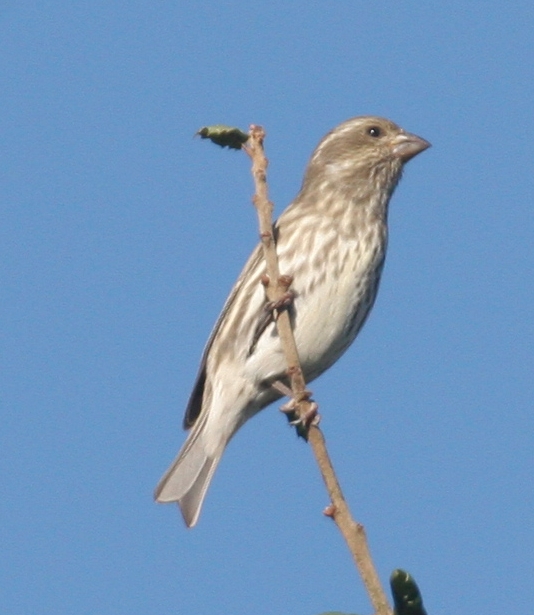
Purple Finch ♀ - Note robust bill, unstreaked vent (A. Kotin 11/13/10)
amphitheater and along the edge of the campground. Although the campground is usually very “birdy” we found it to be rather quiet, perhaps because of the cold. However, a female Purple Finch perched in the open where we able to see it well and there were a few sparrows moving around. As we walked from the campground along the access road, the first Red-tailed Hawk of the morning soared overhead.
As we started along the Nature Trail, we saw a Say’s Phoebe and a female Purple Finch with a robust lower mandible. The mature oak trees along that trail offered some species typical of that habitat, including Oak Titmouse, Bushtit, White-breasted Nuthatch and Ruby-crowned Kinglet. Our attention was drawn to the song of a Hutton’s Vireo and most of us got good looks at the bird although it was quite active.

Cassin's Kingbird - backlighting creates illusion of white outer tail feathers (A. Kotin 11/13/10)
After leaving the Nature Trail, we crossed the creek and started along Crags Road in the direction of the Visitors’ Center. As we walked along Crags Road, we found a Loggerhead Shrike and a small flock of Pine Siskin among other species. A few people got a look at a Canyon Wren that had been calling repeatedly from rocky outcrop next to the trail.
We had good looks at a Red-breasted Sapsucker that was busily drilling holes in one of the trees near the Visitors’ Center and a few people saw a Red-naped Sapsucker in the same tree. When we left the area of the Visitors’ Center, we took advantage of the sun angle to get a better look at a small flock of Band-tailed Pigeons that was perched in the trees along the creek. As we walked back to the parking lot for a late picnic lunch, we realized that the White-tailed Kite was still present.
A review of the checklist (shown below) made it clear that we missed a few of the species commonly found in the park while enjoying some unusual sightings. [Chuck Almdale]
| Malibu Creek State Park | Trip List | |
| Mallard | Anas platyrhynchos | 15 |
| Ring-necked Duck | Aythya collaris | 1 |
| Great Blue Heron | Ardea herodias | 1 |
| White-tailed Kite | Elanus leucurus | 2 |
| Red-shouldered Hawk | Buteo lineatus | 1 |
| Red-tailed Hawk | Buteo jamaicensis | 3 |
| American Kestrel | Falco sparverius | 1 |
| American Coot | Fulica americana | 15 |
| Band-tailed Pigeon | Columba fasciata | 12 |
| Mourning Dove | Zenaida macroura | 2 |
| White-throated Swift | Aeronautes saxatalis | 20 |
| Anna’s Hummingbird | Calypte anna | 2 |
| Belted Kingfisher | Ceryle alcyon | 1 |
| Acorn Woodpecker | Melanerpes formicivorus | 15 |
| Red-naped Sapsucker | Sphyrapicus nuchalis | 1 |
| Red-breasted Sapsucker | Sphyrapicus varius | 1 |
| Nuttall’s Woodpecker | Picoides nuttallii | 1 |
| Downy Woodpecker | Picoides pubescens | 2 |
| Northern Flicker | Colaptes auratus | 2 |
| Black Phoebe | Sayornis nigricans | 6 |
| Say’s Phoebe | Sayornis saya | 2 |
| Cassin’s Kingbird | Tyrannus vociferans | 2 |
| Loggerhead Shrike | Lanius ludovicianus | 1 |
| Hutton’s Vireo | Vireo huttoni | 1 |
| Western Scrub-Jay | Aphelocoma californica | 6 |
| American Crow | Corvus brachyrhynchos | 30 |
| Common Raven | Corvus corax | 10 |
| Oak Titmouse | Baeolophus inornatus | 12 |
| Bushtit | Psaltriparus minimus | 15 |
| White-breasted Nuthatch | Sitta carolinensis | 6 |
| Canyon Wren | Catherpes mexicanus | 1 |
| Bewick’s Wren | Thryomanes bewickii | 2 |
| House Wren | Troglodytes aedon | 3 |
| Ruby-crowned Kinglet | Regulus calendula | 3 |
| Western Bluebird | Sialia mexicana | 1 |
| Wrentit | Chamaea fasciata | H |
| Yellow-rumped Warbler | Dendroica coronata | 40 |
| Common Yellowthroat | Geothlypis trichas | 1 |
| Spotted Towhee | Pipilo maculatus | 4 |
| California Towhee | Pipilo crissalis | 4 |
| Song Sparrow | Melospiza melodia | 1 |
| White-crowned Sparrow | Zonotrichia leucophrys | 20 |
| Dark-eyed Junco | Junco hyemalis | 12 |
| Purple Finch | Carpodacus purpureus | 2 |
| House Finch | Carpodacus mexicanus | 4 |
| Pine Siskin | Carduelis pinus | 5 |
| Lesser Goldfinch | Carduelis psaltria | H |
| Total 47 Birds |
Snowy Plover Update for northern Los Angeles County
The following message appeared on LACountyBirds on Sunday, Nov. 14, 2010. As a recent field trip report refers to the absence of Snowy Plovers at Malibu during our regular 4th Sunday of the month Malibu Lagoon birdwalk, I thought I’d share this with everyone, as you may not be a subscriber to the LACoBirds web chat. [Want to sign up? Read this.] [Chuck Almdale]
***************************
It does appear that only a few snowy plovers were observed at Malibu Lagoon between October 23 and November 10. The good news: we surveyed the three northern roosts at Zuma, Malibu Lagoon and Santa Monica, using the snowy plover survey protocol, on Friday (11/12/10) and found 143 snowy plovers among the three roosts, including 47 at Malibu Lagoon. For comparison we found 162 at these three roosts in October and 134 in September. We have observed large roosts relocate in the past and have noted that in some years, most birds remain at the main roost sites, and in other years they are more scattered. We haven’t come up with any definitive reason or observed anything out of the ordinary that might have caused the temporary relocation.
If anyone is interested, we are going to hold our annual Snowy Plover volunteer training on Saturday, January 8, 2011. If you are interested in becoming an LA County Snowy Plover monitor or docent, please contact Stacey Vigallon at LA Audubon off the listserv at (svigallon@hotmail.com). We expect the USFWS winter window survey to be during the second week of January next year, followed by surveys in March, May, and September. [Thomas Ryan]



 SANTA MONICA BAY AUDUBON SOCIETY BLOG