Free email delivery
Please sign up for email delivery in the subscription area to the right.
No salesman will call, at least not from us. Maybe from someone else.
Planning Meeting July 31, 2010 – Summary of Minutes
The full board of directors met at the home of Margaret Huffman for our annual planning meeting. In attendance were: Chuck Almdale, Lillian Johnson Almdale, Chuck Bragg, Adrian Douglas, Jean Garrett, Margaret Huffman, Chris Lord, Lu Plauzoles, Mary Prismon, Ellen Vahan (president).
The meeting was called to order at 10:15 am and adjourned at 2:35 pm, with a short break for lunch. Dessert was served after the meeting.
After Ellen welcomed the board and thanked Margaret for her hospitality, she read the mission statement of both NAS and SMBAS:
“The National Audubon Society’s Mission is to conserve and restore natural ecosystems, focusing on birds and wildlife for the benefit of humanity and the earth’s biological diversity. “
Our chapter’s particular mission is to be a center for wildlife education, habitat protection, and conservation issues that involve birds.
There was no discussion.
She also announced that David Yarnold is the new president of NAS, replacing John Flicker.
Budget for 2010/2011 fiscal year – Lillian
Income – Most of our income comes from the annual appeal. Other income sources are our dues share from NAS (this is a fixed amount), our Beginning Birding Class, and other donations (usually in memoriam).
Beginning Birding Class will again be offered again in Feb, 2011.
Year-end Appeal – We discussed mailing the year-end appeal in September along with a copy of the full-year calendar, rather than waiting until the end of November. Some concern was expressed about recipients putting aside the letter until year-end and then forgetting to send in a donation. In an effort to keep chapter members informed of activities and save mailing costs, the board decided to send the letter in September. Lillian and Ellen will head this up.
Expenses – All chapter expenses go to supporting chapter goals for education, protection and conservation issues.
Grants to Other Organizations – Every year, the board votes on charitable organizations to support with monetary grants. This year’s list includes: American Bird Conservancy, Ballona Renaissance, Ballona Wetlands Audubon Education Program, Birders’ Exchange, California State Parks Foundation, Endangered Habitats League, Friends of Big Morongo, and Student Conservation Association. (The following blog post has details about and web-links to these organizations).
UCLA Scholarships for PhD Research – We increased the number of scholarships from two to three. We also decided to offer several small grants to the public. Lillian will follow up on both of these items.
Evening Program Speaker Budget – Adrian requested that we increase the budget to allow additional compensation for speakers coming from outside the area. Board approved.
Field Trips – Chuck A. led a discussion about which field trips the chapter will offer and who the trip leaders will be. (The entire calendar will be sent with the year end appeal and posted on the website: http://www.smbas.org)
Coastal Cleanup Saturday, Sept. 25 9am to noon – Ellen reminded the board that SMBAS will again be heading up the annual cleanup efforts at Malibu Lagoon. She also noted that this year recyclables will not be segregated.
Conservation – Lu and Mary
Snowy Plovers are back on So Cal Beaches – Lu informed us that Tom Ryan hopes to get funding to study the behavior of the plovers. This would involve 2-hour shifts recording all plover activity.
Butterbredt Spring – Mary announced that Keith Axelson and Reed Tollefson sent us a letter about a pending solar project in the area. She will try to get more details. She also offered a big thank you to the Friends of Jawbone Canyon and the Student Conservation Association for installing “gates” across the illegal motorcycle trails around Butterbredt Spring.
Membership – Chuck B.
Membership is slightly under 800; NAS reports almost 100 more due to a difference in timing of expired memberships.
Chapter-only Membership – Chuck B will check to see how many Chapter-only members have expired and not renewed. He has not been sending out renewal notices, but will do so after he reviews the membership data. A chapter-only membership is $25.
Newsletter, Website and Blog – Chuck A and Chuck B
Newsletter – Chuck B is currently sending out 100 2-page imprints every other month, 5 times per year; this has cut our publication costs significantly.
Blog – Chuck A will link field trip announcements to prior year field trip reports so interested parties can get a better idea about which birds we may see on the field trip.
Articles Needed – Chuck B & Chuck A both request more articles posted to the blog on conservation and other “interesting” articles on “any” topic (i.e. birds, bird names, conservation in general, gardens for birds etc.
Programs – Adrian
Program Schedule – Adrian reported that all programs for the year are scheduled (to be included on the mailed calendar). Speakers are: Alan Polack, Neil Losin, Kurt Leucshner, Allen Kotin, Olga Clarke, Chuck & Lillian Almdale, and Ted Cheeseman. Adrian will follow up with the Santa Monica Mirror about announcing our meetings. The Mirror requires a 2 month lead time.
Program Announcements – Chuck A will post announcements on our Blog as well as on the Calbird and LA County Bird chat lines.
Program Location – Lu has again secured the Ken Edwards Center for Oct/Nov/Dec. The Feb/March 2011 applications are due in Sept.
Meeting Time – will continue to be at 7:30 pm, 1st Tuesday of the month at KEC with dinner for the speaker before.
Native Plant Presentations – Margaret and Ellen will again do some plant presentations at the start of the evening program.
November: When to Plant
December: Toyon
Hospitality – Chris Lord requested that Lillian order more refreshment cups.
Native Plants – Margaret
Fall Native Plant Sale – The Calif. Native Plant Society plant sale is Oct 2/3 at the Sepulveda Garden Center.
New Business – Ellen
Younger Members – How do we get younger members and new members to join the board? This issue was briefly discussed and tabled until a later date.
Board Contact Information – Adrian suggested that the imprint should include contact information on page 2.
Future Board Meeting Dates – 2010: 9/14, 11/9. 2011: 1/11/, 3/15, 5/17
Next Annual Planning Meeting –Summer 2011
[Lillian Johnson}
SMBAS Grants to Other Organizations for 2010-11
SMBAS had its annual planning meeting at the end of July. One of our duties is deciding which organizations we will support with monetary grants in the coming fiscal year. We have investigated all of the organizations listed below and believe that our donations are well invested. We encourage all our members to consider them when making their own environmentally-related charitable donations.
1. American Bird Conservancy
ABC is a “four-star exceptional” charity whose mission is to conservancy wild birds and their habitats throughout the Americas. Among their many projects are: acquiring land important to endangered/threatened species in many countries; securing easements in Colombia for wintering Cerulean Warblers; create plant nurseries and plant trees throughout the Americas; reduce seabird mortality from West Coast fisheries; create nesting habitat for owls in the Pacific Northwest; reduce feral cat populations and persuade cat owners to keep their cats indoors; protect Spotted Owl and Marbled Murrelet habitat; lobby for birds & habitat in Washington, DC; acquire and convert coffee/cacao plantations for revenue for local sanctuaries; many dozens more. SMBAS has been a member of ABC for 6 years.
Weblink: http://www.abcbirds.org/
2. Ballona Creek Renaissance
BCR is a small local group whose mission is “to improve Ballona Creek and the community’s use of in terms of water quality, ecosystem, recreation, arts, attractiveness and amenities.” They are an enthusiastic, dedicated and underfunded group who need help and support from the Westside environmental community. We will give financial support to their community matching projects. Weblink: http://www.ballonacreek.org/index.shtml
3. Ballona Wetlands Audubon Education Program
SMBAS has helped fund the BWAEP for over two decades, and many members of our chapter have dedicated a great deal of time to them. Eight months a year, twice a week, they bring groups of 60 schoolchildren – mostly 5th graders – onto the wetlands and give them hands-on experience with reptiles, invertebrates, habitat restoration, plant and bird identification. Due to widespread budget cutbacks, many schools cannot afford to hire a bus to bring the children to the wetlands, so BWAEP has begun offering “bus scholarships”. BWAEP expenses are always minimal and all of the labor is done by volunteers. Former SMBAS founder and long-term member Abigail King volunteered with them for many years, and we are funding some bus scholarships in her name.
Weblink: http://losangelesaudubon.org/index.php?option=com_content&task=view&id=495&Itemid=203
4. Birder’s Exchange
Birder’s Exchange, directed by the American Birding Association, is dedicated towards getting birding equipment to poor, birding-destination nations in the Americas. Field guides, binoculars and telescopes, both new and used, are supplied free of charge to individuals and groups in order to increase their appreciation of and involvement in their local wildlife. For example, they recently distributed over 11,000 copies of the Spanish translation of John Kricher’s A Neotropical Companion throughout the Spanish-speaking Americas. Such efforts have created many new birders throughout the Americas. Some volunteer, others work in ecotourism or lead field trips; others go on to pursue education in ornithology and other fields of science. This is a low cost, high-volunteer and high-return organization, directly focused on the development of birding and birders where it is needed most.
Weblink: http://www.aba.org/bex/
5. California State Parks Foundation
As birders and SMBAS members, we use the state parks all the time: for example, our monthly Malibu Lagoon birdwalk at held at Malibu Lagoon State Park. CSPF is over 40 years old, and is the only statewide independent nonprofit organization dedicated to protecting, enhancing and advocating for California’s state parks. Since 1969, they have raised more than $150 million to benefit state parks. They are committed to improving the quality of life for all Californians by expanding access to the natural beauty, rich culture and history, and recreational and educational opportunities offered by California’s 278 state parks the largest state park system in the United States. Many parks have been closed down due to budget cutbacks and they need as much help as they can get. CSPF also supports the current Auto License Plate Initiative.
Weblink: http://www.calparks.org/
6. Endangered Habitats League
EHL started over a decade ago primarily to preserve habitat for the threatened California Gnatcatcher which lives only in the sort of brushy chaparral which developers love to clear for housing developments, and SMBAS has supported it since its inception. Since then, they have worked to protect habitat throughout the general SoCal area. They are a small, shoestring operation which deserves our continued support.
Weblink: http://www.ehleague.org/
7. Friends of Big Morongo
Anyone who has birded at Big Morongo Nature Preserve in the springtime knows its tremendous importance as a high-desert oasis. Millions of migrating birds come up the west Mexican Coast and, after lingering at the Salton Sea, must run the gantlet of the fierce winds at the San Gorgonio Pass. BMNP provides an oasis, sanctuary, resting place and feeding grounds for these migrants before they continue through California and as far north as Alaska and the Canadian Arctic. FBM is a small volunteer organization which maintains the preserve and keeps it open for anyone to visit any time of year, and we are happy to support it.
Weblink: http://www.bigmorongo.org/
8. Student Conservation Association
SMBAS began supporting the SCA 5 years ago when we first learned of it. Since then we have sponsored the work of students in both the Santa Monica Mountains and the Tehachapi mountains around Butterbredt Spring. Some of our members have worked with them clearing trails, installing and repairing signs and fences and blocking access of ORV’s from off-limits, protected areas. We get letters from the students thanking us for our sponsorship and reporting on their activities. SCA provides hands-on conservation service opportunities to high-school and college-aged people across the nation and provides opportunities to donors to sponsor students in their local areas. Since 1957, over 50,000 young people have provided over 1/2 billion dollars worth of labor. This year, about 4,000 interns and volunteers will provide over 2 million hours of conservation service. More importantly, 70% of SCA alumni remain active in conservation in their careers or communities. This is a low cost, highly-effective way of introducing young people to our beautiful wildlands and getting some much-needed work done at the same time.
Weblink: http://www.thesca.org/
9. Butterbredt Spring
Our support of the spring is in a class by itself. For over 30 years, SMBAS – spearheaded by Keith Axelson – has championed the spring in all ways possible: mending fences and signage, re-installation of a cattle trough, perpetual negotiating with the landowners and BLM, getting SCA (see above) workers to the area, attending local Governmental Agency meetings, getting it listed as an Important Bird Area, running the Christmas Count, semi-annual field trip campouts, and on and on. Our involvement will continue.
Link to 2008 Christmas Count pictures: http://www.natureali.org/CBCs/BUTcbc109.htm
Link to history of Frederick Butterbredt & Sageland: http://www.dustyway.com/2007/09/pioneer-frederick-butterbredt.html
[Lillian Johnson]
Malibu Lagoon Trip Report: 22 August, 2010
It’s definitely August: it’s still a bit cooler than usual, but the blanket-covered beach and squadrons of surfers were unmistakable signs. Lucky for them, big ones were rolling in from a storm to the south and a windless day meant the waves weren’t blown out into foam. Tide was high; waves broke over the offshore rocks and there
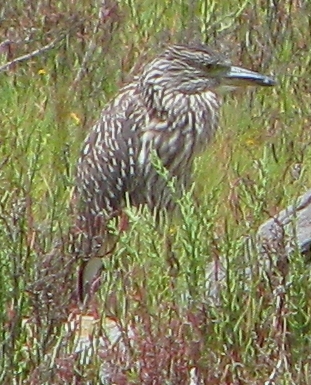
Yellow-crowned x Black-crowned Night-Heron Hybrid(?) on its favorite log (L.Johnson 8/6/10
was nothing on the shore or water, so we concentrated on the lagoon. There are now two sand islands, one large and one quite small, and the birds love them. Only a foolish human ventures into the bacteria-laden lagoon water, so with no clumsy people lurching around to step on them, the birds are free to relax. So relaxed, apparently, that they may be trying to breed there, unheard of in recent decades: Kimball Garrett reported on Sunday 8/15 that he spotted a skimmer egg on the island, although no one was attending it.
Earlier this month there was a ‘flap’ when a sub-adult Yellow-crowned Night Heron (YCNH) was reported at the lagoon. Birders went to look, pictures were taken, characteristics noted and opinions swapped. Eventually local avian maven Kimball Garrett checked it out and reported that it looked like a YCNH-BCNH hybrid. We looked for it on our walk, but all the birds were hiding deep in the reeds and the only juvenile night-herons we could see well all looked like Black-crowned.
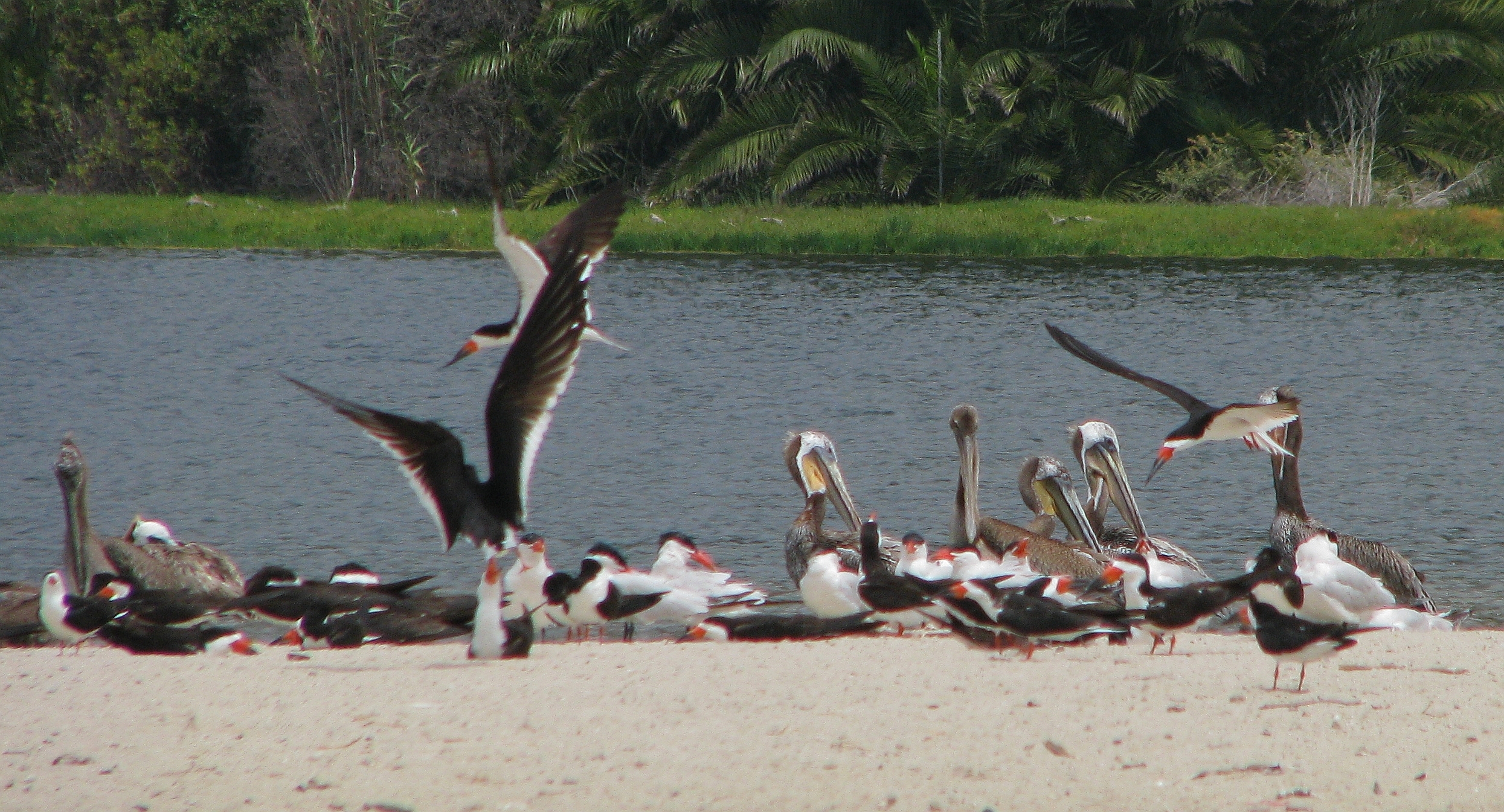
A few of the Black Skimmers (L.Johnson 8/10)
Beyond that, the shorebird and tern populations continued to grow. An all-time high of 103 Black Skimmers were roosting and skimming: this is almost triple last month’s previous high of 35 and more than the total skimmers we’ve had in the past 10 years (96 birds spread over 11 appearances). The Black-bellied Plovers showed up but the Least Terns left.

Ruddy Turnstone still in breeding plumage (L.Johnson 8/10)
Other migrants appearing were: 6 Northern Pintail, 1 Green Heron, 1 Sora, 1 Spotted Sandpiper, 1 Belted Kingfisher, 1 Cassin’s and 4 Western Kingbirds, 1 Tree Swallow and l Western Tanager. The Downy Woodpecker sighted near the parking lot may be the same individual seen in June, but missed in July. They’re uncommon south of the highway (4 sightings over 10 years), so it’s easier to believe it’s the same bird than two different birds.
On the 10 am parents & children birdwalk, Jean and Chris each talked with a different family and were very impressed with the enthusiasm & abilities of all the kids. We hope they all come back!
The July-August chart below will continue to grow monthly through December, but six months of data is all I can squeeze into this blog format. Here are links to field trip bird lists for Jan – June 2010 and July – Dec 2009. [Chuck Almdale]
| Malibu Census – 2010 | July | Aug |
| Temperature | 60-67 | 68-75 |
| Tide Height | +4.05 | +4.32 |
| Low/High & Time | H:1036 | H:0933 |
| Brant | 6 | 5 |
| Mallard | 49 | 55 |
| Northern Pintail | 6 | |
| Ruddy Duck | 3 | 5 |
| Pied-billed Grebe | 5 | 9 |
| Brown Pelican | 187 | 163 |
| Dble-crstd Cormorant | 20 | 30 |
| Great Blue Heron | 6 | 6 |
| Great Egret | 4 | 4 |
| Snowy Egret | 14 | 19 |
| Green Heron | 1 | |
| Blk-crwnd N-Heron | 4 | 7 |
| Red-tailed Hawk | 1 | |
| Sora | 1 | |
| American Coot | 15 | 28 |
| Black-bellied Plover | 55 | |
| Snowy Plover | 26 | 44 |
| Semipalmated Plover | 6 | |
| Killdeer | 3 | 3 |
| Willet | 7 | 10 |
| Spotted Sandpiper | 1 | |
| Whimbrel | 48 | 8 |
| Ruddy Turnstone | 3 | 3 |
| Black Turnstone | 8 | |
| Sanderling | 4 | 30 |
| Western Sandpiper | 20 | 4 |
| Least Sandpiper | 2 | 4 |
| Heermann’s Gull | 125 | 62 |
| Ring-billed Gull | 4 | |
| California Gull | 1 | 3 |
| Western Gull | 80 | 66 |
| Caspian Tern | 13 | 13 |
| Royal Tern | 2 | 2 |
| Elegant Tern | 10 | 45 |
| Forster’s Tern | 5 | |
| Least Tern | 36 | |
| Black Skimmer | 35 | 103 |
| Rock Pigeon | 6 | 4 |
| Mourning Dove | 4 | 3 |
| Anna’s Hummingbird | 1 | 2 |
| Allen’s Hummingbird | 6 | 4 |
| Belted Kingfisher | 1 | |
| Downy Woodpecker | 1 | |
| Black Phoebe | 2 | 5 |
| Cassin’s Kingbird | 1 | |
| Western Kingbird | 4 | |
| American Crow | 6 | 4 |
| Tree Swallow | 1 | |
| Rough-wingd Swallow | 5 | 3 |
| Cliff Swallow | 10 | |
| Barn Swallow | 20 | 8 |
| Bushtit | 6 | 17 |
| Northern Mockingbird | 2 | 5 |
| European Starling | 80 | 7 |
| Common Yellowthroat | 4 | 5 |
| Western Tanager | 1 | |
| California Towhee | 2 | 1 |
| Song Sparrow | 3 | 3 |
| Red-winged Blackbird | 1 | 2 |
| Brwn-headed Cowbird | 3 | 1 |
| Hooded Oriole | 4 | 1 |
| House Finch | 2 | 4 |
| Lesser Goldfinch | 2 | 3 |
| Totals by Type | July | Aug |
| Waterfowl | 58 | 71 |
| Water Birds-Other | 227 | 231 |
| Herons, Egrets | 28 | 37 |
| Quail & Raptors | 1 | 0 |
| Shorebirds | 127 | 162 |
| Gulls & Terns | 306 | 299 |
| Doves | 10 | 7 |
| Other Non-Pass. | 7 | 8 |
| Passerines | 152 | 76 |
| Totals Birds | 916 | 891 |
| Total Species | July | Aug |
| Waterfowl | 3 | 4 |
| Water Birds-Other | 4 | 5 |
| Herons, Egrets | 4 | 5 |
| Quail & Raptors | 1 | 0 |
| Shorebirds | 10 | 10 |
| Gulls & Terns | 9 | 8 |
| Doves | 2 | 2 |
| Other Non-Pass. | 2 | 4 |
| Passerines | 16 | 19 |
| Totals Species – 63 | 51 | 57 |
Notice about Blog Emails
Dear SMBAS blog email recipients:
From time to time this WordPress blog program makes weird errors. If you recently received a reminder notice about the May 23 Malibu Lagoon birdwalk, ignore it. I have no idea why the blogsite generated a re-send of this old message. I have no idea how to correct this sort of program error nor how to make sure it never happens again. If anyone out there does know, feel free to tell me, because I haven’t got a clue.
Rule of thumb from now on.
If you get what looks like an old, out-of-date message, that’s probably exactly what it is. Ignore it. It’s just this blog program “burping” again. What seems really bizarre to me is that some people got this latest goof, and some (like me) did not.
Our normal messages concerning field trips and programs are: announcements and reminders prior to the trip and a trip report not long (we hope!) afterwards.
Have no fear: our regular 4th Sunday of the month Malibu Lagoon trip will proceed as scheduled on 8/22. The reminder notice is scheduled to go out on 8/15. I try to get the reminders out about a week ahead of time.
So…sorry about that. Sometimes this program just does what it ‘feels like’ doing. Let’s hope it doesn’t morph into SkyNet (as in Terminator 3). [Chuck Almdale]
Malibu Lagoon Trip Report: 25 July, 2010

Busy birders on the bridge (C.Almdale 7/10)
Coastal overcast made for a cool day and most birders never got their extra layer off. Some early returning birds from northern breeding were back and in their brightest plumage: Willets, Whimbrels (48!), Western and Least Sandpipers, Semipalmated Plovers and – of course – our local group of wintering Snowy Plovers, 26 strong. Other, more local, breeders were busy reducing the invertebrate population: various herons and egrets including 4 Black-crowned Night Herons; Least, Caspian, Royal and Elegant Terns, and an extraordinary count of 35 Black Skimmers. The air was busy with Swallows: Rough-winged, Cliff and Barn – all local breeders. European Starlings – aggressive, sharp-billed and a bane to all native hole-nesting birds – had a bumper crop and ornamented several trees in a Christmas fashion.

Snowy Plover on Malibu Beach (C.Almdale 10/09)
While we were counting and re-counting Snowy Plovers, a beach maintenance crew drove up to empty the trash bins. We warned them that they were about to drive into the mixed flock of (endangered) Least Terns and (threatened) Snowy Plovers. They were very pleased to know this as they had been warned to watch out for them, and – as all birders know – these diminutive species are nearly invisible when roosting motionless on the sand. We ourselves were very happy to learn that the word about these two species continues to spread through the various governmental authorities.
The Adamson House produced a small number of hummers – Anna’s and Allen’s – at the flowering wall, and a foursome of Hooded Orioles investigated the flowering trees, but few other species were present. As we were leaving we spotted a Red-tailed Hawk soaring far away above the Serra Retreat.
Judging by the number of tents with product names on them, some sort of surfing competition was taking place, but the waves weren’t particularly good. A cool day and a light breeze made for very pleasant birding, if not surfing, conditions.
The chart below includes counts for July 2010 and 2009. Sometimes it’s interesting to compare data for equivalent dates in different years. For example, 37 out of 54 species were present in both years and total birds present in 2010 were triple the 2009 population. [Chuck Almdale]
Link to field trip bird lists for Jan – June 2010 or July – Dec 2009
| Malibu Census – July | 2010 | 2009 |
| Temperature | 60-67 | 68-75 |
| Tide Height | +4.05 | +0.4 |
| Low/High & Time | H:1036 | L:0704 |
| (Black) Brant | 6 | 0 |
| Mallard | 49 | 25 |
| Ruddy Duck | 3 | 1 |
| Pied-billed Grebe | 5 | 6 |
| Brown Pelican | 187 | 40 |
| Dble-crstd Cormorant | 20 | 15 |
| Great Blue Heron | 6 | 3 |
| Great Egret | 4 | 5 |
| Snowy Egret | 14 | 40 |
| Blk-crwnd N-Heron | 4 | 2 |
| Red-tailed Hawk | 1 | 1 |
| American Coot | 15 | 20 |
| Snowy Plover | 26 | 1 |
| Semipalmated Plover | 6 | 0 |
| Killdeer | 3 | 0 |
| Willet | 7 | 1 |
| Whimbrel | 48 | 1 |
| Ruddy Turnstone | 3 | 0 |
| Black Turnstone | 8 | 0 |
| Sanderling | 4 | 0 |
| Western Sandpiper | 20 | 1 |
| Least Sandpiper | 2 | 0 |
| Heermann’s Gull | 125 | 12 |
| Ring-billed Gull | 4 | 0 |
| California Gull | 1 | 2 |
| Western Gull | 80 | 30 |
| Caspian Tern | 13 | 0 |
| Royal Tern | 2 | 0 |
| Elegant Tern | 10 | 0 |
| Least Tern | 36 | 0 |
| Black Skimmer | 35 | 0 |
| Rock Pigeon | 6 | 1 |
| Eur. Collared-Dove | 0 | 1 |
| Mourning Dove | 4 | 1 |
| Anna’s Hummingbird | 1 | 1 |
| Allen’s Hummingbird | 6 | 3 |
| Belted Kingfisher | 0 | 1 |
| Black Phoebe | 2 | 6 |
| American Crow | 6 | 1 |
| Rough-winged Swallow | 5 | 2 |
| Cliff Swallow | 10 | 24 |
| Barn Swallow | 20 | 12 |
| Bushtit | 6 | 6 |
| Wrentit | 0 | 1 |
| Northern Mockingbird | 2 | 3 |
| European Starling | 80 | 6 |
| Common Yellowthroat | 4 | 2 |
| California Towhee | 2 | 2 |
| Song Sparrow | 3 | 1 |
| Red-winged Blackbird | 1 | 2 |
| Brwn-headed Cowbird | 3 | 1 |
| Hooded Oriole | 4 | 2 |
| House Finch | 2 | 24 |
| Lesser Goldfinch | 2 | 0 |
| Totals by Type | 2010 | 2009 |
| Waterfowl | 58 | 26 |
| Water Birds-Other | 227 | 81 |
| Herons, Egrets | 28 | 50 |
| Quail & Raptors | 1 | 1 |
| Shorebirds | 127 | 4 |
| Gulls & Terns | 306 | 44 |
| Doves | 10 | 3 |
| Other Non-Pass. | 7 | 5 |
| Passerines | 152 | 95 |
| Totals Birds | 916 | 309 |
| Total Species | 2010 | 2009 |
| Waterfowl | 3 | 2 |
| Water Birds-Other | 4 | 4 |
| Herons, Egrets | 4 | 4 |
| Quail & Raptors | 1 | 1 |
| Shorebirds | 10 | 4 |
| Gulls & Terns | 9 | 3 |
| Doves | 2 | 3 |
| Other Non-Pass. | 2 | 3 |
| Passerines | 16 | 16 |
| Totals Species – 54 | 51 | 40 |



 SANTA MONICA BAY AUDUBON SOCIETY BLOG