Free email delivery
Please sign up for email delivery in the subscription area to the right.
No salesman will call, at least not from us. Maybe from someone else.
Malibu Lagoon Trip Report, 26 September, 2010
We start off with a mystery bird this month.
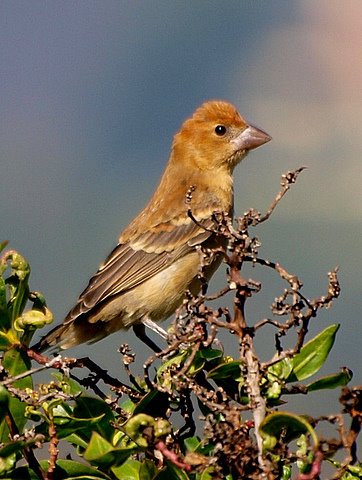
Mystery Bird (J.Waterman 9/26/10)
What do you think it is? Joyce Waterman snapped this about 11 am. She, I, and (to settle matters) local bird maven Kimball Garrett, all agreed on what it is. Answer is at the bottom of this report, following the trip list.
Summer is technically gone but summer heat finally showed up, bringing loads of birds. When you look out over Santa Monica Bay and see a thin line of brown air to the west, you know it’s “Santa Ana conditions”: do not breathe deeply. My car thermometer claimed it was only 79° at 11:30, but I’m sure it was lying. Nevertheless, we had a throng of birders.
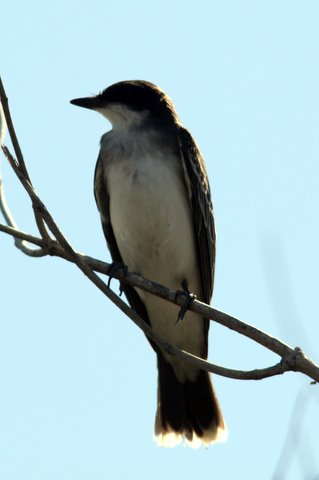
Eastern Kingbird (Frank/Susan Gilliland 9/25/10)
A twitchathon started last Tuesday when Todd McGrath reported both Eastern and Tropical Kingbirds at the lagoon. We’ve hosted Tropical Kingbird (this one soon disappeared) previously: Oct.’01 – Feb.’02 and Oct.’04, so we almost expect it, but the Eastern was a first. Loads of people saw it on Saturday during the Annual Coastal Cleanup, but no one I met saw it today. Disappointment was endemic.
Fortunately, the Gray Flycatcher – another first for the lagoon on our monthly field trips – was still around, and everyone got good looks, even watching its tail slowly drop and quickly rise. There certainly were plenty of water-hovering flies. Wrens and warblers were relatively common, for the lagoon. Also reported were Lazuli Bunting and Lawrence’s Goldfinch, both sighted only twice before on our field trips. I suspect that the presence of the Eastern Kingbird twitcher-throng turned up a few more species than usual. We recorded a record 78 species, beating the Sept. ’04 total of 76 species.
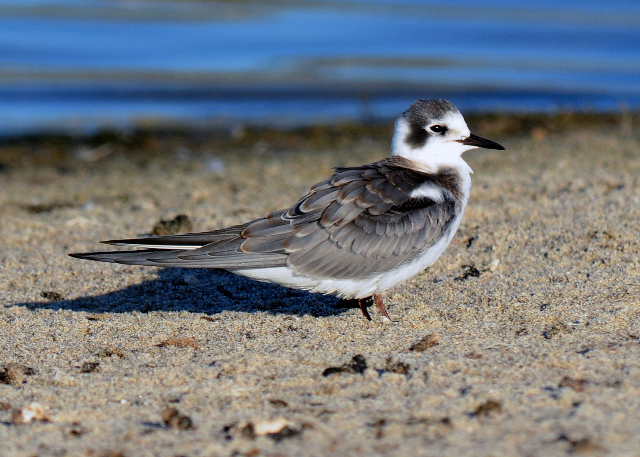
Black Tern juvenile (J.Kenney 9/26/10)
The ocean was flat, the tide was high, the offshore rocks were birdless and self-respecting surfers were elsewhere. The sandy island in the lagoon, however, was covered with birds. Among the Elegant Terns were 8 (uncommon) Common Terns and 1 juvenile Black Tern, previously recorded by us only once in Aug.’88. They were very nice to see. The Black Skimmers had all left, taking the Caspian Terns with them. The sole Pectoral Sandpiper remaining was on the grassy margin of the middle channel. The Brants, which looked really ratty in August were now in very nice plumage. They’ve been at the lagoon for over 6 months: we don’t know why, but it’s nice to have them around. Only one Wilson’s Phalarope remained of the small group that appeared earlier in the month. Our Snowy Plover population jumped up to 62, another record high, beating the Oct.’09 count of 61. Perhaps this signifies that 2010 was a good breeding year for the Snowies.
The July-Sept chart below will continue to grow monthly through December, but six months of data is all I can squeeze into this blog format. For prior periods, follow these links to Jan-Jun‘10, Jul-Dec‘09, and Jan-June‘09. [Chuck Almdale]
| Malibu Census – 2010 | July 25 | Aug 22 | Sep 26 |
| Temperature | 60-67 | 68-75 | 70-79 |
| Tide Height | +4.05 | +4.32 | +5.54 |
| Low/High & Time | H:1036 | H:0933 | H:1055 |
| (Black) Brant | 6 | 5 | 5 |
| Gadwall | 20 | ||
| American Wigeon | 1 | ||
| Mallard | 49 | 55 | 48 |
| Northern Shoveler | 4 | ||
| Northern Pintail | 6 | ||
| Ruddy Duck | 3 | 5 | 15 |
| Pied-billed Grebe | 5 | 9 | 18 |
| Eared Grebe | 2 | ||
| Western Grebe | 4 | ||
| Brown Pelican | 187 | 163 | 46 |
| Dble-crstd Cormorant | 20 | 30 | 38 |
| Great Blue Heron | 6 | 6 | 5 |
| Great Egret | 4 | 4 | 6 |
| Snowy Egret | 14 | 19 | 14 |
| Green Heron | 1 | 1 | |
| Blk-crwnd N-Heron | 4 | 7 | 10 |
| Red-tailed Hawk | 1 | ||
| Merlin | 1 | ||
| Sora | 1 | 1 | |
| American Coot | 15 | 28 | 230 |
| Blk-bellied Plover | 55 | 78 | |
| Snowy Plover | 26 | 44 | 62 |
| Semipalmated Plover | 6 | 11 | |
| Killdeer | 3 | 3 | 1 |
| Willet | 7 | 10 | 56 |
| Spotted Sandpiper | 1 | 2 | |
| Whimbrel | 48 | 8 | 17 |
| Long-billed Curlew | 1 | ||
| Marbled Godwit | 22 | ||
| Ruddy Turnstone | 3 | 3 | 10 |
| Black Turnstone | 8 | ||
| Sanderling | 4 | 30 | 20 |
| Western Sandpiper | 20 | 4 | 28 |
| Least Sandpiper | 2 | 4 | 14 |
| Pectoral Sandpiper | 1 | ||
| Short-billed Dowitcher | 1 | ||
| Wilson’s Phalarope | 1 | ||
| Heermann’s Gull | 125 | 62 | 68 |
| Ring-billed Gull | 4 | 30 | |
| California Gull | 1 | 3 | 22 |
| Western Gull | 80 | 66 | 73 |
| Caspian Tern | 13 | 13 | |
| Royal Tern | 2 | 2 | 1 |
| Elegant Tern | 10 | 45 | 40 |
| Common Tern | 8 | ||
| Forster’s Tern | 5 | 6 | |
| Least Tern | 36 | ||
| Black Tern | 1 | ||
| Black Skimmer | 35 | 103 | |
| Rock Pigeon | 6 | 4 | 12 |
| Mourning Dove | 4 | 3 | 2 |
| Anna’s Hummingbird | 1 | 2 | 2 |
| Allen’s Hummingbird | 6 | 4 | 1 |
| Belted Kingfisher | 1 | 1 | |
| Downy Woodpecker | 1 | ||
| Gray Flycatcher | 1 | ||
| Black Phoebe | 2 | 5 | 5 |
| Cassin’s Kingbird | 1 | 2 | |
| Western Kingbird | 4 | 4 | |
| American Crow | 6 | 4 | 3 |
| Tree Swallow | 1 | ||
| Rough-wingd Swallow | 5 | 3 | 4 |
| Cliff Swallow | 10 | ||
| Barn Swallow | 20 | 8 | 1 |
| Bushtit | 6 | 17 | 11 |
| Bewick’s Wren | 1 | ||
| House Wren | 2 | ||
| Marsh Wren | 4 | ||
| Northern Mockingbird | 2 | 5 | 3 |
| European Starling | 80 | 7 | 62 |
| Yellow Warbler | 2 | ||
| Townsend’s Warbler | 1 | ||
| Common Yellowthroat | 4 | 5 | 4 |
| Wilson’s Warbler | 1 | ||
| Western Tanager | 1 | ||
| California Towhee | 2 | 1 | |
| Savannah Sparrow | 1 | ||
| Song Sparrow | 3 | 3 | 4 |
| White-crwnd Sparrow | 4 | ||
| Blue Grosbeak | 1 | ||
| Lazuli Bunting | 6 | ||
| Red-winged Blackbird | 1 | 2 | 14 |
| Western Meadowlark | 3 | ||
| Brewer’s Blackbird | 15 | ||
| Brwn-headed Cowbird | 3 | 1 | 3 |
| Hooded Oriole | 4 | 1 | |
| House Finch | 2 | 4 | 10 |
| Lesser Goldfinch | 2 | 3 | 2 |
| Lawrence’s Goldfinch | 2 | ||
| Totals by Type | Jul 25 | Aug 22 | Sep 26 |
| Waterfowl | 58 | 71 | 93 |
| Water Birds-Other | 227 | 231 | 339 |
| Herons, Egrets | 28 | 37 | 36 |
| Quail & Raptors | 1 | 0 | 1 |
| Shorebirds | 127 | 162 | 325 |
| Gulls & Terns | 306 | 299 | 249 |
| Doves | 10 | 7 | 14 |
| Other Non-Pass. | 7 | 8 | 4 |
| Passerines | 152 | 76 | 176 |
| Totals Birds | 916 | 891 | 1237 |
| Total Species | Jul 25 | Aug 22 | Sep 26 |
| Waterfowl | 3 | 4 | 6 |
| Water Birds-Other | 4 | 5 | 7 |
| Herons, Egrets | 4 | 5 | 5 |
| Quail & Raptors | 1 | 0 | 1 |
| Shorebirds | 10 | 10 | 16 |
| Gulls & Terns | 9 | 8 | 9 |
| Doves | 2 | 2 | 2 |
| Other Non-Pass. | 2 | 4 | 3 |
| Passerines | 16 | 19 | 29 |
| Totals Species – 90 | 51 | 57 | 78 |
The mystery bird is a female or hatch year Blue Grosbeak.
Coastal Cleanup at Malibu Lagoon, 25 September, 2010
The lagoon outlet had filled up with sand, so the lagoon water level was high. The veteran trash pickers among us thought the trash levels were lower than usual. Whether this signifies some sort of trend is unknown, but I – for one – doubt it.
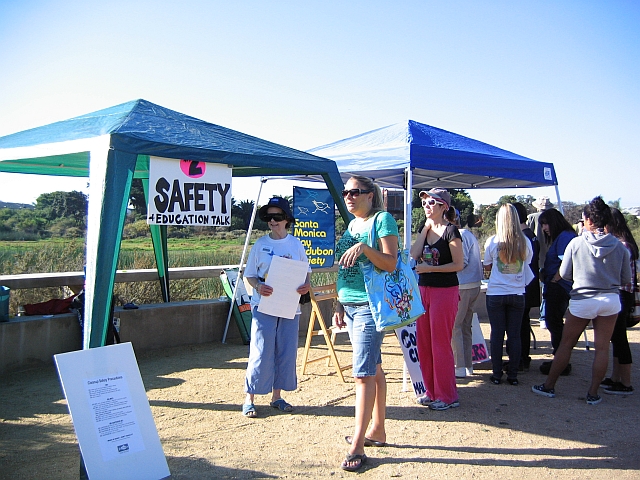
A behatted Jean, avant le déluge (L.Johnson 9/10)
Ellen Vahan and Jean Garrett again organized and managed the Malibu Lagoon operation admirably. We had a record turnout of 275 people who collectively collected 127 bags of trash totaling 297 lbs. in under 3 hours. Three busloads of students showed up, including 60 students and their teachers from Centennial High School in Compton. As usual, little pieces of styrofoam food & drink containers and colored shards of plastic were the most numerous forms of trash.I hope no one is under the illusion that this stuff is even remotely biodegradable. The pieces just get smaller and smaller. Are we supposed to believe that they’ll eventually “disappear into infinity” as did The Incredible Shrinking Man?
Recyclable bottles were down considerably, probably the effect of the 10-cent deposit combined with the economic downturn. Our significant “recyclable by nature” item was a dead and very flat coyote, discovered out in the pickleweed (which truly does tastes like a pickle – the plant, not the coyote).
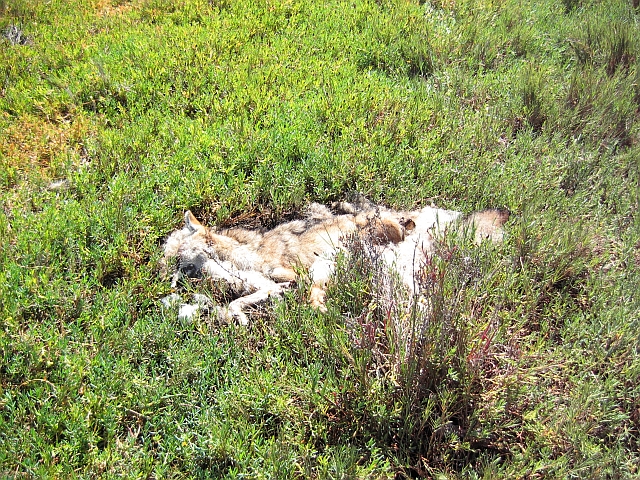
Not merely resting, but an ex-Coyote (L.Johnson 9/10)
Heal The Bay – the local organizer for this international cleanup effort – reports:
* 14,131 volunteers (a new record) at 65 sites in Los Angeles County
* 101 miles of coastline, river bank, etc. covered
* 137,422 pounds of debris
* Since 1990, 1.57 million pounds have been picked up
* Cigarette butts, plastic bottle caps and Styrofoam pieces are the most frequently found
* In California, 80,312 volunteers covered 1,702 miles and collected 1.100.122 pounds of trash
* The next Coastal Cleanup Day will be September 17, 2011. Join us!
More pictures of the cleanup can be found here.
Afterwards, the lagoon looked pristine. The birds, especially this group of Wilson’s Phalaropes, were grateful. [Chuck Almdale]
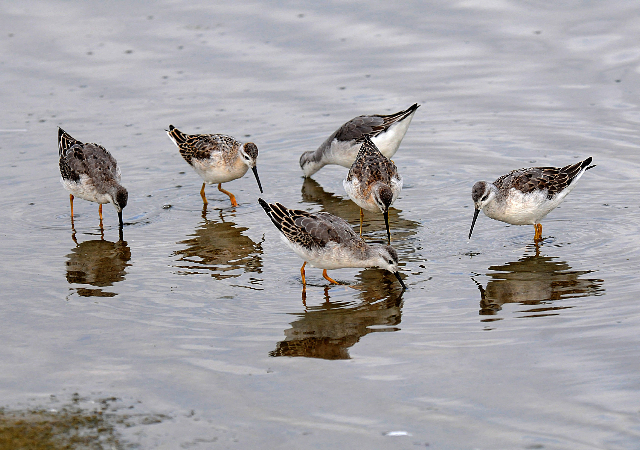
"Hey! Look! You can see the bottom!" (J.Kenney 8/10)
California Bird Festivals 2010-2011
Bird festivals are fun. You meet other birders, visit new places, see their regular birds plus whatever rarities have dropped in, hear interesting presentations and discussions, admire – possibly buy – beautiful bird paintings and carvings, eat lunch and dinner with others, support their local economy and much more, not far from home. Festivals marked TBA have not yet scheduled their dates. Make reservations in advance.
September 2010
23-26 Thur – Sun 6th Annual Monterey Bay Birding Festival http://montereybaybirding.org/
25 Saturday 16th Annual Kern Valley Turkey Vulture Festival http://kern.audubon.org/tvfest.htm
October 2010
30 Saturday Orange County Sea & Sage Book Sale & Pancake Breakfast http://www.seaandsageaudubon.org/SpecialEvents/SpecialEvents.html
November 2010
5-7 Fri – Sun 14th Annual Lodi Sandhill Crane Festival http://www.cranefestival.com/
18-21 Thur – Sun 14th Annual Central Valley Birding Symposium http://www.cvbirds.org/Symposium.htm
January 2011
14-17 Fri – Mon 15th Annual Morro Bay Bird Festival http://morrobaybirdfestival.org/index.htm
27-30 Thur – Sun 12th Annual Chico Snow Goose Festival http://www.snowgoosefestival.org/
February 2011
11-13 Fri – Sun 15th Annual San Francisco Bay Flyway Festival http://www.sfbayflywayfestival.com/
18-20 Fri – Sun 32nd Annual Klamath Falls Winter Wings Festival http://www.winterwingsfest.org/
Canceled 14th Annual Salton Sea Birding Festival http://www.newriverwetlands.com/
25-26 Fri – Sat Davis California Duck Days http://www.yolobasin.org/documents/Duck%20Days%202011.pdf
March 2011
3-6 Thur – Sun 15th Annual San Diego Bay Bird Festival http://www.sandiegoaudubon.org/birdfest.htm
April 2011
13-16 Wed – Sat Yuma Birding & Nature Festival http://www.visityuma.com/birding_and_nature_festival.html
14-20 Thur – Wed 16th Annual Arcata Godwit Days Bird Festival http://www.godwitdays.com/
30-May 1 Sat – Sun Clear Lake Heron Festival http://www.heronfestival.org/
23 Saturday 17th Annual Kern River Valley Spring Nature Festival http://kern.audubon.org/KRVSNF.htm
29-May 2 Fri – Mon Point Reyes Birding & Nature Festival http://www.pointreyesbirdingfestival.org/site/
May 2011
6-8 Fri – Sun California Redwoods Bird & Nature Festival http://www.calredwoodsbirdfest.org/
16 Monday Tule Lake Migratory Bird Festival http://www.visitsiskiyou.org/blog/tag/tule-lake-migratory-bird-festival/
June 2011
4 Saturday 2nd Annual Tahoe International Migratory Bird Festival http://www.tinsweb.org/index.php?option=com_content&view=article&id=102&Itemid=178
17-19 Fri – Sun 10th Annual Mono Lake Bird Chautaqua http://www.birdchautauqua.org/
August 2011
13 Saturday 13th Annual Kern River Valley Hummingbird Celebration http://kern.audubon.org/hummer_fest.htm
[Chuck Almdale]
The Fall Season Begins at the Farallon Islands
From time to time, we like to alert our members to interesting bird-related news that comes along. The Farallon Islands, not far west of the Golden Gate Bridge but amid some rough seas, has been home to a research station for many years. Recently researcher Matt Brady sent out this message on the [Calbirds] chat line. Follow his two links to some very nice bird photos and information about Pt. Reyes Bird Observatory which has been involved in the Farallons for over 40 years. Follow Matt’s future reports on his blog or on [Calbird]. [Chuck Almdale]
**********************************
Hello all! The Fall Season on Southeast Farallon Island started on August 21st, when head biologist Jim Tietz, Farallon rookie Oscar Johnson and myself arrived on the Island. Since then, the weather has been fairly poor for landbird arrivals, but we have managed to find a few interesting species. Chief among them was the Island’s 3rd ever (second modern) record of White-faced Ibis, a flock of 14 juveniles seen on August 24th! Almost as rare was the Island’s 6th ever (and California’s 13th or so) Ruby-throated Hummingbird. That bird was captured and examined in-hand. Other vagrants and unusual island birds were an Island high-count of four Blue Grosbeaks, three Long-eared Owls (including one captured and banded), a family group of eight Greater White-fronted Geese, a record-early Mew Gull, a record-early Blackburnian Warbler, an American Redstart, a Rose-breasted Grosbeak, a Least Flycatcher, a White-winged Dove and a Lark Bunting.
More details on some of these birds, as well as photos, can be found on our blog, at http://losfarallones.blogspot.com/
Since in the past I have had a few querries as to how “chaseable” some of the birds I have reported have been, I’d just like to point out that Southeast Farallon Island is a closed National Wildlife Refuge, managed by the US Fish and Wildlife Service, and is unfortunately currently not open to outside visitors. Jim, Oscar and myself are all employees of PRBO Conservation Science, which has been helping to manage the refuge for USFWS since 1967. If you’d like to find out more about PRBO’s involvement on SE Farallon, and perhaps contribute to our research, please see the PRBO website at http://www.prbo.org/cms/157
I’ll try to keep the birding community updated on what we’re seeing out here, as well as regularly update the Farallon blog, but since our Internet connection is generally tenuous-at-best, I may not be able to as much as I’d like to.
Good birding this fall,
Matt Brady
SE Farallon Island, SF Co.
Malibu Lagoon Black Skimmer Egg Update
The following is a message from Kimball Garrett of the Natural History Museum of LA County. This message was originally posted 8/29/10 on LACoBirds, the chat line for LA County Birders.
[If you wish to sign up on LACoBirds, send an email to LACoBirds-subscribe@yahoogroups.com
Type “subscribe” WITHOUT the quotes in both the Subject Line the message area.]
********************************
I visited Malibu Lagoon yesterday (28 August) to check on the skimmer colony on the island just inland from the beach berm at the lagoon. I counted 102 adult skimmers. Of these, only 4-6 birds were sitting in incubation position; the flock flushed several times for no apparent reason while I watched from a high point on the beach berm well away from the island — when this happened I could see at least three clutches of eggs. There were also at least 3 random, scattered eggs in the colony that were not being attended. The skimmers seemed a bit agitated by the 60-70 Elegant Terns (including many juveniles) that were massing near and even within the skimmer nesting area. Fortunately, the 110+ Brown Pelicans on the island were staying near the shoreline and not impacting skimmer nests (one misplaced totipalmate foot and you have a runny skimmer omelet).
Skimmers eggs hatch after about 23 days, so if things go well (very iffy in such a crowded beach area) there’s a chance that hatching may begin around 10-15 September. I urge birders to keep their eyes on these birds (from a distance) and be vigilant in keeping people and dogs away from the island (so far this doesn’t seem to be a problem, but Labor Day weekend is coming up).
Of interest among the skimmers was an adult with a pink tape-wrapped band on the R leg — banded by Charlie Collins in Orange County (Bolsa Chica?) in 1990.
A good variety of shorebirds at the lagoon included a juvenile Short-billed Dowitcher, two adult Long-billed Dowitchers, a juv. Ruddy Turnstone, 43 Snowy Plovers, etc. (I didn’t see the ~6 Wilson’s Phalaropes others saw this weekend). The Yellow-crowned-ish Night-Heron was on its favorite log east (lagoon-wards) of the second footbridge.
Kimball L. Garrett
Section of Ornithology
Natural History Museum of Los Angeles County
900 Exposition Blvd.
Los Angeles, CA 90007
213-763-3368
*******************
As Kimball suggests, please don’t walk around on the sand island. Observe from a distance. If you make any observations, you can post them on LACoBirds, or call them into Kimball at the museum. [Chuck Almdale]



 SANTA MONICA BAY AUDUBON SOCIETY BLOG