Free email delivery
Please sign up for email delivery in the subscription area to the right.
No salesman will call, at least not from us. Maybe from someone else.
Malibu Lagoon Sightings Oct-Nov 2009
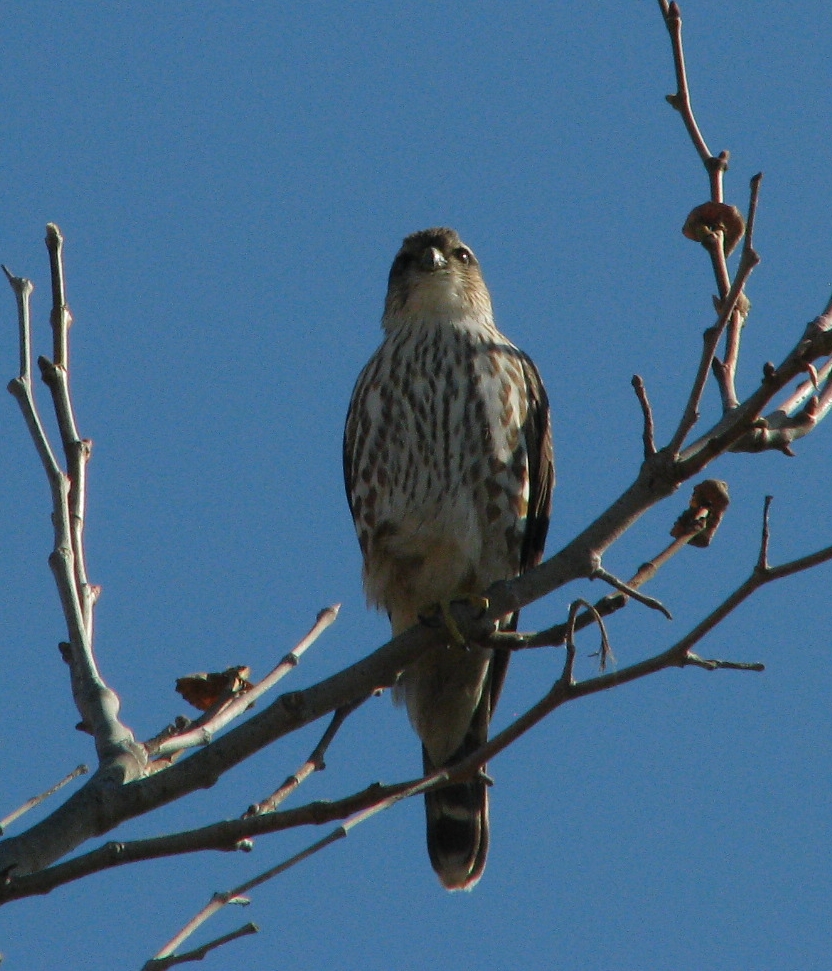
Merlin momentarily resting (L.Johnson 11/09)
This is an experiment to see if it is feasible to post a table of bird sightings in this blog. If it works, we’ll try to post this monthly, reporting the sightings for the quarter. Thus Jan 2010 will have only one month, Feb will report two months and March will have all three. So far, my experimentation shows that the blog won’t allow enough columns for an entire year’s worth of data. In this month’s table the two rightmost columns show totals for the entire year.
November 22, 2009. We had 59 species total on an unusually fine day for late November, with the most unusual sighting being the female or juvenile Merlin who was very busy catching dragonflies off the water. I saw it catch 4 in about 5 minutes, and it had been doing this for quite a while before I started counting. In other notes, there were 48 Snowy Plovers on the beach, including the bird banded Left Leg: Brown/Orange; Right Leg: White/White which was present on October 25 as well. It was one of three fledglings identically “brood banded” at Vandenberg Air Force Base this past summer.
| MALIBU BIRD | YEAR – | 2009 | 2009 | 2009 | 2009 | |
| COUNTS | MONTH – | 10 | 11 | Year | Number |
|
| SMABS Collected | DAY – | 25 | 22 | Total | Of |
|
| 2009 |
Tide > | L +3.5 | H +4.6 | Birds | Months | |
| Species | Tide Time > | 0941 | 1137 | Seen | Seen | |
| 1 | (Black) | Brant | 6 | 3 | ||
| 2 | Wood | Duck | 1 | 1 | 1 | |
| 3 | Gadwall | Gadwall | 4 | 7 | 110 | 10 |
| 4 | American | Wigeon | 10 | 6 | 58 | 7 |
| 5 | Mallard | Mallard | 24 | 15 | 236 | 11 |
| 6 | Cinnamon | Teal | 9 | 2 | ||
| 7 | Northern | Shoveler | 25 | 5 | 84 | 6 |
| 8 | Northern | Pintail | 2 | 2 | ||
| 9 | Green-winged | Teal | 4 | 6 | 51 | 5 |
| 10 | Greater | Scaup | 1 | 1 | ||
| 11 | Lesser | Scaup | 1 | 1 | ||
| 12 | Surf | Scoter | 28 | 3 | ||
| 13 | Bufflehead | Bufflehead | 5 | 24 | 3 | |
| 14 | Red-breasted | Merganser | 1 | 13 | 4 | |
| 15 | Ruddy | Duck | 18 | 20 | 94 | 8 |
| 16 | Red-throated | Loon | 2 | 1 | ||
| 17 | Pacific | Loon | 6 | 4 | ||
| 18 | Common | Loon | 1 | 1 | 3 | 3 |
| 19 | Pied-billed | Grebe | 10 | 5 | 41 | 10 |
| 20 | Horned | Grebe | 2 | 2 | ||
| 21 | Eared | Grebe | 6 | 6 | 1 | |
| 22 | Western | Grebe | 20 | 15 | 81 | 6 |
| 23 | Brown | Pelican | 8 | 12 | 1009 | 11 |
| 24 | Brandt’s | Cormorant | 1 | 2 | 10 | 6 |
| 25 | Double-crested | Cormorant | 25 | 29 | 250 | 11 |
| 26 | Pelagic | Cormorant | 1 | 8 | 5 | |
| 27 | Great Blue | Heron | 4 | 3 | 37 | 10 |
| 28 | Great | Egret | 1 | 1 | 28 | 9 |
| 29 | Snowy | Egret | 15 | 8 | 150 | 11 |
| 30 | Green | Heron | 2 | 2 | ||
| 31 | Black-crowned | Night-Heron | 1 | 14 | 6 | |
| 32 | Turkey | Vulture | 1 | 1 | ||
| 33 | Osprey | Osprey | 1 | 1 | ||
| 34 | Cooper’s | Hawk | 2 | 2 | ||
| 35 | Red-shouldered | Hawk | 2 | 2 | ||
| 36 | Red-tailed | Hawk | 1 | 2 | 11 | 9 |
| 37 | American | Kestral | 1 | 1 | ||
| 38 | Merlin | Merlin | 1 | 1 | 1 | |
| 39 | Peregrine | Falcon | 1 | 1 | 1 | |
| 40 | Sora | Rail | 4 | 6 | 16 | 6 |
| 41 | Virginia | Rail | 1 | 2 | 2 | |
| 42 | American | Coot | 266 | 295 | 1237 | 10 |
| 43 | Blk-bellied | Plover | 114 | 89 | 510 | 8 |
| 44 | Snowy | Plover | 61 | 48 | 306 | 8 |
| 45 | Semipalmated | Plover | 27 | 3 | ||
| 46 | Killdeer | Killdeer | 5 | 3 | 23 | 9 |
| 47 | Black | Oystercatcher | 2 | 1 | ||
| 48 | Black-necked | Stilt | 2 | 1 | ||
| 49 | American | Avocet | 13 | 3 | ||
| 50 | Greater | Yellowlegs | 2 | 2 | ||
| 51 | Lesser | Yellowlegs | 1 | 1 | ||
| 52 | Willet | Willet | 40 | 18 | 137 | 10 |
| 53 | Spotted | Sandpiper | 4 | 2 | 17 | 8 |
| 54 | Whimbrel | Whimbrel | 6 | 5 | 66 | 10 |
| 55 | Marbled | Godwit | 25 | 14 | 91 | 7 |
| 56 | Ruddy | Turnstone | 12 | 13 | 95 | 8 |
| 57 | Black | Turnstone | 2 | 3 | 2 | |
| 58 | Sanderling | Sanderling | 145 | 155 | 642 | 7 |
| 59 | Western | Sandpiper | 5 | 40 | 6 | |
| 60 | Least | Sandpiper | 12 | 28 | 7 | |
| 61 | Pectoral | Sandpiper | 2 | 1 | ||
| 62 | Dunlin | Dunlin | 4 | 7 | 3 | |
| 63 | Short-billed | Dowitcher | 20 | 29 | 3 | |
| 64 | Boneparte’s | Gull | 1 | 1 | ||
| 65 | Heermann’s | Gull | 12 | 13 | 210 | 11 |
| 66 | Ring-billed | Gull | 14 | 50 | 298 | 9 |
| 67 | California | Gull | 123 | 58 | 2196 | 10 |
| 68 | Herring | Gull | 1 | 1 | 3 | 3 |
| 69 | Western | Gull | 82 | 67 | 937 | 11 |
| 70 | Glaucous-winged | Gull | 32 | 4 | ||
| 71 | Caspian | Tern | 1 | 62 | 6 | |
| 72 | Royal | Tern | 19 | 5 | ||
| 73 | Elegant | Tern | 11 | 1 | 795 | 8 |
| 74 | Forster’s | Tern | 2 | 1 | ||
| 75 | Least | Tern | 1 | 1 | ||
| 76 | Black | Skimmer | 30 | 1 | ||
| 77 | Rock | Pigeon | 6 | 6 | 57 | 11 |
| 78 | Eurasian | Collrd Dove | 1 | 1 | ||
| 79 | Mourning | Dove | 10 | 3 | 34 | 10 |
| 80 | Black-hooded | Parakeet | 6 | 1 | ||
| 81 | Anna’s | Hummingbird | 1 | 4 | 21 | 11 |
| 82 | Allen’s | Hummingbird | 2 | 2 | 36 | 11 |
| 83 | Belted | Kingfisher | 1 | 4 | 4 | |
| 84 | Downy | Woodpecker | 1 | 1 | ||
| 85 | Pacific Slope | Flycatcher | 1 | 1 | ||
| 86 | Black | Phoebe | 6 | 6 | 86 | 11 |
| 87 | Say’s | Phoebe | 1 | 1 | 5 | 5 |
| 88 | Western | Kingbird | 4 | 2 | ||
| 89 | American | Crow | 5 | 6 | 66 | 11 |
| 90 | Common | Raven | 2 | 1 | ||
| 91 | Tree | Swallow | 1 | 181 | 2 | |
| 92 | Rough-winged | Swallow | 74 | 7 | ||
| 93 | Cliff | Swallow | 49 | 5 | ||
| 94 | Barn | Swallow | 53 | 7 | ||
| 95 | Oak | Titmouse | 1 | 1 | 1 | |
| 96 | Bushtit | Bushtit | 40 | 80 | 7 | |
| 97 | Bewick’s | Wren | 5 | 1 | 6 | 2 |
| 98 | House | Wren | 1 | 4 | 2 | |
| 99 | Marsh | Wren | 2 | 1 | 5 | 4 |
| 100 | Ruby-crowned | Kinglet | 1 | 1 | ||
| 101 | Wrentit | Wrentit | 2 | 2 | ||
| 102 | Northern | Mockingbird | 3 | 1 | 25 | 11 |
| 103 | European | Starling | 12 | 6 | 160 | 11 |
| 104 | Orange-crowned | Warbler | 3 | 2 | ||
| 105 | Yellow-rumped | Warbler | 3 | 6 | 33 | 6 |
| 106 | Common | Yellowthroat | 3 | 5 | 22 | 10 |
| 107 | Spotted | Towhee | 2 | 2 | ||
| 108 | California | Towhee | 2 | 17 | 6 | |
| 109 | Savannah | Sparrow | 8 | 10 | 2 | |
| 110 | Song | Sparrow | 6 | 4 | 56 | 11 |
| 111 | White-crowned | Sparrow | 4 | 4 | 16 | 4 |
| 112 | Red-winged | Blackbird | 6 | 4 | ||
| 113 | Western | Meadowlark | 1 | 5 | 2 | |
| 114 | Brewer’s | Blackbird | 1 | 1 | ||
| 115 | Great-tailed | Grackle | 3 | 8 | 4 | |
| 116 | Brown-headed | Cowbird | 7 | 5 | ||
| 117 | Hooded | Oriole | 7 | 3 | ||
| 118 | Bullock’s | Oriole | 2 | 1 | ||
| 119 | House | Finch | 4 | 6 | 79 | 11 |
| 120 | Lesser | Goldfinch | 9 | 5 | ||
| Total Trip Birds | 1233 | 1093 | 11519 | |||
| Totals Individuals | ||||||
| Waterfowl | 86 | 65 | 718 | |||
| Water Birds – Other | 341 | 367 | 2673 | |||
| Herons, Egrets,Ibis | 20 | 13 | 231 | |||
| Quail & Raptors | 2 | 3 | 20 | |||
| Shorebirds | 455 | 347 | 2043 | |||
| Gulls & Terns | 244 | 190 | 4586 | |||
| Doves | 16 | 9 | 92 | |||
| Otr Non-Pas’rines | 3 | 7 | 68 | |||
| Passerines | 66 | 92 | 1088 | |||
| Totals Birds | 1233 | 1093 | 11519 | |||
| Total Species | ||||||
| Waterfowl | 7 | 8 | 15 | |||
| Water Birds – Other | 9 | 10 | 14 | |||
| Herons,Egrets, Ibis | 3 | 4 | 5 | |||
| Quail & Raptors | 2 | 2 | 8 | |||
| Shorebirds | 14 | 9 | 21 | |||
| Gulls & Terns | 7 | 6 | 13 | |||
| Doves | 2 | 2 | 3 | |||
| Otr Non-Pas’erines | 2 | 3 | 5 | |||
| Passerines | 17 | 15 | 36 | |||
| Totals – Species | 63 | 59 | 120 |
SMART GARDENING
The Native Plant Society has honored me for my contributions over the years with the gift of a native plant, a beautiful ceanothus “yankee point.” This is a ground cover that has lovely blue blooms in the spring and is very happy in my garden.
Thank you, Native Plant Society. Margaret
Ballona Creek & Freshwater Marsh Trip Report: 14 Nov. 2009
When a westerly wind comes ripping off the ocean, the swells can surge completely across the Ballona Creek middle jetty. Anyone nearby is soaked by the freezing spray. Despite our forebodings, this was not one of those days, and we soon found ourselves struggling out of our extra layers of clothing.
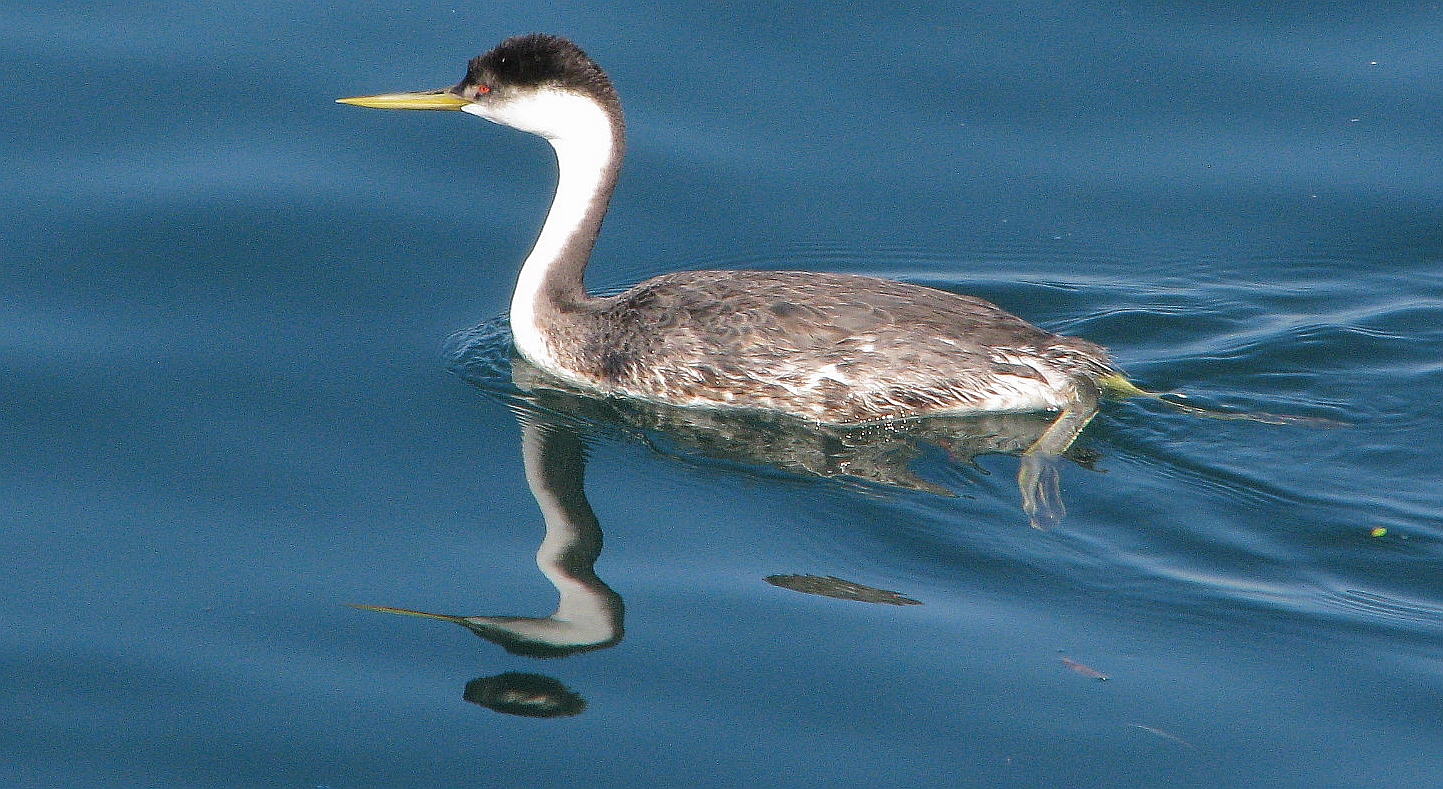
Greenish-yellow bill & dark around the eye makes this a Western Grebe (C.Almdale 11/09)
After checking out the ducks and the several Greater White-fronted Geese at Del Rey lagoon, leader Lu Plauzoles took us east down Ballona Creek to the tidal gate about half-way to Lincoln Blvd. We found the Burrowing Owl keeping its solitary vigil on the ice-plant covered sandy hill just east of the wetlands channel. It must now be about 5 years since this bird began wintering here. The creek was full of UCLA crews paddling up and down, shouting all the while, and the ducks did their best to keep out of their way, but there were plenty of shorebirds on the rocky edges: Willets, Whimbrels, Ruddy Turnstones, Western and Least Sandpipers; Ruddy Ducks, Buffleheads and Red-breasted Mergansers kept near the shores, but the Common Loons easily dodged the crew shells by diving under.
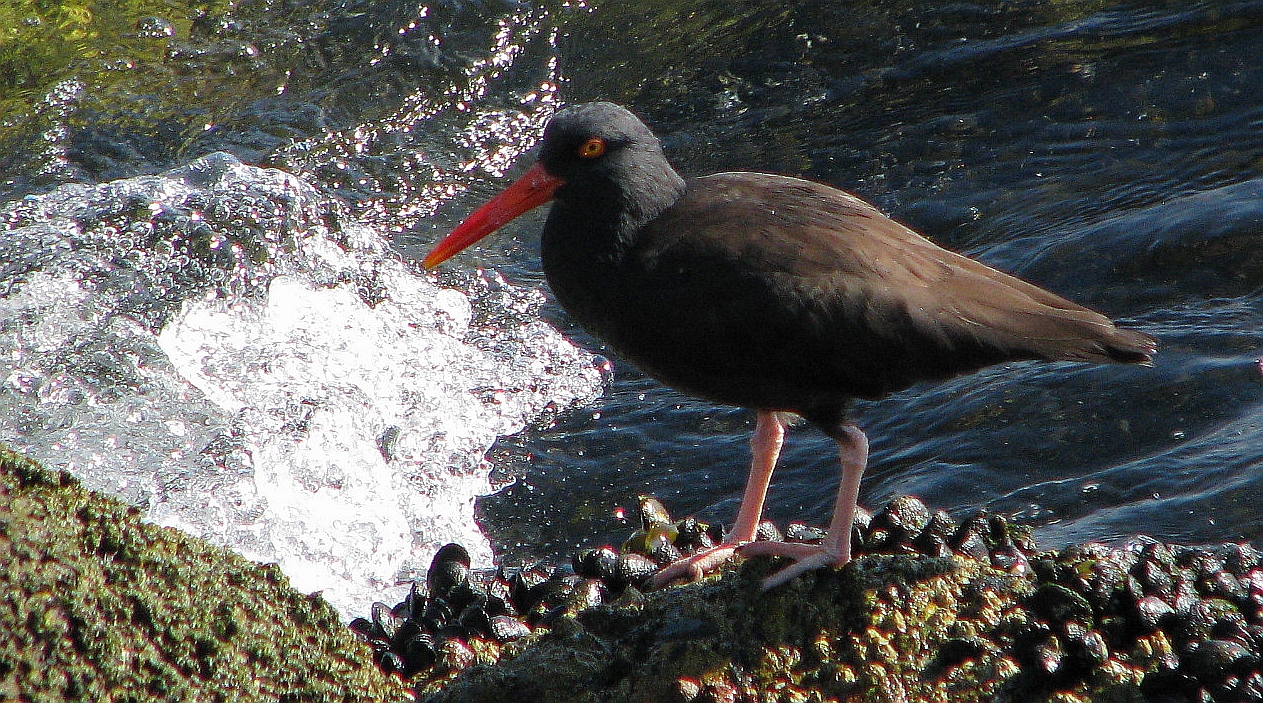
Black Oystercatcher on the Jetty (C.Almdale 11/09)
Along the central jetty we found Surfbirds, Black Turnstones and Black Oystercatchers in [relative] abundance, which means several dozens of the first two and about 10 of the latter. The outer jetty was covered with Brown Pelicans and Brandt’s Cormorants: amazingly we could not find a single Pelagic or Double-crested Cormorant resting there, which must be a first for me. Rafts of scoters and [probably mostly] Western Grebes were off to the south, too far to properly view. Diligent searching did not turn up any Wandering Tattlers, a rocky-shore-loving bird uncommon but regular on the SoCal mainland.

Surfbird Trio (C.Almdale 11/09)
We had spent so much time wandering up and down the creek that our visit to the Freshwater Marsh at the corner of Lincoln & Jefferson Blvds. was abbreviated. Nevertheless, we managed to scare up plenty of Black-crowned Night Herons and a Sora as well as hearing a Virginia Rail. This is a reliable spot for Common Moorhen and we found several poking along the edges of the reeds. The pond at the south end had at least 6 Wilson’s Snipe foraging among the pond-edge leaves and brush. On the way back, an American Kestrel perched on a light pole, while a Red-tailed Hawk and several Common Ravens flew overhead. Altogether, a surprisingly fine day.
| Ballona Channel & Del Rey Lagoon |
Ballona Freshwater Marsh |
| Greater White-fronted Goose Gadwall American Wigeon Mallard Lesser Scaup Surf Scoter Bufflehead Red-breasted Merganser Ruddy Duck Common Loon Pied-billed Grebe Eared Grebe Western Grebe Clark’s Grebe Brown Pelican Brandt’s Cormorant Double-crested Cormorant Great Blue Heron Great Egret Snowy Egret Turkey Vulture Red-tailed Hawk American Coot Black-bellied Plover Killdeer Black Oystercatcher Willet Whimbrel Marbled Godwit Ruddy Turnstone Black Turnstone Surfbird Sanderling Western Sandpiper Least Sandpiper Short-billed Dowitcher Heermann’s Gull Ring-billed Gull Western Gull California Gull Forester’s Tern Rock Pigeon Mourning Dove Burrowing Owl Anna’s Hummingbird Allen’s Hummingbird Black Phoebe Say’s Phoebe American Crow Bushtit Northern Mockingbird European Starling Orange-crowned Warbler Yellow-rumped Warbler Savannah Sparrow White-crowned Sparrow Brewer’s Blackbird House Finch Lesser Goldfinch House Sparrow |
Gadwall American Wigeon Mallard Cinnamon Teal Northern Shoveler Green-winged Teal Bufflehead Ruddy Duck Pied-billed Grebe Eared Grebe Double-crested Cormorant Great Blue Heron Great Egret Snowy Egret Green Heron Black-crowned Night Heron Turkey Vulture Osprey Red-tailed Hawk Ferrugenous Hawk American Kestrel Virginia Rail (H) Sora Common Moorhen American Coot Killdeer Spotted Sandpiper Wilson’s Snipe Ring-billed Gull Rock Pigeon Mourning Dove Anna’s Hummingbird Allen’s Hummingbird Northern Flicker Black Phoebe Say’s Phoebe Western Kingbird American Crow Common Raven Bushtit Marsh Wren (H) Ruby-crowned Kinglet Blue-gray Gnatcatcher Hermit Thrush Northern Mockingbird European Starling Orange-crowned Warbler Yellow-rumped Warbler Common Yellowthroat California Towhee Song Sparrow White-crowned Sparrow Red-winged Blackbird Great-tailed Grackle House Finch Lesser Goldfinch |
| 60 Species | 56 Species |
Rare Bird Alerts by Email
The internet is filled with information and services attractive to birders. This is the first of an irregular series alerting our members to some of them.
A list serve is a website to which people post messages, and then distributes the messages to people who have signed up to receive them. Our blog is a list serve if you’ve signed up to automatically receive the postings by email. Rare bird alerts also usually operate as a list serve. There are rare bird alerts available for virtually everywhere in the world. Places like China, Russia, Southeast Asia, Africa or South America may have only one alert for the entire region, but here in California, we have dozens. Many of the Southern California counties have their own alert, and it is very easy to sign up for these alerts. Many list serves make new sign-ups wait a week or two before allowing you to post something. This allows you to see their rules of etiquette in action and keeps out web pests who only want to post annoying messages instantly.
For example, if you were signed up for either the Orange County or LA County list serves, you would have known about the Bar-tailed Godwit (pictured below) which showed up (still there as of this writing) at Upper Newport Bay, just below the Jamboree Rd. bridge. This bird nests in western Alaska and normally heads southwest into Asia for the winter. Every once in a while it goes southeast instead, and shows up here. Of course, seeing the bird isn’t the same as getting a decent picture of the bird.
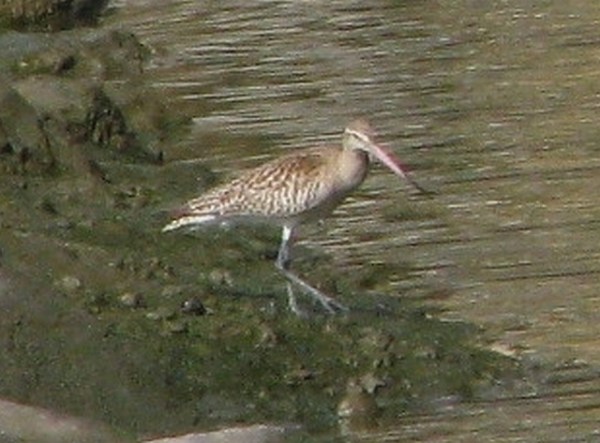
Bar-tailed Godwit (Limosa lapponica lookifuzzi)
If you’d like to seem some better pictures of this bird taken by Chris Taylor, click this link: http://kiwifoto.com/f/btgo_newport_110709
I receive BirdChat, BirdWest and CalBird in what is called “Digest” mode. All messages for the day are bundled so you get only one email per day. But you can get them individually if you prefer. I let the messages for the local county lists come in one-by-one, as there aren’t many messages. I subscribe to the Los Angeles and Orange Counties list serves. There are also list serves for: Ventura, Santa Barbara, Kern, San Diego, SE California, No. California and so on. You can sign up for any and all. As with any email, if the subject line doesn’t sound interesting, delete it.
The subscribing system on all these list serve sites is automated. You can’t go wrong. If you make an error, it will tell you what to do to fix it.
Bird Chat
Nationwide conversations about birdy stuff of all sorts.
List-Subscribe: <mailto:BIRDCHAT-subscribe-request@LISTSERV.ARIZONA.EDU>
Type “subscribe” WITHOUT the quotes in both the Subject Line the message area.
BirdWest:
Collection of rare bird reports for the Western US.
Rare bird reports come out weekly from dozens of counties, Audubon chapters, etc. BirdWest collects all these reports for the Western US and sends them to you.
BIRDWEST-subscribe-request@LISTSERV.ARIZONA.EDU
Leave the subject line blank. Type “subscribe” WITHOUT the quotes in the message area.
LA County Birds
Rare bird sightings primarily for LA County, but also some nearby areas.
LACoBirds-subscribe@yahoogroups.com
Type “subscribe” WITHOUT the quotes in both the Subject Line the message area.
Orange County Birds
Rare bird sightings primarily for Orange County, but also some nearby areas.
OrangeCountyBirding-subscribe@yahoogroups.com
Type “subscribe” WITHOUT the quotes in both the Subject Line the message area.
California Birds
Statewide bird news and sightings.
CALBIRDS-subscribe@yahoogroups.com
Type “subscribe” WITHOUT the quotes in both the Subject Line the message area.
If you are traveling to another county, state, or overseas, it’s worthwhile finding out if they have a local bird alert and signing up for it before you travel. Note, however, that since they mostly report rare birds, they may be more interested in birds common to Southern California than they are in their own common birds. You can always post a RFI (Request For Information) on how to find their local birds. Birders are usually quite helpful. Be sure to follow the listserve etiquette which you will receive in your Welcome! message, and thank anyone who helps you out.
Feel free to send in questions, comments and suggestions for other web birding items.
California Gull Breeding Success
This is an interesting report on how California Gulls have been encouraged to breed so successfully (from 28 gulls in 1980 to nearly 47,000 in 2008) that the numbers are now threatening the success of the Wetlands project in the San Franciso South Bay.
http://www.insidebayarea.com/dailyreview/localnews/ci_13722097



 SANTA MONICA BAY AUDUBON SOCIETY BLOG