Free email delivery
Please sign up for email delivery in the subscription area to the right.
No salesman will call, at least not from us. Maybe from someone else.
The Farallon Islands, Ashy Storm-Petrels, mice, owls and brodifacoum | Los Angeles Times
[Posted by Chuck Almdale]
Could toxic airdrop balance nature?
Los Angeles Times | Steve Lopez | 15 Dec 2021 | 10 minute read
This Coastal Commission will be discussing this on Thursday 15 Dec 2021.
Here’s a few links: one of them should get your there.
Staff Report on Farallon plan
Virtual Hearing Procedures
Cal-Span Full Coverage Streaming
This might also access the streaming
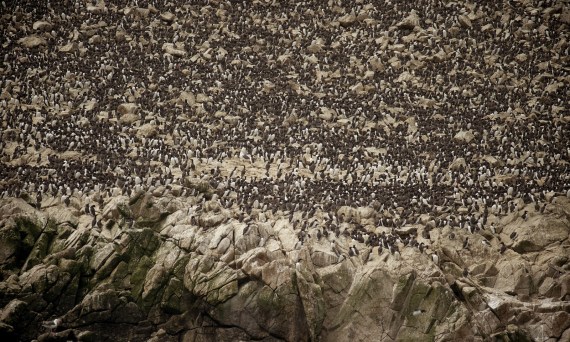
Rats there draw owls that also prey on Ashy Storm-Petrel eggs.
(Josh Edelson for The Times)
From the article’s introduction:
The mice of the Farallon Islands think they’ve got it made.
They’re out there with ocean views in every direction, picnicking on plants, salamanders and insects like there’s no tomorrow. But there might not be a tomorrow for the lowly rodents, because the United States government is gunning for them.
The Fish and Wildlife Service has found the mice indirectly guilty of serial murder in the death of seabirds and sentenced them to death by poisoning, with a key review of the extermination plan up this week before the California Coastal Commission.
Each year, burrowing mainland owls fly to the Farallones to feast on the teeming mouse population. When the mice population drops, as it does seasonally, the owls then eat the eggs of the ashy storm petrel, a bird some consider a future candidate for the endangered species list.
So the mice are essentially co-conspirators in the demise of the storm petrels, and the question is: How do you poison 60,000 or so mice who live on an island 30 miles off San Francisco?
Steve Lopez is an excellent journalist and author who has written hundreds of hard-hitting, factual and funny pieces. This is no exception. He’s not a birder though, so he does make the occasion gaff obvious to birders.
I love his above phrase “burrowing mainland owls,” but I wouldn’t go out on a limb and say just exactly what that’s supposed to mean. The default assumption would be “Burrowing Owls from the mainland.” If that’s correct, I’m surprised. Burrowing Owls are getting to be a rare breeding bird in California these days, as vast swaths of their former breeding territory have been covered with houses, farms and warehouses. But it might also mean any owl that has anything to do with burrows, such as sit at their entrance and wait for a mouse to come out and agree to be eaten.
Less confusing yet also amusing is “ashy storm petrel.” There are petrels and there are storm-petrels, and while they do meet o’er the wine-dark seas, they are in different avian families and cannot interbreed. [Go here and scroll about halfway down.]
These two nitpicky errors illustrate why I consider a bird species’ English name to be a proper noun, and always capitalize it. This eliminates confusion. You wouldn’t write “Steve mainland Lopez” would you? If he had written “mainland Burrowing Owl” we’d know for certain what he’s talking about, and by treating the species name Burrowing Owl as the proper noun name, not merely a description, you’re far less likely to insert adjectives and whatnot into the middle of the name. Likewise, we’ll know we’re talking not about an Ashy-storm Petrel, but an Ashy Storm-Petrel, two entirely different birds (the first is fictitious, the second is not).
This is, by the way, less important for mammals than it is for birds. Without doing an analysis of 5,000 mammal names, and 10,500 bird names, I’d say that more bird names than mammal names—both numerically and proportionally—are descriptive. A Yellow-throated Warbler is a particular species, but a yellow-throated warbler could be any of several dozen species that happen to have yellow on their throat. It might be any warbler whose throat is dusted with yellow pollen. In that sense, there hundreds of species of yellow-headed hummingbird.
I hope I’ve pounded that point into the ground.
And to confirm that Burrowing Owl is the species intended, read this from Point Blue.
Please read Lopez’ entire article, as it’s far more interesting and informative than my peevish expression of irkdom.
A few high points of the article:
- 60,000 House Mice Mus musculus on the Farallons
- Burrowing Owls Athene cunicularia fly over from the mainland to eat them (30 miles west of San Francisco)
- When they run out of mice, or the mice get wise, the owls eat bird eggs, especially the bite-sized eggs (1.1 x 0.8 in., 1/4 oz) of Ashy Storm-Petrels Hydrobates homochroa
- Various agencies want to dump 2,800 lbs. of pellets laced with brodifacoum, an anti-coagulant especially lethal to rodents
- They’ll dump it on the high parts of the island
- This has been done elsewhere with good results
- Point Blue and other respected conservation agencies approve the idea
- Other conservationists are horrified
My reaction to the article is: “Gee, what could go wrong with that idea?”
Incidentally, approximately 250,000 seabirds and shorebirds in twelve species nest on the Farallons: Western Gull, Brandt’s Cormorant, Pelagic Cormorant, Double-crested Cormorant, Pigeon Guillemot, Common Murre, Cassin’s Auklet, Tufted Puffin, Black Oystercatcher, Rhinoceros Auklet, Ashy Storm-Petrel, and Leach’s Storm-Petrel.
All capitalized. See, that’s not so hard.
Friendly, foul-mouthed crow befriends entire Oregon elementary school before state police are called in | The Oregonian
[Posted by Chuck Almdale]
Frankly, I think it’s a Common Raven. Look at that enormous bill! But a great story nevertheless. Proving once again that Ravens can be very smart, and when you look them in the eyes, and they look back, it certainly seems like someone’s in there, and it’s not just some dumb animal, running entirely on instinct.
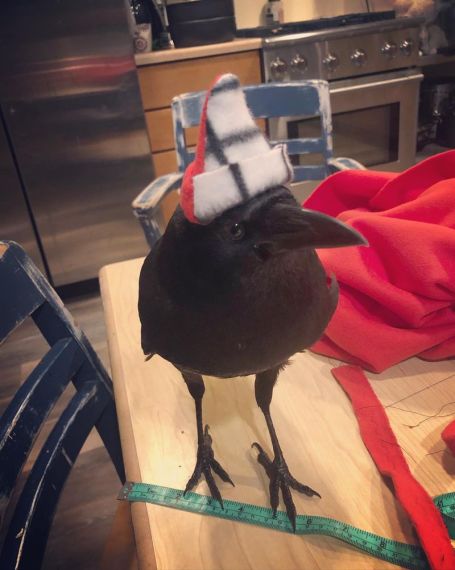
From The Oregonian
Friendly, foul-mouthed crow befriends entire Oregon elementary school before state police are called in
The Oregonian | Lizzie Acker | 9 Dec 2021 | 5 minute read
From the article’s introduction:
A friendly, if somewhat foul-mouthed, crow became a temporary mascot at Allen Dale Elementary School in November when the bird took up residence at the Grants Pass school.
“This crow showed up at our school just out of the blue one morning,” said Naomi Imel, an education assistant at Allen Dale, over the phone on Thursday.
It began looking into classrooms, Imel said, and pecking on doors. At one point, it made its way into a fifth-grade classroom where it “helped itself to some snacks,” she said.
Birds Aren’t Real? | Mock Conspiracy Theory
[Posted by Chuck Almdale]
Birders might happen across some of these “conspiracy theorists” and think they’re for real — that they actually think all birds were rounded up in the 1970’s and what we now see are spy drones, watching our every move. Relax.
They’re not and it’s not.
It’s a joke, albeit a serious joke, mocking all the conspiracy theories abounding these days that people actually do believe. Fervently. Need I mention which ones they are? Sometimes mockery is all that’s left us.
If access to the New York Times article is blocked, try Googling your way in. It’s worth it.
Sex Life of Spiders | Evening program now on-line
[Posted by Chuck Almdale]
Episodes from the Sex Life of Spiders, with Dr. Martina Ramirez
Time: 1:15:33

Once common in Southern California, including Santa Catalina Island,
populations and gene pool now shrinking due to loss of habitat.
Link to Episodes from the Sex Life of Spiders
This program is on Google Drive and needs no password.
A presentation of some of the recent findings Dr. Ramirez and her students have made in their spider lab concerning the sex life of spiders, specifically focusing on whether female trapdoor spiders mate once or many times, and on how the lack of a Y-chromosome in a local leaf litter spider is driving genetic differences between males and females. Includes discussion of teaching at Loyola. Spiders begins at time 7:40.

Originated in the Mediterranean area, now cosmopolitan distribution. Hunts woodlice,
sowbugs and pillbugs under logs, rocks, bricks, plant pots and in leaf litter in warm places.
Dr. Martina Ramirez is a Professor of Biology in the Seaver College of Science and Engineering at Loyola Marymount University. She did her undergraduate work in biology at LMU and received her PhD at UC Santa Cruz. She has focused her scientific pursuits on spiders covering aspects such as population genetics, reproductive biology, and environmental toxicology. In addition to her scientific endeavors, she has also been very active in the development of the biology department at LMU including increases in the faculty, involvement in building new facilities and in student affairs. Along with having published 19 scientific papers, including 13 with undergraduate student co-authors, Dr. Ramirez is also co-author of a book, Happier as a Woman: Transforming Friendships, Transforming Lives (Cleis Press, 2019).
December King tides photos — Next chance Jan. 2-3, 2022
[Posted by Chuck Almdale]
Next King Tide is January 2-3, 2022. I really hope someone takes photos of the high and low tides from the same location and send them in. It need not be somewhere famous. The following tide data is for Mugu Lagoon. Anywhere in LA/Ventura/Orange counties should be close to these times, but you can go to this site and enter your own time & location and get it as exact as possible (scroll to below the wavy line chart and enter your location & dates).
- 1 Jan 2022: High 7:19 am +6.77 ft; Low 2:50 pm -1.70 ft
- 2 Jan 2022: High 8:05 am +6.92 ft; Low 3:36 pm -1.87 ft
- 3 Jan 2022: High 8:53 am +6.85 ft; Low 4:22 pm -1.81 ft
- 4 Jan 2022: High 9:40 am +6.56 ft; Low 5:08 pm -1.53 ft
A foggy King Tide day at Malibu Lagoon
Stubborn gulls and a few other birds refuse to move to dry ground.

Six minutes later, not much has changed.

The lagoon is full.
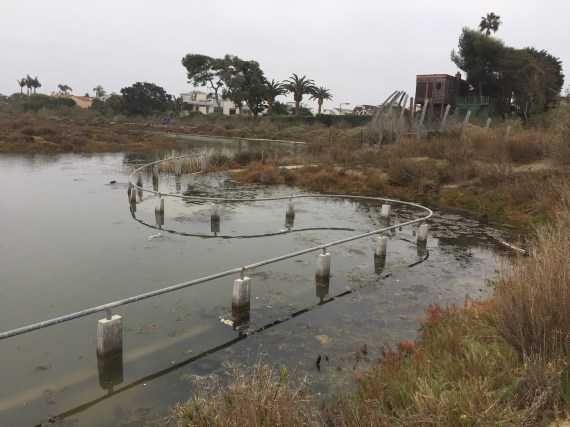
Malibu Lagoon King Tide 16 Nov 2020

L. A. County King Tide photos 12 Dec 2021 from the project.
California King Tide project wants your photos.
Look out for King Tides!
Jan 2-3, 2022 Plus, for locations North of Ventura, Jan. 1, 2022
The California King Tides Project is calling on you to photograph our highest high tides of the year. Documenting these tides helps us preview the impacts of sea level rise and understand how our shoreline is affected by high water today.
If you’re able to safely take photos at the coast or Delta during King Tides you will be contributing to an important community science effort.
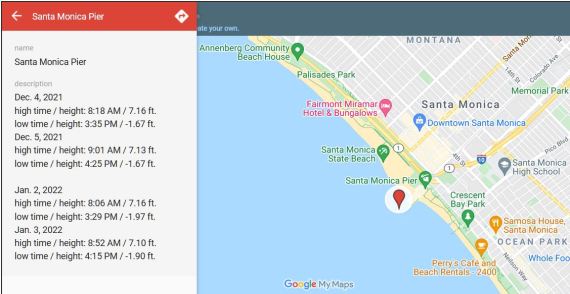
Find your local King Tide times and learn how to upload your photos on our website or with a free app. You can check out a selection of photos from each coastal county and access a map of all the King Tides photos from the last few years. Educators and parents can find ways to incorporate King Tides into student learning, including with an elementary-level science journal downloadable in English or Spanish. Middle and high school students may want to use King Tides images and concepts as they enter the Climate Video Challenge.
We can’t wait to see your photos! In the meantime, please join us on social media for #KingTides:
What causes sea level rise, and what do King Tides have to do with it?
The sea level rise we’re experiencing now and will experience in the future is caused by burning fossil fuels like coal, oil, and natural gas. Carbon dioxide in our atmosphere acts like a blanket, trapping in heat that would otherwise escape. When we burn fossil fuels, we’re adding more carbon dioxide, “thickening the blanket” and warming the planet and ocean. Sea level is rising because land-based glaciers and ice sheets are melting into the ocean and also because water expands in volume when it warms. The amount of sea level rise we will ultimately experience will depend on how quickly we stop burning fossil fuels.
King Tides themselves are not caused by sea level rise, but allow us to experience what higher sea level will be like. King Tides are the highest high tides of the year, about a foot or two higher than average tides, which corresponds to the one to two foot rise in sea level expected during the next few decades. When you observe the King Tides, imagine seeing these tides (and the flooded streets, beaches, and wetlands) every day. Understanding what a King Tide looks like today will help us plan for sea level rise in the future.
Sharing your photos and talking about what you’ve noticed helps others understand that they’re part of a community that cares about climate change.
Why are there different dates for northern and southern California?
Southern California will experience King Tides in November and December. There is an additional January King Tide in northern California, north of Point Conception/Vandenberg AFB, due to a combination of astronomical influences such as the relative tilt of the Earth’s rotation with respect to the Sun and seasonal influences on water level such as temperature and wind that differ in southern California as compared to northern California over the course of the year.
Thank you for your help! We look forward to seeing your photos! california.kingtides.net
California Coastal Commission
455 Market Street, Suite 228, San Francisco, CA 94105



 SANTA MONICA BAY AUDUBON SOCIETY BLOG