Free email delivery
Please sign up for email delivery in the subscription area to the right.
No salesman will call, at least not from us. Maybe from someone else.
Boxing Day at Malibu Lagoon, 26 December 2021
[Posted by Chuck Almdale]
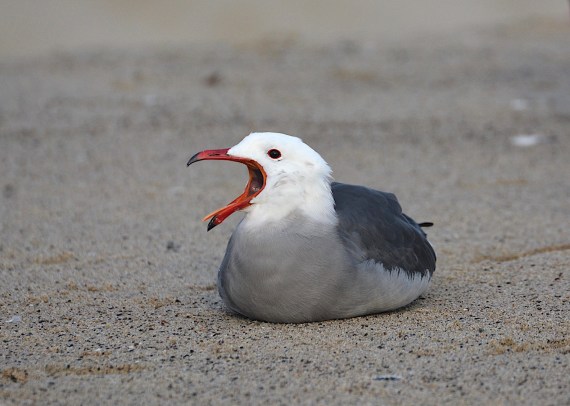
We stood at the viewpoint near the Pacific Coast Highway bridge, scanning the lagoon, sun in our eyes, searching for ducks among hundreds of black coots. All the birds were equally coal-dark and similarly sized! Slowly Gadwall, Mallard, Ruddy, Bufflehead, American Wigeon, Green-winged Teal, one Pintail and a few Red-breasted Mergansers emerged from dark waters and bright glare. Someone said there were 3, 4, maybe 5 Hooded Mergansers up past the bridge. Brush and wide bridge supports blocked our view, but one-by-one we glimpsed poorly one or more of these uncommonly beautiful birds. At least one was a strikingly-marked male. I decided we must clomp to and under the bridge for better views, risky these days due to the people living in the bushes and under the bridge. There turned out to be three people under the bridge, staying out of the rain of the prior two days. We startled one relaxing creekside as our group of ten birders came tromping by, and he quickly disappeared.
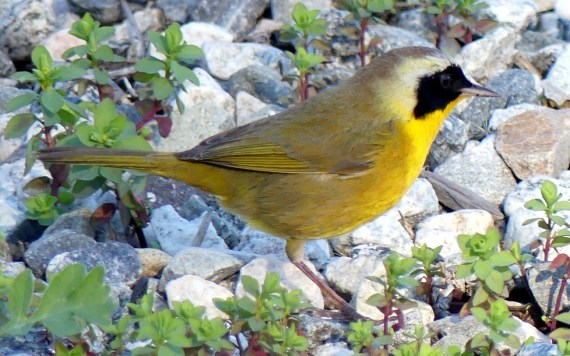
Sure enough, with bushes and cement out of the way, we saw a lot. A dozen Ruddy Duck, one Red-breasted Merganser, Double-crested Cormorants diving for fish in the deeper water below the north of the PCH bridge, and eight Hooded Mergansers—six females and two males. Over the next 20 minutes, they grew to 13 in number, now including 3 males. I suppose they came floating down the creek. They prefer fresh water and are occasionally found upstream in a few locations. I’ve never seen them in salt water, and they don’t seem to much care for brackish water either. However, with all the rain we’ve had in recent days, I suspect the lagoon is primarily fresh water throughout.
I checked my records later and since October 1979 SMBAS has recorded Hooded Merganser 23 times for a total of (at least 65) birds. Six of those sightings only their presence was noted, but not the count. The previous sighting was 2 birds on 1-26-20. Before that we had 1-5 birds from 11-27-16 to 2-26-17. Not terrifically common.

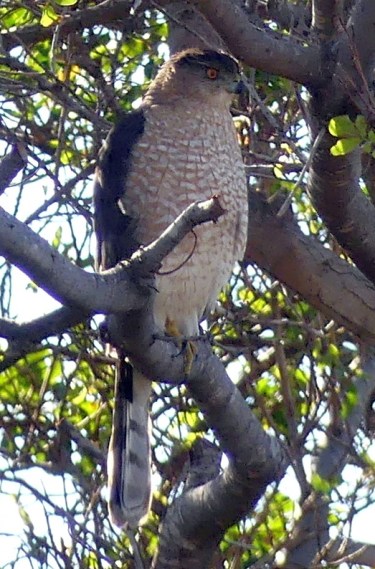
A Double-crested Cormorant caught a large fish, which looked like a catfish because it seemed to have thickish “whiskers” sticking out from around it’s very wide mouth. It was quite fat side-to-side, and the cormorant was having an terrible time trying to get it oriented head first and “down the hatch.” A helpful Great Blue Heron came over for a closer look at this struggle, and decided to assist his brother bird by stealing the fish altogether and driving the cormorant away. The heron now engaged in a 10-minute struggle with the fish which—as I said—was quite fat. It was also still alive, despite being out-of-water for the last five minutes, and was still struggling madly. The heron repeatedly dipped the bird in the water as if trying to make it slippery, or perhaps getting it oriented properly (head first!, always head first!) without losing it into the creek. Finally, the fish no longer struggling—I think, as I was finding this hard to watch—the heron swallowed the fish, where it made a heck of a bulge in its gullet. We were all chilly from standing in the shade, so we went back to the viewing platform and the sun. Unfortunately, these events were so fascinating that no one took a photo.
The other big event of the day was one Osprey catching two fish, or was it two Osprey catching one fish each? The catches were maybe 1 hour apart.

I couldn’t believe that an Osprey would want to eat two large fish only an hour apart, but none of us saw two birds at the same time, so I have to assume it was a single bird. And they were big fish!

The Osprey(s) struggled to get aloft.

The Western Gulls became quite interested and chased the Osprey all around the lagoon for many circles as the Osprey—hanging onto the fish with only one foot, perhaps only one talon!—tried to gain sufficient altitude to land in a tree.

The first bird eventually flew east past Adamson House and disappeared behind the property’s tall trees, perhaps landing in one.

The second Osprey landed with his/her fish on top of the “Mockingbird Pole” at the northeast corner of Malibu Colony, where it slowly pulled the fish—still twitching spasmodically—apart.

Chris Lord later emailed me the following:
Birds of prey have roughened pads on the undersides of their toes to help them to readily grasp prey. The fish-eating Osprey also has spines on the pads on the soles of its toes for holding on to slippery fishes. These are very helpful when sequentially and sometimes simultaneously holding onto a slippery fish while evading gulls, a crow, a great egret, a snowy egret and a great blue heron.
The Birders Handbook, Ehrlich et al., page 241

These photos give a better view of the fish and this one at least is not a catfish. No whiskers, to start with. Looks like a Jumping Mullet to me.
I counted 34 Snowy Plovers but there were probably more. As usual, storm water rushing down the creek from the over-100-square-mile Malibu Creek watershed blew straight through the beach, very close to the permanent hillock near the foot of the path. All the lagoon water flowed out, leaving a wide channel full of icy cold rushing water which I was not going to attempt wading across, as I’d likely be swept out to sea and never heard of again, ruining my binoculars and telescope in the process. When I waded the channel last winter the water was so cold that the pain up to my shins was quite intense after about 20 seconds.
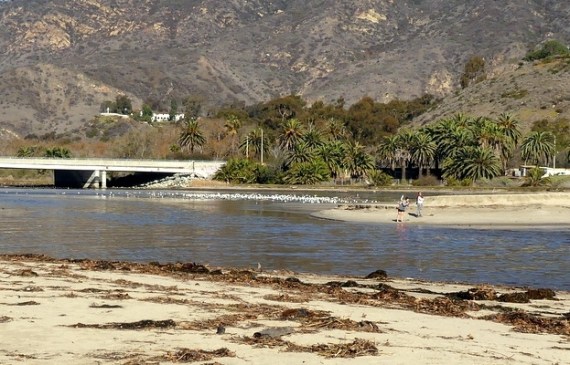
East of this channel the beach dropped off four feet almost straight down to the water, and the Snowy Plovers were scattered along this steep slope, which seemed a peculiar, atypical location to roost. Perhaps, for them, it was out of the undetectable wind. There were undoubted some plovers on the flat sand just above this drop off, but I couldn’t see them from across the channel.
Despite today being Boxing Day, no fisticuffians were present.
Malibu Lagoon on eBird: 12-30-21 5474 lists, 312 species.
Oddly enough, a month ago the eBird totals were 5438 lists and 315 species, so 36 lists were added yet three species disappeared. I didn’t know that not seeing a bird would remove it from the “seen” list. (Joking.) I checked to see if Femi’s November Hairy Woodpecker was one one of the “disappeared,” but it was still there.
Birds new for the season: Hooded Merganser, Horned Grebe, Bonaparte’s Gull, Red-throated Loon, Green Heron, Turkey Vulture, Red-shouldered Hawk, Nuttall’s Woodpecker, Downy Woodpecker, Barn Swallow, Wrentit, Hermit Thrush, Savannah Sparrow, Dark-eyed Junco.
Many thanks to photographers: Marsha Collins, Femi Faminu & Grace Murayama.
The next three SMBAS scheduled field trips?: Good Question.
The next SMBAS program: Someone discussing something interesting, most likely on Tuesday, Feb 1, 2022 at 7:30 p.m. Keep your eyes on the blog.
The SMBAS 10 a.m. Parent’s & Kids Birdwalk remains canceled until further notice due to the near-impossibility of maintained proper masked social distancing with parents and small children.
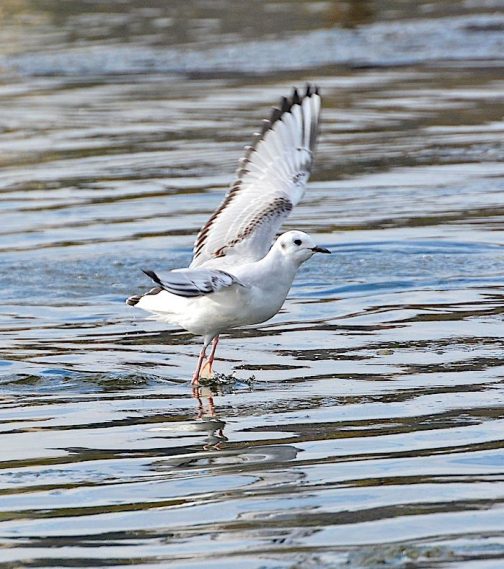
(G. Murayama 11-22-21)
Links: Unusual birds at Malibu Lagoon
9/23/02 Aerial photo of Malibu Lagoon
Prior checklists:
2021: Jan-July
2020: Jan-July, July-Dec 2019: Jan-June, July-Dec
2018: Jan-June, July-Dec 2017: Jan-June, July-Dec
2016: Jan-June, July-Dec 2015: Jan-May, July-Dec
2014: Jan-July, July-Dec 2013: Jan-June, July-Dec
2012: Jan-June, July -Dec 2011: Jan-June, July-Dec
2010: Jan-June, July-Dec 2009: Jan-June, July-Dec.
The 10-year comparison summaries created during the Lagoon Reconfiguration Project period, remain available—despite numerous complaints—on our Lagoon Project Bird Census Page. Very briefly summarized, the results unexpectedly indicate that avian species diversification and numbers improved slightly during the restoration period June’12-June’14.
Many thanks to Adrian Douglas, Esme Douglas, Femi Faminu, Lillian Johnson, Chris Lord and others for their contributions to this month’s checklist.
The appearance of the list below has changed slightly. I’ve added a column on the left side with numbers 1-9, keyed to the nine categories of birds at the bottom.
[Chuck Almdale]
| Malibu Census 2021 | 7/25 | 8/22 | 9/26 | 10/24 | 11/28 | 12/26 | |
| Temperature | 66-74 | 68-73 | 63-70 | 54-63 | 57-70 | 54-62 | |
| Tide Lo/Hi Height | H+4.20 | H+4.55 | L+2.52 | H+5.23 | L+2.35 | L+2.58 | |
| Tide Time | 1148 | 1034 | 0556 | 1105 | 1104 | 0900 | |
| 1 | Canada Goose | 10 | 4 | ||||
| 1 | Northern Shoveler | 2 | |||||
| 1 | Gadwall | 48 | 12 | 4 | 2 | 20 | |
| 1 | American Wigeon | 7 | 4 | 2 | 10 | ||
| 1 | Mallard | 37 | 9 | 18 | 3 | 2 | 12 |
| 1 | Northern Pintail | 2 | 1 | ||||
| 1 | Green-winged Teal | 1 | 5 | 5 | 15 | ||
| 1 | Bufflehead | 1 | 10 | ||||
| 1 | Hooded Merganser | 13 | |||||
| 1 | Red-breasted Merganser | 1 | 1 | 17 | 15 | ||
| 1 | Ruddy Duck | 2 | 1 | 5 | 8 | 13 | |
| 2 | Pied-billed Grebe | 2 | 1 | 3 | 5 | 3 | 5 |
| 2 | Horned Grebe | 1 | |||||
| 2 | Eared Grebe | 1 | 1 | ||||
| 2 | Western Grebe | 12 | |||||
| 7 | Feral Pigeon | 15 | 6 | 8 | 6 | 52 | 3 |
| 7 | Mourning Dove | 4 | 3 | 5 | 1 | 1 | |
| 8 | Anna’s Hummingbird | 1 | 1 | 1 | 2 | ||
| 8 | Allen’s Hummingbird | 3 | 1 | 3 | 1 | 4 | |
| 2 | American Coot | 8 | 2 | 130 | 240 | 245 | 360 |
| 5 | Black-bellied Plover | 43 | 90 | 103 | 87 | 166 | 104 |
| 5 | Snowy Plover | 9 | 29 | 34 | 34 | 40 | 34 |
| 5 | Semipalmated Plover | 1 | 4 | 3 | 2 | ||
| 5 | Killdeer | 9 | 20 | 10 | 23 | 20 | 10 |
| 5 | Whimbrel | 51 | 17 | 8 | 4 | 12 | 9 |
| 5 | Long-billed Curlew | 1 | |||||
| 5 | Marbled Godwit | 4 | 30 | 34 | 9 | 71 | |
| 5 | Ruddy Turnstone | 2 | 8 | 3 | 6 | 1 | |
| 5 | Red-necked Stint | 1 | |||||
| 5 | Sanderling | 12 | 20 | 104 | 22 | 22 | |
| 5 | Dunlin | 2 | 2 | ||||
| 5 | Baird’s Sandpiper | 5 | |||||
| 5 | Least Sandpiper | 8 | 35 | 12 | 9 | 3 | 35 |
| 5 | Western Sandpiper | 12 | 65 | 2 | 2 | 1 | |
| 5 | Short-billed Dowitcher | 3 | |||||
| 5 | Long-billed Dowitcher | 1 | |||||
| 5 | Spotted Sandpiper | 2 | 1 | ||||
| 5 | Willet | 40 | 14 | 25 | 34 | 13 | |
| 5 | Red-necked Phalarope | 4 | 4 | ||||
| 6 | Bonaparte’s Gull | 2 | |||||
| 6 | Heermann’s Gull | 2 | 1 | 1 | 2 | 53 | 26 |
| 6 | Ring-billed Gull | 1 | 2 | 28 | 170 | ||
| 6 | Western Gull | 52 | 55 | 10 | 63 | 92 | 85 |
| 6 | California Gull | 1 | 4 | 9 | 515 | 370 | |
| 6 | Herring Gull | 1 | |||||
| 6 | Glaucous-winged Gull | 1 | 1 | 2 | |||
| 6 | Least Tern | 1 | |||||
| 6 | Caspian Tern | 2 | |||||
| 6 | Royal Tern | 5 | 13 | 2 | |||
| 6 | Elegant Tern | 240 | 1 | ||||
| 2 | Red-throated Loon | 1 | |||||
| 2 | Brandt’s Cormorant | 2 | 10 | 1 | |||
| 2 | Double-crested Cormorant | 52 | 27 | 35 | 67 | 52 | 39 |
| 2 | Pelagic Cormorant | 1 | 2 | 1 | 4 | 1 | |
| 2 | Brown Pelican | 58 | 30 | 11 | 21 | 99 | 44 |
| 3 | Great Blue Heron | 5 | 4 | 3 | 3 | 3 | 4 |
| 3 | Great Egret | 11 | 4 | 1 | 3 | 1 | 7 |
| 3 | Snowy Egret | 22 | 24 | 14 | 11 | 4 | 24 |
| 3 | Green Heron | 2 | |||||
| 3 | Black-crowned Night-Heron | 9 | 3 | 3 | 1 | 1 | |
| 4 | Turkey Vulture | 1 | |||||
| 4 | Osprey | 2 | 1 | 1 | |||
| 4 | Cooper’s Hawk | 1 | 1 | 1 | 2 | ||
| 4 | Red-shouldered Hawk | 1 | 1 | ||||
| 4 | Red-tailed Hawk | 1 | 1 | ||||
| 8 | Belted Kingfisher | 1 | |||||
| 8 | Nuttall’s Woodpecker | 1 | |||||
| 8 | Downy Woodpecker | 1 | |||||
| 8 | Hairy Woodpecker | 1 | |||||
| 4 | Merlin | 1 | |||||
| 4 | Peregrine Falcon | 1 | |||||
| 9 | Black Phoebe | 3 | 4 | 5 | 5 | 4 | 4 |
| 9 | Say’s Phoebe | 1 | 1 | ||||
| 9 | California Scrub-Jay | 1 | 1 | 1 | 2 | ||
| 9 | American Crow | 4 | 4 | 4 | 6 | 1 | 7 |
| 9 | No. Rough-winged Swallow | 2 | |||||
| 9 | Cliff Swallow | 4 | |||||
| 9 | Barn Swallow | 40 | 25 | 3 | 2 | ||
| 9 | Oak Titmouse | 1 | 2 | ||||
| 9 | Bushtit | 1 | 20 | 48 | |||
| 9 | House Wren | 1 | 2 | 1 | |||
| 9 | Marsh Wren | 2 | |||||
| 9 | Bewick’s Wren | 1 | 4 | ||||
| 9 | Blue-gray Gnatcatcher | 4 | 4 | 1 | |||
| 9 | Ruby-crowned Kinglet | 1 | 1 | ||||
| 9 | Wrentit | 1 | 1 | ||||
| 9 | Hermit Thrush | 1 | |||||
| 9 | Northern Mockingbird | 1 | 1 | 2 | 1 | ||
| 9 | European Starling | 30 | 40 | 31 | 9 | ||
| 9 | American Pipit | 1 | |||||
| 9 | House Finch | 6 | 18 | 7 | 4 | 18 | 8 |
| 9 | Lesser Goldfinch | 2 | 1 | 2 | 2 | ||
| 9 | Spotted Towhee | 1 | |||||
| 9 | California Towhee | 1 | 2 | 2 | 4 | ||
| 9 | Savannah Sparrow | 1 | |||||
| 9 | Song Sparrow | 5 | 3 | 5 | 4 | 7 | 8 |
| 9 | White-crowned Sparrow | 5 | 15 | 17 | |||
| 9 | Dark-eyed Junco | 2 | |||||
| 9 | Western Meadowlark | 1 | 1 | ||||
| 9 | Red-winged Blackbird | 25 | |||||
| 9 | Great-tailed Grackle | 20 | 5 | 1 | 4 | 3 | 7 |
| 9 | Orange-crowned Warbler | 1 | 2 | ||||
| 9 | Common Yellowthroat | 2 | 5 | 4 | 5 | 6 | |
| 9 | Yellow-rumped Warbler | 6 | 19 | 20 | |||
| Totals by Type | Jul | Aug | Sep | Oct | Nov | Dec | |
| 1 | Waterfowl | 86 | 24 | 27 | 23 | 49 | 113 |
| 2 | Water Birds – Other | 120 | 61 | 181 | 349 | 414 | 452 |
| 3 | Herons, Egrets & Ibis | 47 | 35 | 21 | 18 | 8 | 38 |
| 4 | Quail & Raptors | 1 | 2 | 4 | 0 | 3 | 6 |
| 5 | Shorebirds | 139 | 341 | 242 | 332 | 307 | 299 |
| 6 | Gulls & Terns | 300 | 65 | 25 | 79 | 689 | 655 |
| 7 | Doves | 19 | 9 | 8 | 11 | 53 | 4 |
| 8 | Other Non-Passerines | 1 | 5 | 1 | 3 | 3 | 8 |
| 9 | Passerines | 107 | 126 | 75 | 56 | 163 | 107 |
| Totals Birds | 820 | 668 | 584 | 871 | 1689 | 1682 | |
| Total Species | Jul | Aug | Sep | Oct | Nov | Dec | |
| 1 | Waterfowl | 3 | 4 | 4 | 6 | 9 | 10 |
| 2 | Water Birds – Other | 4 | 5 | 5 | 8 | 7 | 8 |
| 3 | Herons, Egrets & Ibis | 4 | 4 | 4 | 4 | 3 | 5 |
| 4 | Quail & Raptors | 1 | 2 | 3 | 0 | 3 | 5 |
| 5 | Shorebirds | 9 | 17 | 14 | 12 | 9 | 9 |
| 6 | Gulls & Terns | 5 | 7 | 4 | 6 | 5 | 6 |
| 7 | Doves | 2 | 2 | 1 | 2 | 2 | 2 |
| 8 | Other Non-Passerines | 1 | 3 | 1 | 1 | 3 | 4 |
| 9 | Passerines | 11 | 18 | 13 | 19 | 16 | 20 |
| Totals Species – 104 | 40 | 62 | 49 | 58 | 57 | 69 |
Butterbredt Christmas Count 12/17/2021
The Butterbredt count circle has quite varied habitats inside its 15 mile diameter. We have desert scrub (creosote and coyote bush), steep hillsides and large flatlands, dry land and Kelso Creek with lots of trees, cattle fields, cattle ponds, and oak woodlands up in the Piute Mountains. That leads to a wide variety of birdlife, but we also have to remember that it is (1) the middle of winter, and (2) we’ve been in a drought for some time. So, this year when we saw 34 species it’s not so bad compared to the norm of 50+ a few years back. With this season’s rains we are probably on the up side of the curve for next year.
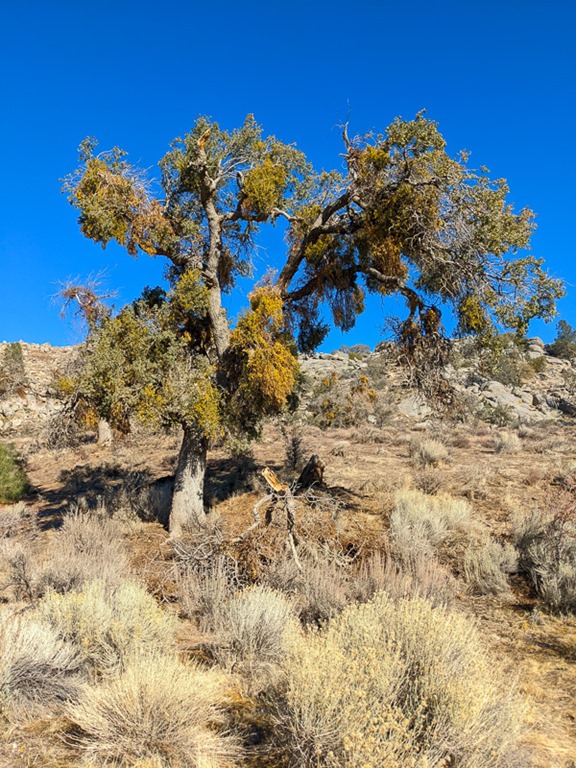
Years of drought have affected many of the live oaks. This one is almost entirely consumed by mistletoe.
.
Weather was sunny but cold: 34 degrees at the start. Only a light breeze made it easy to take. It was suggested that our Covid masks made for warmer breathing – a silver lining!
My group got lucky and found some really nice and some unusual birds. On our very first stop in the desert scrub at the edge of the circle we found 70 Bell’s Sparrows. Yow! The trip total of 122 was over double the average. Perhaps the bird of the day was a Short-eared Owl that sprang up from the ground as Chris Lord was coming back to the car. This is the first time one has been seen on the count – we took care to make sure of it, but we are sure.
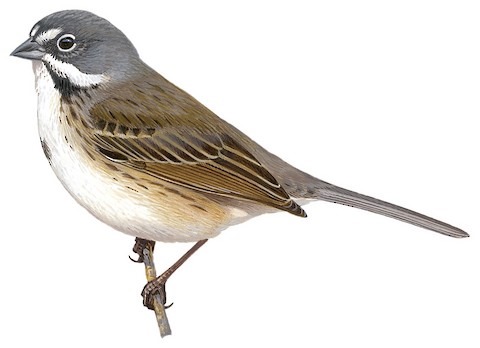
Bell’s Sparrow, formerly Sage Sparrow. One of the prettiest of the sparrows.
.
Not too long afterwards we scoured the area where Le Conte’s Thrasher has been seen every now and then and struck out. Five minutes later as we drove along we spotted one. Very lucky. And a lot of very good looks in bright sun.

Junco country. At 4200 feet there was snow on the ground from last week’s storm.
.
Juncos were strong at 147 and White-crowned Sparrows were down at 255. No Mountain Bluebirds – a real disappointment. Ravens were down again, but we think it is because cattle operations are much less than in the past. We expected raptors would be down again (fewer furry mammals in this drought) but at the end of our run through open pasture we got really lucky.
A Prairie Falcon spooked and flew much ahead of us to perch on a fencepost. We approached carefully and saw it fly off to a distant field. Rats. But then it spooked at least 200 Horned Larks that flew up like one of those starling flights one sees on YouTube. There were a lot of birds – 200 is our conservative guess. Or perhaps we should say 199 Horned Larks. The falcon was then seen on a far fencepost eating something from under one foot. Nature: red in tooth and claw.
Many thanks to our counters: Alice Bragg, Kathy Dwyer, Jean Garrett, Ray Juncosa, Chris Lord, Mary Martin, Cindy Schotté, Grady Smith, Reed Tollefson. We really appreciate the effort they put out to make CBC season a success.
The List:
Duck species 3
California Quail 16
Northern Harrier 1
Sharp-shinned Hawk 1
Cooper’s Hawk 2
Red-tailed Hawk 6
Short-eared Owl 1
Acorn Woodpecker 12
Ladder-backed Woodpecker 1
Hairy Woodpecker 3
Woodpecker species 1
Prairie Falcon 1
Loggerhead Shrike 4
California Scrub Jay 23
American Crow 3
Common Raven 19
Horned Lark 200
Oak Titmouse 2
Bushtit 17
White-breasted Nuthatch 1
Rock Wren 3
Bewick’s Wren 9
Ruby-crowned Kinglet 7
Western Bluebird 7
Le Conte’s Thrasher 1
Phainopepla 7
Yellow-rumped Warbler 1
Dark-eyed (Oregon) Junco 147
White-crowned Sparrow 255
Golden-crowned Sparrow 6
Bell’s Sparrow (belli) 122
Song Sparrow 1
California Towhee 11
Spotted Towhee 9
House Finch 27
Number of Birds Seen 930
Net Species Seen 34
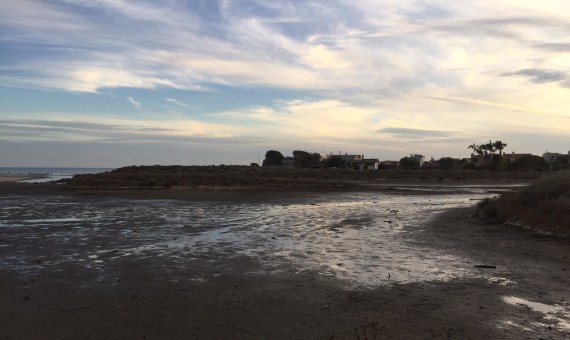
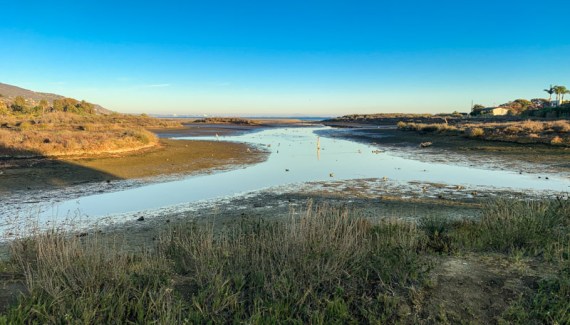
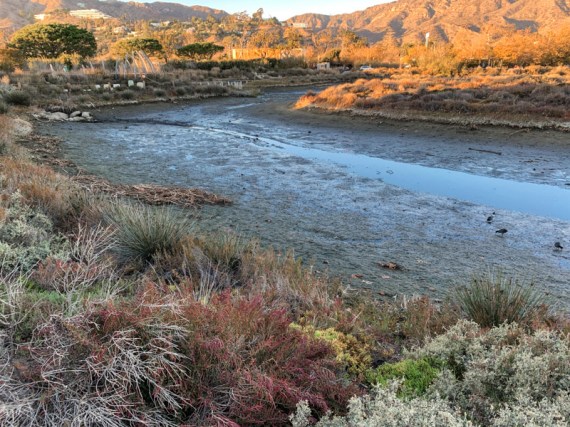
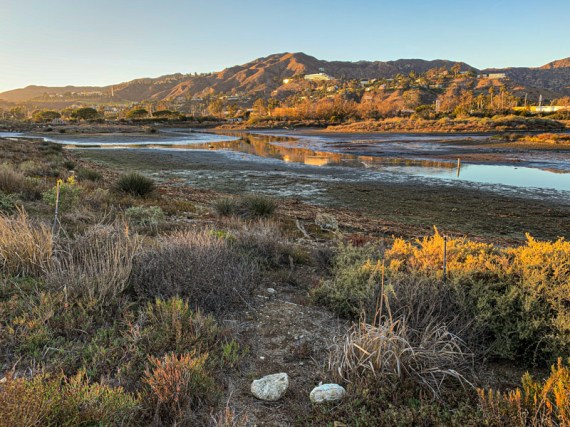
Low Tide Malibu Lagoon
[Photos by Ray Juncosa, posted by Chuck Almdale]
We’ve had a lot of high tide photos lately, what with the winter King Tides and the waves and flooding that accompany them. The lagoon looks very different at low tide. According to the tide table, low tide on 18-Dec-2021 was -0.51 ft at 3:27 PM. Ray and Liz Juncosa happened to be there at the right time and captured these views. They are presented in sequence as if on a walk from the first viewpoint near the Pacific Coast Highway, around the channels and to the beach.







Twelve Days of Christmas | Important Update
[By Ellen Vahan, posted by Chuck Almdale]
Twelve Days of Christmas Redux

It would seem that True Love and PNC Christmas Price Index were on hiatus last year (the cursed 2020). There was no Twelve Days of Christmas Index pricing all the gifts that one might accumulate from True Love. However….we are back in business and we have prices.
For those who have no idea what I am blathering about….Twelve Days of Christmas is a carol sung at Christmas time and at ALL school Christmas events. The twelve days start at Christmas and continue until January 5th the day before Epiphany. Each day “My True Love” gives a gift and adds to the ones from the days before, so day one = one gift and up to day twelve when there are gifts from all previous days (12 from the 12th and 11 from the 11th and so on which adds up to a lot of livestock, fowl and people). The index just adds up the cost of the 12th day (one batch of everything).
So….
- 1 Partridge in a pear tree $222.68 up 6.0% from 2019 – cost of the tree
- 2 Turtle Doves $450.00 up 50% (yikes)
- 3 French Hens $255.00 up 40.5%
- 4 Calling Birds $599.96 no change
- 5 Gold Rings $895.00 up 8.5%
- 6 Geese-A-Laying $660.00 up 57.1% (wow!)
- 7 Swans-A-Swimming $13,125.00 no change, but still most expensive gift
- 8 Maid-A-Milking $58.00 no change – this is Federal Minimum Wage and apparently no extra charge for cows
- 9 Ladies Dancing $7,552.84 no change from 2019 – rate for Pittsburgh ballet
- 10 Lords-A-Leaping $11,260.00 up 12.6% from 2019 and able to perform
- 11 Pipers Piping $2,943.93 up 7.1% as live performances are happening
- 12 Drummers Drumming $3,183.17 up 7.1%
This totals to $41,205.58, up 5.7% from 2019.
And should you count all the repetitions totaling 364 gifts, the cost would be $179,454.19.
The original Index in 1984 totaled $20,069.58.
PNC Bancorp Inc. in Pittsburgh, PA has kept this going for 37 years (38 if you include the gap for 2020). For this I thank them.
Merry Christmas to all
EV
Auditor’s opinion on the above Statement of Expenditures
We have audited the accompanying Statement of Expenditures of True Love and PNC Bancorp Inc. of Pittsburgh, PA as of December 25, 2021. This financial statement is the responsibility of the Company’s management. Our responsibility is to express an opinion on these financial statements based on our audit.
In our opinion, the above statement of expenditures presents fairly, in all material respects, the proposed expenditures in conformity with generally accepted accounting principles.
We conducted our audit in accordance with auditing standards generally accepted in the United States of America. Those standards require that we plan and perform the audit to obtain reasonable assurance about whether the financial statements are free of material misstatement. An audit includes examining, on a test basis, evidence supporting the amounts and disclosures in the financial statements. An audit also includes assessing the accounting principles used and significant estimates made by management, as well as evaluating the overall financial statement presentation. We believe that our audit provides a reasonable basis for our opinion.
In our opinion, the financial statement referred to above, presents fairly, in all material respects, the financial position of True Love and PNC Bancorp Inc. of Pittsburgh, PA as of December 25, 2021, and the results of its expenditures for the year then ended in conformity with accounting principles generally accepted in the United States of America.
Scrooge, Marley and Cratchit, LLC.
Certifiable Public Accountants
B.S. Barnum, lead auditor
[Posted by Chuck Almdale]
Some songbirds now migrate east to west. Climate change may play a role
Science News Magazine | Jake Buehler | 9 Nov 2021 | 5 minute read
A dramatic shift in some Richard’s pipits’ winter plans might be linked to a warming Europe.
From the introduction:
As the chill of autumn encroaches on Siberia’s grasslands, Richard’s pipits usually begin their southward trek to warmer latitudes. But a growing number of the slender, larklike songbirds seem to be heading west instead, possibly establishing a new migratory route for the species.
This would be the first new route known to emerge on an east-west axis in a long-distance migratory bird, researchers report October 22 in Current Biology. The finding could have implications for how scientists understand the evolution of bird migration routes over time and how the animals adapt to a shifting climate.
Link to the original study paper in Current Biology.



 SANTA MONICA BAY AUDUBON SOCIETY BLOG