Free email delivery
Please sign up for email delivery in the subscription area to the right.
No salesman will call, at least not from us. Maybe from someone else.
Lower Los Angeles River Trip Report: 6 September, 2014

Fiery Skippers female & male, warming their exoskeletons
(J. Waterman 9/6/14)
7:30am was not too early to begin our fifth annual walk along the banks of the lower Los Angeles River. We began at Willow St, about 3 miles north of Long Beach Harbor, ending about 6 miles farther north at Alondra Blvd. We usually visit 4 sites, but this year we skipped DeForest Park as our leader, Dick Barth, had visited the park earlier and found no warblers or other passerines at all in the trees. It was slightly overcast and about 70° when we started, clearing up and topping out about 88° when we finished at 12:15.

Birds & vegetation at Willow St. (C. Almdale 9/6/14)
The most vegetation in this section of river channel is at Willow St., with sand and mud islands, floating rafts of water plants, wading egrets, ducks, and large flocks of shorebirds, gulls, the occasional tern, plus a few raptors and plenty of Barn Swallows and Rock Pigeons. The Orange Bishop can usually be found in the tall riverbed island grass in this area.

Male Orange Bishop at Willow St (J. Waterman 9/6/14)
Just as we had finished checking out some Greater Yellowlegs, a pair of less-common Lesser Yellowlegs flew in, providing an opportunity to compare the two. Most of the difference noted was the size and shape of the bill: shorter and straighter in the Lesser. What we momentarily thought might be a Virginia Rail turned out to be a juvenile Common Gallinule (recently split from its Eurasian congener and renamed from Common Moorhen).

Avocets & Dowitchers in flight (J. Waterman 9/6/14)
Among the numerous Long-billed Dowitchers we found a few Short-billed. At 34th St., our second stop, we found a few juvenile Short-billed in very fresh plumage, allowing us to check out the orange “tiger stripes” in their tertials. We hunted through the numerous mixed flocks of Least and Western Sandpipers for rarities, finally finding a single Pectoral Sandpiper, skulking in the brush and grass on a small island. For at least 20 minutes we entertained ourselves with persistent comments such as: “it’s head is poking out between those two stilts”; “which stilts?”; “the two on that little island”; “now the grass is moving to the left of the left stilt, watch that spot”; “now it’s under the rear end of the right stilt” and so on. Finally the bird walked out into the open water and we all got great looks.

Pectoral Sandpiper at Willow St. (J. Waterman 9/6/14)
Gulls – mostly Western – continued to gather here, but we had to leave before the Laughing Gull, a local resident throughout the summer, arrived. We went north to 34th St. where we didn’t see anything new except a few juvenile Short-billed Dowitchers in very fresh plumage, allowing us to check out the orange “tiger stripes” in their tertials. We then went on to Alondra Blvd., next to the Home Depot. House Sparrows have found a fine foraging spot here, gleaning orts and pieces of bread from the ground around the groups of workers waiting for daily work.
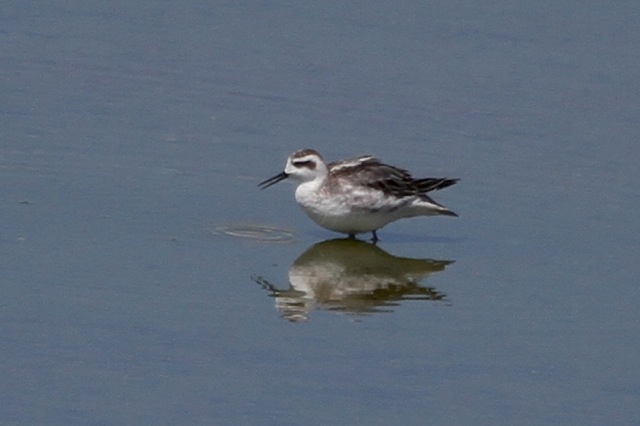
Red-Necked Phalarope at Alondra Blvd. (J. Waterman 9/6/14)
Another large gull flock was here, as well as many Least and Western Sandpipers flocks, through which spun a single Red-necked Phalarope. It didn’t so much spin – as they typically do in deeper water to create a vortex which lifts food to where they can snag it – as twisted in ankle-deep water. This looked a bit odd.
A very special thanks to Richard Barth who frequently birds this area. His knowledge and enthusiastic explanations of difficult plumages are invaluable, especially during migration season! I’m sure his upcoming program at Los Angeles Audubon this Wednesday, September 10, will be great. [Chuck Almdale]
Prior Reports: August 2013, September 2012, September 2011, October 2010
| Lower L.A. River 9/6/14 | Willow | 34th | Alondra | Total | |
| Species | Street | Street | Blvd. | Birds | |
| Gadwall | 2 | 2 | |||
| Mallard | 110 | 16 | 15 | 141 | |
| Cinnamon Teal | 5 | 9 | 14 | ||
| Northern Shoveler | 8 | 8 | |||
| Bufflehead | 1 | 1 | |||
| Pied-billed Grebe | 1 | 1 | |||
| Double-crested Cormorant | 6 | 6 | |||
| Great Blue Heron | 2 | 2 | |||
| Great Egret | 2 | 2 | |||
| Snowy Egret | 5 | 5 | |||
| Green Heron | 1 | 1 | |||
| Black-crowned Night-Heron | 2 | 2 | |||
| Turkey Vulture | 3 | 1 | 4 | ||
| Osprey | 1 | 1 | |||
| Common Gallinule | 1 | 1 | |||
| American Coot | 25 | 25 | |||
| Semipalmated Plover | 2 | 2 | |||
| Killdeer | 65 | 1 | 66 | ||
| Black-necked Stilt | 425 | 120 | 545 | ||
| American Avocet | 160 | 12 | 172 | ||
| Spotted Sandpiper | 14 | 14 | |||
| Greater Yellowlegs | 4 | 4 | |||
| Willet | 1 | 1 | |||
| Lesser Yellowlegs | 2 | 2 | |||
| Western Sandpiper | 100 | 125 | 225 | ||
| Least Sandpiper | 490 | 340 | 830 | ||
| Pectoral Sandpiper | 1 | 1 | |||
| Short-billed Dowitcher | 30 | 10 | 40 | ||
| Long-billed Dowitcher | 200 | 70 | 270 | ||
| Red-necked Phalarope | 1 | 1 | |||
| Ring-billed Gull | 20 | 5 | 25 | ||
| Western Gull | 100 | 280 | 380 | ||
| California Gull | 50 | 50 | |||
| Caspian Tern | 2 | 2 | |||
| Rock Pigeon | 130 | 110 | 240 | ||
| Eurasian Collared-Dove | 3 | 3 | |||
| White-throated Swift | 6 | 6 | |||
| Allen’s Hummingbird | 2 | 2 | |||
| American Kestrel | 2 | 2 | |||
| Yellow-chevroned Parakeet | 7 | 7 | |||
| Black Phoebe | 2 | 2 | |||
| American Crow | 6 | 6 | |||
| Barn Swallow | 45 | 15 | 12 | 72 | |
| European Starling | 40 | 40 | |||
| Savannah Sparrow | 1 | 1 | |||
| Red-winged Blackbird | 20 | 20 | |||
| Yellow-headed Blackbird | 1 | 1 | |||
| Great-tailed Grackle | 3 | 3 | |||
| House Finch | 12 | 12 | |||
| House Sparrow | 12 | 12 | |||
| Orange Bishop | 1 | 1 | |||
| Total Species & Birds – 51 | 48 | 9 | 10 | 3276 |
Full Harvest Moon Update: 8 September 8, 2014, 6:38 P.M. PDT
Here’s another update from SMBAS Blog on that large, disc-like, shining object which has frequently and mysteriously appeared in our nighttime sky this year (known to many as the moon).
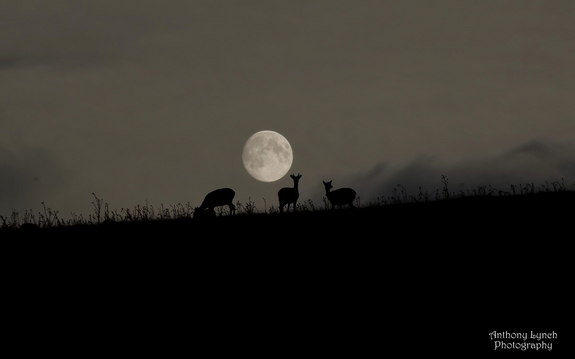
Irish harvest moon & deer (Anthony Lynch 9/19/13 from Space.com)
Sept. 8, 6:38 p.m. PDT — Full Harvest Moon. Traditionally, this designation goes to the full moon that occurs closest to the Autumnal (Fall) Equinox. This year’s version comes unusually early. At the peak of the harvest, farmers can work into the night by the light of this moon. Usually the moon rises an average of 50 minutes later each night, but for the few nights around the Harvest Moon, the moon seems to rise at nearly the same time each night: just 25 to 30 minutes later across the U.S., and only 10 to 20 minutes later for much of Canada and Europe. Corn, pumpkins, squash, beans and wild rice — the chief Indian staples — are now ready for gathering.
Interesting & useful factoids on moon averages:
Apparent width of the moon (full or otherwise): 1 /2 degree.
Time one full moon to next full moon: 29.5 days
Angle moon moves in 24 hours: 12.2 degrees
Time for moon to move it’s own width (1/2 degree): 59 minutes
Thus, on average, the moon takes just under an hour to move it’s own width. When trying to estimate the size of something, compare it to the moon, a known quantity.
MoonPhases.info – A handy site for a googolplex of moon facts.
The next significant full moon will occur on October 8, 3:51 a.m. PDT. Keep an eye on this spot for additional late-breaking news on this unprecedented event.
This information comes to you courtesy of: http://www.space.com/24262-weird-full-moon-names-2014-explained.html
written by Joe Rao. Joe Rao serves as an instructor and guest lecturer at New York’s Hayden Planetarium. He writes about astronomy for Natural History magazine, the Farmer’s Almanac and other publications, and he is also an on-camera meteorologist for News 12 Westchester, N.Y.
But that’s waaay too long to type in, and besides, you don’t need to go there because SMBAS has done the work for you!
[Chuck Almdale]
A (whispered) warning…
![Passenger_Pigeon_(Columba_Migratoria) [By Toronto Public Library [CC-BY-SA-2.0 (http://creativecommons.org/licenses/by-sa/2.0)], via Wikimedia Commons]](https://smbasblog.com/wp-content/uploads/2014/08/passenger_pigeon_columba_migratoria.jpg)
Passenger_Pigeon_(Columba_Migratoria) [By Toronto Public Library [CC-BY-SA-2.0 (http://creativecommons.org/licenses/by-sa/2.0)%5D, via Wikimedia Commons]
If you can’t wait, go to: http://www.nytimes.com/2014/08/31/opinion/sunday/saving-our-birds.html
If that doesn’t work, try HERE.
LucienP
Quick! I don’t know how long this offer lasts
The developers who promote, polish and prepare the Audubon Apps for those who have smart phones, iPads, and other such devices, are having a Labor Day weekend sale at 99cents per app. these are not “the definitive” bird app nor The Illustrator’s best. They are very good, recent, photo-illustrated apps. Much better than the last edition extant of the Audubon (photo-illustrated) book versions. I like them better than iBird Pro. In addition, I’ve found they have a good library of sound recordings, especially since they welcome additions from the public. So, you’ve already paid $15-$30 for the Sibley and/or the NationalGeo apps, but this is definitely worth the price for the very specific California Birds, the Trees, the Butterflies…how about the Flowers? Spoil yourself to all four! We’ll compare notes in the field!
Use this link: (copy and paste in your browser)
LucienP
Bird Camouflage – Films, games & Links
FIND THE BIRD!
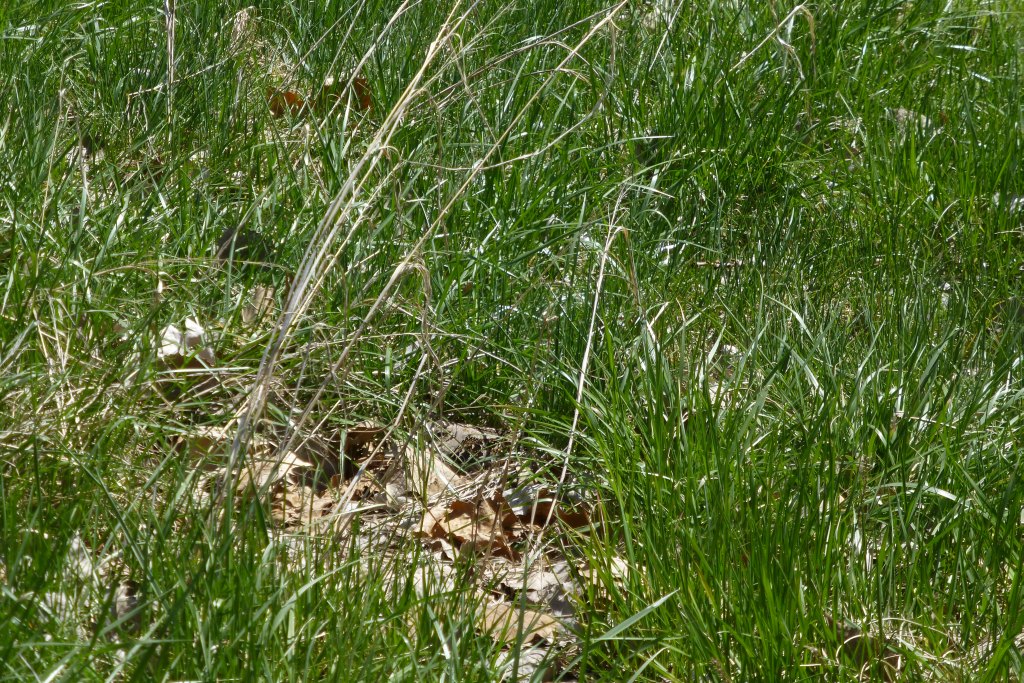
Taken at McGee Marsh, Ohio (L. Johnson 5-7-14)
When other animals think of you as food, it’s good to be hard to see.
When you’re a ground-nesting bird, it’s essential. The above photo contains one bird.
Often you don’t see the bird until you’re about to step on it and it flushes. The Killdeer nesting by Malibu Lagoon run away, pretending they have a broken wing. Mallards will leap up out of the brush, only to land close by, waiting for you to leave. I unexpectedly flushed a Sooty Grouse in Yosemite National Park; exploding from the ground, it nearly gave me a heart attack, then much to my delight landed in a nearby tree.
To learn something about camouflage, why animals use it and how it works, go here.
It’s a 13 1/2 minute film from Aaran Frood of the Biotechnology and Biological Sciences Research Council (BBSRC) and provides a visual context for their animal camouflage research. The BBSRC is experimenting by sending cameras to some of their BBSRC-funded researchers so they can record their experiences while pursuing research in the field — gnarly roads, bush fires, biting insects, boomslangs and all! The purpose for this project is “to bring the viewer closer to the action, and so the public paying for the research can see some of the nuances of how it’s really done and what they’re up to”, writes Mr Frood in email.
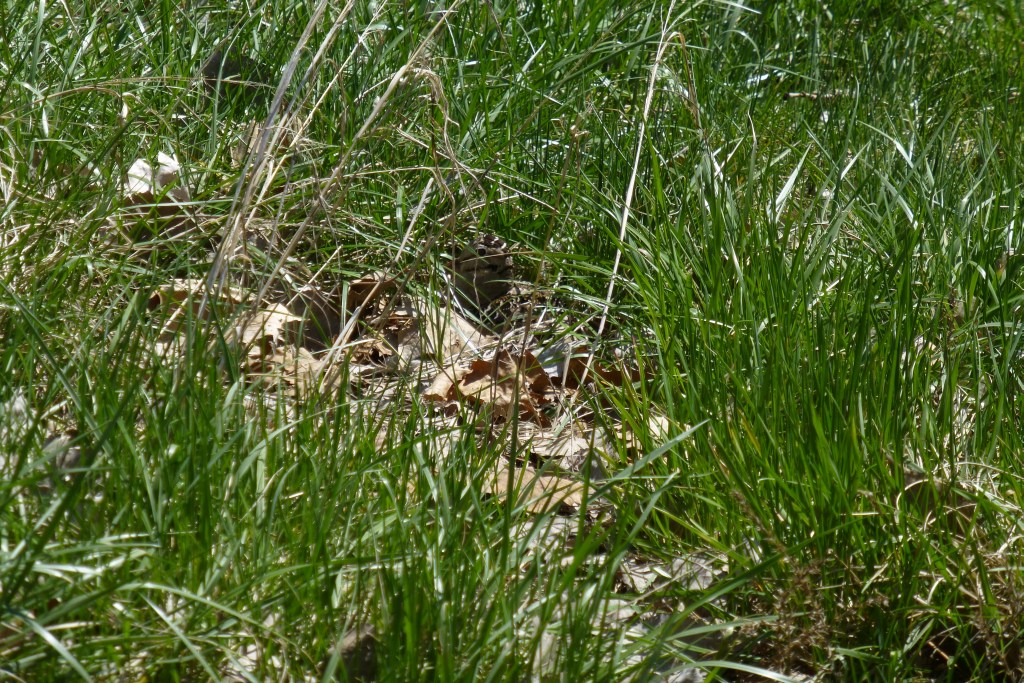
It’s on a nest. McGee Marsh, Ohio (L. Johnson 5-7-14)
GRRLSCIENTIST, hosted by The Guardian but frequently found elsewhere, writes on many topics, including birds. Her 8/27/14 article, Eggcellent citizen science: evolution of camouflage in bird eggs reports on “how an online video game relies on citizen scientists to test the evolution of avian egg camouflage colours and patterns.”
Links to the games are found within her article via the name “hidden nightjars.” Read the article.
If you want to go directly to the games, they’re at the Project Nightjar website.
If you couldn’t find the bird, here’s an even closer view.
[Chuck Almdale]
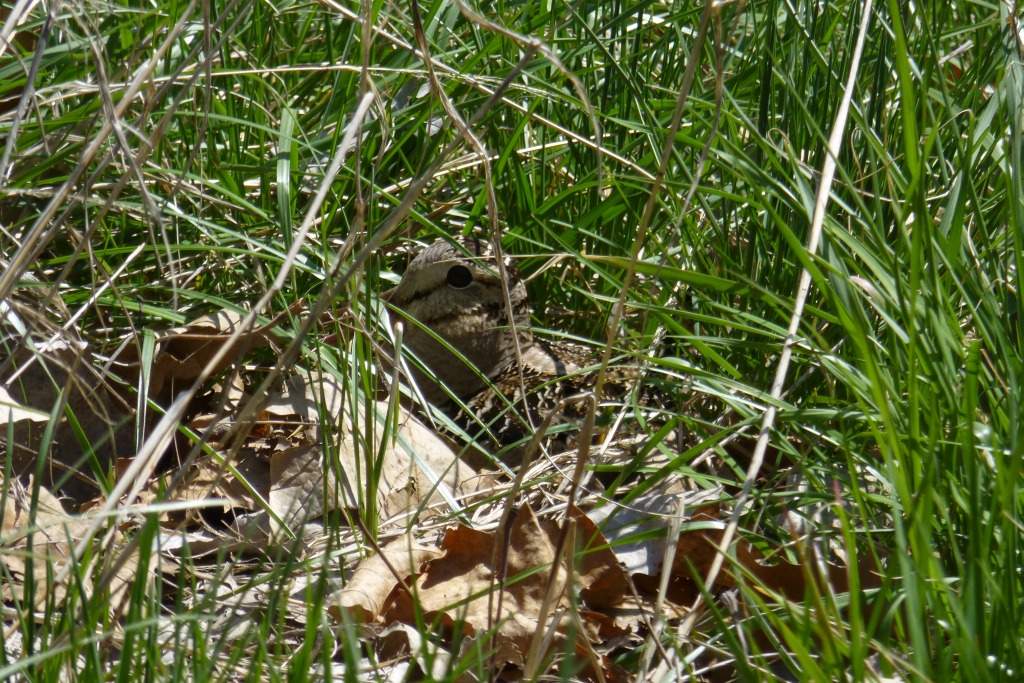
American Woodcock nesting next to the parking lot at McGee Marsh, Ohio
(L. Johnson 5-7-14)



 SANTA MONICA BAY AUDUBON SOCIETY BLOG