Free email delivery
Please sign up for email delivery in the subscription area to the right.
No salesman will call, at least not from us. Maybe from someone else.
Malibu Lagoon Trip Report: 24 June, 2012
This slideshow follows the same path as the 27 May show. Compare them to see the changes. Don’t forget to visit our new page for the Malibu Lagoon 2012 Project, frequently updated with new photos.
As expected, the west channels area is a muddy mess. The parking lot is about 1/3rd size, holding 35-40 cars, and the perimeter access road is now the beach path, fenced with chain link and plastic mesh along the channel side. We looked through the various viewing holes, but there was little to see. Overall, we saw two areas taped off, indicating the presence of active nests, although there may be more. A few passerines were along the other side of the path, but most of the land birds we saw (see trip list below) were either in the air or at Adamson House. We saw four families of Mallard: two in the south channel and two in the main lagoon. The White-tailed Kite which has been hanging around for about a week was patrolling the hill northeast of the lagoon.
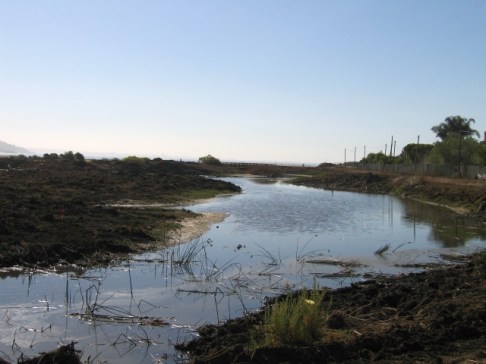
South channel view from west end (L. Johnson 6/24/12)
Two juvenile Bullock’s Orioles chased each other in the large colony cypresses near the southwest corner of the channels area, but no other roosting birds were there. These cypresses have looked increasing “ill” for quite a while. I suspect that when the foundation was laid for the house going up just below their east side, the tree’s roots were severed or otherwise damaged. I would not be surprised to see the trees gone within a few years.
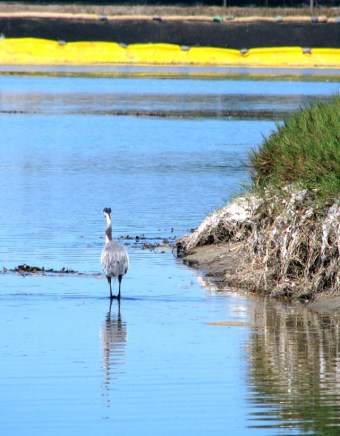
Great Blue Heron patrols lagoon near Adamson House (C.Almdale 6/24/12)
It was about 90 minutes after low tide when we arrived on the beach, and many Elegant Terns were resting on the exposed cobbles at sea’s-edge while the Whimbrels foraged among them. As the tide rose and waves began crashing on the cobbles, the terns began relocating to the sand islands along the lagoon’s beach edge, where the gulls and pelicans already loafed. A small raft of Brown Pelicans was offshore just past the many surfers, while the slim Pelagic Cormorants surface-dived for fish near them. Far offshore was a huge, uncounted, flock of pelicans plunge-diving. Snowy Egrets and a Great Blue Heron patrolled the edges of the main lagoon.
The beach breach of a few weeks ago was quite obvious, with 3-6 ft. ‘cliffs’ of sand on each side. The longshore ocean current from the west has already caused the ocean end of the outlet channel to shift eastward about 50-75 yds. No water flowed out, but the sand looked wet and I suspect that high tide could still flow into the lagoon, with the lagoon flowing back out until its level reached that of the beach.
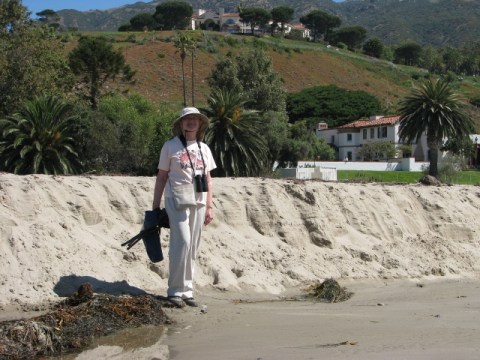
Sand ‘cliff’ at breach east edge, Adamson House in background (C.Almdale 6/24/12)
Adamson House had an unusual number of hummingbirds, it seemed to me, most of them Allen’s and the rest Anna’s, as usual. There was an adult male Hooded Oriole in the palms. We counted up our checklist on the deck of the boathouse. The inlet below us, so full a month ago, was dry, with a Killdeer (see below)wandering through. Song Sparrows and Black Phoebes flitted about, while one of the world’s loudest Northern Mockingbirds sang from a nearby bush.

Killdeer in the Adamson boat house lagoon inlet, now dry (C.Almdale 6/24/12)
Crossing back over the highway bridge we saw the egret colony in the trees behind Starbuck’s: at least 16 birds, evenly split between Great and Snowy Egrets (not included in the count). The remaining north channel reed bed was still intact, surrounded by yellow plastic tape. Two American Coots were adding reeds to their nest at the edge of the reeds, while their orange-headed juvenile floated nearby. Coots build their nests of floating vegetation, in this case, of reeds; as the dead reeds on the undersurface of the nest rot and become soggy, the birds must continually add fresh reeds at the top. The young are able to swim almost immediately; it’s 7-8 weeks before they can fly.
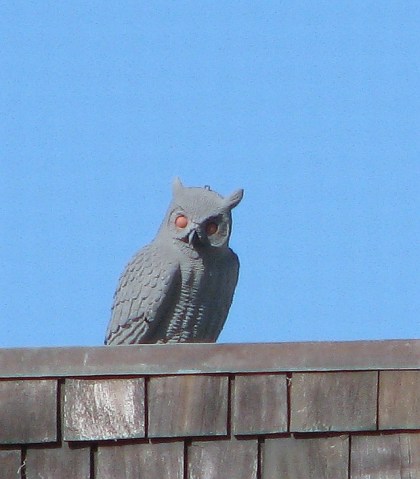
Fortunately the endemic Western Roof Owl is high and dry on a colony housetop – right-facing behavioral morph shown (C.Almdale 6/24/12)
Our next three field trips: Malibu Lagoon, 22 July, 8:30 am; Malibu Lagoon, 26 August, 8:30 am; Los Angeles River, 8 Sept., 8am.
Our next program: Tuesday, 2 October, 7:30 pm. The usual reminders will be emailed from the blog.
NOTE: Our 10 a.m. Parent’s & Kids Birdwalk is canceled until the lagoon project is completed and the parking lot is again available.
Links: Unusual birds at Malibu Lagoon
Aerial photo of Malibu Lagoon from 9/23/02.
Prior checklists: July-Dec’11, Jan-June’11, July-Dec ’10, Jan-June ’10, Jul-Dec ‘09, and Jan-June ‘09.
Comments on Bird List Below
Species Diversity: No census was taken in June 2008, so June 2006 is included to keep the comparison at six years. Of 72 total species appearing in June for 2006-12, no more than 62% of them appeared on any one count day, something to keep in mind if you wonder why what is there is much less than what could be there. June 2012 gets the species low count of 37, 18% below 2011’s high of 45, and 4 species below average. This is the same variance we had for May when 2010 was the low year. I expect species diversity to continue to run lower than average while the project is underway.
Total Birds: Species diversity was low, but total numbers of 863 was high, 2nd only to 2008’s 897 total birds. High numbers of Brown Pelican (340) and Elegant Tern (240) accounted for the higher than average numbers.
[Chuck Almdale]
| Malibu Census | 2006 | 2007 | 2009 | 2010 | 2011 | 2012 | |
| June 2006 – 2012 | 6/25 | 6/24 | 6/28 | 6/27 | 6/26 | 6/24 | |
| Temperature | 66-74 | 65-75 | 68-72 | 70-76 | |||
| Tide Lo/Hi Height | H +3.0 | H +3.0 | L +0.4 | H +3.81 | H +3.0 | L +0.07 | Ave. |
| Tide Time | 0626 | 0626 | 0838 | 1139 | 0754 | 0714 | Birds |
| Brant | 1 | 1 | 1 | 11 | 2.3 | ||
| Gadwall | 3 | 14 | 15 | 4 | 5 | 2 | 7.2 |
| Mallard | 35 | 40 | 25 | 40 | 41 | 24 | 34.2 |
| Red-brstd Merganser | 1 | 0.2 | |||||
| Ruddy Duck | 6 | 7 | 2.2 | ||||
| Pied-billed Grebe | 4 | 2 | 2 | 3 | 4 | 2.5 | |
| Clark’s Grebe | 1 | 0.2 | |||||
| Dble-crstd Cormorant | 7 | 6 | 22 | 5 | 54 | 17 | 18.5 |
| Pelagic Cormorant | 1 | 1 | 3 | 0.8 | |||
| Brown Pelican | 19 | 239 | 71 | 205 | 28 | 340 | 150.3 |
| Great Blue Heron | 2 | 3 | 8 | 6 | 4 | 1 | 4.0 |
| Great Egret | 2 | 4 | 3 | 2 | 5 | 2.7 | |
| Snowy Egret | 8 | 8 | 14 | 14 | 8 | 4 | 9.3 |
| Little Blue Egret | 1 | 0.2 | |||||
| Green Heron | 3 | 1 | 0.7 | ||||
| Blk-crwnd N-Heron | 5 | 3 | 6 | 1 | 2.5 | ||
| Osprey | 1 | 1 | 0.3 | ||||
| White-tailed Kite | 1 | 0.2 | |||||
| Cooper’s Hawk | 1 | 1 | 0.3 | ||||
| Red-shouldered Hawk | 1 | 0.2 | |||||
| Red-tailed Hawk | 1 | 1 | 2 | 0.7 | |||
| Peregrine Falcon | 1 | 0.2 | |||||
| American Coot | 4 | 20 | 22 | 5 | 12 | 4 | 11.2 |
| Blk-bellied Plover | 6 | 15 | 3.5 | ||||
| Killdeer | 2 | 5 | 1 | 1.3 | |||
| Black Oystercatcher | 1 | 0.2 | |||||
| Willet | 19 | 3 | 3 | 4.2 | |||
| Whimbrel | 5 | 8 | 2.2 | ||||
| Western Sandpiper | 1 | 2 | 0.5 | ||||
| Bonaparte’s Gull | 1 | 2 | 0.5 | ||||
| Heermann’s Gull | 24 | 16 | 48 | 17 | 15 | 44 | 27.3 |
| Ring-billed Gull | 15 | 7 | 3.7 | ||||
| Western Gull | 153 | 380 | 72 | 61 | 68 | 84 | 136.3 |
| California Gull | 1 | 1 | 0.3 | ||||
| Least Tern | 1 | 0.2 | |||||
| Caspian Tern | 15 | 3 | 9 | 10 | 1 | 6.3 | |
| Forster’s Tern | 4 | 0.7 | |||||
| Royal Tern | 4 | 6 | 2 | 1 | 4 | 2.8 | |
| Elegant Tern | 120 | 25 | 15 | 4 | 240 | 67.3 | |
| Black Skimmer | 5 | 1 | 1.0 | ||||
| Rock Pigeon | 8 | 4 | 6 | 4 | 4 | 3 | 4.8 |
| Mourning Dove | 2 | 4 | 4 | 5 | 1 | 2.7 | |
| Anna’s Hummingbird | 1 | 1 | 2 | 2 | 1 | 3 | 1.7 |
| Allen’s Hummingbird | 2 | 1 | 4 | 1 | 8 | 2.7 | |
| Belted Kingfisher | 1 | 0.2 | |||||
| Downy Woodpecker | 1 | 0.2 | |||||
| Black Phoebe | 6 | 2 | 15 | 2 | 10 | 5 | 6.7 |
| Cassin’s Kingbird | 1 | 1 | 0.3 | ||||
| Western Scrub-Jay | 1 | 0.2 | |||||
| American Crow | 6 | 6 | 12 | 4 | 4 | 4 | 6.0 |
| Rough-wingd Swallow | 4 | 6 | 6 | 1 | 2.8 | ||
| Tree Swallow | 6 | 1.0 | |||||
| Barn Swallow | 16 | 30 | 8 | 40 | 25 | 4 | 20.5 |
| Cliff Swallow | 8 | 8 | 7 | 30 | 15 | 4 | 12.0 |
| Oak Titmouse | 1 | 0.2 | |||||
| Bushtit | 9 | 4 | 8 | 3.5 | |||
| Marsh Wren | 1 | 0.2 | |||||
| Wrentit | 1 | 0.2 | |||||
| Northern Mockingbird | 6 | 3 | 2 | 2 | 3 | 6 | 3.7 |
| European Starling | 10 | 8 | 20 | 65 | 21 | 5 | 21.5 |
| Common Yellowthroat | 3 | 3 | 1 | 1 | 1 | 1.5 | |
| Spotted Towhee | 2 | 2 | 0.7 | ||||
| California Towhee | 1 | 1 | 4 | 1 | 1.2 | ||
| Song Sparrow | 8 | 4 | 6 | 3 | 3 | 6 | 5.0 |
| Red-winged Blackbird | 13 | 1 | 55 | 11.5 | |||
| Great-tailed Grackle | 3 | 3 | 2 | 1.3 | |||
| Brwn-headed Cowbird | 1 | 1 | 2 | 1 | 0.8 | ||
| Hooded Oriole | 4 | 1 | 1 | 1.0 | |||
| Bullock’s Oriole | 1 | 2 | 0.5 | ||||
| House Finch | 8 | 5 | 6 | 4 | 14 | 8 | 7.5 |
| Lesser Goldfinch | 2 | 4 | 1.0 | ||||
| House Sparrow | 8 | 2 | 1.7 | ||||
| Malibu Census | 2006 | 2007 | 2009 | 2010 | 2011 | 2012 | |
| Totals by Type | 6/25 | 6/24 | 6/28 | 6/27 | 6/26 | 6/24 | Ave. |
| Waterfowl | 39 | 62 | 41 | 62 | 46 | 26 | 46.0 |
| Water Birds-Other | 31 | 271 | 117 | 217 | 97 | 368 | 183.5 |
| Herons, Egrets | 12 | 24 | 28 | 28 | 19 | 5 | 19.3 |
| Quail & Raptors | 0 | 2 | 3 | 1 | 4 | 1 | 1.8 |
| Shorebirds | 25 | 3 | 9 | 2 | 7 | 25 | 11.8 |
| Gulls & Terns | 333 | 433 | 139 | 105 | 96 | 373 | 246.5 |
| Doves | 10 | 4 | 10 | 8 | 9 | 4 | 7.5 |
| Other Non-Pass. | 3 | 2 | 6 | 3 | 2 | 12 | 4.7 |
| Passerines | 94 | 96 | 93 | 220 | 122 | 49 | 112.3 |
| Totals Birds | 547 | 897 | 446 | 646 | 402 | 863 | 634 |
| 2006 | 2007 | 2009 | 2010 | 2011 | 2012 | ||
| Total Species | 6/25 | 6/24 | 6/28 | 6/27 | 6/26 | 6/24 | Ave. |
| Waterfowl | 3 | 5 | 3 | 4 | 2 | 2 | 3.2 |
| Water Birds-Other | 4 | 6 | 4 | 4 | 4 | 5 | 4.5 |
| Herons, Egrets | 3 | 6 | 4 | 4 | 5 | 2 | 4.0 |
| Quail & Raptors | 0 | 2 | 3 | 1 | 3 | 1 | 1.7 |
| Shorebirds | 2 | 1 | 3 | 1 | 2 | 4 | 2.2 |
| Gulls & Terns | 8 | 6 | 5 | 7 | 6 | 5 | 6.2 |
| Doves | 2 | 1 | 2 | 2 | 2 | 2 | 1.8 |
| Other Non-Pass. | 2 | 2 | 2 | 2 | 2 | 3 | 2.2 |
| Passerines | 14 | 15 | 16 | 15 | 19 | 13 | 15.3 |
| Totals Species | 38 | 44 | 42 | 40 | 45 | 37 | 41 |
New Blog Page on Malibu Lagoon Reconfiguration
We’ve created a new permanent page on our blog devoted mostly to photos of the reconfiguration project, now underway.
It’s self-explanatory. https://smbasblog.wordpress.com/malibu-lagoon-project/
There is a permanent link to this page on our blog home page, located under the title photo.
[Chuck Almdale]
Bird News Roundup
Loads of fun for the entire birding family!
Birding in L.A.: 7 Reasons to Do It and How to Get Started by Tawny Flechtner
Published in LA Weekly on 5/29/12. Local birder writes funny and useful article.
http://blogs.laweekly.com/arts/2012/05/birding_bird_watching.php
****************************************
The winners of the HBW (Handbook of Birds of the World) 2012 photography contest. Stunning photography!
http://www.hbwcontest.com/awardees.php
****************************************
Rockjumper is a bird travel company based in Africa (where the rockjumpers live) and they select a photo-of-the-month. They are always outstanding, and if you sign up for it on-line, they’ll email it to you every month. They’ll also keep you apprised of their upcoming trips. I’ve never traveled with them but I know people who have and have gotten good reports from them. See their latest picture here.
http://rockjumper-worldwidebirdingadventures.createsend2.com/t/ViewEmail/y/CD72586039DAA48F/DA8D5F4372A0019DA7F290B8E8FDC6A0
****************************************
Paleobirding 125 Million Years Ago: Enormous teeth, long snouts and long, bony tails.
From Wired Science: Daniela Hernandez, April 9, 2012
http://www.wired.com/wiredscience/2012/04/paleo-birding/?pid=3498&viewall=true
****************************************
The Politics of Checklist Instability, by Ted Floyd.
http://blog.aba.org/2012/04/the-politics-of-checklist-instability.html
****************************************
Here’s a California Condor picture, taken 4/3/12 at Big Sur.
http://rauzon.zenfolio.com/p859914566/h220e5e35#h220e5e35
****************************************
Book review of How to be a Better Birder, by Derek Lovich
Reviewed on The Passionate Birder
http://thepassionatebirder.blogspot.com/2012/04/book-reviews-how-to-be-better-birder.html
****************************************
Link to a large archive of USGS lectures on film, such as the 3/31/11 lecture by Jon Hagstrum on How Homing Pigeons Know Where To Go. It is fascinating and presents a strong case that sound is the major clue to the birds rather than sight, magnetic field, etc.
http://online.wr.usgs.gov/calendar/2012.html
***************************************
Here’s a photo essay on a real Roadrunner, not like that one we were hornswoggled into publishing two months ago.
http://www.birdingisfun.com/2012/05/roadrunning-roadraging-roadkill.html
***************************************
The WSJ (yes! that Wall Street Journal) had an article on field guides for birds. Imagine that!
Knowing a Hawk from a Handsaw, by Laura Jacobs, 5/25/12http://online.wsj.com/article/SB10001424052702304203604577397871538852242.html
***************************************An article from the University of Oxford (England)
Feathers Show Their True Colors, by Pete Wilson, 5/10/12
http://www.ox.ac.uk/media/science_blog/120510.html
***************************************
An article on mistnetting from Conservation Magazine
Entangled, by David Malakoff, 6/30/11
http://www.conservationmagazine.org/2011/06/entangled/?utm_source=Conservation+Magazine&utm_campaign=147a56fb01-This_Week_July_57_5_2011&utm_medium=email
**************************************
Last, but not least…….
I nominate the legislators of North Carolina for the annual The Light’s On But Nobody’s Home award. I’ll bet you didn’t know there was one. They decided to stop the sea level from rising, causing them to lose land and citizens, by outlawing science that might predict that ocean levels will rise. From Scientific American.
NC Considers making Sea Level Rise Illegal, by Scott Huler, 5/30/12
http://blogs.scientificamerican.com/plugged-in/2012/05/30/nc-makes-sea-level-rise-illegal/?print=true
*************************************
Full Strawberry Moon 6/4/12 4:12 a.m. PDT
Here’s another update from SMBAS Blog on that large shining object which has frequently and mysteriously appeared in our nighttime sky this year (known to many as the moon).
June 4, 4:12 a.m. PDT — Full Strawberry Moon. Known to every Algonquin tribe, Europeans called it the Rose Moon. A partial eclipse of the moon will be visible chiefly favoring those living around the Pacific Rim. Observers in Japan and Australia for instance, can see it at, or soon after, moonrise, while those in the western United States and western Canada see it at, or just before, moonset. At maximum, about 37 percent of the moon’s diameter will be immersed in the dark umbra shadow of the Earth.
The next significant full moon will occur on July 3, 11:52 a.m. PDT. Keep an eye on this spot for additional breaking news on this unprecedented event.
This information comes to you courtesy of:
http://www.msnbc.msn.com/id/45911225/ns/technology_and_science-space/t/how-s-full-moons-got-their-strange-names/#.T16CDHlIXUx
But that’s waaay too long to type in, and besides, you don’t need to go there because SMBAS has done the work for you!
[Chuck Almdale]
Solstice Canyon Trip Report: 5/12/12
We had a great attendance of eighteen people, including some students from Cindy’s birding class. People in the parking lot were greeted by a Red-tailed Hawk sitting in one of the trees, as well as a puffed-out Olive-sided Flycatcher.

Olive-sided Flycatcher displaying his ‘tufts’ for all to see (J. Kenney 5/12/12)
At the entrance to the trail, there was a tree with a nest of Nuttall’s Woodpeckers. Everyone got a good look because the parents were feeding them often. Later on we stood and watched a Common Raven gathering nesting material. We kept waiting to see where it was nesting and finally the bird landed at the site but it was not visible like the Nuttall’s nest. All along the trail, Black-headed Grosbeaks were serenading us but it was some time before anyone saw one of them. Later, at the granary tree we saw just a few Acorn Woodpeckers.

Yellow-breasted Chat – not easy to find in western L.A. County (J. Kenney 5/12/12)
The area was not as active with families of woodpeckers as we are used to seeing. Sound-wise, besides the Black-headed Grosbeaks, we could hear the Hutton’s Vireo, Pacific-slope Flycatcher, Lesser Goldfinch, and Purple Finch and could find all of the birds except the Purple Finch. Chuck Almdale called the Canyon Wren in but it took a lot of coaxing to get it to quit hiding behind the leaves. Finally we could see a silhouette as it stood on a snag one third of the way up the slope. It really gave us a chance to see how the long bill is. On the horizon there was another Red-tailed Hawk and a Turkey Vulture. Our trip was also a good day for hummingbirds since we found 3 species: Allen’s, Anna’s, & Black-chinned.

California Wild Rose in magnificent bloom (J. Kenney 5/12/12)
The flowers were quite good for a year that was short on rain. This walk always offers a chance to compare the Bush Sunflower we see along the roadside (brown center) and the canyon sunflower (yellow center) which likes a little more protection. This year the Deer Weed seemed to have formed larger and very good looking bushes whereas the Hummingbird Sage was much more modest from the lack of rain. [Jean Garrett]

Her cryptically-colored fawn is close behind (J. Kenney 5/12/12)
Birds
Red-tailed Hawk Buteo jamaicensis
Turkey Vulture Cathartes aura
Common Raven Corvus corax
American Crow Corvus brachyrhynchos
Western Scrub-Jay Aphelocoma californica
Acorn Woodpecker Melanerpes formieivorus
Nuttall’s Woodpecker Picoides nuttallii
Bewick’s Wren Thryomanes bewickii
Canyon Wren Catherpes mexicanus
House Wren Troglodytes aedon
Western Bluebird Sialia mexicana
Common Yellowthroat Geothlypis trichas
Yellow-breasted Chat Icterria virens
Orange-crowned Warbler Oreothlypis celata
Townsend’s Warbler Setophaga townsendi
California Towhee Melozone crissalis
Spotted Towhee Pipilo maculatus
Song Sparrow Melospiza melodia
Black-headed Grosbeak Pheucticus melanocephalus
Black-hooded Parakeet Nandayus nenday
Lesser Goldfinch Spinus psaltria
House Finch Carpodacus mexicanus
Purple Finch Carpodacus purpureus
Black-chinned Humingbird Archilochus alexandri
Allen’s Hummingbird Selasphorus sasin
Anna’s Hummingbird Calypte anna
Olive-sided Flycatcher Contopus cooperi
Pacific-slope Flycatcher Empidonax difficilis
Western Wood-Pewee Contopus sordidulus
Ash-throated Flycatcher Myiarchus cinerascens
Black Phoebe Sayornis nigricans
Hutton’s Vireo Vireo huttoni
Oak Titmouse Baeolophus inornatus
Bushtit Psaltriparus minimus
Wrentit Chamaea fasciata
Ruby-crowned Kinglet Regulus calendula
Flowers
Golden Yarrow (Sunflower Family)
Cheeseweed (Mallow Family)
Hedge Nettle (Mint Family)
Humingbird Sage (Mint Family)
Caterpillar Phacelia (Waterleaf Family)
Deer Weed (Pea Family)
Wild Rose
Sticky Phacelia
California Everlasting (Sunflower Family)
Canyon Sunflower
Bush Sunflower



 SANTA MONICA BAY AUDUBON SOCIETY BLOG