Free email delivery
Please sign up for email delivery in the subscription area to the right.
No salesman will call, at least not from us. Maybe from someone else.
From The President
Happy 2010 to one and all ! We have been reaping the benefits of living in Southern California – birding has been wonderful and some plants have been sprouting and the sun has been shining – we have been having “Rose Bowl Days”. We hope to have winter next week – we dearly need rain and snow pack in the mountains.
Christmas Counts have been done around the country – the results are not in as yet. The next big milestone is the 13th Great Backyard Bird Count February 12-15, 2010 – check out www.birdcount.org – another little step of citizen science. Interesting to note the top bird reported in the 2009 GBBC was the Northern Cardinal – we need to report more Western birds !
Come join us for our month end fourth Sunday Malibu Lagoon walk, come to our first Tuesday General meeting, join us for our field trips – enjoy the birds, enjoy the weather, enjoy the people – learn and participate.
Best of birds in 2010.
Ellen V
Native Plants
It’s spring, and in spite of the drought, some chaparral plants are bravely in bloom. One of the commonest is Purple Nightshade (Solanum xantii), named in honor of the same Xantus as Xantus’ murrelet. The genus Solanum is large, including potato (Solanum tuberosum) and eggplant (Solanum melongena), as well as several more-or-less toxic species, of which Xanti is one. The green berries are the most toxic part of xanti. I haven’t tasted the berries.
Douglas’s Nightshade, which has smaller, white blossoms, comes into bloom later and has shiny, black berries that are edible when fully ripe.
Don’t confuse “our” nightshade with the European occurrence, DEADLY NIGHTSHADE, which is in the genus Atropa, an entirely different family. As few as three berries of this plant could kill a small child. It’s not surprising that Deadly Nightshade is rarely grown in California.
Antelope Valley Raptor Search – Field Trip Report, 9 Jan. 2010
Jan 9, 2010. Our raptor search began across the street from the curiously birdless Desert-Aire Golf Course with some nice non-raptors, a field full of Mountain Bluebirds including some stunningly beautiful males.

Singing LeConte's Thrasher (L.Johnson 1/10)
We then tooled around looking for whatever was to be found, dodging the flatland speedsters on their way to elsewhere. Red-tailed Hawks were numerous and varied, including several extremely dark birds with black bellies and under-fore-wings, and dark red breasts. At the Ave. K wash between 50th & 70th Sts. east, we walked several hundred yards south until we ran across a LeConte’s Thrasher (a lifer for some) who was nice enough to get up and sing for us. We also had a Rock Wren and our first of at least 6 Loggerhead Shrikes, scattered in singletons around the valley.

Guess the bird! (L.Johnson 1/10)
The large grassy field on the SE corner of I & 110th E had the reported many dozens of Mountain Plovers, plus many Killdeer, hoards of Horned Larks, at least a dozen Long-billed Curlews and many Western Meadowlarks.

After seeing this, we went to lunch. (C.Almdale 1/10)
A Merlin perched across the street on a handy Joshua Tree permitted a few photos,
while a Ferruginous Hawk kept the plovers on their toes. The hawk was more interested in rodents however, as we watched him dive and capture one and eat the whole animal in one gulp.

Ferruginous Hawk taking off (L.Johnson 1/10)
We checked a tamarisk grove at H & 110th east that harbored a Long-eared Owl several years back, but the trees hadn’t fully recovered from a fire and lacked enough protective foliage to shelter any birds. After lunchtime at the Saddleback Butte campground, with very pleasant weather (no wind, about 55° but feeling warmer in the sun) and cookies from Carol, we headed to Apollo Park. We found a variety of ducks there, a lot of Canada Geese, and some Dark-eyed Juncos we hadn’t yet seen.
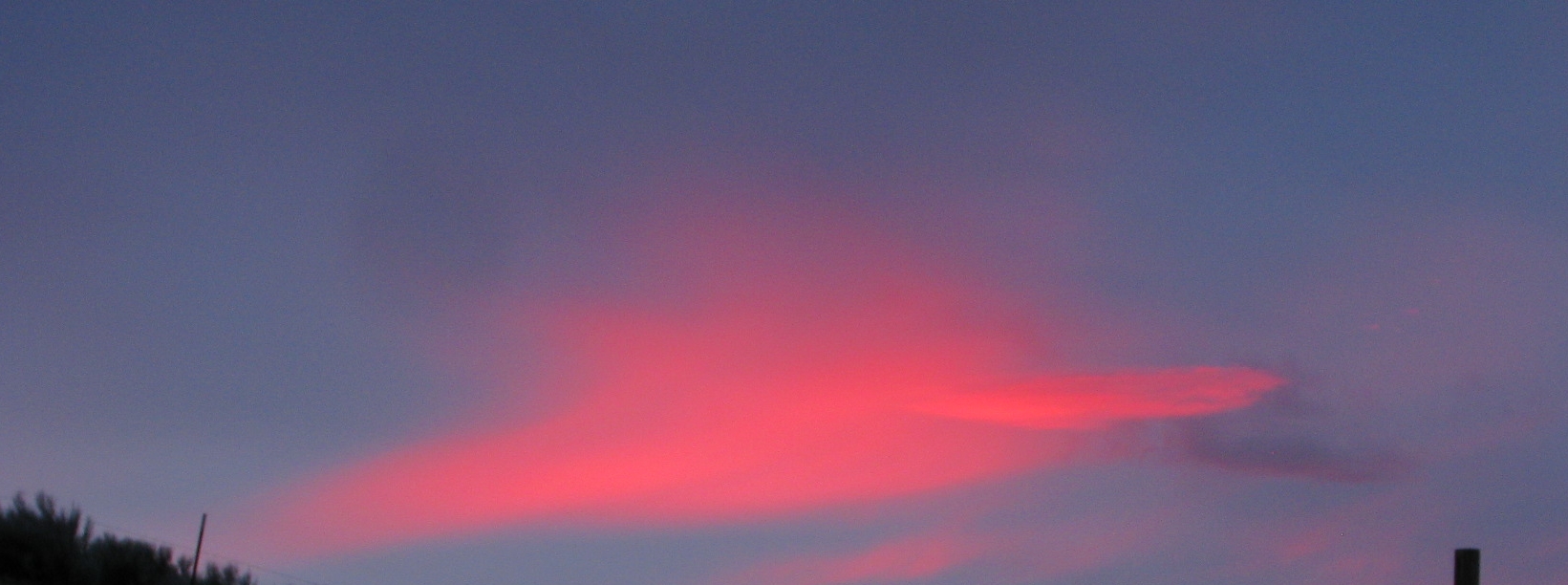
Pink cloud at night, Birder's delight. (C.Almdale 1/10)
A Rough-legged Hawk dashed in front of the cars as we rounded a bend at the SW corner of the Poppy Preserve. We stopped and watched it fly on out of sight around a hill, never to return. It may not sound like we’d done much, but with all the starts and stops, Horned Larks and various blackbirds, we’d managed to while away about six hours, so we headed on to Holiday Lake near Ave. D and 260th west, passing a Northern Harrier on the way. The lake was full of Canada Geese, plus some Mallards and Green-winged Teal. At least two dozen Black-crowned Night Herons emerged from the reeds and roosted in the trees, as it was just beginning to get dark. A Marsh Wren worked the reeds at water’s edge. Chris found a Red-breasted Sapsucker working over a tree; Great-tailed Grackles called as Jean spotted a Great-horned Owl roosting in a tree across the lake, staring at the humans jabbering away.
While heading on to Gorman to refuel, we spotted a Prairie Falcon landing in a tree, dark wing-pits and all. All told, we drove about 220 miles, birded for almost 9 hours, spotted 56 species including 9 raptors.
| TRIP LIST | |
| Ross’s Goose | Mourning Dove |
| Canada Goose | Great Horned Owl (1) |
| Gadwall | Red-breasted Sapsucker |
| Mallard | Northern Flicker (H) |
| Northern Shoveler | Black Phoebe |
| Green-winged Teal | Say’s Phoebe |
| Lesser Scaup | Loggerhead Shrike (6+) |
| Bufflehead | Common Raven |
| Ruddy Duck | Horned Lark |
| Pied-billed Grebe | Cactus Wren |
| Black-crowned Night Heron | Rock Wren |
| Northern Harrier | Marsh Wren |
| Cooper’s Hawk (2) | Mountain Bluebird (100+) |
| Red-tailed Hawk | LeConte’s Thrasher (1) |
| Ferruginous Hawk (7-8) | European Starling |
| Rough-legged Hawk (1) | Yellow-rumped Warbler |
| American Kestrel (6) | Lark Sparrow |
| Merlin (2) | Song Sparrow |
| Prairie Falcon (1) | Savannah Sparrow |
| Sora (H) | White-crowned Sparrow |
| American Coot | Dark-eyed Junco |
| Killdeer | Red-winged Blackbird |
| Mountain Plover | Tricolored Blackbird |
| Long-billed Curlew | Western Meadowlark |
| Ring-billed Gull | Brewer’s Blackbird |
| California Gull | Great-tailed Grackle |
| Rock Pigeon | House Finch |
| Eurasian Collared-Dove | House Sparrow |
New Year’s at Malibu Lagoon
On the day that most people are watching the Rose Parade and wondering why they live in New Hampshire (“Live, Freeze, or Die”) we went down to the lagoon and took a few photos.
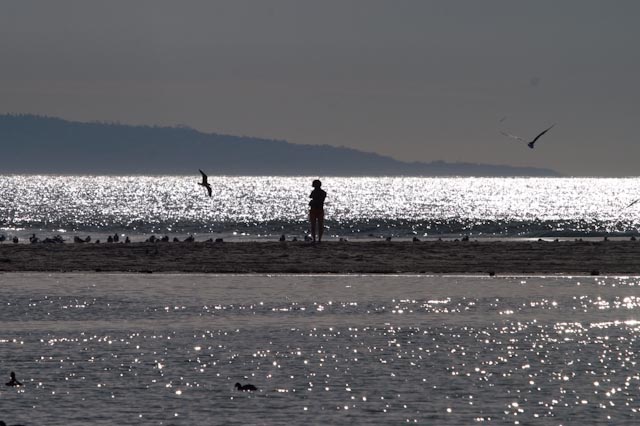
Person and Birds in low winter sun.
At the first bridge we found an old friend. Soras seem to be year-round residents – will we ever see any young ones?
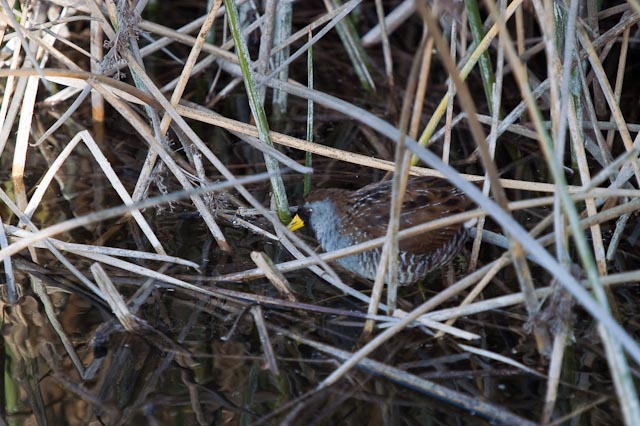
Sora (Porzana carolina)
There were about 50 Snowy Egrets on the banks of the lagoon – the water was so high it was too deep to wade for them.
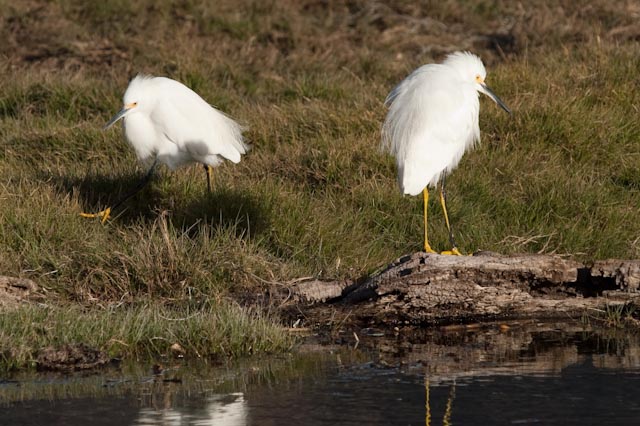
Snowy Egret (Egretta thula)
Well, all right, the kestrel was up at the Pepperdine Ponds, not down at the beach. There was a pair hunting grasshoppers on the golf course.
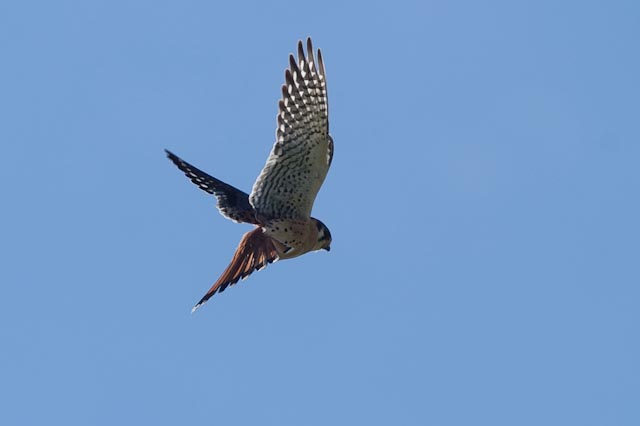
American Kestrel (Falco sparverius)
And while we were at the ponds, we found the Most Unusual birds of the day, a single Ross’ Goose with a single Snow Goose.
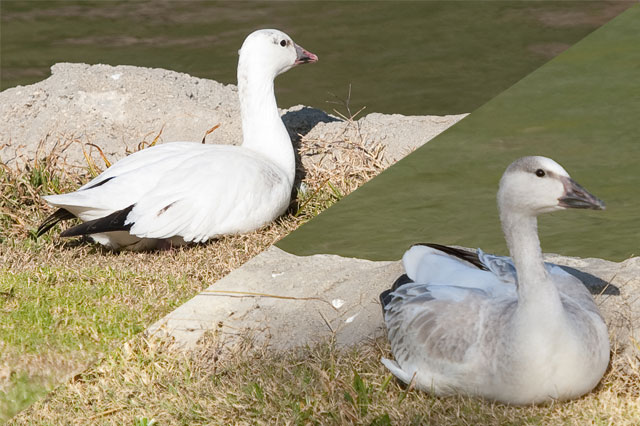
Ross' Goose (Chen rossi) & Snow Goose (Chen caerulescens)
Since it was a holiday, nobody argued as to whether these were Royal or Elegant Terns.
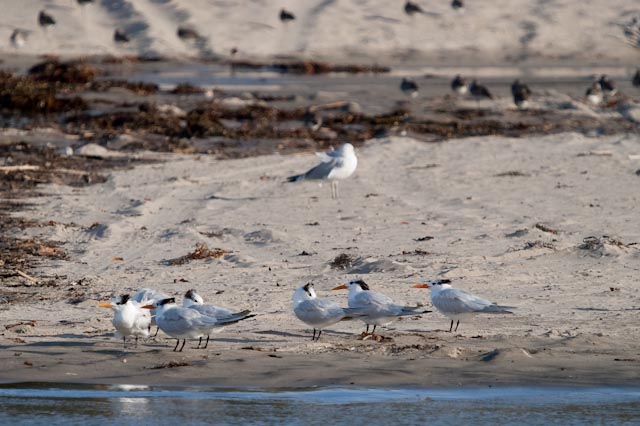
Royal Tern (Thalasseus maximus)
As mentioned, the water was at the highest of hide tide marks, which covered the cormorants’ favored perches, such as the larger offshore rocks. This perplexed juvenile just sat and watched from a safe place on the beach.
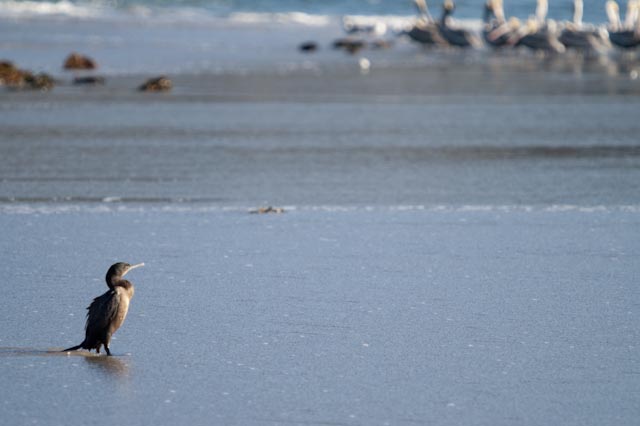
Double-crested Cormorant (Phalacrocorax auritus)
If you wait long enough, some gull will walk close enough to get you a full-frame photo. Who says bird photography is hard?
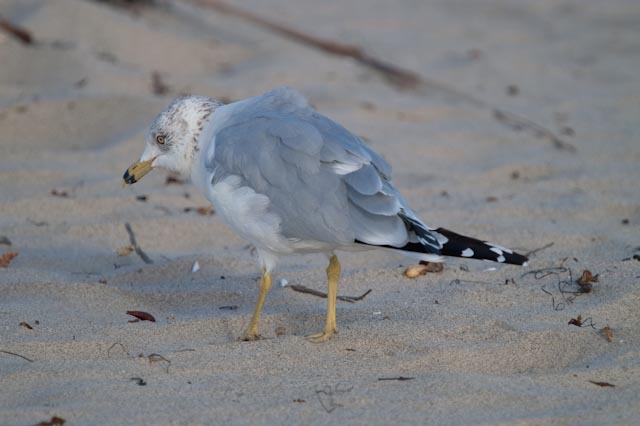
Ring-billed Gull (Larus delawarensis)
SMBAS Enables Donation to Audubon Ballona Wetlands Education Program
With great pleasure we share the following letter from Cindy Hardin, Audubon Ballona Wetlands Education Program Coordinator.
This letter was received December 31, 2009
*********
The Audubon Ballona Wetlands Education Program is the delighted recipient of a $4000.00 grant through the organization Fulbright Canada. Fulbright Canada has recently established an “Eco Leadership Program”, which is designed to support environmental programs located in the host communities of Fulbright scholars. Grant criteria includes level of community involvement and the environmental impact based on dollars spent.
Patrick Belanger, a Vancouver, Canada resident who is currently completing his doctorate at USC, was our sponsor for the grant. Mr. Belanger attended a monthly meeting of the Santa Monica Bay Audubon Society, where he met Chuck and Lillian Almdale. The Almdales referred him to the Ballona program as a possible grant candidate. Mr. Belanger then contacted program coordinator Cindy Hardin, who arranged for him to attend a presentation to students at Grant Elementary in Santa Monica regarding their upcoming field trip to the Ballona Wetlands. Mr. Belanger and his wife Michelle also participated in several events on-site at the salt marsh, including a field trip visit from Braddock Elementary School.
The grants offered by the Fulbright Eco Leadership Program range in amounts of $2000.00 to $4000.00. There were 50 applicants for the grants; only a handful were chosen. Of those chosen, The Audubon Ballona Program was the only one to receive the full amount possible.
The money was used to acquire two new spotting scopes, two new microscopes and twelve new pairs of binoculars. These additional optics were needed, as class sizes have recently increased due to budget cuts, and we now have larger groups visiting Ballona with each field trip. The remainder of the award was set aside to help fund bus scholarships for cash strapped schools.
The Audubon Ballona Program is thrilled and most grateful to receive this support and recognition. Special thanks are also in order for the continued support of the Santa Monica Bay Audubon Society, to the Almdales for their referral and to Mr. Belanger for his efforts in seeking us out and administration of the grant.
*********


Since the inception of the Audubon Ballona Wetlands Education Program well over a decade ago, SMBAS has supported it with member volunteer time and money. We feel it is an exceptionally worthy project. Every year, classes from dozens of elementary schools are able to experience Ballona salt marsh and learn about its wildlife, plants and ecology. If are looking for a local organization into which to put your volunteer time or dollars, they’re hard to beat.
The project gets a lot of thank-you letters and drawings from the kids. These and more can be seen on our website. — Chuck




 SANTA MONICA BAY AUDUBON SOCIETY BLOG