Free email delivery
Please sign up for email delivery in the subscription area to the right.
No salesman will call, at least not from us. Maybe from someone else.
Ballona Creek & Freshwater Marsh Trip Report: 14 Nov. 2009
When a westerly wind comes ripping off the ocean, the swells can surge completely across the Ballona Creek middle jetty. Anyone nearby is soaked by the freezing spray. Despite our forebodings, this was not one of those days, and we soon found ourselves struggling out of our extra layers of clothing.
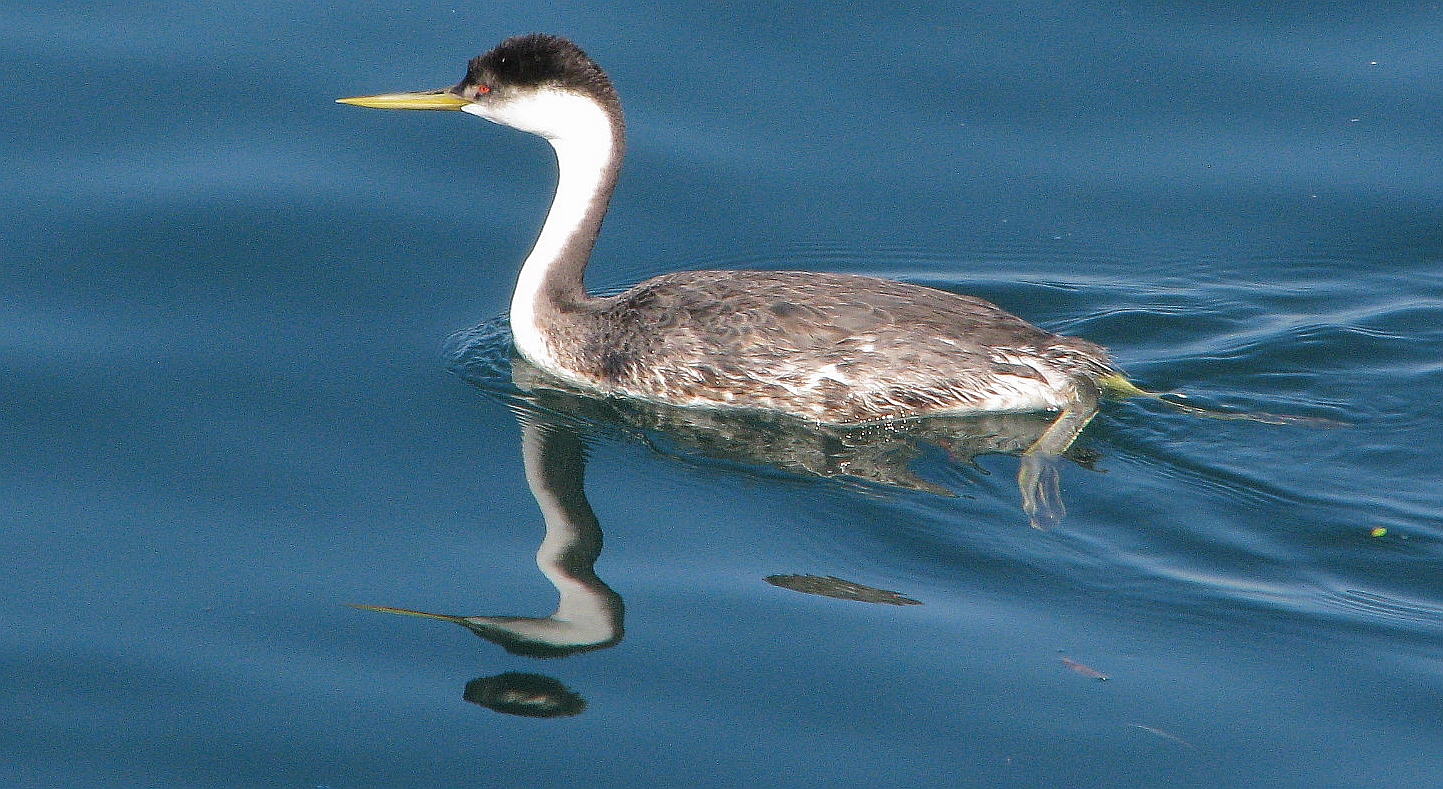
Greenish-yellow bill & dark around the eye makes this a Western Grebe (C.Almdale 11/09)
After checking out the ducks and the several Greater White-fronted Geese at Del Rey lagoon, leader Lu Plauzoles took us east down Ballona Creek to the tidal gate about half-way to Lincoln Blvd. We found the Burrowing Owl keeping its solitary vigil on the ice-plant covered sandy hill just east of the wetlands channel. It must now be about 5 years since this bird began wintering here. The creek was full of UCLA crews paddling up and down, shouting all the while, and the ducks did their best to keep out of their way, but there were plenty of shorebirds on the rocky edges: Willets, Whimbrels, Ruddy Turnstones, Western and Least Sandpipers; Ruddy Ducks, Buffleheads and Red-breasted Mergansers kept near the shores, but the Common Loons easily dodged the crew shells by diving under.
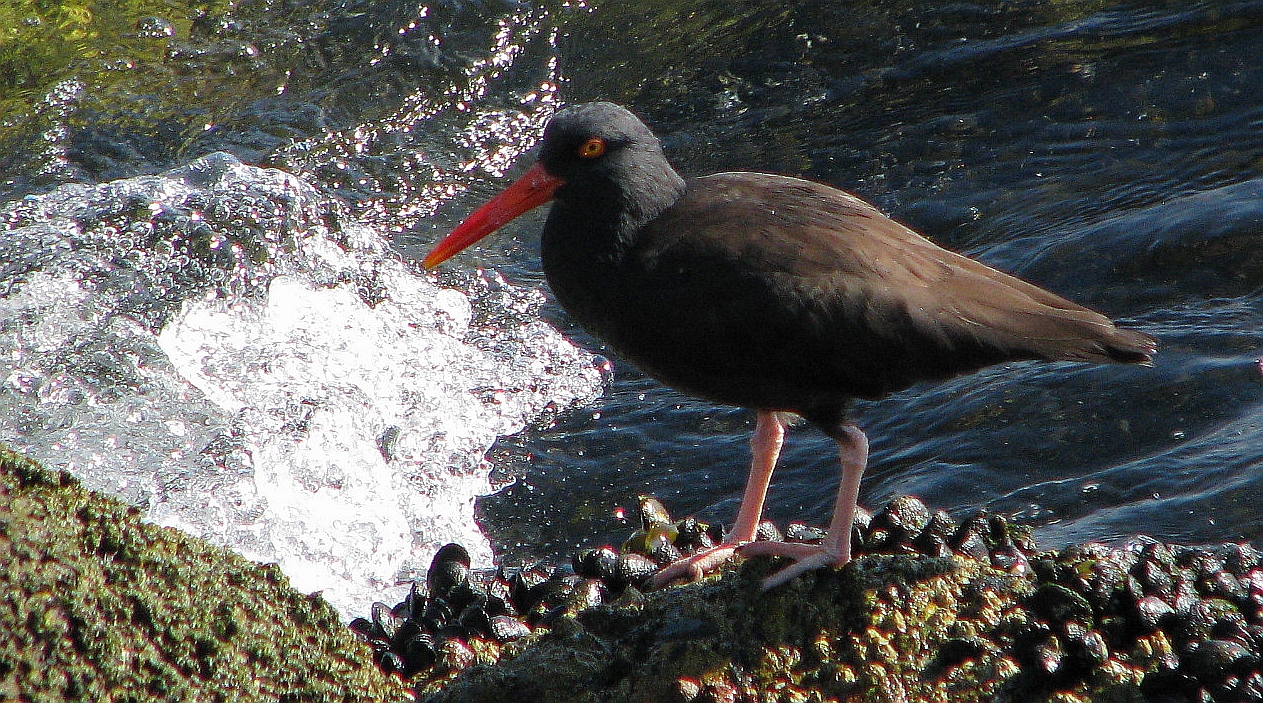
Black Oystercatcher on the Jetty (C.Almdale 11/09)
Along the central jetty we found Surfbirds, Black Turnstones and Black Oystercatchers in [relative] abundance, which means several dozens of the first two and about 10 of the latter. The outer jetty was covered with Brown Pelicans and Brandt’s Cormorants: amazingly we could not find a single Pelagic or Double-crested Cormorant resting there, which must be a first for me. Rafts of scoters and [probably mostly] Western Grebes were off to the south, too far to properly view. Diligent searching did not turn up any Wandering Tattlers, a rocky-shore-loving bird uncommon but regular on the SoCal mainland.

Surfbird Trio (C.Almdale 11/09)
We had spent so much time wandering up and down the creek that our visit to the Freshwater Marsh at the corner of Lincoln & Jefferson Blvds. was abbreviated. Nevertheless, we managed to scare up plenty of Black-crowned Night Herons and a Sora as well as hearing a Virginia Rail. This is a reliable spot for Common Moorhen and we found several poking along the edges of the reeds. The pond at the south end had at least 6 Wilson’s Snipe foraging among the pond-edge leaves and brush. On the way back, an American Kestrel perched on a light pole, while a Red-tailed Hawk and several Common Ravens flew overhead. Altogether, a surprisingly fine day.
| Ballona Channel & Del Rey Lagoon |
Ballona Freshwater Marsh |
| Greater White-fronted Goose Gadwall American Wigeon Mallard Lesser Scaup Surf Scoter Bufflehead Red-breasted Merganser Ruddy Duck Common Loon Pied-billed Grebe Eared Grebe Western Grebe Clark’s Grebe Brown Pelican Brandt’s Cormorant Double-crested Cormorant Great Blue Heron Great Egret Snowy Egret Turkey Vulture Red-tailed Hawk American Coot Black-bellied Plover Killdeer Black Oystercatcher Willet Whimbrel Marbled Godwit Ruddy Turnstone Black Turnstone Surfbird Sanderling Western Sandpiper Least Sandpiper Short-billed Dowitcher Heermann’s Gull Ring-billed Gull Western Gull California Gull Forester’s Tern Rock Pigeon Mourning Dove Burrowing Owl Anna’s Hummingbird Allen’s Hummingbird Black Phoebe Say’s Phoebe American Crow Bushtit Northern Mockingbird European Starling Orange-crowned Warbler Yellow-rumped Warbler Savannah Sparrow White-crowned Sparrow Brewer’s Blackbird House Finch Lesser Goldfinch House Sparrow |
Gadwall American Wigeon Mallard Cinnamon Teal Northern Shoveler Green-winged Teal Bufflehead Ruddy Duck Pied-billed Grebe Eared Grebe Double-crested Cormorant Great Blue Heron Great Egret Snowy Egret Green Heron Black-crowned Night Heron Turkey Vulture Osprey Red-tailed Hawk Ferrugenous Hawk American Kestrel Virginia Rail (H) Sora Common Moorhen American Coot Killdeer Spotted Sandpiper Wilson’s Snipe Ring-billed Gull Rock Pigeon Mourning Dove Anna’s Hummingbird Allen’s Hummingbird Northern Flicker Black Phoebe Say’s Phoebe Western Kingbird American Crow Common Raven Bushtit Marsh Wren (H) Ruby-crowned Kinglet Blue-gray Gnatcatcher Hermit Thrush Northern Mockingbird European Starling Orange-crowned Warbler Yellow-rumped Warbler Common Yellowthroat California Towhee Song Sparrow White-crowned Sparrow Red-winged Blackbird Great-tailed Grackle House Finch Lesser Goldfinch |
| 60 Species | 56 Species |
Rare Bird Alerts by Email
The internet is filled with information and services attractive to birders. This is the first of an irregular series alerting our members to some of them.
A list serve is a website to which people post messages, and then distributes the messages to people who have signed up to receive them. Our blog is a list serve if you’ve signed up to automatically receive the postings by email. Rare bird alerts also usually operate as a list serve. There are rare bird alerts available for virtually everywhere in the world. Places like China, Russia, Southeast Asia, Africa or South America may have only one alert for the entire region, but here in California, we have dozens. Many of the Southern California counties have their own alert, and it is very easy to sign up for these alerts. Many list serves make new sign-ups wait a week or two before allowing you to post something. This allows you to see their rules of etiquette in action and keeps out web pests who only want to post annoying messages instantly.
For example, if you were signed up for either the Orange County or LA County list serves, you would have known about the Bar-tailed Godwit (pictured below) which showed up (still there as of this writing) at Upper Newport Bay, just below the Jamboree Rd. bridge. This bird nests in western Alaska and normally heads southwest into Asia for the winter. Every once in a while it goes southeast instead, and shows up here. Of course, seeing the bird isn’t the same as getting a decent picture of the bird.
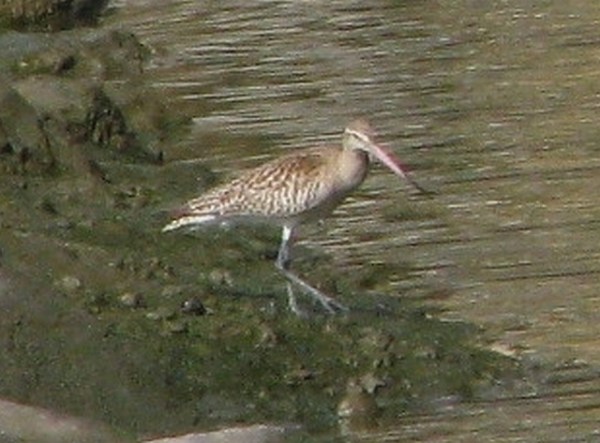
Bar-tailed Godwit (Limosa lapponica lookifuzzi)
If you’d like to seem some better pictures of this bird taken by Chris Taylor, click this link: http://kiwifoto.com/f/btgo_newport_110709
I receive BirdChat, BirdWest and CalBird in what is called “Digest” mode. All messages for the day are bundled so you get only one email per day. But you can get them individually if you prefer. I let the messages for the local county lists come in one-by-one, as there aren’t many messages. I subscribe to the Los Angeles and Orange Counties list serves. There are also list serves for: Ventura, Santa Barbara, Kern, San Diego, SE California, No. California and so on. You can sign up for any and all. As with any email, if the subject line doesn’t sound interesting, delete it.
The subscribing system on all these list serve sites is automated. You can’t go wrong. If you make an error, it will tell you what to do to fix it.
Bird Chat
Nationwide conversations about birdy stuff of all sorts.
List-Subscribe: <mailto:BIRDCHAT-subscribe-request@LISTSERV.ARIZONA.EDU>
Type “subscribe” WITHOUT the quotes in both the Subject Line the message area.
BirdWest:
Collection of rare bird reports for the Western US.
Rare bird reports come out weekly from dozens of counties, Audubon chapters, etc. BirdWest collects all these reports for the Western US and sends them to you.
BIRDWEST-subscribe-request@LISTSERV.ARIZONA.EDU
Leave the subject line blank. Type “subscribe” WITHOUT the quotes in the message area.
LA County Birds
Rare bird sightings primarily for LA County, but also some nearby areas.
LACoBirds-subscribe@yahoogroups.com
Type “subscribe” WITHOUT the quotes in both the Subject Line the message area.
Orange County Birds
Rare bird sightings primarily for Orange County, but also some nearby areas.
OrangeCountyBirding-subscribe@yahoogroups.com
Type “subscribe” WITHOUT the quotes in both the Subject Line the message area.
California Birds
Statewide bird news and sightings.
CALBIRDS-subscribe@yahoogroups.com
Type “subscribe” WITHOUT the quotes in both the Subject Line the message area.
If you are traveling to another county, state, or overseas, it’s worthwhile finding out if they have a local bird alert and signing up for it before you travel. Note, however, that since they mostly report rare birds, they may be more interested in birds common to Southern California than they are in their own common birds. You can always post a RFI (Request For Information) on how to find their local birds. Birders are usually quite helpful. Be sure to follow the listserve etiquette which you will receive in your Welcome! message, and thank anyone who helps you out.
Feel free to send in questions, comments and suggestions for other web birding items.
California Gull Breeding Success
This is an interesting report on how California Gulls have been encouraged to breed so successfully (from 28 gulls in 1980 to nearly 47,000 in 2008) that the numbers are now threatening the success of the Wetlands project in the San Franciso South Bay.
http://www.insidebayarea.com/dailyreview/localnews/ci_13722097
Butterbredt Spring Halloween Campout 10/31 – 11/1 2009
Thirteen, turned out to be a lucky number, the participants in our Butterbredt Spring birding, camping at Sageland, feasting, and imaginative pumpkin carving event, with plenty of surprise sightings!
First, after meeting Saturday morning at the Spring’s gate, there enjoying the sweet winter calls of myriads of White-crowned Sparrows who were flying in to the puddles in the rushes, we wondered what was making another murmuring sound.
In the cottonwood grove, Chuck Bragg spotted an interesting warbler with a “white” face. Possibly a Hermit? Others saw a Robin. The usual Bewick’s Wrens and Rock Wrens were about. No sign of the expected Great Horned Owls.
Onward, we crawled through the eastern fence to the water trough where it was apparent the flow needed help. As the outflow began trickling down the slope into the open puddle area, literally dozens and dozens of Sage Sparrows flew in from the surroundings for a drink and bath. They came from many directions, running, tails high, like miniature Roadrunners. Their contact calls explained the mystery murmur we’d heard earlier. Standing out of their way, we observed their every feature, better than ever previously, in my case.
Further down the trail produced a number of Ruby-crowned Kinglets, more wrens, House Finches, a Flicker, Lesser Gold Finches, an Orange-crowned Warbler, a distant Raven, but no Long-eared Owls.
Returning, we paused again under the big Cottonwood in the draw where Chuck spotted an animal high in the tree’s crotch, apparently sleeping. Raccoon, was the guess, but no. It finally turned its sleepy head to reveal a “fox”. Much speculation followed regarding its species but eventually all agreed, the tail was black to the tip, and the red in the coat was typical of our native species. That non-bird, so high in a tree was a great sighting! Foxes do climb, it seems, and like to sleep days, out of reach of harm. Then, a Great Horned Owl was discovered high in one of the Spring’s cottonwoods on the way out.
After snacks, the group chose to proceed up the Butterbredt Canyon OHV road in hopes of specialties. It reportedly had been recently graded and passable, even for most regular autos. Chuck lead in his Prius, did not get stuck, and Liz Galton, despite lack of previous experience, bravely followed at the end, in her Prius, unaware of the to-be-expected challenges of sand, bumps, narrow passages. She did well, but, might not want to attempt another such run. The only new bird was a perched Loggerhead Shrike. Eagles absent. No Meadowlarks, Roadrunners, Mountain Bluebirds, Pinyon Jays. However, reports indicate big raptors and the Bluebirds are now in the area – available for the upcoming Christmas Bird Count.
Continuing then, to Keith Axelson’s Sageland Ranch, off Kelso Creek, for camping, partying, more walks, many more birds, (they regularly flock there to his stream, feeders, and great riparian habitat), we carved our pumpkins for the evening’s show and contest, and enjoyed barbeque dinners with special deserts. Afterwards, came the pumpkin lighted display which was spectacular, possibly the best ever in many years. Chuck Bragg, out of long practice, judged a prize for each one with a final for his outstanding, unique, incised “Rabbit Bush”! Who could argue?
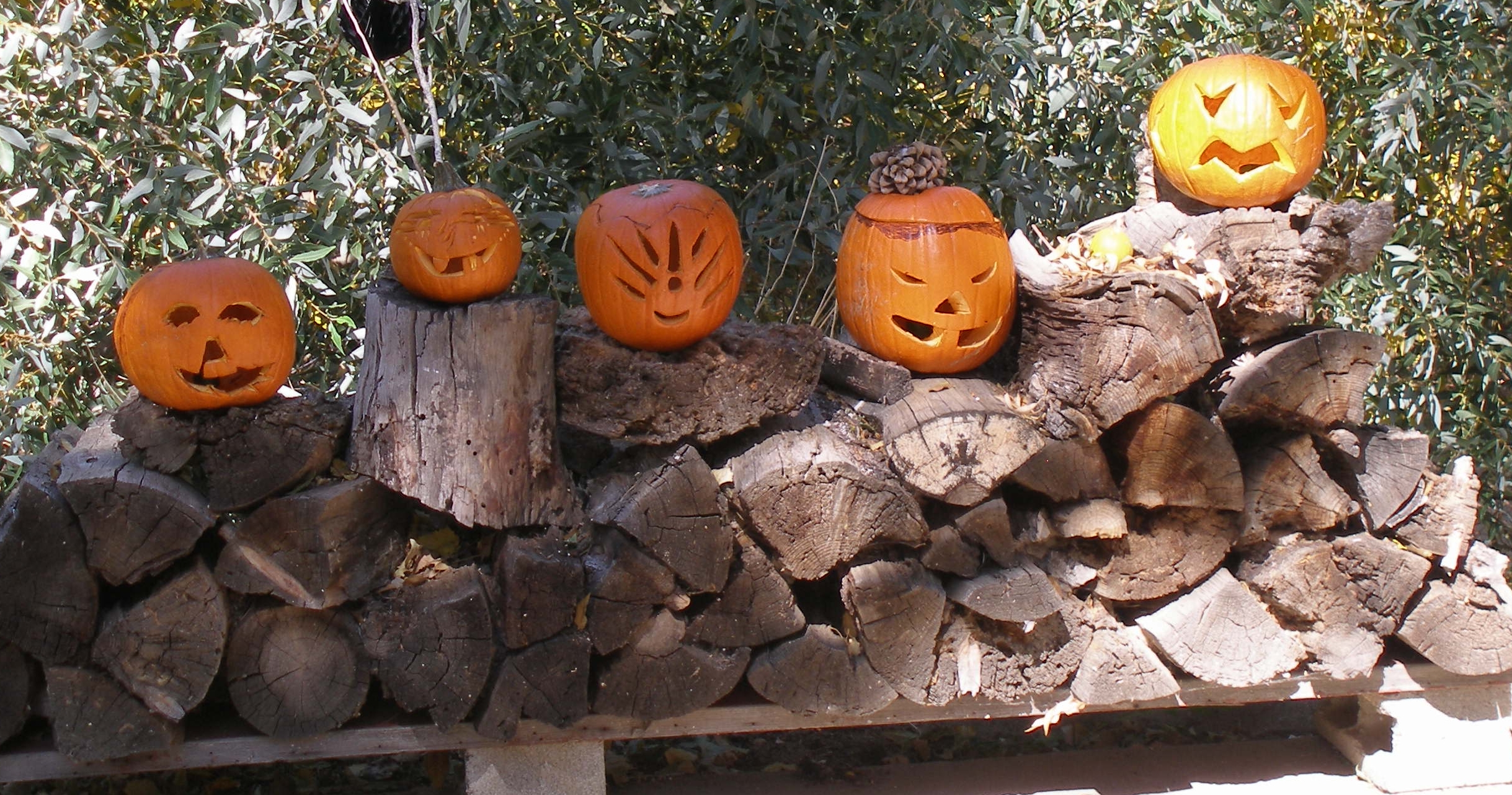
Hollowed heads of fallen friends are prominently displayed
The golden glow of rabbit brush is a signature feature of this outing as are the brilliant yellow crowns of the cottonwoods at this season, and the campfire, and, happily, the perfect weather.
During an afternoon walk down to Kelso Creek and return, Chuck, lucky man, spotted an unusual woodpecker-type bird, black, with a long white wing patch, a Williamson’s Sapsucker male. We were blown away! Usually found in higher elevation woodlands, it was the first-ever male seen there by Keith. Later it turned up in nearby trees and some of us had a chance for our best ever view of this rather uncommon bird.
Roxane Seidner also discovered another unexpected bird, below the suspension bridge, a Wilson’s Snipe, lurking along the stream. Of course, when the rest of us rushed to look, it had already slipped away.
Two other sightings deserve mention. We were horrified on our initial arrival at the Butterbredt Spring to see a large pile of feathers, the discarded wings of a quail flock, possibly, also of Chuckars, left by hunters. Although in legal hunting season, it is impossible to imagine anyone wanting to shoot these beautiful little birds.
The other sighting involved Keith’s recently built and installed owl box. Lys, Keith’s daughter, noticed feathers around the bottom edge of the box, so, on a hunch, he opened it, discovering a little Screech Owl calmly roosting there. We were all permitted a very brief look. This seems like a happy replacement family for Sageland, after Keith’s original family of Screech Owls perished from effects of the drought and predation. We heard them calling each other in the evenings, a sweet and haunting warble, rather than a screech.
Sunday, Nov. 1, some participants needed to leave for home, but those continuing enjoyed a long hike up Axelson Creek to Dove Spring Road, cross country, thence up the rocky draw northeast, where we observed a wood-log barrier recently installed by the SCA (Student Conservation Association) and Keith. This type of barrier virtually prevents motorcyclists from jumping off a legitimate trail at critical points, in order for them to cut down canyons or cross country. These barriers are very substantial, virtually impossible to ignore, bypass or up-root, as happens with posted signs and other obstacles. It is satisfying to see support of SCA being rewarded.
The atmosphere at Butterbredt and Sageland was, and always is, very birdy, very beautiful, restful, sometimes, eventful, Nature at its best!. This was no exception. One is reluctant to leave. The group was altogether congenial. We hope we will see them and other of our members on more outing at SMBAS sponsored Butterbredt Spring.
Leader: Mary Prismon
Participants: Chuck Bragg, Lys Axelson, Keith Axelson, Andrew and Sylvia Nawrocky, John Vanderhoest, Jean Garrett, Gloria Bando, Elizabeth Galton, Natsumi Rice, Roxane Seidner, Mary Prismon, Allison Sheehey
A bird list follows.
Bird List: Butterbredt Spring, Kelso Valley, Sageland
10/31 – 11/2 – 2009
| White-crowned Sparrow | Sage Sparrow |
| Ruby-crowned Kinglet | California Towhee |
| California Quail | Red-tailed Hawk |
| American Robin | Nashville Warbler |
| Yellow-rumped Warbler | Bewick’s Wren |
| Rock Wren | House Finch |
| Northern Flicker | Common Raven |
| Spotted Towhee | American Kestrel |
| Cooper’s Hawk | Dark-eyed Junco |
| Wilson’s Snipe | Williamson’s Sapsucker (male) |
| Pine Siskin | Western Bluebird |
| Anna’s Hummingbird | Scrub Jay |
| European Starling | Western Screech Owl |
| California Thrasher | Red-breasted Sapsucker |
| Loggerhead Shrike | Lesser Goldfinch |
| Nuttall’s Woodpecker |
Bird Articles from the Science Press
Tool Use to Crow About
http://www.sciencenews.org/view/generic/id/46196/title/Tool_use_to_crow_about
Crows use sticks, stones to show skills at manipulating tools in lab.
From Science News, Aug. 29, 2009
Tiny Bird, Tiny Genome
http://www.sciencenews.org/view/generic/id/46148/title/Tiny_bird%2C_tiny_genome
Scientists find that hummingbirds have less DNA in their cells than any previously studied bird, reptile or mammal. From Science News, Aug. 29, 2009
Avian Moltitasking
The time it takes to replace feathers might limit birds’ body size.
From Natural History Magazine, September 2009
http://www.naturalhistorymag.com/samplings/241532/avian-moltitasking



 SANTA MONICA BAY AUDUBON SOCIETY BLOG