Returnees: Malibu Lagoon, 27 August 2023
[By Chuck Almdale]
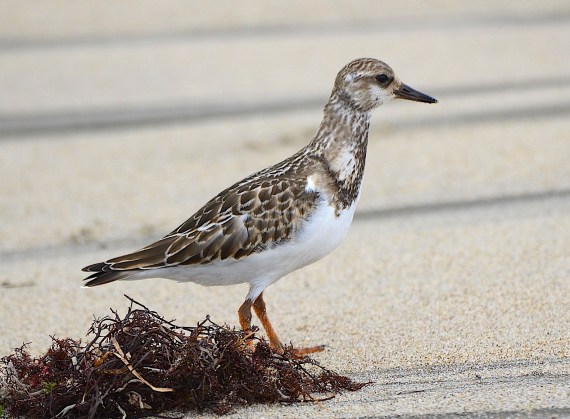
Stand up and be counted! Please! Ruddy Turnstone (Larry Loeher 8/31/23)
Turnstones rarely stand up straight, but hunch over, looking down for tiny things to eat. They’re at the upper end of peep-sized.
Last month we had 70 shorebirds in 9 species; this month we had 145 shorebirds in 15 species. And that’s about right for the July to August transition. Birds are returning. Some stay all winter, or at least the species is present if not the individuals. Some, Semipalmated Plovers for example, continue south, then return briefly in the Spring on their way north. Some, like the Brown Pelican (not an actual “shorebird” although technically it is a bird on the shore) below, continually drop in all year around.
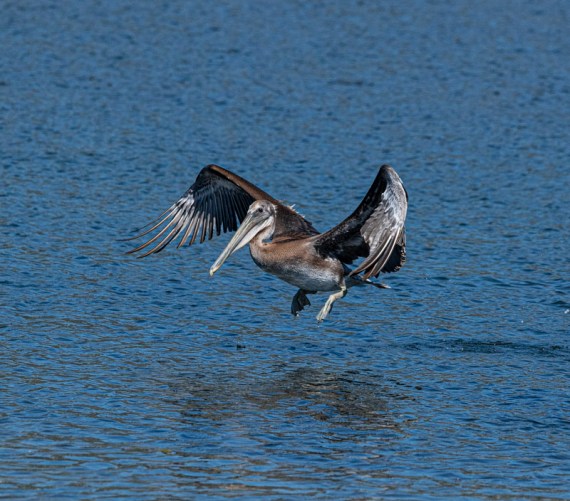
Brown Pelican levitates o’er the lagoon (Ray Juncosa 8/27/23)
I think we arrived at almost 30 birders (whom I rarely enumerate) who drifted in and out. Many arrive late — suddenly I find myself surrounded by people appearing out of nowhere — but by the time we hit the beach they’ve wandered off in different directions. The weather was nice, starting at 69°F and not getting much warmer.
The Osprey was on its Official Osprey Pole, installed a decade ago as a perch intended specifically for him. But he and/or she prefers the various cypress trees or the telephone pole by Malibu Colony, or the monkey-puzzle tree by Adamson House. He got up later and flew around a bit, even swooped low a couple of times, but didn’t actually dive on anything. He did give some of the peeps, gulls, and terns a fright. Notice the amber eye.
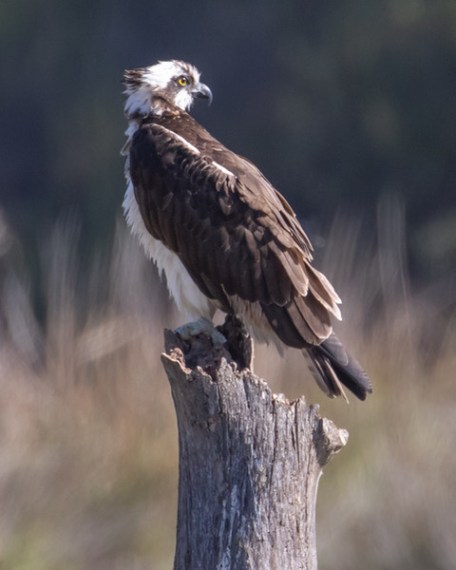
Osprey (Chris Tosdevin 8/27/23)
Black-crowned Night-Herons tend to feed by themselves, as someone else nearby might scare the fish or try to steal one you just caught. But these two juveniles stayed pretty close to each other. Perhaps they were recent nestmates, and weren’t used to being by themselves quite yet. Two young herons face the world!
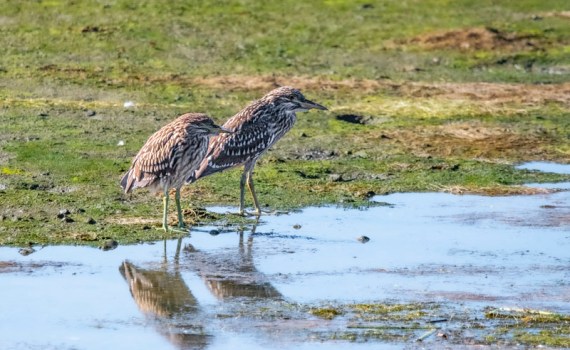
Black-crowned Night-Heron juveniles (Ray Juncosa 8/27/23)
Let’s take a look at some of the shorebirds, especially the “peeps.” Do you know, by the way, why they’re called “peeps?”

A baffling of birders on the west end path looking at peeps and egrets (Ray Juncosa 8/27/23)
Birders tend to confuse the smallest peeps with each other — the Least and the Western for example. As befits the name, the Least is the smallest peep, 1/4-1/2″ smaller than the Western. This time of year they can appear in juvenile, breeding (alternate), or winter (basic) plumages. The Least (below) tends to be a bit “warmer” brown , more streaky breast with a shorter slightly decurved bill and yellow-green legs. Westerns never have yellow-green legs, so thats a good “quickie” field mark, but which needs to be confirmed with the other marks. But sometimes the Least’s legs can look black from mud or shadow. Check the legs on this bird below. Black. But it looks like a Least, with warm brown colors, especially on the breast. Check that one toe in the sunlight. Yellow-green. Ah hah!
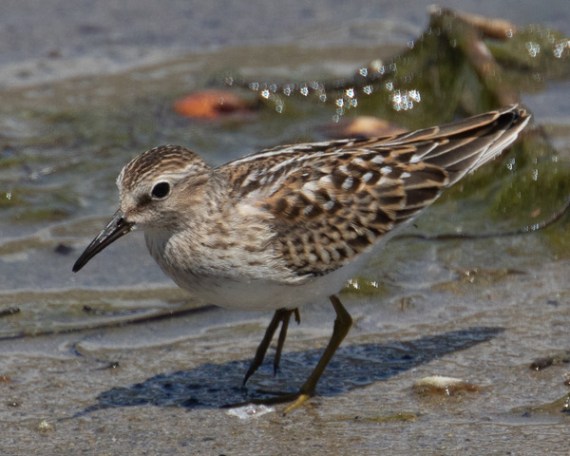
Least Sandpiper (Chris Tosdevin 8/27/23)
Below is a real Western Sandpiper. Not as warm brown, more gray-black-white, save for that rusty-brown streak on the shoulder, a left-over from breeding. Black legs and longer, more curved black bill. Check the bill closely. Tiny points like teeth on the bill edges. You rarely get a good enough look to see those.
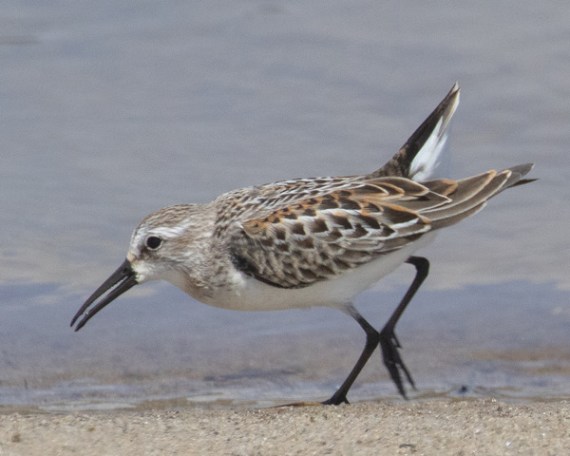
Western Sandpiper (Chris Tosdevin 8/27/23)
Sanderlings look a lot like both Western Sandpipers and Snowy Plovers, but not at the same time. It depends on the time of year. They’re generally even more gray-black-white than the Westerns, except in breeding when they can have a lot of warm rusty-red colors, but we rarely see that in SoCal. They frequently roost among the Snowy Plovers on Malibu Beach, so we have to be careful of them when we’re censusing the SNPLs and all we can see is the tops of their heads. They’re about 1.5″ larger than the Westerns, a significant difference except when they’re crouched down in a tiny dimple in the sand. Their legs and bill are black and the bill is thicker and shorter, often with a tiny bulge at the tip. They are often seen running back and forth on the sand as the wavelets wash in and out, and when most people think of “sandpiper,” they’re thinking of this bird. They are our chapter “mascot.”

Sanderling (Chris Tosdevin 8/27/23)
The three phalarope species look like peeps, but they are really their own group. 92% of our phalarope visits at the lagoon are by Red-throated, like the bird below, which has the intermediate-length bill of the three. They’re all about the same size or slightly larger than Sanderlings, but they look less bulky and behave differently. Sanderlings poke at the sand; phalaropes normally feed in fairly shallow calm water, spinning in a circle to make an tiny upwelling vortex which brings invertebrates to the surface where they pick them up. Phalaropes are also polyandrous: the females are more colorful than the males and they take multiple mates while the males tend to the nest and the young.
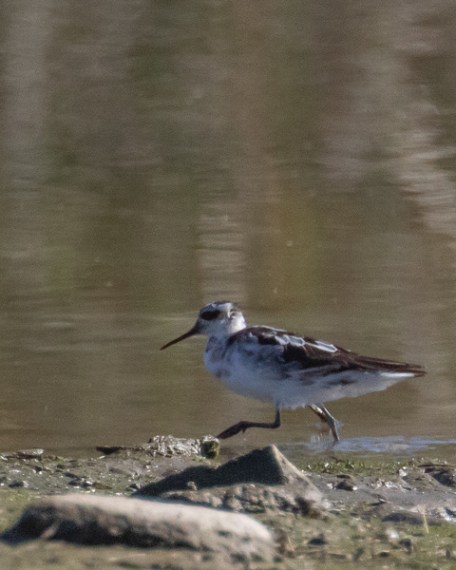
Red-throated Phalarope (Chris Tosdevin 8/27/23)
Snowy Plovers are semi-polyandrous. All our readers should be familiar with them as our chapter has “adopted” them and censused them on several L.A. County beaches over the past three decades. The males are ever-so-slightly more colorful than the females, and both male and female build the nest (such as it is, which isn’t much) and sit on the eggs. But within a few days of the eggs hatching, the female leaves and flies elsewhere to find a new mate and nest again. She may do this several times each breeding season. The male, meanwhile, stays with the young and watches over them. But he doesn’t bring them any food. They have to find their own, while he stands around and watches. Occasionally, when he feels that a potential predator (gull, larger shorebird) is nearby, he’ll try to chase it off. And he may rest near the young. But that’s about the extent of his parental care.
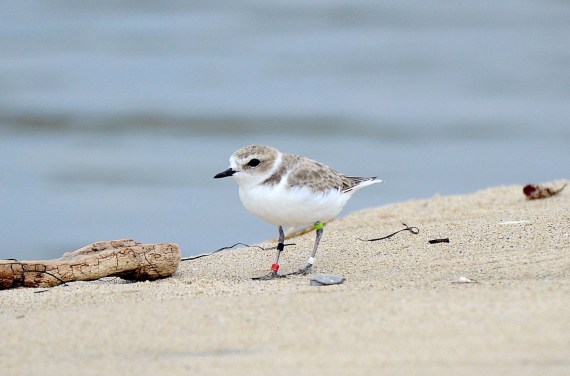
Snowy Plover Lw: kr (Larry Loeher 8/31/23)
The code stands for Left Side, Lime (above the ankle or “backwards knee”) over White: Right side, Black over Red.
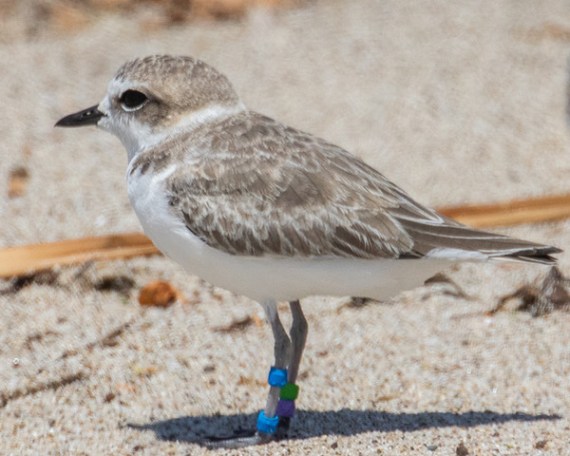
Snowy Plover bb: gv (Chris Tosdevin 8/27/23)
The code stands for Left Side, Blue over Blue: Right side, Green over Violet.
Our final sandpiper is not a “peep.” Fully grown they can be 23″ long. Their bills can vary in length as it takes a few months for their bill length to catch up to their body size. Long-billed Curlews look a lot like Whimbrels as their long bills curve downward. Whimbrels are about 50 times more common at the lagoon than the Long-billed, max out at 17.5″ long, have dark stripes on their head including one through the eye, and are less warmly brown all over. Curlews briefly stop at the lagoon to rest but don’t really like the limited habitat, and leave before long. A few dozen generally spend the winter at Upper Newport Bay which has more extensive marshland and grassy fields.
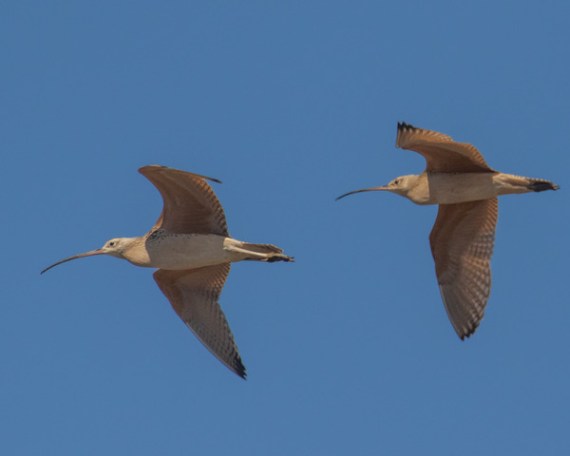
Long-billed Curlews (Chris Tosdevin 8/27/23)
I don’t know how Chris Tosdevin finds these butterflies, which at 1/2-3/4″ inch, wing-tip to wing-tip, are the world’s smallest butterfly. [The largest moth is the Atlas Moth of SE Asia, with a 10″ wingspan.] Their range is fairly extensive and includes the lagoon. I put one of his older Pygmy Blue photos into this month’s trip announcement; perhaps he saw it and felt it needed a companion.
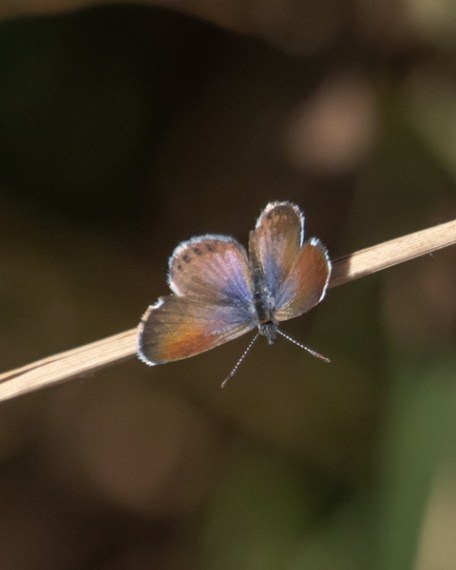
Western Pygmy Blue Butterfly, Brephidium exilis (Chris Tosdevin 8/27/23)

Range of the Western Pygmy Blue Butterfly, Brephidium exilis. Source: Butterflies & Moths
Occasionally the locals get rowdy, usually some sort of turf (or aerial equivalent) battle.
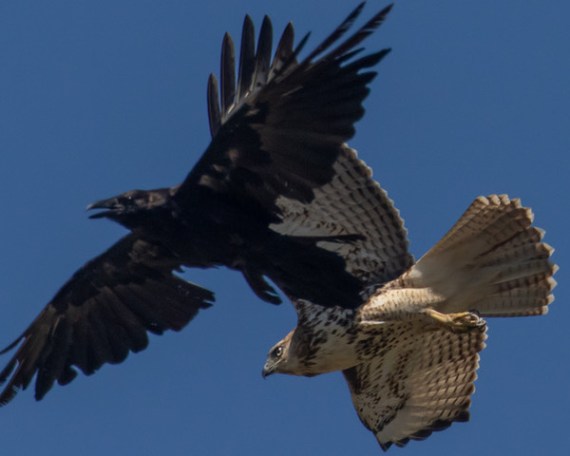
Northern Raven and juvenile Red-tailed Hawk (Chris Tosdevin 8/27/23)
You’ll be happy to know that The Arc of the Cormorant, Part II is still playing at the lagoon.

The Arc of the Cormorant [Double-crested] (Ray Juncosa 8/27/23)
One can only guess what this Heermann’s Gull is up to with this stick. The Western Gull seems bemused as well.
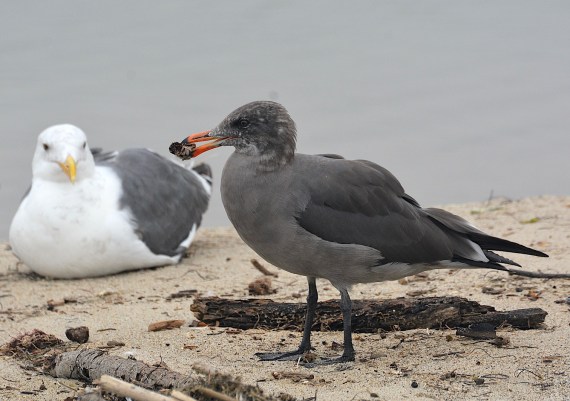
Western & Heermann’s Gulls (Grace Murayama 8/31/23)
Finally, we have a Snowy Egret stirring up the waters, trying to arouse some curiosity among the fish.
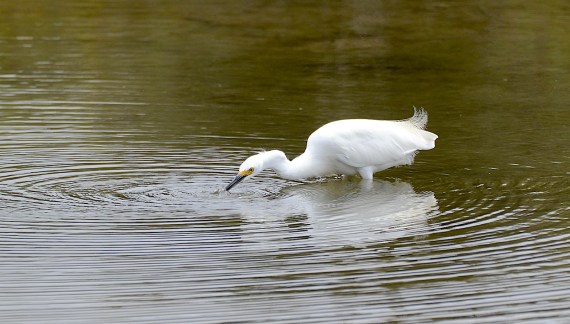
Snowy Egret (Larry Loeher 8/31/23)
Not much to report on the ducks and geese, alas. Not all the Mallards and Gadwall are full-sized yet, and after seven months our small family of four Canada Geese have left.
Birds new for the Season: Pied-billed Grebe, Feral Pigeon, Long-billed Curlew, Marbled Godwit, Ruddy Turnstone, Sanderling, Short-billed Dowitcher, Spotted Sandpiper, Red-necked Phalarope, Herring Gull, Caspian Tern, Green Heron, Osprey, Red-tailed Hawk, Wrentit, Yellow Warbler.
Malibu Lagoon on eBird as of 8-29-23: 7066 lists, 319 species
Most recent species added: Lilac-crowned Parrot (13 May 2023, Nick Diaco).
Many, many thanks to photographers: Ray Juncosa, Larry Loeher, Grace Murayama, Chris Tosdevin
Upcoming SMBAS scheduled field trips:
- Malibu Lagoon, Sun. Aug 24, 8:30 am. No reservations or Covid card required.
- Coastal Cleanup Day, Various Locations, Sat. Sep 23, 9 am–Noon
- Field trip to be announced: Sat. Oct 14.
- Malibu Lagoon, Sun. Oct 22, 8:30 am. No reservations or Covid card required.
- These and any other trips we announce for the foreseeable future will depend upon expected status of the Covid/flu/etc. pandemic at trip time. Any trip announced may be canceled shortly before trip date if it seems necessary. By now any other comments should be superfluous.
- Link to Programs & Field Trip schedule.
The next SMBAS Zoom program: “Birds of Cuba” with Alvaro Jaramillo. Tuesday, 3 Oct. 2023, 7:30 p.m.
The SMBAS 10 a.m. Parent’s & Kids Birdwalk restarted April 23. Reservations for groups (scouts, etc.) necessary; not necessary for families.
Links: Unusual birds at Malibu Lagoon
9/23/02 Aerial photo of Malibu Lagoon
More recent aerial photo
Prior checklists:
2023: Jan-June
2021: Jan-July, July-Dec 2022: Jan-June, July-Dec
2020: Jan-July, July-Dec 2019: Jan-June, July-Dec
2018: Jan-June, July-Dec 2017: Jan-June, July-Dec
2016: Jan-June, July-Dec 2015: Jan-May, July-Dec
2014: Jan-July, July-Dec 2013: Jan-June, July-Dec
2012: Jan-June, July-Dec 2011: Jan-June, July-Dec
2010: Jan-June, July-Dec 2009: Jan-June, July-Dec
The 10-year comparison summaries created during the Lagoon Reconfiguration Project period, remain available—despite numerous complaints—on our Lagoon Project Bird Census Page. Very briefly summarized, the results unexpectedly indicate that avian species diversification and numbers improved slightly during the restoration period June’12-June’14.
Many thanks to Ray Juncosa, Chris Lord, Chris Tosdevin, Ruth Tosdevin and others for their contributions to this month’s checklist.
The species lists below is irregularly re-sequenced to agree with the California Bird Records Committee Official California Checklist as updated Aug 2023. If part of the chart’s right side is hidden, there’s a slider button at the bottom of the list.
[Chuck Almdale]
| Malibu Census 2023 | 3/26 | 4/23 | 5/28 | 6/25 | 7/23 | 8/27 | |
| Temperature | 57-60 | 57-66 | 61-62 | 59-71 | 66-70 | 69-73 | |
| Tide Lo/Hi Height | L+0.28 | L-.041 | L+0.81 | L+0.89 | L+0.81 | H+3.68 | |
| Tide Time | 0800 | 0637 | 1131 | 0919 | 0730 | 0832 | |
| 1 | Canada Goose | 6 | 4 | 5 | 4 | 4 | |
| 1 | Gadwall | 42 | 24 | 17 | 45 | 90 | 45 |
| 1 | Mallard | 12 | 15 | 12 | 33 | 77 | 20 |
| 1 | Green-winged Teal | 5 | |||||
| 1 | Redhead | 3 | |||||
| 1 | Surf Scoter | 22 | 3 | 2 | |||
| 1 | Red-breasted Merganser | 2 | |||||
| 2 | Pied-billed Grebe | 1 | 2 | 2 | |||
| 2 | Western Grebe | 80 | 6 | ||||
| 7 | Feral Pigeon | 6 | 1 | 8 | 3 | ||
| 7 | Eurasian Collared-Dove | 2 | |||||
| 7 | Mourning Dove | 1 | 2 | 2 | 2 | 2 | 2 |
| 8 | White-throated Swift | 5 | |||||
| 8 | Anna’s Hummingbird | 1 | 1 | 1 | |||
| 8 | Allen’s Hummingbird | 3 | 2 | 1 | 2 | 4 | |
| 2 | American Coot | 37 | 6 | 5 | 6 | ||
| 5 | Black-bellied Plover | 3 | 6 | 39 | |||
| 5 | Killdeer | 5 | 4 | 4 | 8 | 8 | 13 |
| 5 | Semipalmated Plover | 14 | 1 | 7 | |||
| 5 | Snowy Plover | 1 | 7 | 13 | |||
| 5 | Whimbrel | 25 | 16 | 11 | 32 | 38 | |
| 5 | Long-billed Curlew | 4 | |||||
| 5 | Marbled Godwit | 2 | 1 | ||||
| 5 | Ruddy Turnstone | 2 | |||||
| 5 | Sanderling | 2 | 2 | ||||
| 5 | Dunlin | 2 | |||||
| 5 | Least Sandpiper | 19 | 4 | 8 | |||
| 5 | Western Sandpiper | 30 | 6 | 3 | |||
| 5 | Short-billed Dowitcher | 1 | |||||
| 5 | Spotted Sandpiper | 3 | |||||
| 5 | Willet | 7 | 2 | 7 | 5 | 9 | |
| 5 | Wilson’s Phalarope | 1 | |||||
| 5 | Red-necked Phalarope | 2 | |||||
| 6 | Bonaparte’s Gull | 3 | |||||
| 6 | Heermann’s Gull | 3 | 80 | 152 | 94 | 89 | 90 |
| 6 | Ring-billed Gull | 46 | 120 | 12 | 5 | 1 | |
| 6 | Western Gull | 26 | 50 | 72 | 105 | 150 | 85 |
| 6 | California Gull | 95 | 60 | 2 | 3 | ||
| 6 | Herring Gull | 2 | 1 | ||||
| 6 | Caspian Tern | 2 | 2 | 1 | |||
| 6 | Royal Tern | 13 | 3 | 20 | 10 | ||
| 6 | Elegant Tern | 90 | 630 | 305 | 150 | 2 | 40 |
| 6 | Black Skimmer | 2 | |||||
| 2 | Red-throated Loon | 1 | |||||
| 2 | Pacific Loon | 1 | 1 | ||||
| 2 | Common Loon | 2 | 1 | ||||
| 2 | Brandt’s Cormorant | 12 | 8 | 2 | |||
| 2 | Pelagic Cormorant | 2 | 3 | 3 | 1 | ||
| 2 | Double-crested Cormorant | 26 | 53 | 74 | 75 | 42 | 23 |
| 2 | Brown Pelican | 62 | 655 | 168 | 162 | 174 | 56 |
| 3 | Great Blue Heron | 2 | 1 | 4 | 4 | 5 | |
| 3 | Great Egret | 2 | 1 | 2 | 2 | 3 | 5 |
| 3 | Snowy Egret | 2 | 1 | 3 | 4 | 4 | 8 |
| 3 | Green Heron | 1 | |||||
| 3 | Black-crowned Night-Heron | 2 | 2 | 5 | |||
| 4 | Turkey Vulture | 5 | 1 | 2 | |||
| 4 | Osprey | 1 | 1 | 1 | 1 | ||
| 4 | Cooper’s Hawk | 1 | 1 | ||||
| 4 | Red-tailed Hawk | 2 | 2 | 1 | |||
| 4 | Peregrine Falcon | 1 | |||||
| 9 | Cassin’s Kingbird | 1 | |||||
| 9 | Pacific-slope Flycatcher | 1 | |||||
| 9 | Black Phoebe | 2 | 1 | 6 | 4 | 6 | 2 |
| 9 | California Scrub-Jay | 2 | 1 | ||||
| 9 | American Crow | 6 | 4 | 3 | 9 | 20 | 9 |
| 9 | Common Raven | 2 | 2 | 2 | 1 | ||
| 9 | Oak Titmouse | 1 | |||||
| 9 | Northern Rough-winged Swallow | 6 | 6 | 5 | 15 | ||
| 9 | Barn Swallow | 14 | 15 | 30 | 35 | 12 | 35 |
| 9 | Cliff Swallow | 3 | 25 | 4 | 30 | ||
| 9 | Bushtit | 3 | 2 | 8 | 4 | 22 | |
| 9 | Wrentit | 1 | 1 | 1 | |||
| 9 | Cedar Waxwing | 12 | |||||
| 9 | House Wren | 2 | |||||
| 9 | Bewick’s Wren | 1 | 1 | ||||
| 9 | Northern Mockingbird | 1 | 1 | ||||
| 9 | European Starling | 2 | 3 | 6 | |||
| 9 | House Finch | 5 | 7 | 13 | 8 | 15 | 5 |
| 9 | Lesser Goldfinch | 5 | 2 | 5 | 1 | ||
| 9 | Dark-eyed Junco | 1 | 1 | ||||
| 9 | White-crowned Sparrow | 12 | |||||
| 9 | Song Sparrow | 5 | 7 | 10 | 5 | 5 | 4 |
| 9 | California Towhee | 1 | 5 | 3 | 1 | 3 | |
| 9 | Hooded Oriole | 1 | 1 | 3 | 1 | ||
| 9 | Red-winged Blackbird | 2 | 4 | 3 | 6 | ||
| 9 | Brown-headed Cowbird | 1 | 3 | 1 | |||
| 9 | Great-tailed Grackle | 6 | 4 | 2 | 1 | 1 | |
| 9 | Orange-crowned Warbler | 3 | 1 | 1 | |||
| 9 | Common Yellowthroat | 3 | 1 | ||||
| 9 | Yellow Warbler | 1 | |||||
| 9 | Yellow-rumped Warbler (Audubon’s) | 7 | |||||
| 9 | Wilson’s Warbler | 1 | |||||
| Totals by Type | Mar | Apr | May | Jun | Jul | Aug | |
| 1 | Waterfowl | 92 | 46 | 36 | 82 | 171 | 65 |
| 2 | Water Birds – Other | 212 | 739 | 253 | 245 | 216 | 87 |
| 3 | Herons, Egrets & Ibis | 6 | 2 | 6 | 12 | 13 | 24 |
| 4 | Quail & Raptors | 8 | 5 | 1 | 3 | 1 | 2 |
| 5 | Shorebirds | 44 | 88 | 4 | 26 | 70 | 145 |
| 6 | Gulls & Terns | 277 | 940 | 549 | 376 | 244 | 230 |
| 7 | Doves | 7 | 3 | 12 | 2 | 2 | 5 |
| 8 | Other Non-Passerines | 8 | 3 | 1 | 3 | 5 | 0 |
| 9 | Passerines | 99 | 89 | 106 | 129 | 96 | 59 |
| Totals Birds | 753 | 1915 | 968 | 878 | 818 | 617 | |
| Total Species | Mar | Apr | May | Jun | Jul | Aug | |
| 1 | Waterfowl | 7 | 4 | 4 | 3 | 3 | 2 |
| 2 | Water Birds – Other | 9 | 9 | 4 | 5 | 2 | 4 |
| 3 | Herons, Egrets & Ibis | 3 | 2 | 3 | 4 | 4 | 5 |
| 4 | Quail & Raptors | 3 | 4 | 1 | 2 | 1 | 2 |
| 5 | Shorebirds | 6 | 8 | 1 | 3 | 9 | 15 |
| 6 | Gulls & Terns | 8 | 5 | 7 | 6 | 5 | 7 |
| 7 | Doves | 2 | 2 | 3 | 1 | 1 | 2 |
| 8 | Other Non-Passerines | 2 | 2 | 1 | 2 | 2 | 0 |
| 9 | Passerines | 20 | 20 | 20 | 17 | 14 | 9 |
| Totals Species – 92 | 60 | 56 | 44 | 43 | 41 | 46 |
Discover more from SANTA MONICA BAY AUDUBON SOCIETY BLOG
Subscribe to get the latest posts sent to your email.



 SANTA MONICA BAY AUDUBON SOCIETY BLOG
Great instructional narrative of a bird walk, Chuck! One of your best. A concise basic course in shorebird ID at Malibu.
LikeLike
thx.
LikeLike