Loons & Tunes at Malibu Lagoon, 26 Nov. 2023
[Chuck Almdale]

It was a lovely day on our sunny, sunny Southern California lagoon and beach. The temperatures, however, are inexorably moving on towards Winter, that fact borne out as we began our bird walk at a frosty 62°F (16.7°C) and ended at 68°. The sky was incredibly clear with very high clouds. We could see the shoreline stretching all around Santa Monica Bay, ending south at Palos Verdes Peninsula, which – 28 miles away – stuck out like a sore thumb. Even Santiago Peak in the Santa Ana Mountains in Orange County, 70 miles distant, was easily visible.

One beach visitor, a bit overcome by the crystal-clear view, excitedly came up to me, pointed at Palos Verdes and asked if that was the famous Catalina Island. “No,” I replied, directing him to the stretched-out land mass with two peaks farther to the right, “that’s Catalina,” only 48 miles away. “This is an exceptionally clear day,” I added. “Sometimes you can barely see Malibu Pier right over there,” a whole half-mile away.
Interactive Google map of Malibu and the four mountains
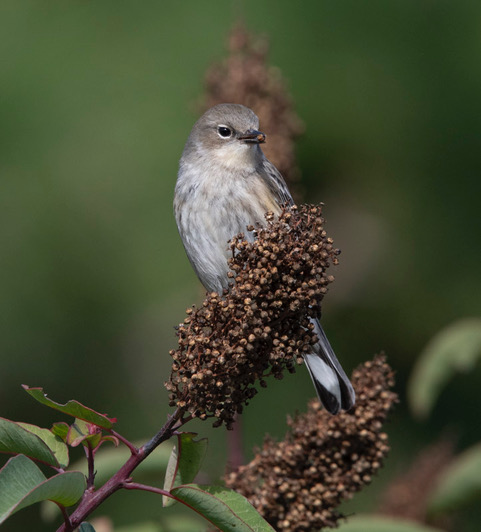
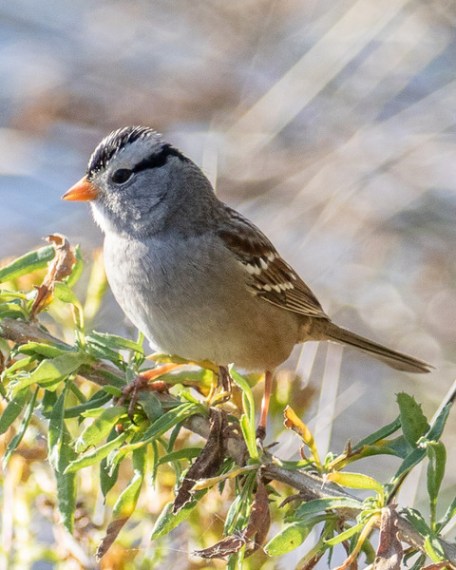
Some of our first birds were along the path on our way to the first viewpoint near the Pacific Coast Highway bridge. White-crowned Sparrows were hopping about the picnic tables caging crumbs from a Malibuite and sneeze-singing in the brush. Yellow-rumped warblers of varying brightness and color flitted about, some flycatching from twigs – one had yellow throat, yellow rump and yellow flanks, while the one pictured below just barely has a hint of yellow on its left flank.
A few Bushtits appeared, flitting from bush to bush to bush as is typical for them, followed by a few more, then a few more, and then a whole string of them that just kept coming and coming. I estimated 50, Femi estimated 100, Chris and two others came up with 30. So…fifty (on average) it is!
The tide was exceptionally high today: 6.53 ft. @ 7:40am, and dropping a whopping 7.49 ft. to -0.96 ft @2:57pm. High tides over 6 ft. and negative low tides are exceptional (full moon is on Tues. 28 Nov.)
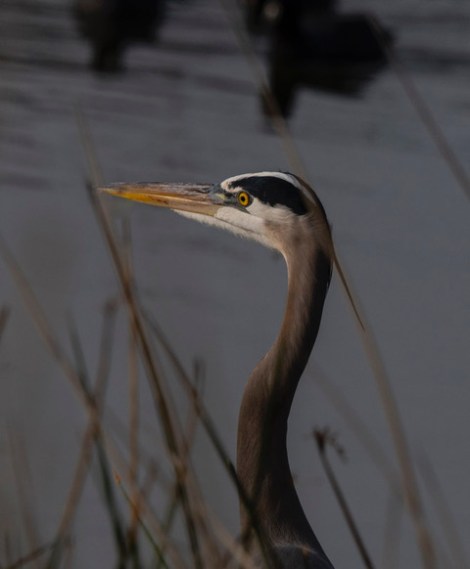
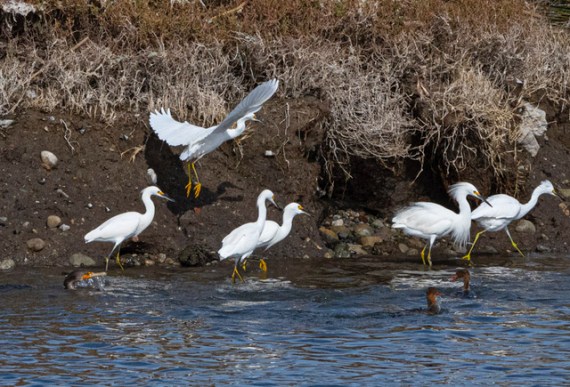
There were quite a few herons and egrets: 4 Great Blue Herons, 4 Great Egrets and 20 Snowy Egrets. The Snowys tended to cluster together, chasing after small schools of fish near the lagoon’s surface. In the photos below, they seem to be cooperating with the Double-crested Cormorants to corral the unlucky fish.
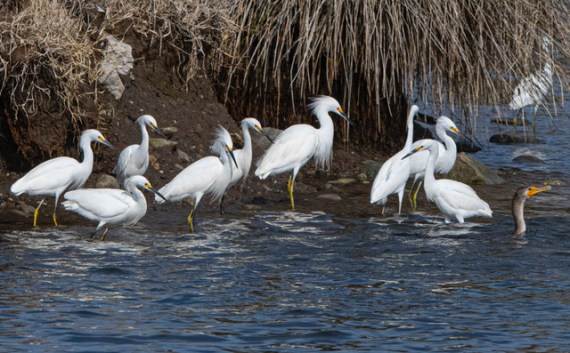
If you look closely at their legs, you can see that most of them are yellow on the back and black on the front. This is typical for juvenile Snowy Egrets (perhaps also for adults in basic [non-breeding, winter] plumage, but I don’t know about that) and often confuses people. “Wait a minute, that egret had black legs a minute ago, and now they’re yellow! What’s going on here, anyway?” Another birding optical illusion — birding is full of such mysteries.
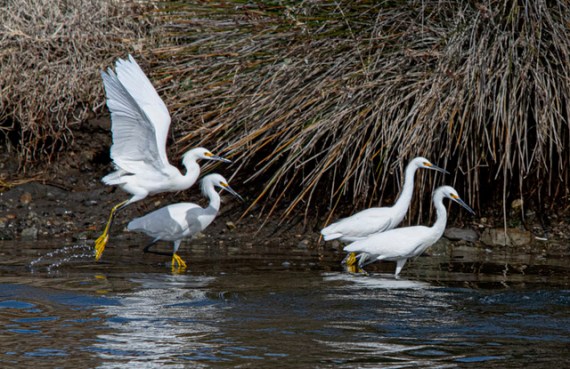
There can be a bit of a struggle trying to keep ahead of the fish when the egrets at the front aren’t moving fast enough for the egrets at the rear.
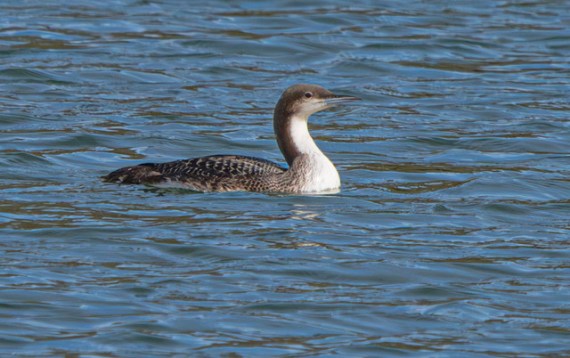
One of the big hits of the day was a Pacific Loon in the lagoon. Normally they’re 1/4-1/2 mile offshore and frequently under water diving for fish or on the other side of a wave: hard to find, hard to see, harder to identify. This one was very close and I don’t remember it diving at all, giving us plenty of opportunity to check out its head, bill, neck, back and posture and discuss why it wasn’t a Red-throated or the (less common around Malibu) Common Loon. My field guide photos came in very handy. Speaking of field guides, photos and identifying a bird….
A brief aside on bird names
Someone asked a question about bird names and changing bird names, so we discussed this topic for a couple of minutes. [The following is my personal understanding of this topic which I’ve been following for the past three years.] The American Ornithological Society’s (AOS) recently decided to change the name of birds that had a European-style human name appended to it, as such names weren’t “helpful” and they said they wanted to make bird names more “inclusive” and/or “useful.” [See recent opinion article 11/12/23 in the L.A. Times.] I made the point that for nearly all of the world’s approximately 11,000 species of birds it’s impossible to give them a “helpful, useful, descriptive” name, if that’s supposed to mean a name that can help someone identify that bird and which will necessitate the elimination of all other possible species. This is for three reasons.’.] The American Ornithological Society’s (AOS) recently decided to change the name of birds that had a European-style human name appended to it, as such names weren’t “helpful” and they said they wanted to make bird names more “inclusive” and/or “useful.” [See recent opinion article 11/12/23 in the L.A. Times.] I made the point that for nearly all of the world’s approximately 11,000 species of birds it’s impossible to give them a “helpful, useful, descriptive” name, if that’s supposed to mean a name that can help someone identify that bird and which will necessitate the elimination of all other possible species. This is for three reasons.
- Inter-species similarities: Nearly all species have “look-alikes,” some have many. Notable examples are: Empidonax flycatchers of the New World, American sparrows often referred to as “LBJs” for “Little Brown Jobs”), the many Phylloscopus warblers of Eurasia, tyrant flycatchers, the shearwaters, the gulls.
- Intra-species variations: Age, breeding/non-breeding, molts, range variations, sub-species, sexual dimorphism, feather wear, color morphs. caused by age, seasons, molts, sex, migration, range variations, color morph.
- Oftentimes characteristics unique to a species and used as part of their name are visible on dead birds in a museum but rarely visible on live birds in the field, thus useless for ID purposes: “ring-necked,” “semipalmated” foot, “rough-winged,” “ruby-crowned,” “orange-crowned.”
Who are the privileged elites in the AOS who voted to change the names of 70-180 American birds? Anyone can join the AOS by paying dues. Was the ballot box stuffed? How many AOS members voted for this plan? 5, 10, 50, 100, 500? (I know for a fact many AOS members were against it.) There are now many millions of American birders greatly inconvenienced, annoyed, even angered by this plan. How many birders wanted this change? How many people honestly were offended or felt “harmed” by these names of people nearly no one knew anything about. Two, five, twenty? Why do a handful of AOS members feel they have the right to force this change upon millions of people for a purported benefit to an infinitesimal few? Did they actually solicit opinions from birders beyond their immediate friends?
We then moved on.
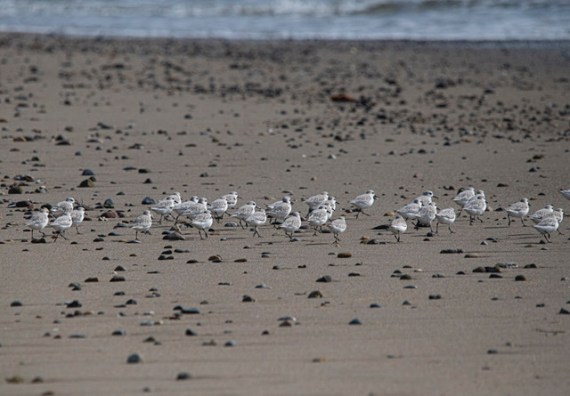
As the tide fell and beach and shoreline began to appear, sandpipers began showing up from wherever they’d been hiding, probably somewhere with a wide beach, like Zuma, a few miles up the coast. A flock of 69 Sanderlings flew in and bunched into a tight cluster for a while before they decided to go for a stroll, probably heading for the damp sand at the surf’s edge. That’s where the food is.
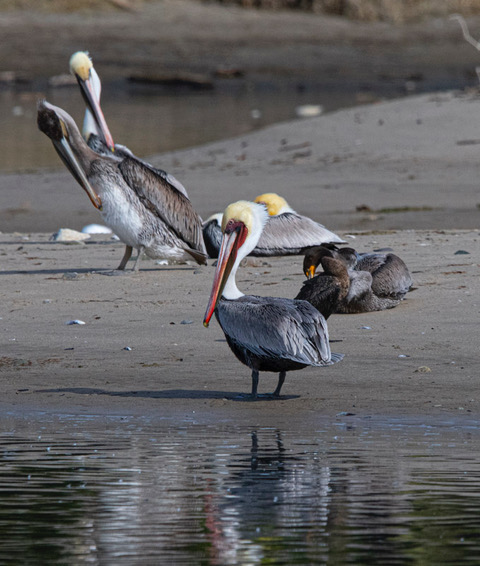
Brown Pelicans, old and young, rested on the sand or floated on the lagoon, usually accompanied by their cousins the cormorants. “Brown Pelicans” begin as brown, but as they age over several years they become silver, gray, yellow, red and cream colored.
As we approached the beach we could hear a very loud chirp!, much like a smoke alarm. One of the birders recorded it with a phone app (iNaturalist perhaps) and announced it was a White-tailed Kite. We quickly determined that it was actually coming from an Osprey. [So much for the reliability of phone apps.] There were two Osprey, one flying around in circles both low and high, and the other perched on the “mockingbird phone pole” at the northeast corner of Malibu Colony. I think the chirp was coming from the bird on the pole, but they both might have been calling. Perhaps the pole bird was advising the other that it was time for it to produce a fish.
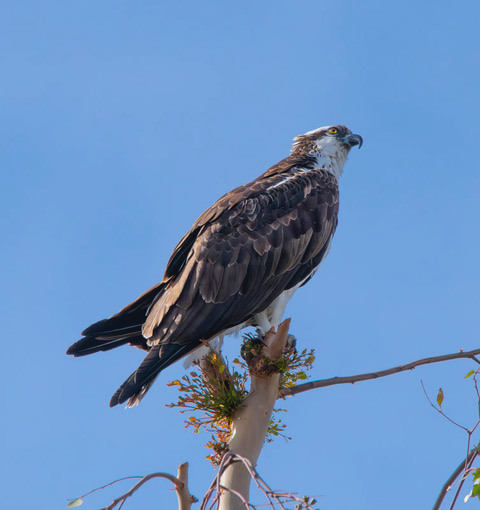
When I began counting the gulls there were 403 of them. But by the time we were leaving it was almost noon, and a very large scavenging of gulls had gathered on the mud flat near the first viewpoint which appeared to be at least triple that size. I couldn’t bring myself to walk back that way to count well over 1000 gulls, most of which appeared to be California Gulls, so they’re left out of the count. We saw only one Snowy Plover, but there may have been others hiding on the other side of the small dunes east of the outlet stream.
Malibu Lagoon on eBird as of 10-25-23: 7174 lists, 319 species
Most recent species added: Red-breasted Nuthatch (31 October 2023, Kyle Te Poel).
Many, many thanks to photographer Ray Juncosa
Upcoming SMBAS scheduled field trips; no reservations or covid card necessary unless specifically mentioned:
- Newport Back Bay, Sat. Dec 9, 8:00 am. Reservations.
- Butterbredt Spring Christmas Count, Sat. Dec 16, 8:30 am. Reservations.
- Malibu Lagoon, Sun. Dec 24, 8:30 & 10 am
- Antelope Valley Raptor Search, Sat. Jan 13, meet at 7:00 am. Reservations.
- These and any other trips we announce for the foreseeable future will depend upon expected status of the Covid/flu/etc. pandemic at trip time. Any trip announced may be canceled shortly before trip date if it seems necessary. By now any other comments should be superfluous.
- Link to Programs & Field Trip schedule.
The next SMBAS Zoom program: ““Evolution of Avian Flight” with Dr. Ashley Heers, Evening Meeting, Tuesday, Dec 5, 2023, 7:30 p.m. A recording of our 7 Nov. program, “Gray Vireos in Baja, with Dr. Phil Unitt, is now on the blog.
The SMBAS 10 a.m. Parent’s & Kids Birdwalk restarted April 23. Reservations for groups (scouts, etc.) necessary; not necessary for families.
Links: Unusual birds at Malibu Lagoon
9/23/02 Aerial photo of Malibu Lagoon
More recent aerial photo
Prior checklists:
2023: Jan-June
2021: Jan-July, July-Dec 2022: Jan-June, July-Dec
2020: Jan-July, July-Dec 2019: Jan-June, July-Dec
2018: Jan-June, July-Dec 2017: Jan-June, July-Dec
2016: Jan-June, July-Dec 2015: Jan-May, July-Dec
2014: Jan-July, July-Dec 2013: Jan-June, July-Dec
2012: Jan-June, July-Dec 2011: Jan-June, July-Dec
2010: Jan-June, July-Dec 2009: Jan-June, July-Dec
The 10-year comparison summaries created during the Lagoon Reconfiguration Project period, remain available—despite numerous complaints—on our Lagoon Project Bird Census Page. Very briefly summarized, the results unexpectedly indicate that avian species diversification and numbers improved slightly during the restoration period June’12-June’14.
Many thanks to Femi Faminu, Ray Juncosa, Chris Lord and others for their contributions to this month’s checklist.
The species lists below is irregularly re-sequenced to agree with the California Bird Records Committee Official California Checklist. If part of the chart’s right side is hidden, there’s a slider button inconveniently located at the bottom of the list.
The numbers 1-9 left of the species names are keyed to the nine categories of birds at the bottom.
[Chuck Almdale]
| Malibu Census 2023 | 6/25 | 7/23 | 8/27 | 9/24 | 10/22 | 11/26 | |
| Temperature | 59-71 | 66-70 | 69-73 | 56-74 | 62-70 | 62-68 | |
| Tide Lo/Hi Height | L+0.89 | L+0.81 | H+3.68 | H+3.77 | L+3.34 | H+6.53 | |
| Tide Time | 0919 | 0730 | 0832 | 0739 | 1029 | 0740 | |
| 1 | Canada Goose | 4 | 4 | ||||
| 1 | Cinnamon Teal | 3 | |||||
| 1 | Northern Shoveler | 1 | |||||
| 1 | Gadwall | 45 | 90 | 45 | 40 | 23 | 30 |
| 1 | American Wigeon | 5 | |||||
| 1 | Mallard | 33 | 77 | 20 | 12 | 9 | |
| 1 | Green-winged Teal | 1 | 31 | ||||
| 1 | Lesser Scaup | 1 | |||||
| 1 | Surf Scoter | 15 | 8 | ||||
| 1 | Bufflehead | 5 | |||||
| 1 | Red-breasted Merganser | 20 | |||||
| 1 | Ruddy Duck | 12 | 22 | ||||
| 2 | Pied-billed Grebe | 2 | 1 | 4 | 6 | ||
| 2 | Western Grebe | 28 | 13 | ||||
| 7 | Feral Pigeon | 3 | 4 | 3 | 4 | ||
| 7 | Mourning Dove | 2 | 2 | 2 | 5 | 1 | |
| 8 | Anna’s Hummingbird | 1 | 1 | 2 | 2 | ||
| 8 | Allen’s Hummingbird | 2 | 4 | 1 | 4 | 1 | |
| 2 | Sora | 1 | |||||
| 2 | American Coot | 5 | 6 | 49 | 157 | 230 | |
| 5 | Black-bellied Plover | 6 | 39 | 82 | 79 | 7 | |
| 5 | Killdeer | 8 | 8 | 13 | 6 | 1 | 5 |
| 5 | Semipalmated Plover | 1 | 7 | 3 | |||
| 5 | Snowy Plover | 7 | 13 | 22 | 18 | 1 | |
| 5 | Whimbrel | 11 | 32 | 38 | 32 | 23 | 4 |
| 5 | Long-billed Curlew | 4 | 3 | ||||
| 5 | Marbled Godwit | 1 | 48 | 45 | 5 | ||
| 5 | Short-billed Dowitcher | 1 | 2 | ||||
| 5 | Wilson’s Phalarope | 1 | |||||
| 5 | Red-necked Phalarope | 2 | |||||
| 5 | Spotted Sandpiper | 3 | 3 | ||||
| 5 | Willet | 7 | 5 | 9 | 29 | 56 | 12 |
| 5 | Ruddy Turnstone | 2 | 4 | 10 | 1 | ||
| 5 | Sanderling | 2 | 32 | 27 | 69 | ||
| 5 | Least Sandpiper | 4 | 8 | 18 | 6 | 35 | |
| 5 | Western Sandpiper | 6 | 3 | 15 | |||
| 6 | Heermann’s Gull | 94 | 89 | 90 | 51 | 55 | 71 |
| 6 | Ring-billed Gull | 5 | 1 | 4 | 42 | ||
| 6 | Western Gull | 105 | 150 | 85 | 65 | 45 | 68 |
| 6 | Herring Gull | 1 | 1 | ||||
| 6 | California Gull | 2 | 3 | 7 | 7 | 220 | |
| 6 | Glaucous-winged Gull | 1 | |||||
| 6 | Black Skimmer | 2 | |||||
| 6 | Caspian Tern | 1 | |||||
| 6 | Forster’s Tern | 1 | |||||
| 6 | Elegant Tern | 150 | 2 | 40 | 24 | 2 | 1 |
| 6 | Royal Tern | 20 | 10 | 4 | 5 | 12 | |
| 2 | Pacific Loon | 1 | |||||
| 2 | Common Loon | 1 | |||||
| 2 | Black-vented Shearwater | 20 | 28 | ||||
| 2 | Brandt’s Cormorant | 2 | 1 | ||||
| 2 | Pelagic Cormorant | 1 | 1 | 2 | |||
| 2 | Double-crested Cormorant | 75 | 42 | 23 | 30 | 48 | 37 |
| 2 | Brown Pelican | 162 | 174 | 56 | 27 | 12 | 26 |
| 3 | Black-crowned Night-Heron | 2 | 2 | 5 | 2 | ||
| 3 | Snowy Egret | 4 | 4 | 8 | 5 | 2 | 20 |
| 3 | Green Heron | 1 | 3 | 1 | |||
| 3 | Great Egret | 2 | 3 | 5 | 6 | 4 | |
| 3 | Great Blue Heron | 4 | 4 | 5 | 3 | 2 | 4 |
| 4 | Turkey Vulture | 2 | 1 | 2 | |||
| 4 | Osprey | 1 | 1 | 1 | 2 | ||
| 4 | Cooper’s Hawk | 1 | 1 | ||||
| 4 | Red-shouldered Hawk | 1 | |||||
| 4 | Red-tailed Hawk | 1 | 1 | 2 | |||
| 8 | Belted Kingfisher | 2 | 1 | ||||
| 8 | Nuttall’s Woodpecker | 1 | |||||
| 8 | Northern Flicker (Red-shafted) | 1 | |||||
| 4 | American Kestrel | 1 | |||||
| 4 | Peregrine Falcon | 1 | |||||
| 8 | Nanday Parakeet | 2 | |||||
| 9 | Black Phoebe | 4 | 6 | 2 | 4 | 4 | 2 |
| 9 | Say’s Phoebe | 1 | |||||
| 9 | California Scrub-Jay | 2 | 1 | 2 | |||
| 9 | American Crow | 9 | 20 | 9 | 6 | 44 | 3 |
| 9 | Common Raven | 2 | 1 | 2 | |||
| 9 | Oak Titmouse | 1 | 3 | 1 | |||
| 9 | Northern Rough-winged Swallow | 15 | 2 | ||||
| 9 | Barn Swallow | 35 | 12 | 35 | 4 | ||
| 9 | Cliff Swallow | 30 | |||||
| 9 | Bushtit | 4 | 22 | 8 | 22 | 50 | |
| 9 | Wrentit | 1 | 4 | 1 | 4 | ||
| 9 | Ruby-crowned Kinglet | 1 | |||||
| 9 | Blue-gray Gnatcatcher | 2 | |||||
| 9 | House Wren | 2 | 2 | 3 | |||
| 9 | Marsh Wren | 1 | |||||
| 9 | Bewick’s Wren | 1 | 1 | 1 | |||
| 9 | European Starling | 6 | 15 | 12 | 22 | ||
| 9 | Northern Mockingbird | 1 | |||||
| 9 | House Finch | 8 | 15 | 5 | 6 | 5 | 6 |
| 9 | Lesser Goldfinch | 1 | 2 | ||||
| 9 | Dark-eyed Junco | 1 | |||||
| 9 | White-crowned Sparrow | 10 | 20 | ||||
| 9 | Savannah Sparrow | 1 | |||||
| 9 | Song Sparrow | 5 | 5 | 4 | 5 | 5 | 6 |
| 9 | California Towhee | 1 | 3 | 3 | 1 | 2 | |
| 9 | Hooded Oriole | 3 | 1 | ||||
| 9 | Red-winged Blackbird | 3 | 6 | 7 | 15 | ||
| 9 | Brown-headed Cowbird | 1 | |||||
| 9 | Great-tailed Grackle | 1 | 1 | 1 | 20 | ||
| 9 | Orange-crowned Warbler | 1 | 2 | ||||
| 9 | Common Yellowthroat | 2 | 4 | 8 | |||
| 9 | Yellow Warbler | 1 | |||||
| 9 | Yellow-rumped Warbler (Aud) | 5 | 12 | ||||
| 9 | Townsend’s Warbler | 1 | |||||
| 9 | Wilson’s Warbler | 1 | |||||
| 9 | Western Tanager | 1 | |||||
| 9 | Black-headed Grosbeak | 1 | |||||
| Totals by Type | Jun | Jul | Aug | Sep | Oct | Nov | |
| 1 | Waterfowl | 82 | 171 | 65 | 53 | 51 | 134 |
| 2 | Water Birds – Other | 245 | 216 | 87 | 129 | 280 | 314 |
| 3 | Herons, Egrets & Ibis | 12 | 13 | 24 | 13 | 11 | 28 |
| 4 | Quail & Raptors | 3 | 1 | 2 | 4 | 4 | 5 |
| 5 | Shorebirds | 26 | 70 | 145 | 299 | 265 | 139 |
| 6 | Gulls & Terns | 376 | 244 | 230 | 152 | 118 | 416 |
| 7 | Doves | 2 | 2 | 5 | 9 | 4 | 4 |
| 8 | Other Non-Passerines | 3 | 5 | 0 | 6 | 10 | 1 |
| 9 | Passerines | 129 | 96 | 59 | 82 | 154 | 146 |
| Totals Birds | 878 | 818 | 617 | 747 | 897 | 1187 | |
| Total Species | Jun | Jul | Aug | Sep | Oct | Nov | |
| 1 | Waterfowl | 3 | 3 | 2 | 3 | 4 | 10 |
| 2 | Water Birds – Other | 5 | 2 | 4 | 7 | 8 | 7 |
| 3 | Herons, Egrets & Ibis | 4 | 4 | 5 | 4 | 4 | 3 |
| 4 | Quail & Raptors | 2 | 1 | 2 | 4 | 3 | 3 |
| 5 | Shorebirds | 3 | 9 | 15 | 14 | 9 | 9 |
| 6 | Gulls & Terns | 6 | 5 | 7 | 6 | 6 | 8 |
| 7 | Doves | 1 | 1 | 2 | 2 | 2 | 1 |
| 8 | Other Non-Passerines | 2 | 2 | 0 | 4 | 5 | 1 |
| 9 | Passerines | 17 | 14 | 9 | 23 | 17 | 18 |
| Totals Species – 107 | 43 | 41 | 46 | 67 | 58 | 60 |
Discover more from SANTA MONICA BAY AUDUBON SOCIETY BLOG
Subscribe to get the latest posts sent to your email.



 SANTA MONICA BAY AUDUBON SOCIETY BLOG