Ducks, Loons & Terns: Malibu Lagoon, 28 Apr. 2024
[Text by Chuck Almdale; photos by Femi Faminu, Ray Juncosa & Grace Murayama]
Don’t miss the quiz at the bottom.
Brought low by a species of Coronavirus (aka common cold) I decided to stay home in bed. In my stead, Lucien Plauzoles led, and kindly showed the gathered birders several good birds (see below). I received comments of appreciation from various attendees for Lu’s guidance. Many thanks, Lu!
Banded Caspian Tern
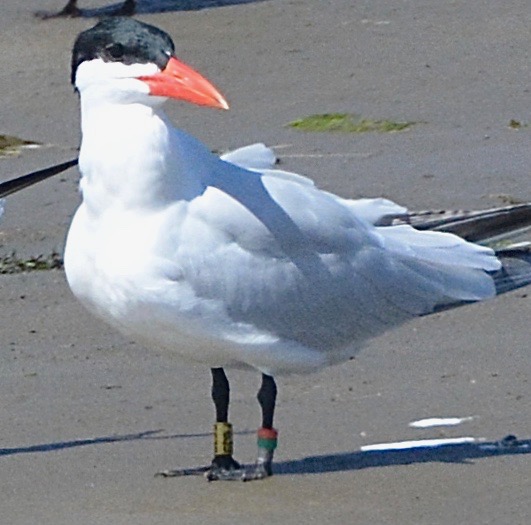
[UPDATE NOTE: On 16 May, 2024 Grace Murayama sent me what she’d discovered on the bird above. This bird (or birds, as more than one was banded) was from the Columbia River (Wash-Ore border) estuary area, apparently the largest Caspian Tern nesting site in world. The band scheme on one bird indicates it was banded in 2012 on East Sand Island. The study was performed by an Oregon State University researcher who is no longer there. The Bird Banding Lab people had no information, so Grace had to “sleuth around.” She found a retired guy at Long Beach State, who referred her to an OSU contact; both people kindly answered her many questions!]
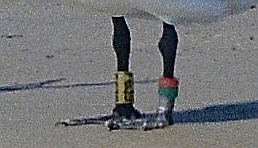
Anyone know the bird above? It’s loaded down with leg bands: left leg has orange-red over blue-green, plus something silvery below that; right leg has a large coded band that looks like it might read “CC”-something. Here’s an almost useless close-up.
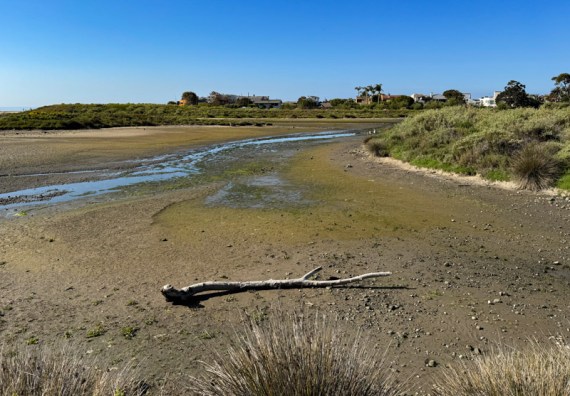
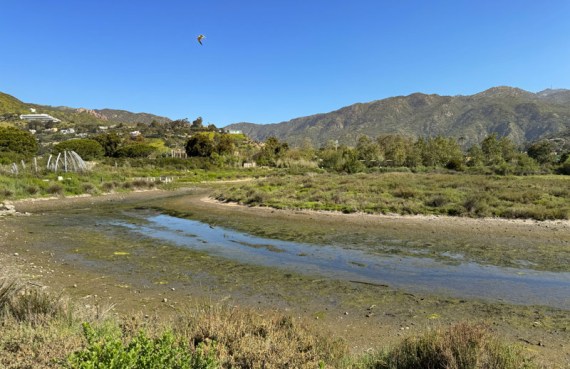
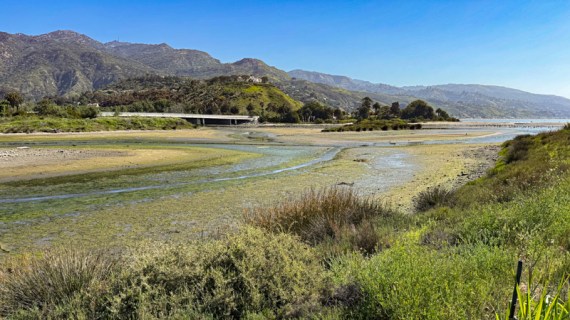
The tide was low, quite low: -0.14 ft. at 7 :38 am, with the high of +2.69 ft. at 3:02 pm. [Anything negative is really low for Malibu.] Obviously the lagoon is open to the sea or the water wouldn’t disappear like this.
Long-tailed Duck
The bird of the day and the biggest treat was the Long-tailed Duck. [Dang! I missed it!] This visitor from the far north nests primarily north of the Canadian prairie provinces and well up into the assorted Arctic islands like Baffin and around most of the coast of Greenland. The first one I ever saw was in March of 1981 flying along Ballona Creek and over the salt marsh. The next one was swimming through the melting ice in a pond near Churchill on Hudson Bay, nine years later. So you treasure the few sighting you get. It’s plumage is the color of dirty ice. 16″ long, the male’s tail (when he has it, unlike the bird below) adds another 6″. SoCal gets them regularly in the winter in very small numbers, I’d guess less than a half-dozen per winter. Has anyone ever seen two of them at the same time in SoCal? We have seen Long-tailed Duck previously in Malibu Lagoon, way back on 12/27/09 and on 1/24/10; almost certainly the same individual. When they find a place they like during the winter, they often stay a while.
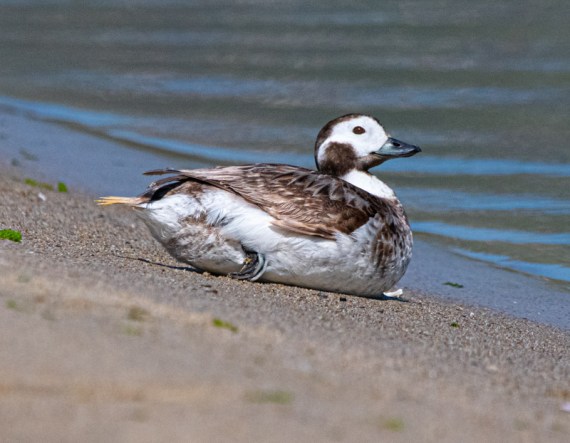
Long-tailed Duck is the only species in the genus Clangula, *from the Greek klange for “a noise or sound.” It’s prior official English name, Oldsquaw, also referred to its noisy call, apparently reminiscent of an angry old woman to many human ears. Most of its many other colloquial names also refer to its call: cockawee, coal, candlelight, old injun, old wife, noisy duck, hound, long-tailed hareld, swallow-tailed duck, south-southerly, south southerland, old granny, old molly, old Billy, John Connally, Uncle Huldy, my Aunt Huldy, cowhen, calaw, calloo, scoldenore, scolder, quandy. [Such a cacophony of common names is not uncommon, and the assortment above is a good example of why birders & ornithologists decided to standardize the English names of birds.] The Cree called it Hah-ha-way. By any name it’s a treat to see.
The Elegant Terns have returned from their wintering quarters all around Baja California. When they get up and fly around as in the photo below, it may be because one of them sighted a raptor and alerted the others. Just as likely they felt like flying for a minute or two. They’ve returned north (that’s here!) for their breeding season and they’re pretty jumpy. You would be too if your gonads suddenly swelled up to ten or twenty times their non-breeding size and started cranking out large quantities of hormones.
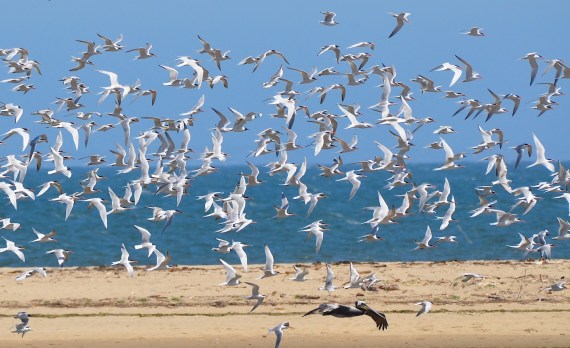
Oddly enough, when the water level goes down in one part of the lagoon or channels, it goes down in all the other channels as well. ‘Tis a mystery, having something to do with gravity.
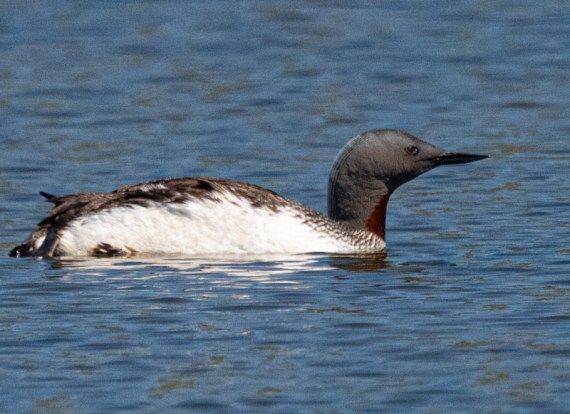
Red-throated Loon
Our last special bird in a Red-throated Loon in alternate (breeding) plumage, another bird we don’t see often, at least not in breeding plumage. Since Oct 1979 we’ve seen only 40 appearances and 66 birds. They show up October – April with 65% of the birds in December, February and March. They are totally absent May – September. My first sighting at the lagoon was on 3 Mar 1980, about 4 1/2 months after I began censusing the lagoon. A bird that appeared 22 Dec 2019 mostly rested on the western lagoon shore, as did the bird below. Unfortunately I didn’t keep notes on their plumage status, but the six birds in four April appearances were likely in alternate plumage.
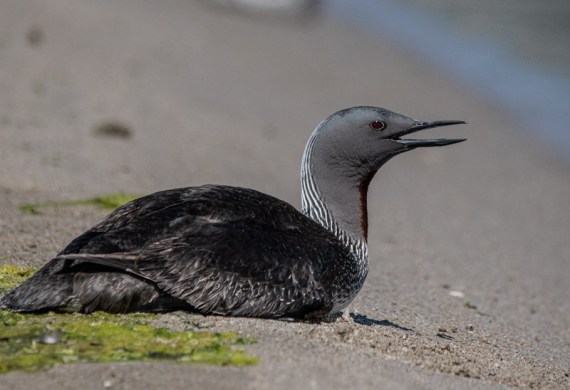
Loon legs are placed far back on their bodies, likely to maximize their ability to efficiently swim and dive, and they are very good fish chasers and catchers. As a result it is impossible (or nearly so) for them to actually walk or even waddle on land (short film), and they fall forward onto their breast more than actually walk. They typically **nest near the water’s edge, or in a small scrape on a mound built in shallow water near the shore or in a marsh. This difficulty in moving on land makes them easy prey for any fox, cat or wolf hanging around. All of this means they don’t like to go onto land and if you see one lying down on the ground other than near the nest during breeding season, it may be ill, or wounded, or exhausted.
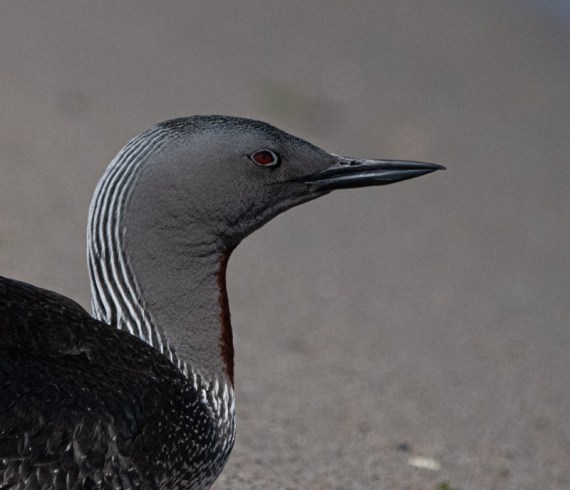
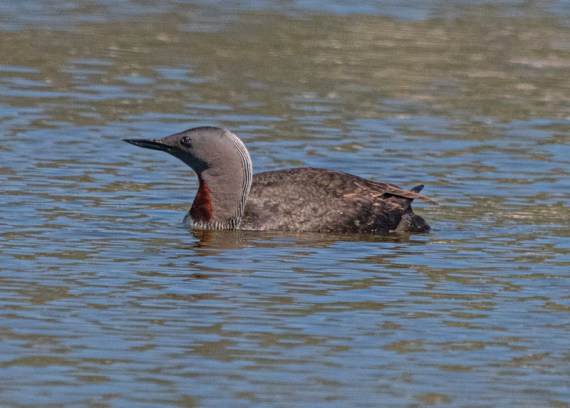
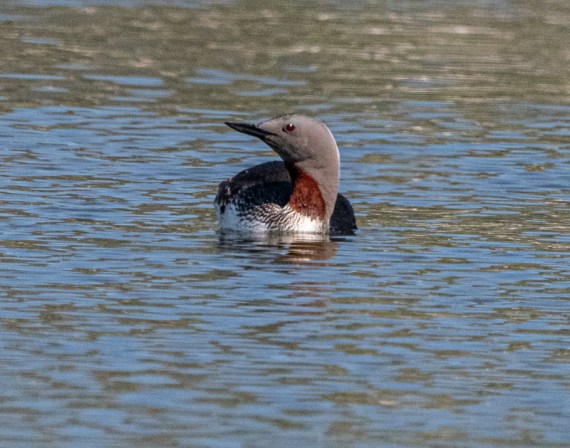
I did a color search, found this site and decided that “Barn Red” (RGB 124, 10, 2) was the named shade of red closest to the bird’s throat color. So I suggest that this bird’s name – as long as we’re busily changing bird names to reflect our most up-to-date and ephemeral judgements of descriptive nomenclature – should be changed to Barn Red (RGB124,10,2)-throated Loon. Just a suggestion, American Ornithological Society.
The Quiz
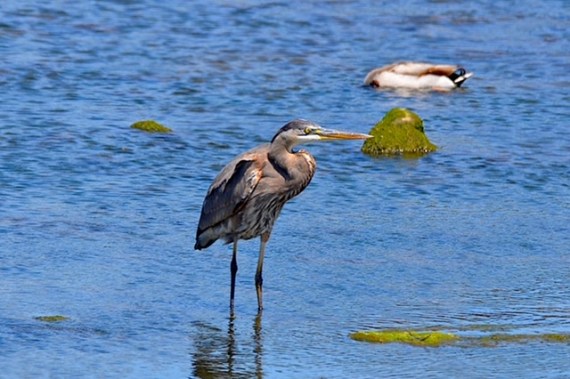
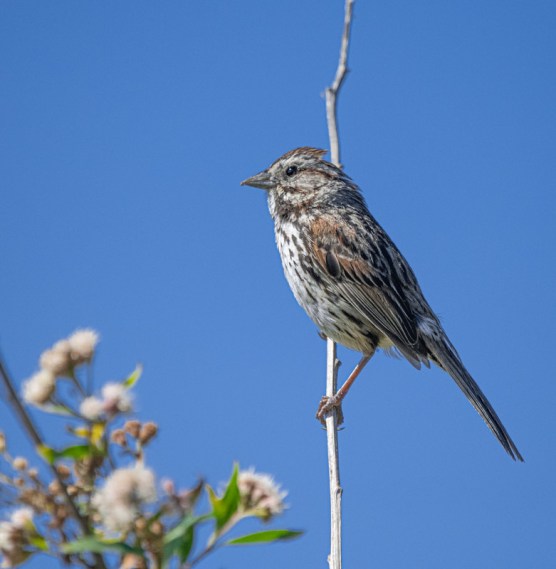
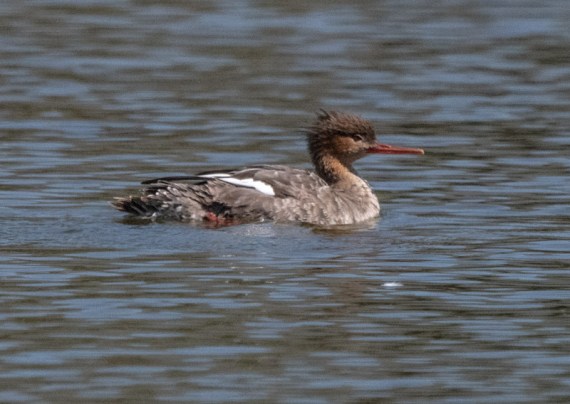
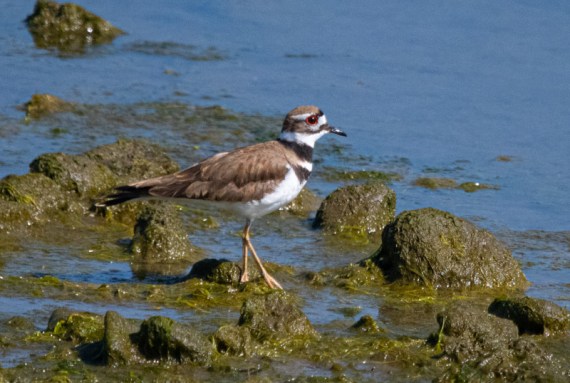
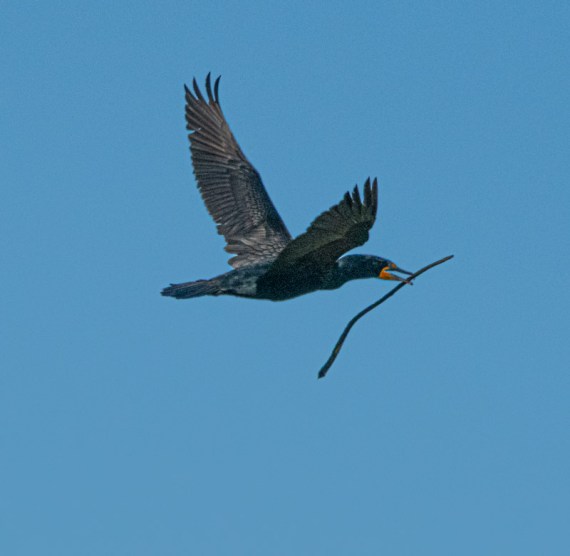
Back by popular demand! Not everything is as may first appear. In some species males look different than females. One bird is carrying a stick? Why?






Quiz Answers & credits
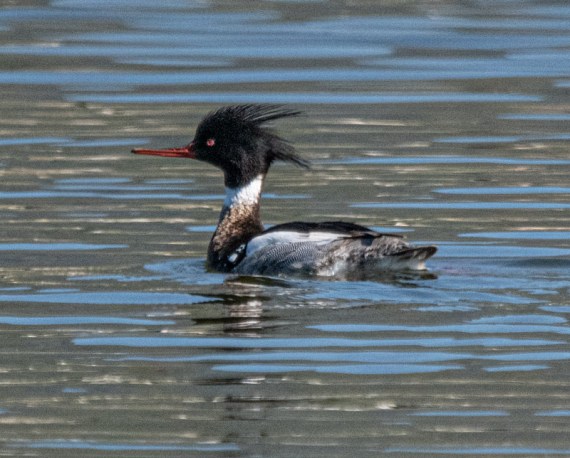
#1. Red-breasted Merganser, male (Ray Juncosa 4-28-24)
#2. Great Blue Heron (Grace Murayama 4-26-24)
#3. By-the-wind sailor, sea raft, purple sail, little sail, or simply Vellela. Velella velella is the only species in the Velella genus in the Porpitidae family of colonial hydrozoa, found worldwide. (Grace Murayama 4-26-24)
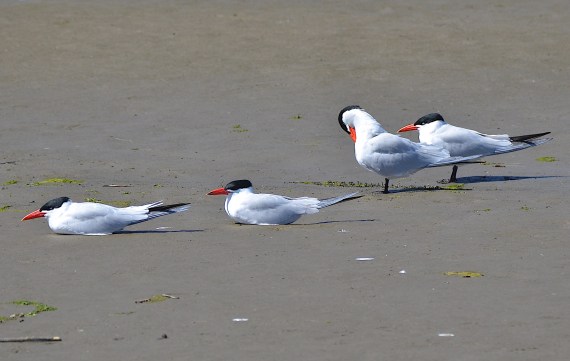
#4. Caspian Terns (Grace Murayama 4-26-24)
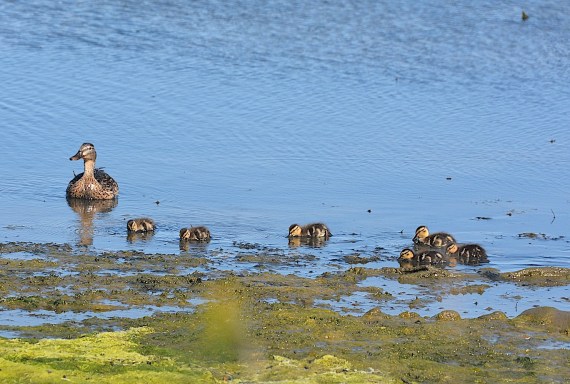
#5. Mallard hen & ducklings (Grace Murayama 4-26-24)
#6. Ducks flying o’er the brine, possibly Surf Scoters (Femi Faminu 4-28-24)
#7. Black Oystercatchers (Femi Faminu 4-28-24)
#8. 4 Elegant Terns & 1 Bonaparte’s Gull (Femi Faminu 4-28-24)
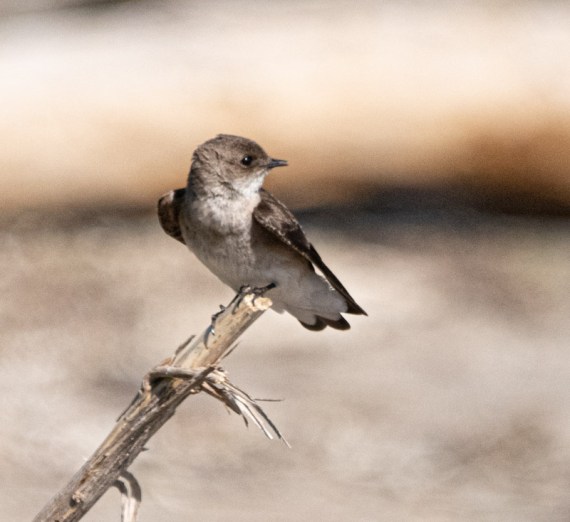
#9. Rough-winged Swallow (Ray Juncosa 4-28-24)
#10. Ochre-bellied Flycatcher Mionectes oleagineus, but once upon a time was called the Oleaginous Pipromorpha [one of my favorite bird names] Pipromorpha oleagineus. A movement is afoot to reinstate three Mionectes species to their Pipromorpha genus status to differentiate them from the two highland Mionectes species. (photographer unknown, Venezuela)
#11. Song Sparrow (Ray Juncosa 4-28-24)
#12. Bushtit, female has pale eye (Ray Juncosa 4-28-24)
#13. Red-breasted Merganser female (Ray Juncosa 4-28-24)
#14. Red-throated Loon has a white belly (Ray Juncosa 4-28-24)
#15. Killdeer nest on this beach (Ray Juncosa 4-28-24)
#16. Snowy Egret (Ray Juncosa 4-28-24)
#17. Double-crested Cormorant, stick is for nest (Ray Juncosa 4-28-24)
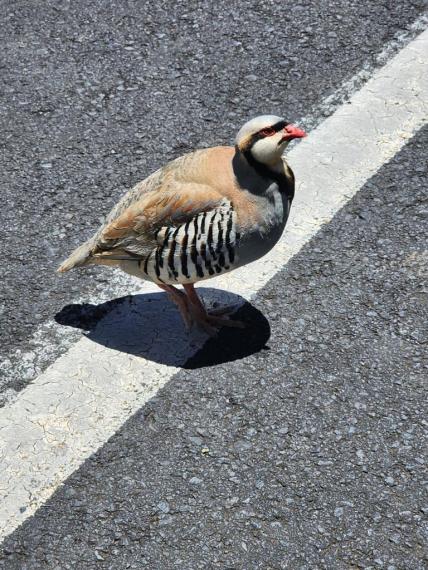
#18. Chukar in Maui, Hawaii; introduced to U.S. from Asia (Grace Murayama’s daughter), apparently stopping to contemplate just exactly why the chicken did cross the road.
Reference notes:
*Long-tailed Duck names: Choate, Ernest A.; Dictionary of American Bird Names, 1985, Harvard Common Press.
**Loon nests: Baicich, Paul J. & Harrison, Colin J.O.; Guide to the Nests, Eggs and Nestlings of North American Birds, 2nd. Ed.; 1997, AP Natural World – Academic Press.
Malibu Lagoon on eBird as of 5-03-24: 7698 lists, 319 species
Most recent species added: Red-breasted Nuthatch (31 October 2023, Kyle Te Poel).
Birds new for the season: Long-tailed Duck, Black Oystercatcher, Semipalmated Plover, Spotted Sandpiper, Greater Yellowlegs, Bonaparte’s Gull, Elegant Tern, Black-crowned Night-Heron, Great Egret, Osprey, Violet-green Swallow. “New for the season” means it has been three or more months since last recorded on our trips.
Many, many thanks to photographers: Femi Faminu, Ray Juncosa & Grace Murayama
Upcoming SMBAS scheduled field trips; no reservations or covid card necessary unless specifically mentioned:
- Malibu Creek State Park Sat May 11, 8 or 8:30 am, unless we decided creek level too high & relocate
- Malibu Lagoon, Sun. May 26, 8:30 (adults) & 10 am (parents & kids)
- Mt. Pinos Birds & Butterflies Sat 15 June 8am
- These and any other trips we announce for the foreseeable future will depend upon expected status of the Covid/flu/etc. pandemic at trip time. Any trip announced may be canceled shortly before trip date if it seems necessary. By now any other comments should be superfluous.
- Link to Programs & Field Trip schedule.
The next SMBAS Zoom program: “Red and Lilac-crowned Parrots in SoCal,” with Brenda Ramirez, Evening Meeting, Tuesday, May 7, 2024, 7:30 p.m.
The SMBAS 10 a.m. Parent’s & Kids Birdwalk is again running. Reservations not necessary for families, but for groups (scouts, etc.), call Jean (213-522-0062).
Links: Unusual birds at Malibu Lagoon
9/23/02 Aerial photo of Malibu Lagoon
More recent aerial photo
Prior checklists:
2023: Jan-June, July-Dec
2021: Jan-July, July-Dec 2022: Jan-June, July-Dec
2020: Jan-July, July-Dec 2019: Jan-June, July-Dec
2018: Jan-June, July-Dec 2017: Jan-June, July-Dec
2016: Jan-June, July-Dec 2015: Jan-May, July-Dec
2014: Jan-July, July-Dec 2013: Jan-June, July-Dec
2012: Jan-June, July-Dec 2011: Jan-June, July-Dec
2010: Jan-June, July-Dec 2009: Jan-June, July-Dec
The 10-year comparison summaries created during the Lagoon Reconfiguration Project period, remain available—despite numerous complaints—on our Lagoon Project Bird Census Page. Very briefly summarized, the results unexpectedly indicate that avian species diversification and numbers improved slightly during the restoration period June’12-June’14.
Many thanks to Lucien Plauzoles & persons unknown for their contributions to this month’s checklist.
The species lists below is irregularly re-sequenced to agree with the California Bird Records Committee Official California Checklist. If part of the right side of the chart below is hidden, there’s a slider button conveniently located at the far end of the list. The numbers 1-9 left of the species names are keyed to the nine categories of birds at the bottom.
[Chuck Almdale]
| Malibu Census 2023-24 | 11/26 | 12/24 | 1/28 | 2/25 | 3/24 | 4/28 | |
| Temperature | 62-68 | 53-64 | 53-64 | 51-62 | 46-54 | 62-72 | |
| Tide Lo/Hi Height | H+6.53 | H+6.20 | H+5.06 | H+5.06 | H+4.71 | L-0.14 | |
| Tide Time | 0740 | 0644 | 1008 | 0921 | 0936 | 0738 | |
| 1 | Canada Goose | 21 | 8 | 9 | 7 | 6 | |
| 1 | Cinnamon Teal | 3 | 1 | 3 | 2 | ||
| 1 | Northern Shoveler | 13 | 10 | 4 | |||
| 1 | Gadwall | 30 | 27 | 54 | 40 | 24 | 20 |
| 1 | American Wigeon | 5 | 14 | 4 | |||
| 1 | Mallard | 9 | 8 | 7 | 35 | 12 | 10 |
| 1 | Green-winged Teal | 31 | 8 | 17 | 25 | 4 | |
| 1 | Lesser Scaup | 1 | |||||
| 1 | Surf Scoter | 8 | 3 | 4 | 32 | 6 | 4 |
| 1 | Long-tailed Duck | 1 | |||||
| 1 | Bufflehead | 5 | 18 | 12 | |||
| 1 | Red-breasted Merganser | 20 | 5 | 4 | 2 | 9 | 4 |
| 1 | Ruddy Duck | 22 | 37 | 30 | 1 | ||
| 2 | Pied-billed Grebe | 6 | 2 | 2 | |||
| 2 | Horned Grebe | 1 | |||||
| 2 | Eared Grebe | 1 | 1 | ||||
| 2 | Western Grebe | 13 | 18 | 14 | 240 | ||
| 7 | Feral Pigeon | 4 | 4 | 4 | 4 | 2 | |
| 7 | Eurasian Collared-Dove | 1 | |||||
| 7 | Mourning Dove | 4 | |||||
| 8 | Anna’s Hummingbird | 2 | 1 | 2 | 2 | ||
| 8 | Allen’s Hummingbird | 1 | 3 | 5 | 5 | 5 | 1 |
| 2 | American Coot | 230 | 280 | 148 | 46 | 63 | |
| 5 | Black Oystercatcher | 1 | 4 | ||||
| 5 | Black-bellied Plover | 7 | 52 | 45 | 42 | 3 | |
| 5 | Killdeer | 5 | 20 | 18 | 12 | 3 | 6 |
| 5 | Semipalmated Plover | 9 | |||||
| 5 | Snowy Plover | 1 | 21 | 20 | |||
| 5 | Whimbrel | 4 | 8 | 4 | 6 | 39 | 4 |
| 5 | Marbled Godwit | 5 | 11 | 5 | 20 | 20 | |
| 5 | Spotted Sandpiper | 1 | |||||
| 5 | Willet | 12 | 22 | 3 | 15 | 4 | 2 |
| 5 | Greater Yellowlegs | 1 | |||||
| 5 | Ruddy Turnstone | 1 | 10 | 5 | 2 | ||
| 5 | Sanderling | 69 | 10 | 7 | 10 | ||
| 5 | Least Sandpiper | 35 | 28 | 16 | 20 | 12 | 2 |
| 5 | Western Sandpiper | 8 | 20 | ||||
| 6 | Bonaparte’s Gull | 3 | 2 | ||||
| 6 | Heermann’s Gull | 71 | 22 | 12 | 60 | 16 | |
| 6 | Ring-billed Gull | 42 | 34 | 25 | 200 | 18 | 4 |
| 6 | Western Gull | 68 | 64 | 30 | 85 | 58 | 16 |
| 6 | Herring Gull | 1 | 1 | 2 | 3 | ||
| 7 | Lesser Black-backed Gull | 1 | |||||
| 6 | California Gull | 220 | 425 | 270 | 400 | 170 | 60 |
| 6 | Glaucous-winged Gull | 1 | 5 | 3 | 3 | 1 | |
| 6 | Caspian Tern | 2 | 20 | ||||
| 6 | Elegant Tern | 1 | 200 | ||||
| 6 | Royal Tern | 12 | 7 | 3 | 4 | 60 | |
| 2 | Red-throated Loon | 1 | 2 | ||||
| 2 | Pacific Loon | 1 | 1 | 1 | |||
| 2 | Brandt’s Cormorant | 1 | 1 | 1 | |||
| 2 | Pelagic Cormorant | 5 | 1 | 4 | 1 | ||
| 2 | Double-crested Cormorant | 37 | 47 | 18 | 28 | 32 | 26 |
| 2 | Brown Pelican | 26 | 72 | 26 | 300 | 171 | 235 |
| 3 | Black-crowned Night-Heron | 1 | 1 | 1 | |||
| 3 | Snowy Egret | 20 | 18 | 7 | 6 | 3 | 3 |
| 3 | Great Egret | 4 | 2 | 5 | |||
| 3 | Great Blue Heron | 4 | 2 | 1 | 3 | 1 | 4 |
| 4 | Turkey Vulture | 2 | 2 | ||||
| 4 | Osprey | 2 | 1 | 1 | 1 | ||
| 4 | Red-shouldered Hawk | 1 | 1 | ||||
| 4 | Red-tailed Hawk | 1 | |||||
| 8 | Belted Kingfisher | 1 | 1 | 2 | |||
| 8 | Downy Woodpecker | 1 | |||||
| 8 | Nuttall’s Woodpecker | 1 | |||||
| 8 | Hairy Woodpecker | 1 | |||||
| 4 | Peregrine Falcon | 1 | |||||
| 9 | Black Phoebe | 2 | 4 | 1 | 4 | 2 | 4 |
| 9 | Say’s Phoebe | 1 | |||||
| 9 | Cassin’s Kingbird | 1 | 4 | ||||
| 9 | California Scrub-Jay | 1 | 2 | 2 | 2 | 1 | |
| 9 | American Crow | 3 | 5 | 10 | 10 | 4 | 3 |
| 9 | Common Raven | 1 | 1 | 2 | |||
| 9 | Oak Titmouse | 1 | |||||
| 9 | Tree Swallow | 1 | |||||
| 9 | Violet-green Swallow | 2 | |||||
| 9 | Northern Rough-winged Swallow | 5 | 5 | ||||
| 9 | Barn Swallow | 10 | 10 | ||||
| 9 | Bushtit | 50 | 12 | 12 | 2 | 2 | |
| 9 | Wrentit | 4 | 3 | 1 | 2 | ||
| 9 | Ruby-crowned Kinglet | 1 | |||||
| 9 | Blue-gray Gnatcatcher | 2 | 1 | 1 | |||
| 9 | House Wren | 3 | 2 | 1 | |||
| 9 | Marsh Wren | 1 | |||||
| 9 | Bewick’s Wren | 1 | |||||
| 9 | European Starling | 22 | 28 | 2 | 19 | 5 | |
| 9 | Hermit Thrush | 1 | |||||
| 9 | House Finch | 6 | 9 | 12 | 12 | 15 | 10 |
| 9 | Lesser Goldfinch | 2 | 6 | 20 | 20 | 2 | |
| 9 | Dark-eyed Junco | 2 | |||||
| 9 | White-crowned Sparrow | 20 | 27 | 15 | 12 | 15 | |
| 9 | Song Sparrow | 6 | 7 | 10 | 10 | 14 | 10 |
| 9 | California Towhee | 2 | 1 | 1 | 2 | 1 | 1 |
| 9 | Spotted Towhee | 1 | |||||
| 9 | Red-winged Blackbird | 16 | 2 | 35 | 4 | ||
| 9 | Brown-headed Cowbird | 2 | |||||
| 9 | Great-tailed Grackle | 1 | 1 | 3 | |||
| 9 | Orange-crowned Warbler | 2 | 2 | 1 | 1 | ||
| 9 | Common Yellowthroat | 8 | 5 | 5 | 2 | 2 | |
| 9 | Yellow-rumped Warbler (Audubon’s) | 12 | 6 | 6 | 10 | 4 | |
| Totals by Type | Nov | Dec | Jan | Feb | Mar | Apr | |
| 1 | Waterfowl | 134 | 155 | 149 | 144 | 72 | 45 |
| 2 | Water Birds – Other | 314 | 426 | 211 | 621 | 268 | 263 |
| 3 | Herons, Egrets & Ibis | 28 | 23 | 9 | 9 | 4 | 13 |
| 4 | Quail & Raptors | 5 | 4 | 2 | 0 | 1 | 1 |
| 5 | Shorebirds | 139 | 162 | 103 | 156 | 123 | 29 |
| 6 | Gulls & Terns | 416 | 562 | 345 | 748 | 272 | 362 |
| 7 | Doves | 4 | 4 | 4 | 9 | 2 | 0 |
| 8 | Other Non-Passerines | 1 | 9 | 6 | 8 | 7 | 3 |
| 9 | Passerines | 146 | 119 | 88 | 158 | 115 | 57 |
| Totals Birds | 1187 | 1464 | 917 | 1853 | 864 | 773 | |
| Total Species | Nov | Dec | Jan | Feb | Mar | Apr | |
| 1 | Waterfowl | 10 | 11 | 10 | 7 | 9 | 6 |
| 2 | Water Birds – Other | 7 | 8 | 8 | 8 | 5 | 3 |
| 3 | Herons, Egrets & Ibis | 3 | 4 | 3 | 2 | 2 | 4 |
| 4 | Quail & Raptors | 3 | 3 | 2 | 0 | 1 | 1 |
| 5 | Shorebirds | 9 | 9 | 8 | 10 | 8 | 8 |
| 6 | Gulls & Terns | 8 | 9 | 7 | 5 | 8 | 7 |
| 7 | Doves | 1 | 1 | 1 | 3 | 1 | 0 |
| 8 | Other Non-Passerines | 1 | 6 | 2 | 3 | 2 | 2 |
| 9 | Passerines | 18 | 17 | 16 | 19 | 22 | 14 |
| Totals Species – 100 | 60 | 68 | 57 | 57 | 58 | 45 |
Discover more from SANTA MONICA BAY AUDUBON SOCIETY BLOG
Subscribe to get the latest posts sent to your email.



 SANTA MONICA BAY AUDUBON SOCIETY BLOG