A few good birds*, and a few good people: Malibu Lagoon, 25 August 2024
[Text by Chuck Almdale; photos by Ray Juncosa & Chris Tosdevin]
*Original title of a 1992 film about legal eagles.
Don’t miss the quiz at the bottom.
It’s not a bird, but it was certainly among the most stunning flying creatures seen. But birders tend to appreciate (or simply envy) just about anything that flies: butterflies, moths, bats, grasshoppers, bees, even the occasional fly or those Jade Beetles (my name) that eat our figs unless the squirrels find them first. Mosquitoes and hornets, not so popular.

This diurnal moth of the family Erebidae, one of the largest moth families, is the Brown (or Brown-winged) Ctenucha, and is found from Central to Southern Coastal California. The body of Ctenucha brunnea is 20–26 mms (0.79–1.02 in) long and is blue with red markings on the head and shoulders; the wingspan 35–50 mm (1 3/8–2 in). Richard Harper Stretch first described it in 1872. Wikipedia says the adults are on wing mid-May to mid-July, but here it is August and this one is still out and about. They feed on the nectar of Toyon (Heteromeles arbutifolia), a very common shrub of our coastal sage scrub.

The eggs are round, laid in rows and fade from white to yellow. Larvae are black with buff-colored or yellow hairs, with two black tufts on the front and rear and an amber or orange head. They feed on Wild Rye (Leymus condensatus) plus other grasses and sedges. The pupae are chestnut in color and wrapped loosely in a cocoon of the larval hairs. From Santa Maria and north into Oregon it is replaced by Ctenucha multifaria. Keep an eye out for them! Two Links: Moth Photographers, Bug Guide
This won’t be all about moths and butterflies, but I have to put in some more photos of our very locally very common Pygmy Blue Butterfly (Brephidium exilis), reportedly the smallest butterfly in the world (some waffling websites say among the smallest, hrumpf!), wingspan 0.47-0.79″. Several dozen (at least!) were seen near a short stretch of the pathway to the beach, although you have to be careful of such claims are there are flies in the area nearly as large.

Although the low tide was not particularly low at +2.0 ft, it was less than an hour after the low that we began birding, and nearly all the water had run out of the channels and lagoon into the ocean.

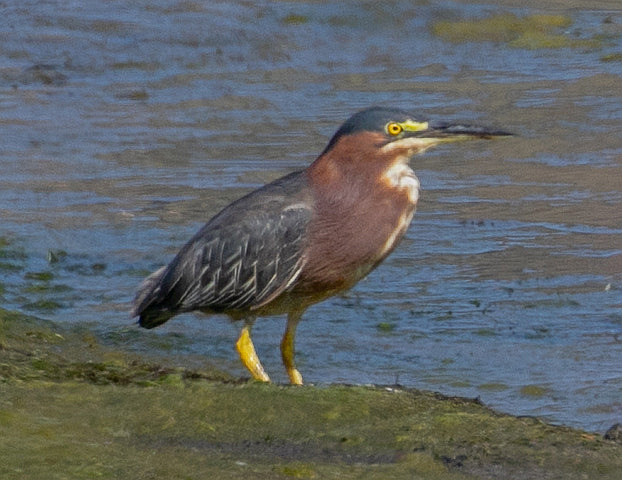
Unlike the other herons and egrets we never get many Green Herons, but we’ve had one per month for the past three months. Our records show that we had 6 on one occasion, 4 once, 3 four times, and the rest mostly singletons. They show up only 13% of the time – Black-crowned Night Heron is the next lowest at 47% of the time, and Snowy Egret tops the frequency list at 99% – but they’re better than the others at hiding and being obscure so they’re probably here more often than we think. Their neck is much longer than it looks here, but they keep it scrunched and hidden by feathers except when they lunge. As previously mentioned, the green is a muted olive-green, often not seen except in bright sunlight.
The shorebirds were definitely returning – five species “new for the season,” and twelve in all. The Ruddy Turnstones are among the most beautiful in breeding plumage (try Churchill on the Hudson Bay in June for thousands of them). The one below is a bit past the peak, but still quite lovely.

Not just shorebirds were dropping in. A small flock of six Western Kingbirds landed in the brush near us, and perched awhile before setting about on some serious flycatching.

One of the birds of the day was the Hairy Woodpecker. A couple of our birders who still have good hearing – probably Chris, Femi or Ruth – heard it among the cypress at the back of Malibu Colony. We watched it climb up and down the trunk and limbs before it took off. The lagoon is not exactly Woodpecker-rich habitat. Over the past 45 years our grand totals are: 6 species, 34 sightings, 35 individual birds. The six species: Acorn 1, Downy 7, Nuttall’s 16 and Hairy 3 Woodpeckers, Red-breasted Sapsucker 1 and Northern Flicker 7. I’ve seen more woodpecker species and higher counts in 5 hours of birding in a Georgia forest.

A few hours later the lagoon level was rising.

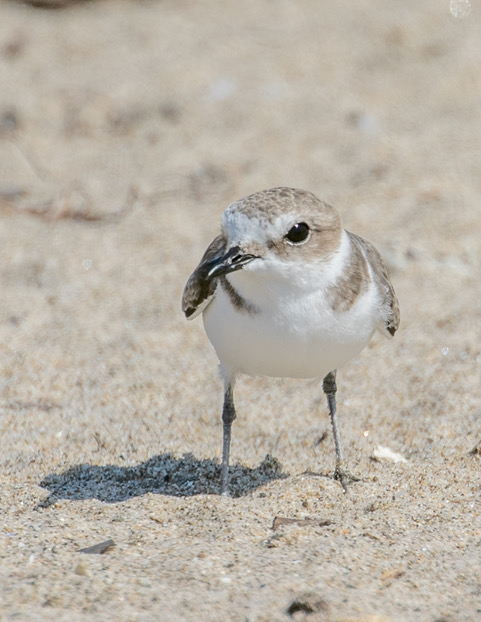
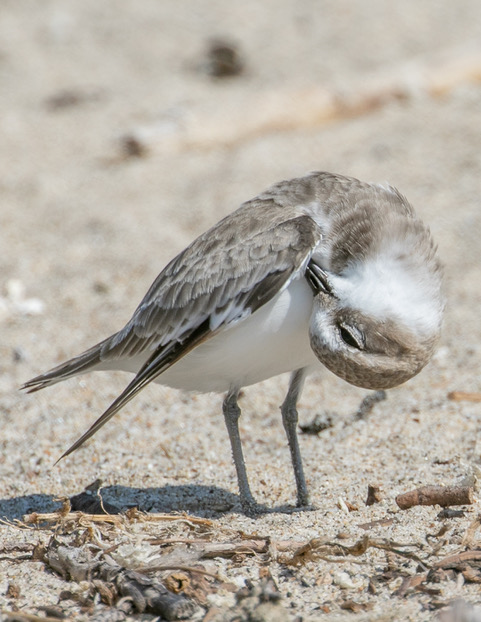
The Western Snowy Plovers were back last month with six birds; 22 this month. We didn’t see any banded birds. They were resting peacefully (as they do during rising tides) at the lagoon’s SE corner until two young women strolled right through the middle of them and they moved elsewhere not so easily seen nor trodden upon.
Black-bellied Plovers were in all shapes and forms, seventy birds strong.

European Birders call them Grey Plovers. As their bellies turn black in spring and back to off-white in late summer, thus spending more time “grey” than “black-bellied,” that may be a better name, as Golden Plovers also get black-bellies in breeding. There really is no one-name-fits-all-members-all-the-time-and-only-members for this species, and most other species as well. This one below seems to be losing a wing feather.

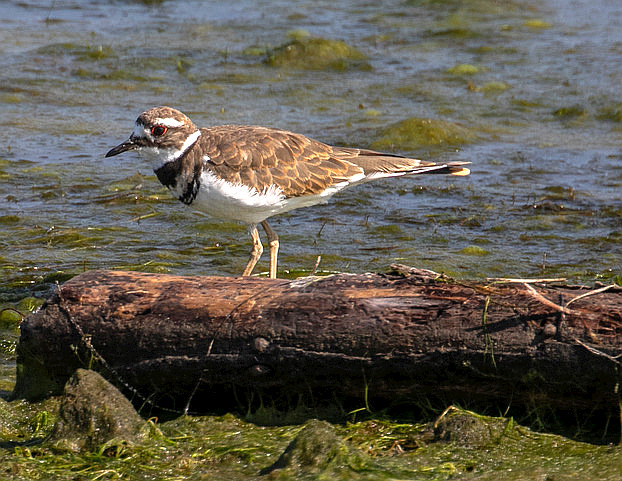
The Killdeer is a close cousin of the Black-belled Plover, albeit a different genus and 1″ shorter. Killdeer have bred around the lagoon for decades; I spotted my first Killdeer nest there in 1995, and their residency probably predates the previous ice age.
Long-billed Curlew is a species that drops in during migration for some R&R, but rarely stays long as the habitat isn’t really right for them. My first sighting of them here was 39 birds in mid-August 1980, a real anomaly, as my total for this species at the lagoon is only 70 birds on 22 occasions. Fifteen of those sightings were of single birds.

The lagoon edge was quite curvaceous, as befits the Surfrider Beach locale.

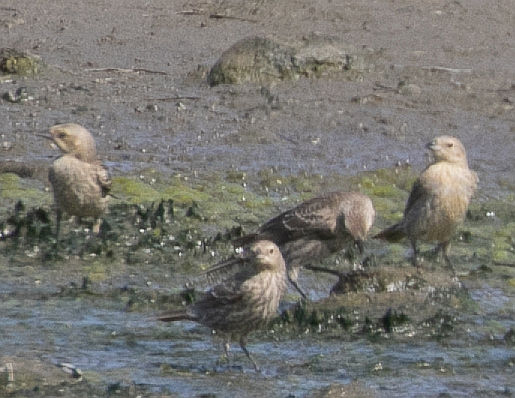
Shortly before leaving Chris Tosdevin saw a flock of birds drop down next to some distant water (hence photo blurriness). He decided upon closer photo analysis they were Brown-headed Cowbirds and I concur. They look like some sort of finch when they’re in this juvenile light brown coloration. Several of them were molting into dark plumage as is one of these below.

Our most unusual shorebird, a Greater Yellowlegs, managed to elude our photographers. They’ve been here on 39 occasions, a total of 51 individuals, or only 4% of our recorded visits. That’s not a lot for 319 total visits, but the Lesser (perhaps that ought to be Fewer) Yellowlegs is even less common: two occasions, two birds total.
Quiz Time!
As these photos are all taken this August at the lagoon, many of the birds may be in plumage transition. Hint – Some of the following hints are “jokes” as they should be obvious and therefore of little use, but I’m not saying which ones.






Quiz Answers & credits
#1. Western Kingbird (Chris Tosdevin 8/25/24) White outer tail feathers.
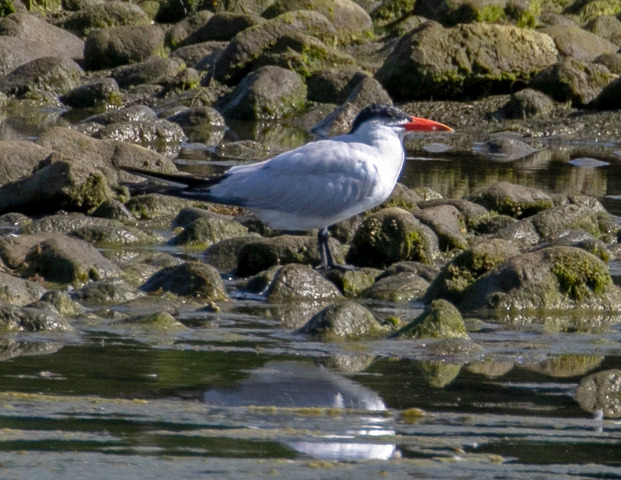
#2. Caspian Tern Tosdevin 8/25/24). Bloody great bloody red bill.
#3. Black-bellied Plovers, all of them. (Ray Juncosa 8/25/24)
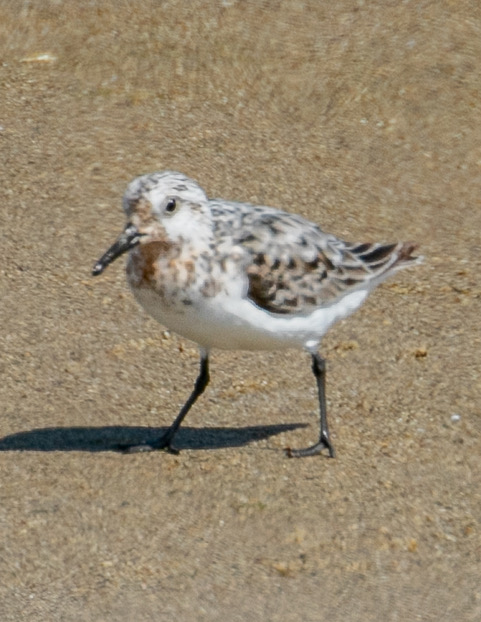
#4. Sanderlings (Chris Tosdevin 8/25/24)
#5. Western Snowy Plover (Chris Tosdevin 8/25/24)
#6. Sanderling, partially molted (Chris Tosdevin 8/25/24)
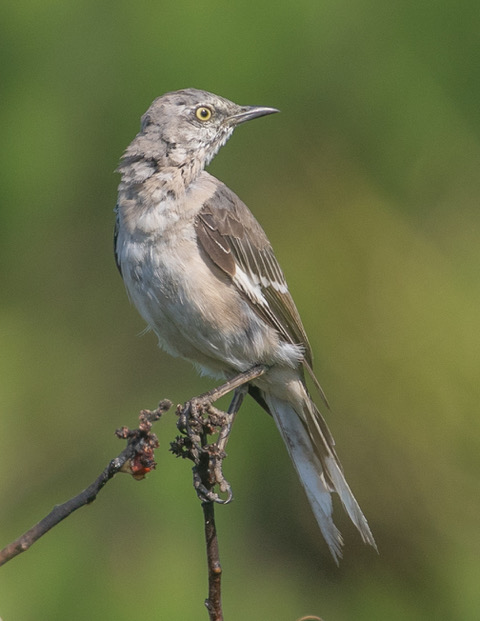
#7. Northern Mockingbird (Chris Tosdevin 8/25/24). Question: Why is it “Northern?” Seriously.
#8. Brown-headed Cowbirds (Chris Tosdevin 8/25/24) in juvenile plumage.
#9. Black-bellied Plover and Sanderling (Chris Tosdevin 8/25/24)
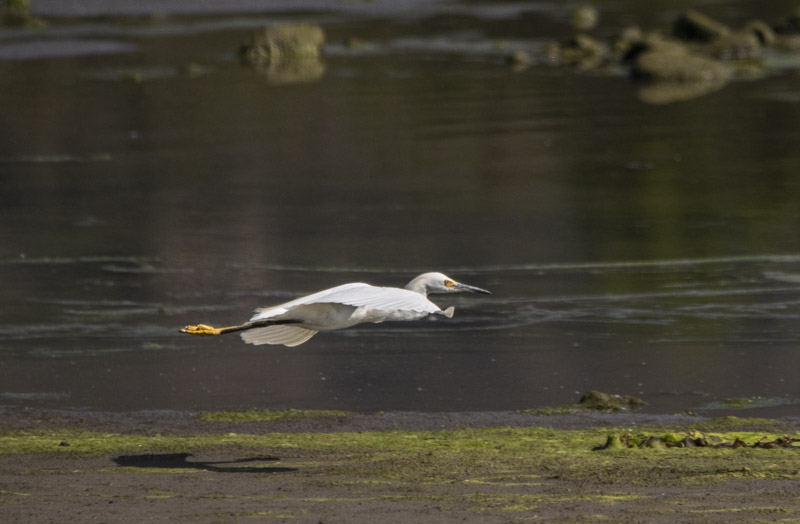
#10. Snowy Egret (Ray Juncosa 8/25/24)
#11. Double-crested Cormorants, end of nesting season in shopping center tree. (Ray Juncosa 8/25/24)
#12. Glaucous Winged Gull (Chris Tosdevin 8/25/24)
#13. Two Least Sandpipers and four Semipalmated Plovers (Chris Tosdevin 8/25/24)
#14. Allen’s Hummingbird (Chris Tosdevin 8/25/24)
Malibu Lagoon on eBird as of 8-28-24: 7985 lists, 2561 eBirders, 320 species.
Most recent species added: Red-breasted Nuthatch (31 October 2023, Kyle Te Poel).
Birds new for the season: American Coot, Semipalmated Plover, Greater Yellowlegs, Ruddy Turnstone, Sanderling, Least Sandpiper, Ring-billed Gull, Forster’s Tern, Royal Tern, Belted Kingfisher, Hairy Woodpecker, Ash-throated Flycatcher, Cassin’s Kingbird, Western Kingbird, Oak Titmouse, Blue-gray Gnatcatcher, House Wren, European Starling, Northern Mockingbird, Dark-eyed Junco, Brown-headed Cowbird, Orange-crowned Warbler, Common Yellowthroat. “New for the season” means it has been three or more months since last recorded on our trips.
Many, many thanks to photographers: Ray Juncosa, Chris Tosdevin.
Upcoming SMBAS scheduled field trips; no reservations or Covid card necessary unless specifically mentioned:
- Coastal Cleanup Day Sat. Sep 21, 9 am – Noon
- Malibu Lagoon, Sun. Sep 22, 8:30 (adults) & 10 am (parents & kids)
- Huntington Central Park, Sat. Oct 12, 8 am, contact leader
- These and any other trips we announce for the foreseeable future will depend upon expected status of the Covid/flu/etc. pandemic at trip time. Any trip announced may be canceled shortly before trip date if it seems necessary. By now any other comments should be superfluous.
- Link to Programs & Field Trip schedule.
The next SMBAS Zoom program: Professor Barney Schlinger, UCLA Dept. of Ecology & Evolutionary Biology; Language and the Brains of Birds & Humans, Evening Meeting, Tuesday, October 8, 2024, 7:30 p.m.
The SMBAS 10 a.m. Parent’s & Kids Birdwalk is again running. Reservations not necessary for families, but for groups (scouts, etc.), call Jean (213-522-0062).
Links: Unusual birds at Malibu Lagoon
9/23/02 Aerial photo of Malibu Lagoon
More recent aerial photo
Prior checklists:
2023: Jan-June, July-Dec 2024: Jan-June
2021: Jan-July, July-Dec 2022: Jan-June, July-Dec
2020: Jan-July, July-Dec 2019: Jan-June, July-Dec
2018: Jan-June, July-Dec 2017: Jan-June, July-Dec
2016: Jan-June, July-Dec 2015: Jan-May, July-Dec
2014: Jan-July, July-Dec 2013: Jan-June, July-Dec
2012: Jan-June, July-Dec 2011: Jan-June, July-Dec
2010: Jan-June, July-Dec 2009: Jan-June, July-Dec
The 10-year comparison summaries created during the Lagoon Reconfiguration Project period, remain available—despite numerous complaints—on our Lagoon Project Bird Census Page. Very briefly summarized, the results unexpectedly indicate that avian species diversification and numbers improved slightly during the restoration period June’12-June’14.
Many thanks to Marie Barnidge-McIntyre, Femi Faminu, Lillian Johnson & others for their contributions to this month’s checklist.
The species lists below is irregularly re-sequenced to agree with the California Bird Records Committee Official California Checklist. If part of the right side of the chart below is hidden, there’s a slider button inconveniently located at the bottom end of the list. The numbers 1-9 left of the species names are keyed to the nine categories of birds at the bottom.
[Chuck Almdale]
| Malibu Census 2023-24 | 3/24 | 4/28 | 5/26 | 6/23 | 7/28 | 8/25 | |
| Temperature | 46-54 | 62-72 | 57-64 | 62-72 | 63-72 | 64-78 | |
| Tide Lo/Hi Height | H+4.71 | L-0.14 | L-0.77 | L-1.17 | L+1.81 | L+2.00 | |
| Tide Time | 0936 | 0738 | 0635 | 0537 | 0916 | 0735 | |
| 1 | Brant (Black) | 2 | |||||
| 1 | Canada Goose | 7 | 6 | 8 | 9 | 4 | |
| 1 | Cinnamon Teal | 2 | |||||
| 1 | Northern Shoveler | 4 | 2 | ||||
| 1 | Gadwall | 24 | 20 | 22 | 35 | 27 | 12 |
| 1 | American Wigeon | 4 | |||||
| 1 | Mallard | 12 | 10 | 14 | 15 | 6 | 2 |
| 1 | Green-winged Teal | 4 | |||||
| 1 | Surf Scoter | 6 | 4 | ||||
| 1 | Long-tailed Duck | 1 | |||||
| 1 | Red-breasted Merganser | 9 | 4 | 2 | |||
| 2 | Pied-billed Grebe | 1 | 1 | 1 | 1 | ||
| 2 | Western Grebe | 9 | 1 | ||||
| 7 | Feral Pigeon | 2 | 5 | 3 | 6 | 9 | |
| 7 | Mourning Dove | 2 | 5 | 2 | 3 | ||
| 8 | Anna’s Hummingbird | 2 | 2 | 2 | 1 | 2 | |
| 8 | Allen’s Hummingbird | 5 | 1 | 5 | 1 | 2 | 3 |
| 2 | American Coot | 63 | 1 | 2 | |||
| 5 | Black-necked Stilt | 2 | |||||
| 5 | Black Oystercatcher | 4 | |||||
| 5 | Black-bellied Plover | 3 | 1 | 51 | 70 | ||
| 5 | Killdeer | 3 | 6 | 4 | 3 | 12 | 4 |
| 5 | Semipalmated Plover | 9 | 13 | ||||
| 5 | Snowy Plover | 20 | 6 | 22 | |||
| 5 | Whimbrel | 39 | 4 | 2 | 52 | 2 | |
| 5 | Long-billed Curlew | 1 | 1 | ||||
| 5 | Marbled Godwit | 20 | |||||
| 5 | Wilson’s Phalarope | 1 | |||||
| 5 | Spotted Sandpiper | 1 | 2 | ||||
| 5 | Willet | 4 | 2 | 2 | 9 | 5 | |
| 5 | Greater Yellowlegs | 1 | 1 | ||||
| 5 | Ruddy Turnstone | 1 | |||||
| 5 | Sanderling | 2 | |||||
| 5 | Least Sandpiper | 12 | 2 | 23 | |||
| 5 | Western Sandpiper | 20 | 6 | 13 | |||
| 6 | Bonaparte’s Gull | 2 | 10 | ||||
| 6 | Heermann’s Gull | 16 | 6 | 65 | 42 | 5 | |
| 6 | Ring-billed Gull | 18 | 4 | 3 | 2 | ||
| 6 | Western Gull | 58 | 16 | 45 | 160 | 220 | 113 |
| 6 | Herring Gull | 3 | |||||
| 6 | California Gull | 170 | 60 | 38 | 3 | 10 | 23 |
| 6 | Glaucous-winged Gull | 1 | 1 | 1 | |||
| 6 | Caspian Tern | 2 | 20 | 8 | 14 | 4 | |
| 6 | Forster’s Tern | 1 | 2 | ||||
| 6 | Elegant Tern | 200 | 190 | 25 | 240 | 10 | |
| 6 | Royal Tern | 4 | 60 | 2 | 5 | ||
| 2 | Red-throated Loon | 2 | |||||
| 2 | Common Loon | 1 | |||||
| 2 | Brandt’s Cormorant | 1 | 35 | ||||
| 2 | Pelagic Cormorant | 1 | 1 | 4 | 1 | ||
| 2 | Double-crested Cormorant | 32 | 26 | 120 | 24 | 28 | 37 |
| 2 | Brown Pelican | 171 | 235 | 348 | 125 | 163 | 27 |
| 3 | Black-crowned Night-Heron | 1 | 1 | 2 | 1 | 1 | |
| 3 | Snowy Egret | 3 | 3 | 2 | 7 | 4 | 3 |
| 3 | Green Heron | 1 | 1 | 1 | |||
| 3 | Great Egret | 5 | 4 | 9 | 3 | 3 | |
| 3 | Great Blue Heron | 1 | 4 | 3 | 3 | 4 | |
| 4 | Turkey Vulture | 1 | 4 | 1 | |||
| 4 | Osprey | 1 | |||||
| 4 | Red-shouldered Hawk | 1 | |||||
| 8 | Belted Kingfisher | 1 | |||||
| 8 | Nuttall’s Woodpecker | 1 | |||||
| 8 | Hairy Woodpecker | 1 | |||||
| 9 | Black Phoebe | 2 | 4 | 7 | 3 | 6 | 3 |
| 9 | Ash-throated Flycatcher | 1 | |||||
| 9 | Cassin’s Kingbird | 4 | 1 | ||||
| 9 | Western Kingbird | 8 | |||||
| 9 | Warbling Vireo | 1 | |||||
| 9 | California Scrub-Jay | 2 | 1 | ||||
| 9 | American Crow | 4 | 3 | 4 | 6 | 4 | 4 |
| 9 | Common Raven | 1 | 2 | 3 | |||
| 9 | Oak Titmouse | 1 | |||||
| 9 | Tree Swallow | 1 | 3 | ||||
| 9 | Violet-green Swallow | 2 | 8 | ||||
| 9 | No. Rough-winged Swallow | 5 | 5 | 2 | 5 | 2 | |
| 9 | Barn Swallow | 10 | 10 | 20 | 20 | 20 | 20 |
| 9 | Cliff Swallow | 30 | 6 | 4 | |||
| 9 | Bushtit | 2 | 2 | 5 | 9 | 19 | 5 |
| 9 | Wrentit | 2 | 1 | ||||
| 9 | Blue-gray Gnatcatcher | 1 | 1 | ||||
| 9 | House Wren | 1 | 2 | ||||
| 9 | European Starling | 5 | 1 | ||||
| 9 | Northern Mockingbird | 1 | |||||
| 9 | Scaly-breasted Munia | 1 | |||||
| 9 | House Finch | 15 | 10 | 15 | 11 | 12 | 5 |
| 9 | Lesser Goldfinch | 20 | 2 | 5 | 2 | ||
| 9 | Dark-eyed Junco | 2 | 1 | ||||
| 9 | White-crowned Sparrow | 15 | |||||
| 9 | Song Sparrow | 14 | 10 | 5 | 5 | 4 | 10 |
| 9 | California Towhee | 1 | 1 | 4 | 4 | 1 | 1 |
| 9 | Spotted Towhee | 1 | 1 | ||||
| 9 | Hooded Oriole | 1 | 1 | 1 | |||
| 9 | Red-winged Blackbird | 4 | 11 | ||||
| 9 | Brown-headed Cowbird | 2 | 18 | ||||
| 9 | Great-tailed Grackle | 3 | 2 | 3 | 3 | ||
| 9 | Orange-crowned Warbler | 1 | 1 | 1 | 1 | ||
| 9 | Common Yellowthroat | 2 | 1 | 1 | |||
| 9 | Yellow-rumped Warbler | 4 | |||||
| Totals by Type | Mar | Apr | May | Jun | Jul | Aug | |
| 1 | Waterfowl | 72 | 45 | 50 | 59 | 37 | 14 |
| 2 | Water Birds – Other | 268 | 263 | 516 | 155 | 192 | 68 |
| 3 | Herons, Egrets & Ibis | 4 | 13 | 7 | 22 | 12 | 12 |
| 4 | Quail & Raptors | 1 | 1 | 1 | 0 | 4 | 1 |
| 5 | Shorebirds | 123 | 29 | 6 | 9 | 139 | 157 |
| 6 | Gulls & Terns | 272 | 362 | 302 | 254 | 527 | 165 |
| 7 | Doves | 2 | 0 | 7 | 8 | 8 | 12 |
| 8 | Other Non-Passerines | 7 | 3 | 8 | 2 | 2 | 7 |
| 9 | Passerines | 115 | 57 | 118 | 92 | 70 | 92 |
| Totals Birds | 864 | 773 | 1015 | 601 | 991 | 528 | |
| Total Species | Mar | Apr | May | Jun | Jul | Aug | |
| 1 | Waterfowl | 9 | 6 | 6 | 3 | 3 | 2 |
| 2 | Water Birds – Other | 5 | 3 | 8 | 5 | 3 | 5 |
| 3 | Herons, Egrets & Ibis | 2 | 4 | 3 | 5 | 5 | 5 |
| 4 | Quail & Raptors | 1 | 1 | 1 | 0 | 1 | 1 |
| 5 | Shorebirds | 8 | 8 | 2 | 5 | 8 | 12 |
| 6 | Gulls & Terns | 8 | 7 | 8 | 5 | 6 | 9 |
| 7 | Doves | 1 | 0 | 2 | 2 | 2 | 2 |
| 8 | Other Non-Passerines | 2 | 2 | 3 | 2 | 1 | 4 |
| 9 | Passerines | 22 | 14 | 19 | 17 | 9 | 22 |
| Totals Species – 98 | 58 | 45 | 52 | 44 | 38 | 62 |
Discover more from SANTA MONICA BAY AUDUBON SOCIETY BLOG
Subscribe to get the latest posts sent to your email.



 SANTA MONICA BAY AUDUBON SOCIETY BLOG