Birds on the move: Malibu Lagoon, 27 April 2025

[By Chuck Almdale; Photos by Chris Tosdevin]
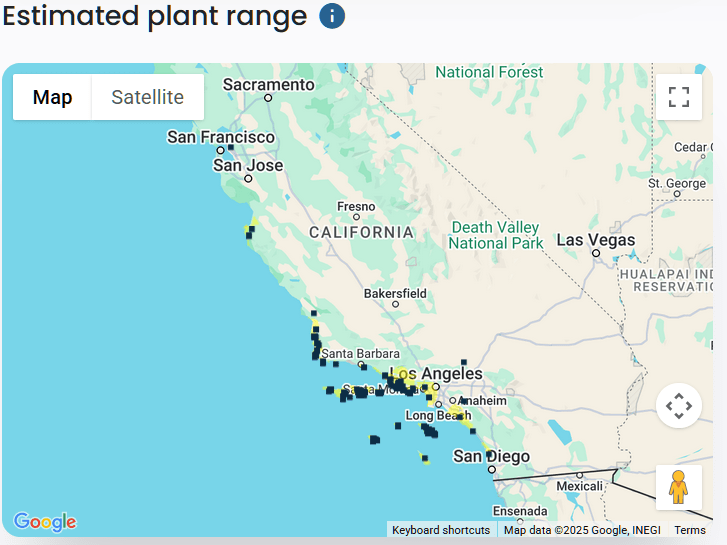
Giant Coreopsis Leptosyne gigantea (Link) is endemic to the Channel Islands and a very few locations on the nearby mainland. They were introduced to the lagoon during the 2012 reconfiguration – and as far as I’m concerned they are a welcome addition to the flora – but I wouldn’t be surprised to learn they lived here in the past before all the houses appeared. They’re grow quite large on diminutive Santa Barbara Island.
A dozen people showed up for the unofficial lagoon bird walk. We hope PCH will finally reopen to all comers and goers before May 25, the date set for our next walk, but as a very recent mudslide closed the highway yet again, I’m not holding my breath for that. As it was, we had more people than sandpipers and plovers (nine!) and almost as many as there were gulls and terns (twenty-six!). We even outnumbered the eleven coots.
Here’s a news flash: Female Whimbrels are larger than the males, especially in the bill.
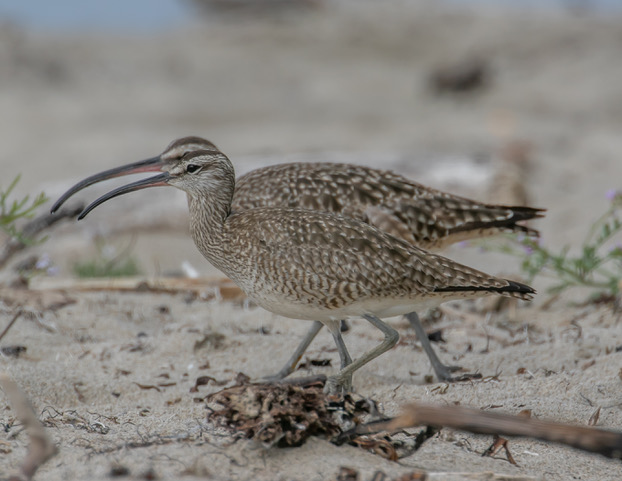
The female’s bill averages 9.4% longer. So when you see them on the beach and one looks bigger and you wonder what’s going on, sexual dimorphism is what’s going on. [Measurements below in millimeters.]

Birds were singing everywhere, or more like loudly buzzing in the case of the Spotted Towhee. Ages ago when I began birding, this bird was known as the Rufous-sided Towhee and included what are now considered two distinct species, our Spotted and the eastern Eastern Towhee. For years I found laughably erroneous the bird book description of the bird’s song as “Drink, drink, drink your tea.” Our bird’s buzzing cannot be rendered into that pattern. Maybe the Rufous-sided Towhees of the east, but not ours. The idea was ludicrous. So when the species was split, I was not shocked (although I was sorry to see the name “Rufous-sided Towhee” disappear as it held a special, personal meaning for me). They had two very different songs for a very good reason — they were two species! As it turns out, different songs can be a very strong hint that you may be dealing with different species, even when they seem to look exactly alike. Biogeography has a lot to do with it.

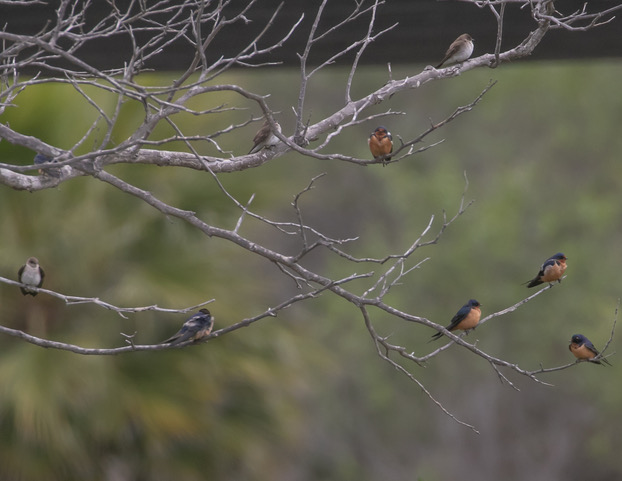
The swallows have definitely arrived. One of their favorite perches is this medium-sized leafless tree by the west end of the PCH bridge, and nine are in this photo. Barn Swallows are the rusty ones, Northern Rough-winged Swallow are the dull brown-back, pale-belly ones, “distinguished by their lack of distinguishing characteristics” among the swallows. The five Violet-green Swallows were confining themselves to the north side of the bridge over the deeper pools of water, and the Cliff Swallows were scattered hither and yon. I discovered that the Barn Swallows were using the bird outlines carved into the cement bridge supports as safe and secluded resting shelves.
The Song Sparrows were busy singing. I counted eight, but there could have been more. Their song territories tend to overlap and it becomes difficult to know if this singer is the same as the previous singer or not.

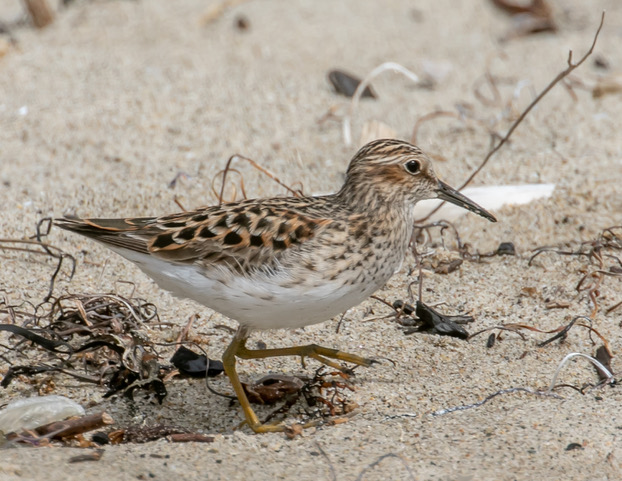
The Least Sandpiper below comprised 100% of the “peeps” and 25% of the sandpipers.
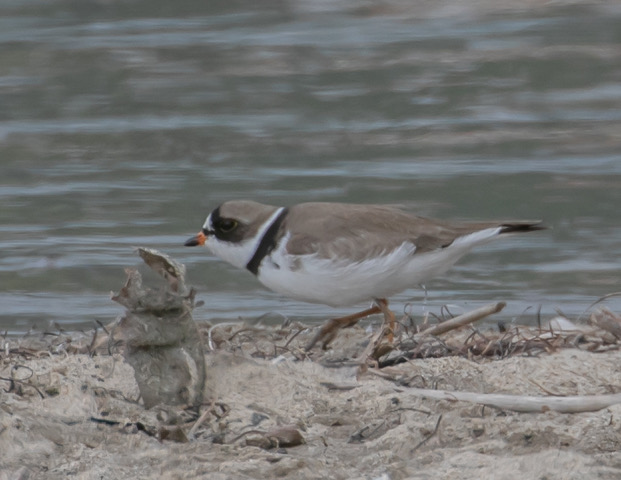
Semipalmated Plovers (below) are a regular spring and fall migrant stopover at the lagoon. My first record of them was 13 birds on 7 Sep 1980. Since then I’ve counted 523 birds on 86 occasions, averaging 6 birds per visit. They’ve appeared in all months except June, but the numbers are clearly skewed. 52 (9.9%) showed up in the nine months of October through March and May through July. April has 291 birds (55.6%), August 102 (19.5%) , and September 78 (14.9%). As I said…a spring and fall migrant. They are “semipalmated” for the same reason that Semipalmated Sandpipers (and Western Sandpipers as well) are semipalmated, and you can see the toe webbing just about equally poorly on all three species.
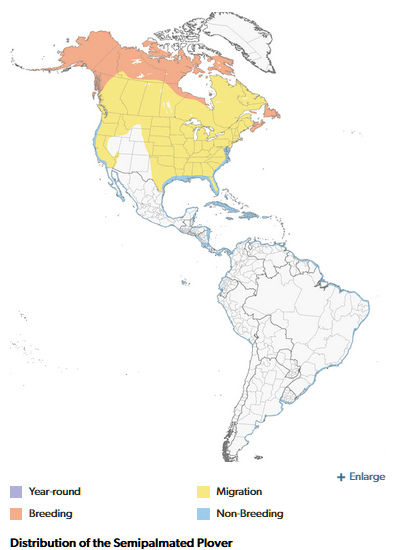
The distribution map below is from Birds of the World (Link). Once the southbound migrants get to South America their range gets a bit difficult to see, but they can winter along both coasts (slightly thicker blue line) all the way down to the southern tip. When you see them at the lagoon, refueling or resting, consider that they still have a long, long way to go.
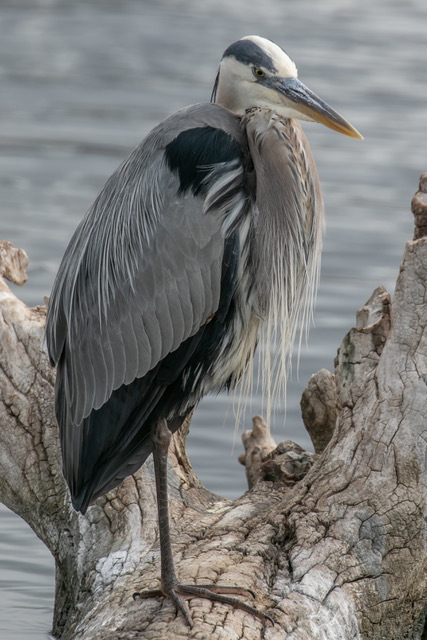
It was actually easy to miss this 4-foot-tall bird standing on a log, it blended in so well, gray on gray.
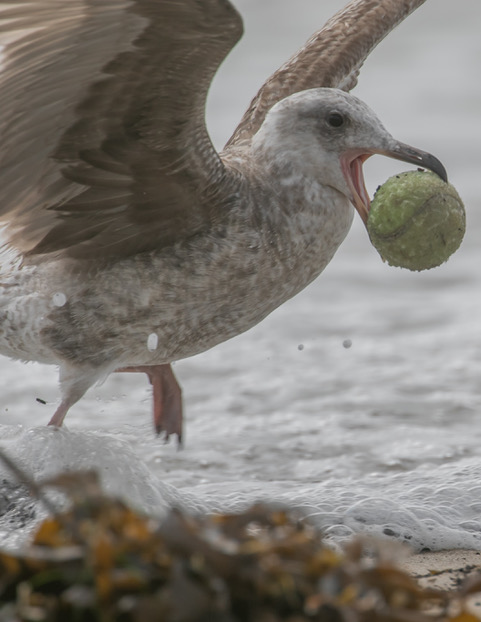
If you live in Malibu Colony and your tennis balls keep disappearing, it’s one of your neighbors sneaking off with them, perhaps to see if anything edible is within.
On our way back to our cars, we had a bit of excitement among the Ardeidae (herons & egrets). First, look closely at the photo below.
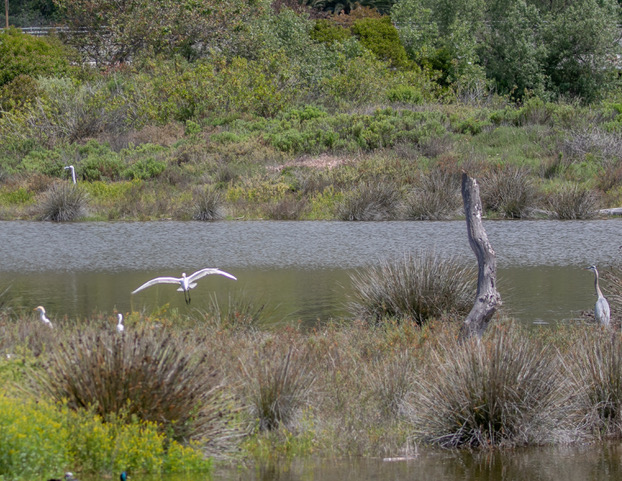
One them is this fellow. Recognize it before you scroll down?
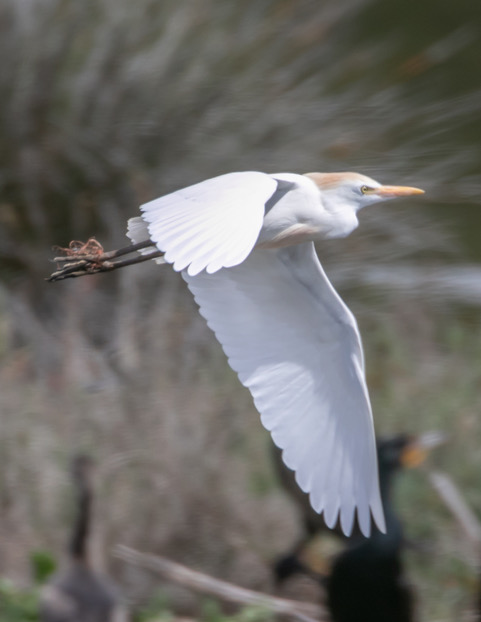
Besides the shortish yellow bill and the dark legs and feet and the relatively small overall size, they have these rusty areas on head and breast in breeding plumage. The excitement began when a Snowy Egret began chasing the Cattle Egret all around the lagoon. It looked pretty aggressive about it and this went on for perhaps five minutes with lots of swooping, hairpin turns and twists, and diving.
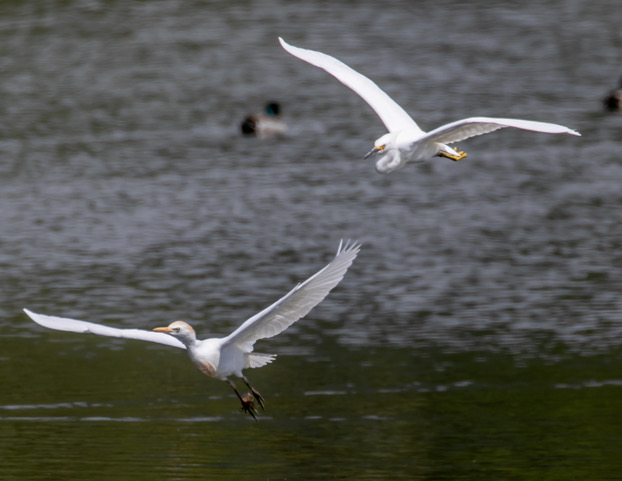
Finally one or the other of them landed near the “Osprey Pole” on the westernmost sand island, and the other landed next to it. Until we left they stayed very close to one another, neither even slightly aggressive to the other. Were they really pals just having some fun, or what?
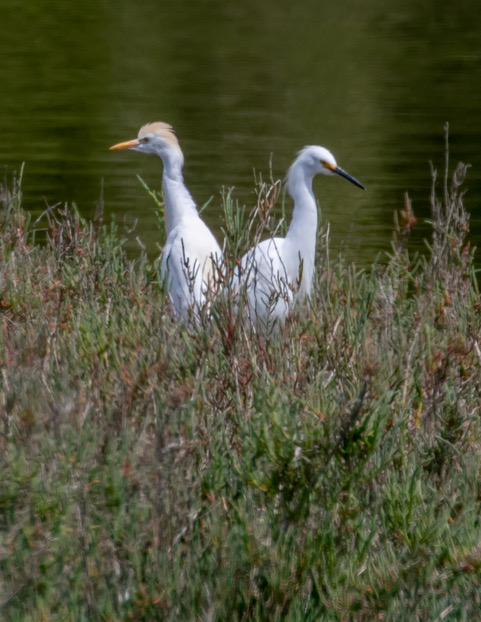
Unlike most of the other herons, egrets and bitterns, Cattle Egrets prefer fields, especially when they support hoofed mammals who walk around and stir up insects. [They’re Cattle Egrets, right?] In Africa they follow antelope, elephants, buffalo or rhinoceros, often riding on their backs. In 2023 they were split into two species: Western Cattle-Egret (Ardea ibis) in Africa, Europe and the Americas, and Eastern Cattle-Egret (Ardea coromanda) from Pakistan to Japan, Australia and New Zealand. There are morphological differences between them which Google will be glad to tell you about.
We don’t get many at the lagoon, but if you go to the fields of Imperial County south of the Salton Sea around sundown, you can see thousands of them overhead, flying to their nighttime roosts. At the lagoon, since 17 Nov 1979 when I spotted 13 birds, I’ve recorded only 65 total birds in 27 appearances. From Nov 2004 to Apr 2006 they appeared almost monthly, mostly as singletons, but on Christmas Day 2005 there were 21 birds. Prior to today, my most recent sighting at the lagoon was of 5 birds on 26 Nov 2017, over seven years ago.
Just how this species appears among us may be unique in the annals of avifauna. [Note: unique ≠ unusual.] Here’s a very short history:
Sub-Saharan Africa: very long term resident, whence they spread.
South America: Suriname 1877, Guyana 1911, Tierra del Fuego 1977.
Antarctica: South Shetlands 1985.
Caribbean: Nicaragua islands 1933; Aruba 1944; Puerto Rico & Jamaica 1948; Bahamas 1953, Cuba & St. Croix 1957; by 1988 on over 50 islands.
Central America: Panama & Costa Rica 1954; Belize 1956; Honduras & Guatemala 1958; Cocos and Clipperton Islands 1961; Nicaragua 1962; El Salvador 1969.
Mexico: Quintana Roo 1956; Veracruz 1958; Tabasco 1959; Tamaulipas 1961; Campeche, Chiapas, Puebla & Yucatan 1963; Guerrero, Sinaloa, Sonora & southern Baja California 1964; northwestern Baja California 1967; Durango & Coahuila 1971; Chihuahua, San Luis Potosí, & Nuevo León 1972; Colima and central Baja California 1973.
Continental United States. South Florida 1941, New Jersey 1951, Massachusetts 1952, Texas 1959, Minnesota 1970, Southern California 1962, Vancouver Island 1969, Montana 1979, southern Alaska 1981; breeding in California 1970.
Canadian provinces. Newfoundland 1952; all other provinces by 1974; Northwest Territories 1971 at Fort Smith south of Great Slave Lake near 60°N latitude; not recorded from Yukon Territory.
Hawaiian Islands. Introduced on the main islands. Reports from Midway may be of Eastern Cattle-Egret.
I haven’t heard of such a rapid spread by any other avian species, although the Eurasian Collard-Dove might be a contender.
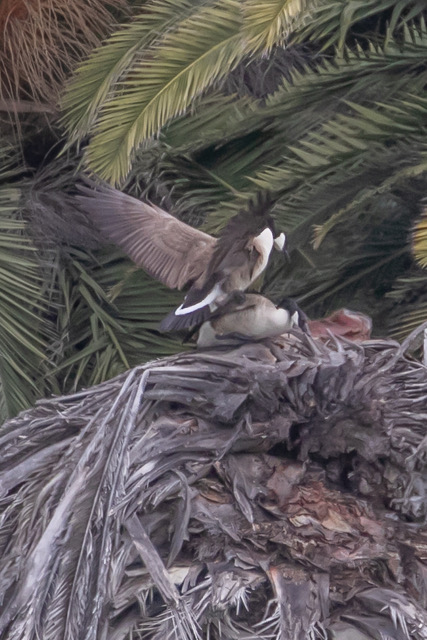
I left this to last. I’ve never heard of Canada Geese nesting in trees, but take a look at this, taking place on Adamson House property in full view of the public.
Malibu Lagoon on eBird as of 5-2-25: 8552 lists, 2744 eBirders, 321 species
Most recent new species seen: Nelson’s Sparrow, 11/29/24 by Femi Faminu (SMBAS member). When the newest species added to the list was seen on a date prior to the most recently seen new species, there is no way I can find to easily determine what that bird is. Another minor nit to pick about eBird.
Birds new for the season: Western Cattle-Egret, Semipalmated Plover, Turkey Vulture, Violet-green Swallow, Hooded Oriole, Brown-headed Cowbird. “New for the season” means it has been three or more months since last recorded on our trips.
Many, many thanks to photographer Chris Tosdevin.
Upcoming SMBAS scheduled field trips; no reservations or Covid card necessary unless specifically mentioned:
- Bear Divide & Walker Ranch, Sat. May 3, 7:30 am
- Malibu Lagoon, Sun. May 25, 8:30 (adults) & 10 am (parents & kids)
- Malibu Creek State Park, Sat, June 14, 8 am
- Malibu Lagoon, Sun. June 22, 8:30 (adults) & 10 am (parents & kids)
- These and any other trips we announce for the foreseeable future will depend upon expected status of the Covid/flu/etc. pandemic, not to mention landslides, at trip time. Any trip announced may be canceled shortly before trip date if it seems necessary. By now any other comments should be superfluous.
- Link to Programs & Field Trip schedule.
The next SMBAS Zoom program: Changing Behavior in Changing Cities: Shifting Trends in Urban Bird Behavior Across Seasons and Cityscapes, with Joey Di Liberto & Suu Zhou. Tuesday, 6 May, 7:30 p.m., Zoom waiting room opens 7:15 p.m.
The SMBAS 10 a.m. Parent’s & Kids Birdwalk will resume when we can again schedule official monthly walks. Reservations not necessary for families, but for groups (scouts, etc.), call Jean (213-522-0062).
Links: Unusual birds at Malibu Lagoon
9/23/02 Aerial photo of Malibu Lagoon
More recent aerial photo
Prior checklists:
2023: Jan-June, July-Dec 2024: Jan-June, July-Dec
2021: Jan-July, July-Dec 2022: Jan-June, July-Dec
2020: Jan-July, July-Dec 2019: Jan-June, July-Dec
2018: Jan-June, July-Dec 2017: Jan-June, July-Dec
2016: Jan-June, July-Dec 2015: Jan-May, July-Dec
2014: Jan-July, July-Dec 2013: Jan-June, July-Dec
2012: Jan-June, July-Dec 2011: Jan-June, July-Dec
2010: Jan-June, July-Dec 2009: Jan-June, July-Dec
The 10-year comparison summaries created during the Lagoon Reconfiguration Project period, remain available—despite numerous complaints—on our Lagoon Project Bird Census Page. Very briefly summarized, the results unexpectedly indicate that avian species diversification and numbers improved slightly during the restoration period June’12-June’14.
Many thanks to Marie Barnidge-McIntyre, Femi Faminu, Lillian Johnson and Chris Tosdevin for contributions made to this month’s census counts.
The species list below was re-sequenced as of 12/31/24 to agree with the California Bird Records Committee Official California Checklist. If part of the right side of the chart below is hidden, there’s a slider button inconveniently located at the bottom end of the list. The numbers 1-9 left of the species names are keyed to the nine categories of birds at the bottom. Updated lagoon bird check lists can be downloaded here.
[Chuck Almdale]
| Malibu Census 2024-25 | 11/24 | 12/22 | 1/30 | 2/23 | 3/23 | 4/27 | |
| Temp °F. | 54-59 | 56-62 | 57-59 | 57-70 | 54-64 | 56-64 | |
| Tide Lo/Hi ft. | L+2.06 | L+2.47 | H+6.14 | H+4.79 | H+4.15 | H+4.29 | |
| Tide Time | 1139 | 0939 | 0913 | 0526 | 0433 | 0957 | |
| 1 | Canada Goose | 2 | 2 | 8 | |||
| 1 | Cinnamon Teal | 5 | 6 | ||||
| 1 | Northern Shoveler | 6 | |||||
| 1 | Gadwall | 26 | 32 | 89 | 9 | 35 | 10 |
| 1 | American Wigeon | 12 | 35 | ||||
| 1 | Mallard | 10 | 20 | 22 | 6 | 22 | 21 |
| 1 | Green-winged Teal | 1 | 10 | 5 | 16 | 6 | |
| 1 | Ring-necked Duck | 3 | |||||
| 1 | Lesser Scaup | 2 | |||||
| 1 | Surf Scoter | 2 | 15 | 6 | |||
| 1 | Bufflehead | 9 | 10 | 23 | |||
| 1 | Red-breasted Merganser | 10 | 13 | 12 | 8 | 3 | 1 |
| 1 | Ruddy Duck | 22 | 35 | 37 | 17 | 11 | 10 |
| 2 | Pied-billed Grebe | 8 | 5 | 4 | 7 | 8 | 4 |
| 2 | Eared Grebe | 1 | 1 | ||||
| 2 | Western Grebe | 1 | 34 | 30 | 30 | 25 | |
| 7 | Feral Pigeon | 4 | 6 | 5 | 1 | ||
| 7 | Mourning Dove | 1 | 2 | ||||
| 8 | Anna’s Hummingbird | 1 | 3 | 3 | 3 | ||
| 8 | Allen’s Hummingbird | 1 | 3 | 1 | 5 | 6 | 5 |
| 2 | Sora | 2 | |||||
| 2 | American Coot | 560 | 705 | 797 | 45 | 55 | 11 |
| 5 | Black Oystercatcher | 2 | 2 | ||||
| 5 | Black-bellied Plover | 75 | 50 | 30 | 30 | ||
| 5 | Killdeer | 1 | 30 | 2 | 4 | 4 | 3 |
| 5 | Semipalmated Plover | 2 | |||||
| 5 | Snowy Plover | 34 | 27 | 2 | 2 | 3 | |
| 5 | Whimbrel | 15 | 4 | 8 | 5 | 8 | 3 |
| 5 | Marbled Godwit | 12 | 25 | 3 | 2 | 8 | |
| 5 | Ruddy Turnstone | 6 | 4 | 2 | 4 | ||
| 5 | Sanderling | 200 | 100 | 22 | |||
| 5 | Dunlin | 1 | |||||
| 5 | Least Sandpiper | 8 | 27 | 7 | 14 | 5 | 1 |
| 5 | Western Sandpiper | 16 | 34 | ||||
| 5 | Spotted Sandpiper | 1 | 1 | 1 | 1 | ||
| 5 | Willet | 51 | 20 | 15 | 8 | 10 | |
| 5 | Greater Yellowlegs | 2 | |||||
| 6 | Heermann’s Gull | 29 | 2 | 7 | 1 | ||
| 6 | Ring-billed Gull | 15 | 19 | 12 | 12 | 6 | 2 |
| 6 | Western Gull | 65 | 35 | 90 | 55 | 20 | 20 |
| 6 | California Gull | 525 | 60 | 575 | 105 | 1 | 2 |
| 6 | American Herring Gull | 1 | 1 | 1 | 2 | 1 | |
| 6 | Glaucous-winged Gull | 3 | 1 | ||||
| 6 | Caspian Tern | 11 | 2 | ||||
| 6 | Royal Tern | 2 | 5 | 10 | |||
| 6 | Elegant Tern | 2 | |||||
| 2 | Red-throated Loon | 1 | |||||
| 2 | Pacific Loon | 1 | 1 | 1 | |||
| 2 | Common Loon | 4 | 10 | ||||
| 2 | Brandt’s Cormorant | 5 | 7 | 1 | 5 | 12 | |
| 2 | Pelagic Cormorant | 2 | 2 | 1 | |||
| 2 | Double-crested Cormorant | 44 | 23 | 55 | 25 | 25 | 25 |
| 2 | American White Pelican | 5 | |||||
| 2 | Brown Pelican | 260 | 35 | 23 | 29 | 200 | 25 |
| 3 | Snowy Egret | 5 | 5 | 5 | 6 | 5 | 1 |
| 3 | Black-crowned Night-Heron | 1 | 2 | 1 | |||
| 3 | Green Heron | 1 | |||||
| 3 | Great Egret | 3 | 1 | 1 | 2 | 2 | 1 |
| 3 | Western Cattle-Egret | 1 | |||||
| 3 | Great Blue Heron | 4 | 4 | 1 | 2 | 1 | |
| 4 | Turkey Vulture | 1 | 2 | ||||
| 4 | Osprey | 1 | 1 | 2 | 1 | 1 | |
| 4 | Cooper’s Hawk | 1 | 1 | ||||
| 4 | Bald Eagle | 1 | |||||
| 4 | Red-tailed Hawk | 1 | 1 | 1 | 1 | ||
| 8 | Belted Kingfisher | 1 | 1 | 1 | 1 | ||
| 8 | Nuttall’s Woodpecker | 1 | |||||
| 8 | Nanday Parakeet | 4 | 4 | 2 | |||
| 9 | Cassin’s Kingbird | 1 | 1 | ||||
| 9 | Black Phoebe | 6 | 1 | 1 | 3 | 3 | 1 |
| 9 | Say’s Phoebe | 1 | 1 | ||||
| 9 | California Scrub-Jay | 1 | 1 | ||||
| 9 | American Crow | 22 | 8 | 9 | 26 | 6 | 5 |
| 9 | Common Raven | 1 | 2 | 9 | 2 | ||
| 9 | Oak Titmouse | 1 | |||||
| 9 | Tree Swallow | 12 | 5 | ||||
| 9 | Violet-green Swallow | 5 | |||||
| 9 | No. Rough-winged Swallow | 17 | 20 | ||||
| 9 | Barn Swallow | 1 | 10 | 20 | |||
| 9 | Cliff Swallow | 3 | 7 | ||||
| 9 | Bushtit | 12 | 50 | 4 | 5 | 25 | 2 |
| 9 | Wrentit | 2 | 1 | 1 | 4 | 2 | |
| 9 | Ruby-crowned Kinglet | 3 | 1 | 1 | |||
| 9 | Blue-gray Gnatcatcher | 1 | 1 | ||||
| 9 | Bewick’s Wren | 2 | 1 | 1 | |||
| 9 | Northern House Wren | 1 | |||||
| 9 | Northern Mockingbird | 1 | 1 | 1 | |||
| 9 | European Starling | 7 | 1 | 10 | 10 | ||
| 9 | Western Bluebird | 1 | |||||
| 9 | Hermit Thrush | 1 | |||||
| 9 | House Finch | 4 | 6 | 8 | 9 | 26 | 15 |
| 9 | Lesser Goldfinch | 6 | 2 | 10 | 4 | ||
| 9 | Dark-eyed Junco | 2 | 1 | 1 | 1 | ||
| 9 | White-crowned Sparrow | 15 | 20 | 8 | 7 | 5 | 1 |
| 9 | Song Sparrow | 8 | 6 | 12 | 8 | 10 | 8 |
| 9 | California Towhee | 2 | 2 | 3 | 3 | 3 | |
| 9 | Spotted Towhee | 1 | 1 | 1 | |||
| 9 | Western Meadowlark | 1 | |||||
| 9 | Hooded Oriole | 1 | |||||
| 9 | Red-winged Blackbird | 1 | 2 | ||||
| 9 | Brown-headed Cowbird | 2 | |||||
| 9 | Great-tailed Grackle | 15 | 22 | 2 | 3 | ||
| 9 | Orange-crowned Warbler | 2 | 1 | 1 | 3 | 1 | |
| 9 | Common Yellowthroat | 8 | 6 | 2 | 2 | 6 | 4 |
| 9 | Yellow-rumped Warbler | 15 | 14 | 6 | 8 | 3 | |
| 9 | Wilson’s Warbler | 1 | |||||
| Totals Birds by Type | Nov | Dec | Jan | Feb | Mar | Apr | |
| 1 | Waterfowl | 93 | 157 | 196 | 78 | 91 | 50 |
| 2 | Water Birds – Other | 882 | 769 | 922 | 144 | 339 | 104 |
| 3 | Herons, Egrets & Ibis | 14 | 12 | 7 | 8 | 10 | 4 |
| 4 | Quail & Raptors | 2 | 2 | 0 | 5 | 3 | 4 |
| 5 | Shorebirds | 404 | 290 | 92 | 86 | 76 | 9 |
| 6 | Gulls & Terns | 635 | 119 | 685 | 183 | 52 | 26 |
| 7 | Doves | 4 | 0 | 6 | 5 | 1 | 3 |
| 8 | Other Non-Passerines | 3 | 8 | 1 | 14 | 10 | 10 |
| 9 | Passerines | 142 | 150 | 57 | 92 | 160 | 115 |
| Totals Birds by Type | 2179 | 1507 | 1966 | 615 | 742 | 325 | |
| Total Species by Group | Nov | Dec | Jan | Feb | Mar | Apr | |
| 1 | Waterfowl | 8 | 8 | 8 | 8 | 8 | 5 |
| 2 | Water Birds – Other | 8 | 5 | 8 | 9 | 9 | 8 |
| 3 | Herons, Egrets & Ibis | 5 | 4 | 3 | 2 | 4 | 4 |
| 4 | Quail & Raptors | 2 | 2 | 0 | 4 | 3 | 3 |
| 5 | Shorebirds | 10 | 11 | 10 | 10 | 10 | 4 |
| 6 | Gulls & Terns | 5 | 6 | 5 | 7 | 8 | 4 |
| 7 | Doves | 1 | 0 | 1 | 1 | 1 | 2 |
| 8 | Other Non-Passerines | 3 | 3 | 1 | 5 | 3 | 3 |
| 9 | Passerines | 24 | 17 | 14 | 20 | 25 | 22 |
| Totals Species by Group – 106 | 66 | 56 | 50 | 66 | 71 | 55 |
Discover more from SANTA MONICA BAY AUDUBON SOCIETY BLOG
Subscribe to get the latest posts sent to your email.



 SANTA MONICA BAY AUDUBON SOCIETY BLOG