Gulls, grebes, plovers and terns: Malibu Lagoon, 23 Nov. 2025
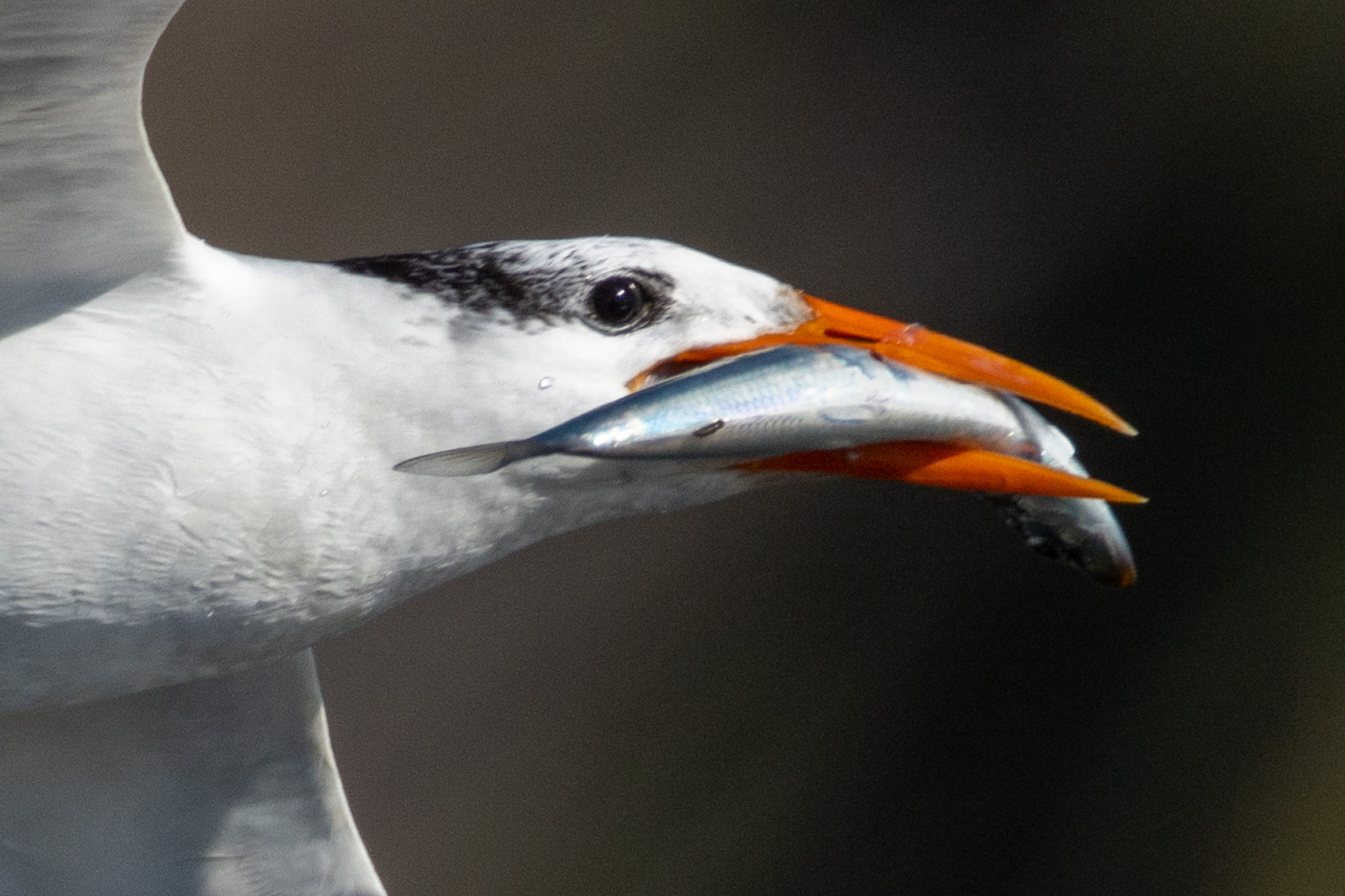
(Armando Martinez 11-23-25)
[By Chuck Almdale; photos by Marie Barnidge-McIntyre, Femi Faminu, Armando Martinez, Emily Roth & Chris Tosdevin]
Although it was only 55°F. when we started, the sun was bright and it didn’t seem as cold as it might, so many of us stripped down to only three layers. There were not a lot of ducks on the water, nor even many coots, although a dozen Canada Geese were unusual. The Gadwall flock showed up a bit later. The White Pelicans reported earlier in the week were gone, and if there was a possible Vega Gull (east Asian form of the Herring Gull which some authorities consider a separate species) among the gulls, as had been reported earlier in the week, we didn’t see it. I estimated the large flock of gulls across the lagoon to number 2,000-3,000, but throughout the morning they continually flew away in groups of 10-100, and by the time we got close enough to sort them out, only 500 remained.

The lagoon outlet was as wide as I’ve ever seen it, probably from all the creek outflow during the 6″ of rain we had earlier in the month, and the high tide of 5.46 ft. was at 9:39am, so the lagoon was quite full.


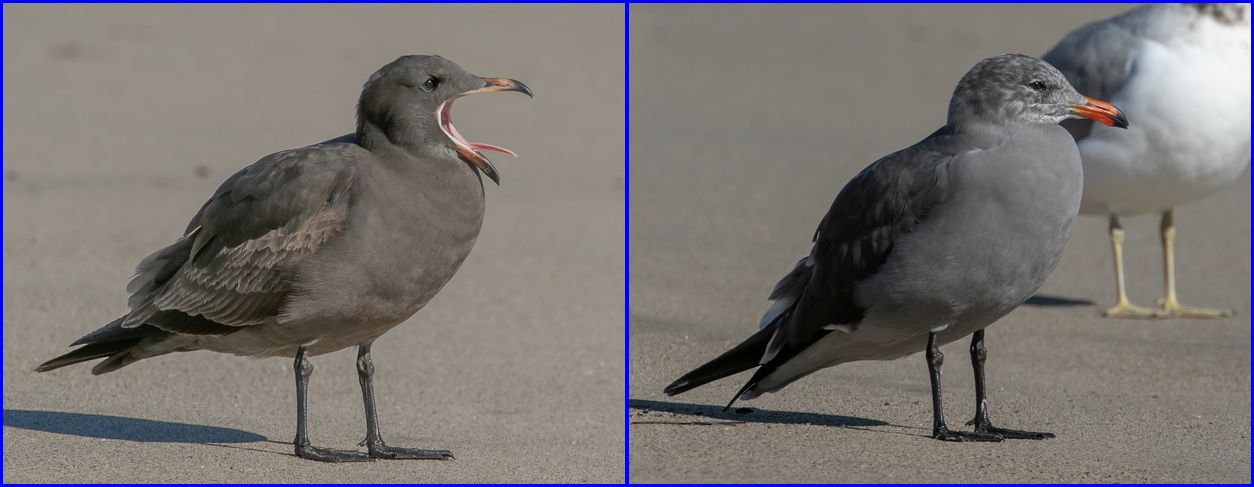
Heermann’s Gulls, which nest in the Sea of Cortez, are a West Coast specialty and are classified as “casual” (one or less per year) on the east coast. Non-birders often think gulls are supposed to be white with maybe some dark on the top on their wings, and certainly not all coal-colored. These are 4-year gulls, but the plumage changes per year are not enormous. The tired bird below left is first-cycle (born last spring but now out of juvenal plumage), or possibly 2nd cycle; the pale area on the flanks are very worn upper wing coverts (covering the base of the feathers just below them), which probably remain from the juvenal plumage. The right bird is a non-breeding adult which has lost almost all of the white head feathers, thus is at least 4 years old. They are very similar, but the adult is primarily gray, almost blue-gray, rather than gray-brown.

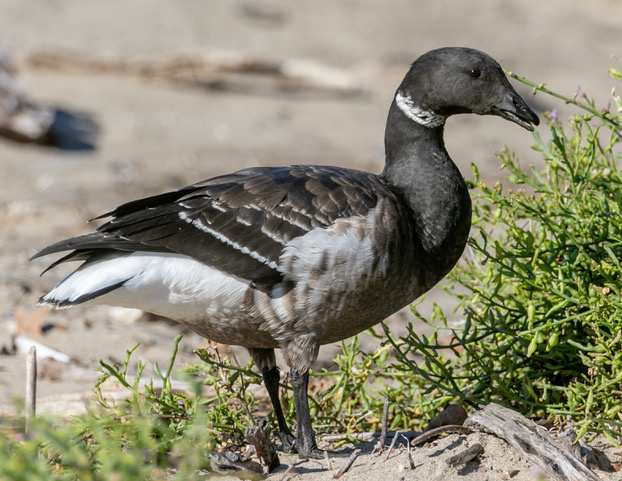
We first spotted the Brant from far across the lagoon, standing on a dune among the plants, with the sun directly behind it. It has a very distinctive profile for a goose or duck. By the time we reached the beach, over an hour later, it had probably moved less than 10 ft. It spent much of the time lying down among the plants, relocating only when we got too close for its comfort. It may have just finished a long migratory flight.
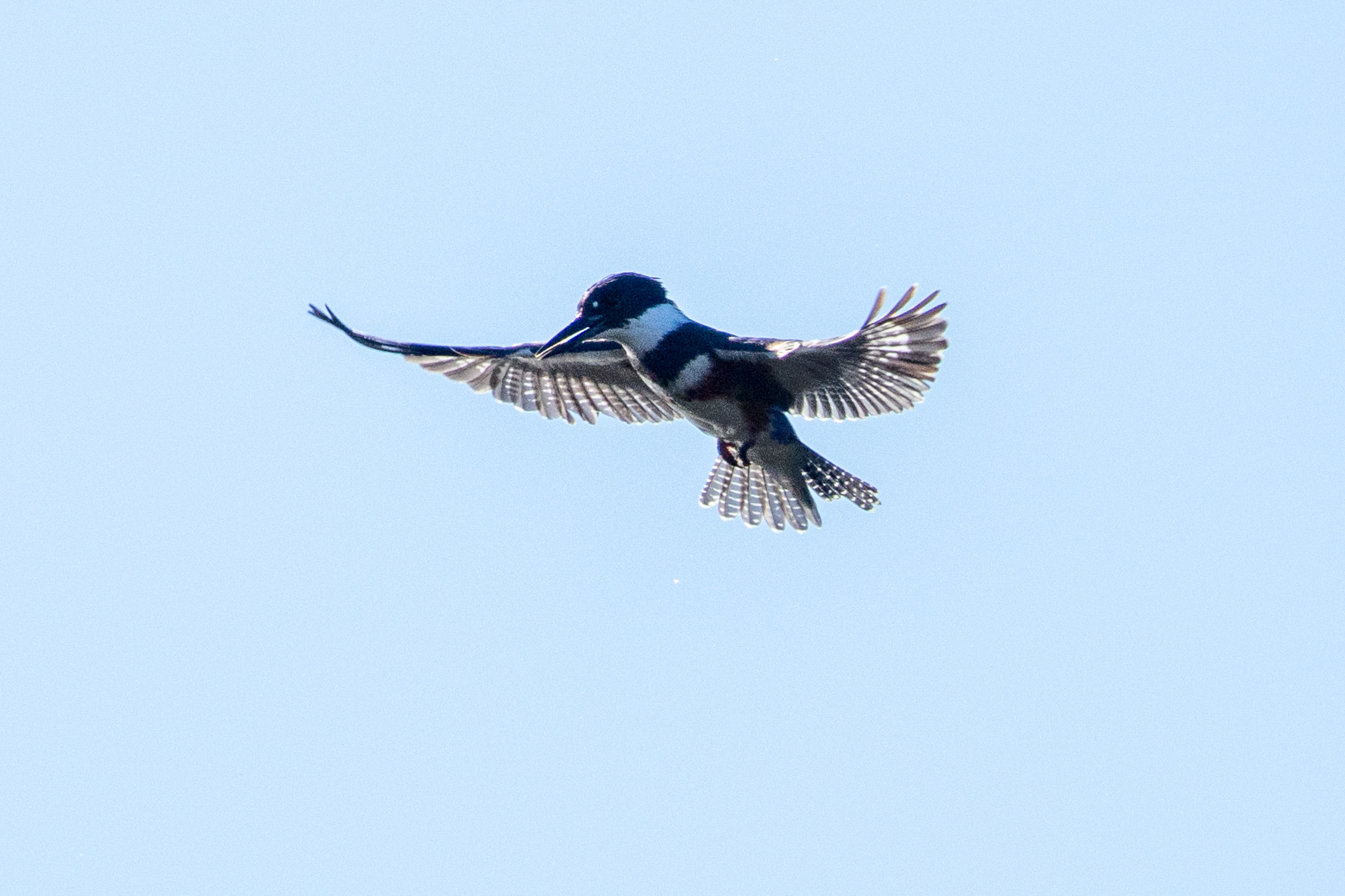
(Chris Tosdevin 11-23-25)
Western Grebes show up at this time of year. They are mostly just offshore, and later in the winter at Dockweiler Beach about 15 miles to the south we can see thousands of them in rafts just past the surf zone. The ambitious can search through these rafts and perhaps one percent of them can be identified as the very similar Clark’s Grebe.

At the lagoon, most of them are also offshore, but some do come within the lagoon, as do the occasional Clark’s Grebe. Don’t ID them until you see the white around their eyes.

How often do we see these two species? Funny you should ask. For the period Oct’79–Nov’25, including offshore birds:
Western Grebe: 166 appearances, 3089 birds
Clark’s Grebe: 16 appearances, 20 birds
For these two species combined, 0.64% of them are Clark’s.
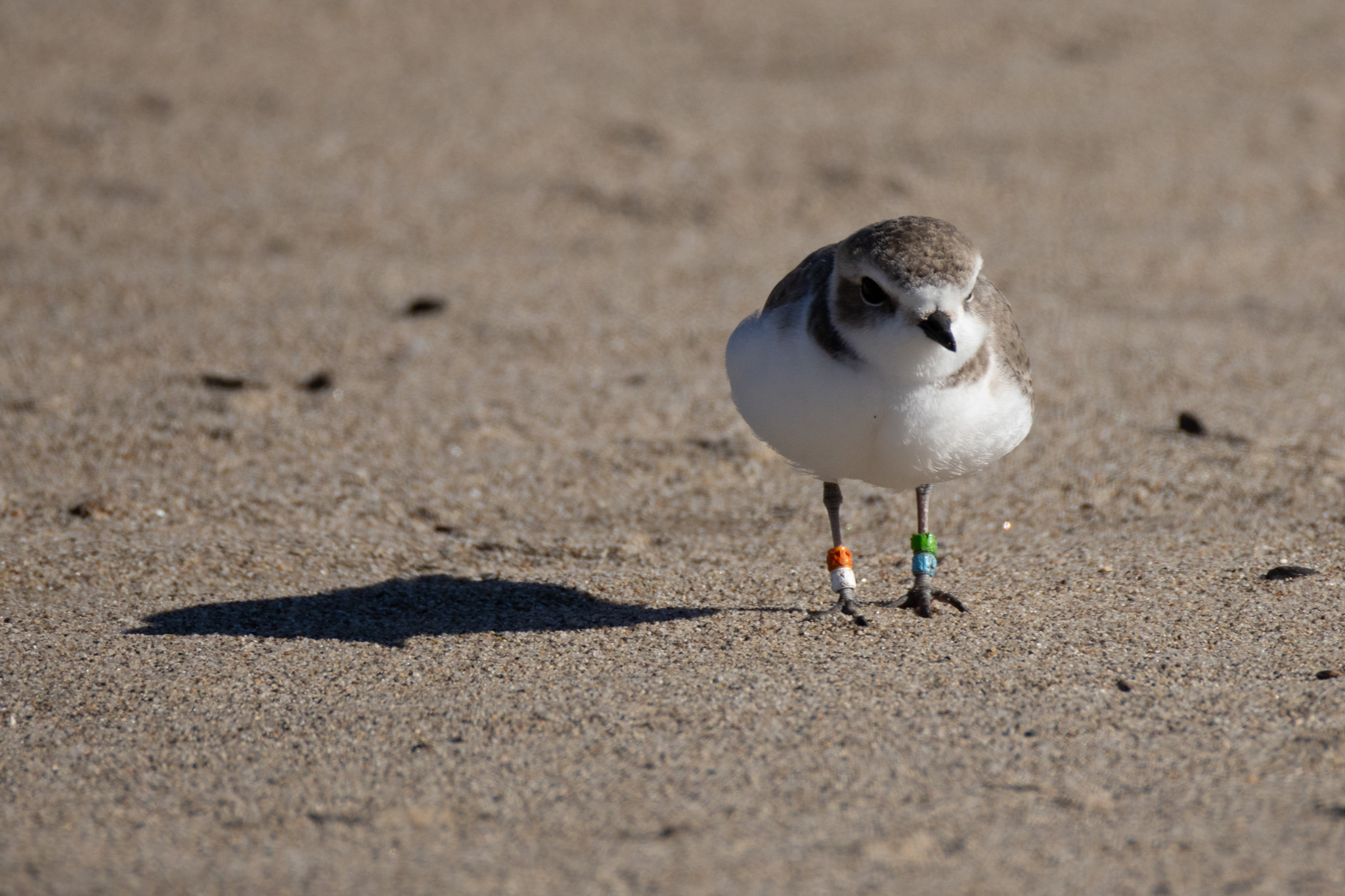
The Western Snowy Plovers are solidly back for the winter. The first 17 appeared in July; by October there were 40, and this month there were “at least” 40. Various people were busily counting them, so we had at least 20 and perhaps 30 counts (I counted them 4 times), and every count had a different total. As Chris Lord, probably the best counter in the group (and whose count I finally used) said, “I don’t know…they were running all over the place, and I kept finding new groups of them, but there were at least forty of them.” I had settled on 26 birds the 4th time through, but then discovered at least 20 more about 50-100 ft. away and, unsure if they had just ran over there while I was counting elsewhere or had been there all along, gave up and used Chris’ count.
At some point Chris Tosdevin noticed some unusual activity. He narrates:

(Emily Roth 11-23-25)
I observed some squabbling [Great-tailed] Grackles – one carrying something which it dropped. I noticed it was a small bird that was still moving; the grackle swooped down and picked up the bird again and I decided to give chase and clapped my hands to startle the grackle, at which point it dropped it again. I then went over to check the bird and found it to be a juvenile Snowy Plover. The bird looked shaken and stunned but didn’t seem to have any other injuries. I relocated it to a sheltered area in the dunes and left it to recover not wanting to stress it any further.
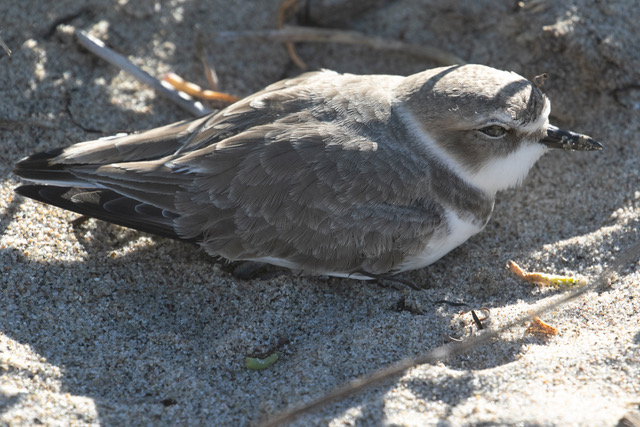
We like to watch out for “our” Snowies. There’s perhaps only 2000-2500 of them in the world, and Malibu Lagoon is one of only seven roosting spots in Los Angeles County.
We used to have a lot more Bonaparte’s Gulls than we do now.
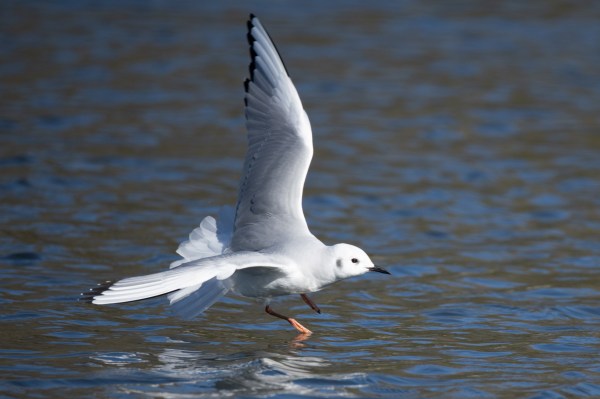
The bird was named after Charles Lucien Jules Laurent Bonaparte, prince of Canino and Musignano (b.1803-d.1857), and a naturalist. Nephew of that Bonaparte, his family fell on hard times after his uncle’s defeat at Waterloo and decided to move to the United States where they lived in New Jersey and in Philadelphia. Between 1822 and 1828 CLJL Bonaparte re-edited a book with the longest title in American Ornithology: American Ornithology, or History of Birds Inhabiting the United States not given by Wilson. Bonaparte is considered to be the ‘father of systematic ornithology’ in America. [From E.A. Choate’s Dictionary of American Bird Names, 1985.]

Some spreadsheet history of their presence at the lagoon gives you an idea of the decline progression. In the earliest years they were present only Nov – May.
Nov’79 – May’80: 3,399 includes 1,600 on 3/15/80
Nov’80 – May’81: 1,503 includes 530 on 11/29/80
Nov’81 – May’82: 2,003 includes 950 on 11/29/81
Nov’82 – Jan’83: 1,813 includes 1,095 on 12/12/82
After this I stopped regular censusing for almost two decades.
Nov’00 – May’11: 142 in 11 years
Oct’11 – Oct’17: 43 in 6 years
Nov’17 – Nov’25: 25 in 8 years, includes 10 birds on 5/26/24, their last visit until today.
Total of above 8,928.
So…it was quite nice to see the Boney (as we say) today. It spent some time lying on the sand, affording good looks.

Then, apparently it got into a scrape with some other birds. Most of us (including me) missed this, but saw the result. Chris T. did witness it: “Regarding the crows attacking the Boney, I only managed to get the photo of it flopped on the beach with its wings slightly spread.”
While leaving the beach, the rest of us saw the bird, and Armando got some photos.

It’s right wing was spread out much wider than the left wing.

And it was nodding its head, bobbing its bill up and down, up and down, up and down.
When I witnessed this I did not yet know it had been attacked by crows, and the repetitive head motion immediately made me think of domoic acid poising in seals and sea lions. [NBC news report March 2025] They sit on the sand and move their heads (and to a lesser extent their shoulders) in a repetitive figure-eight motion. The gull’s head motion was up-and-down only. Which came first, the repetitive motion or the attack? It’s possible the bird was sick and repetitively moving as it lay on the sand and the crows moved in, sensing an easy target. (Most of the morning we were a significant distance from the bird and could easily miss noticing the head motion.) Or perhaps the motion was entirely due to injury sustained from the crow attack. If anyone definitely noticed the motion or distinct lack of motion prior to the attack, let me know and I’ll update this message.

We left it there on the sand. Authorities advise against approaching possibly sick animals – primarily seals and sea lions which can get big and dangerous – and call the help lines such as International Bird Rescue at (866) 767-2473. I felt that anything I did would only stress the bird more. I believe someone with a phone called the Malibu animal rescue office.
Our 10am parents & kids walks have resumed. As we were leaving I saw Jean Garrett, surrounded by about 10 people, busily pointing out the various birds. Call her (213-522-0062) if you have a group. If it’s just you and a couple of kids, you don’t need to call, just meet her around 10am at the metal-roofed pavilion by the parking lot.
Cruising home and drinking coffee along Malibu Canyon Rd. just north of Mulholland Drive, I saw Marie Barnidge-McIntyre walking down the side of the road, camera in hand. Figuring that she had seen something good – probably a Lewis’s Woodpecker as they frequently winter very slightly south of here – I pulled over and walked back. Turns out that Chris T. had tipped her off to where he’d recently seen a Lewis’s, and she’d gotten a photo just as the bird flew. She then alerted me to a distant raptor on a snag, and I looked to see a Red-shouldered Hawk eating some unfortunate mammal. And…slightly to the right, much closer, I glimpsed an exceptionally fat Robin sitting on the edge of a tree, an unusual fall location for one to sit. Closer inspection of the “robin” proved it to be a Lewis’s Woodpecker. Lewis’s are great at flycatching from trees and in our area, when they show up in the fall, they often stick close to the same small clump of trees all winter long.

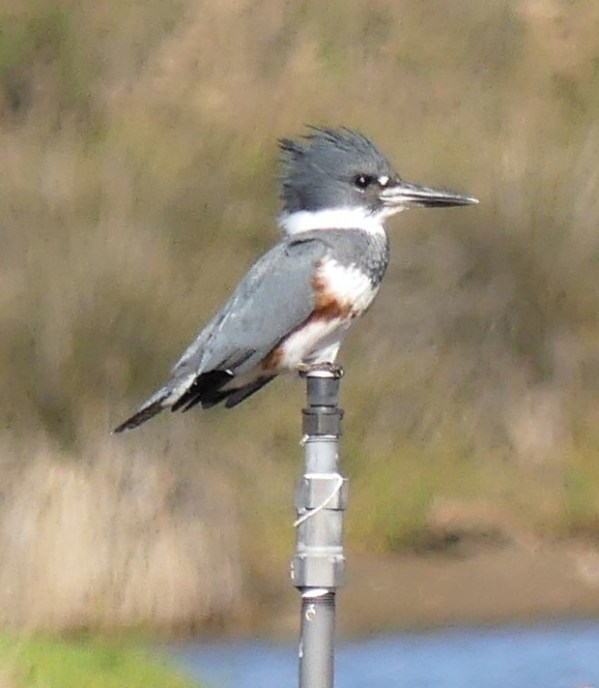
Malibu Lagoon on eBird as of 11-24-25: 8938 lists, 2873 eBirders, 322 species
Most recent new species seen: Nelson’s Sparrow, 11/29/24 by Femi Faminu (SMBAS member). When the newest species added to the list was seen on a date prior to the most recently seen new species, there is no way I can find to easily determine what that bird is. Another minor nit to pick about eBird.
Birds new for the season: Brant, Canada Goose, Bufflehead, Red-breasted Merganser, Clark’s Grebe, Boneparte’s Gull, American Herring Gull, Red-throated Loon, Pacific Loon, Turkey Vulture, Nuttall’s Woodpecker, Say’s Phoebe, Blue-gray Gnatcatcher, Hermit Thrush, Lesser Goldfinch, Western Meadowlark. “New for the season” means it has been three or more months since last recorded on our trips.
Many, many thanks to photographers Marie Barnidge-McIntyre, Femi Faminu, Armando Martinez, Emily Roth & Chris Tosdevin.
Upcoming SMBAS scheduled field trips; no reservations or Covid card necessary unless specifically mentioned:
- Back Bay Newport, Sat. Dec. 13, 8am. Reservation: webinfo493[AT]verizon[dot]net
- Butterbredt Xmas Count, Mon, Dec 15 9am, Reservation JeanGarrett2001[AT]AOL[dot]com
- Malibu Lagoon, Sun. Dec. 28, 8:30 (adults) & 10 am (parents & kids)
- L.A. Christmas Count Santa Monica area, 7am Woodlawn Cemetery, Lu Plauzoles 310-779-0966, contact Lu before Jan 2.
- Antelope Valley Raptor Search or Bette Davis-Riverwalk 8 am SMBAS, Reservation smbaudubon [AT]gmail[dot]com
- These and any other trips we announce for the foreseeable future will depend upon expected status of the Covid/flu/etc. pandemic, not to mention landslides, at trip time. Any trip announced may be canceled shortly before trip date if it seems necessary. By now any other comments should be superfluous.
- Link to Programs & Field Trip schedule.
The next SMBAS Zoom program: December 2, 7:30pm; Red Queen Recovery: The complicated story of why California Condor lead poisoning rates are increasing, with UCSC Prof. Dr. Myra Finkelstein.
The SMBAS 10 a.m. Parent’s & Kids Birdwalk has again resumed. Reservations not necessary for families, but for groups (scouts, etc.), call Jean (213-522-0062).
Links: Unusual birds at Malibu Lagoon
9/23/02 Aerial photo of Malibu Lagoon
More recent aerial photo
Prior checklists:
2025: Jan-June
2023: Jan-June, July-Dec 2024: Jan-June, July-Dec
2021: Jan-July, July-Dec 2022: Jan-June, July-Dec
2020: Jan-July, July-Dec 2019: Jan-June, July-Dec
2018: Jan-June, July-Dec 2017: Jan-June, July-Dec
2016: Jan-June, July-Dec 2015: Jan-May, July-Dec
2014: Jan-July, July-Dec 2013: Jan-June, July-Dec
2012: Jan-June, July-Dec 2011: Jan-June, July-Dec
2010: Jan-June, July-Dec 2009: Jan-June, July-Dec
The 10-year comparison summaries created during the Lagoon Reconfiguration Project period, remain available—despite numerous complaints—on our Lagoon Project Bird Census Page. Very briefly summarized, the results unexpectedly indicate that avian species diversification and numbers improved slightly during the restoration period June’12-June’14.
Many thanks to Marie Barnidge-McIntyre, Femi Faminu, Chris Lord, Armando Martinez, Chris & Ruth Tosdevin andothers for contributions made to this month’s census counts.
The species list below was re-sequenced as of 12/31/24 to agree with the California Bird Records Committee Official California Checklist, mostly. If part of the right side of the chart below is hidden, there’s a slider button inconveniently located at the bottom end of the list. The numbers 1-9 left of the species names are keyed to the nine categories of birds at the bottom. Updated lagoon bird check lists can be downloaded here.
[Chuck Almdale]
| Malibu Census 2025 | 6/22 | 7/27 | 8/24 | 9/28 | 10/26 | 11/23 | |
| Temperature | 66-73 | 64-70 | 68-75 | 65-69 | 58-65 | 59-65 | |
| Tide Lo/Hi Height | H+3.31 | L-0.46 | H+4.74 | H+4.54 | H+5.02 | H+5.46 | |
| Tide Time | 0824 | 0605 | 1102 | 1244 | 1125 | 0939 | |
| 1 | Brant (Black) | 1 | 1 | ||||
| 1 | Canada Goose | 5 | 1 | 12 | |||
| 1 | Gadwall | 25 | 20 | 19 | 6 | 14 | |
| 1 | Mallard | 20 | 40 | 14 | 7 | 26 | 1 |
| 1 | Ring-necked Duck | 1 | |||||
| 1 | Surf Scoter | 10 | 2 | 22 | |||
| 1 | Bufflehead | 4 | |||||
| 1 | Red-breasted Merganser | 1 | 2 | ||||
| 1 | Ruddy Duck | 3 | 19 | 1 | 5 | ||
| 2 | Pied-billed Grebe | 4 | 3 | 4 | 6 | 2 | 3 |
| 2 | Eared Grebe | 1 | 6 | 3 | |||
| 2 | Western Grebe | 2 | 30 | 8 | |||
| 2 | Clark’s Grebe | 2 | |||||
| 7 | Feral Pigeon | 5 | 5 | 4 | 6 | ||
| 7 | Mourning Dove | 1 | 2 | 2 | 3 | 1 | |
| 8 | Anna’s Hummingbird | 1 | 1 | 1 | 2 | 3 | |
| 8 | Allen’s Hummingbird | 2 | 4 | 4 | 4 | 5 | 4 |
| 2 | Sora | 1 | 1 | ||||
| 2 | American Coot | 1 | 6 | 4 | 31 | 4 | 25 |
| 5 | Black Oystercatcher | 1 | |||||
| 5 | Black-bellied Plover | 21 | 49 | 55 | 88 | 64 | |
| 5 | Killdeer | 5 | 4 | 9 | 1 | 8 | 10 |
| 5 | Semipalmated Plover | 4 | 1 | ||||
| 5 | Snowy Plover | 13 | 17 | 35 | 40 | 40 | |
| 5 | Whimbrel | 1 | 12 | 3 | 14 | 8 | |
| 5 | Marbled Godwit | 21 | 8 | ||||
| 5 | Ruddy Turnstone | 3 | 1 | 3 | 6 | 4 | |
| 5 | Sanderling | 1 | 13 | 23 | |||
| 5 | Dunlin | 2 | 1 | ||||
| 5 | Least Sandpiper | 10 | 4 | 6 | 12 | 6 | |
| 5 | Western Sandpiper | 4 | 14 | 1 | 2 | ||
| 5 | Willet | 1 | 10 | 14 | 20 | ||
| 5 | Wilson’s Phalarope | 1 | |||||
| 6 | Sabine’s Gull | 1 | |||||
| 6 | Bonaparte’s Gull | 1 | |||||
| 6 | Heermann’s Gull | 13 | 36 | 10 | 38 | 2 | 49 |
| 6 | Ring-billed Gull | 5 | 2 | 4 | 1 | 7 | 6 |
| 6 | Western Gull | 79 | 52 | 115 | 61 | 35 | 55 |
| 6 | California Gull | 5 | 1 | 4 | 10 | 116 | 410 |
| 6 | American Herring Gull | 1 | |||||
| 6 | Caspian Tern | 4 | 4 | 2 | |||
| 6 | Forster’s Tern | 1 | |||||
| 6 | Royal Tern | 21 | 135 | 12 | 2 | 22 | |
| 6 | Elegant Tern | 70 | 4 | 2 | 3 | ||
| 2 | Red-throated Loon | 2 | |||||
| 2 | Pacific Loon | 1 | |||||
| 2 | Brandt’s Cormorant | 1 | 1 | 5 | 2 | ||
| 2 | Pelagic Cormorant | 1 | 2 | 1 | 3 | 2 | |
| 2 | Double-crested Cormorant | 18 | 98 | 74 | 49 | 28 | 38 |
| 2 | Brown Pelican | 138 | 118 | 32 | 45 | 138 | 13 |
| 3 | Snowy Egret | 1 | 10 | 10 | 5 | 34 | 30 |
| 4 | Yellow-crowned Night-Heron | 1 | |||||
| 3 | Black-crowned Night-Heron | 4 | 1 | 1 | 2 | 1 | |
| 3 | Green Heron | 1 | 2 | 1 | 2 | 1 | |
| 3 | Great Egret | 3 | 4 | 2 | 3 | 4 | 2 |
| 3 | Great Blue Heron | 9 | 5 | 5 | 4 | 6 | 4 |
| 3 | White-faced Ibis | 1 | |||||
| 4 | Turkey Vulture | 1 | |||||
| 4 | Osprey | 1 | 1 | 1 | 1 | ||
| 4 | Cooper’s Hawk | 1 | |||||
| 4 | Red-shouldered Hawk | 1 | 1 | 2 | 1 | ||
| 4 | Red-tailed Hawk | 1 | 1 | 1 | |||
| 8 | Belted Kingfisher | 1 | 1 | 1 | 2 | ||
| 8 | Nuttall’s Woodpecker | 1 | 1 | 1 | |||
| 4 | Peregrine Falcon | 1 | |||||
| 8 | Nanday Parakeet | 20 | 9 | ||||
| 9 | Black Phoebe | 2 | 2 | 2 | 4 | 2 | 3 |
| 9 | Say’s Phoebe | 1 | |||||
| 9 | California Scrub-Jay | 1 | 1 | 2 | |||
| 9 | American Crow | 6 | 9 | 8 | 6 | 10 | 7 |
| 9 | Common Raven | 1 | |||||
| 9 | Oak Titmouse | 2 | 2 | 1 | |||
| 9 | No. Rough-winged Swallow | 1 | 5 | 2 | |||
| 9 | Barn Swallow | 22 | 20 | 40 | 4 | ||
| 9 | Cliff Swallow | 24 | 12 | ||||
| 9 | Bushtit | 12 | 20 | 20 | 9 | 35 | 4 |
| 9 | Wrentit | 2 | 2 | 1 | 2 | 2 | 4 |
| 9 | Swinhoe’s White-eye | 1 | 1 | ||||
| 9 | Blue-gray Gnatcatcher | 2 | |||||
| 9 | Bewick’s Wren | 2 | |||||
| 9 | Northern House Wren | 1 | 2 | 1 | |||
| 9 | Marsh Wren | 1 | 1 | ||||
| 9 | Northern Mockingbird | 1 | |||||
| 9 | European Starling | 6 | 25 | 35 | 2 | 6 | 30 |
| 9 | Western Bluebird | 2 | |||||
| 9 | Hermit Thrush | 2 | |||||
| 9 | Scaly-breasted Munia | 7 | |||||
| 9 | House Finch | 4 | 5 | 12 | 3 | 2 | 5 |
| 9 | Lesser Goldfinch | 2 | 2 | ||||
| 9 | Dark-eyed Junco | 2 | 1 | 6 | 2 | 3 | |
| 9 | White-crowned Sparrow | 2 | 10 | 12 | |||
| 9 | Savannah Sparrow | 1 | |||||
| 9 | Song Sparrow | 5 | 3 | 6 | 5 | 4 | 4 |
| 9 | California Towhee | 1 | 1 | 2 | 1 | 2 | |
| 9 | Western Meadowlark | 2 | |||||
| 9 | Hooded Oriole | 1 | 2 | ||||
| 9 | Great-tailed Grackle | 8 | 1 | 23 | 6 | 16 | |
| 9 | Orange-crowned Warbler | 1 | 1 | 2 | 1 | 2 | |
| 9 | Common Yellowthroat | 5 | 1 | 4 | 7 | 6 | 2 |
| 9 | Yellow-rumped Warbler | 2 | 25 | 10 | |||
| 9 | Black-throated Gray Warbler | 1 | |||||
| Totals Birds by Type | Jun | Jul | Aug | Sep | Oct | Nov | |
| 1 | Waterfowl | 54 | 81 | 33 | 25 | 28 | 61 |
| 2 | Water Birds – Other | 163 | 227 | 117 | 134 | 216 | 100 |
| 3 | Herons, Egrets & Ibis | 17 | 21 | 22 | 15 | 47 | 37 |
| 4 | Quail & Raptors | 1 | 2 | 2 | 5 | 2 | 3 |
| 5 | Shorebirds | 6 | 61 | 93 | 130 | 219 | 185 |
| 6 | Gulls & Terns | 106 | 116 | 341 | 127 | 164 | 547 |
| 7 | Doves | 6 | 7 | 6 | 9 | 1 | 0 |
| 8 | Other Non-Passerines | 3 | 6 | 6 | 26 | 17 | 10 |
| 9 | Passerines | 103 | 110 | 141 | 82 | 122 | 122 |
| Totals Birds | 459 | 631 | 761 | 553 | 816 | 1065 | |
| Total Species by Group | Jun | Jul | Aug | Sep | Oct | Nov | |
| 1 | Waterfowl | 5 | 5 | 2 | 5 | 2 | 8 |
| 2 | Water Birds – Other | 5 | 6 | 6 | 7 | 8 | 12 |
| 3 | Herons, Egrets & Ibis | 4 | 5 | 7 | 5 | 5 | 4 |
| 4 | Quail & Raptors | 1 | 2 | 2 | 4 | 2 | 3 |
| 5 | Shorebirds | 2 | 9 | 7 | 10 | 12 | 10 |
| 6 | Gulls & Terns | 5 | 6 | 8 | 7 | 6 | 8 |
| 7 | Doves | 2 | 2 | 2 | 2 | 1 | 0 |
| 8 | Other Non-Passerines | 2 | 3 | 3 | 4 | 4 | 4 |
| 9 | Passerines | 16 | 16 | 16 | 20 | 21 | 22 |
| Totals Species – 100 | 42 | 54 | 53 | 64 | 61 | 71 |
Discover more from SANTA MONICA BAY AUDUBON SOCIETY BLOG
Subscribe to get the latest posts sent to your email.



 SANTA MONICA BAY AUDUBON SOCIETY BLOG