Low Water at Malibu Lagoon, 28 Dec. 2025
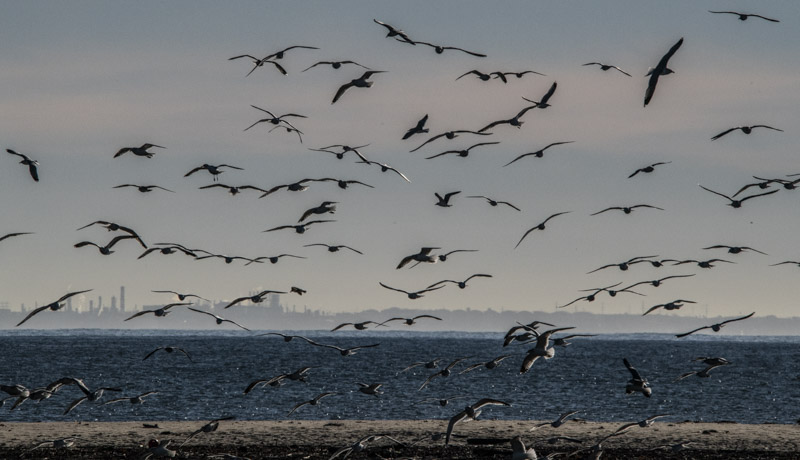
[By Chuck Almdale; photos by Marie Barnidge-McIntyre, Femi Faminu, Ray Juncosa & Armando Martinez]
Getting to and from Malibu Lagoon is sometimes tricky. I usually take the 405 to the 101 through San Fernando Valley to Las Virgenes Rd. and over the hills to Pacific Coast Hwy (PCH), but several traffic websites informed me that Las Virgenes Rd. no longer existed and I must take the 405 to the 10 to PCH to get there. One site acknowledged its continued existence but claimed road closure. The two routes are virtually the same distance but the latter is much slower due to the 25 MPH reconstruction zones resulting from our massive “fire event” last January, and less vegetated. Our roadways are partially funded by traffic ticket sales, so speeding citations are eagerly distributed and I know people who’ve been ticketed exceeding 25 MPH on PCH. I poked along at exactly 25 mph (three cheers for cruise control!) for what seemed like hours while everyone else ripped past me, blowing their horns or shaking their fists. Not a cop or road worker in sight the entire distance. Of course it was 7:30 am on a Sunday and everyone except birders were asleep, or in church, or both.
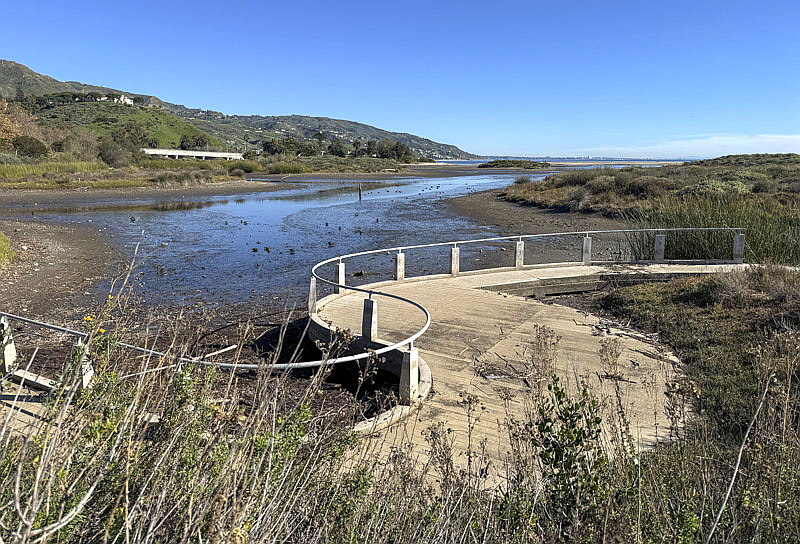
Even so, I arrived early. I headed up past the first lookout point and under the PCH bridge to look for diving birds in the deep water. Sure enough, Grebes, Coots, Buffleheads and Ruddy Ducks, plus a male Belted Kingfisher who was resting in a tree. The water was very low and I nearly got stuck in the exposed mud while exploring new routes.
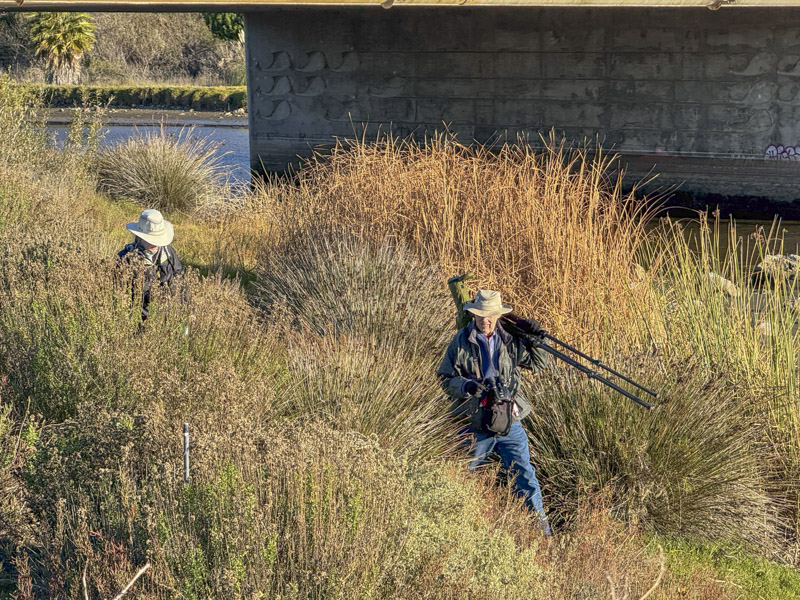
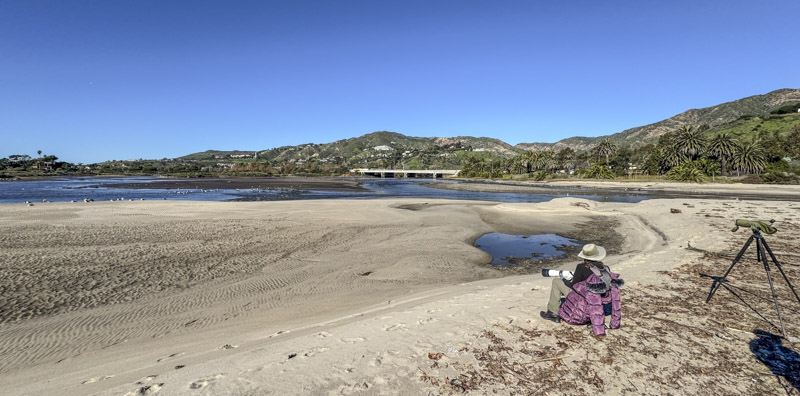
On my way back I bumped into Marie, sent to hunt me down and get the trip started. I later asked if her legs were stabbed by the prickly bushes (see above photo). “Yes,” she said, succinctly. “Of course!” she undoubtedly thought.
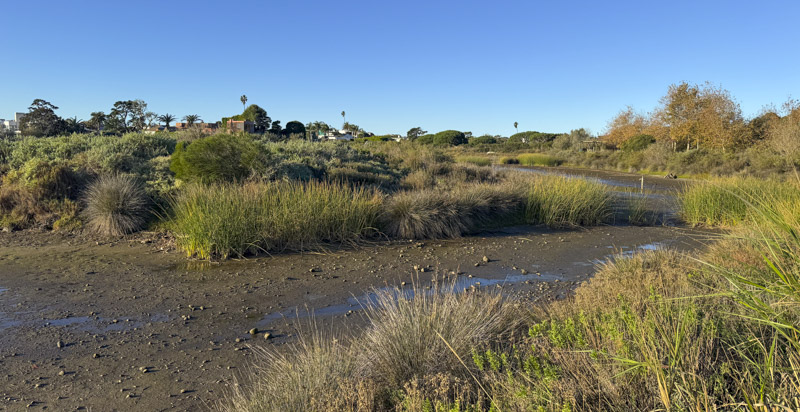
The lagoon water level was very low. “I’ve never seen it this low!” someone always exclaims during these events, never the same person twice. Actually, sea level was not particularly low, moving from the high of +4.81 ft @ 3:38am to the low of +1.35 ft @ 10:47am. But the rains had carved out a nice channel through the beach and every drop of lagoon and creek water that could run out was running out. This created a strong current under the PCH bridge and the Mallards and Coots were enjoying ‘shooting the rapids’ backwards.
Our lowest low tides of the year are negative, for example:
Six days of negative tides centered on the 20 Nov. low of -0.32 ft
Seven negative lows centered on the 5 Dec. low of -1.68 ft
Nine negative lows centered on the 3 Jan 2026 low of -1.80 ft
Nine negative lows centered on the 18 Jan low of -0.91 ft
Eight negative lows centered on the 31 Jan low of -1.65 ft.
Even June has negative tides: nine negative lows centered on 15 June low of -1.80 ft. But when the lagoon outlet is closed, as it usually is in summer, the lagoon fills up from the creek. The ocean tides then become irrelevant. [Tide chart link]
As usual, a few gulls, cormorants, coots, plovers and ducks were gathered near the first viewpoint next to the PCH bridge. For the second month running a single American Herring Gull was occupying the same spot at the southern end of the nearby gull flock.
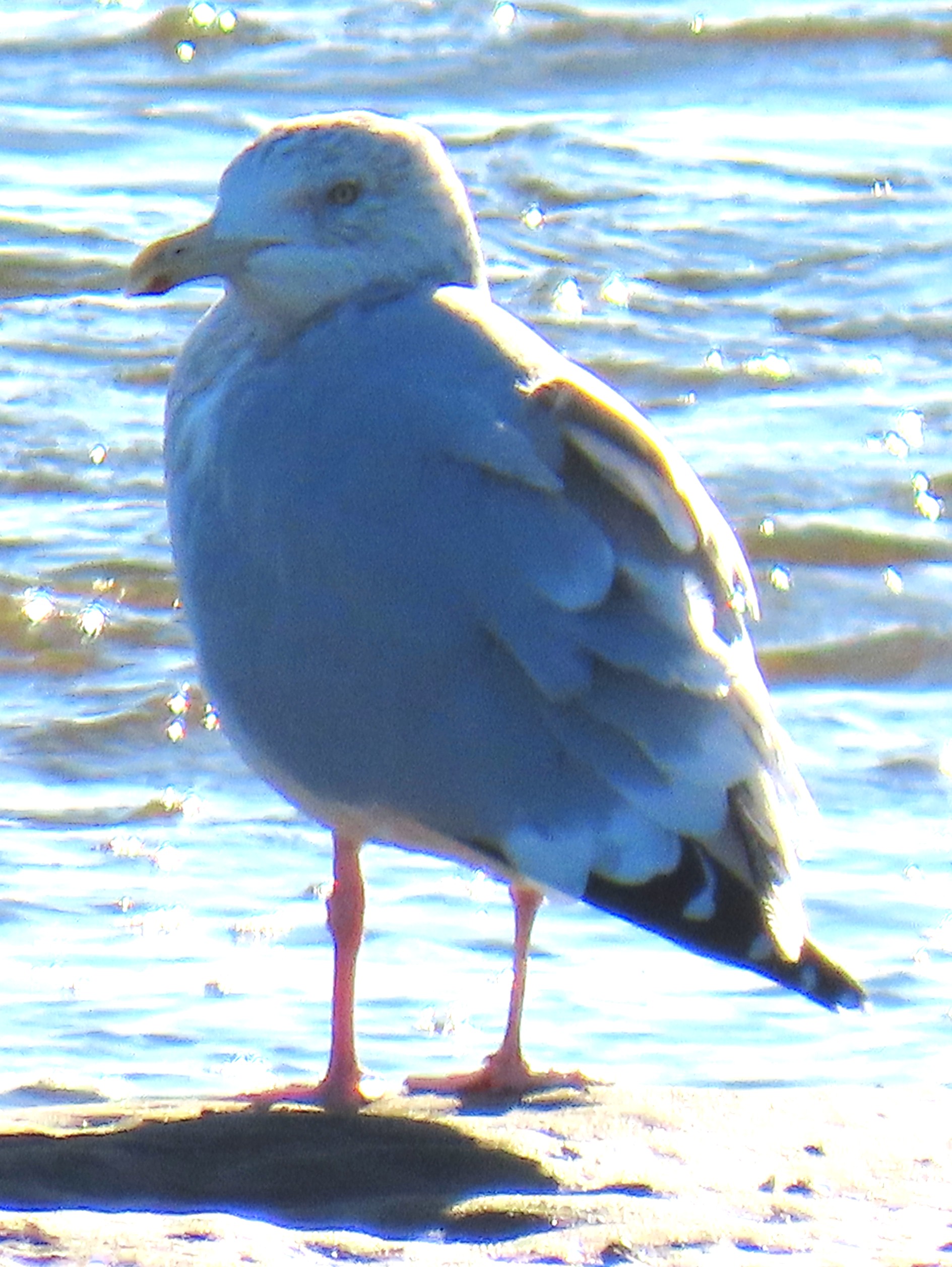
(Marie Barnidge-McIntyre 12-28-25)
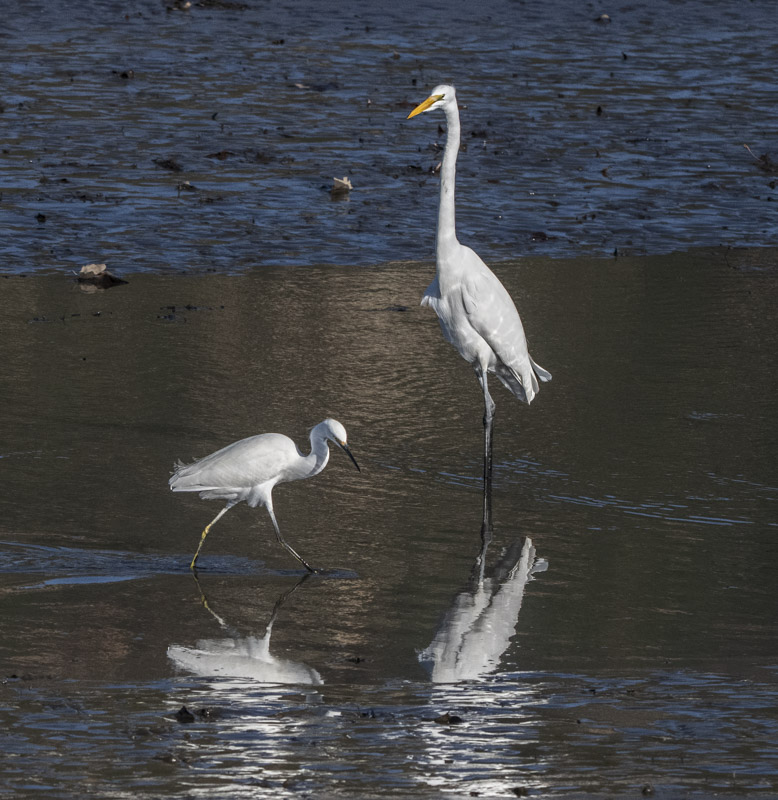
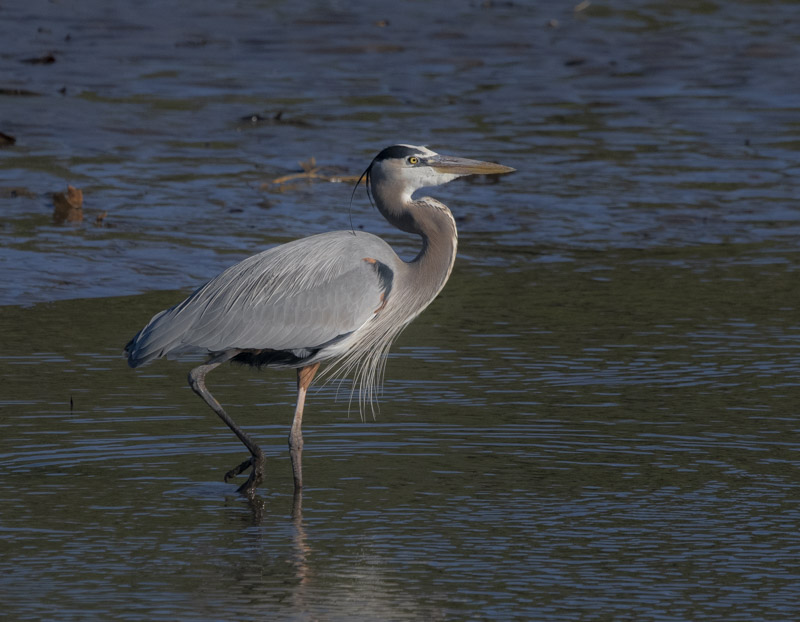
Here’s a short gallery of our longer-billed birds.
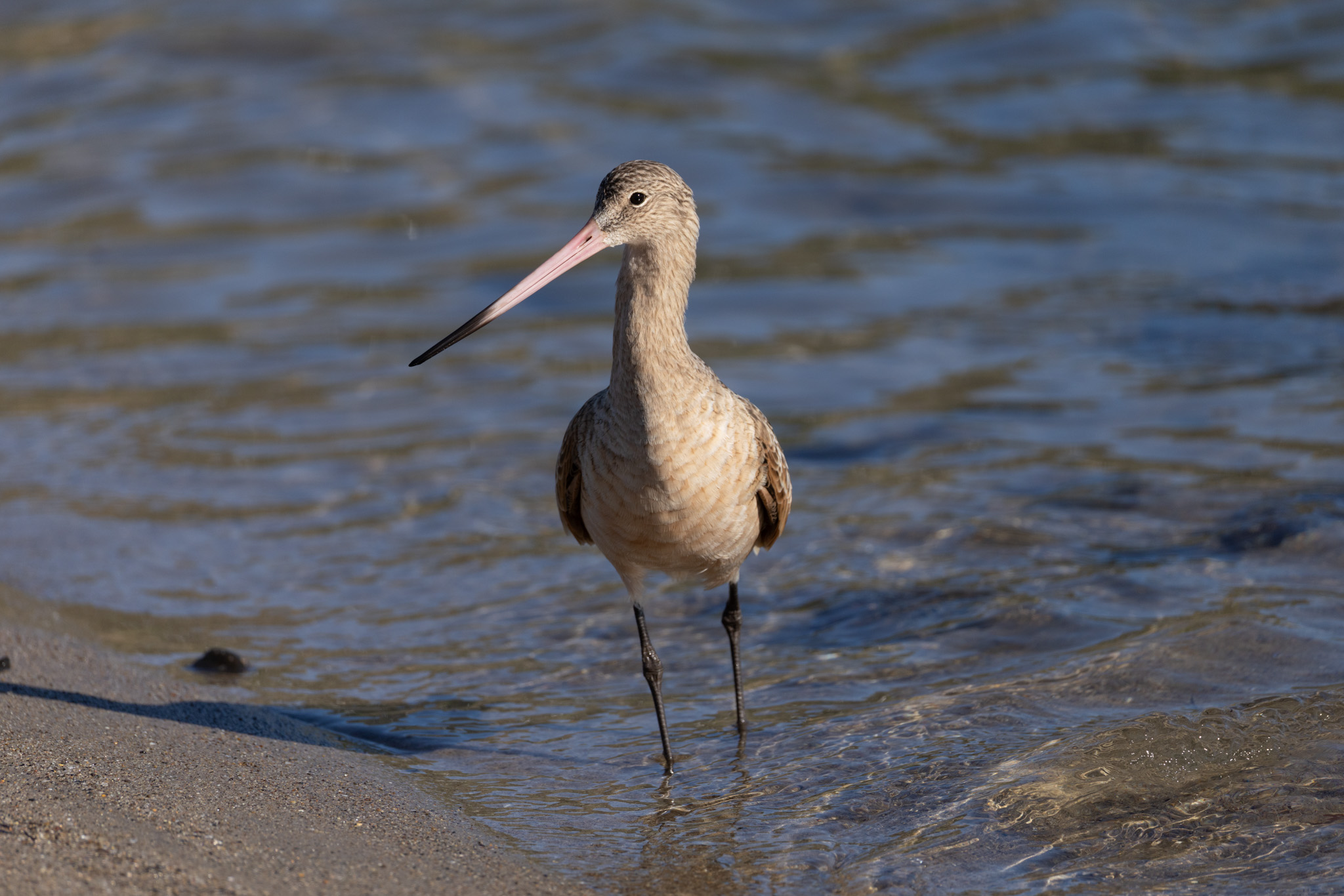
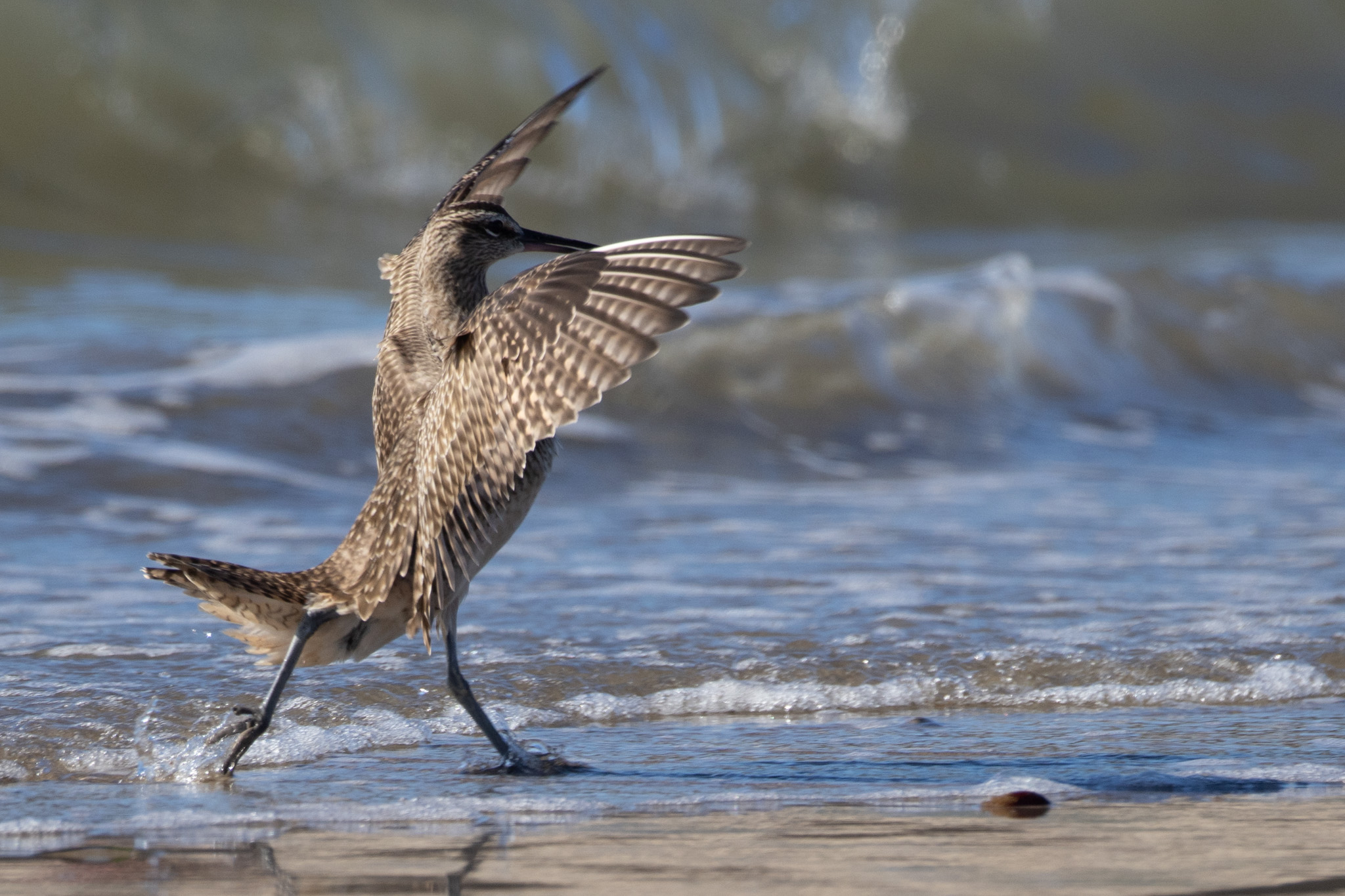
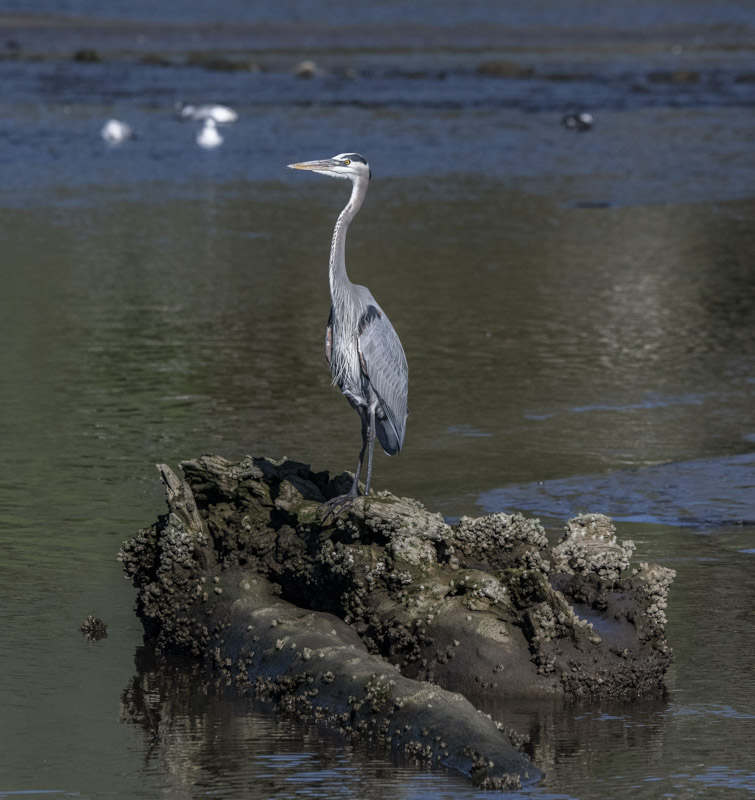
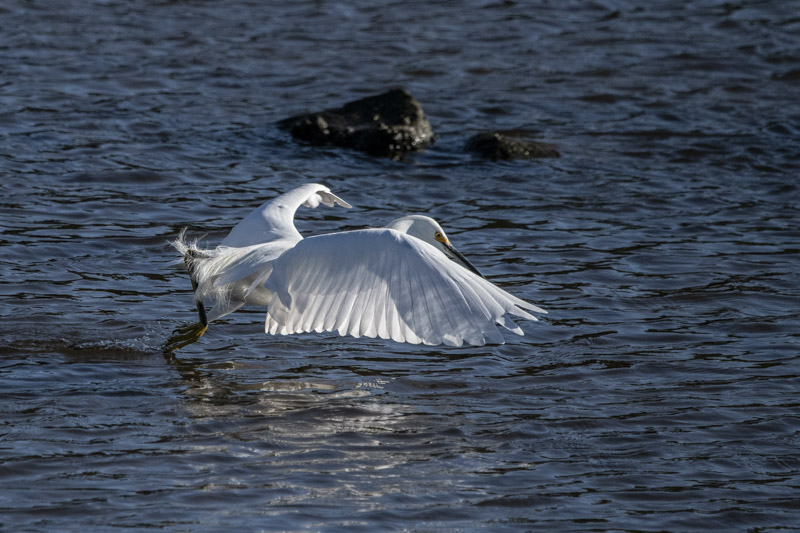
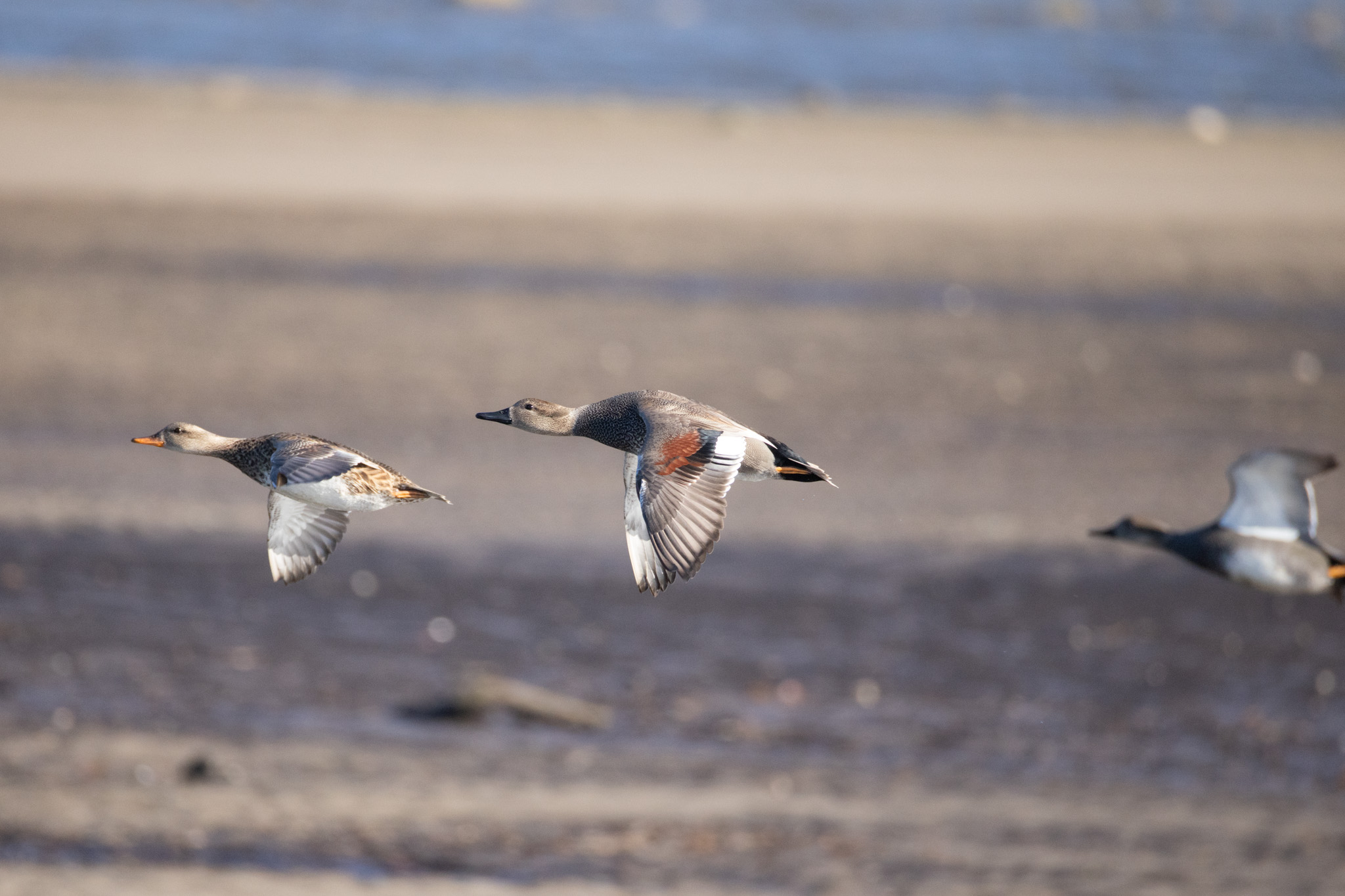
And some energetic Gadwalls. You rarely get to see the lovely chestnut in the upperwing secondary coverts, These feathers are hidden when they’re on the ground, and hard to see on a wildly flapping wing.
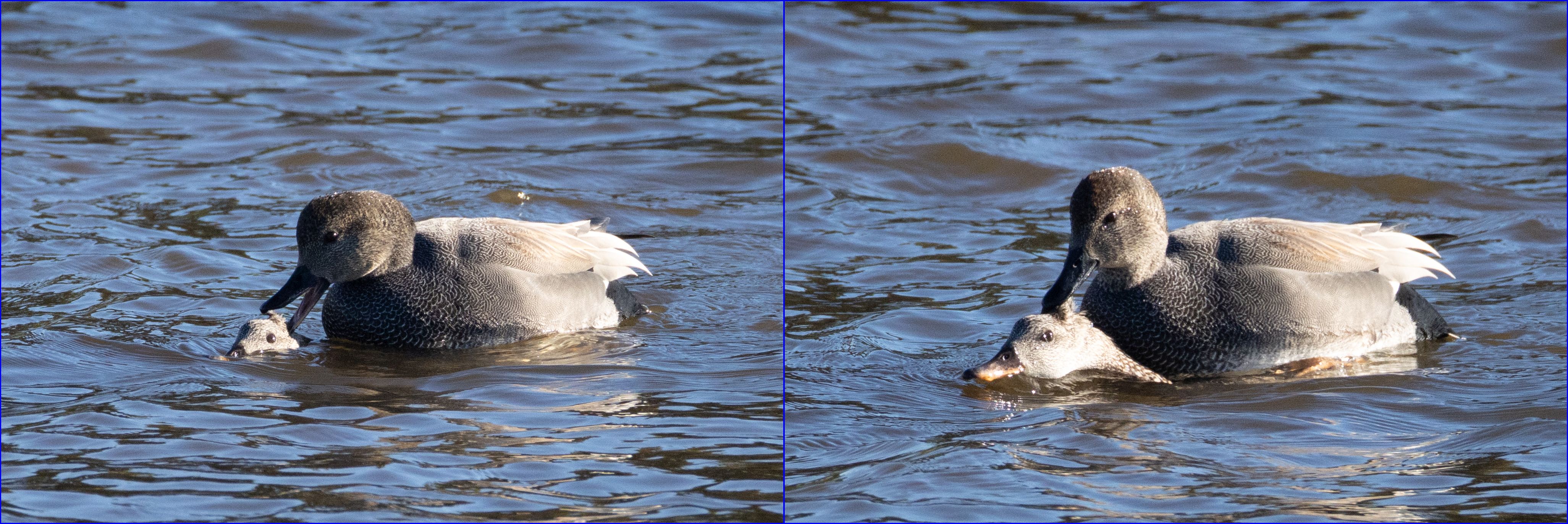
Once landed, you never know what they’ll get up to.
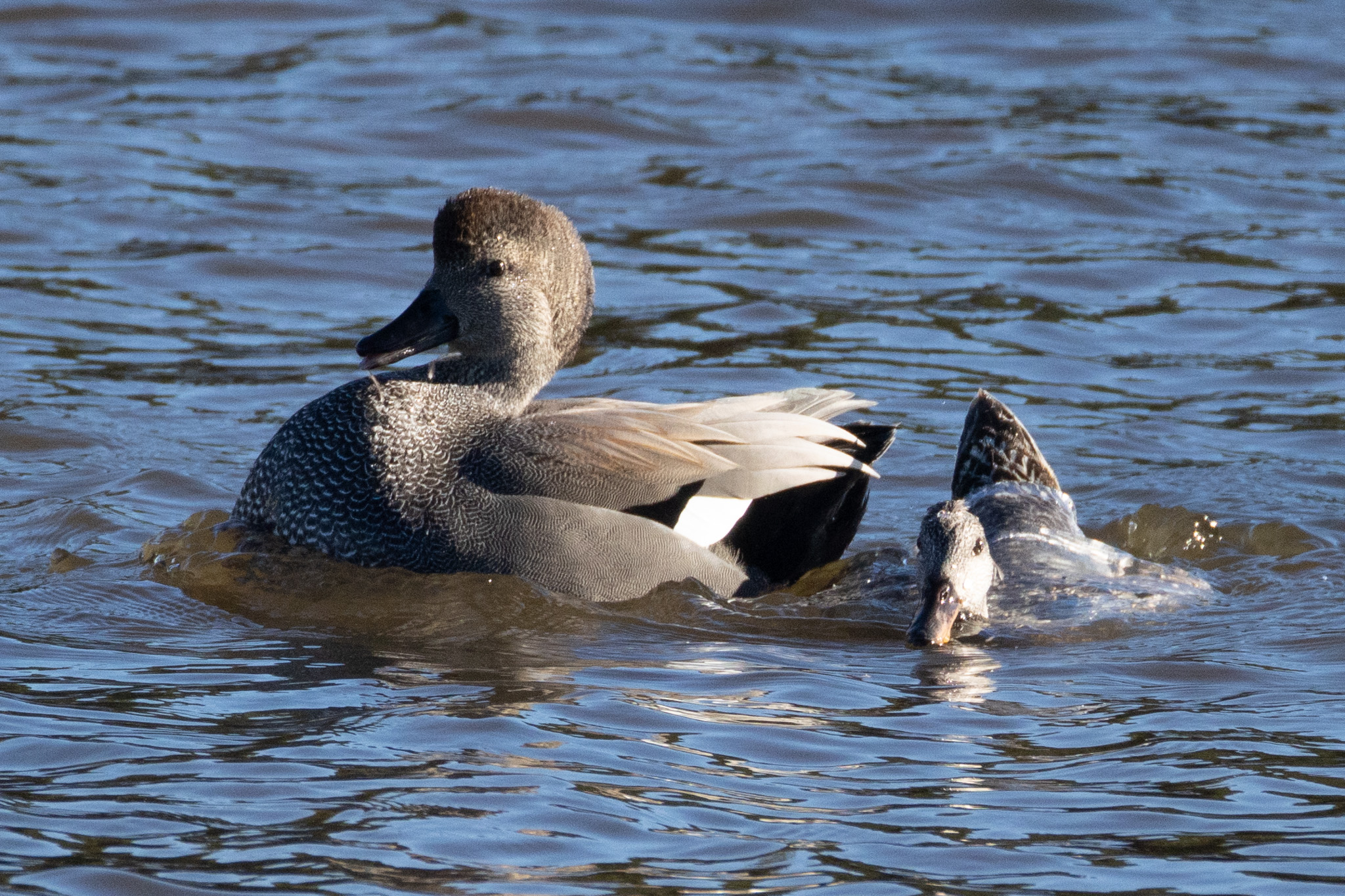
At the west end of the channels, the ducks were more wading than swimming.
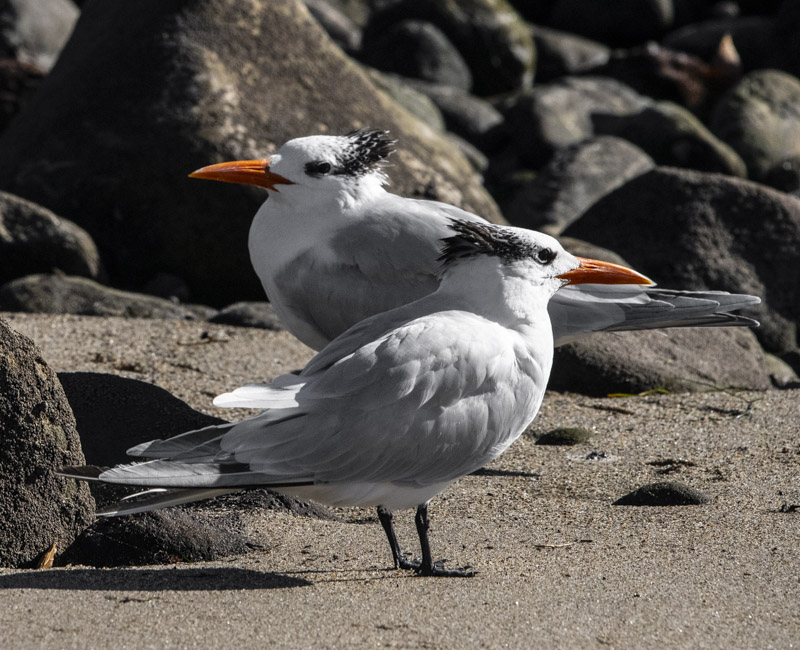
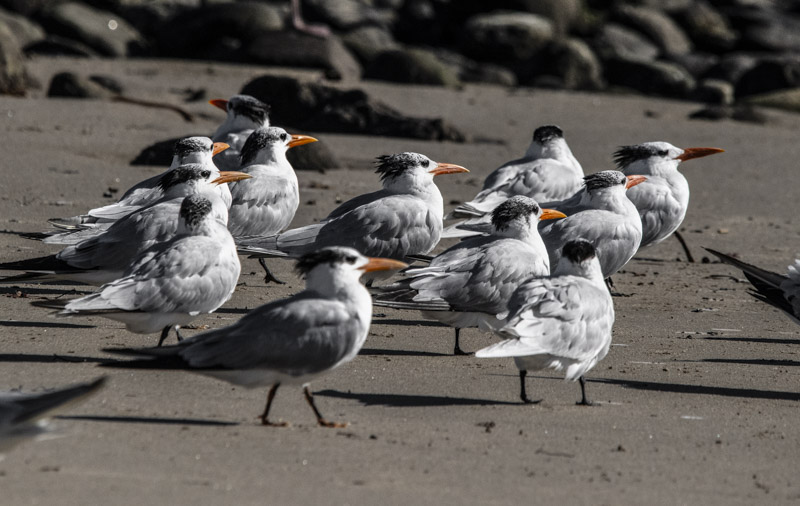
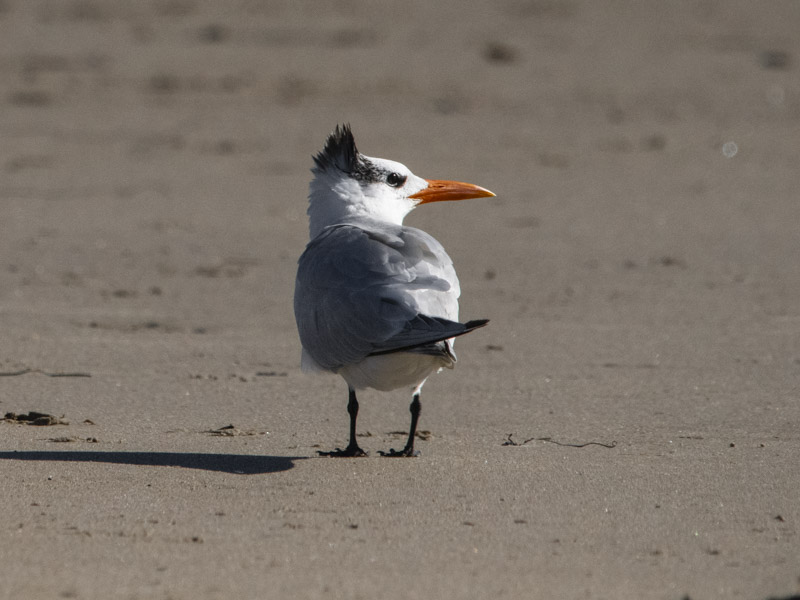
Down by the sea’s edge the usually hidden rocky reefs were exposed. As the sea level dropped, more and more gulls and shorebirds were attracted to them, including this small flock of Royal Terns. Their crown feathers are erectable, and a variety of positions are shown below. Their bills are generally orange, but can vary from deep orange/near red, to dull yellow-orange. If you look closely at the bill underside, some of them show a very small ‘gonydeal angle.’ The confusingly similar Elegant Tern never has this angle.
Something is definitely happening thataway.
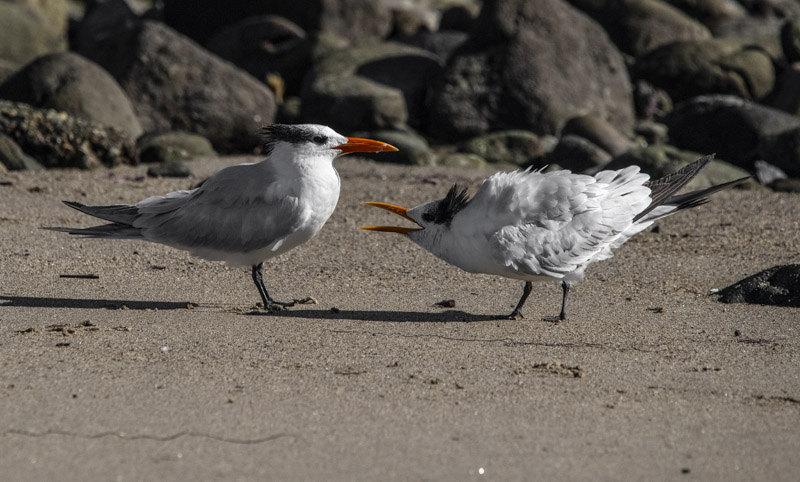
We’ve had discussions about the behavior shown below, whether it’s a young bird begging for food, or a courtship element where one bird elicits food-bringing behavior from the other to see if they respond properly and thus might make a good mate. The all-knowing Google AI informed me that: “Juveniles stay with their parents for months after fledging, migrating and continuing to beg for fish into winter, sometimes even into late winter or early spring, a behavior seen in Florida and other coastal areas.” This sounds right to me, particularly as December is really early to be doing courtship rituals, but not all that late to be pestering one’s parents for handouts (billouts?) What?…You thought it was only humans that had this problem?
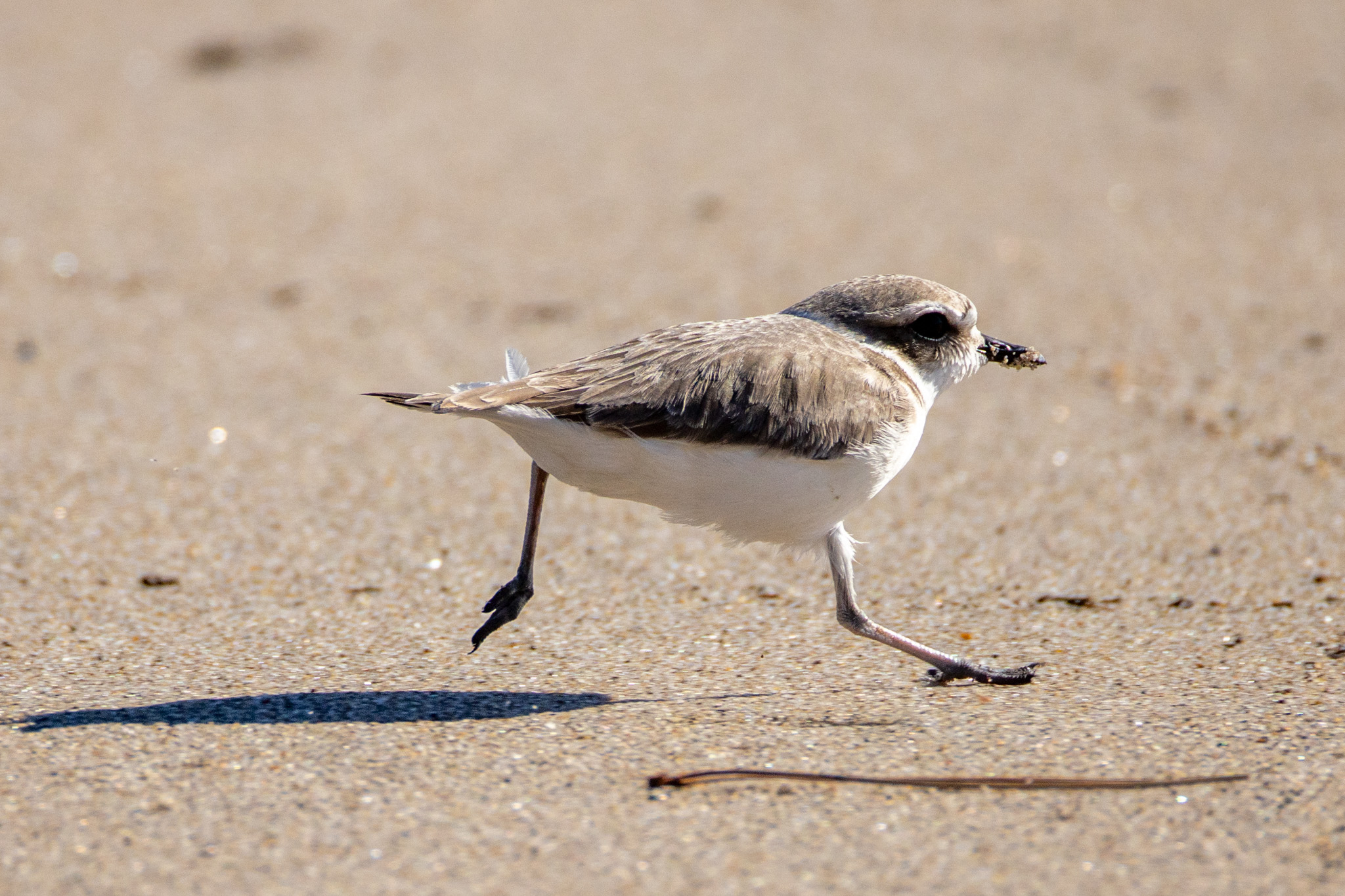
The water had gone so far out that it was about 50 yards from the wrack line of rotting sea vegetation on the sand to the rocks by the water’s edge. Western Snowy Plovers usually display a rather intermittent manner of walking, but this one took off at full speed over this entire stretch of sand. I think it felt exposed on the featureless flat surface and was wary of danger from above. It’s the farthest I’ve ever seen one run nonstop.
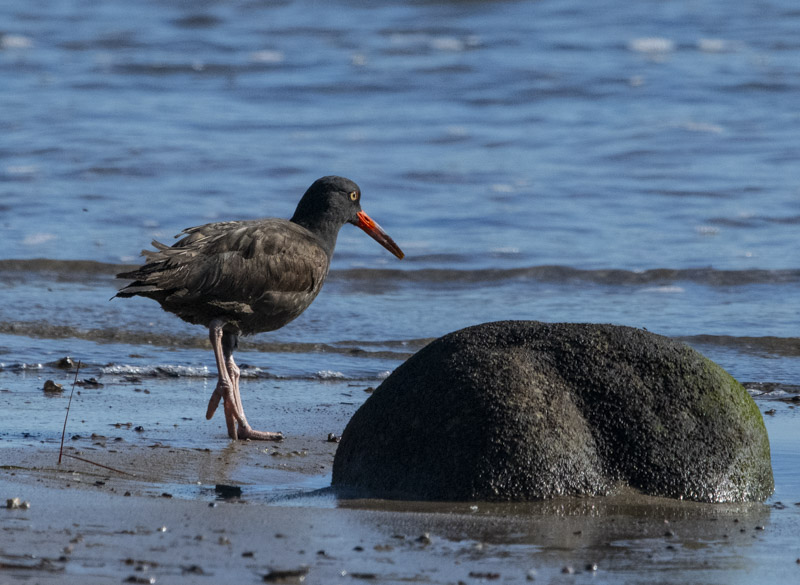
Four days later at an even lower tide, SMBAS member Lu Plauzoles had six Black Oystercatchers. We’ve never had more than five (once) on our lagoon trips, and and have had four birds five times. Most sightings (61 birds in 29 sightings) are singletons.
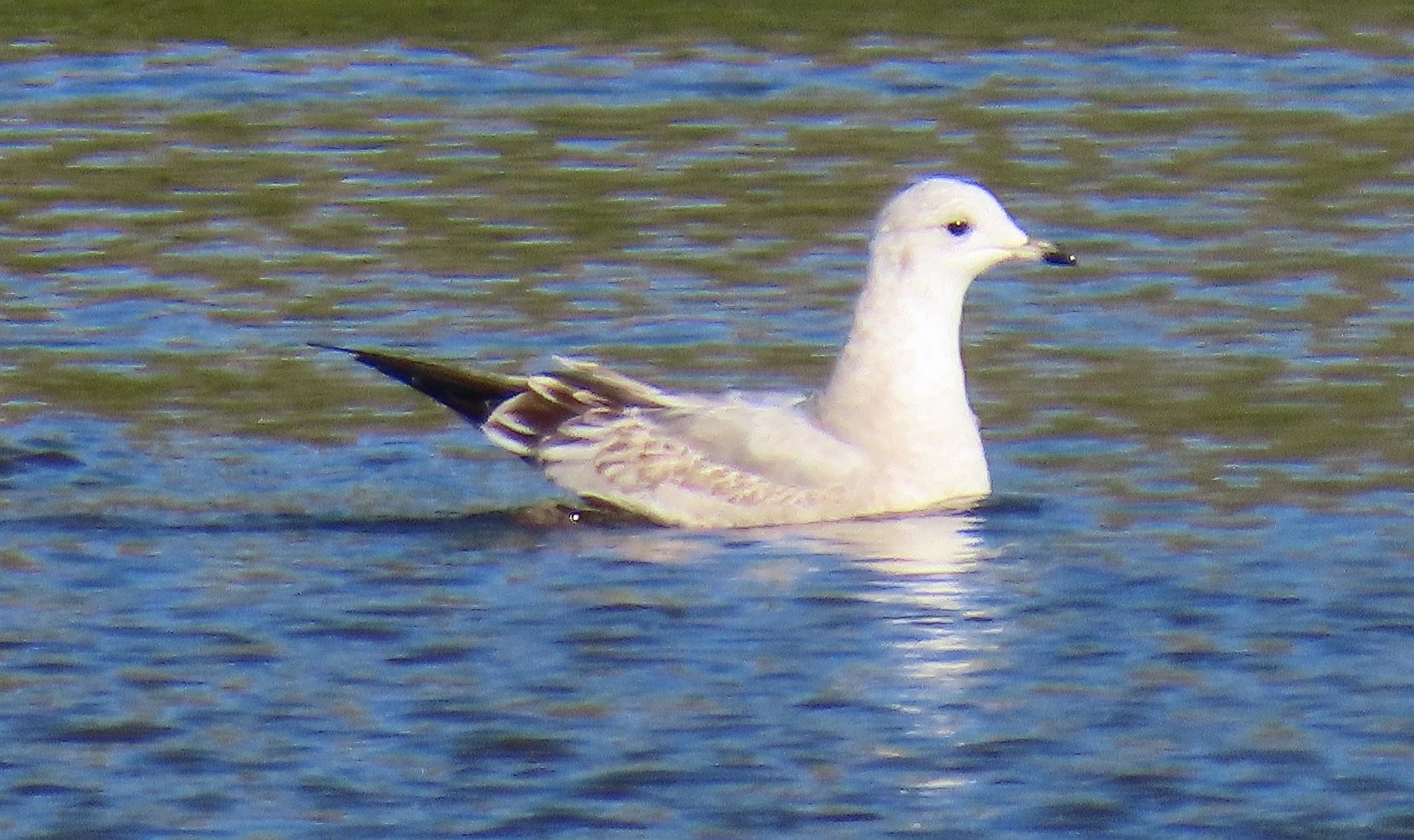
While searching through the rocky reefs for interesting birds I managed to completely miss this gull in the lagoon. What do you think it is? Look closely at plumage and bill.
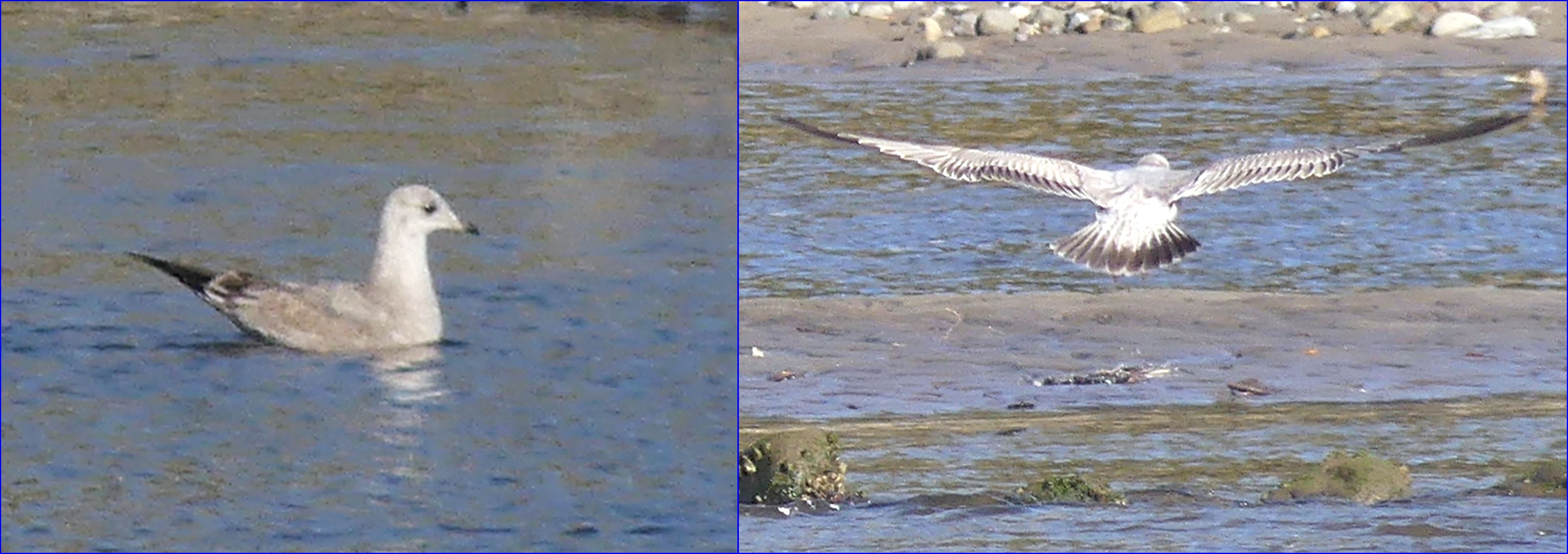
Not to hold the suspense too long, it’s a Short-billed Gull Larus brachyrhynchus. When I began birding, and until recently (as in the NGS bird field guide 6th edition, 2011) it was a Mew Gull Larus canus, and considered a subspecies of the European Common Gull Larus canus. I’ve also heard Small-billed and Little-billed bandied about, just to add extra confusion.
Some taxonomic history:
The species was first described by Scottish naturalist John Richardson in 1831 as the “short-billed mew gull”, Larus brachyrhynchus. Since 1931 the AOU and some other authorities have considered brachyrhynchus to be a subspecies of Common Gull Larus canus, described in 1758 by Carl Linnaeus; other authorities recognized them as distinct species. In 2021 the AOS agreed to split them based on differences in genetics, plumage, morphology and vocalizations. Though “Mew Gull” was long used for L. canus brachyrhynchus by North Americans, “Short-billed Gull” was chosen at the new name because “Mew Gull” had been used in recent literature to denote all forms of L. canus, plus the fact that “Short-billed Gull” was previously used in older AOS/AOU checklists since 1886. The word ‘mew’ comes from Old English “meaw” and Dutch “meeuw,” both meaning ‘gull’ but initially imitative of the bird’s cry. They were also called “sea-mew,” essentially meaning “gull gull.” — mostly Wikipedia
They’re not terrifically common in SoCal. The sheet below shows their appearances on our field trips Oct’79 – Dec’25; 106 birds on 43 visits, present mostly Oct-Mar.
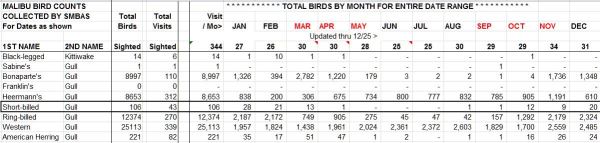
But over the past 25 years (2001-2025) there has been only 26 birds in 23 visits, and the past 5 years (2021-2025) has brought only 3 birds in 3 visits. Unlike the millions of Common Gulls mewing merrily away all over Europe, the Short-billed has never been common in SoCal.
Historically, nearly all the (now) Short-billed Gulls I’ve seen in SoCal were at two locations: the Ventura Wastewater Service plant on Spinnaker Drive on the south side of Ventura Harbor; Dockweiler Beach in front of the Hyperion Sewage Treatment Plant on Vista del Mar south of Playa del Rey. Several decades ago they were easily located at the Ventura Plant, just look for the huge round charcoal filtration tubs; dozens to hundreds of the gulls were always sitting on the slowly rotating spray arms, going round and round and round. Unfortunately (for gulls and birders looking for them) the plant roofed over their spray tubs and the birds moved elsewhere, some to the beach, some to the settlement ponds. On Dockweiler Beach, they gathered on the sand directly in front of the plant on what was probably the point of land closest to the ocean end of the plant’s outfall tube.
There’s something about sewage that really attracts these gulls.
Malibu Lagoon on eBird as of 12-31-25: 9037 lists, 2921 eBirders, 322 species
Most recent new species seen: Nelson’s Sparrow, 11/29/24 by Femi Faminu (SMBAS member). When the newest species added to the list was seen on a date prior to the most recently seen new species, there is no way I can find to easily determine what that bird is. Another minor nit to pick about eBird.
Birds new for the season: Northern Shoveler, American Wigeon, Green-winged Teal, Feral Pigeon, Spotted Sandpiper, Short-billed Gull, Horned Grebe, American Goldfinch, Savannah Sparrow. “New for the season” means it has been three or more months since last recorded on our trips.
Many, many thanks to photographers Marie Barnidge-McIntyre, Femi Faminu, Ray Juncosa, and Armando Martinez.
Upcoming SMBAS scheduled field trips; no reservations or Covid card necessary unless specifically mentioned:
- Bette Davis-Riverwalk or Veteran’s Park, Sat. Jan 10, 8 am
- Malibu Lagoon, Sun. Jan. 25, 8:30 (adults) & 10 am (parents & kids)
- These and any other trips we announce for the foreseeable future will depend upon expected status of the Covid/flu/etc. pandemic, not to mention landslides, fires, local flooding and atmospheric rivers at trip time. Any trip announced may be canceled shortly before trip date if it seems necessary. By now any other comments should be superfluous.
- Link to Programs & Field Trip schedule.
The next SMBAS Zoom program: Tuesday, February 3, 7:30pm; to be announced.
The SMBAS 10 a.m. Parent’s & Kids Birdwalk has again resumed. Reservations not necessary for families, but for groups (scouts, etc.), call Jean (213-522-0062).
Links: Unusual birds at Malibu Lagoon
9/23/02 Aerial photo of Malibu Lagoon
More recent aerial photo
Prior checklists:
2025: Jan-June
2023: Jan-June, July-Dec 2024: Jan-June, July-Dec
2021: Jan-July, July-Dec 2022: Jan-June, July-Dec
2020: Jan-July, July-Dec 2019: Jan-June, July-Dec
2018: Jan-June, July-Dec 2017: Jan-June, July-Dec
2016: Jan-June, July-Dec 2015: Jan-May, July-Dec
2014: Jan-July, July-Dec 2013: Jan-June, July-Dec
2012: Jan-June, July-Dec 2011: Jan-June, July-Dec
2010: Jan-June, July-Dec 2009: Jan-June, July-Dec
The 10-year comparison summaries created during the Lagoon Reconfiguration Project period, remain available—despite numerous complaints—on our Lagoon Project Bird Census Page. Very briefly summarized, the results unexpectedly indicate that avian species diversification and numbers improved slightly during the restoration period June’12-June’14.
Many thanks to Marie Barnidge-McIntyre, Femi Faminu, Chris Lord, Armando Martinez, Chris & Ruth Tosdevin andothers for contributions made to this month’s census counts.
The species list below was re-sequenced as of 12/31/24 to agree with the California Bird Records Committee Official California Checklist, mostly. If part of the right side of the chart below is hidden, there’s a slider button inconveniently located at the bottom end of the list. The numbers 1-9 left of the species names are keyed to the nine categories of birds at the bottom. Updated lagoon bird check lists can be downloaded here.
[Chuck Almdale]
| Malibu Census 2025 | 7/27 | 8/24 | 9/28 | 10/26 | 11/23 | 12/28 | |
| Temperature | 64-70 | 68-75 | 65-69 | 58-65 | 59-65 | 60-69 | |
| Tide Lo/Hi Height | L-0.46 | H+4.74 | H+4.54 | H+5.02 | H+5.46 | L+1.35 | |
| Tide Time | 0605 | 1102 | 1244 | 1125 | 0939 | 1047 | |
| 1 | Brant (Black) | 1 | 1 | ||||
| 1 | Canada Goose | 1 | 12 | 14 | |||
| 1 | Northern Shoveler | 4 | |||||
| 1 | Gadwall | 20 | 19 | 6 | 14 | 20 | |
| 1 | American Wigeon | 15 | |||||
| 1 | Mallard | 40 | 14 | 7 | 26 | 1 | 12 |
| 1 | Green-winged Teal | 5 | |||||
| 1 | Ring-necked Duck | 1 | |||||
| 1 | Surf Scoter | 10 | 2 | 22 | 4 | ||
| 1 | Bufflehead | 4 | 4 | ||||
| 1 | Red-breasted Merganser | 1 | 2 | 5 | |||
| 1 | Ruddy Duck | 19 | 1 | 5 | 11 | ||
| 2 | Feral Pigeon | 5 | 4 | 6 | 5 | ||
| 2 | Mourning Dove | 2 | 2 | 3 | 1 | 1 | |
| 2 | Anna’s Hummingbird | 1 | 1 | 2 | 3 | ||
| 2 | Allen’s Hummingbird | 4 | 4 | 4 | 5 | 4 | 3 |
| 3 | Sora | 1 | 1 | ||||
| 3 | American Coot | 6 | 4 | 31 | 4 | 25 | 25 |
| 4 | Black Oystercatcher | 1 | 1 | ||||
| 4 | Black-bellied Plover | 21 | 49 | 55 | 88 | 64 | 62 |
| 4 | Killdeer | 4 | 9 | 1 | 8 | 10 | 4 |
| 4 | Semipalmated Plover | 4 | 1 | ||||
| 4 | Snowy Plover | 13 | 17 | 35 | 40 | 40 | 7 |
| 4 | Hudsonian Whimbrel | 1 | 12 | 3 | 14 | 8 | 4 |
| 4 | Marbled Godwit | 21 | 8 | 10 | |||
| 4 | Wilson’s Phalarope | 1 | |||||
| 4 | Spotted Sandpiper | 1 | |||||
| 4 | Willet | 10 | 14 | 20 | 7 | ||
| 4 | Ruddy Turnstone | 3 | 1 | 3 | 6 | 4 | 3 |
| 4 | Sanderling | 1 | 13 | 23 | 14 | ||
| 4 | Dunlin | 2 | 1 | ||||
| 4 | Least Sandpiper | 10 | 4 | 6 | 12 | 6 | 10 |
| 4 | Western Sandpiper | 4 | 14 | 1 | 2 | ||
| 5 | Sabine’s Gull | 1 | |||||
| 5 | Bonaparte’s Gull | 1 | |||||
| 5 | Heermann’s Gull | 36 | 10 | 38 | 2 | 49 | 10 |
| 5 | Short-billed Gull | 1 | |||||
| 5 | Ring-billed Gull | 2 | 4 | 1 | 7 | 6 | 5 |
| 5 | Western Gull | 52 | 115 | 61 | 35 | 55 | 85 |
| 5 | American Herring Gull | 1 | 1 | ||||
| 5 | California Gull | 1 | 4 | 10 | 116 | 410 | 650 |
| 5 | Caspian Tern | 4 | 2 | ||||
| 5 | Forster’s Tern | 1 | |||||
| 5 | Elegant Tern | 70 | 4 | 2 | 3 | ||
| 5 | Royal Tern | 21 | 135 | 12 | 2 | 22 | 25 |
| 6 | Pied-billed Grebe | 3 | 4 | 6 | 2 | 3 | 6 |
| 6 | Horned Grebe | 1 | |||||
| 6 | Eared Grebe | 1 | 6 | 3 | 1 | ||
| 6 | Western Grebe | 30 | 8 | 10 | |||
| 6 | Clark’s Grebe | 2 | |||||
| 6 | Red-throated Loon | 2 | |||||
| 6 | Pacific Loon | 1 | |||||
| 6 | Brandt’s Cormorant | 1 | 1 | 5 | 2 | 1 | |
| 6 | Pelagic Cormorant | 1 | 2 | 1 | 3 | 2 | 3 |
| 6 | Double-crested Cormorant | 98 | 74 | 49 | 28 | 38 | 17 |
| 6 | White-faced Ibis | 1 | |||||
| 6 | Yellow-crowned Night-Heron | 1 | |||||
| 6 | Black-crowned Night-Heron | 1 | 1 | 2 | 1 | ||
| 6 | Snowy Egret | 10 | 10 | 5 | 34 | 30 | 11 |
| 6 | Green Heron | 1 | 2 | 1 | 2 | 1 | |
| 6 | Great Egret | 4 | 2 | 3 | 4 | 2 | 1 |
| 6 | Great Blue Heron | 5 | 5 | 4 | 6 | 4 | 5 |
| 6 | Brown Pelican | 118 | 32 | 45 | 138 | 13 | 3 |
| 7 | Turkey Vulture | 1 | 2 | ||||
| 7 | Osprey | 1 | 1 | 1 | 1 | 1 | |
| 7 | Cooper’s Hawk | 1 | |||||
| 7 | Red-shouldered Hawk | 1 | 1 | 2 | 1 | ||
| 7 | Red-tailed Hawk | 1 | 1 | 1 | 2 | ||
| 8 | Belted Kingfisher | 1 | 1 | 1 | 2 | 1 | |
| 8 | Nuttall’s Woodpecker | 1 | 1 | 1 | |||
| 8 | Nanday Parakeet | 20 | 9 | ||||
| 9 | Black Phoebe | 2 | 2 | 4 | 2 | 3 | 1 |
| 9 | Say’s Phoebe | 1 | |||||
| 9 | California Scrub-Jay | 1 | 1 | 2 | 1 | ||
| 9 | American Crow | 9 | 8 | 6 | 10 | 7 | 6 |
| 9 | Common Raven | 1 | |||||
| 9 | Oak Titmouse | 2 | 2 | 1 | 1 | ||
| 9 | No. Rough-winged Swallow | 5 | 2 | ||||
| 9 | Barn Swallow | 20 | 40 | 4 | |||
| 9 | Cliff Swallow | 12 | |||||
| 9 | Bushtit | 20 | 20 | 9 | 35 | 4 | 19 |
| 9 | Wrentit | 2 | 1 | 2 | 2 | 4 | 1 |
| 9 | Swinhoe’s White-eye | 1 | 1 | ||||
| 9 | Blue-gray Gnatcatcher | 2 | |||||
| 9 | Northern House Wren | 1 | 2 | 1 | 1 | ||
| 9 | Marsh Wren | 1 | 1 | ||||
| 9 | Bewick’s Wren | 2 | |||||
| 9 | European Starling | 25 | 35 | 2 | 6 | 30 | |
| 9 | Northern Mockingbird | 1 | 1 | ||||
| 9 | Western Bluebird | 2 | 1 | ||||
| 9 | Hermit Thrush | 2 | |||||
| 9 | Scaly-breasted Munia | 7 | |||||
| 9 | House Finch | 5 | 12 | 3 | 2 | 5 | 15 |
| 9 | Lesser Goldfinch | 2 | 2 | ||||
| 9 | American Goldfinch | 4 | |||||
| 9 | Dark-eyed Junco | 1 | 6 | 2 | 3 | 1 | |
| 9 | White-crowned Sparrow | 2 | 10 | 12 | 18 | ||
| 9 | Savannah Sparrow | 1 | 1 | ||||
| 9 | Song Sparrow | 3 | 6 | 5 | 4 | 4 | 3 |
| 9 | California Towhee | 1 | 2 | 1 | 2 | 2 | |
| 9 | Western Meadowlark | 2 | |||||
| 9 | Hooded Oriole | 2 | |||||
| 9 | Great-tailed Grackle | 1 | 23 | 6 | 16 | 3 | |
| 9 | Orange-crowned Warbler | 1 | 1 | 2 | 1 | 2 | 1 |
| 9 | Common Yellowthroat | 1 | 4 | 7 | 6 | 2 | 1 |
| 9 | Yellow-rumped Warbler | 2 | 25 | 10 | 8 | ||
| 9 | Black-throated Gray Warbler | 1 | |||||
| Totals Birds by Type | Jul | Aug | Sep | Oct | Nov | Dec | |
| 1 | Waterfowl & Quail | 81 | 33 | 25 | 28 | 61 | 95 |
| 2 | Doves, Swifts & Hummers | 11 | 11 | 14 | 8 | 7 | 9 |
| 3 | Rails & Coots | 6 | 4 | 32 | 4 | 26 | 25 |
| 4 | Shorebirds | 61 | 93 | 130 | 219 | 185 | 123 |
| 5 | Gulls & Terns | 116 | 341 | 127 | 164 | 547 | 777 |
| 6 | Grebe, Loon, Heron, Pelican | 242 | 135 | 117 | 259 | 111 | 59 |
| 7 | Hawks & Falcons | 2 | 2 | 5 | 2 | 3 | 5 |
| 8 | Kingfish, Peckers & Parrots | 2 | 1 | 21 | 10 | 3 | 1 |
| 9 | Passerines | 110 | 141 | 82 | 122 | 122 | 91 |
| Totals Birds | 631 | 761 | 553 | 816 | 1065 | 1185 | |
| Total Species by Group | Jul | Aug | Sep | Oct | Nov | Dec | |
| 1 | Waterfowl & Quail | 5 | 2 | 5 | 2 | 8 | 11 |
| 2 | Doves, Swifts & Hummers | 3 | 4 | 4 | 3 | 2 | 3 |
| 3 | Rails & Coots | 1 | 1 | 2 | 1 | 2 | 1 |
| 4 | Shorebirds | 9 | 7 | 10 | 12 | 10 | 11 |
| 5 | Gulls & Terns | 6 | 8 | 7 | 6 | 8 | 7 |
| 6 | Grebe, Loon, Heron, Pelican | 10 | 12 | 10 | 12 | 14 | 11 |
| 7 | Hawks & Falcons | 2 | 2 | 4 | 2 | 3 | 3 |
| 8 | Kingfish, Peckers & Parrots | 2 | 1 | 2 | 2 | 2 | 1 |
| 9 | Passerines | 16 | 16 | 20 | 21 | 22 | 21 |
| Totals Species – 107 | 54 | 53 | 64 | 61 | 71 | 69 |
Discover more from SANTA MONICA BAY AUDUBON SOCIETY BLOG
Subscribe to get the latest posts sent to your email.



 SANTA MONICA BAY AUDUBON SOCIETY BLOG