Muddy, muddy Malibu Lagoon, 22 Feb. 2026
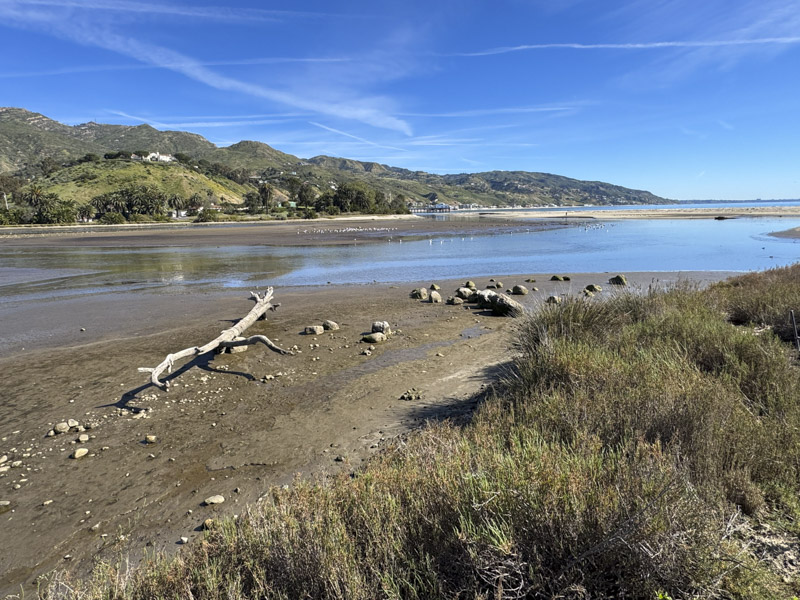
Yes, there’s an large airport about 15 miles away. (Ray Juncosa 2-22-26)
[By Chuck Almdale; photos by Femi Faminu, Ray Juncosa, Emily Roth]
It started off quite chilly – for SoCal – at 49°F with a little breeze, so of course we were all vastly overlayered and roasting by 11:30 when it was 65°, sun high in a clear blue sky. Heat prostration nearly set in for some of us. My apologies to anyone reading this while up to their earlobes in snow.
Beginning birders always wonder what’s that black duck with the white bill that’s all over the lagoon but no one ever mentions. This time I began with some nonsense about how “that’s a not-a-duck, one member of a very large family of birds, all of whom are not ducks.” Then the truth; it’s the American Coot. They look a lot like ducks, but their bill is compressed laterally, not wide like a duck bill. They’re actually more closely related to Cranes. They don’t have webbed feet either, but lobed toes (see photo below).
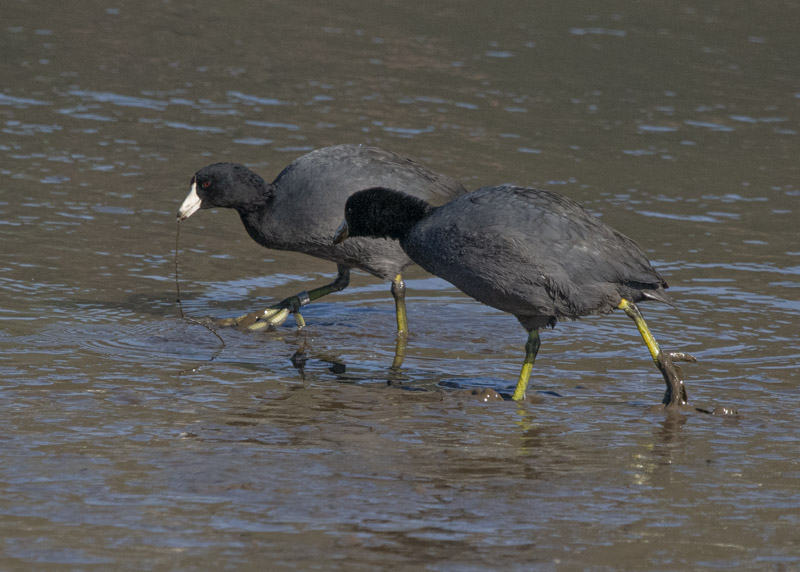
When the swimming coot brings their foot forward the lobes close, reducing water resistance. But on the backward power stroke, the lobes spread apart, greatly increasing surface area, power and speed. On land, they can walk, not waddle like a duck, so they’re a lot more comfortable grazing on a park lawn for insects than a duck will ever be. It’s a great foot design, and a wonderful example of convergent evolution in action. I usually end with the question, “Ever hear the phrase ‘you old coot’?” No one under the age of fifty knows that phrase. All the old colorful phrases are dying out, being replaced by acronyms and emojis. And…finally…no one ever mentions the coots because they are really common. But they make funny – seemingly rude – sounds, so they’re worth listening to. Much like any ‘old coot’ in your own family.
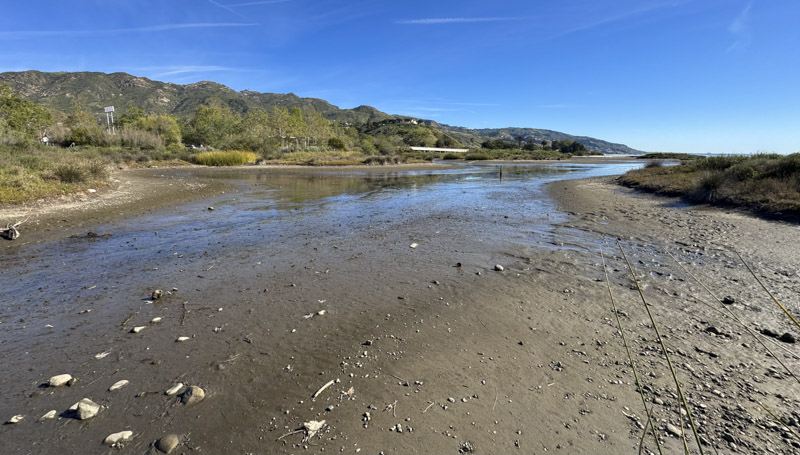
The low tide today was not particularly low – +0.65 ft. at 06:55; it does go negative, more often than one might think – but it gave the lagoon water the opportunity to run out to sea, and it’s always someone’s lowest lagoon level ever.
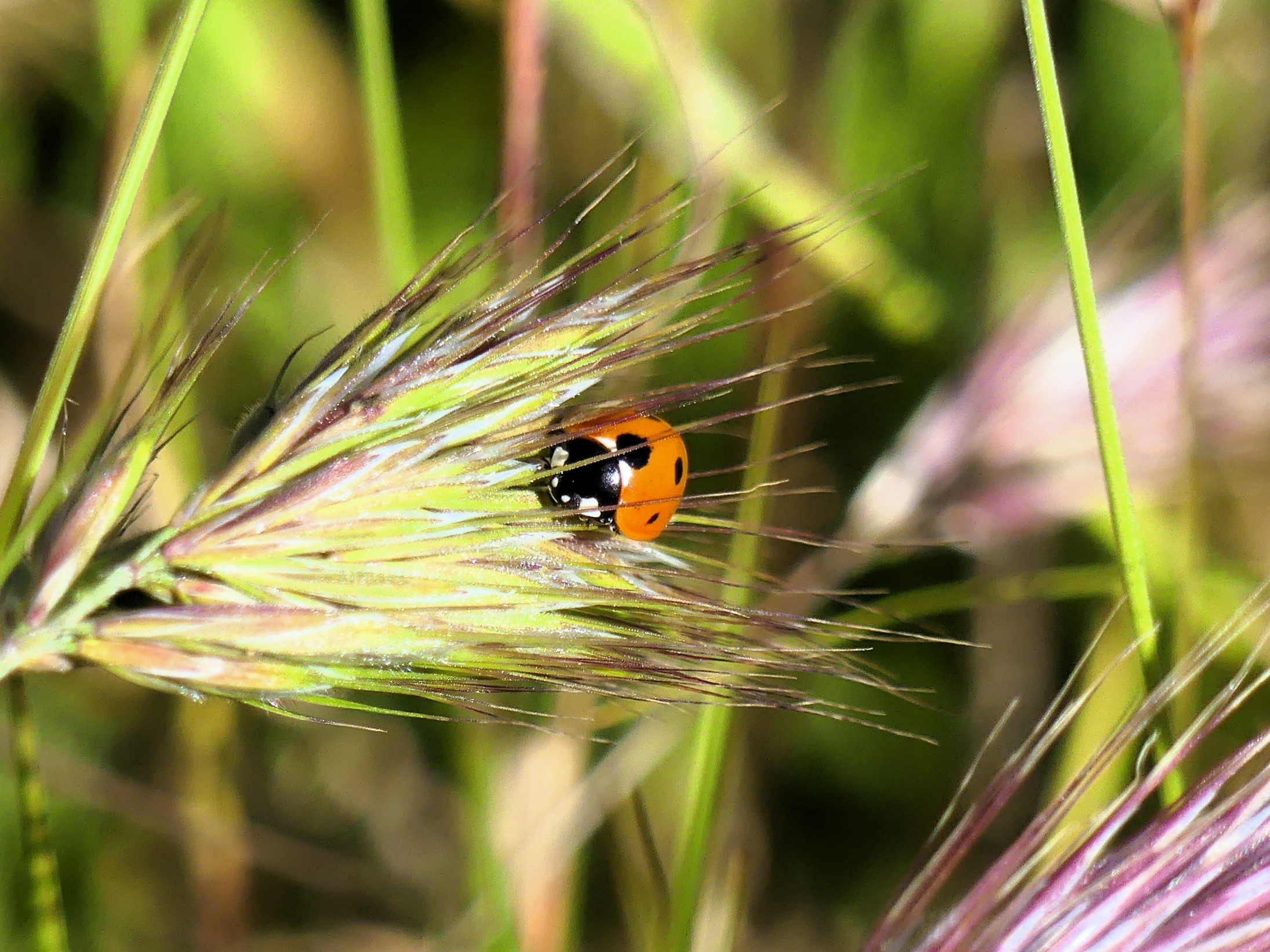
Sometimes you have to look really closely to see something a little different, perhaps ordinary, but quite beautiful.
Western Grebes are supposed to look like this in the winter: yellow-green bill, red eye surrounded by dark feathers, mostly-dark flanks down to the waterline.
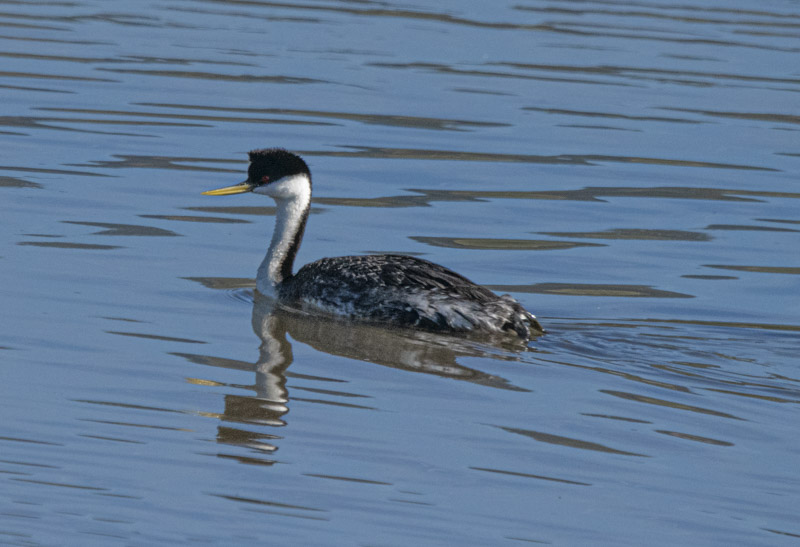
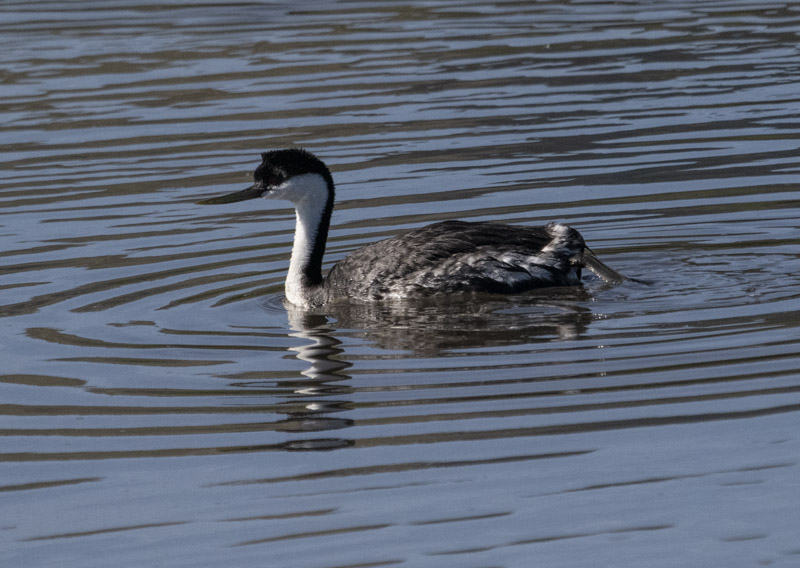
This one below looks like a ‘proper’ Western Grebe except for that black bill that seems to have an upward curve. If anyone knows what that’s about, let me know. Grebes are semi-famous for their inability to walk on land. With that leg sticking out of the back end of the bird rather than tucked away neatly under its abdomen, you can see why that’s true. Their genus name Podiceps means “rump-foot.”
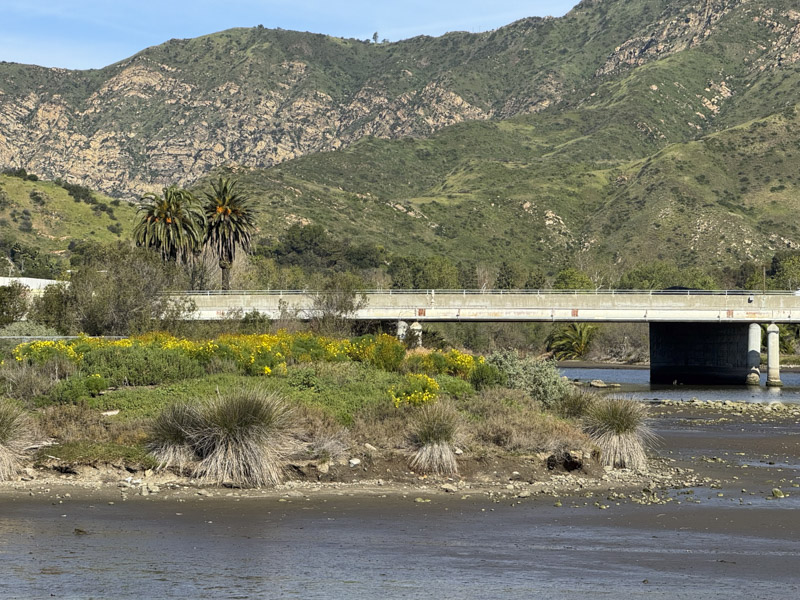
Lots of yellow Giant Coreopsis in bloom. The palm trees to the rear are in fruit.
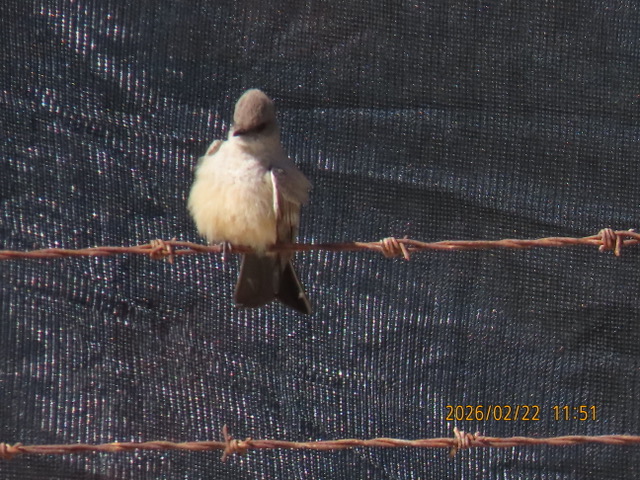
Say’s Phoebe are close relatives of our widespread Black Phoebe, but are here primarily in the winter. This one resting on the fence next to a Malibu Colony house under repair is probably the last one we’ll see until next September. The color on its breast and belly is usually described as orangish or ochraceous or ochraceus, the latter referring to that funny brownish-orange color ocher or ochre. As with all flycatchers, they spend a lot of time sitting on a perch, trying to be unnoticeable, waiting for a flying insect to pass by.
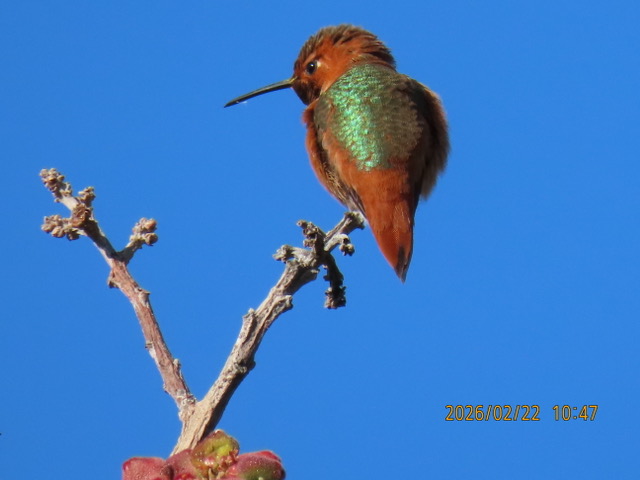
Speaking of brownish-reddish-orangish-whatever colors, this reddish color on the Allen’s Hummingbird is usually described as “rufous.” The word “rufous” come from the Latin word rufus, which translates to “red” “red-haired” or “tawny”. It entered English usage around the late 18th-century (circa 1775–1785) as a descriptor for colors in nature, particularly for bird plumage and animal fur. [I cut-and-pasted this etymological tidbit from Google AI, which definitely has its uses.]
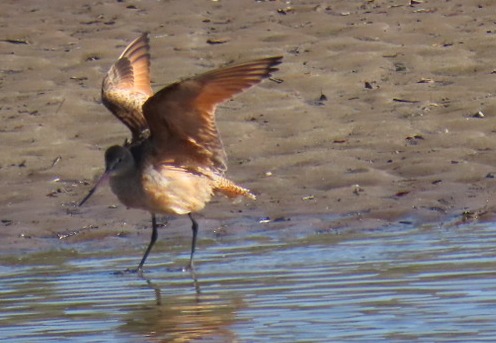
And speaking of yet one more reddish bird, this Marbled Godwit looks especially reddish. Perhaps it’s just the sunlight giving it this glow.
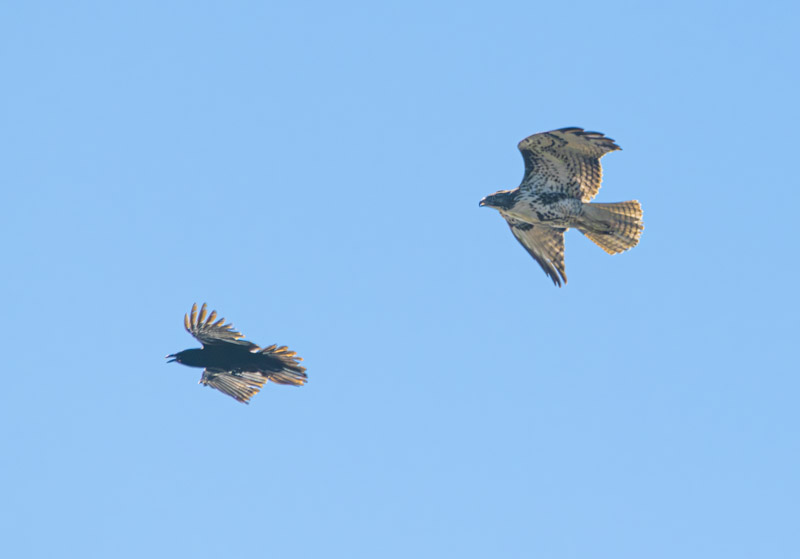
Overhead, some crows were busily mobbing whatever hawks happened to be passing by, including this Red-tailed Hawk. It takes 18 to 24 months for the initially brown-banded tail to turn red.
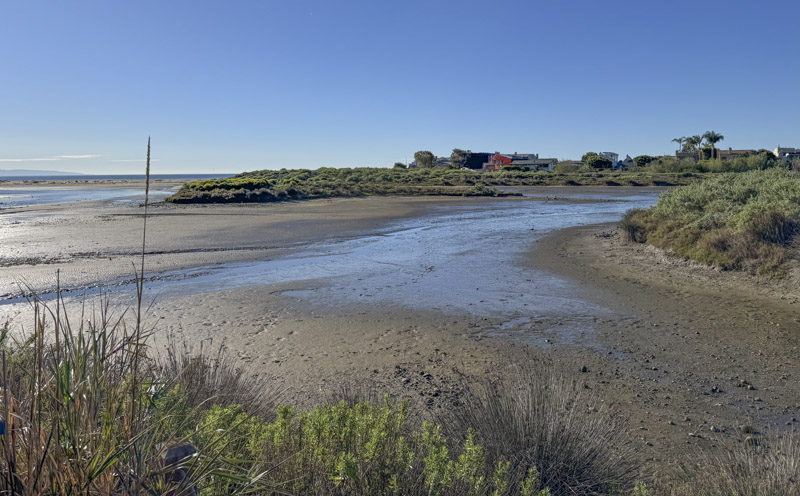
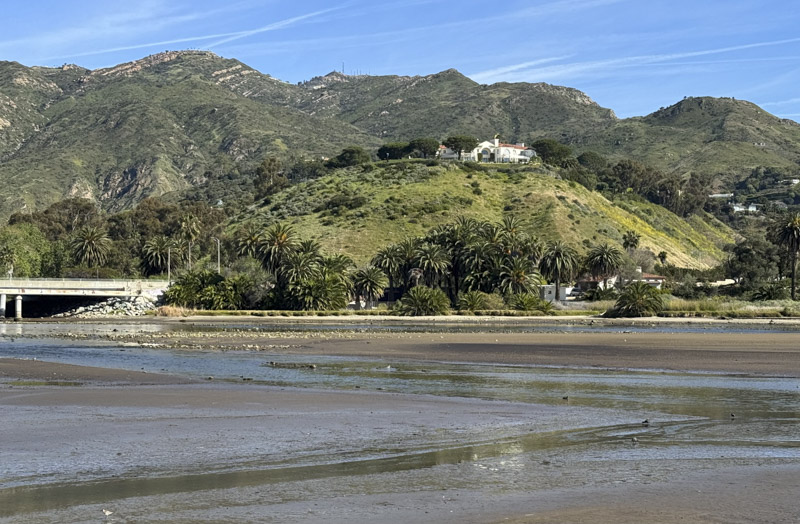
Mud flats, low water, Boot-heel Island, a corner of the lagoon, the lagoon south shore and the west end of Malibu Colony in the distance. In the very far distance is the NW end of Santa Catalina Island.
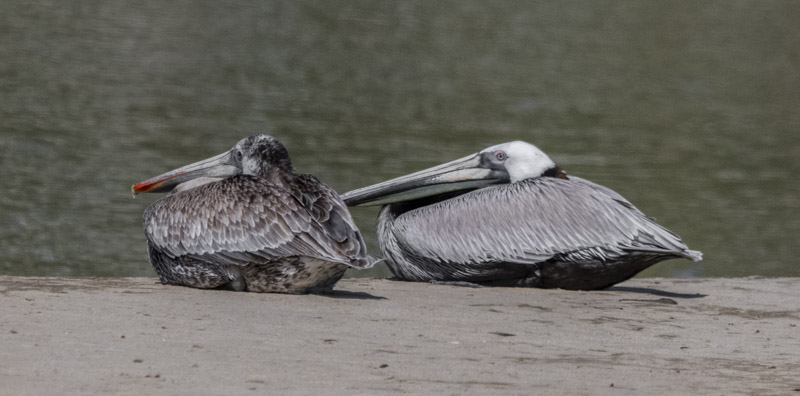
Breeding Brown Pelicans often have some red at the tip of their bill, but this bird below looks like a sub-adult and that amount of red seems unusual. Their breeding season “starts” in March, but they’re asynchronous breeders, and some may not start until late summer.
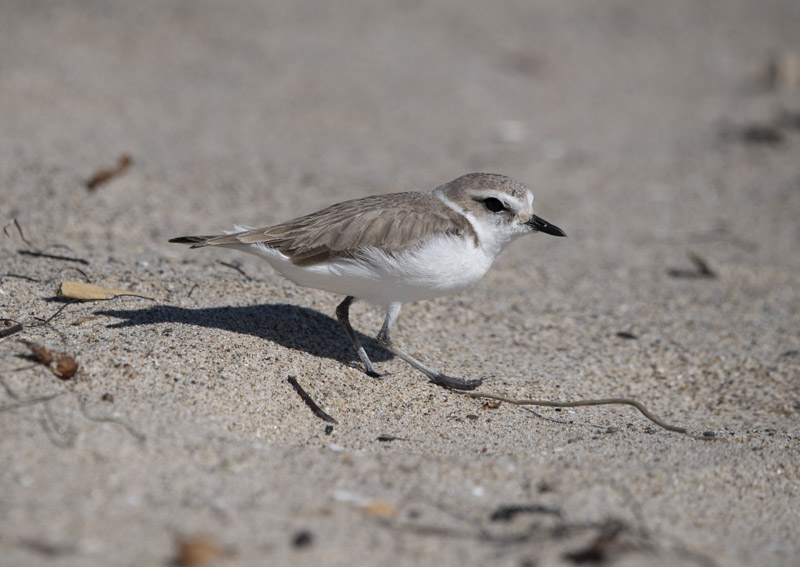
Our Western Snowy Plovers are still with us. Among them was the bird banded vg:ow (not the bird pictured below) who has been with us since at least last November, if not all the way back to last July.
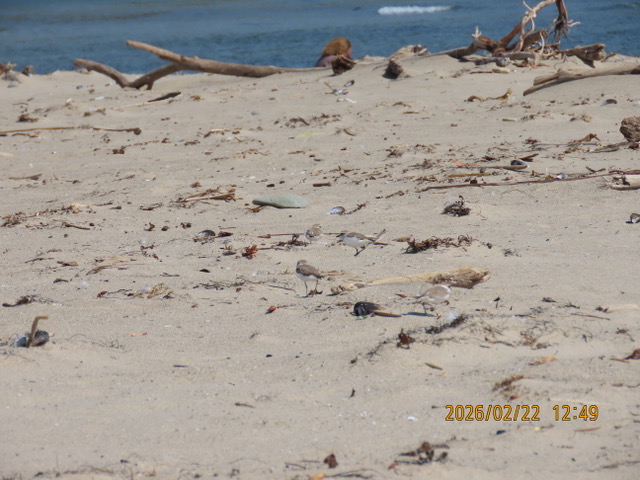
There’s plenty of small debris on the beach for the plovers to hide among. How many plovers can you find below? Answer* at the very bottom of the blog.
Malibu Lagoon on eBird as of 2-27-26: 9238 lists, 3006 eBirders, 322 species
Most recent new species seen: Nelson’s Sparrow, 11/29/24 by Femi Faminu (SMBAS member). When the newest species added to the list was seen on a date prior to the most recently seen new species, there is no way I can find to easily determine what that bird is. Another minor nit to pick about eBird.
Birds new for the season: Cinnamon Teal, Anna’s Hummingbird, Clark’s Grebe, Pacific Loon, Sharp-shinned Hawk, Red-shouldered Hawk, Downy Woodpecker, Say’s Phoebe, Cassin’s Kingbird, Common Raven, Swinhoe’s White-eye, Ruby-crowned Kinglet. “New for the season” means it has been three or more months since last recorded on our trips.
Many, many thanks to photographer Femi Faminu, Ray Juncosa, Emily Roth.
Upcoming SMBAS scheduled field trips; no reservations or Covid card necessary unless specifically mentioned:
- Sepulveda Basin, Sat. Mar. 14, 8:00
- Malibu Lagoon, Sun. Mar. 22, 8:30 (adults) & 10 am (parents & kids)
- Bear Divide/Walker Ranch Sat. Apr. 18, 7:30 am, leader Armando Martinez, Reservation
- These and any other trips we announce for the foreseeable future will depend upon expected status of the Covid/flu/etc. pandemic, not to mention landslides, fires, local flooding and atmospheric rivers at trip time. Any trip announced may be canceled shortly before trip date if it seems necessary. By now any other comments should be superfluous.
- Link to Programs & Field Trip schedule.
The next SMBAS Zoom program: Tuesday, March 3, 7:30pm; Evolutionary History and Biogeography of Passerines, with Diego Blanco.
The SMBAS 10 a.m. Parent’s & Kids Birdwalk has again resumed, with ten guests on 25 Jan 2026. Reservations not necessary for families, but for groups (scouts, etc.), please call Jean (213-522-0062).
Links: Unusual birds at Malibu Lagoon
9/23/02 Aerial photo of Malibu Lagoon
Aerial ‘film’ flying north over lagoon
More recent aerial photo
Prior checklists:
2025: Jan-June
2023: Jan-June, July-Dec 2024: Jan-June, July-Dec
2021: Jan-July, July-Dec 2022: Jan-June, July-Dec
2020: Jan-July, July-Dec 2019: Jan-June, July-Dec
2018: Jan-June, July-Dec 2017: Jan-June, July-Dec
2016: Jan-June, July-Dec 2015: Jan-May, July-Dec
2014: Jan-July, July-Dec 2013: Jan-June, July-Dec
2012: Jan-June, July-Dec 2011: Jan-June, July-Dec
2010: Jan-June, July-Dec 2009: Jan-June, July-Dec
The 10-year comparison summaries created during the Lagoon Reconfiguration Project period, remain available—despite numerous complaints—on our Lagoon Project Bird Census Page. Very briefly summarized, the results unexpectedly indicate that avian species diversification and numbers improved slightly during the restoration period June’12-June’14.
Many thanks to Marie Barnidge-McIntyre, Femi Faminu, Lu Plauzoles, Emily Roth and others for contributions made to this month’s census counts.
The species list below was re-sequenced as of 12/31/25 to agree with the eBird sequence. If part of the right side of the chart below is hidden, there’s a slider button inconveniently located at the bottom end of the list. The numbers 1-9 left of the species names are keyed to the nine categories of birds at the bottom. Updated lagoon bird check lists can be downloaded here.
[Chuck Almdale]
| Malibu Census 2025-26 | 9/28 | 10/26 | 11/23 | 12/28 | 1/25 | 2/22 | |
| Temperature | 65-69 | 58-65 | 59-65 | 60-69 | 47-55 | 49-63 | |
| Tide Lo/Hi Height | H+4.54 | H+5.02 | H+5.46 | L+1.35 | L+1.31 | L+0.65 | |
| Tide Time | 1244 | 1125 | 0939 | 1047 | 0846 | 0655 | |
| 1 | Brant (Black) | 1 | 1 | 1 | 1 | ||
| 1 | Canada Goose | 12 | 14 | 3 | 4 | ||
| 1 | Cinnamon Teal | 2 | |||||
| 1 | Northern Shoveler | 4 | |||||
| 1 | Gadwall | 6 | 14 | 20 | 34 | 35 | |
| 1 | American Wigeon | 15 | 4 | 4 | |||
| 1 | Mallard | 7 | 26 | 1 | 12 | 5 | 7 |
| 1 | Green-winged Teal | 5 | 11 | 8 | |||
| 1 | Ring-necked Duck | 1 | |||||
| 1 | Surf Scoter | 10 | 2 | 22 | 4 | 3 | 6 |
| 1 | Bufflehead | 4 | 4 | ||||
| 1 | Red-breasted Merganser | 2 | 5 | 6 | 7 | ||
| 1 | Ruddy Duck | 1 | 5 | 11 | |||
| 2 | Feral Pigeon | 6 | 5 | 4 | |||
| 2 | Mourning Dove | 3 | 1 | 1 | |||
| 2 | Anna’s Hummingbird | 1 | 2 | 3 | 1 | ||
| 2 | Allen’s Hummingbird | 4 | 5 | 4 | 3 | 3 | 3 |
| 3 | Sora | 1 | 1 | ||||
| 3 | American Coot | 31 | 4 | 25 | 25 | 50 | 55 |
| 4 | Black Oystercatcher | 1 | 1 | 3 | |||
| 4 | Black-bellied Plover | 55 | 88 | 64 | 62 | 34 | 20 |
| 4 | Killdeer | 1 | 8 | 10 | 4 | 4 | 6 |
| 4 | Snowy Plover | 35 | 40 | 40 | 7 | 17 | 4 |
| 4 | Hudsonian Whimbrel | 3 | 14 | 8 | 4 | 3 | 4 |
| 4 | Marbled Godwit | 21 | 8 | 10 | 3 | 4 | |
| 4 | Spotted Sandpiper | 1 | |||||
| 4 | Willet | 10 | 14 | 20 | 7 | 7 | 3 |
| 4 | Ruddy Turnstone | 3 | 6 | 4 | 3 | 2 | 3 |
| 4 | Sanderling | 1 | 13 | 23 | 14 | 35 | 10 |
| 4 | Dunlin | 2 | 1 | ||||
| 4 | Least Sandpiper | 6 | 12 | 6 | 10 | 20 | 20 |
| 4 | Western Sandpiper | 14 | 1 | 2 | |||
| 5 | Sabine’s Gull | 1 | |||||
| 5 | Bonaparte’s Gull | 1 | |||||
| 5 | Heermann’s Gull | 38 | 2 | 49 | 10 | ||
| 5 | Short-billed Gull | 1 | |||||
| 5 | Ring-billed Gull | 1 | 7 | 6 | 5 | 17 | 4 |
| 5 | Western Gull | 61 | 35 | 55 | 85 | 45 | 41 |
| 5 | American Herring Gull | 1 | 1 | 1 | |||
| 5 | California Gull | 10 | 116 | 410 | 650 | 275 | 140 |
| 5 | Elegant Tern | 4 | 2 | 3 | |||
| 5 | Royal Tern | 12 | 2 | 22 | 25 | 12 | 28 |
| 6 | Pied-billed Grebe | 6 | 2 | 3 | 6 | 2 | 2 |
| 6 | Horned Grebe | 1 | |||||
| 6 | Eared Grebe | 1 | 6 | 3 | 1 | ||
| 6 | Western Grebe | 30 | 8 | 10 | 45 | 4 | |
| 6 | Clark’s Grebe | 2 | 2 | ||||
| 6 | Red-throated Loon | 2 | 2 | ||||
| 6 | Pacific Loon | 1 | 1 | ||||
| 6 | Brandt’s Cormorant | 5 | 2 | 1 | 35 | 5 | |
| 6 | Pelagic Cormorant | 1 | 3 | 2 | 3 | 1 | |
| 6 | Double-crested Cormorant | 49 | 28 | 38 | 17 | 28 | 15 |
| 6 | Black-crowned Night-Heron | 2 | 1 | ||||
| 6 | Snowy Egret | 5 | 34 | 30 | 11 | 3 | 3 |
| 6 | Green Heron | 1 | 2 | 1 | |||
| 6 | Great Egret | 3 | 4 | 2 | 1 | 1 | 1 |
| 6 | Great Blue Heron | 4 | 6 | 4 | 5 | 5 | 3 |
| 6 | Brown Pelican | 45 | 138 | 13 | 3 | 13 | 10 |
| 7 | Turkey Vulture | 1 | 2 | 2 | 2 | ||
| 7 | Osprey | 1 | 1 | 1 | 1 | 2 | |
| 7 | Sharp-shinned Hawk | 1 | |||||
| 7 | Cooper’s Hawk | 1 | |||||
| 7 | Red-shouldered Hawk | 2 | 1 | 2 | |||
| 7 | Red-tailed Hawk | 1 | 1 | 2 | 1 | 2 | |
| 8 | Belted Kingfisher | 1 | 1 | 2 | 1 | 1 | 1 |
| 8 | Downy Woodpecker | 1 | |||||
| 8 | Nuttall’s Woodpecker | 1 | |||||
| 8 | Nanday Parakeet | 20 | 9 | 2 | |||
| 9 | Black Phoebe | 4 | 2 | 3 | 1 | 3 | 3 |
| 9 | Say’s Phoebe | 1 | 1 | ||||
| 9 | Cassin’s Kingbird | 1 | |||||
| 9 | Hutton’s Vireo | 1 | |||||
| 9 | California Scrub-Jay | 1 | 2 | 1 | |||
| 9 | American Crow | 6 | 10 | 7 | 6 | 11 | 10 |
| 9 | Common Raven | 1 | 1 | ||||
| 9 | Oak Titmouse | 2 | 2 | 1 | 1 | ||
| 9 | Barn Swallow | 4 | |||||
| 9 | Bushtit | 9 | 35 | 4 | 19 | 20 | 5 |
| 9 | Wrentit | 2 | 2 | 4 | 1 | 2 | 2 |
| 9 | Swinhoe’s White-eye | 1 | 2 | ||||
| 9 | Ruby-crowned Kinglet | 1 | |||||
| 9 | Blue-gray Gnatcatcher | 2 | |||||
| 9 | Northern House Wren | 2 | 1 | 1 | 1 | 1 | |
| 9 | Marsh Wren | 1 | 1 | ||||
| 9 | Bewick’s Wren | 2 | |||||
| 9 | European Starling | 2 | 6 | 30 | 1 | 10 | |
| 9 | Northern Mockingbird | 1 | 1 | 1 | |||
| 9 | Western Bluebird | 2 | 1 | ||||
| 9 | Hermit Thrush | 2 | |||||
| 9 | Scaly-breasted Munia | 7 | |||||
| 9 | House Finch | 3 | 2 | 5 | 15 | 7 | 10 |
| 9 | Lesser Goldfinch | 2 | 2 | 7 | 2 | ||
| 9 | American Goldfinch | 4 | |||||
| 9 | Dark-eyed Junco | 2 | 3 | 1 | 1 | ||
| 9 | White-crowned Sparrow | 2 | 10 | 12 | 18 | 6 | 5 |
| 9 | Savannah Sparrow | 1 | |||||
| 9 | Song Sparrow | 5 | 4 | 4 | 3 | 5 | 7 |
| 9 | California Towhee | 2 | 1 | 2 | 2 | 3 | 2 |
| 9 | Western Meadowlark | 2 | |||||
| 9 | Great-tailed Grackle | 23 | 6 | 16 | 3 | 10 | 3 |
| 9 | Orange-crowned Warbler | 2 | 1 | 2 | 1 | 1 | 1 |
| 9 | Common Yellowthroat | 7 | 6 | 2 | 1 | 1 | 2 |
| 9 | Yellow-rumped Warbler | 2 | 25 | 10 | 8 | 6 | 6 |
| 9 | Black-throated Gray Warbler | 1 | 1 | ||||
| Totals Birds by Type | Sep | Oct | Nov | Dec | Jan | Feb | |
| 1 | Waterfowl & Quail | 25 | 28 | 61 | 95 | 67 | 74 |
| 2 | Doves, Swifts & Hummers | 14 | 8 | 7 | 9 | 3 | 8 |
| 3 | Rails & Coots | 32 | 4 | 26 | 25 | 50 | 55 |
| 4 | Shorebirds | 130 | 219 | 185 | 123 | 128 | 74 |
| 5 | Gulls & Terns | 127 | 164 | 547 | 777 | 349 | 214 |
| 6 | Grebe, Loon, Heron, Pelican | 117 | 259 | 111 | 59 | 134 | 47 |
| 7 | Hawks & Falcons | 5 | 2 | 3 | 5 | 5 | 7 |
| 8 | Kingfish, Peckers & Parrots | 21 | 10 | 3 | 1 | 3 | 2 |
| 9 | Passerines | 82 | 122 | 122 | 91 | 86 | 77 |
| Totals Birds | 553 | 816 | 1065 | 1185 | 825 | 558 | |
| Total Species by Group | Sep | Oct | Nov | Dec | Jan | Feb | |
| 1 | Waterfowl & Quail | 5 | 2 | 8 | 11 | 8 | 9 |
| 2 | Doves, Swifts & Hummers | 4 | 3 | 2 | 3 | 1 | 3 |
| 3 | Rails & Coots | 2 | 1 | 2 | 1 | 1 | 1 |
| 4 | Shorebirds | 10 | 12 | 10 | 11 | 10 | 9 |
| 5 | Gulls & Terns | 7 | 6 | 8 | 7 | 4 | 5 |
| 6 | Grebe, Loon, Heron, Pelican | 10 | 12 | 14 | 11 | 9 | 11 |
| 7 | Hawks & Falcons | 4 | 2 | 3 | 3 | 3 | 4 |
| 8 | Kingfish, Peckers & Parrots | 2 | 2 | 2 | 1 | 2 | 2 |
| 9 | Passerines | 20 | 21 | 22 | 21 | 17 | 22 |
| Totals Species – 104 | 64 | 61 | 71 | 69 | 55 | 66 |
*We found four Western Snowy Plovers.
Discover more from SANTA MONICA BAY AUDUBON SOCIETY BLOG
Subscribe to get the latest posts sent to your email.



 SANTA MONICA BAY AUDUBON SOCIETY BLOG