Free email delivery
Please sign up for email delivery in the subscription area to the right.
No salesman will call, at least not from us. Maybe from someone else.
A Springtime Exaltation of Nouns of the Venery
[Submitted by Ellen Vahan, posted by Chuck Almdale]
The 12 Days of Spring
We missed the annual recitation of the 12 Days of Christmas and the costs thereof, thanks to Covid-19; we could not have Lords a Leaping or Pipers Piping or any get together. We have made a wish list of what we would like to celebrate Spring and the hopes of the end of the pandemic. Our source — A Compendium of Collective Nouns by Mark Faulkner, et al.
On the first day a Charm of Goldfinches,

On the second day a Wake of Bustards,

On the third day an Opera of Canaries,

On the fourth day a fourth a Clattering of Choughs,

On the fifth, a Ballet of Swans;

On the sixth a Prettying of Doves,
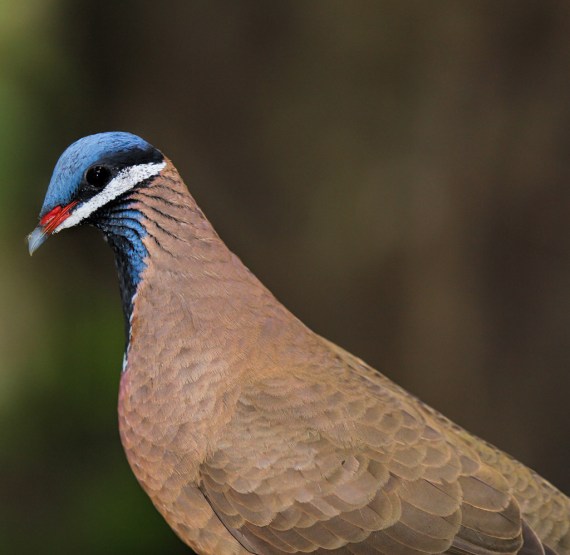
on the seventh a Jubilee of Eagles.

On the eighth a Flamboyance of Flamingos,

on the ninth a Bazaar of Guillemots,

On the tenth a Hover of Kestrels,
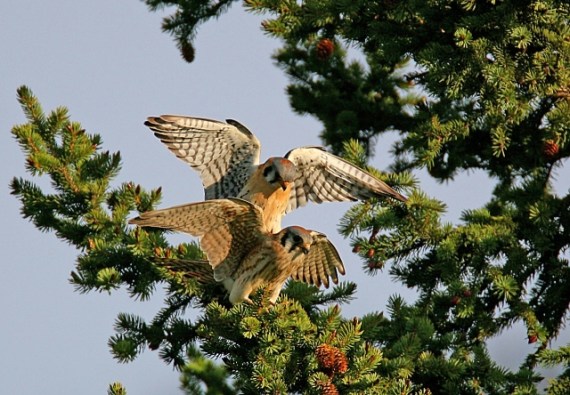
On the eleventh a bellowing of Bullfinches,

And on the twelfth day of Spring, a Mutation of Thrushes.
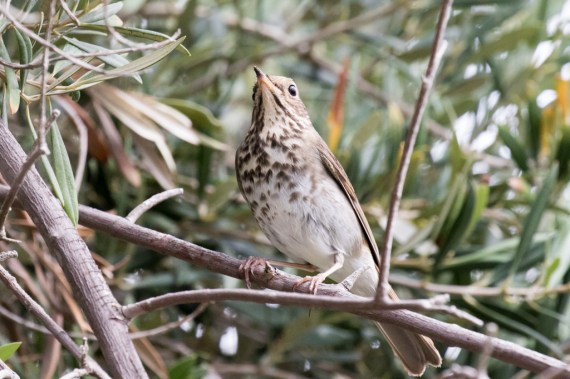
Oh, and please drop by some birdseed.
The Mutation of Thrushes is from The Book of Saint Albans:
It is a recognized fact amongst naturalists that Thrushes acquire new legs, and cast the old ones when about ten years old.
This common fact remains news to many in the scientific community.
Happy Spring and new beginnings!
Photo Credits
- Lawrence’s Goldfinch — Doug Waterman; California; 11 June 2017
- Kori Bustard — Winfried Bruenken; Etosha, Namabia; 20 Sep 2004; Wikipedia
- Atlantic Canary — Juan Emilio; Parque Rural del Nublo, Gran Canaria, Spain; male; 2 Feb 2012; Wikipedia
- Red-billed Chough — Dibyendu Ash; Sikkim, India; 13 May 2014
- Tundra Swan — Mike at RoadsEndNaturalist.com
- Blue-headed Quail-Dove — Arturo Kirkconnell; Cuba
- Golden Eagle grabbing a drone — Mont-de-Marsan French Air Force base, Southwestern France.
- Greater Flamingo — Sorin Furcoi,Al Jazeera; Qatar
- Pigeon Guillemot — Grace Murayama; 14 June 2016
- American Kestrel — Ted Schroeder, LeGrande, OR, March 2013
- Eurasian Bullfinch — Francis Franklin; Lancashire, UK; Male; 4 Jan 2015; Wikipedia
- Hermit Thrush — Randy Ehler; California; 25 Oct 2015
Birds can Dance! | Video
[Posted by Chuck Almdale. Thanks to Hollywood Dave.]
Birds can dance. Yes they Can Can.
A wonderful video. Music by Strauss. Turn up the volume.
1st Sunday of Spring, Malibu Lagoon, 21 March 2021
[Posted by Chuck Almdale]

Double-crested Cormorant (Ray Juncosa 3-21-21)
After doing our non-official, nearly-impromptu lagoon census-walk on weekdays for the past ten months, primarily to avoid maskless crowds, I decided to try one on the weekend. People in Los Angeles are seeing a (perhaps illusory) light at the end of the Covid tunnel, vaccines are being injected, the maskless are again on the loose, and the weekday morning roads and highways are refilling with drivers. So Sunday morning it was to be.
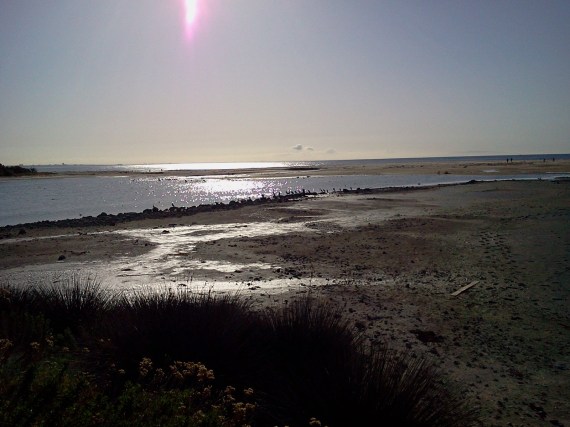
Mudflat, rocks with cormorants, lagoon, Surfrider Beach, Pacific Ocean and Santa Monica in the distance (Lillian Johnson 3-21-21)

Good weather, a lowering tide, acceptably cool and not as breezy as predicted all made for a good day. Some who worked or are otherwise occupied during the week were able to come, and we had thirteen birders, all masked and ready to go. That’s the most we’ve had since February 2020, and it’s about the limit of social-distancing birders the narrower paths can handle. In my opinion.
Reed beds were flattened from the rain and hail earlier in the month, leaving nowhere for Soras and Virginia Rails to hide, if there were any, which there aren’t. An Osprey – absent last month – alit upon a pipe protruding from the north channel mud. It soon began chirp-calling in its odd, un-raptorlike manner, and within a few minutes another Osprey approached from the south and dropped out of the sky. After circling the calling bird it headed off towards the shopping center to the north. Territorial display? Courting? Saying hi? Kemosabe?
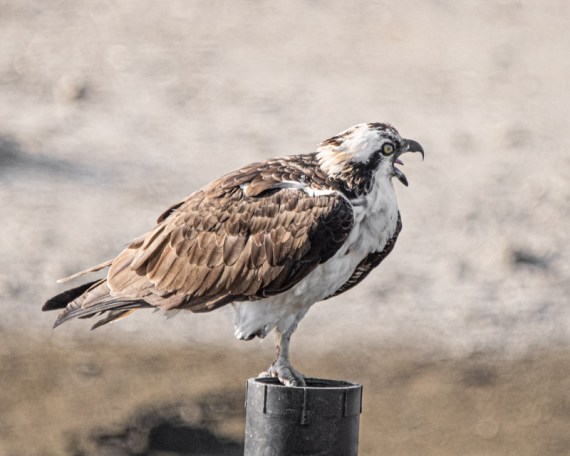
Osprey calling; none of the photos of this bird showed any more of a right leg than this (R. Juncosa 3-21-21)
The two Western Bluebirds flitted about in the trees over the port-a-potties, which seems to be their favorite spot. We’ve seen them there in the past, scarfing Sugarbush berries. It’s leafy and they can perch high to spot snacks (aka insects) flying by. Perhaps they drop down to the grassy private golf course a few feet away, invisible to us on the other side of a high brick wall.
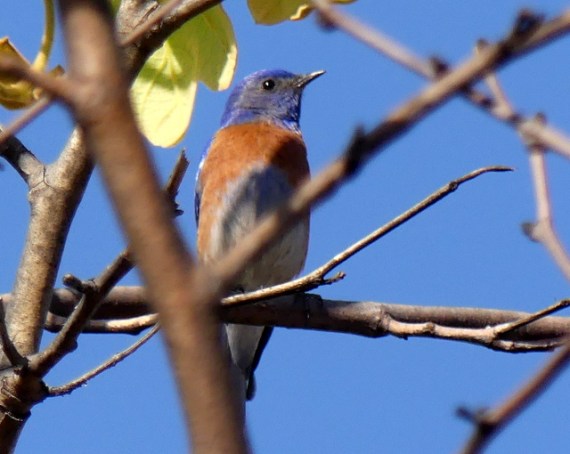
Western Bluebird male (Femi Faminu 3-21-21)
Nine species of ducks and geese rested on the exposed mud or dabbled in the water. Last month’s Pintails, Buffleheads and Ruddy Ducks were absent, but Northern Shovelers were there. Relatively abundant were the 25 Green-winged Teal, most of them lying on the muddy shore of a sand island. Pied-billed Grebes dove in the deeper water by the PCH bridge, accompanied by many coots and several Red-breasted Mergansers.

Northern Shovelers have a very large bill for a duck (C. Tosdevin 3-21-21)
The mockingbirds were back in place – after their two-month absence (perhaps they went to Cancun?) – near the telephone at the colony west end corner. Although neither sang from the top of their rightful pole, there was plenty of chasing around and singing from the lower bushes and small trees.


Allen’s Hummingbird male 3-21-21 Left: R. Juncosa — Right: C. Tosdevin
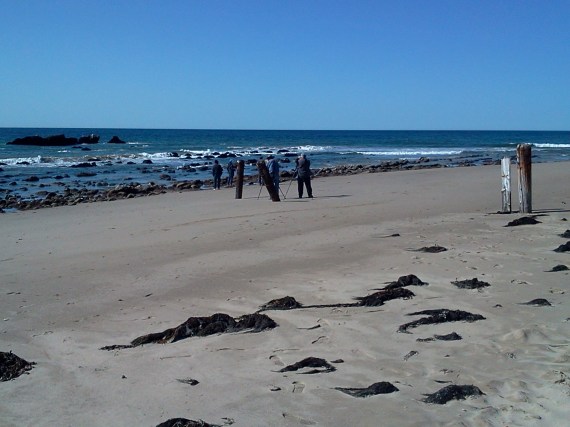
The oft-referred-to “outer rocks” are at upper left, perhaps 100 meters offshore (L. Johnson 3-21-21)
While checking the higher offshore rocks in front of Malibu Colony’s west end, we found a large number of shorebirds among the low exposed rocks (we were well on our way towards 11:53am low tide of +0.74 ft.). They turned out to be mostly Sanderlings, 160 of them, with some larger Whimbrels, Willets and Marbled Godwits mixed in.

Thirty-three or so of the Sanderlings (C. Tosdevin 3-21-21)
A single Brown Pelican sat on the outer rocks, alone, probably because the waves were still making the seaward side of the rocks unusable. But a closer look revealed a Black Oystercatcher standing atop one rock. Searching more carefully, we found three more Black Oystercatchers, blending in very well with the dark wet rocks. Photographs were taken, of course. One obliging bird saw us staring at him and flew to a nearby rock to give us a better look, or maybe take a better look at us, or perhaps something else entirely.
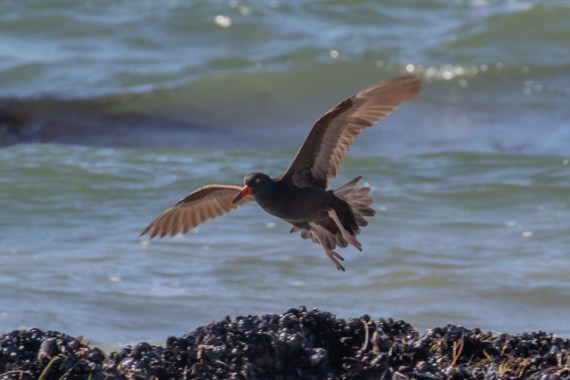
Black Oystercatcher glides in (C. Tosdevin 3-21-21)
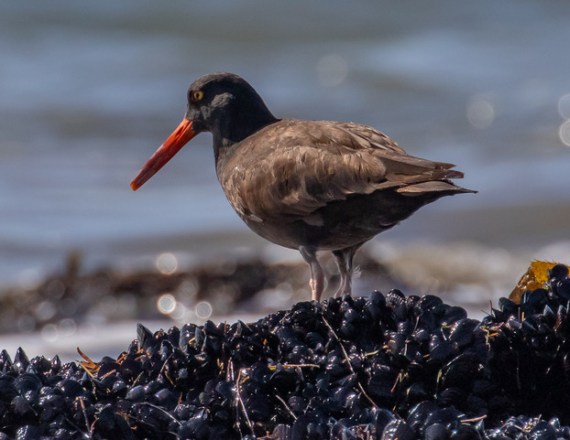
Black Oystercatcher (C. Tosdevin 3-21-21)
As we walked eastward towards the other exposed rocky reefs, two of the oystercatchers flew by and dropped into those dark damp rocks near the gulls and terns, and began exploring the newly-exposed crevices and gravel.

Beach wrack, exposed rocks and Santa Monica in far distance (L. Johnson 3-21-21)
Jean and Liz had already explored the beach and informed us they didn’t see any Snowy Plovers. So we needed to do a close investigation of all the little pockmark holes across the now-broad beach, widened by the lowering tide and the near-empty lagoon. To our surprise we found them fairly close to the beachblanketed sunbathers perched on the beach berm, widely scattered, in small groups of two to eight birds, totaling 23 birds, including winter resident gg:yg.

Western Snowy Plovers gets quite colorful in the spring (Grace Murayama 3-20-21)
The ~250 gulls included six species: 130 California, 65 Westerns, 42 Heermann’s, a dozen Ring-bills and one each of Herring and Glaucous-winged. The 28 terns were 4 Caspian and 24 Royal. Elegant Terns and the other smaller terns will probably show up next month. Ruddy Turnstones and Black-bellied Plovers roamed and rested on the rocks among the gulls.

Marbled Godwit, almost fully extended (R. Juncosa 3-21-21)
I forded the outlet stream – about 6 inches deep and warmer than last month’s ice water – and went on to Adamson House. Crossing over Surfrider beach, swarming with surfers and surfer-watchers, I noticed two Eared Grebes diving under Malibu Pier, darkening into breeding plumage.

A small example of Giant Coriopsis, coming into bloom, endemic to local shoreline and nearby channel islands (G. Murayama 3-20-21)

Local birder Tom Miko, one who certainly gets around the L.A. area a lot, had reported a weird woodpecker there the day before, seemingly a blend of Nuttall’s and Downy, but with a black face. I searched the grounds high and low, but found little other than a large flock of European Starlings. There weren’t even any hummingbirds in the flowering hedges! However, I was quite pleased to see that the boathouse rooftop viewing platform has been completely repaired, finally! (it’s been years), and open for use. Unfortunately, lagoon water level was so low that the pool below the boathouse was bone dry, with not a bird to see. C’est La Vie.
Birds new for the season: Northern Shoveler, Herring Gull, Caspian Tern, Common Raven, Rough-winged Swallow, Barn Swallow, Western Bluebird, Northern Mockingbird, Red-winged Blackbird, Brown-headed Cowbird.
Many thanks to photographers: Femi Faminu, Lillian Johnson, Ray Juncosa, Grace Murayama and Chris Tosdevin
The next three SMBAS scheduled field trips: Who knows? Not I.
The next SMBAS program: April 6, The Secret Lives of Gulls (and what their poo may reveal), with Kristen Covino, on ZOOM, 7:45 PM. NOTE NEW TIME (this meeting only).
The SMBAS 10 a.m. Parent’s & Kids Birdwalk is canceled until further notice due to the near-impossibility of maintained proper masked social distancing with parents and small children.
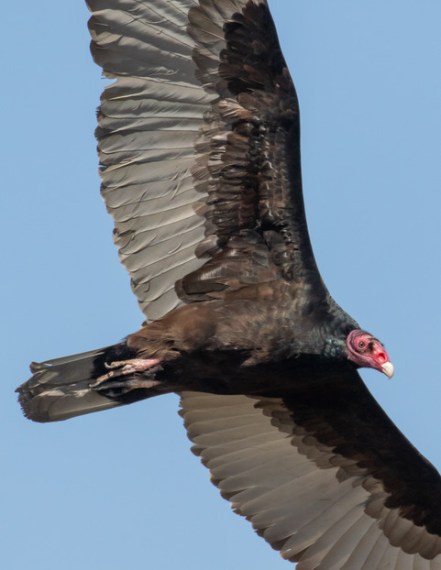
Links: Unusual birds at Malibu Lagoon
9/23/02 Aerial photo of Malibu Lagoon
Prior checklists:
2020: Jan-July, July-Dec 2019: Jan-June, July-Dec
2018: Jan-June, July-Dec 2017: Jan-June, July-Dec
2016: Jan-June, July-Dec 2015: Jan-May, July-Dec
2014: Jan-July, July-Dec 2013: Jan-June, July-Dec
2012: Jan-June, July -Dec 2011: Jan-June, July-Dec
2010: Jan-June, July-Dec 2009: Jan-June, July-Dec.
The 10-year comparison summaries created during the Lagoon Reconfiguration Project period, despite numerous complaints, remain available on our Lagoon Project Bird Census Page. Very briefly summarized, the results unexpectedly indicate that avian species diversification and numbers improved slightly during the restoration period June’12-June’14.
[Chuck Almdale]
| Malibu Census 2020-21 | 10/21 | 11/23 | 12/22 | 1/22 | 2/22 | 3/22 |
| Temperature | 64-68 | 52-64 | 57-64 | 60-61 | 65-74 | 60-61 |
| Tide Lo/Hi Height | L+2.70 | L+2.17 | L+2.15 | L+0.86 | L-0.13 | L+0.86 |
| Tide Time | 0634 | 1135 | 1052 | 1223 | 1314 | 1223 |
| Snow Goose | 2 | |||||
| (Black) Brant | 1 | |||||
| Canada Goose | 8 | 8 | 6 | |||
| Cinnamon Teal | 4 | 7 | ||||
| Northern Shoveler | 8 | |||||
| Gadwall | 2 | 28 | 6 | 8 | 12 | 16 |
| American Wigeon | 3 | 30 | 26 | 8 | 12 | 8 |
| Mallard | 14 | 8 | 10 | 16 | ||
| Northern Pintail | 1 | 2 | 2 | |||
| Green-winged Teal | 12 | 8 | 6 | 11 | 25 | |
| Surf Scoter | 3 | 13 | 15 | 2 | ||
| Bufflehead | 10 | 5 | 6 | 4 | ||
| Red-breasted Merganser | 9 | 12 | 1 | 12 | 12 | |
| Ruddy Duck | 9 | 35 | 19 | 6 | 25 | |
| Pied-billed Grebe | 2 | 3 | 3 | 2 | 6 | 6 |
| Eared Grebe | 1 | 1 | 5 | 1 | 2 | |
| Western Grebe | 6 | 2 | 4 | 11 | ||
| Rock Pigeon | 10 | 9 | 14 | 3 | 4 | 6 |
| Mourning Dove | 2 | 9 | 2 | 1 | 6 | |
| Anna’s Hummingbird | 1 | 2 | 2 | 3 | ||
| Allen’s Hummingbird | 1 | 2 | 2 | 2 | 2 | |
| Sora | 1 | |||||
| American Coot | 118 | 287 | 445 | 110 | 210 | 235 |
| Black Oystercatcher | 4 | 2 | 4 | 4 | ||
| Black-bellied Plover | 91 | 30 | 10 | 25 | 25 | 31 |
| Snowy Plover | 42 | 28 | 22 | 21 | 27 | 23 |
| Semipalmated Plover | 4 | 1 | ||||
| Killdeer | 1 | 8 | 14 | 20 | 4 | 7 |
| Whimbrel | 3 | 5 | 8 | 8 | 3 | 6 |
| Marbled Godwit | 5 | 4 | 8 | 10 | 11 | 10 |
| Ruddy Turnstone | 6 | 2 | 6 | 1 | 5 | |
| Sanderling | 75 | 78 | 25 | 8 | 50 | 160 |
| Least Sandpiper | 4 | 13 | 6 | 4 | 8 | |
| Western Sandpiper | 1 | 4 | ||||
| Spotted Sandpiper | 1 | 2 | 2 | 1 | ||
| Willet | 5 | 14 | 10 | 12 | 11 | 6 |
| Greater Yellowlegs | 1 | |||||
| Heermann’s Gull | 85 | 43 | 16 | 2 | 42 | |
| Mew Gull | 2 | |||||
| Ring-billed Gull | 10 | 65 | 15 | 38 | 12 | |
| Western Gull | 21 | 53 | 34 | 30 | 80 | 65 |
| California Gull | 1 | 535 | 485 | 50 | 235 | 130 |
| Herring Gull | 1 | 1 | 1 | |||
| Glaucous-winged Gull | 1 | 3 | 3 | 1 | 1 | |
| Caspian Tern | 4 | |||||
| Forster’s Tern | 1 | |||||
| Royal Tern | 3 | 5 | 6 | 24 | ||
| Red-throated Loon | 1 | |||||
| Pacific Loon | 1 | 1 | 1 | |||
| Brandt’s Cormorant | 1 | 5 | ||||
| Double-crested Cormorant | 16 | 108 | 28 | 85 | 52 | 25 |
| Pelagic Cormorant | 3 | 4 | 1 | 1 | ||
| Brown Pelican | 5 | 206 | 32 | 162 | 12 | 27 |
| Great Blue Heron | 3 | 3 | 3 | 1 | 3 | |
| Great Egret | 1 | 1 | 2 | 2 | 2 | |
| Snowy Egret | 5 | 4 | 23 | 10 | 9 | 3 |
| Black-crowned Night-Heron | 1 | |||||
| Turkey Vulture | 2 | 2 | 1 | 1 | ||
| Osprey | 1 | 1 | 1 | 1 | 2 | |
| Cooper’s Hawk | 1 | 1 | ||||
| Red-tailed Hawk | 1 | |||||
| Belted Kingfisher | 1 | 1 | 1 | |||
| Nuttall’s Woodpecker | 1 | |||||
| Downy Woodpecker | 1 | |||||
| Black Phoebe | 5 | 4 | 6 | 1 | 2 | 2 |
| Say’s Phoebe | 2 | 2 | 5 | 1 | ||
| Vermilion Flycatcher | 1 | |||||
| California Scrub-Jay | 1 | 2 | ||||
| American Crow | 4 | 11 | 14 | 6 | 2 | 5 |
| Common Raven | 1 | |||||
| Tree Swallow | 3 | |||||
| Rough-winged Swallow | 6 | |||||
| Barn Swallow | 10 | |||||
| Bushtit | 75 | 30 | 30 | 8 | 20 | |
| House Wren | 2 | 1 | ||||
| Marsh Wren | 3 | |||||
| Bewick’s Wren | 2 | |||||
| Blue-gray Gnatcatcher | 2 | 2 | ||||
| Ruby-crowned Kinglet | 2 | |||||
| Western Bluebird | 2 | |||||
| Northern Mockingbird | 2 | 1 | 2 | |||
| European Starling | 5 | 85 | 30 | 10 | 75 | |
| House Finch | 4 | 4 | 6 | 4 | 4 | 10 |
| Lesser Goldfinch | 2 | 2 | 5 | 6 | 4 | 16 |
| California Towhee | 1 | 1 | 1 | 4 | ||
| Song Sparrow | 7 | 12 | 3 | 3 | 4 | 7 |
| White-crowned Sparrow | 4 | 12 | 4 | 5 | 6 | |
| Dark-eyed Junco | 1 | |||||
| Red-winged Blackbird | 2 | |||||
| Brown-headed Cowbird | 2 | |||||
| Great-tailed Grackle | 2 | 8 | 3 | 1 | 8 | |
| Orange-crowned Warbler | 2 | 1 | ||||
| Common Yellowthroat | 5 | 8 | 5 | 1 | 3 | |
| Yellow-rumped(Aud) Warbler | 10 | 8 | 16 | 6 | 14 | 15 |
| Totals by Type | Oct | Nov | Dec | Jan | Feb | Mar |
| Waterfowl | 17 | 125 | 106 | 53 | 115 | 100 |
| Water Birds – Other | 146 | 617 | 518 | 359 | 292 | 306 |
| Herons, Egrets & Ibis | 9 | 7 | 27 | 13 | 15 | 5 |
| Quail & Raptors | 1 | 5 | 3 | 3 | 0 | 3 |
| Shorebirds | 229 | 175 | 127 | 114 | 141 | 264 |
| Gulls & Terns | 22 | 688 | 634 | 119 | 362 | 279 |
| Doves | 12 | 18 | 16 | 3 | 5 | 12 |
| Other Non-Passerines | 2 | 3 | 6 | 2 | 4 | 5 |
| Passerines | 135 | 170 | 126 | 72 | 46 | 198 |
| Totals Birds | 573 | 1808 | 1563 | 738 | 980 | 1172 |
| Total Species | Oct | Nov | Dec | Jan | Feb | Mar |
| Waterfowl | 4 | 7 | 10 | 9 | 11 | 9 |
| Water Birds – Other | 7 | 9 | 9 | 4 | 9 | 6 |
| Herons, Egrets & Ibis | 3 | 2 | 3 | 3 | 4 | 2 |
| Quail & Raptors | 1 | 4 | 2 | 3 | 0 | 2 |
| Shorebirds | 9 | 10 | 13 | 11 | 11 | 11 |
| Gulls & Terns | 2 | 8 | 7 | 6 | 6 | 8 |
| Doves | 2 | 2 | 2 | 1 | 2 | 2 |
| Other Non-Passerines | 2 | 2 | 4 | 2 | 2 | 2 |
| Passerines | 18 | 18 | 14 | 11 | 11 | 20 |
| Totals Species – 94 | 48 | 62 | 64 | 50 | 56 | 62 |
Regent Honeyeaters are forgetting their songs | The Guardian
[Posted by Chuck Almdale — Suggested by Lucien Plauzoles]
[Editor’s Note: In 1988 when we birded Australia extensively for five months, the Regent Honeyeater was the rarest, most endangered of the 65 species of Australian honeyeaters then recognized.]
How an endangered Australian songbird is forgetting its love songs
New study suggests young regent honeyeaters are not getting the chance to learn mating calls
The Guardian | Graham Readfearn | 16 March 2021 | 4 min read
This Guardian article contains a 2:04 video featuring the variety of wrong songs.

What happens to a species if the music starts to die, or when their songs become corrupted or their singers have never heard the original tunes?
A new study has found that a loss of melody and song could be a bad sign for one of Australia’s rarest songbirds – the Regent Honeyeater.
Once seen in flocks of hundreds across south-eastern Australia, there are now thought to be only a few hundred of the songbirds left in the wild.
The birds are known to imitate the songs of other species, such as friarbirds, currawongs and cuckooshrikes, but there was no clear theory for why they did it. More….
Link to original article in Proceedings of the Royal Society B
Loss of vocal culture and fitness costs in a critically endangered songbird
Ross Crates , Naomi Langmore , Louis Ranjard , Dejan Stojanovic , Laura Rayner , Dean Ingwersen and Robert Heinsohn. Published: 17 March 2021 https://doi.org/10.1098/rspb.2021.0225
Complete paper is available to read or download.
Abstract:
Cultures in humans and other species are maintained through interactions among conspecifics. Declines in population density could be exacerbated by culture loss, thereby linking culture to conservation. We combined historical recordings, citizen science and breeding data to assess the impact of severe population decline on song culture, song complexity and individual fitness in critically endangered regent honeyeaters (Anthochaera phrygia). Song production in the remaining wild males varied dramatically, with 27% singing songs that differed from the regional cultural norm. Twelve per cent of males, occurring in areas of particularly low population density, completely failed to sing any species-specific songs and instead sang other species’ songs. Atypical song production was associated with reduced individual fitness, as males singing atypical songs were less likely to pair or nest than males that sang the regional cultural norm. Songs of captive-bred birds differed from those of all wild birds. The complexity of regent honeyeater songs has also declined over recent decades. We therefore provide rare evidence that a severe decline in population density is associated with the loss of vocal culture in a wild animal, with concomitant fitness costs for remaining individuals. The loss of culture may be a precursor to extinction in declining populations that learn selected behaviours from conspecifics, and therefore provides a useful conservation indicator.

Figure 1. Spatial and acoustic summary of regent honeyeater song types. (a) Locations of contemporary wild male regent honeyeaters (2015–2019) and their song types. The species whose songs each interspecific singing regent honeyeater most closely resembled are shown: (1) eastern rosella; (2) little wattlebird; (3) little friarbird; (4) spiny-cheeked honeyeater; (5) black-faced cuckooshrike; (6) noisy friarbird; (7) pied currawong (electronic supplementary material, text S5). Dotted lines denote the southern and northern limits of distinct breeding areas in the Northern Tablelands (red) and the Blue Mountains (blue), respectively. Centre left inset: data from Capertee Valley, the core breeding area within the Blue Mountains. Bottom right inset: Location of study area on a national scale, with the regent honeyeater’s contemporary range shaded dark. Due to map scale and spatial clustering of sightings, not all individuals are visible. (b) Discriminant function analysis of regent honeyeater song types, including captive-bred and pre-2012 birds from the Blue Mountains. Discriminant function analysis labels each multivariate mean with a circle corresponding to a 95% confidence limit for the mean. Groups that are significantly different have nonintersecting circles. (c) The number of contemporary wild, co-occurring male regent honeyeaters detected within the same breeding season within (i) 1 km and (ii) 50 km for male regent honeyeaters with interspecific songs (yellow) versus males with a species-specific song type (green). (Online version in colour.)
Webinar on Ballona Wetlands & Coastal Conservation | UCLA Ursus Environmental Symposium – 13 April 2021
[Posted by Chuck Almdale — Submitted by Larry Loeher]
| Glen MacDonald FRSC UCLA Endowed Chair in Geography of California and the American West Director, UC White Mountain Research Center Chair, UCLA Canadian Studies Program invites you to attend Ursus Environmental Symposium Ballona Wetlands and the Future of Southern California Coastal Conservation a panel discussion featuring Richard Ambrose Professor, UCLA Department of Environmental Health Sciences and Institute of the Environment and Sustainability David Jacobs Professor, UCLA Department of Ecology and Evolutionary Biology Shelley Luce President and Chief Executive Officer, Heal the Bay David McNeill Executive Officer, Baldwin Hills Conservancy  Tuesday, April 13, 2021 12:00 p.m. – 1:15 p.m. PDT Live streaming via Zoom Webinar Registration Please submit your questions in advance of the webinar via email to: hnadworny@support.ucla.edu (by Monday, April 12th at 12:00 p.m. PDT) Instructions to join the webinar will be provided once your registration has been confirmed. About the discussion: With almost all of Southern California’s coastal wetlands degraded or destroyed by development, and a need to provide the public with more opportunities to enjoy nature, the proposed restoration of Los Angeles’ Ballona Wetlands would appear to be a goal laudable to conservationists, and a potential model for similar efforts elsewhere in the State. However, scientific debates and sharp policy differences have arisen regarding the future course for the Ballona Wetlands. This Ursus Symposium will bring together top UCLA scientists with key figures involved in the Ballona Wetlands Restoration Project to offer their perspectives in a dialogue on this important issue and and wider implications. UCLA College 1309 Murphy Hall, PO Box 951413 Los Angeles, CA 90095-1413 |



 SANTA MONICA BAY AUDUBON SOCIETY BLOG