Free email delivery
Please sign up for email delivery in the subscription area to the right.
No salesman will call, at least not from us. Maybe from someone else.
Oystercatchers at Malibu Lagoon, 22 February 2021
[Posted by Chuck Almdale]
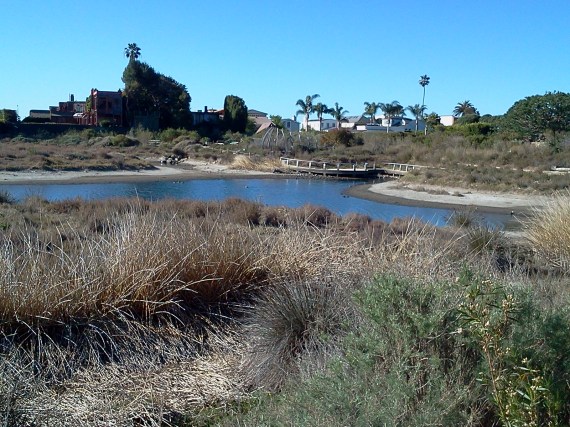
The weather really was perfect. The temperature started at 65°F at 9am, rising to 74°F by 11:30. A slight breeze rose as the day warmed, keeping it very pleasant. We never needed to add or shed clothing. While descending Malibu Canyon Road we saw a light brown haze stretching south from Santa Monica over the bay, but at sea level we couldn’t see it, and the sky was a cloudless pristine blue.
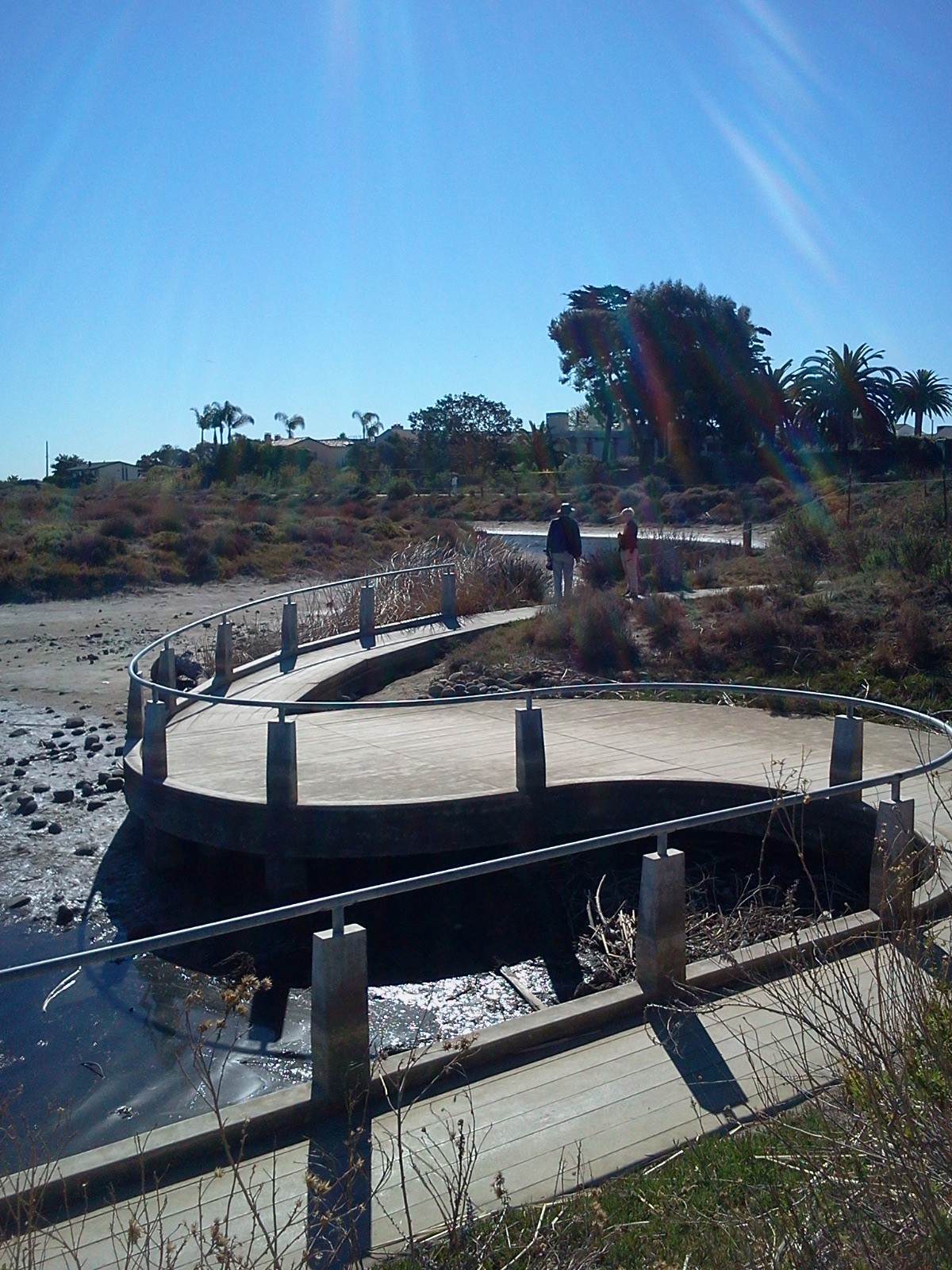

Low tide and high water at Malibu Lagoon (L – L. Johnson 2-22-21, R – G. Murayama 7-31-20)
Very few, if any, surfers graced the water. Tide was very low, heading lower to -0.13 ft. at 1:14pm. A high-pressure zone in the desert was blowing from land to sea, hence the smog layer. When there’s little swell, such winds flatten whatever waves there are. I saw one paddleboarder over by the pier.
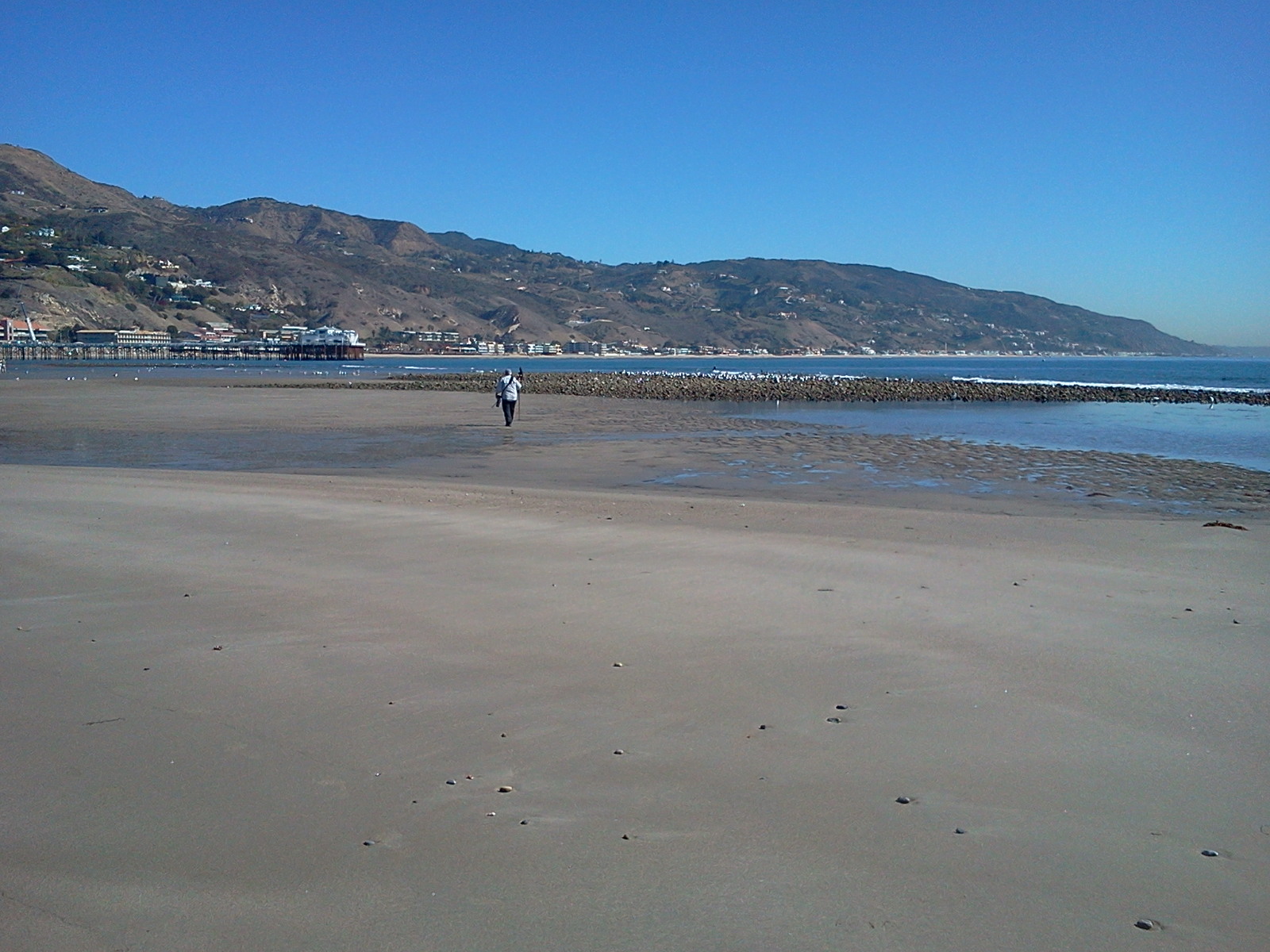

Low tide at Malibu — where did all those rocks come from? (Photos L. Johnson 2-22-21)
There were seven birders, all masked – save for one nose – and ready to bird. Bring ‘em on!

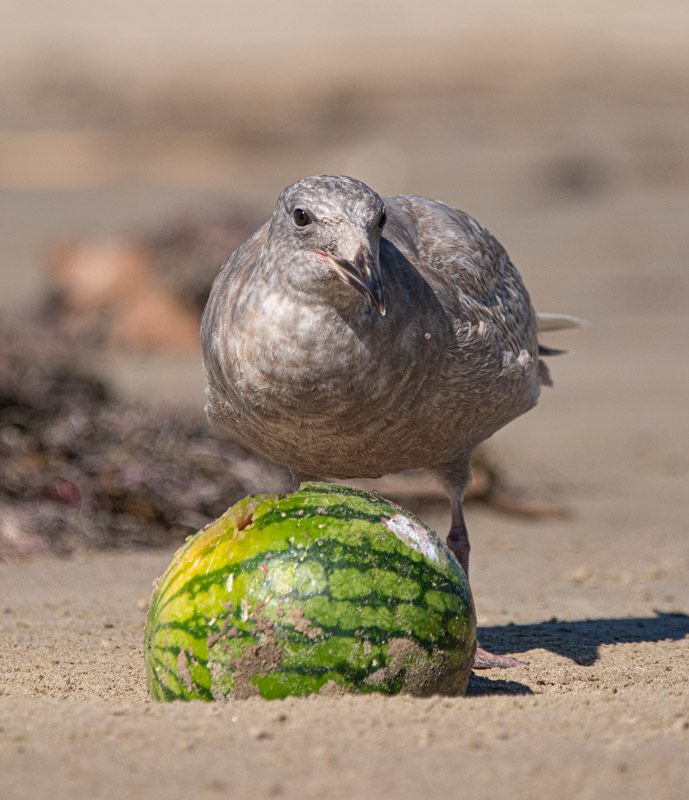
Glaucous-winged Gull discovers the joys of watermelon (L – C. Bragg, R – R. Juncosa 2-22-21)
Well…we had a good variety of ducks, a fair number of gulls and good diversity but low counts of shorebirds, but the passerines were conspicuous by their absence. Not even a mockingbird!


An immaculate Brown Pelican ready to breed (Photos L – C. Bragg R – C. Tosdevin 2-22-21)


A Great Egret stayed very close to the picnic area behind Malibu Colony. We speculated whether it could reach into the trash bin (probably couldn’t), then discovered why it was there, when it caught and ate a lizard. (Photos: L – C. Bragg, R – R. Juncosa 2-22-21)
I would not be surprised to find at least two pair of Canada Geese nesting this spring at the lagoon. They seemed to quite like the easternmost sand & brush island – one pair at each end – but last month a pair seemed to be very interested in the area near the “osprey perch” at the western island’s east end. With eight geese honking and fighting, if they pair up there’s plenty of room.

By the time we got to the ocean, the tide was really, really out, with perhaps more rocky reefs exposed than I’ve ever seen before. [I have a sneaking hunch that I think this every time the water is really low.] Back home, I checked to see how accurate this memory is. Not bad, as it turned out. During the exactly 200 visits since 6/27/04, there have been only 17 dates with negative tides, the lowest being -1.10 ft on 4/23/13 (on-line table now says -1.06 ft). So…today’s -0.17 ft. was not the lowest, but not far off.

The high offshore rocks near the Malibu Colony had an assortment of cormorants – five Brandt’s among the Double-crested, plus a sleeping Harbor Seal at the other end, well away from the potentially noisy and annoying birds. Several of the Brandt’s had breeding-blue gular pouches and white cheek plumes. These birds usually leave about the time they develop these features, so we don’t see them every year.

(digiscope photo C. Tosdevin 2-22-21)
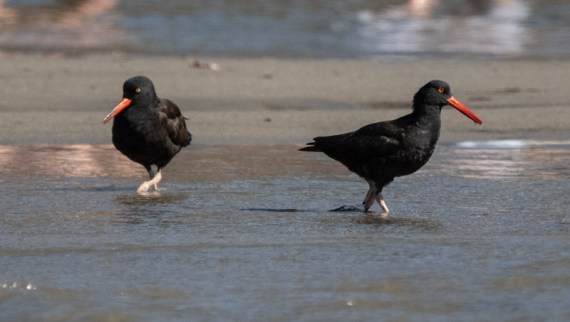
The most interesting birds were the oystercatchers – three Black and one not-Black. They were all out on the exposed rocky reefs among the gulls. The three Blacks even left the rocks and ran around on the sand, unusual for Oystercatchers. One even took a bath in the waves with a gull. Quite astonishing!
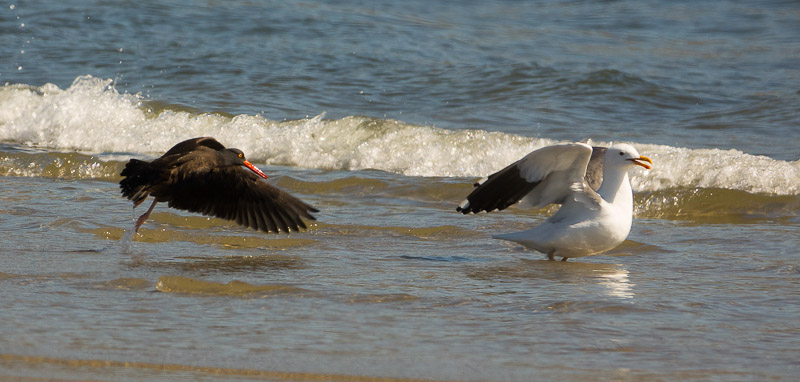
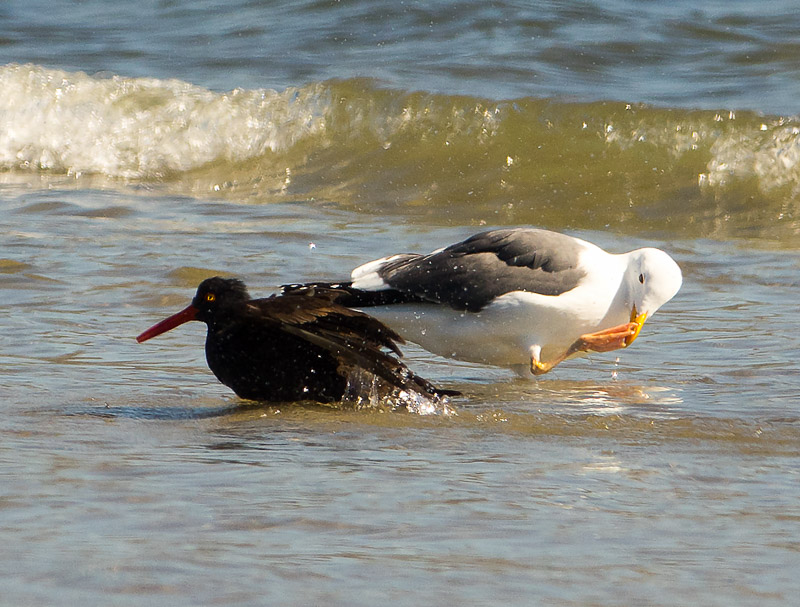
A frolic in the waves with a Western Gull – how could an oystercatcher pass that up?
(photos: C. Bragg 1/22/21)
I wrote a long blog in March 2020 about the oystercatchers at and around Malibu Lagoon so if you want to know everything I know about them, read it here. It’s a tricky call. “Frazar’s” American Oystercatcher breeds around the Sea of Cortez and on the west coast of Baja, and they look very much like our bird here. Black Oystercatchers also breed on the west coast of Baja and will hybridize with the Frazar’s. They do not hybridize with Frazar’s breeding around the Sea of Cortez. In Southern California we can have four types of Oystercatcher: Black (by far the most common), full American (least common, coming from Gulf of Mexico), Frazar’s (either side of Baja), and hybrid Frazar’s/Black (west coast of Baja).

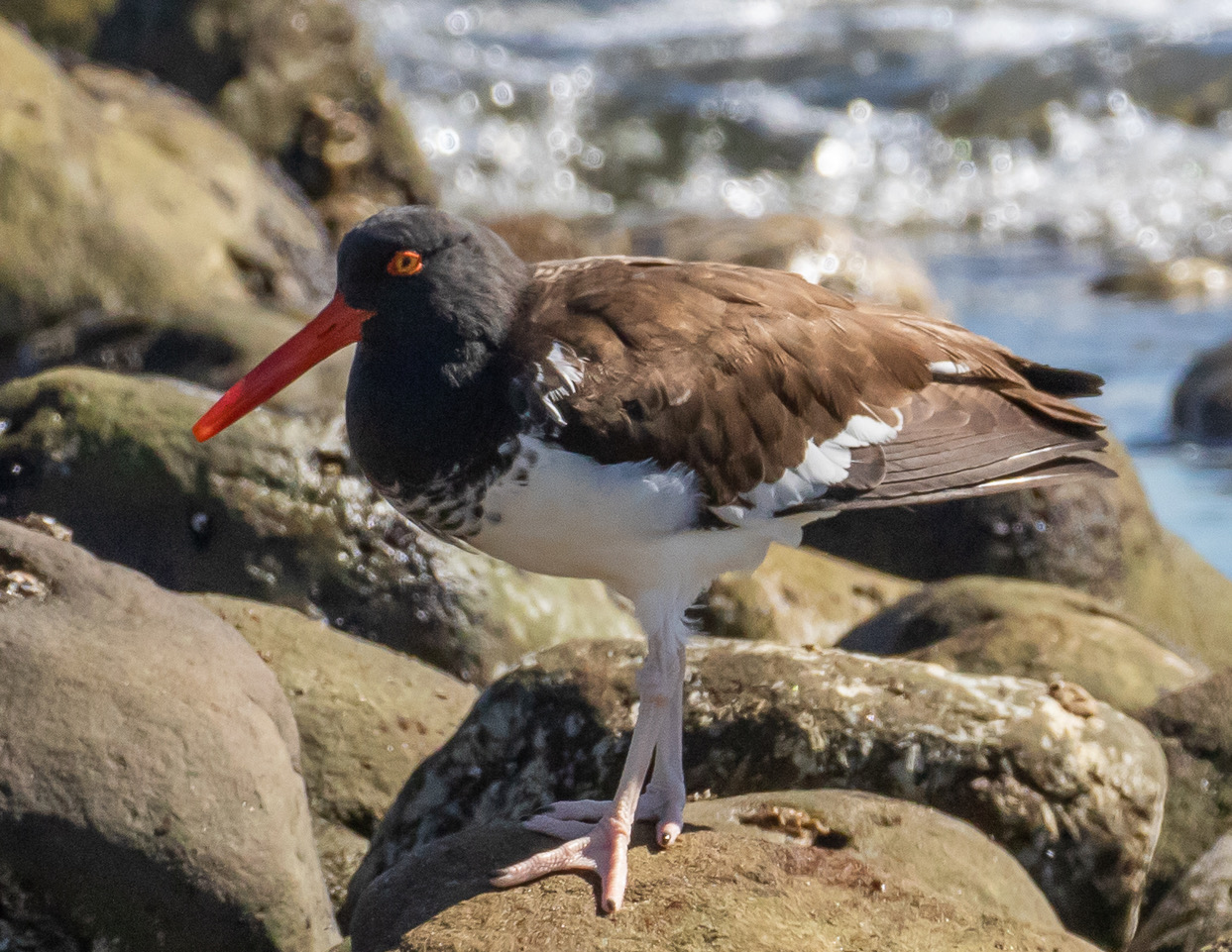
Hybrid Oystercatcher or American “Frazar’s” Oystercatcher (H.p.frazari) — a close call.
The stance of the right-hand bird reminds me a bit of Mae West. (All 4 photos C. Tosdevin 2-22-21)
A bird rated 30 or higher on the the Jehl Scale is supposed to be an American. I rate this bird overall 28-33 of 42 points. Some criteria are difficult to impossible to see. Upper Tail Coverts – 2-3, Tail – 2, Chest – 3, Belly – 6, Under Tail Coverts – 3-4, Thighs – 4, Greater Secondary Coverts – 2-3, Extent of Primary Wing Stripe – 1-2, Underwing Coverts – 2-3, and Axillars – 3. The Jehl Scale is given at the end of the March 2020 blog, and can be downloaded or printed here.

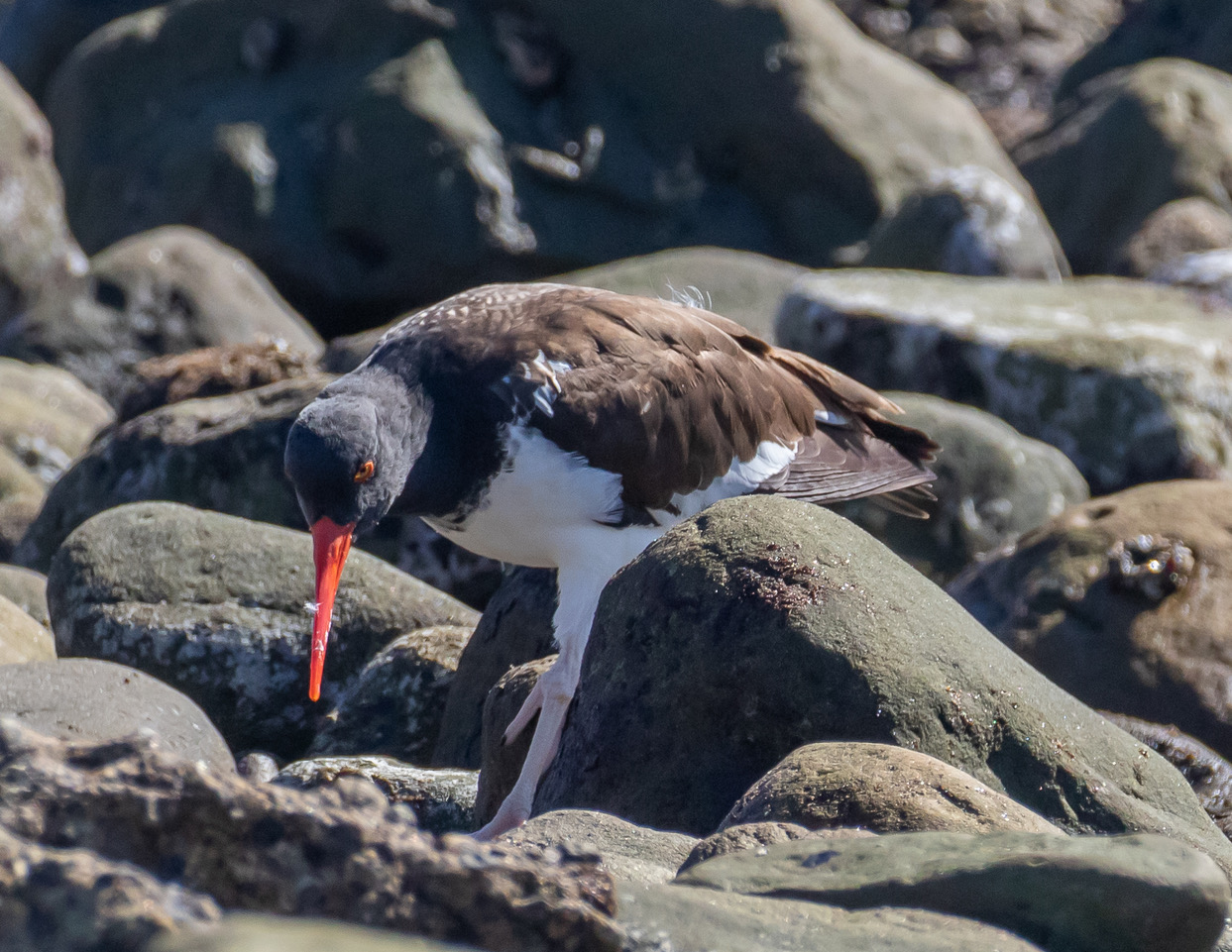
This bird, in my inexpert opinion, is on the borderline between Hybrid and H.p.frazari. I feel it ought to have a bit more white going up the shoulder between black breast and wing. I also think this is one of the birds in the March 2020 blog, which I couldn’t reach a firm conclusion on. It probably spends most of it’s time along the wet rocky areas within a few miles of Malibu, and drops in at Malibu when the tide is low.
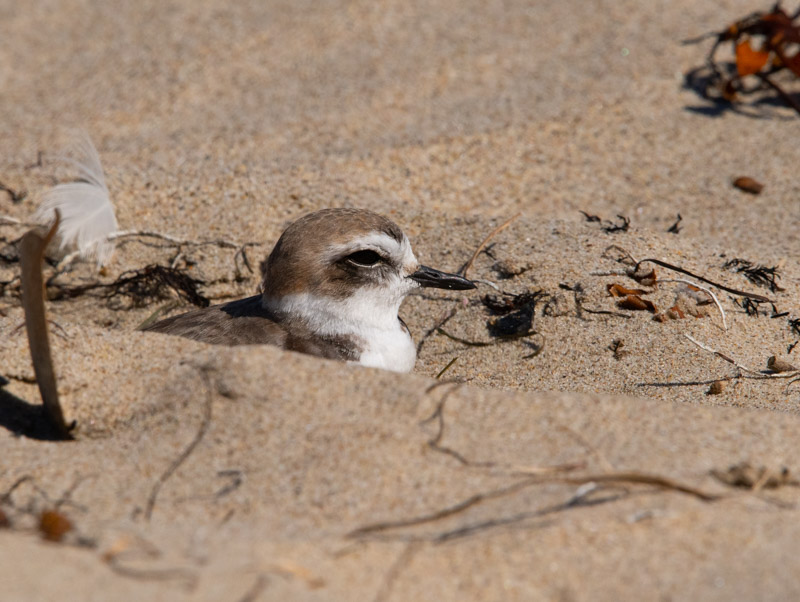

Two Western Snowy Plovers (L – R. Juncosa R – C. Tosdevin 2/22/21)
I waded across the outlet stream, opting for wide and shallow rather than narrow and deep. The water rose halfway up my shins — more where the sand was very soft and I started sinking in. Icy cold! I though my feet had fallen off by the time I got across. The point of crossing was to search all areas for Western Snowy Plovers which we hadn’t seen on our trip down the wide beach. Of course there were none. Back across the stream and westward we walked, finally finding 27 birds in their little sand-pockets, inland of the berm.
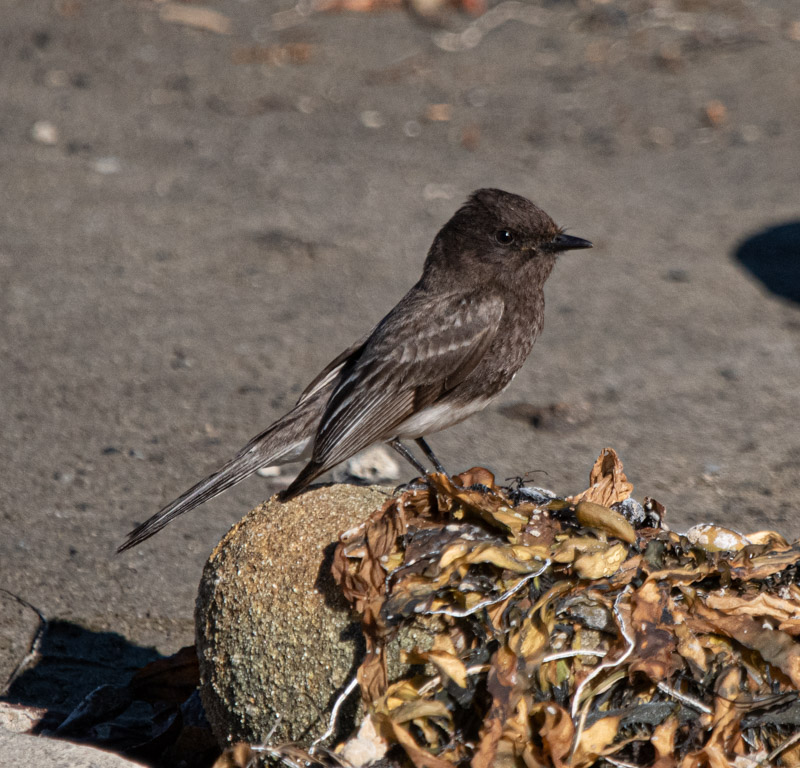

Black Phoebe, a bit closer. Tide-wet sand. (L – R. Juncosa R – L. Johnson 2-22-21)
Birds new for the season: Cinnamon Teal, Western Sandpiper, Brandt’s Cormorant, Black-crowned Night-Heron, California Scrub-Jay, California Towhee.
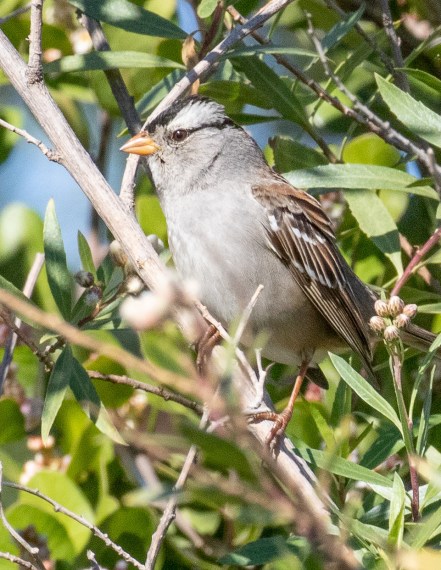
(C. Tosdevin 2-22-21)
Many thanks to photographers: Chuck Bragg, Lillian Johnson, Ray Juncosa and Chris Tosdevin
The next three SMBAS scheduled field trips: Who knows? Not I.
The next SMBAS program: March 2, Changes in Bird Status in California’s Central Valley, with John Sterling, on ZOOM, 7:30 PM.
The SMBAS 10 a.m. Parent’s & Kids Birdwalk is canceled until further notice due to the near-impossibility of maintained proper masked social distancing with parents and small children.
Links: Unusual birds at Malibu Lagoon
9/23/02 Aerial photo of Malibu Lagoon
Prior checklists:
2019: Jan-June, July-Dec 2020: Jan-July, July-Dec
2018: Jan-June, July-Dec 2017: Jan-June, July-Dec
2016: Jan-June, July-Dec 2015: Jan-May, July-Dec
2014: Jan-July, July-Dec 2013: Jan-June, July-Dec
2012: Jan-June, July -Dec 2011: Jan-June, July-Dec
2010: Jan-June, July-Dec 2009: Jan-June, July-Dec.
The 10-year comparison summaries created during the Lagoon Reconfiguration Project period, despite numerous complaints, remain available on our Lagoon Project Bird Census Page. Very briefly summarized, the results unexpectedly indicate that avian species diversification and numbers improved slightly during the restoration period June’12-June’14.
[Chuck Almdale]
| Malibu Census 2020-21 | 9/24 | 10/21 | 11/23 | 12/22 | 1/22 | 2/22 |
| Temperature | 66-77 | 64-68 | 52-64 | 57-64 | 60-61 | 65-74 |
| Tide Lo/Hi Height | L+3.05 | L+2.70 | L+2.17 | L+2.15 | L+0.86 | L-0.13 |
| Tide Time | 1004 | 0634 | 1135 | 1052 | 1223 | 1314 |
| Snow Goose | 2 | |||||
| (Black) Brant | 1 | |||||
| Canada Goose | 8 | 8 | ||||
| Cinnamon Teal | 4 | |||||
| Gadwall | 2 | 2 | 28 | 6 | 8 | 12 |
| American Wigeon | 3 | 30 | 26 | 8 | 12 | |
| Mallard | 14 | 14 | 8 | 10 | ||
| Northern Pintail | 2 | 1 | 2 | 2 | ||
| Green-winged Teal | 12 | 8 | 6 | 11 | ||
| Surf Scoter | 3 | 13 | 15 | |||
| Bufflehead | 10 | 5 | 6 | 4 | ||
| Red-breasted Merganser | 9 | 12 | 1 | 12 | ||
| Ruddy Duck | 9 | 35 | 19 | 6 | 25 | |
| Pied-billed Grebe | 2 | 2 | 3 | 3 | 2 | 6 |
| Eared Grebe | 1 | 1 | 5 | 1 | ||
| Western Grebe | 6 | 2 | 4 | |||
| Rock Pigeon | 6 | 10 | 9 | 14 | 3 | 4 |
| Mourning Dove | 4 | 2 | 9 | 2 | 1 | |
| Vaux’s Swift | 8 | |||||
| Anna’s Hummingbird | 1 | 2 | 2 | |||
| Allen’s Hummingbird | 1 | 1 | 2 | 2 | 2 | |
| Sora | 1 | |||||
| American Coot | 48 | 118 | 287 | 445 | 110 | 210 |
| Black Oystercatcher | 4 | 2 | 4 | |||
| Black-bellied Plover | 102 | 91 | 30 | 10 | 25 | 25 |
| Snowy Plover | 27 | 42 | 28 | 22 | 21 | 27 |
| Semipalmated Plover | 8 | 4 | 1 | |||
| Killdeer | 12 | 1 | 8 | 14 | 20 | 4 |
| Whimbrel | 1 | 3 | 5 | 8 | 8 | 3 |
| Marbled Godwit | 3 | 5 | 4 | 8 | 10 | 11 |
| Ruddy Turnstone | 1 | 6 | 2 | 6 | 1 | |
| Sanderling | 39 | 75 | 78 | 25 | 8 | 50 |
| Least Sandpiper | 12 | 4 | 13 | 6 | 4 | |
| Western Sandpiper | 1 | 1 | ||||
| Spotted Sandpiper | 2 | 1 | 2 | 2 | 1 | |
| Willet | 40 | 5 | 14 | 10 | 12 | 11 |
| Greater Yellowlegs | 1 | |||||
| Heermann’s Gull | 14 | 85 | 43 | 16 | 2 | |
| Mew Gull | 2 | |||||
| Ring-billed Gull | 10 | 65 | 15 | 38 | ||
| Western Gull | 90 | 21 | 53 | 34 | 30 | 80 |
| California Gull | 12 | 1 | 535 | 485 | 50 | 235 |
| Herring Gull | 1 | 1 | ||||
| Glaucous-winged Gull | 1 | 3 | 3 | 1 | ||
| Forster’s Tern | 1 | |||||
| Royal Tern | 12 | 3 | 5 | 6 | ||
| Elegant Tern | 1 | |||||
| Red-throated Loon | 1 | |||||
| Pacific Loon | 1 | 1 | 1 | |||
| Brandt’s Cormorant | 1 | 5 | ||||
| Double-crested Cormorant | 43 | 16 | 108 | 28 | 85 | 52 |
| Pelagic Cormorant | 1 | 3 | 4 | 1 | 1 | |
| Brown Pelican | 5 | 5 | 206 | 32 | 162 | 12 |
| Great Blue Heron | 3 | 3 | 3 | 3 | 1 | 3 |
| Great Egret | 20 | 1 | 1 | 2 | 2 | |
| Snowy Egret | 2 | 5 | 4 | 23 | 10 | 9 |
| Black-crowned Night-Heron | 1 | |||||
| Turkey Vulture | 2 | 2 | 1 | |||
| Osprey | 1 | 1 | 1 | 1 | ||
| Cooper’s Hawk | 1 | 1 | ||||
| Red-tailed Hawk | 1 | |||||
| Belted Kingfisher | 2 | 1 | 1 | 1 | ||
| Nuttall’s Woodpecker | 1 | |||||
| Downy Woodpecker | 1 | |||||
| Black Phoebe | 4 | 5 | 4 | 6 | 1 | 2 |
| Say’s Phoebe | 1 | 2 | 2 | 5 | 1 | |
| Vermilion Flycatcher | 1 | |||||
| Loggerhead Shrike | 1 | |||||
| California Scrub-Jay | 2 | 1 | ||||
| American Crow | 3 | 4 | 11 | 14 | 6 | 2 |
| Tree Swallow | 3 | |||||
| Bushtit | 16 | 75 | 30 | 30 | 8 | |
| House Wren | 2 | 1 | ||||
| Marsh Wren | 5 | 3 | ||||
| Bewick’s Wren | 2 | |||||
| Blue-gray Gnatcatcher | 5 | 2 | 2 | |||
| Ruby-crowned Kinglet | 2 | |||||
| Wrentit | 1 | |||||
| Northern Mockingbird | 2 | 1 | ||||
| European Starling | 2 | 5 | 85 | 30 | 10 | |
| House Finch | 8 | 4 | 4 | 6 | 4 | 4 |
| Lesser Goldfinch | 2 | 2 | 2 | 5 | 6 | 4 |
| Lawrence’s Goldfinch | 15 | |||||
| California Towhee | 1 | 1 | 1 | 1 | ||
| Song Sparrow | 3 | 7 | 12 | 3 | 3 | 4 |
| White-crowned Sparrow | 4 | 12 | 4 | 5 | ||
| Dark-eyed Junco | 1 | |||||
| Great-tailed Grackle | 2 | 8 | 3 | 1 | ||
| Orange-crowned Warbler | 4 | 2 | 1 | |||
| Common Yellowthroat | 4 | 5 | 8 | 5 | 1 | |
| Yellow Warbler | 2 | |||||
| Yellow-rumped(Aud) Warbler | 10 | 8 | 16 | 6 | 14 | |
| Totals by Type | Sep | Oct | Nov | Dec | Jan | Feb |
| Waterfowl | 18 | 17 | 125 | 106 | 53 | 115 |
| Water Birds – Other | 99 | 146 | 617 | 518 | 359 | 292 |
| Herons, Egrets & Ibis | 25 | 9 | 7 | 27 | 13 | 15 |
| Quail & Raptors | 0 | 1 | 5 | 3 | 3 | 0 |
| Shorebirds | 248 | 229 | 175 | 127 | 114 | 141 |
| Gulls & Terns | 129 | 22 | 688 | 634 | 119 | 362 |
| Doves | 10 | 12 | 18 | 16 | 3 | 5 |
| Other Non-Passerines | 11 | 2 | 3 | 6 | 2 | 4 |
| Passerines | 79 | 135 | 170 | 126 | 72 | 46 |
| Totals Birds | 619 | 573 | 1808 | 1563 | 738 | 980 |
| Total Species | Sep | Oct | Nov | Dec | Jan | Feb |
| Waterfowl | 3 | 4 | 7 | 10 | 9 | 11 |
| Water Birds – Other | 5 | 7 | 9 | 9 | 4 | 9 |
| Herons, Egrets & Ibis | 3 | 3 | 2 | 3 | 3 | 4 |
| Quail & Raptors | 0 | 1 | 4 | 2 | 3 | 0 |
| Shorebirds | 12 | 9 | 10 | 13 | 11 | 11 |
| Gulls & Terns | 5 | 2 | 8 | 7 | 6 | 6 |
| Doves | 2 | 2 | 2 | 2 | 1 | 2 |
| Other Non-Passerines | 3 | 2 | 2 | 4 | 2 | 2 |
| Passerines | 18 | 18 | 18 | 14 | 11 | 11 |
| Totals Species – 92 | 51 | 48 | 62 | 64 | 50 | 56 |
A magnetic field reversal 42,000 years ago may have contributed to mass extinctions | Science News
[Posted by Chuck Almdale]
The topic of reversals of the Earth’s magnetic field has interested me for over 50 years. In the 1920’s it was discovered that some volcanic rocks were magnetized with polarity opposite to the local magnetic field. In the 1950’s, when research vessels were taking core samples of the floor of the Atlantic Ocean, they discovered that magnetic polarity of the sediments ran in north-south bands, and occasionally the polarity reversed.
This led to the theory that the sea floor is spreading out in opposite directions from the Mid-Atlantic Ridge, that “new rock” emerges at the ridge, that the earth’s crust is made of large continent-sized plates which “float” on underlying mantle rock, emerging in some places and diving under other plates in other places. The ensuing science of Plate Tectonics leapt to the forefront of geology, while the phenomenon of magnetic field reversals stayed in the background, useful for measuring crustal movements, but not much else.
When the Earth’s magnetic poles reverse, the field strength dwindles (at an unknown rate) to the zero point, then builds back up but with the north pole now at the south and vice-versa. What we currently call the “north magnetic pole” is actually the Earth’s magnetic south pole, and vice-versa for the “south magnetic pole.” Check the diagram below. I presume, but feel free to check elsewhere, that when our magnetic poles next flip, our compass needles will all point south.
For me, it’s this dwindling and zero-point of field strength which is of interest.
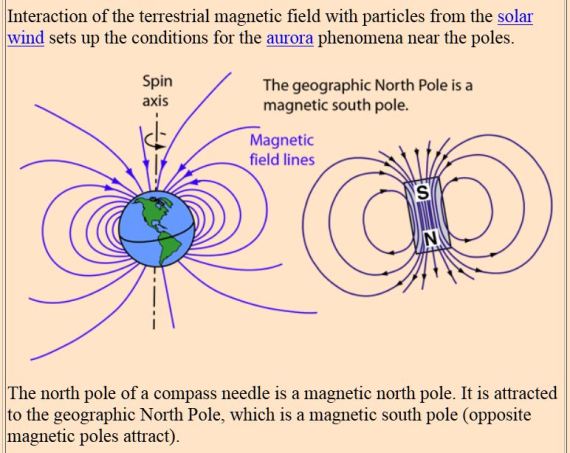
From Magnetic Field of the Earth
Our magnetic field protects us from incoming charged particles — cosmic rays — by deflecting them magnetically. Decrease the field and more cosmic rays come down to the surface. At the zero point of field strength, there’s only atmospheric gas molecules to stop them. In the 1960’s I learned that such charged particles are important causes of genetic changes, i.e. mutations. These protons, etc. come whizzing in from outer space, bang into our DNA molecules, knock a base pair or two around, and if it happens inside a spermatozoa or ova, the animal or plant born with that change is a mutant.
Many such mutations have no physiological affect whatsoever, causing only “genetic drift.” Many others are detrimental — with complex creatures, it’s easier for things to get worse rather than better. A few mutations bring an improvement: possibly the offspring will be stronger, faster, smarter, on any of a million other ways to “improve.” This is where natural selection comes in; the environment weeds out faulty genes and their owners, and — on average — good genes enable their owners to have more offspring. Evolution happens.
In the 1990’s, after his talk at a meeting I asked a geologist: “If huge numbers of incoming cosmic rays during these zero-point magnetic field events cause mutation rates to explode, wouldn’t a lot of animals die — from cancer, say — and greater numbers than usual of beneficial genes appear? Perhaps this has something to do with Gould and Eldredge’s theory of punctuated equilibrium? Nothing much changes for hundreds of thousands of years, then a magnetic pole reversal occurs, and suddenly new species appear and others disappear.”
“Interesting idea,” he said. “Possibly true, but I don’t know how anyone is ever going to be able to test it, or prove it, or disprove it.”
Time moves on, discoveries are made. Apparently we’re getting closer to testing and proving this idea.
ScienceNews.org | Carolyn Gramling | 18 February 2021
A flip-flop of Earth’s magnetic poles between 42,000 and 41,000 years ago briefly but dramatically shrank the magnetic field’s strength — and may have triggered a cascade of environmental crises on Earth, a new study suggests.
With the help of new, precise carbon dating obtained from ancient tree fossils, the researchers correlated shifts in climate patterns, large mammal extinctions and even changes in human behavior just before and during the Laschamps excursion, a brief reversal of the magnetic poles that lasted less than a thousand years. It’s the first study to directly link a magnetic pole reversal to large-scale environmental changes, the team reports in the Feb. 19 Science.
During a reversal, Earth’s protective magnetic field, which shields the planet from a barrage of charged particles streaming from the sun, can lose strength (SN: 1/28/19). So some researchers have suggested that these flip-flops may be linked to extinction events (SN: 11/19/20).

Kauri trees (one shown) have grown in New Zealand for thousands of years. By analyzing tree rings of preserved trees in the Ngawha swampland, scientists identified evidence to suggest a magnetic pole flip around 41,000 years ago.Mark Meredith/Moment/Getty Images
Link to the original article in Science, 19 Feb 2021.
Los Angeles Bird & Garden News
[Posted by Chuck Almdale]
The following is extracted from The Los Angeles Times, Saturday section, 20 February 2021.
The California Native Plant Society has a free and easy online tool to help you plan a native plant garden based on you ZIP Code, sun availability and goals for your yard. Answer a few questions and you’ll get a long list of suggested plants, along with their requirements for water, shade and types of pollinators they attract. https://www.calscape.org/
The camellias are blooming at Descanso Gardens. Now through the end of February is prime bloom time. Descanso has America’s largest collection of camellias, so put your ogling shoes on. Tickets are $15 for non-members, $11 seniors & students, $5 children 5-12, members free. Open 9-5 daily, 1418 Descanso Drive, La Canada Flintridge. https://www.descansogardens.org/
Bird Month at California Botanic Garden includes a chance for visitors to try to identify the many birds who thrive in the state’s largest botanic garden of California native plants (88 acres) at 1500 N. College Ave., Claremont. The contest has prizes to the people who document the most bird species at the garden. Also a scavenger hunt. Open 8-5 Tues-Sunday. Non-members must buy tickets ahead of time online: $10 admission, $6 seniors 65+ & students, $4 children 3-12. All visitors over 2 must wear a face covering. https://www.calbg.org/
February 27, online Zoom class Habitat Gardening for Birds and other Pollinators, led by California Botanic Garden horticulturist Chip Grubbs. This one-hour class focuses on how to turn your garden into habitat attractive to birds, bees and other pollinators, the types of plants to grow and how to care for them. Starts at 11am. $25 fee, $20 for members. https://www.calbg.org/
King tide recap Winter 2020-2021
[Posted by Chuck Almdale, all photos by Larry Loeher except where otherwise noted]
It seems like a good time to recap our winter king tides.
Not much dry beach during the 16 November 2020 king tide

Even less during the 15 December 2020 king tide

Still shrinking as of 13 January 2021 king tide

Some beach still showing as of 11 February 2021 high tide (demoted from king tide),
in addition to the ever-so-slightly higher sand island
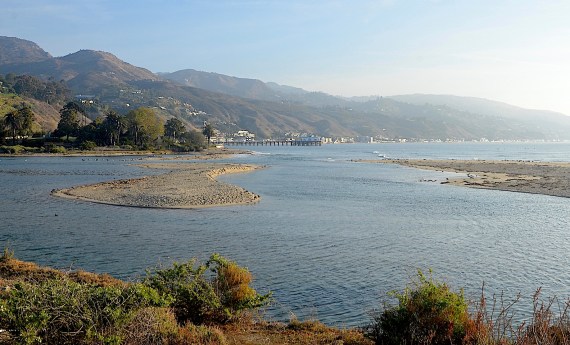
This 11 February 2021 photo shows almost crater-like curvature of opposing shores.
Riffling in the water suggests eddying of the current is taking place.

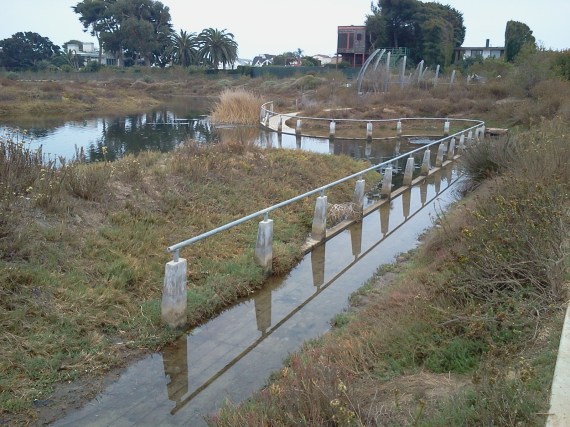
An inundated tidal clock sidewalk measured 6′ 9.6″ lagoon water
level a week after the king tide. (L. Johnson 11-23-20)
A pair of Redheads visited during the November king tide (Grace Murayama 11-16-20)

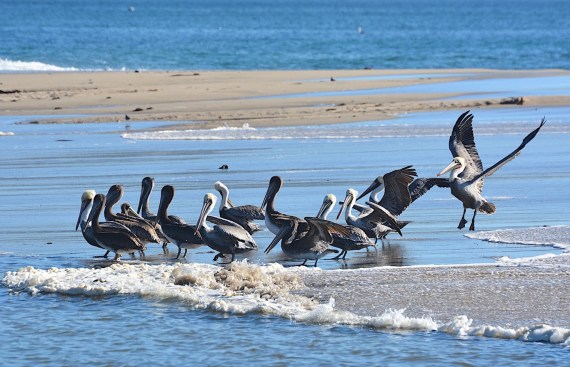
These Brown Pelicans “were bothered at each little wash-up of washover-surf”
according to photographer Larry Loeher during the 11-16-20 king tide.
You never know what might show up. Here’s a beautiful male Hooded Merganser
during the December king tide (Grace Murayama 12-15-20)

This nicely-plumaged male American Wigeon (aka Baldpate)
graced the lagoon during the 1-13-21 king tide.

As did this wing-drying or sun-warming Double-crested Cormorant.

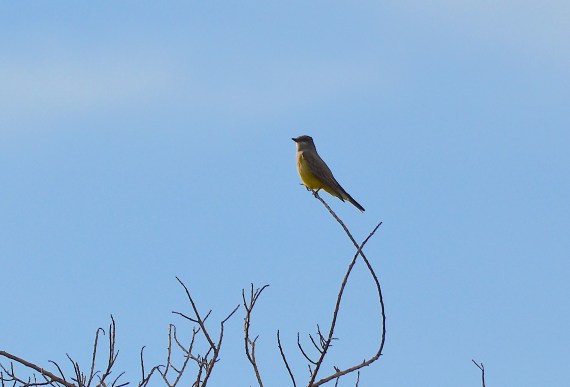
While this distant Cassin’s Kingbird (distinct white chin) waited for a flying fly to fly by.
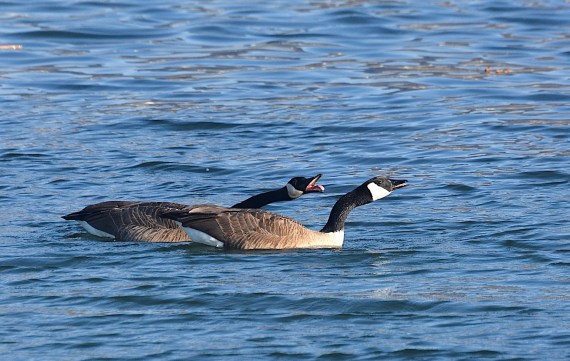
Two Canada Geese a-honking (Grace Murayama 2-11-21)
Two first-winter Heermann’s Gulls during February high tide (Grace Murayama 2-11-21)

The next really high tides will be May 25-27 with the high of 6.67 ft. @ 9:24pm, May 26.
Why were there different king tide dates for northern and southern California?
Southern California experienced King Tides in November and December. There was an additional January King Tide in northern California, north of Point Conception/Vandenberg AFB, due to a combination of astronomical influences such as the relative tilt of the Earth’s rotation with respect to the Sun and seasonal influences on water level such as temperature and wind that differ in southern California as compared to northern California over the course of the year.
An Osprey at Malibu Lagoon
[Posted by Chuck Almdale, photos by Chris Tosdevin]

Osprey has recently replaced the Red-tailed Hawk as the most common raptor at Malibu Lagoon.
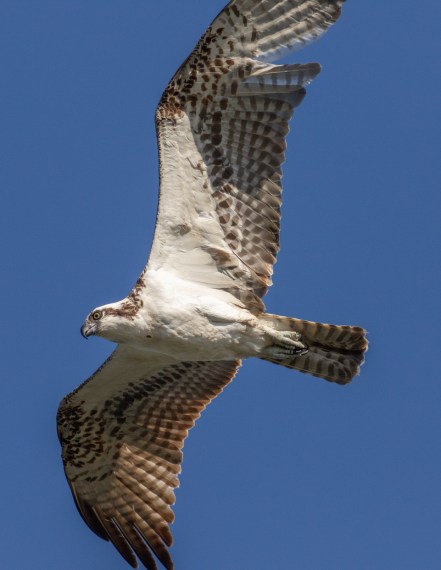
Since I began censusing the lagoon in October 1979 (there are gaps) and through January 2021, I’ve recorded 130 Red-tailed Hawks on 101 occasions, and 84 Osprey on 76 occasions. Red-tailed Hawks appeared one-third more often than Osprey.

But in more recent years, The Osprey has appeared more frequently. Check this chart.
| Osprey | Red-tailed Hawk | |||
| Period | Birds | Appearances | Birds | Appearances |
| 2020 | 5 | 5 | 4 | 2 |
| 2016-20 | 32 | 26 | 19 | 16 |
| 2011-20 | 59 | 52 | 56 | 41 |
| 1979-2020 | 84 | 76 | 130 | 101 |

Other than pure happenstance, the most likely explanation has to do with the greater abundance and reliability of lagoon fish, especially the “Jumping Mullet.” These are big fish relative to the Tidewater Gobies, which are hardly worth bothering with, if you’re an Osprey.

The 2012-2013 reconfiguration of the lagoon which eliminated the three narrow, shallow, nearly-anaerobic channels and greatly increasing the water surface area and depth, made the lagoon much friendlier to Mullet. You can often see them jumping from the water several feet into the air.

Osprey have long been classified into their own family of Padionidae of which they are the only member. There are four subspecies. Discussion occasionally arises concerning splitting Osprey into two or more “good” species, but it doesn’t seem to go very far, partially because the subspecies are very difficult to tell apart.

Osprey eat fish and little else. After they catch them in their talons, they grip them with both feet, one foot in front of the other, and carry the fish head first to reduce wind resistance. They return to a perch or to the ground to eat it, holding it in one or both sets of talons and tear at it with their sharply-pointed, hooked bill.

There has been a lot of recent discussion concerning the changing of birds’ English names to make some people happier. The Osprey’s English name goes a long way back, possibly to the 1300’s when many Latin and Old French words came into English, and has never been accurate. It was previously known as the “Ossifrage,” a term found in some English translations of the Bible. This came from Latin os “bone” + frangere “to break,” to make “bone-breaker.”

The problem with this is that Osprey don’t eat bones; they eat fish. From Choate’s Dictionary of American Bird Names:
The bird the old Romans called ossifragus is not the fish hawk [Osprey]. The ossifragus mentioned by Pliny was the Lammergeier, a German name, which means literally “lamb vulture.” It received its Latin name from its habit of dropping bones and even tortoises from a height in order to fragment their ossified body parts.
The Lammergeier is also known as the Bearded Vulture and is found from Eastern Asia to Southern Africa.

The scientific name is Pandion haliaetus (Linnaeus). According to Jobling’s Dictionary of Scientific Bird Names:
“Pandion comes from Pandion, the King of Attica, whose tragic daughters, Philomela and Procne, were metamorphosed into a nightingale and a swallow respectively.”
Choate gives an extensive description of the Greek myth, which I won’t trouble you with, and ends with Pandion possibly deriving from Greek pan “all” + dio(n) “god.” They both agree on haliaetus: Greek hals (halos) “the sea” + aetos “eagle.”
By any name, the bird loves fish. People often confuse it with that other fish-loving raptor, the Bald Eagle, primarily because they’re both large, have white heads (partially white in the case of the Osprey), are usually found near water and…eat fish!



 SANTA MONICA BAY AUDUBON SOCIETY BLOG