Free email delivery
Please sign up for email delivery in the subscription area to the right.
No salesman will call, at least not from us. Maybe from someone else.
Followup: Jess Morton’s Panama show & Adopta
[Posted by Chuck Almdale]
For those who enjoyed Jess Morton’s program on Panama and would like to help the in-Panama environmental charity he talked about, here’s the information.

The following is an article originally published in Hummin’, the newsletter of the Palos Verdes / South Bay Audubon Society.
A Chucantí Update
By Paul Blieden
In late 2019, Guido Berguido, gave a highly entertaining program for Audubon. He told his story: how a young birder became a passionate conservationist. All he had wanted to do was see all the birds of his native Panama. Then, fifteen years ago, he began taking birders to a remote mountain top in which he had been finding birds never before reported from that part of the country. Each time he went, there was less and less forest to explore. Guido realized that unless something was done, the cloud forest of that sky island, Cerro Chucantí, would disappear—and that it would be up to him to save it.
Chucantí became his life’s work. With no money, but youthful energy and passion, and the will to succeed, Guido has managed to bring funders and conservation-minded people to his side, including Rainforest Trust and our Audubon chapter. Through Adopta, the Panamanian non-profit he created for Chucantí, he acquired the first 1500 acres of what he hopes will become a 50,000-acre national park. He has built a research field station at the edge of his preserve and brought scientists of many disciplines to study the flora and fauna. To date, more than 40 new species [50 as of January 2021] have been found, among them snakes and coffee plants. Many await the funds to describe them formally. And because of the constant threat of illegal logging and burning, Guido has hired rangers to protect the preserve.
Two years ago, Guido led a group of birders on an adventure in Panama that was organized by our treasurer and long term board member Jess Morton. A highlight of the trip was an unforgettable visit to the field station on Chucantí. As a result, our chapter became a strong supporter of Guido’s efforts.
Recently Guido brought us up to date via Zoom from his home, in Gamboa, Panama. He said that to thank us for our critically needed financial help, we would have the honor of naming one of the many new species discovered on Chucantí, a calla lily in the genus Dieffenbachia. The lucky person to name it was drawn by Guido from among the donors to Adopta through PV Audubon. In the drawing, held via Zoom on Saturday, October 3rd, he picked Evi Meyer, a long-time chapter member.
When asked about winning the drawing, Evi said, “Sure. I was happy to hear that I was the winner, but really, the person who is the winner is Jess Morton. Without him we never would have gone to Panama to meet and bird with Guido. Jess was also instrumental in setting up Guido’s visit to Southern California and several of its Audubon chapters to report and inform on Chucanti and Adopta. For all those reasons it was a no-brainer for me to have the flower named after Jess and not myself. It represents a big thank you to Jess for all he does for conservation and our natural environment.”
Publication of this new species will establish its scientific name, a highly important designation. Its known range is limited to the Chucantí Preserve. Thus it is extremely vulnerable, but once named, it will be eligible for the “Critically Endangered” status Guido will be seeking for it. The naming could save a species from extinction!
Wombat poop, cubed | Science News
[Posted by Chuck Almdale]
Just when you thought it was safe to into (out to?) the outback again, the wombats are cubing their poop. What’s next? Making igloos out of them? Skyscrapers? Rabbit-proof fences?
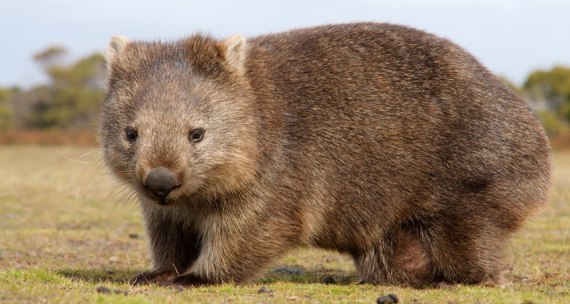
Wombats are the only animals whose poop is a cube. Here’s how they do it.
The elasticity of wombats’ intestines helps to shape their distinctive poops
Science News | Laurel Hamers | Nov 18 2018
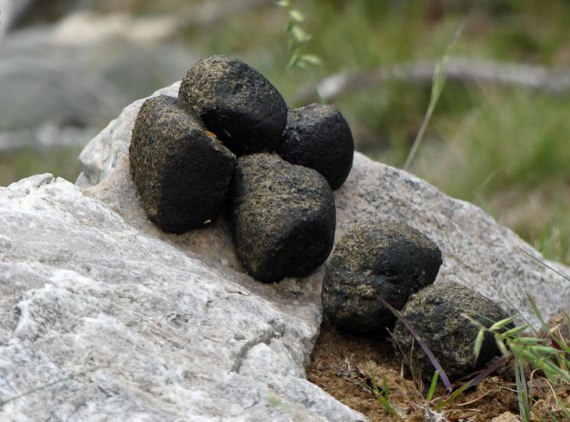
The varied elasticity of the wombat’s intestines helps the marsupials to sculpt their scat into cubelike nuggets, instead of the round pellets, messy piles or tubular coils made by other mammals, researchers reported November 18 at the American Physical Society Division of Fluid Dynamics meeting in Atlanta. More…
Minnesota Bird Songs
[Posted by Chuck Almdale | Suggested by Jane Beseda]
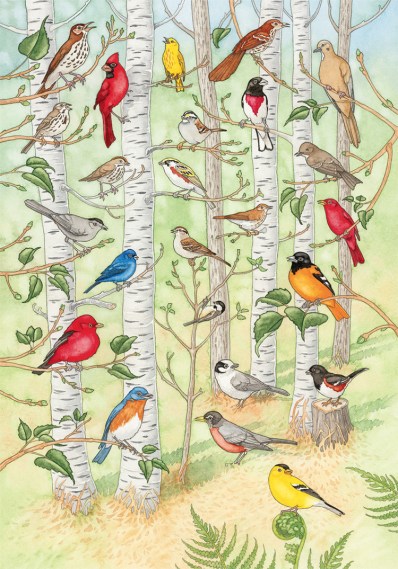
There’s a very cool interactive graphic on this site just like the non-interactive picture to the right, kindly supplied to me by William Stone. Click on a bird and it sings for you. Go and look.
If anyone knows of any other such interactive artwork, send me a link and I’ll post it. I’d especially like to have one for California. The American West always seems to get the short end of the stick when it comes to work like this.
Ballona Freshwater Marsh | Safety Update
[Posted by Chuck Almdale]
We are passing along the following caution to birders and other walkers in the Ballona area.
Hello Birders,
Some of you may be aware that parking, habitat, and safety conditions at the Ballona Freshwater Marsh have deteriorated significantly over the last 8 months or so. I have just been informed that on Tuesday [26 Jan. 2021] a woman who lives in Playa Vista was attacked at the Ballona Freshwater Marsh by three men with knives. She was able to escape and is okay but we don’t know any other details at this time and the men have not been found. The Ballona Wetlands Conservancy is working on measures to increase safety at the marsh. The marsh has not been very safe for some time now, but this confirmed attack pushes us to ask you to not visit the marsh for the time being. Your safety is very important to us. Please spread the word to any other birders that visit the marsh and are not on this email list. If they want to be added to this list for updates, please send me their email address. I will let you know of any new information I receive.
Best wishes during these troubled times,
Neysa Frechette
Manager of Scientific Programs
Friends of Ballona
Lisa Fimiani, long-term board member of Friends of Ballona and maven of all things Ballona, gave me some clarification, which I pass along to you with her consent.
“We have a very serious problem at the Ballona Freshwater Marsh with people who have taken up residence in their RV’s, cars, buses along Jefferson Boulevard; and some of them are not very nice people. The situation has escalated with more and more people crowding into the few parking spots left, so if you go there to bird you basically cannot find a parking spot on Jefferson. We’ve been battling this for over a year, long before the COVID-19 pandemic hit. The City has been absolutely useless in this situation – claiming they cannot force people to move due to COVID-19 restrictions. We’ve tried getting the City to put up NO OVERNIGHT PARKING signs, but the City won’t enforce them. Meanwhile, some of these “service resistant” folks have been cutting bushes and trees down for firewood, snagging wildlife with fishing lines, [going to the bathroom] everywhere, dumping unbelievable amounts of garbage, and basically running roughshod over our beloved Freshwater Marsh. I’m so angry I can barely speak about this, and the Marsh Manager, Edith Read, is beside herself (she’s copied). Her crew has had to deal with this mess, as well as the Ballona Wetlands Conservancy, who have been forced to hire HAZMAT crews and now security to patrol the area.
If you know anyone high up in government who can help, please reach out.”
There you have it. Be careful out there. And if you have any pull, push or twist with local government, feel free to use it.
The Bird Way, by Jennifer Ackerman | Book Review
By Femi Faminu
[Posted by Chuck Almdale]
During a casual conversation about notable books, my mention of a book by Jennifer Ackerman that I was reading at the time was deftly turned by Chuck Almdale into my writing a review of the book.

My introduction to Jennifer Ackerman was through another book of hers, Chance in the House of Fate: A natural history of heredity, which explores the influence of genetics in human behavior and her new book The Bird Way; A new look at how birds talk, work, play, parent, and think is written in a similar meandering yet logical style. Ackerman tackles several topics while seeking an understanding of life from the perspective of the birds themselves, drilling the answers down to the minutia of DNA and then taking a few steps back to view the same question from other angles.
Several of my questions as an amateur birder are addressed, for instance, do female passerines sing? Well, the short answer is, for various reasons, yes and no. And while we’re at it, vocalization is not limited to song, but bird language in both sexes includes calls, mimicry, gongs, whispers, chuckles, trumpeting and caroling at all times of day and night for myriad reasons. Get the picture?
Her answers to an initial question sometimes lead to more questions. Rather than providing simplified answers, Ackerman spends most of the book describing the wonders of Avian life, drawing parallels with humans and explaining how we differ. For instance, why they see colors we cannot and how some have a visual acuity that exceeds ours by such a significant degree that it is difficult to imagine.
Ultimately not all mysteries are solved, because the truth is, we just don’t know how birds perform a lot of the feats they do. I was still left with a deeper sense of wonder and appreciation for our feathered friends. Although we still don’t understand a lot of how or why birds do what they do, this should not reduce our enjoyment of their company, but rather make them appear more wondrous.



