Free email delivery
Please sign up for email delivery in the subscription area to the right.
No salesman will call, at least not from us. Maybe from someone else.
Low Water at Malibu Lagoon, 28 Dec. 2025
[By Chuck Almdale; photos by Marie Barnidge-McIntyre, Femi Faminu, Ray Juncosa & Armando Martinez]
Getting to and from Malibu Lagoon is sometimes tricky. I usually take the 405 to the 101 through San Fernando Valley to Las Virgenes Rd. and over the hills to Pacific Coast Hwy (PCH), but several traffic websites informed me that Las Virgenes Rd. no longer existed and I must take the 405 to the 10 to PCH to get there. One site acknowledged its continued existence but claimed road closure. The two routes are virtually the same distance but the latter is much slower due to the 25 MPH reconstruction zones resulting from our massive “fire event” last January, and less vegetated. Our roadways are partially funded by traffic ticket sales, so speeding citations are eagerly distributed and I know people who’ve been ticketed exceeding 25 MPH on PCH. I poked along at exactly 25 mph (three cheers for cruise control!) for what seemed like hours while everyone else ripped past me, blowing their horns or shaking their fists. Not a cop or road worker in sight the entire distance. Of course it was 7:30 am on a Sunday and everyone except birders were asleep, or in church, or both.
Even so, I arrived early. I headed up past the first lookout point and under the PCH bridge to look for diving birds in the deep water. Sure enough, Grebes, Coots, Buffleheads and Ruddy Ducks, plus a male Belted Kingfisher who was resting in a tree. The water was very low and I nearly got stuck in the exposed mud while exploring new routes.
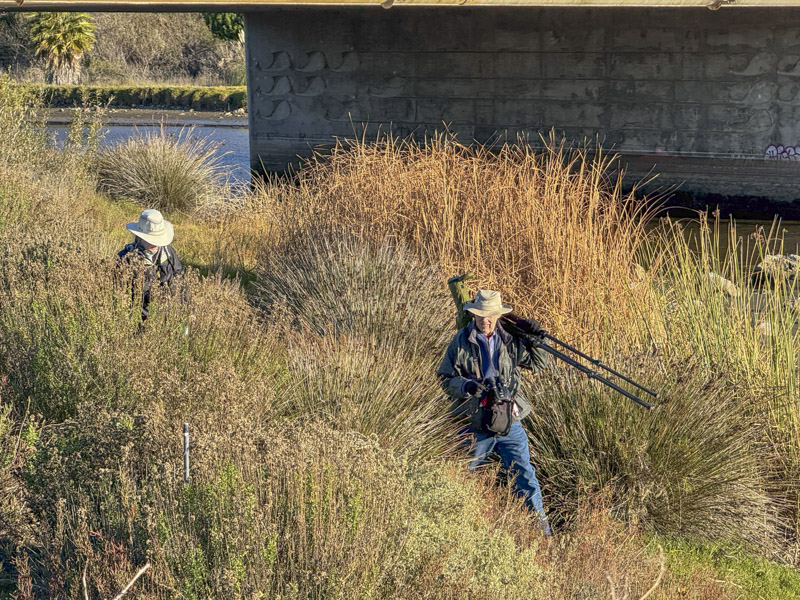
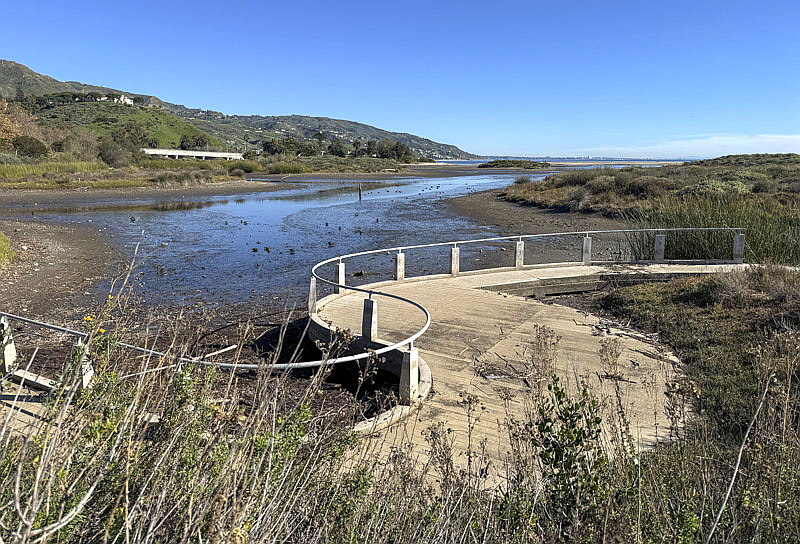
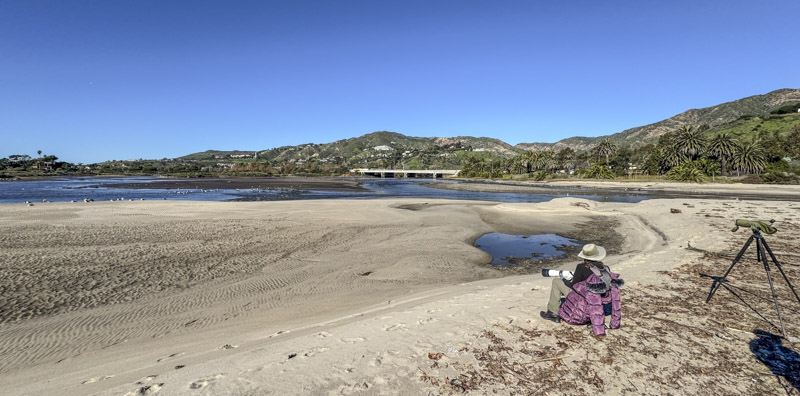
On my way back I bumped into Marie, sent to hunt me down and get the trip started. I later asked if her legs were stabbed by the prickly bushes (see above photo). “Yes,” she said, succinctly. “Of course!” she undoubtedly thought.
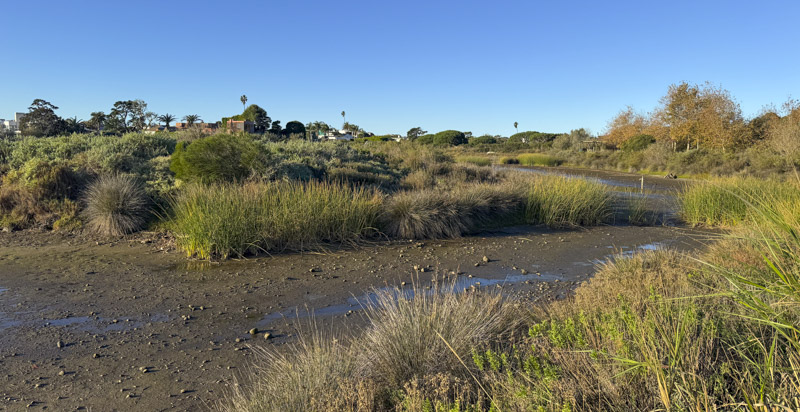
The lagoon water level was very low. “I’ve never seen it this low!” someone always exclaims during these events, never the same person twice. Actually, sea level was not particularly low, moving from the high of +4.81 ft @ 3:38am to the low of +1.35 ft @ 10:47am. But the rains had carved out a nice channel through the beach and every drop of lagoon and creek water that could run out was running out. This created a strong current under the PCH bridge and the Mallards and Coots were enjoying ‘shooting the rapids’ backwards.
Our lowest low tides of the year are negative, for example:
Six days of negative tides centered on the 20 Nov. low of -0.32 ft
Seven negative lows centered on the 5 Dec. low of -1.68 ft
Nine negative lows centered on the 3 Jan 2026 low of -1.80 ft
Nine negative lows centered on the 18 Jan low of -0.91 ft
Eight negative lows centered on the 31 Jan low of -1.65 ft.
Even June has negative tides: nine negative lows centered on 15 June low of -1.80 ft. But when the lagoon outlet is closed, as it usually is in summer, the lagoon fills up from the creek. The ocean tides then become irrelevant. [Tide chart link]
As usual, a few gulls, cormorants, coots, plovers and ducks were gathered near the first viewpoint next to the PCH bridge. For the second month running a single American Herring Gull was occupying the same spot at the southern end of the nearby gull flock.
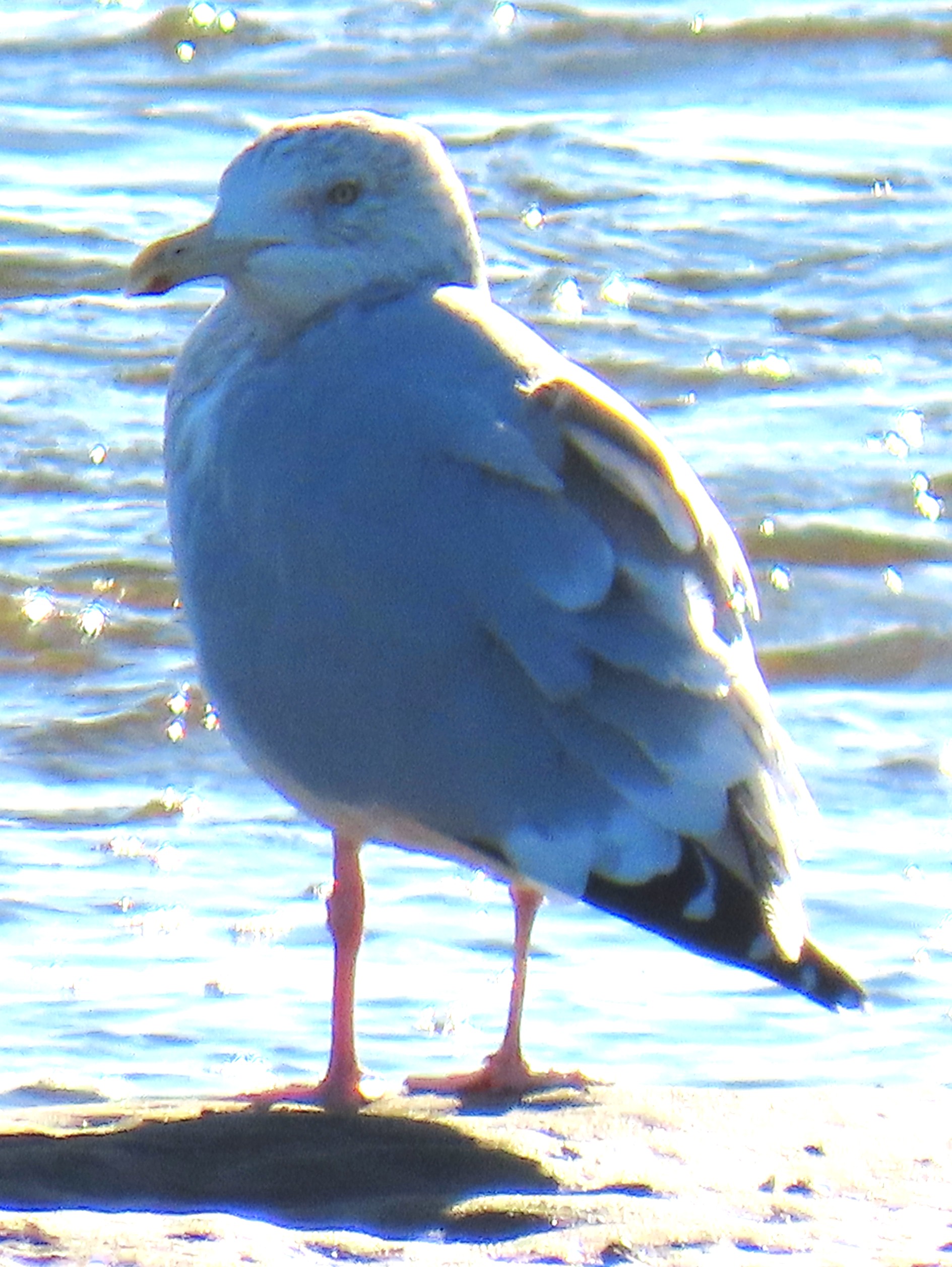
(Marie Barnidge-McIntyre 12-28-25)
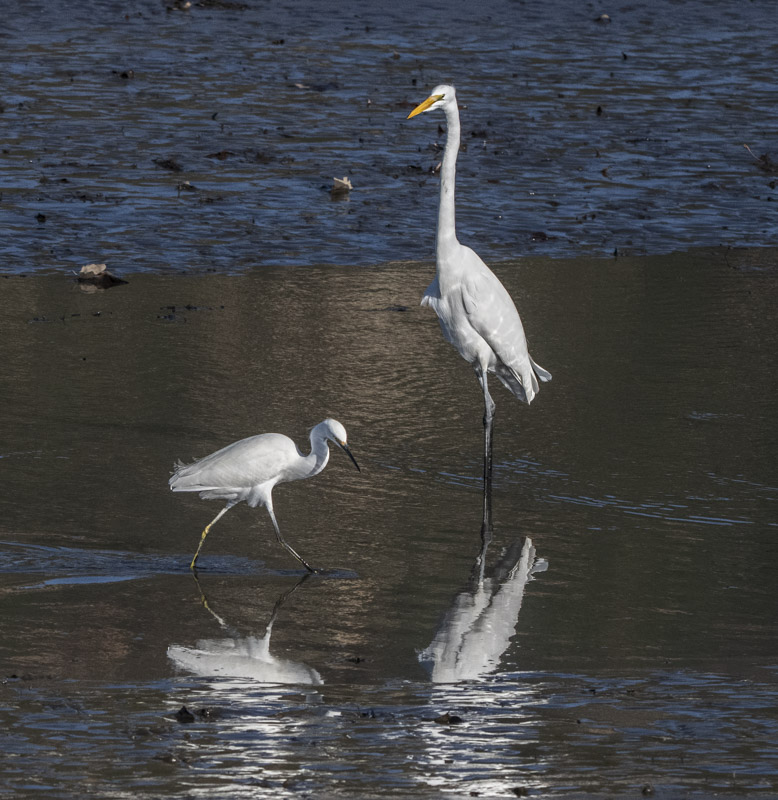
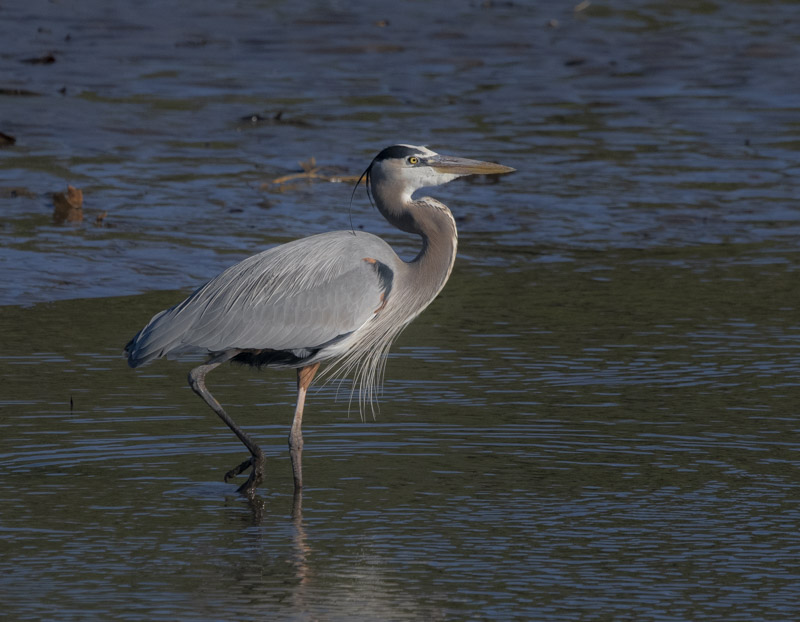
Here’s a short gallery of our longer-billed birds.
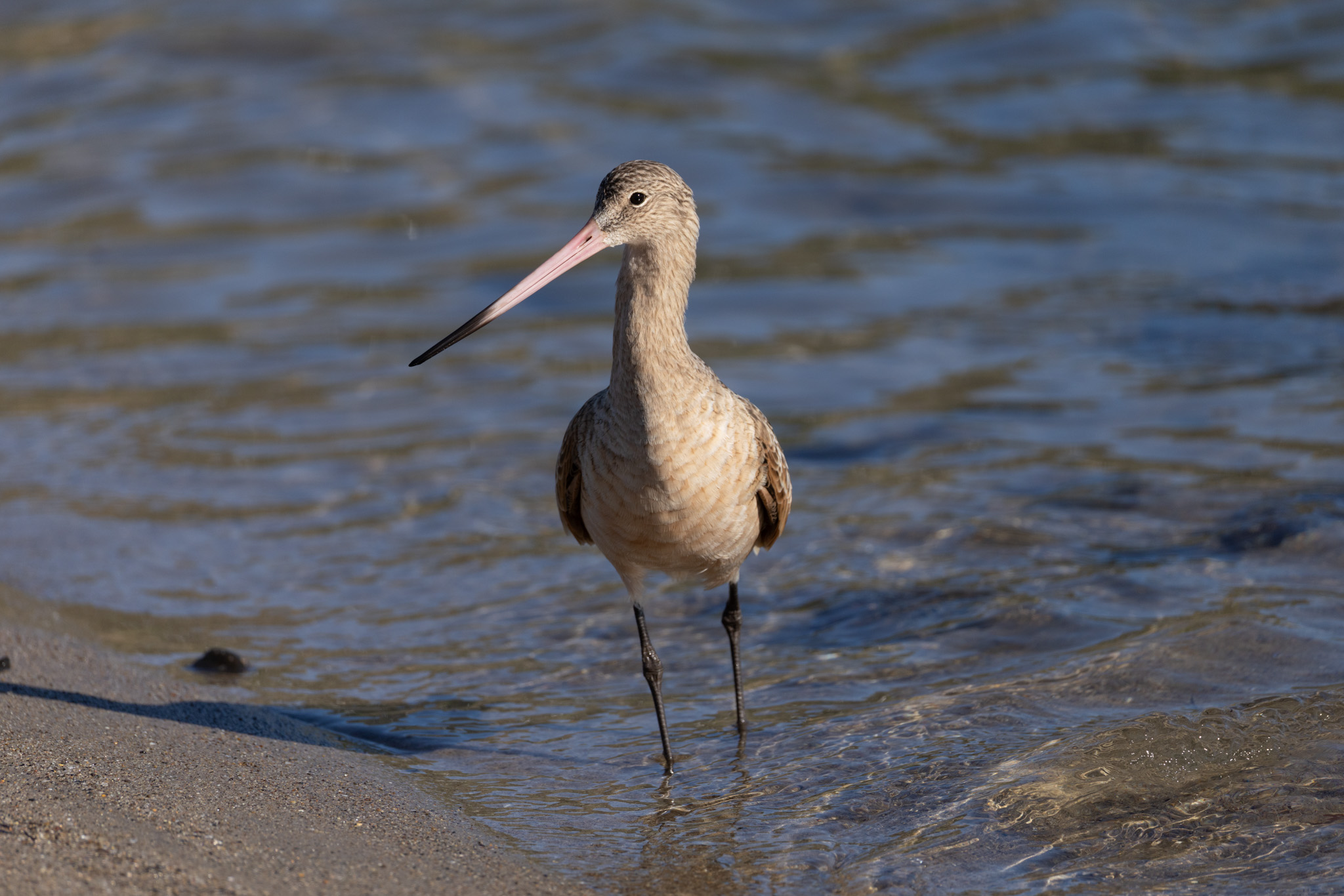
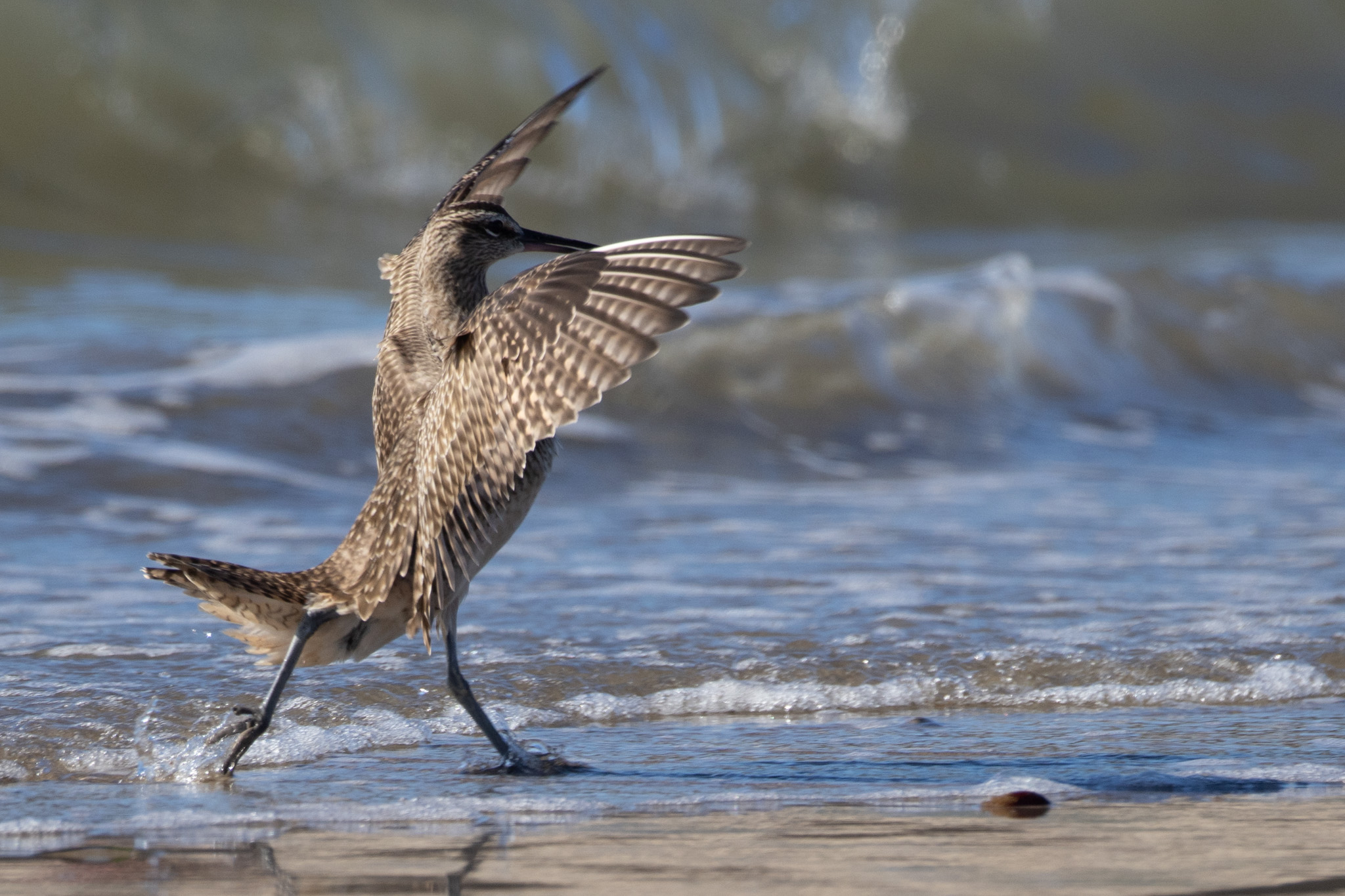
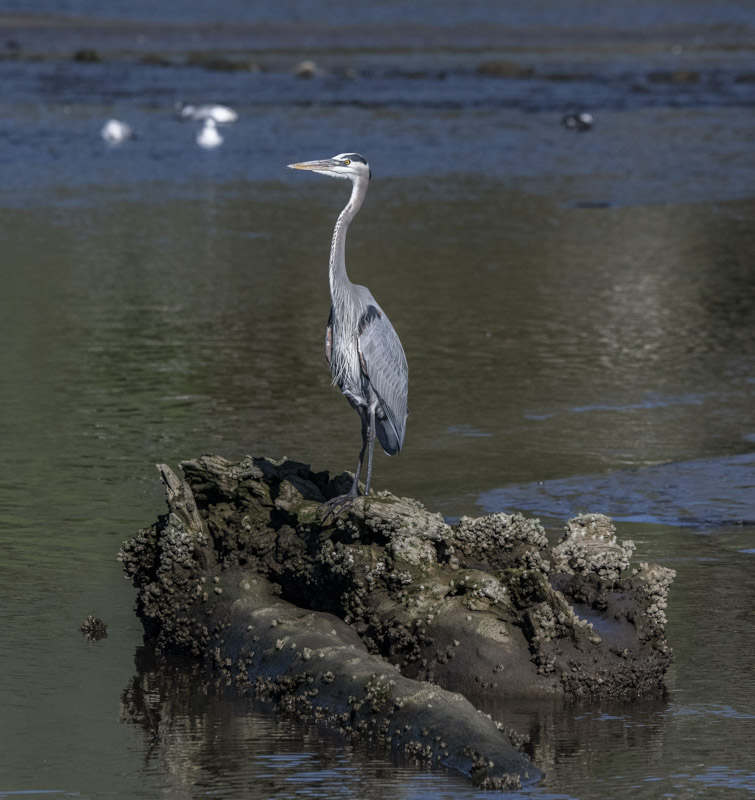
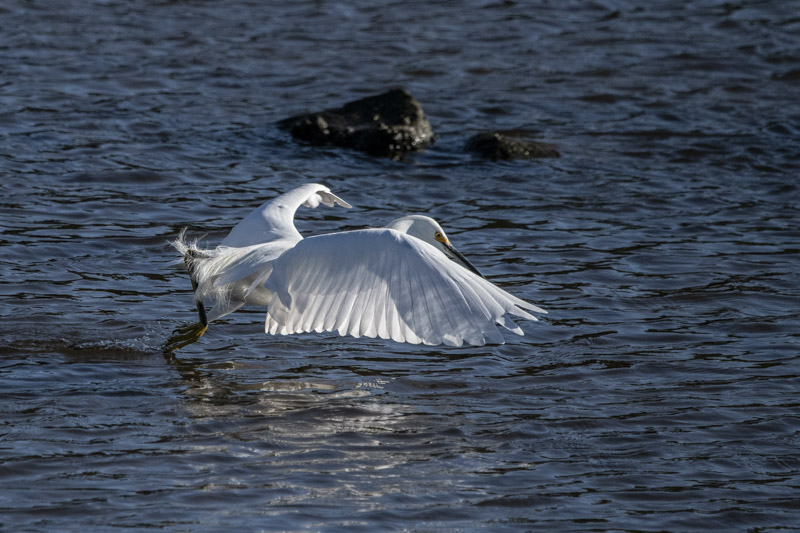
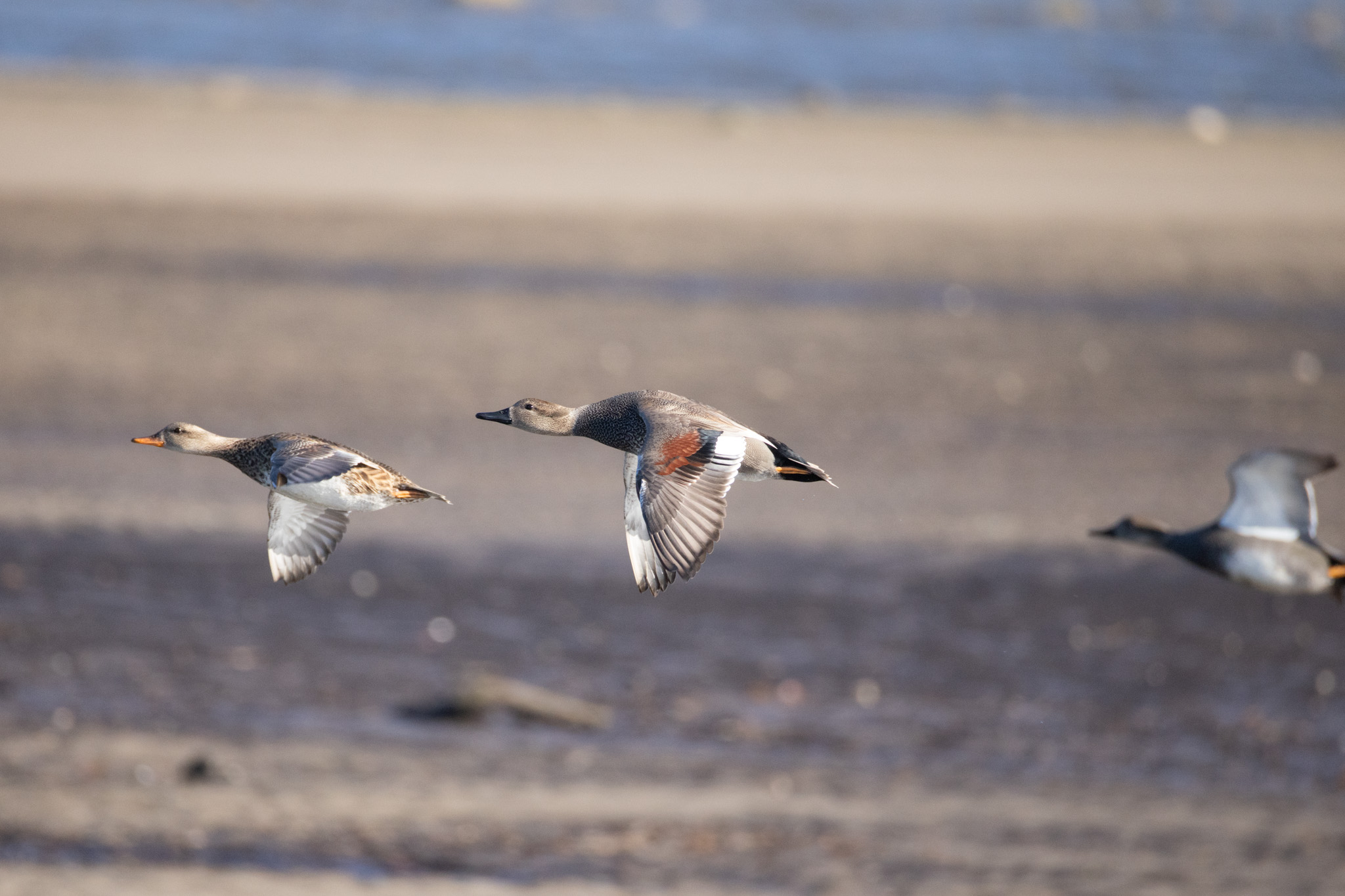
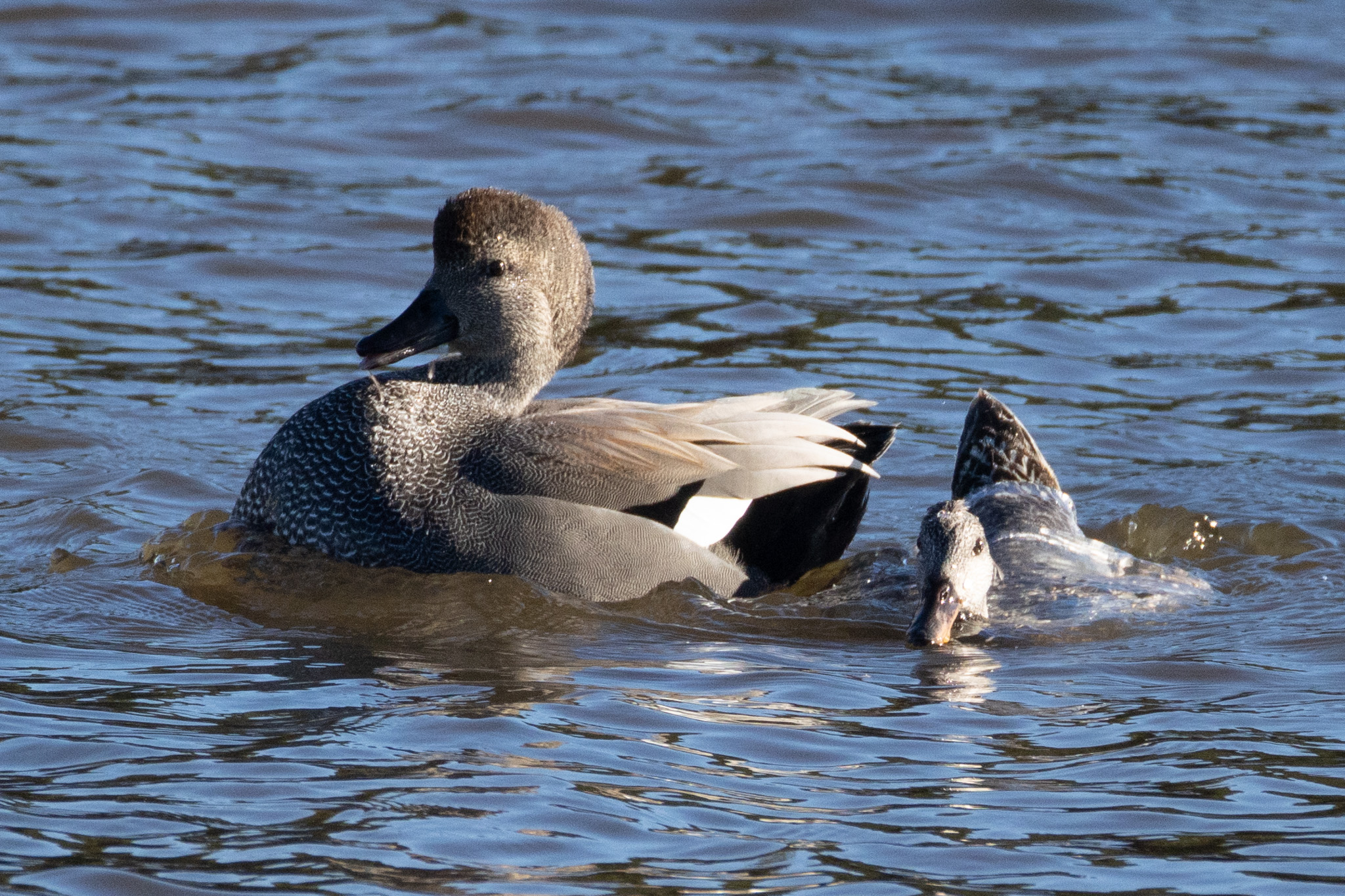
And some energetic Gadwalls. You rarely get to see the lovely chestnut in the upperwing secondary coverts, These feathers are hidden when they’re on the ground, and hard to see on a wildly flapping wing.
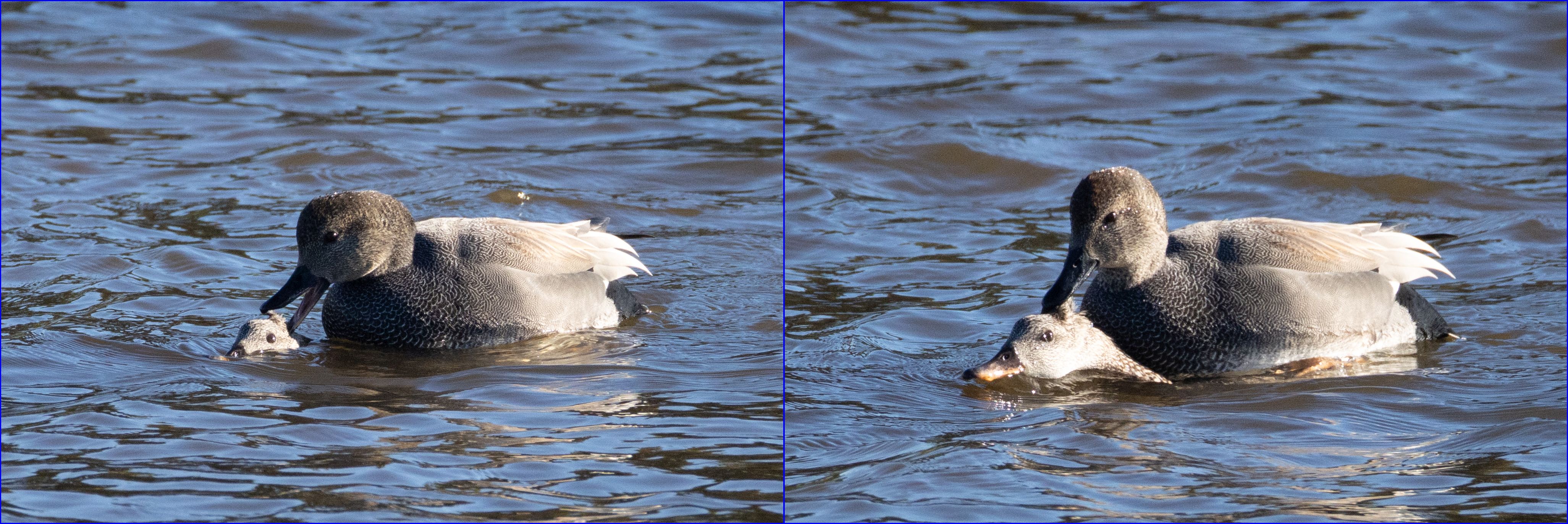
Once landed, you never know what they’ll get up to.
At the west end of the channels, the ducks were more wading than swimming.
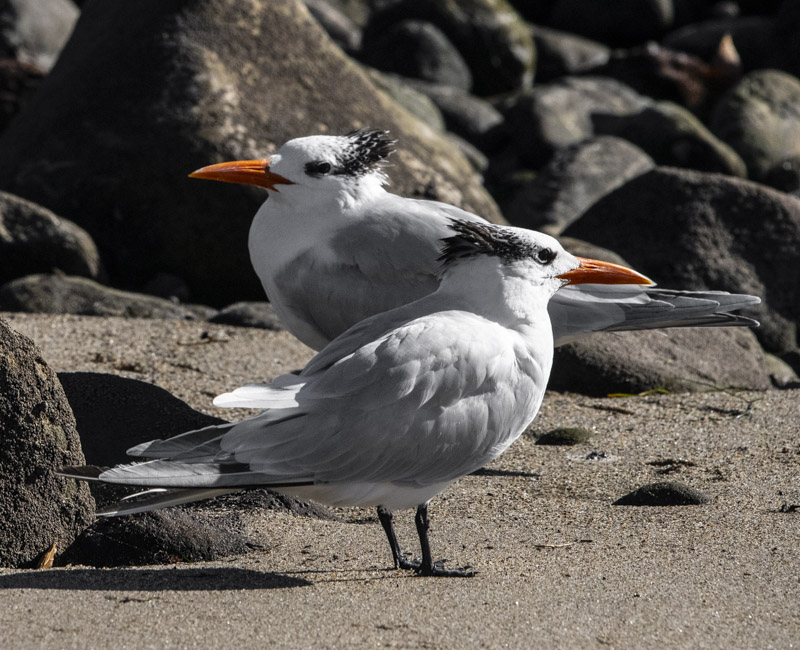
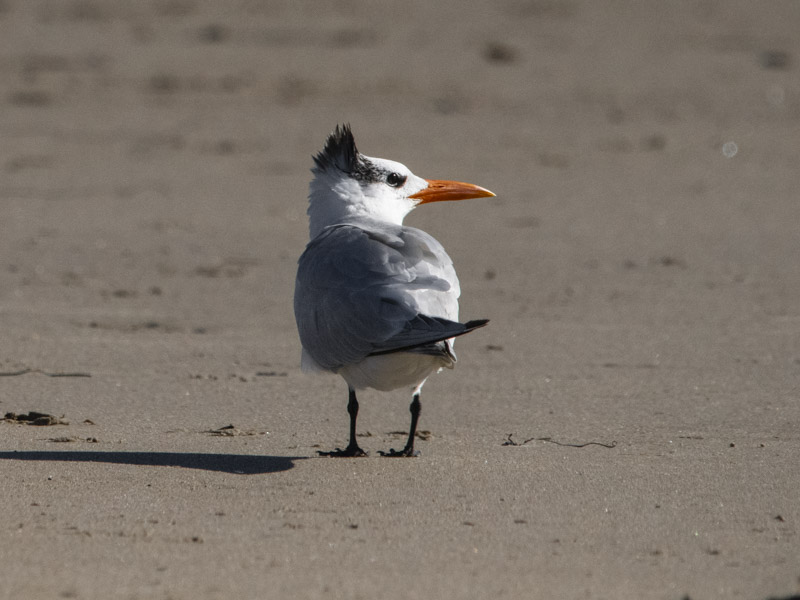
Down by the sea’s edge the usually hidden rocky reefs were exposed. As the sea level dropped, more and more gulls and shorebirds were attracted to them, including this small flock of Royal Terns. Their crown feathers are erectable, and a variety of positions are shown below. Their bills are generally orange, but can vary from deep orange/near red, to dull yellow-orange. If you look closely at the bill underside, some of them show a very small ‘gonydeal angle.’ The confusingly similar Elegant Tern never has this angle.
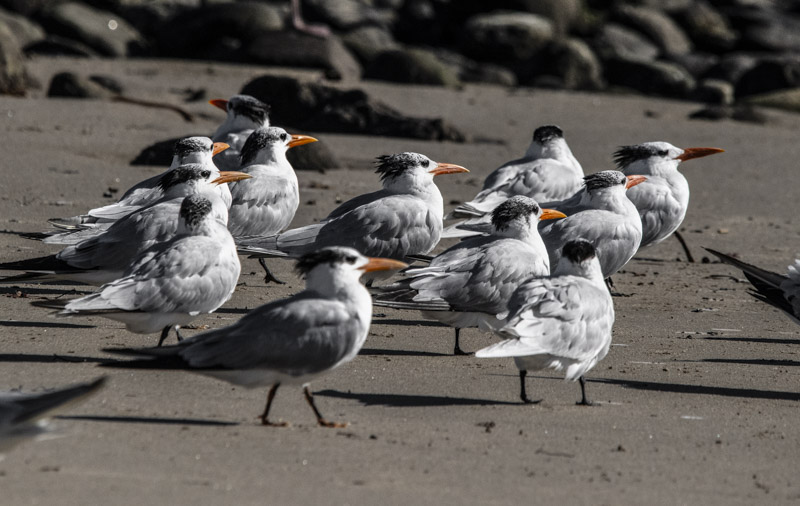
Something is definitely happening thataway.
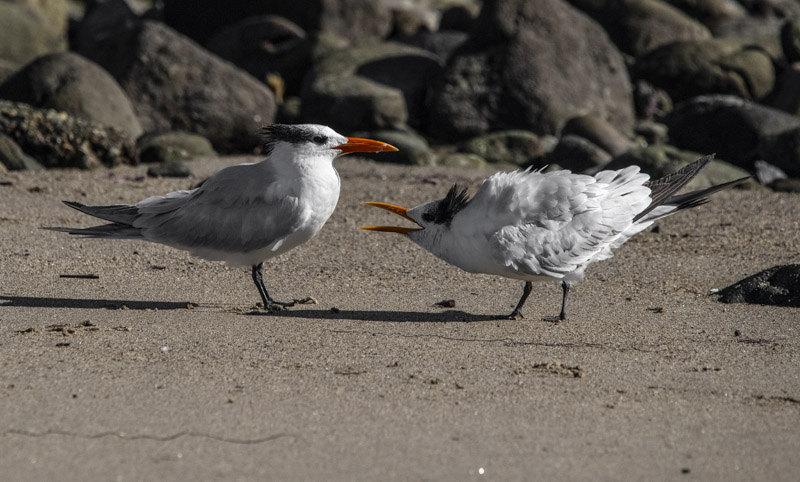
We’ve had discussions about the behavior shown below, whether it’s a young bird begging for food, or a courtship element where one bird elicits food-bringing behavior from the other to see if they respond properly and thus might make a good mate. The all-knowing Google AI informed me that: “Juveniles stay with their parents for months after fledging, migrating and continuing to beg for fish into winter, sometimes even into late winter or early spring, a behavior seen in Florida and other coastal areas.” This sounds right to me, particularly as December is really early to be doing courtship rituals, but not all that late to be pestering one’s parents for handouts (billouts?) What?…You thought it was only humans that had this problem?
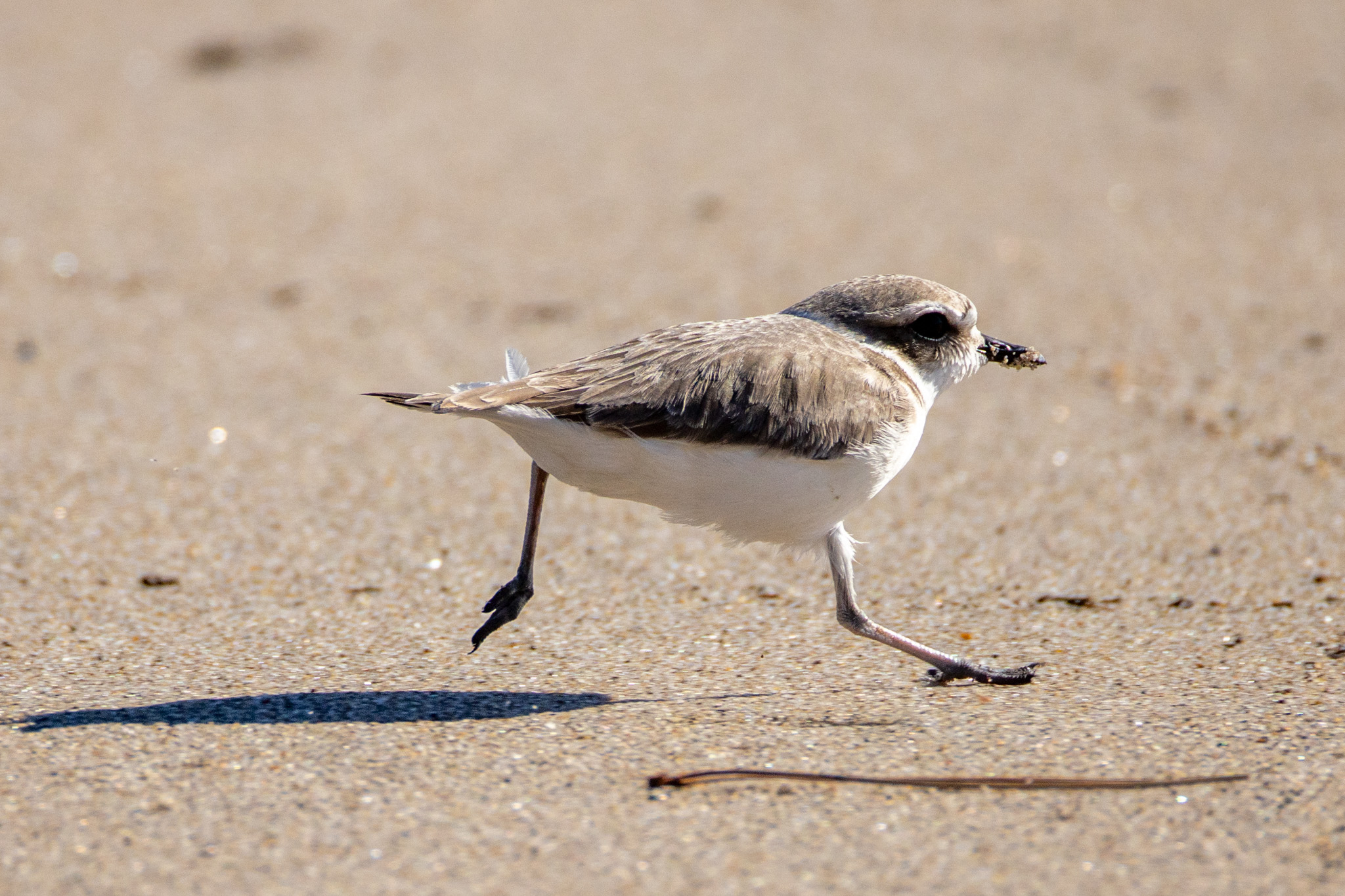
The water had gone so far out that it was about 50 yards from the wrack line of rotting sea vegetation on the sand to the rocks by the water’s edge. Western Snowy Plovers usually display a rather intermittent manner of walking, but this one took off at full speed over this entire stretch of sand. I think it felt exposed on the featureless flat surface and was wary of danger from above. It’s the farthest I’ve ever seen one run nonstop.
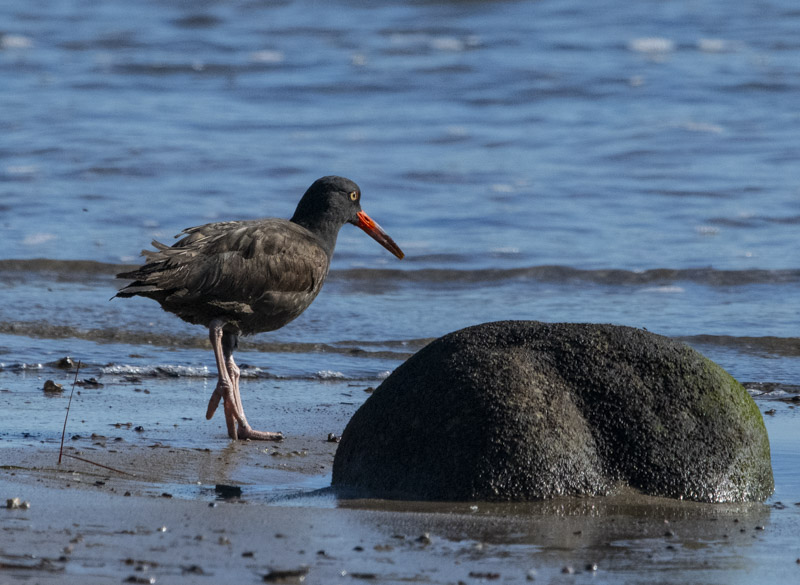
Four days later at an even lower tide, SMBAS member Lu Plauzoles had six Black Oystercatchers. We’ve never had more than five (once) on our lagoon trips, and and have had four birds five times. Most sightings (61 birds in 29 sightings) are singletons.
While searching through the rocky reefs for interesting birds I managed to completely miss this gull in the lagoon. What do you think it is? Look closely at plumage and bill.
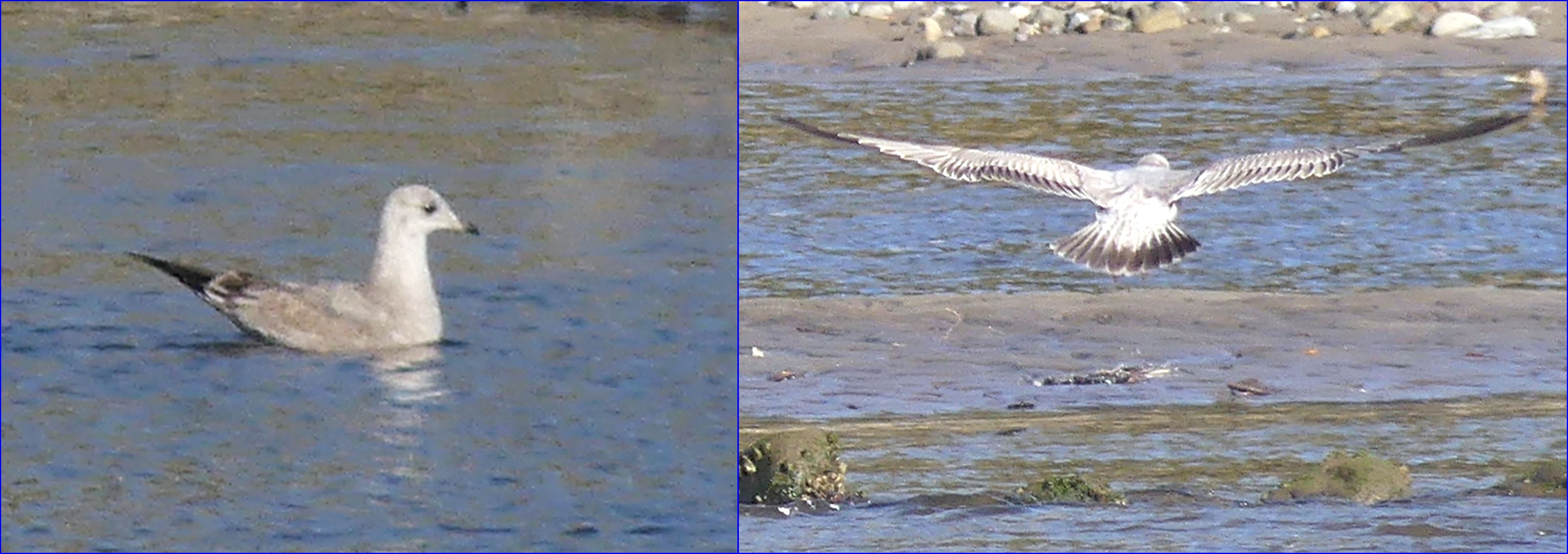
Not to hold the suspense too long, it’s a Short-billed Gull Larus brachyrhynchus. When I began birding, and until recently (as in the NGS bird field guide 6th edition, 2011) it was a Mew Gull Larus canus, and considered a subspecies of the European Common Gull Larus canus. I’ve also heard Small-billed and Little-billed bandied about, just to add extra confusion.
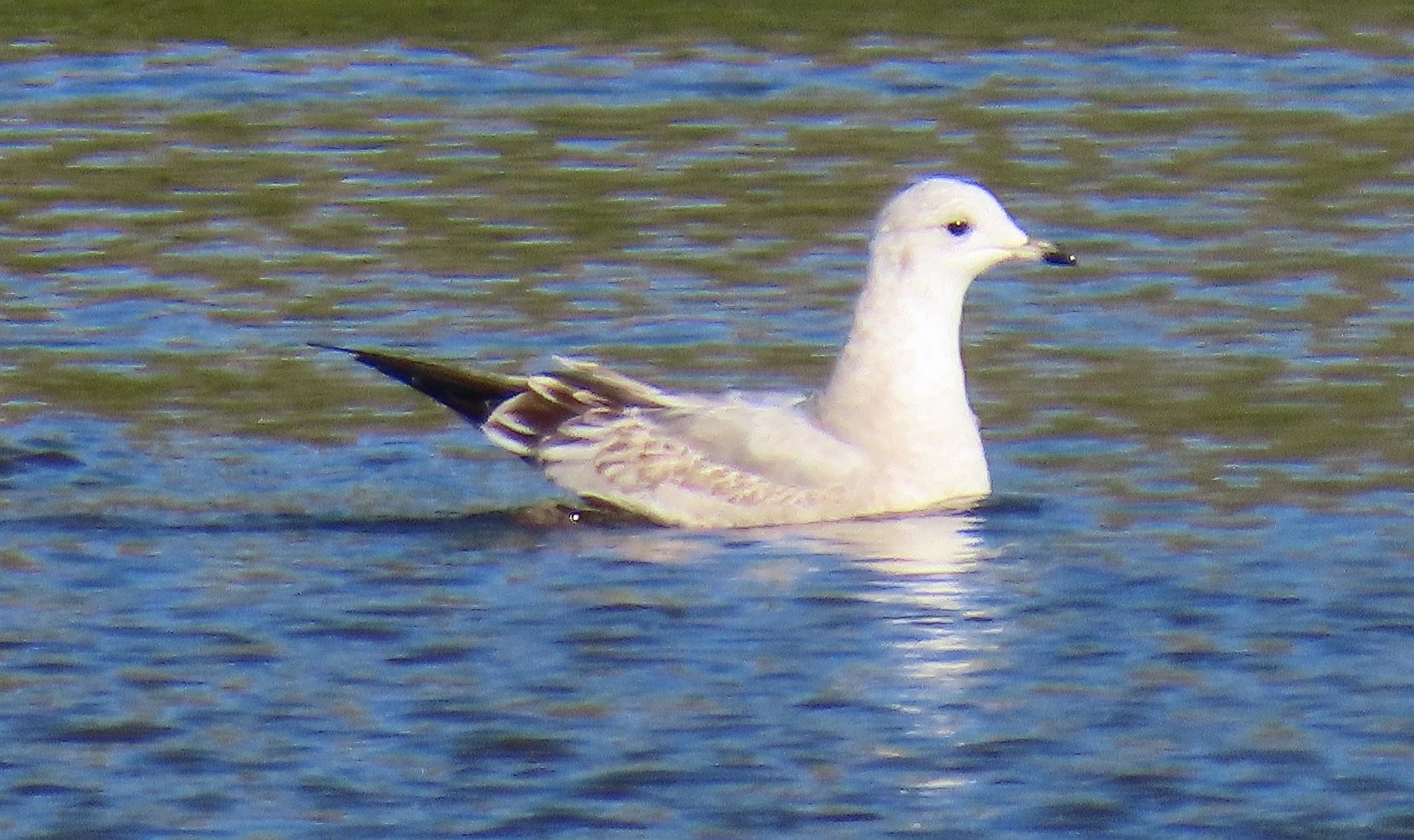
Some taxonomic history:
The species was first described by Scottish naturalist John Richardson in 1831 as the “short-billed mew gull”, Larus brachyrhynchus. Since 1931 the AOU and some other authorities have considered brachyrhynchus to be a subspecies of Common Gull Larus canus, described in 1758 by Carl Linnaeus; other authorities recognized them as distinct species. In 2021 the AOS agreed to split them based on differences in genetics, plumage, morphology and vocalizations. Though “Mew Gull” was long used for L. canus brachyrhynchus by North Americans, “Short-billed Gull” was chosen at the new name because “Mew Gull” had been used in recent literature to denote all forms of L. canus, plus the fact that “Short-billed Gull” was previously used in older AOS/AOU checklists since 1886. The word ‘mew’ comes from Old English “meaw” and Dutch “meeuw,” both meaning ‘gull’ but initially imitative of the bird’s cry. They were also called “sea-mew,” essentially meaning “gull gull.” — mostly Wikipedia
They’re not terrifically common in SoCal. The sheet below shows their appearances on our field trips Oct’79 – Dec’25; 106 birds on 43 visits, present mostly Oct-Mar.
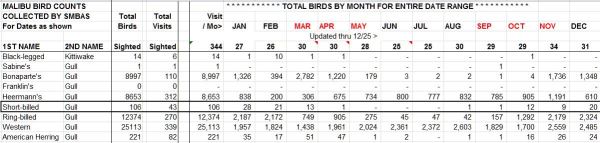
But over the past 25 years (2001-2025) there has been only 26 birds in 23 visits, and the past 5 years (2021-2025) has brought only 3 birds in 3 visits. Unlike the millions of Common Gulls mewing merrily away all over Europe, the Short-billed has never been common in SoCal.
Historically, nearly all the (now) Short-billed Gulls I’ve seen in SoCal were at two locations: the Ventura Wastewater Service plant on Spinnaker Drive on the south side of Ventura Harbor; Dockweiler Beach in front of the Hyperion Sewage Treatment Plant on Vista del Mar south of Playa del Rey. Several decades ago they were easily located at the Ventura Plant, just look for the huge round charcoal filtration tubs; dozens to hundreds of the gulls were always sitting on the slowly rotating spray arms, going round and round and round. Unfortunately (for gulls and birders looking for them) the plant roofed over their spray tubs and the birds moved elsewhere, some to the beach, some to the settlement ponds. On Dockweiler Beach, they gathered on the sand directly in front of the plant on what was probably the point of land closest to the ocean end of the plant’s outfall tube.
There’s something about sewage that really attracts these gulls.
Malibu Lagoon on eBird as of 12-31-25: 9037 lists, 2921 eBirders, 322 species
Most recent new species seen: Nelson’s Sparrow, 11/29/24 by Femi Faminu (SMBAS member). When the newest species added to the list was seen on a date prior to the most recently seen new species, there is no way I can find to easily determine what that bird is. Another minor nit to pick about eBird.
Birds new for the season: Northern Shoveler, American Wigeon, Green-winged Teal, Feral Pigeon, Spotted Sandpiper, Short-billed Gull, Horned Grebe, American Goldfinch, Savannah Sparrow. “New for the season” means it has been three or more months since last recorded on our trips.
Many, many thanks to photographers Marie Barnidge-McIntyre, Femi Faminu, Ray Juncosa, and Armando Martinez.
Upcoming SMBAS scheduled field trips; no reservations or Covid card necessary unless specifically mentioned:
- Bette Davis-Riverwalk or Veteran’s Park, Sat. Jan 10, 8 am
- Malibu Lagoon, Sun. Jan. 25, 8:30 (adults) & 10 am (parents & kids)
- These and any other trips we announce for the foreseeable future will depend upon expected status of the Covid/flu/etc. pandemic, not to mention landslides, fires, local flooding and atmospheric rivers at trip time. Any trip announced may be canceled shortly before trip date if it seems necessary. By now any other comments should be superfluous.
- Link to Programs & Field Trip schedule.
The next SMBAS Zoom program: Tuesday, February 3, 7:30pm; to be announced.
The SMBAS 10 a.m. Parent’s & Kids Birdwalk has again resumed. Reservations not necessary for families, but for groups (scouts, etc.), call Jean (213-522-0062).
Links: Unusual birds at Malibu Lagoon
9/23/02 Aerial photo of Malibu Lagoon
More recent aerial photo
Prior checklists:
2025: Jan-June
2023: Jan-June, July-Dec 2024: Jan-June, July-Dec
2021: Jan-July, July-Dec 2022: Jan-June, July-Dec
2020: Jan-July, July-Dec 2019: Jan-June, July-Dec
2018: Jan-June, July-Dec 2017: Jan-June, July-Dec
2016: Jan-June, July-Dec 2015: Jan-May, July-Dec
2014: Jan-July, July-Dec 2013: Jan-June, July-Dec
2012: Jan-June, July-Dec 2011: Jan-June, July-Dec
2010: Jan-June, July-Dec 2009: Jan-June, July-Dec
The 10-year comparison summaries created during the Lagoon Reconfiguration Project period, remain available—despite numerous complaints—on our Lagoon Project Bird Census Page. Very briefly summarized, the results unexpectedly indicate that avian species diversification and numbers improved slightly during the restoration period June’12-June’14.
Many thanks to Marie Barnidge-McIntyre, Femi Faminu, Chris Lord, Armando Martinez, Chris & Ruth Tosdevin andothers for contributions made to this month’s census counts.
The species list below was re-sequenced as of 12/31/24 to agree with the California Bird Records Committee Official California Checklist, mostly. If part of the right side of the chart below is hidden, there’s a slider button inconveniently located at the bottom end of the list. The numbers 1-9 left of the species names are keyed to the nine categories of birds at the bottom. Updated lagoon bird check lists can be downloaded here.
[Chuck Almdale]
| Malibu Census 2025 | 7/27 | 8/24 | 9/28 | 10/26 | 11/23 | 12/28 | |
| Temperature | 64-70 | 68-75 | 65-69 | 58-65 | 59-65 | 60-69 | |
| Tide Lo/Hi Height | L-0.46 | H+4.74 | H+4.54 | H+5.02 | H+5.46 | L+1.35 | |
| Tide Time | 0605 | 1102 | 1244 | 1125 | 0939 | 1047 | |
| 1 | Brant (Black) | 1 | 1 | ||||
| 1 | Canada Goose | 1 | 12 | 14 | |||
| 1 | Northern Shoveler | 4 | |||||
| 1 | Gadwall | 20 | 19 | 6 | 14 | 20 | |
| 1 | American Wigeon | 15 | |||||
| 1 | Mallard | 40 | 14 | 7 | 26 | 1 | 12 |
| 1 | Green-winged Teal | 5 | |||||
| 1 | Ring-necked Duck | 1 | |||||
| 1 | Surf Scoter | 10 | 2 | 22 | 4 | ||
| 1 | Bufflehead | 4 | 4 | ||||
| 1 | Red-breasted Merganser | 1 | 2 | 5 | |||
| 1 | Ruddy Duck | 19 | 1 | 5 | 11 | ||
| 2 | Feral Pigeon | 5 | 4 | 6 | 5 | ||
| 2 | Mourning Dove | 2 | 2 | 3 | 1 | 1 | |
| 2 | Anna’s Hummingbird | 1 | 1 | 2 | 3 | ||
| 2 | Allen’s Hummingbird | 4 | 4 | 4 | 5 | 4 | 3 |
| 3 | Sora | 1 | 1 | ||||
| 3 | American Coot | 6 | 4 | 31 | 4 | 25 | 25 |
| 4 | Black Oystercatcher | 1 | 1 | ||||
| 4 | Black-bellied Plover | 21 | 49 | 55 | 88 | 64 | 62 |
| 4 | Killdeer | 4 | 9 | 1 | 8 | 10 | 4 |
| 4 | Semipalmated Plover | 4 | 1 | ||||
| 4 | Snowy Plover | 13 | 17 | 35 | 40 | 40 | 7 |
| 4 | Hudsonian Whimbrel | 1 | 12 | 3 | 14 | 8 | 4 |
| 4 | Marbled Godwit | 21 | 8 | 10 | |||
| 4 | Wilson’s Phalarope | 1 | |||||
| 4 | Spotted Sandpiper | 1 | |||||
| 4 | Willet | 10 | 14 | 20 | 7 | ||
| 4 | Ruddy Turnstone | 3 | 1 | 3 | 6 | 4 | 3 |
| 4 | Sanderling | 1 | 13 | 23 | 14 | ||
| 4 | Dunlin | 2 | 1 | ||||
| 4 | Least Sandpiper | 10 | 4 | 6 | 12 | 6 | 10 |
| 4 | Western Sandpiper | 4 | 14 | 1 | 2 | ||
| 5 | Sabine’s Gull | 1 | |||||
| 5 | Bonaparte’s Gull | 1 | |||||
| 5 | Heermann’s Gull | 36 | 10 | 38 | 2 | 49 | 10 |
| 5 | Short-billed Gull | 1 | |||||
| 5 | Ring-billed Gull | 2 | 4 | 1 | 7 | 6 | 5 |
| 5 | Western Gull | 52 | 115 | 61 | 35 | 55 | 85 |
| 5 | American Herring Gull | 1 | 1 | ||||
| 5 | California Gull | 1 | 4 | 10 | 116 | 410 | 650 |
| 5 | Caspian Tern | 4 | 2 | ||||
| 5 | Forster’s Tern | 1 | |||||
| 5 | Elegant Tern | 70 | 4 | 2 | 3 | ||
| 5 | Royal Tern | 21 | 135 | 12 | 2 | 22 | 25 |
| 6 | Pied-billed Grebe | 3 | 4 | 6 | 2 | 3 | 6 |
| 6 | Horned Grebe | 1 | |||||
| 6 | Eared Grebe | 1 | 6 | 3 | 1 | ||
| 6 | Western Grebe | 30 | 8 | 10 | |||
| 6 | Clark’s Grebe | 2 | |||||
| 6 | Red-throated Loon | 2 | |||||
| 6 | Pacific Loon | 1 | |||||
| 6 | Brandt’s Cormorant | 1 | 1 | 5 | 2 | 1 | |
| 6 | Pelagic Cormorant | 1 | 2 | 1 | 3 | 2 | 3 |
| 6 | Double-crested Cormorant | 98 | 74 | 49 | 28 | 38 | 17 |
| 6 | White-faced Ibis | 1 | |||||
| 6 | Yellow-crowned Night-Heron | 1 | |||||
| 6 | Black-crowned Night-Heron | 1 | 1 | 2 | 1 | ||
| 6 | Snowy Egret | 10 | 10 | 5 | 34 | 30 | 11 |
| 6 | Green Heron | 1 | 2 | 1 | 2 | 1 | |
| 6 | Great Egret | 4 | 2 | 3 | 4 | 2 | 1 |
| 6 | Great Blue Heron | 5 | 5 | 4 | 6 | 4 | 5 |
| 6 | Brown Pelican | 118 | 32 | 45 | 138 | 13 | 3 |
| 7 | Turkey Vulture | 1 | 2 | ||||
| 7 | Osprey | 1 | 1 | 1 | 1 | 1 | |
| 7 | Cooper’s Hawk | 1 | |||||
| 7 | Red-shouldered Hawk | 1 | 1 | 2 | 1 | ||
| 7 | Red-tailed Hawk | 1 | 1 | 1 | 2 | ||
| 8 | Belted Kingfisher | 1 | 1 | 1 | 2 | 1 | |
| 8 | Nuttall’s Woodpecker | 1 | 1 | 1 | |||
| 8 | Nanday Parakeet | 20 | 9 | ||||
| 9 | Black Phoebe | 2 | 2 | 4 | 2 | 3 | 1 |
| 9 | Say’s Phoebe | 1 | |||||
| 9 | California Scrub-Jay | 1 | 1 | 2 | 1 | ||
| 9 | American Crow | 9 | 8 | 6 | 10 | 7 | 6 |
| 9 | Common Raven | 1 | |||||
| 9 | Oak Titmouse | 2 | 2 | 1 | 1 | ||
| 9 | No. Rough-winged Swallow | 5 | 2 | ||||
| 9 | Barn Swallow | 20 | 40 | 4 | |||
| 9 | Cliff Swallow | 12 | |||||
| 9 | Bushtit | 20 | 20 | 9 | 35 | 4 | 19 |
| 9 | Wrentit | 2 | 1 | 2 | 2 | 4 | 1 |
| 9 | Swinhoe’s White-eye | 1 | 1 | ||||
| 9 | Blue-gray Gnatcatcher | 2 | |||||
| 9 | Northern House Wren | 1 | 2 | 1 | 1 | ||
| 9 | Marsh Wren | 1 | 1 | ||||
| 9 | Bewick’s Wren | 2 | |||||
| 9 | European Starling | 25 | 35 | 2 | 6 | 30 | |
| 9 | Northern Mockingbird | 1 | 1 | ||||
| 9 | Western Bluebird | 2 | 1 | ||||
| 9 | Hermit Thrush | 2 | |||||
| 9 | Scaly-breasted Munia | 7 | |||||
| 9 | House Finch | 5 | 12 | 3 | 2 | 5 | 15 |
| 9 | Lesser Goldfinch | 2 | 2 | ||||
| 9 | American Goldfinch | 4 | |||||
| 9 | Dark-eyed Junco | 1 | 6 | 2 | 3 | 1 | |
| 9 | White-crowned Sparrow | 2 | 10 | 12 | 18 | ||
| 9 | Savannah Sparrow | 1 | 1 | ||||
| 9 | Song Sparrow | 3 | 6 | 5 | 4 | 4 | 3 |
| 9 | California Towhee | 1 | 2 | 1 | 2 | 2 | |
| 9 | Western Meadowlark | 2 | |||||
| 9 | Hooded Oriole | 2 | |||||
| 9 | Great-tailed Grackle | 1 | 23 | 6 | 16 | 3 | |
| 9 | Orange-crowned Warbler | 1 | 1 | 2 | 1 | 2 | 1 |
| 9 | Common Yellowthroat | 1 | 4 | 7 | 6 | 2 | 1 |
| 9 | Yellow-rumped Warbler | 2 | 25 | 10 | 8 | ||
| 9 | Black-throated Gray Warbler | 1 | |||||
| Totals Birds by Type | Jul | Aug | Sep | Oct | Nov | Dec | |
| 1 | Waterfowl & Quail | 81 | 33 | 25 | 28 | 61 | 95 |
| 2 | Doves, Swifts & Hummers | 11 | 11 | 14 | 8 | 7 | 9 |
| 3 | Rails & Coots | 6 | 4 | 32 | 4 | 26 | 25 |
| 4 | Shorebirds | 61 | 93 | 130 | 219 | 185 | 123 |
| 5 | Gulls & Terns | 116 | 341 | 127 | 164 | 547 | 777 |
| 6 | Grebe, Loon, Heron, Pelican | 242 | 135 | 117 | 259 | 111 | 59 |
| 7 | Hawks & Falcons | 2 | 2 | 5 | 2 | 3 | 5 |
| 8 | Kingfish, Peckers & Parrots | 2 | 1 | 21 | 10 | 3 | 1 |
| 9 | Passerines | 110 | 141 | 82 | 122 | 122 | 91 |
| Totals Birds | 631 | 761 | 553 | 816 | 1065 | 1185 | |
| Total Species by Group | Jul | Aug | Sep | Oct | Nov | Dec | |
| 1 | Waterfowl & Quail | 5 | 2 | 5 | 2 | 8 | 11 |
| 2 | Doves, Swifts & Hummers | 3 | 4 | 4 | 3 | 2 | 3 |
| 3 | Rails & Coots | 1 | 1 | 2 | 1 | 2 | 1 |
| 4 | Shorebirds | 9 | 7 | 10 | 12 | 10 | 11 |
| 5 | Gulls & Terns | 6 | 8 | 7 | 6 | 8 | 7 |
| 6 | Grebe, Loon, Heron, Pelican | 10 | 12 | 10 | 12 | 14 | 11 |
| 7 | Hawks & Falcons | 2 | 2 | 4 | 2 | 3 | 3 |
| 8 | Kingfish, Peckers & Parrots | 2 | 1 | 2 | 2 | 2 | 1 |
| 9 | Passerines | 16 | 16 | 20 | 21 | 22 | 21 |
| Totals Species – 107 | 54 | 53 | 64 | 61 | 71 | 69 |
What are you doing Sunday Jan. 4, 2026?
I usually start at the Woodlawn Cemetery, and depending on how many helpers I have, I rush from site to site almost all day counting as many of the feathered as I can. Of course, it is much more effective and fun to count with others, so please feel free to include yourself in the count with me or on your own. Let me know if you wish to join me starting at 7AM or later, or if you have your favorite spot and time for the highest count. All levels of birding expertise welcome! Call me or text me 310/779.0966….and btw, Happy New Year!
It’s Right There…In The Green Tree! Getting others onto that bird
[by Chuck Almdale & Lillian Johnson]
[Introductory Note: This is a reprint of an old posting which people request from time to time. Feel free to copy this document. To satisfy our boundless curiosity, please take a minute and drop us a line to let us know you did. Also, sign up on our blog to receive our future brilliant, useful, lovely and informative missives. A shorter version is also posted on the American Birding Association website here.]
For many of us birding is both fun and art. As with any art, the better you get, the more you enjoy it and vice versa. But like any art, there are certain techniques you can learn that will enhance both your enjoyment and ability to share that enjoyment with others. Many of these techniques and skills are covered in field guide introductions or magazine articles. Neglected – until now – is the skill of getting others onto the bird you’ve found. The joy of finding a new, interesting or beautiful bird increases when you share it with others. But you can’t share the joy if you can’t help others find the bird. In our years of birding, we have personally made and witnessed others make every single error mentioned below, and we find the suggested techniques to be the most useful and easily learned. Of the five basic points presented here, the final point is the most important, least known, most difficult to learn and gets the longest explanation.
(Chuck Almdale)
Five Basics Points
1. Telescope: If you have a scope, it’s easy to put it on the bird and let others look through it. This works well with birds like shorebirds, ducks or resting raptors who don’t move around quickly; it’s nearly useless with birds flitting through foliage. When the bird is cryptic, partially hidden or distant and small, give useful additional verbal hints such as: look in the upper left portion of the field of view; behind that vertical snag, at the base of the red rock. Knowing which part of the scope’s view contains the bird can quickly ensure a useful look. (When a group of people are waiting to use the scope, tapping their toes and thinking dark thoughts, it’s good birding etiquette to take the briefest look possible, yet still see the bird. However, if you just can’t find the bird in a “reasonable” amount of time, move aside and let others take a first quick look, before returning to the scope to try again. Second looks are for lingering.) If people of widely varying heights will likely be using your scope, the 45°-angled eyepiece is easiest for everyone, especially tall people who won’t have to stoop so much.
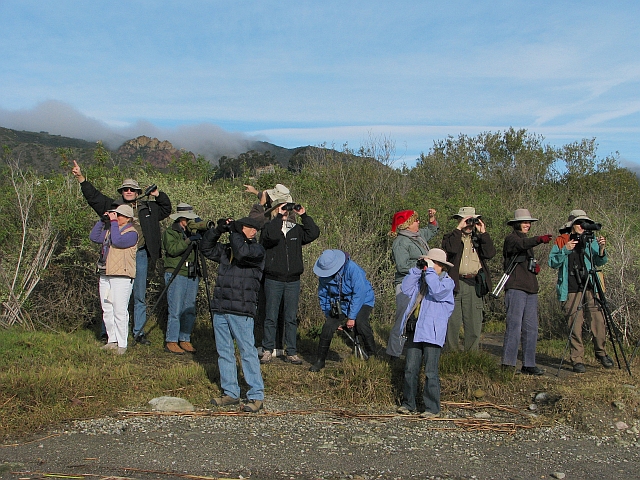
2. Make sure they are looking in the same direction as you are: If possible, just glance around. Birders are often looking in completely different directions while arguing vigorously about what they’re seeing. This happens so frequently that it’s a standing joke. A quick, “Stand behind me and look where I’m looking,” can at least get them into the general area.
3. Clock face: In many situations, using a clock face can aid speedy location. In an open area, twelve o’clock is always straight ahead, six is directly behind, three and nine are 90 degrees right and left, respectively. Other hours fall in between. For a vertical object such as a tree, twelve is the top, three is ½ way down on the right side, and so on. On a boat or in a car (or line of cars), twelve is always straight ahead down the road, six is straight behind down the road, and so on. It should go without saying (but won’t) that 12 o’clock is not simply the direction in which you happen to be looking at that very moment. [I once had to ask a professional bird tour leader why everything was always at 12 o’clock.] If you’re young and don’t know how to read an analog clock, now is a good time to learn.
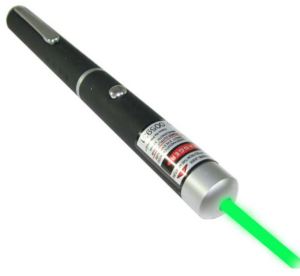
4. Laser Pointers: Pen-sized lasers are now available in various powers and produce either a red or a (preferred) green beam. Many professional tour guides have them, but not all are equally adept at using them. The key is to start from something obvious like a large rock or tree trunk. Starting somewhere close to the bird is far less important. Once everyone
Laser Gun
sees your laser “dot”, they can follow it as you move it along trunk, limb and twig to the bird. Never shine the beam on the bird. Keep the dot where the bird cannot see it so you don’t startle it. Just below the bird works well, as does slowly circling the bird. The dot will display better on solid objects like trunks or twigs than on leaves. Avoid jerky movements. In a forest of leaves, a moving laser beam scatters over many yards. Birders more than a few feet to either side of the pointer-holder sees only a series of bright dots scattered over many leaves and won’t have a clue as to which dot is nearest the bird. Warn the viewers about such scattering and reduce your beam movement to a minimum. In southern California where the sun always shines and forests can be thin, lasers aren’t as useful. A laser dot in a dark forest can be bright red at 100 feet, yet be invisible on a beach at 10 feet. An alternative low-tech solution is a small hand mirror of glass or polished metal, for which you will need the friendly cooperation of the sun.
5. Start from something obvious, easily locatable or describable: How many times have you heard someone say “Near the red leaf in the green tree,” or “By the tall grass stem”? You look around and are confronted with dozens of trees with hundreds of red leaves or an entire field of grass. Which tree, which leaf, which stem? Which direction, how far? This person has forgotten that no one else can see from their exact perspective. They’ve also forgotten that what is absurdly obvious to them through their own binocular’s tiny field of view is not at all obvious to anyone else confronted with a 360° view of the whole, wide world.
The Toughest Basic: Starting from the Obvious
Selecting the Obvious: So what’s considered obvious? Here are some examples: a lone tree, bush, rock or structure; the largest, tallest, darkest, lightest of an assortment of such items; the only group of trees; the leftmost or rightmost tree in a line of trees; the only cloud in the sky; the sun; the only red house in sight; the only house on the left side of the road; the only green sailboat on the sea. Something unique (in the original and proper sense of one-of-a-kind).
Often the bird is in a flock which everyone has already spotted. “There’s a Ominous Cleft-Toe in with that flock of warblers.” They now know that you’ve seen the warblers, are not simply misidentifying one of them, and it helps someone who is way off target to know that they can first find a larger target (a flock) and then look for one individual.
Watch the Birdie: Keep your eye on the bird while giving directions: if it flies, you can follow it and give information about its movements (“going left through the foliage, watch for movement”). Often you can anticipate its movements, especially useful when someone is looking through a scope’s small field of vision. If it flies out of sight, you don’t waste your time telling people where the bird used to be.
Moving from the Obvious: Once you’ve gotten everyone looking in the same direction with your “see the big red house on the hill?”, you can bring them along step-by-step to the bird. “OK, starting from the house, come down to seven o’clock ½ way down the hill to a large brown rock with a big white spot on the bottom left side. Got that? OK, from four o’clock on the rock, go three times the width of the rock to a round gray-green bush with a forked leafless stick pointing out towards ten o’clock from the center of the bush. The bird is on the left fork.”
Occasionally someone “jumps the gun” on your instructions. They hear the first instruction, “See the big red house…” and immediately complain that they can’t see the bird. Deal with this as best you can. We tend to steamroll right over such comments and restate, perhaps enunciating slightly more forcefully: “Now, starting from the red house on the hill, come down to seven o’clock…”, and so on. We figure that getting many or most of the people on the bird is good for the first pass; there is always someone who came in late, wasn’t listening or couldn’t follow. If the bird stays put long enough, we try again
Distance: Use fractions or multiples of an obvious dimension: ½ way down the hill; ¾ of the distance from bottom to top of the tree; 1/3 of distance from trunk to the left edge of the tree; twice as high as that radio tower; ½ way from the sun to the left edge of the lake. Although the size of the field of vision varies widely among binoculars, the number of binocular fields often works as a rough estimate, especially for small specks in the sky: “About two binocular fields 12 o’clock from the red house.” Absolute distances such as 30 ft or 200 yards are of little use. Most people are poor judges of distance or size (although most think they are the exception), and we underestimate distances more often than overestimate. When you do give a distance, qualify it with a phrase like “about”, “approximately” or “between” to indicate that this is a rough estimate. Saying “about 20 to 40 ft away” or “less than 50 feet” can keep people from searching in vain 500 feet away. The exact distance does not matter, it’s the order of magnitude which is important. At sea, where people are looking at a lot of water, distance should be relative to the horizon. Hearing, “Plummeting Mackerel-Snapper, Ten o’clock, ½ way to the horizon,” is a lot more useful than “500 meters off the port bow.”
Practice this on your own, in your own mind. Assume your friends are down the trail when you spot the extremely rare and highly-prized Divested Widget and signal them. They come running. The bird is in the middle of a bunch of trees and bushes, not thrashing around, nor drawing attention to itself. Start from the obvious, and work your way to the bird, using the clock and relative distances. After a while, this sort of verbal guidance becomes close to second nature.
A starting point can be near or far from the bird, above or below, closer or farther. It only has to be OBVIOUS to everyone. Sometimes a building two miles away is the best point from which to start. Sometimes it’s a knee high red flower 5 feet away. It could be a group of bushes halfway across a field. It could be a moving car, boat or airplane, or even another bird that everyone has already seen. It all depends on the situation.
Other Problems
Partially Obscured Birds & Parallax: Sometimes you see a bird through a hole in foliage or twiggy brush. It can’t be seen except from exactly where you are standing. You can confirm this by moving a bit and seeing if the bird becomes obscured. In this case, you can either hog the view for yourself, or you move aside and give someone else your spot. We recommend the latter. Birders are typically polite, and you’ll rarely be criticized for staying put. But your courteous behavior will be appreciated and you’ll likely be helped in return sooner or later by legions of grateful fellow-birders. When a bird is likely to be obscured from points of view other than your own, and you sense that someone simply cannot see it from where they are standing, you can either advise them of this or physically move them into a better location (if you think they won’t take offense). This is a matter of putting yourself into their shoes, which comes with experience.
Bird Color, Shape, Orientation, and Relative Size: Sometimes leaves, grass or twigs obscure a bird, or it blends into the background. In these cases, giving a description of the relative size, color, bill shape, or body orientation e.g. “hanging upside down” can help. Woodpeckers often blend into the trunk or limbs to which they cling. Warblers are famous for moving through the canopies of leafy trees. Towhees and thrashers match their dead leaf feeding grounds in coloration. “Facing left, body almost horizontal, shoulder hunched, tail hidden” can often get someone onto a well-camouflaged motionless bird.
Dealing with Beginners: The special problems beginners experience usually fade with time, so you’ve probably forgotten that you once had them too. Try to figure out their views and put them into perspective for them and others in the group. When one person says that he is looking at a “really big bird way up high” and others can’t find the soaring eagle, the leader who sees where the beginner is looking can help by saying something like, “that robin ten feet up in the oak does look huge and high compared to the juncos on the ground we have just been watching.” A statement like that explains the original observer’s perspective to more experienced participants, helps the others to know what they are looking for (if they want to see the robin), perhaps teaches the beginner something about perspective and comparison, and probably won’t be interpreted as an insult. A similar problem arises after looking at very small birds – sparrows or warblers for example – for a long time, and you then spot something larger like a thrush, and it looks enormous. Alternatively, watch geese for a while, and sparrows will look like gnats.
Wide Open Spaces
Reference points for birds flying across an open space (ocean, lake, marsh, desert, prairie, etc.) may be impossible. If you dare not stop looking, try giving these pointers. 1) Direction of flight (right, left, away, towards, etc.). 2) Height (at horizon, X binocular fields above horizon, directly overhead, etc. 3) “Look at me and look where I’m looking.” 4) Stand behind you and imitate your direction and height. 5) If available, reference obvious clouds, mountains, etc. 6) Get well “ahead” of bird’s approximate location, and either wait for it to fly through your field of view, or sweep back towards the bird. This works better than trying to catch up to or hit directly on the current location. 7) Suggest a likely focal distance, although infinity usually works best. When you’re far out-of-focus, you can look directly at a bird and still be unable to see it.
It Won’t Always Work
You will not always be successful. Accept that. You’re just birding, not solving world peace; keep your sense of humor about this. Some people are not listening, some are hard of hearing, some have vision problems, some may be angry about the coffee they just spilled on themselves, and some have bad binoculars or dirty glasses. Sometimes you’re off your own game, thinking about something else, short-tempered, irritated, too cold, too hot, or you brain just isn’t working properly that day. That’s life. Some people seemingly cannot follow directions from anyone. Some people can never learn to give them. Some of the best birders in the world are unable to give decent directions to anyone else, no matter what. And then there are those most fortunate and irritating few who seem to never need directions. They instantly see everything, everywhere, until you want to bop them on the head from frustration with your own inability.
Main Points to Remember
If you learn these basics and pay attention to your own words, you’ll find that you are actually practicing a form of mindfulness which benefits yourself as well as others. Start from the obvious: something they can’t miss, unique in color, shape, size, type, or direction. Use clock face directions. Identify which member of a group (e.g. 2nd tree from the right). Use fractions and multiples of visible and identified objects rather than absolute distances. Identify bird color and other characteristics when needed. After a short while, you’ll find it actually takes less time and energy to give good directions than to give poor ones. When others quickly get onto the bird, you don’t have to keep repeating your inadequate directions. In the amount of time it takes to say, “It’s right there, in the green tree,” you can say, “Single oak, 8 o’clock, 50 meters, 9 o’clock at the foliage edge.” And you will have said something useful.
And Finally – What Not To Say
There’s no end to the list of unhelpful, frustrating and irritating directions one might give. And – as with speaking to someone in a foreign language – emphasis, raising your voice and waving your arms around does little more than scare away the bird.
Here is a small sampling of rotten directions: It’s right there. Just look. Over there. IT’S RIGHT THERE! There! No, there! Are you blind? It’s right behind the green leaf.
Some useless directions are situation specific. For example: out there in the grass (in a large grassy field); on the phone wire (in a city forest of wires); on the pole (with dozens of phone poles stretching off to the horizon); on the bush (in the chaparral); on the water (from the beach). And the ever-favorite classic, frequently heard in the forest: it’s in the tree, the green tree. You get the idea.
Getting into details of distance and size can mislead. “A foot high bird on a 100-foot boulder 500 yards away,” can be really misleading when the bird is really a Rock Wren on a car-size boulder 50 yards away.
Americans and British traveling overseas should avoid our imperial system of inches, feet, yards and miles. Metric system users vastly outnumber us. Most Americans have a vague notion that a meter is about the same as a yard, so it’s easy to stick to meters. Metric system users probably won’t have a clue as to what an inch, foot or a mile means, nor will they see any point in learning unless they are aficionados of archaic systems of measurement.
When your knowledge of vegetation, rocks, soil, clouds and so forth is better than average, it’s easy to assume your audience knows what you know. “It’s in the Phalanopsis growing by the Dichrodendria distal to that crumbled intrusion of franitactic gneiss,” can be as useless as saying “over there” to the person who cannot identify those objects. And you just might use the wrong term, thus confusing those that actually do know. Common English is best. It’s probably safe to point out the sole oak in a stand of conifers, or a brick among the rocks, but don’t assume too much.
And if you want to really irritate your birding mates, just give a lengthy description of the bird before giving any clue as to where you’re looking. Make sure you pop in such exclamations as, “Oooh….Wow…what IS that?…It’s soooo beautiful….Pleeeese tell me what it is!”, ad nauseam, finishing up with “well…it’s….geee…how can I – whoops!, it just took off! You missed it? Are you blind? It was right there…in the green tree!”
We wish to thank the following people who replied to our BirdChat and CalBird solicitations for comments: Brandon Best, Wim van Dam, Richard Danca, Roy John, David Spector, John van der Woude, Bob & Carol Yutzy. Buried somewhere in the verbiage above, you will find your suggestions, perhaps mutilated beyond all recognition. And, we repeat, we have truly heard real birders make all these mistakes, and we’ve heard real birders give all these useful hints.
Authors Biographical Note, in case you reprint this. Chuck and Lillian live in a northern Los Angeles suburb where – when not peering at birds far and wide and jotting down notes – Lillian tends their ever-growing assortment of native California plants, fruit trees and vegetables, and maintains contacts with other humans. Meanwhile, Chuck practices piano, studies philosophy and edits the Santa Monica Bay Audubon chapter blog (where you can see other examples of their off-kilter humor, especially their controversial monograph on the Western Roof Owl). They’ve been birding for almost fifty years and leading local bird trips for over thirty years.
The ABCs of California’s Native Bees | Book Suggestion
[posted by Chuck Almdale]
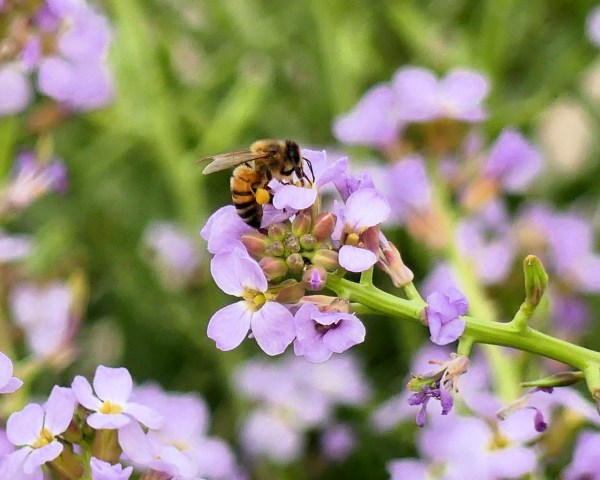
As with most people my knowledge of bees has long been slim and for many decades consisted of: a) they kindly make honey and give much of it to us, b) they unkindly sting us when we try to capture them in jars, and c) Killer Bees were really awful.
This solid base of knowledge changed when we decided that if we removed our water-guzzling lawn, we could plant drought-tolerant native California plants. When the plants grew and began producing bazoozles of flowers, bees by the thousands (truly!) arrived from somewhere and went to work on them. The terrific thing about these bees was that they paid no attention to us whatsoever! More importantly, they did not sting. Not ever. You could nudge them onto your finger and they’d just walk back onto the flower. Occasionally we’d see some gigantic bees [seemingly] the size of a thumb, but nearly all were small yellow bees, slimmer than a honeybee. I found out that they were solitary bees (maybe many species of them for all I know); they didn’t build group hives, they didn’t amass honey and – primarily for those two factors – have nothing to protect and defend and don’t bother stinging people. What great neighbors! And so far not a single Killer Bee among them. Too bad I still know next-to-nothing about them. But I recently garnered a couple of facts that enlarge the picture.
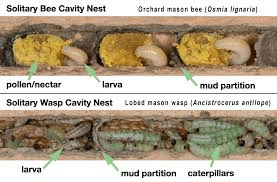
Honeybees are one species out of roughly 20,000 bee species in the world, 4,000 in North America, and 1,640 in California. Most of the rest are some sort of solitary bee, like the ones in our front yard. They also gather pollen and fertilize flowers, but don’t amass buckets of honey for their larvae.
Which brings me to Krystle Hickman. She developed a passion for bees. Lacking a official degree in bee-knowledge, she decided to go look at bees on her own and would drive out to the Mojave desert and suchlike places and look at bees and photograph bees. Sounds a lot like the typical birder in the throes of their passion, except with bees. When she discovered that some of her bee subjects were new to science, she decided she had a knack for this. One thing led to another, and in 2023 National Geographic Society gave her an Explorer Grant to “create a book that features original photographs and documents rare native bees throughout California.” That book is now out in the stores, even at REI, along with their trail maps, camp stoves and tins of foot fungus powder.
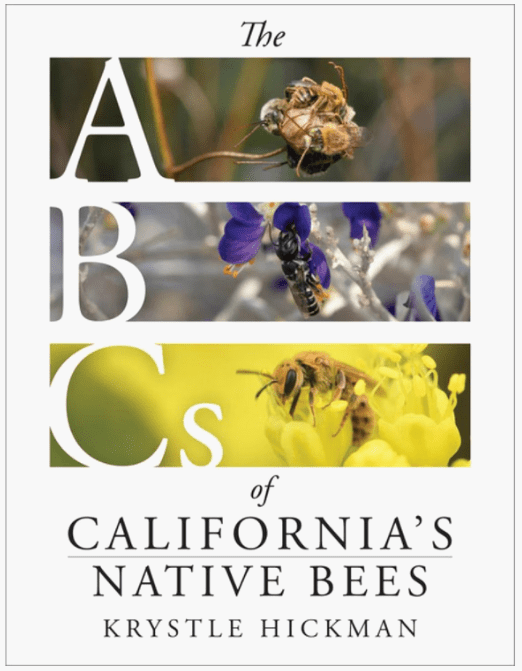
The ABCs of California’s Native Bees is a great introduction to our local world of non-honeybee bees, and introduces us to twenty-six of our California native bees, one for each letter of the alphabet, from Melissodes agilis, the Agile Longhorn Bee, to Calliopsis zonalis, the Zone-tailed Banded Mining-Bee. [I love these names.]
From the publisher’s blurb:
Journey through the world of California native bees, one letter at a time.
National Geographic Explorer Krystle Hickman has spent a decade capturing exquisitely detailed photographs of native bees and making exciting discoveries about their behavior in the field. In her debut book of natural history, she offers an intimate look at the daily habits of rare and overlooked native bees in California: those cloaked in green or black or red, that live alone in the ground or sleep inside flowers, that invade nests and pillage resources like infinitesimal conquerors, or that, unlike more generalist honeybees, are devoted exclusively to the pollen of a single type of flower. A committed conservationist and community scientist who knows all too well how precarious the wellbeing of these insects is, Hickman shares her adventures in local native plant gardens and throughout the far reaches of California to bring the beauty of such diverse ecosystems into wondrous bee’s-eye view. Meant for all curious readers, this collection of bee stories—one for each letter of the alphabet, matching the first letter of a bee’s scientific name—will leave you both wowed and compelled to help save these fascinating beings and the lands they call home.
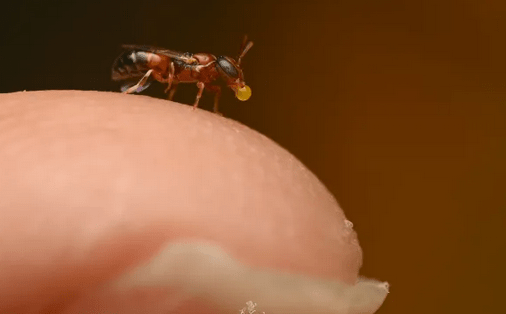
On her website, Beesip.com, Ms. Hickman has a gallery of about thirty of her favorite bees, such as this diminutive female Pachyprosopis purnongensis below.
She also has a collection of short films, such as this one of a Megachile montivaga (Silver-tailed Petalcutter Bee) cutting and carrying a snippet of flower petal back to her nest.
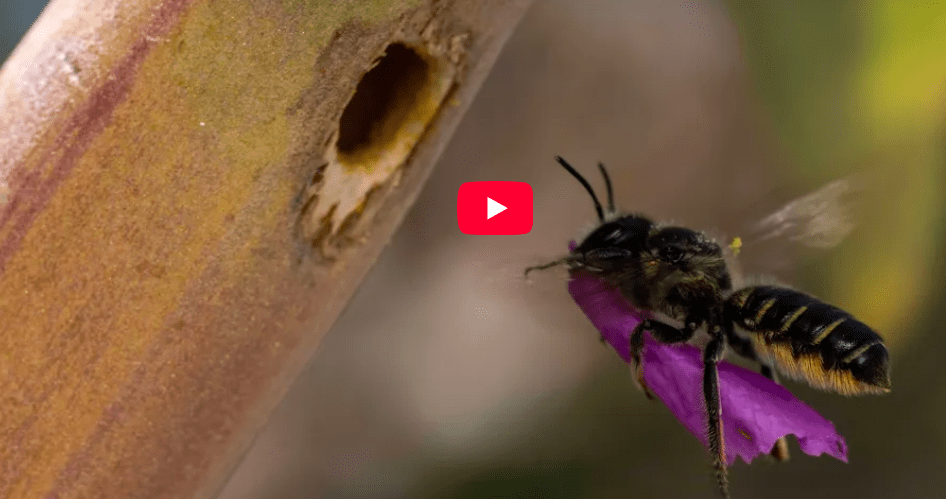
There are also podcasts, interviews (Los Angeles Times) and links to articles by her and by others.

So if you thought that honeybees were the bee-all and end-all of bees, check out her website and read her book. If it inspires you to see more and learn more about our California native bees, remember that “Native Plants attract Native Insects.” If you want to put some native plants into your yard, Theodore Payne Foundation (in the central San Fernando Valley) is the place to get them. They probably also have The ABCs of California’s Native Bees for sale. If they don’t, they should get a stack of them. Native bees and native flowering plants go together better than…well, anything else I can think of.
A new island erupts from the sea | Guardian
[Posted by Chuck Almdale, submitted by Lillian Johnson]
The Guardian is a great source of environment and wildlife articles, with free access to a wide variety of topics.
A new island erupted from the sea – can it show us how nature works without human interference?
By Patrick Greenfield, 13 Oct 2025
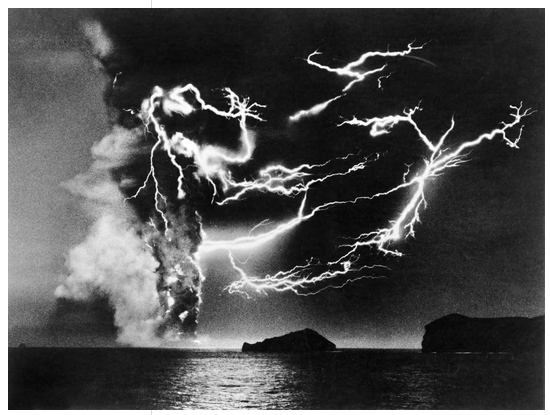
From the article:
In the early 1980s, black-backed gulls started to nest on sections of the island, sheltering in one of the stormiest parts of the Atlantic Ocean. Their arrival kicked off an explosion of life. Guano carried seeds that quickly spread grasses along the island, fed in turn by the nutrients from the birds. For the first time, whole areas of bare rock became green.
Wasowicz says: “It’s surprising. From the times of Darwin, biologists thought that it was just plant species with fleshy fruits that could travel with birds. But the species on Surtsey do not have fleshy fruits. Almost all of the seeds on Surtsey were brought in the faeces of the gulls.”
One lesson from this living laboratory is that recovery after disturbance does not follow a single, predictable path, he says. Instead, it is shaped by multiple, sometimes surprising forces.
Vilmundardóttir says: “I feel that Iceland is really contributing something important to humankind by preserving this area. On the mainland, the impact of humans is everywhere. When I am on Surtsey, I am really in nature. All you can hear are the birds. You see orcas along the coastline and the seals popping out and watching.”



 SANTA MONICA BAY AUDUBON SOCIETY BLOG