Free email delivery
Please sign up for email delivery in the subscription area to the right.
No salesman will call, at least not from us. Maybe from someone else.
The World’s Most Beautiful Bird Songs – Part Two | Bird Kind
Birds are arguably the most talented singers in the natural world. Part two presents a medley of 18 more favourites, including: Western Meadowlark, Canyon Wren, Thrush Nightingale, Song Thrush, Rufous Songlark, White-browed Robin-Chat, Rufous Wren, Suburb Lyrebird & 9 more. Time: 18:40
Part One was posted on 1/15/20.
This sound/film comes from Bird Kind, about whom we know nothing whatsoever, other than they appreciate a good bird song. You can link to their You Tube channel here. If no film or link appears in this email, go to the blog to view it by clicking on the blog title above. If the film stops & starts in an annoying manner, press pause (lower left double bars ||) to let it buffer and get ahead of you. [Chuck Almdale]
Interesting Birds at Ballona Fresh Water Marsh
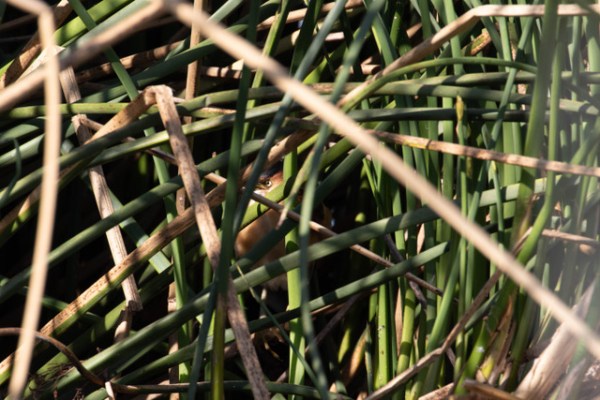
Reed skulker (Chris Tosdevin Feb. 8, 2020; Ballona Fresh Water Marsh, Playa del Rey, CA)
It’s a denizen of the reeds, rarely venturing out into the sunlight. They have been at Ballona Fresh Water Marsh for many years, almost as long as there have been sufficiently dense and extensive reed beds, but are seen by relatively few people. Look closely and see if you know, or can figure out, what it is. Feel free to use your field guide, which – but of course! – you always keep close at hand.
The history of the Ballona Salt Water (SWM) and Fresh Water Marshes (FWM) is a long and checkered one, and includes many arguments and battles between governmental agencies, property owners, developers and local citizens. After many years the SWM was protected and restored, and the FWM was designed and constructed and finally dedicated in 2003. (Please see Friends of Ballona Wetlands History of Ballona.) A few local birders, including several members of our Santa Monica Bay Audubon Society, were immediately enlisted to do a monthly bird census at the FWM. A checklist of the birds of the FWM and adjacent riparian corridor eventually was compiled and currently lists 259 species, including 18 introduced species. as of January 2019. The total list from 2003 through Feb. 1, 2020, stands at 260 native species, according to the Mistresses of the Marsh. I suppose the 18 introduced species (including six parrots!) would be additional. This area has become one of the best birding areas around. For birders visiting from out-of-town, it is located at the corner of Lincoln and Jefferson Blvds. about 10 minutes north of Los Angeles Airport and just south of Marina del Rey.
The above and following pictures were taken on February 8, 2020, at the Ballona Fresh Water Marsh in Playa del Rey, from approximately 10:30am to 11am.
Meanwhile…while you think about that skulker in the reeds, we’ll look at a few other species.
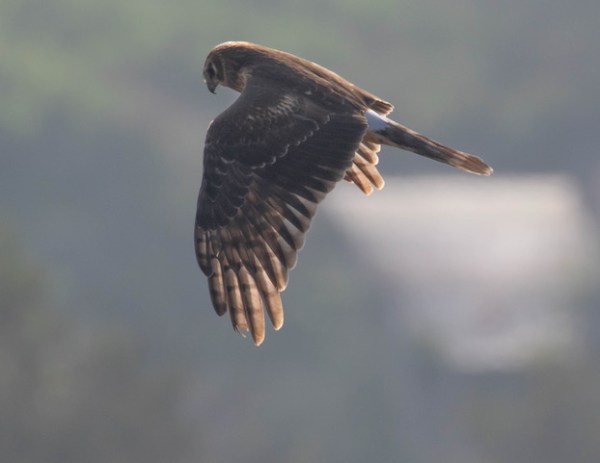
Female Northern Harrier
(Chris Tosdevin Feb. 8, 2020; Ballona Fresh Water Marsh, Playa del Rey, CA)
Well, it is a marsh, so one might reasonably expect to see what was formerly known as the Marsh Hawk or Marsh Harrier. Females, like the bird above, are brown, while the adult male is gray above and white below. Both have the white rump (aka uppertail coverts; not the undertail coverts also known for obvious reasons as the vent), and both have long wing and a peculiar owl-like face. When resting on a tree limb and their features other than the face are difficult or impossible to see, they are often mistaken for owls. They catch their prey by flying low over a field, often hovering or “kiting” with or without a wind, then swooping down to snatch a small mammal or lizard. This is known as “harrying one’s prey;” hence the name of “harrier.”
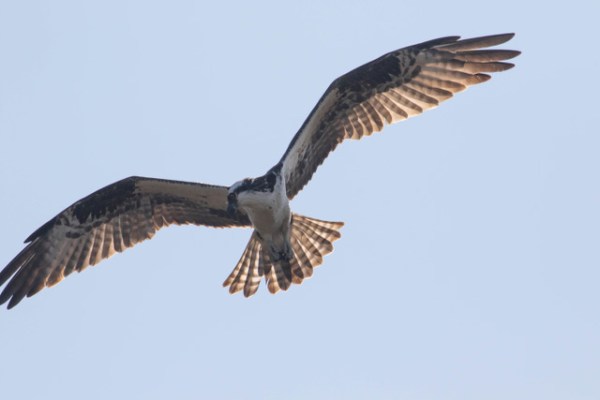
Osprey (Chris Tosdevin Feb. 8, 2020; Ballona Fresh Water Marsh, Playa del Rey, CA)
Ospreys can be seen near any large body of water, although if they can’t catch fish there, they won’t stay long. They are often mistaken by non-birders for Bald Eagles, another fish-eater with a white tail and head, but the Osprey has a black band through the eyes. They catch fish by diving on them head and talons first. With fish in talon, they lift themselves out of the water by briskly flapping their long wings. They then quickly grasp the fish with both feet, one in front of the other, and carry it head forward in a very aerodynamic manner. Lunch is eaten on a nearby tree limb.
The name “osprey” has an interesting origin. It means “bone-predator,” from the Latin os “bone” + frangere “to break.” This name was originally applied to the Lammergeier or Bearded Vulture, widespread but uncommon in mountain ranges from South Africa to east Asia, which superficially looks like the Osprey. The Lammergeier has the unusual habit of swallowing large bones, which it drops onto rocks from a great height before flying down to eat the exposed marrow or swallow the bone. The Osprey doesn’t do anything remotely similar to this. In Tibet, the “bonebreakers,” practicing a trade equivalent to our undertakers, leave out human corpses for the vultures to pick apart, and for the Lammergeiers to eat the bones.

Female Lesser Scaup
(Chris Tosdevin Feb. 8, 2020; Ballona Fresh Water Marsh, Playa del Rey, CA)
In Southern California, Lesser Scaup greatly outnumber Greater in their winter range and numbers. Both can be found at the Fresh Water Marsh, and they are difficult to tell apart. Greater are slightly larger (18.5″ versus 16″) and their white wing-stripe extends past the secondary wing feathers into the primaries, but the size difference is useless and the wing-stripe is visible only on a flying bird. The head of the male of both species is glossy and – depending on angle to the sun – can look black, green or purple. Both females have white patches around the bill. So you’re left with head and bill shape when you’re trying to tell them apart. The Greater has a rounder head with a bit of a bulge at the front, whereas the head of the Lesser bulges at the back. I can’t tell from this photo which this bird has. But it does has a relatively wide black tip to what appears to be an ample bill, which makes me think it might be a Greater Scaup. But I wasn’t there and Chris had better and longer views.
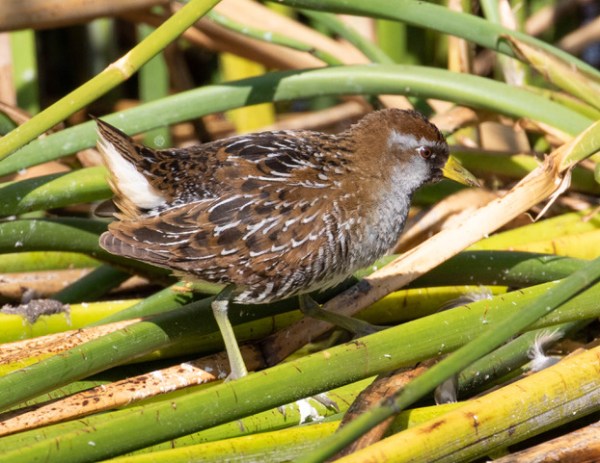
Sora (Chris Tosdevin Feb. 8, 2020; Ballona Fresh Water Marsh, Playa del Rey, CA)
Lastly we come to the Sora, the least shy of the seven species of rails in the U.S. At 8.75″ it’s not a large bird, but birders are usually surprised and pleased when one emerges from the dark depths of the reed bed out into the open. The diminutive Black Rail (6″) and Yellow Rail (7.25″) rarely leave the safety of the reeds, are notoriously difficult to see, and are often among the very last of the North American breeding birds to be found by an American birder. Soras are fairly common in SoCal reed beds, and have been recorded at the Ballona FWM and Malibu Lagoon almost as long as these locations have had reed beds.
The inclusion of this photo of the Sora is a clue to the reader that our reed skulker is not a Sora.
Here is the skulker more out in the open.

Skulker in the reeds. Check the toes.
(Chris Tosdevin Feb. 8, 2020; Ballona Fresh Water Marsh, Playa del Rey, CA)
This should give it away.
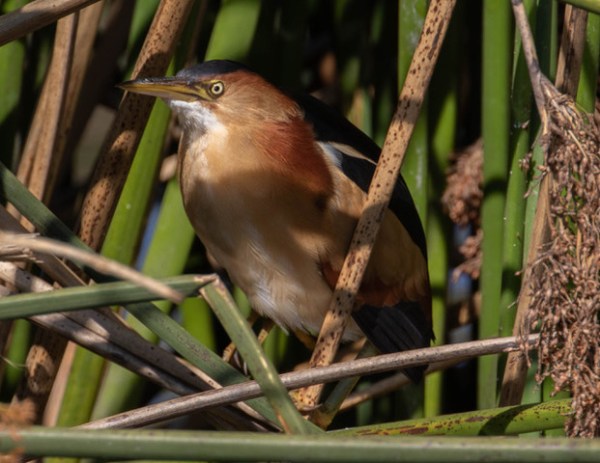
Out in the open! Only 13 inches tall.
(Chris Tosdevin Feb. 8, 2020; Ballona Fresh Water Marsh, Playa del Rey, CA)
Photographer Chris Tosdevin supplied the following commentary.
“The last time I had seen a Least Bittern was back in 1998, long before the 2012 restoration of Malibu Lagoon…”

Least Bittern (Chris Tosdevin Feb. 8, 2020; Ballona Fresh Water Marsh, Playa del Rey, CA)
“I met a local birder at Ballona Fresh Water Marsh and got chatting about what was around…he mentioned that he had had some close encounters with a Least Bittern the week previously…”
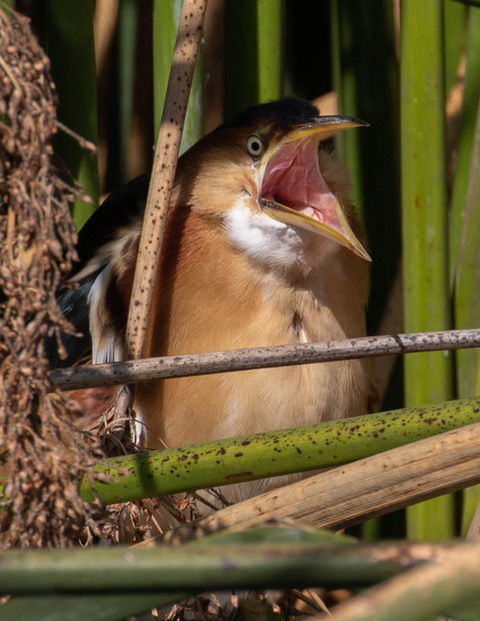
Least Bittern, agape
(Chris Tosdevin Feb. 8, 2020; Ballona FWM, Playa del Rey, CA)
“He later alerted us that he had briefly seen a female on one of the reed islands, and whilst waiting for it to reappear, we heard a second Least Bittern calling off to our left…we stalked the reed bed close to the shore and caught some sulking movement.”

Least Bitterns often cling to two different reeds, suspending between them
(Chris Tosdevin Feb. 8, 2020; Ballona Fresh Water Marsh, Playa del Rey, CA)
“We just waited for 15-20 minutes and the bittern came into view…”

Least Bittern up close and personal
(Chris Tosdevin Feb. 8, 2020; Ballona Fresh Water Marsh, Playa del Rey, CA)
“It’s always good to chat with other birders/photographers to see what’s been around.”
[Chris Tosdevin]
Many thanks to Chris for sending me these great photos of this very elusive and difficult-to-photograph bird. [Chuck Almdale]
Malibu Lagoon Monthly Field Trips: Sunday, 23 February, 8:30 & 10am.

At low tides, both Black (above) and American Oystercatchers have been appearing on the musseled rocks (L. Loeher 1-30-19)
Still more birds than you can shake a stick at. What can I say? Birds you’ve never dreamed of! Garbled Modwit, Club-sandwich Tern, Faque’s Tourniquet, Delicious Gull, Fraculated Wigulet, Desert Island Diskette, Insignificant Sandpiper, Plaid Oysterroaster, the inimitable Glink, Western Roof-Owl (see our monograph), maybe 65 other species. A quiet beach on a quiet day. Who can complain about that? Dress in layers.
Most of January’s birds will still be with us, including: up to 22 species of passerines, 12 species of gulls & terns, 11 ducks, 8 sandpipers, 4 grebes, 4 herons & egrets, 4 raptors, 4 plovers, 3 loons, 3 doves, 3 cormorants, 2 hummingbirds and the inevitable partridge in a persimmon tree. Come and meet them all.
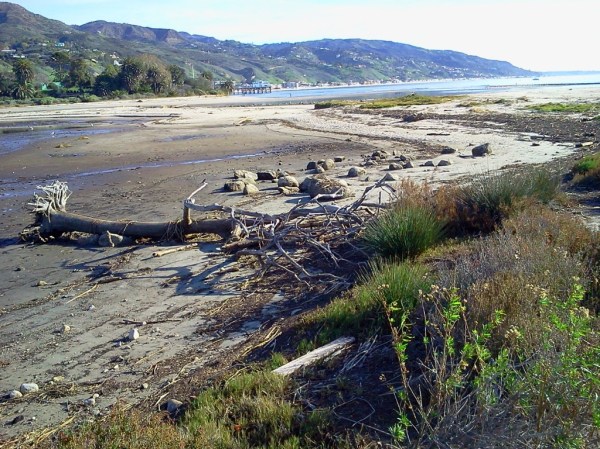
South lagoon, find the Black Phoebe! (L. Johnson 1-27-19)
Adult Walk 8:30 a.m., 4th Sunday of every month. Beginner and experienced, 2-3 hours. Species range from 40 in June to 60-75 during migrations and winter. We meet at the metal-shaded viewing area (see photo below) next to the parking lot and begin walking east towards the lagoon. We always check the offshore rocks and the ocean. When lagoon outlet is closed we continue east around the lagoon to Adamson House. We put out special effort to make our monthly Malibu Lagoon walks attractive to first-time and beginning birdwatchers. So please, if you are at all worried about coming on a trip and embarrassing yourself because of all the experts, we remember our first trips too. Someone showed us the birds; now it’s our turn.
Children and Parents Walk 10:00 a.m., 4th Sunday of every month. One hour session, meeting at the metal-shaded viewing area between parking lot and channel. We start at 10:00 for a shorter walk and to allow time for families to get it together on a sleepy Sunday morning. Our leaders are experienced with kids so please bring them to the beach! We have an ample supply of binoculars that children can use without striking terror into their parents. We want to see families enjoying nature. (If you have a Scout Troop or other group of more than seven people, you must call Jean (310-472-7209) to make sure we have enough binoculars and docents.)
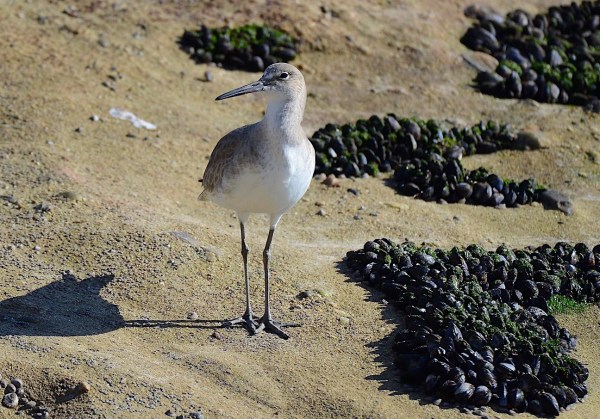
Willet (L. Loeher 1-30-19) Uh oh! I forgot which way it was.
Map to Meeting Place
Directions: Malibu Lagoon is at the intersection of Pacific Coast Highway and Cross Creek Road, west of Malibu Pier and the bridge. Look around for people wearing binoculars.
Parking: Parking machine recently installed in the lagoon lot: 1 hr $3; 2 hrs $6; 3 hrs $9, all day $12 ($11 seniors); credit cards accepted. Annual passes accepted. You may also park (read the signs carefully) either along PCH west of Cross Creek Road, on Cross Creek Road, or on Civic Center Way north (inland) of the shopping center. Lagoon parking in shopping center lots is not permitted.
Prior checklists:
2019: Jan-June, July-Dec
2018: Jan-June, July-Dec 2017: Jan-June, July-Dec
2016: Jan-June, July-Dec 2015: Jan-May, July-Dec
2014: Jan-July, July-Dec 2013: Jan-June, July-Dec
2012: Jan-June, July -Dec 2011: Jan-June, July-Dec
2010: Jan-June, July-Dec 2009: Jan-June, July-Dec.
[Chuck Almdale]
Your Brain on Mars ft. Physics Girl! | PBS BrainCraft Video
Things are different, including how your brain would function.
This is an installment of the PBS – BrainCraft series created by Vanessa Hill. If no film or link appears in this email, go to the blog to view it by clicking on the blog title above. If the film stops & starts in an annoying manner, press pause (lower left double bars ||) to let it buffer and get ahead of you. [Chuck Almdale]
Look Inside a Rattlesnake’s Rattle | Deep Look Video
A rattlesnake’s rattle isn’t like a maraca, with little bits shaking around inside. So how exactly does it make that sound?
This is another installment of the PBS Deep Look series. If no film or link appears in this email, go to the blog to view it by clicking on the blog title above. If the film stops & starts in an annoying manner, press pause (lower left double bars ||) to let it buffer and get ahead of you. [Chuck Almdale]



