Free email delivery
Please sign up for email delivery in the subscription area to the right.
No salesman will call, at least not from us. Maybe from someone else.
Bio Blitz at Malibu Lagoon this Sunday 11am – 1pm, April 28
There will be a Bio Blitz at Malibu Lagoon this Sunday
immediately following our lagoon birdwalks (8:30am & 10am)
The Resource Conservation District of the Santa Monica Mountains is hosting this incredible citizen science project and they hope that many (or all!) of our birdwalkers will join them. They will have people at the lagoon on Sunday to help with iNaturalist and with linking to the challenge.
If you would like to participate in the City Nature Challenge: Malibu Lagoon Bioblitz with the RCD on April 28th from 11am – 1pm:
1. Load the iNaturalist app to your smartphone
2. Bring your phone with you ready to take pictures.
3. Load pictures to iNaturalist and make sure the location feature is on or that you are noting the location.
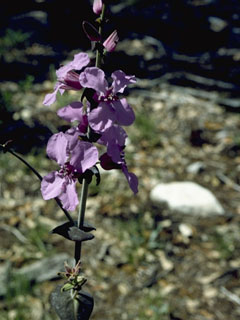
Bracted Twistflower -Streptanthus bracteatus. See text in press release below.
(Bransford, W.D. and Dolphia – Lady Bird Johnson Wildflower Center at University of Texas)
If you need help with any of these steps RCD educators will be at the lagoon to walk you through the process. It is a great way to learn about citizen science! You don’t even need to know the species. The Natural History Museum of LA is going to be having a species ID party to make sure as many identifications as possible are research grade.
You are welcome to take pictures during your walk and load them during the Bio Blitz or on your own.
If you do not have a smart phone and would like to still participate you can bring a camera and submit your photos in the way that works best for you.
email – nature@nhm.org
social media – #NatureinLA
Text – 213 663-6632
iNaturalist.org: website or apps
City Nature Challenge General Rules.
Take photos: 12:00 am April 26 to 11:59 pm April 29
Upload photos/make IDs: April 30 to May 5
Photos of: Wild plants and animals (no pets or humans)
Geographic Boundary: Los Angeles County
Here’s their announcement/press release. [Chuck Almdale]
CITIZEN AND COMMUNITY SCIENTISTS THROUGHOUT THE WORLD
COMPETE IN ‘CITY NATURE CHALLENGE’ APRIL 26-29, 2019
Fourth annual challenge grows to over 150 participating cities on six continents and over 600 partnering organizations; results announced on May 6.
As citizen and community science initiatives continue to increase in popularity, this year’s fourth annual City Nature Challenge will expand to more than 150 cities across the globe. Kicking off April 26 at 12:01 am in each time zone, the Challenge runs through April 29, 11:59 pm. The multi-city, global event calls on current and aspiring citizen scientists, nature and science fans, and people of all ages and science backgrounds to observe and submit pictures of wild plants, animals, and fungi using the free app iNaturalist. Identification of photographed species will be crowdsourced through the online community April 30-May 5 and results will be announced on May 6.
There is nature in every city, and the best way to study it is by connecting community and scientists through citizen science. With human populations worldwide increasingly concentrated in cities, the study of urban biodiversity is quickly becoming integral to the future of plants and wildlife on Earth. Large pools of data, including those built through iNaturalist, natural history museums, and science organizations, help authorities make informed conservation decisions that allow humans to coexist sustainably with the plants and animals in their neighborhoods.
After launching the first-ever City Nature Challenge in 2016, the Natural History Museum of Los Angeles County (NHM) and San Francisco’s California Academy of Sciences (CAS) are hosting their fourth—and much larger—effort. Last year’s five-day challenge invited U.S. participants in over 60 cities to observe and submit pictures of wildlife they encountered using iNaturalist. Participants added over 440,000 observations of nature to iNaturalist, and scientists can use these pools of data to understand and conserve urban wildlife.
This year, the Challenge is expanding, and organizers estimate that 750,000 observations will be made by over 25,000 people in over 160 participating cities. The data collected gives scientists, educators, urban planners, and policymakers insight into the biodiversity of urban locales throughout the world, including in Los Angeles.
“Urbanization is one of the greatest global threats to biodiversity. What better place to study it than right here in Los Angeles, one of the largest mega-cities on the planet,” says Dr. Lori Bettison-Varga, president and director of NHM says. “We want to use our experience with engaging the public to help make cities more appealing to wildlife and humans alike.”
For both budding and veteran citizen scientists, participating is easy:
- Find wildlife. It can be any plant, animal, fungi, slime mold, or any other evidence of life (scat, fur, tracks, shells, carcasses!) found in your participating city.
- Take a picture of what you find, and be sure to note the location of the critter or plant.
- Share your observations by uploading your findings through iNaturalist or your city’s chosen platform.
Scientists can’t be everywhere at once, so without community observations, they’d miss some incredible finds. During the 2018 City Nature Challenge, an observation of a hammerhead worm in the San Francisco Bay Area marked the first-ever recording of this species, which is native to Asia, in the U.S. In central Texas, the Bracted Twistflower—a candidate for federal protection—bloomed in deep purple hues across its only known home in the Edwards Plateau.
In Hong Kong, observations of an incense tree that inspired the city’s name (Hong Kong translates to “scented harbor”) helped document how the once-abundant tree has declined across its native range. And the observation of an endangered songbird flitting through swamps outside of Bogotá, Colombia renewed hope for the future of this rare bird. Many other endangered, endemic, or data deficient species were recorded during the City Nature Challenge: This influx of information gives scientists, educators, urban planners, and policymakers insight into the biodiversity of urban locales throughout the world.
More Information and Education Toolkit
Visit citynaturechallenge.com
iNaturalist
Signing up is easy and free. Visit inaturalist.org from your browser, or download iNaturalist from the Apple App Store or Google Play store.
Social Media
#CityNatureChallenge
Twitter handle: @citnatchallenge
City Nature Challenge YouTube video overview
Want to Learn More? iNaturalist video tutorials

…there is a season! Tern, Tern, Tern (L. Loeher Malibu Lagoon 04-19-19)
Some of the wintering birds have left, but many remain, and our breeding birds are arriving. The air may be filled with swallows. Grebes, loons, pelicans, ducks, egrets, hawks, shorebirds, flycatchers, orioles, finches, ad infinitum.
Some of the great birds we’ve had in April are: Brant, Clark’s Grebe, Osprey, American Kestrel, Virginia Rail, Sora, Snowy Plover, Greater Yellowlegs, Black Turnstone, Surfbird, Dunlin, Bonaparte’s Gull, Royal, Elegant & Forster’s Terns, Eurasian Collared & White-winged Doves, Tree & Violet-Green Swallows, American Pipit, Cedar Waxwing, Orange-crowned & Wilson’s Warblers, Lazuli Bunting and Lesser Goldfinch.
NOTE: There will be a Bio Blitz at Malibu Lagoon, 11am – 1pm, this Sunday immediately following our 8:30am & 10am lagoon birdwalks. This national event will be hosted locally at the lagoon by the Resource Conservation District of the Santa Monica Mountains. Look for our separate announcement on this event.
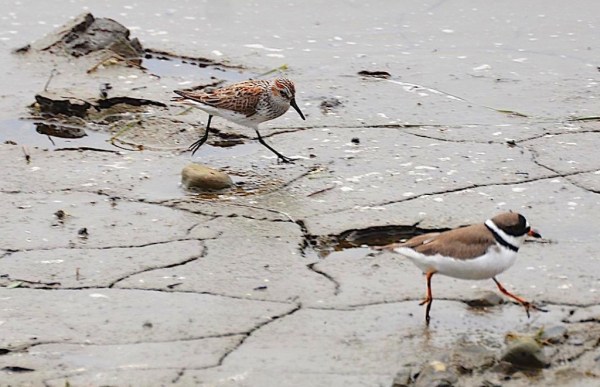
Western Sandpiper and Semipalmated Plover on their way north to breed.
Yes, it’s a very long walk. (G. Murayama Malibu Lagoon 04-19-19)
Adult Walk 8:30 a.m., 4th Sunday of every month. Beginner and experienced, 2-3 hours. Species range from 40 in June to 60-75 during migrations and winter. We meet at the metal-shaded viewing area (see photo below) next to the parking lot and begin walking east towards the lagoon. We always check the offshore rocks and the ocean. When lagoon outlet is closed we continue east around the lagoon to Adamson House. We put out special effort to make our monthly Malibu Lagoon walks attractive to first-time and beginning birdwatchers. So please, if you are at all worried about coming on a trip and embarrassing yourself because of all the experts, we remember our first trips too. Someone showed us the birds; now it’s our turn.
Children and Parents Walk 10:00 a.m., 4th Sunday of every month. One hour session, meeting at the metal-shaded viewing area between parking lot and channel. We start at 10:00 for a shorter walk and to allow time for families to get it together on a sleepy Sunday morning. Our leaders are experienced with kids so please bring them to the beach! We have an ample supply of binoculars that children can use without striking terror into their parents. We want to see families enjoying nature. (If you have a Scout Troop or other group of more than seven people, you must call Jean (310-472-7209) to make sure we have enough binoculars and docents.)
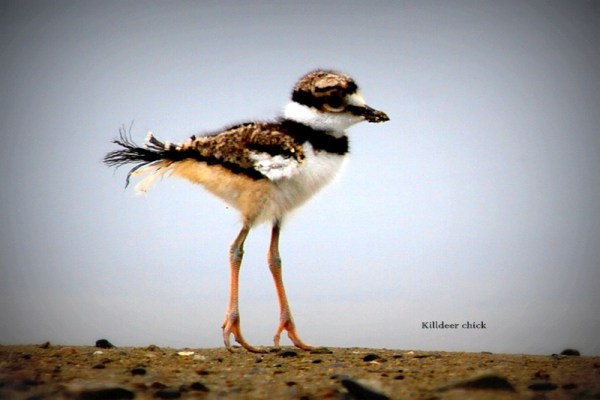
Killdeer chick, as leggy as a Secretary-Bird (J.Waterman 4/21/12)

Great Egret stalks a lizard in the parking lot (Grace Murayama 2-25-18)
IGNORE previous Special Travel Alert: The editor forgot to delete March’s alert about the L.A. Marathon. NO marathon this month!
Directions: Malibu Lagoon is at the intersection of Pacific Coast Highway and Cross Creek Road, west of Malibu Pier and the bridge. Look around for people wearing binoculars.
Parking: Parking machine recently installed in the lagoon lot: 1 hr $3; 2 hrs $6; 3 hrs $9, all day $12 ($11 seniors); credit cards accepted. Annual passes accepted. You may also park (read the signs carefully) either along PCH west of Cross Creek Road, on Cross Creek Road, or on Civic Center Way north (inland) of the shopping center. Lagoon parking in shopping center lots is not permitted.
Prior checklists:
2018: Jan-June, July-Dec 2017: Jan-June, July-Dec
2016: Jan-June, July-Dec 2015: Jan-May, July-Dec
2014: Jan-July, July-Dec 2013: Jan-June, July-Dec
2012: Jan-June, July -Dec 2011: Jan-June, July-Dec
2010: Jan-June, July-Dec 2009: Jan-June, July-Dec.
[Chuck Almdale]
Adam Savage was co-host of science television program Mythbusters for 14 seasons, and now runs tested.com. He chats with Above the Noise host Shirin Ghaffary about why scientific inquiry is more important than ever.
ABOVE THE NOISE is a show that cuts through the hype and takes a deeper look at the science behind controversial and trending topics in the news. Hosted by Myles Bess and Shirin Ghaffary.
This series is aimed at teens, but after viewing a few episodes, I’m sure that most adults will benefit from it as well. Let us know what you think.
This is another installment of KQED’s Above the Noise series. If no film or link appears in this email, go to the blog to view it by clicking on the blog title above. If the film stops & starts in an annoying manner, press pause (lower left double bars ||) to let it buffer and get ahead of you. [Chuck Almdale]
Biologist Karl Berg asks the question, “How do parrots learn their names?” Are they genetically encoded or are the learned from their parents? In this video, Producer Marc Dantzker delves into Karl’s work and explains how this simple question is shedding light on one of nature’s most complex communication systems.
A film from the Cornell Lab of Ornithology. If no film or link appears in this email, go to the blog to view it by clicking on the blog title above. If the film stops & starts in an annoying manner, press pause (lower left double bars ||) to let it buffer and get ahead of you. The Lab is a member-supported organization; they welcome your membership and support. [Chuck Almdale]
Citizen Science? – Check out Zooniverse.org
Zooniverse.
Think of it as crowdsourcing or “wisdom of the crowd”
applied to modern science.

Computers can calculate enormously faster than we humans can, but we are still far better at some things. Pattern recognition is one of those things. There are a lot of projects where you can make a real contribution by using your ability to recognize patterns that supercomputers could examine for days and get nowhere.
Zooniverse is a one-stop site for these projects looking for human helpers. As it says on their site:
The Zooniverse Works
418,806,839
Classifications so far by 1,757,426 registered volunteers
A vibrant community.
Zooniverse gives people of all ages and backgrounds the chance to participate in real research
with over 50 active online citizen science projects. Work with 1.6 million registered users
around the world to contribute to research projects led by hundreds of researchers.
Their sites shows that there are currently 91 projects running in the following eleven general divisions: Arts, Biology, Climate, History, Language, Literature, Medicine, Nature, Physics, Social Science, and Space.
In the Biology division the have the following projects involving birds: The Cornell Lab – Hawk Talk, The Cornell Lab – Battling Birds, London Bird Records, Interior Least Tern and Piping Plover Predators, Penguin Watch, Project Plumage, and Seabird Watch.
Here’s a few of their other projects:
GALAXY ZOO -To understand how galaxies formed we need your help to classify them according to their shapes. If you’re quick, you may even be the first person to see the galaxies you’re asked to classify.Look at telescope images of distant galaxies.Explore the sky. What will you find? “In the decade the project has been running, Galaxy Zoo volunteers have helped understand the Universe and made spectacular discoveries. We hope you’ll join us for the next stage of the adventure. ”
WEATHER RESCUE – We’re asking for your help to unearth some of the long-forgotten secrets about the UK’s weather. By helping us to digitize these records, we can unlock answers to questions about our weather and changing climate, as well as contribute to new discoveries. “The fastest way to collect new weather observations is by looking back in time!”
SHAKESPEARE’S WORLD – Transcribe handwritten documents by Shakespeare’s contemporaries and help us understand his life and times. Along the way you’ll find words that have yet to be recorded in the authoritative Oxford English Dictionary, and which will eventually be added to this important resource.
CHIMP & SEE – Welcome to Africa—home of the chimpanzee. Our cameras have taken thousands of videos of these and other animals. Now we need your help to study, explore, and learn from them.
Link to Zooniverse.
[Chuck Almdale]



 SANTA MONICA BAY AUDUBON SOCIETY BLOG