Free email delivery
Please sign up for email delivery in the subscription area to the right.
No salesman will call, at least not from us. Maybe from someone else.
Return of the Terns: Malibu Lagoon, 24 March, 2019

California Towhee’s dull-brown plumage is tinged green from leaf-reflected light
(L. Loeher 3-24-19 Malibu Lagoon)
Another low tide and very pleasant weather made for plenty of exposed sand and a nice birdwalk. Temperatures ranged from 55-64° but felt warmer without an onshore wind. The lagoon and west channel were mostly exposed mud. The wave zone was full of surfers, indicating that winds were blowing somewhere far out at sea.

Northern Mockingbird knows it’s spring (L. Loeher 3-24-19 Malibu Lagoon)
The Gadwalls were busily rapidly flapping their bills open and shut in the nearly liquid mud. “What are they eating?” someone wondered aloud. I hazarded a guess: “Small invertebrates. They sense their presence with their tongues or the inside surfaces of their bill, then use their tongue to retain them while getting rid of the mud.” Or something like that – an educated guess. That’s how I’d do it if I were a duck.
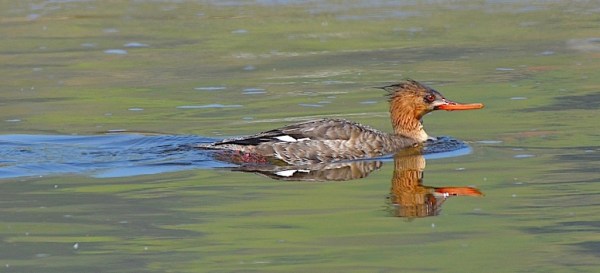
Female Red-breasted Merganser (L. Loeher 3-24-19 Malibu Lagoon)
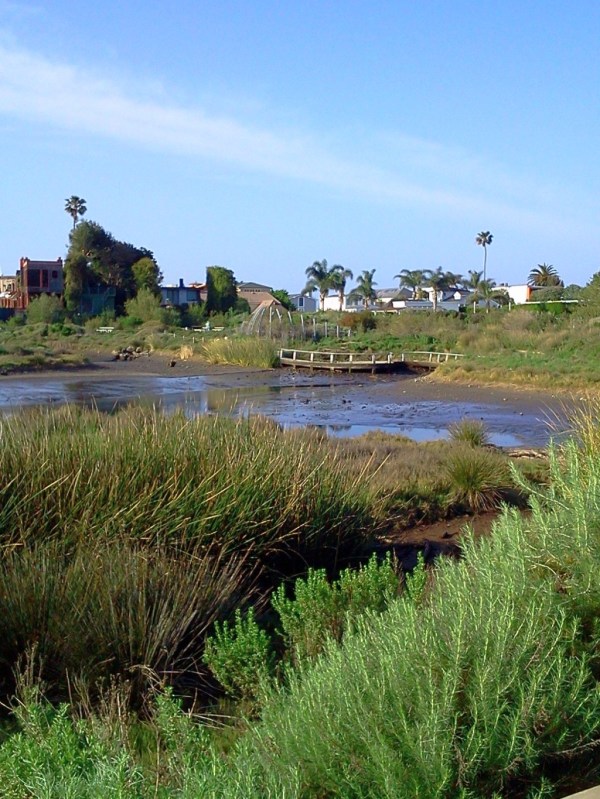
View of Malibu Colony from our meeting place (L. Johnson 3-24-19 Malibu Lagoon)
We were accompanied on our walk by two journalists from Malibu Surfside News – reporter Barbara and photographer Susie. They took lots of photographs and asked lots of questions of various people including myself. I was happy to reply to either the best of my recollection or limit of my imagination, whichever seem appropriate. I assume an article will be forthcoming but I don’t know when. Checking their website reveals that they regularly mention local birds bird-related events: nesting Snowy Plovers, the fall Bird Fest, Coastal Cleanup, wintering birds. So a report on our birdwalks fits in there fairly well.
The two Cinnamon Teal who appeared in late January are still present, looking as beautiful as ever. This time we had good views of their blue speculums; some described it as Robin’s-egg blue or sky blue; I call it baby blue. Only rarely will you see most or all of the speculum on a floating duck. Perhaps it was a sort of display.
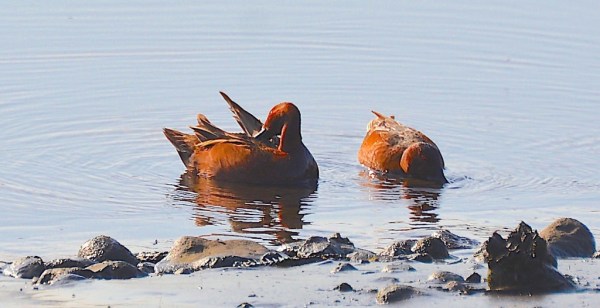
Cinnamon Teal males are still here (G. Murayama 3-24-19 Malibu Lagoon)
Water levels are just as low as last month, so there’s not much depth for the ducks to paddle around in. All the coots were just inland of the PCH bridge in the deepest water available. The creek’s main flow passes under the east end of the PCH bridge, along the shore of the Adamson House (east) side, and out to sea. The water in the rest of the lagoon and west channel remains quite still.

View to north across mostly empty lagoon towards PCH bridge and Adamson House
(L. Johnson 3-24-19 Malibu Lagoon)
A few swallows – Rough-winged and Barn – flew back and forth across the lagoon. We often see Barn Swallows flying low over the length of the beach, catching small flies, but today they were mostly over the water.

If his tail were spread, you could see this Allen’s Hummingbird central four tail feathers are narrow and unnotched when compared to those of the Rufous Hummingbird
(L. Loeher 3-24-19 Malibu Lagoon)
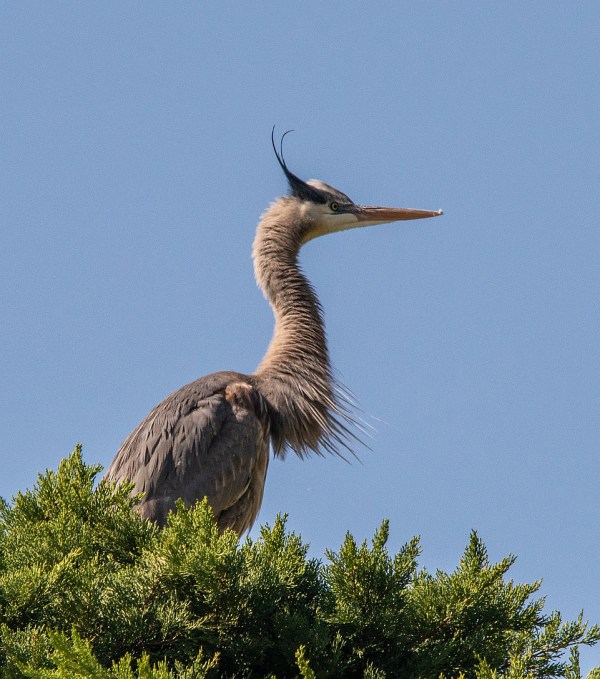
Great Blue Heron in the treetop breeze
(R. Juncosa 3-24-19)
Everyone got good views of the Belted Kingfisher sitting on the end of a snag jutting from the water near the PCH bridge. It lacked any cinnamon on the breast of flanks, making it a male. Belted Kingfishers are one of the few species exhibiting “reverse sexual dimorphism” – the female is more brightly plumaged than the male – which is related to polyandry (female takes multiple mates). There are some indications that the amount of reverse sexual dimorphism is also related to the strength of her polyandrous breeding behavior. In other words, the more the female is more brightly plumaged than the male, the more likely she is to be strongly polyandrous. This relationship is still somewhat conjectural. However, the Belted Kingfisher female is not greatly more colorful than the male, nor is she strongly polyandrous.

View from north viewpoint looking west along north side of channel towards the meeting point
(L. Johnson 3-24-19 Malibu Lagoon)
Among the numerous Double-crested Cormorants was last month’s visitor still wearing his silver ankle bracelet and the yellow plastic bracelet coded in black characters “EN3.” We don’t often get to confirm the lasting present of individual birds. This happens mostly with the ringed Snowy Plovers, some of whom remain all winter and return in following years. But we can be sure this is the same individual cormorant, and that the two male Cinnamon Teal are also continuing birds.
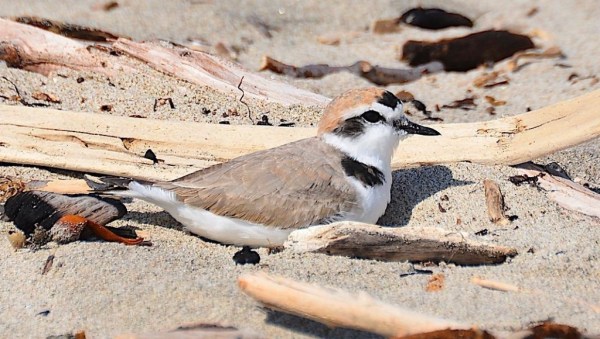
Snowy Plover with a rusty crown, one of 14 hiding among the driftwood
(G. Murayama 3-24-19 Malibu Lagoon)
Low tide today was early: -0.05 feet at 6:38am. By the time we got to the beach, the tide was moving in. Most of the birds had earlier been on the exposed offshore rocky reefs, but as the waves began washing over their feet, they either moved to the sandy flats edging the lagoon or flew off to sea. Most of the gulls flew away (we found only 79); following that the terns – previously absent – moved in.
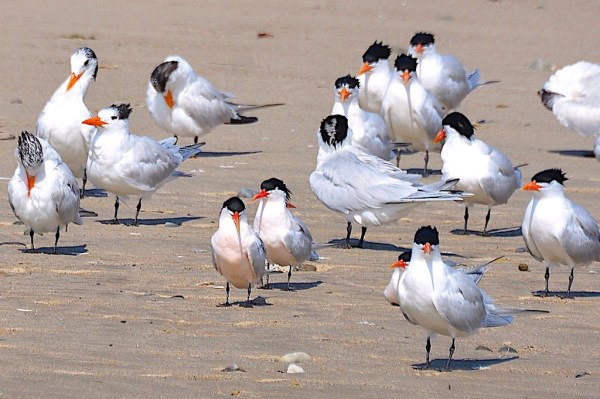
Royal Terns surround two pink-breasted Elegant Terns (G. Murayama 3-24-19 Malibu Lagoon)
We hadn’t seen Caspian Terns since a single bird last September, and all the Elegant Terns left, as usual, in November. It was nice to see them back. Most of the Elegant Terns had rosy breasts. The rosy color comes from carotenoids which they get from either crustaceans or fish in their diet. It may built into the feather itself while growing, or be a component of the waxy secretions of the uropygial gland which they rub on their plumage with their bill. There’s more on this topic in our Oct. 27, 2017 lagoon report.
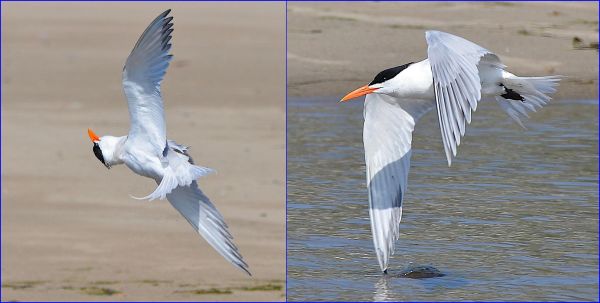
Terns can be quite acrobatic, although they might occasionally get sloppy and drag a wingtip in the water (L. Loeher 3-24-19 Malibu Lagoon)
Birds new for the season were: Canada Goose, Northern Shoveler, Anna’s Hummingbird, Bonaparte’s Gull, Caspian Tern, Elegant Tern, American Kestrel, California Scrub-Jay, Northern Rough-winged Swallow, Barn Swallow, Wrentit, California Towhee. The last species is always around, often within the dense brush in the middle of the parking area, but for some reason no one had seen or heard one since last October.

The Ruby-crowned Kinglet’s white eyering is broken at the top (R. Juncosa 3-24-19)
Many thanks to our photographers: Lillian Johnson, Ray Juncosa, Larry Loeher & Grace Murayama.

Song Sparrow, taking a break from song
(G. Murayama 3-24-19 Malibu Lagoon)
Our next three scheduled field trips: King Gillette State Park 8am, 13 April; Butterbredt Spring Campout 8:30am 27-28 April; Malibu Lagoon 8:30 & 10am, 28 April.
Our next program: Birds of Madagascar, presented by Doug Cheeseman. Tuesday, 2 April, 7:30 p.m., Chris Reed Park, 1133 7th St., NE corner of 7th and Wilshire Blvd. in Santa Monica.
NOTE: Our 10 a.m. Parent’s & Kids Birdwalk meets at the shaded viewpoint just south of the parking area. Watch for Willie the Weasel. He’ll be watching for you and your big floppy feet.
Links: Unusual birds at Malibu Lagoon recently updated with new photos
9/23/02 Aerial photo of Malibu Lagoon
Prior checklists:
2017: Jan-June, July-Dec 2018: Jan-June, July-Dec
2016: Jan-June, July-Dec 2015: Jan-May, July-Dec
2014: Jan-July, July-Dec 2013: Jan-June, July-Dec
2012: Jan-June, July -Dec 2011: Jan-June, July-Dec
2010: Jan-June, July-Dec 2009: Jan-June, July-Dec.
The 10-year comparison summaries created during the Lagoon Reconfiguration Project period, despite numerous complaints, remain available on our Lagoon Project Bird Census Page. Very briefly summarized, the results unexpectedly indicate that avian species diversification and numbers improved slightly during the restoration period June’12-June’14.
Many thanks to Femi Faminu, Lillian Johnson, Chris Lord & Chris Tosdevin for their contributions to the checklist below. [Chuck Almdale]
| Malibu Census 2018-19 | 10/28 | 11/25 | 12/23 | 1/27 | 2/24 | 3/24 |
| Temperature | 61-67 | 64-75 | 55-62 | 65-75 | 54-60 | 55-64 |
| Tide Lo/Hi Height | H+5.83 | H+6.46 | H+6.87 | L+1.36 | L+0.84 | L-0.05 |
| Tide Time | 1143 | 0944 | 0850 | 0913 | 0708 | 0638 |
| Cackling Goose | 1 | |||||
| Canada Goose | 1 | 2 | ||||
| Blue-winged Teal | 2 | |||||
| Cinnamon Teal | 2 | 2 | ||||
| Northern Shoveler | 2 | 1 | ||||
| Gadwall | 4 | 8 | 6 | 12 | 18 | |
| American Wigeon | 12 | 5 | 4 | 8 | 15 | |
| Mallard | 17 | 14 | 12 | 27 | 18 | 14 |
| Northern Pintail | 2 | |||||
| Green-winged Teal | 2 | 4 | 2 | 2 | ||
| Ring-necked Duck | 2 | |||||
| Greater Scaup | 2 | |||||
| Lesser Scaup | 2 | |||||
| Surf Scoter | 14 | |||||
| Bufflehead | 6 | |||||
| Red-breasted Merganser | 4 | 2 | 3 | 1 | 1 | |
| Ruddy Duck | 61 | 95 | 2 | 3 | 5 | |
| Pied-billed Grebe | 1 | 2 | 1 | |||
| Horned Grebe | 1 | 1 | ||||
| Eared Grebe | 4 | 4 | ||||
| Western Grebe | 4 | 2 | 2 | 22 | ||
| Clark’s Grebe | 1 | 1 | ||||
| Rock Pigeon | 23 | 12 | 22 | 13 | 17 | 15 |
| Mourning Dove | 2 | 2 | 2 | 6 | ||
| Anna’s Hummingbird | 1 | 4 | ||||
| Allen’s Hummingbird | 4 | 2 | 2 | 4 | 2 | 2 |
| American Coot | 17 | 85 | 58 | 38 | 36 | 55 |
| Black-necked Stilt | 2 | |||||
| Black-bellied Plover | 82 | 79 | 70 | 99 | 35 | 14 |
| Snowy Plover | 5 | 7 | 32 | 31 | 14 | |
| Killdeer | 2 | 7 | 14 | 17 | 10 | 10 |
| Whimbrel | 7 | 9 | 2 | 7 | 4 | 55 |
| Marbled Godwit | 13 | 15 | 14 | 17 | 23 | 15 |
| Ruddy Turnstone | 5 | 2 | 3 | 4 | 3 | |
| Sanderling | 110 | 60 | 72 | 32 | ||
| Least Sandpiper | 15 | 17 | 23 | 16 | 3 | |
| Western Sandpiper | 2 | |||||
| Spotted Sandpiper | 2 | 1 | 1 | 2 | 2 | |
| Willet | 11 | 13 | 12 | 20 | 12 | 9 |
| Bonaparte’s Gull | 1 | |||||
| Heermann’s Gull | 25 | 14 | 14 | 13 | 5 | |
| Ring-billed Gull | 13 | 30 | 95 | 50 | 85 | 25 |
| Western Gull | 20 | 45 | 75 | 127 | 98 | 30 |
| California Gull | 90 | 700 | 460 | 140 | 22 | |
| Herring Gull | 1 | 2 | 1 | |||
| Glaucous-winged Gull | 1 | 1 | ||||
| Caspian Tern | 2 | |||||
| Royal Tern | 7 | 1 | 4 | 12 | 65 | |
| Elegant Tern | 1 | 43 | ||||
| Red-throated Loon | 1 | |||||
| Pacific Loon | 2 | 1 | 1 | |||
| Common Loon | 2 | 2 | ||||
| Brandt’s Cormorant | 1 | 1 | 20 | 2 | ||
| Double-crested Cormorant | 23 | 34 | 42 | 31 | 24 | 60 |
| Pelagic Cormorant | 1 | 2 | 2 | 2 | ||
| Brown Pelican | 11 | 8 | 29 | 15 | 37 | 65 |
| Great Blue Heron | 2 | 2 | 2 | 2 | 1 | 2 |
| Great Egret | 2 | 2 | 1 | 5 | ||
| Snowy Egret | 12 | 11 | 7 | 5 | 2 | |
| Black-crowned Night-Heron | 2 | |||||
| Turkey Vulture | 1 | |||||
| Cooper’s Hawk | 1 | |||||
| Red-shouldered Hawk | 1 | |||||
| Red-tailed Hawk | 1 | 1 | 1 | 1 | 2 | 1 |
| Belted Kingfisher | 1 | 1 | 1 | |||
| American Kestrel | 1 | |||||
| Peregrine Falcon | 1 | |||||
| Nanday Parakeet | 3 | |||||
| Black Phoebe | 4 | 3 | 6 | 4 | 6 | 2 |
| Say’s Phoebe | 5 | 2 | 1 | 1 | ||
| Cassin’s Kingbird | 1 | |||||
| California Scrub-Jay | 1 | 1 | ||||
| American Crow | 13 | 2 | 6 | 9 | 6 | 6 |
| Rough-winged Swallow | 2 | |||||
| Barn Swallow | 3 | |||||
| Oak Titmouse | 1 | |||||
| Bushtit | 60 | 6 | 8 | 2 | 8 | |
| Rock Wren | 1 | |||||
| House Wren | 2 | 1 | 1 | |||
| Marsh Wren | 2 | 1 | 3 | 1 | 1 | |
| Bewick’s Wren | 1 | 3 | 3 | 1 | 1 | |
| Blue-gray Gnatcatcher | 3 | 12 | 10 | 1 | 2 | |
| Ruby-crowned Kinglet | 5 | 3 | 2 | 1 | ||
| Wrentit | 4 | 3 | 2 | |||
| Hermit Thrush | 1 | 1 | 3 | 2 | ||
| Northern Mockingbird | 2 | 1 | 1 | 2 | 3 | |
| European Starling | 24 | 8 | 35 | 3 | ||
| American Pipit | 1 | 1 | 1 | |||
| House Finch | 2 | 10 | 30 | 28 | 15 | 8 |
| Lesser Goldfinch | 1 | 5 | ||||
| Spotted Towhee | 1 | 2 | ||||
| California Towhee | 1 | 1 | ||||
| Savannah Sparrow | 1 | |||||
| Song Sparrow | 6 | 3 | 4 | 5 | 15 | 10 |
| White-crowned Sparrow | 4 | 4 | 27 | 15 | 18 | 9 |
| Golden-crowned Sparrow | 1 | 1 | ||||
| Dark-eyed Junco | 2 | |||||
| Western Meadowlark | 2 | 3 | 2 | 2 | ||
| Red-winged Blackbird | 1 | 3 | 4 | |||
| Great-tailed Grackle | 7 | 3 | 2 | 6 | 3 | 3 |
| Orange-crowned Warbler | 1 | |||||
| Common Yellowthroat | 4 | 3 | 10 | 5 | 5 | 1 |
| Yellow-rumped(Aud) Warbler | 38 | 18 | 27 | 20 | 16 | 2 |
| Black-throated Gray Warbler | 2 | |||||
| Townsend’s Warbler | 1 | |||||
| Wilson’s Warbler | 1 | |||||
| Totals by Type | Oct | Nov | Dec | Jan | Feb | Mar |
| Waterfowl | 83 | 146 | 47 | 45 | 48 | 53 |
| Water Birds – Other | 56 | 139 | 139 | 90 | 146 | 184 |
| Herons, Egrets & Ibis | 2 | 18 | 15 | 10 | 6 | 9 |
| Quail & Raptors | 1 | 2 | 3 | 1 | 3 | 2 |
| Shorebirds | 125 | 261 | 193 | 294 | 168 | 122 |
| Gulls & Terns | 59 | 186 | 886 | 657 | 341 | 189 |
| Doves | 23 | 12 | 24 | 15 | 19 | 21 |
| Other Non-Passerines | 5 | 2 | 3 | 4 | 6 | 7 |
| Passerines | 187 | 96 | 149 | 150 | 107 | 63 |
| Totals Birds | 541 | 862 | 1459 | 1266 | 844 | 650 |
| Total Species | Oct | Nov | Dec | Jan | Feb | Mar |
| Waterfowl | 5 | 12 | 7 | 6 | 7 | 7 |
| Water Birds – Other | 5 | 9 | 9 | 7 | 10 | 5 |
| Herons, Egrets & Ibis | 1 | 4 | 3 | 3 | 2 | 3 |
| Quail & Raptors | 1 | 2 | 3 | 1 | 2 | 2 |
| Shorebirds | 7 | 11 | 9 | 11 | 10 | 8 |
| Gulls & Terns | 4 | 5 | 6 | 7 | 6 | 8 |
| Doves | 1 | 1 | 2 | 2 | 2 | 2 |
| Other Non-Passerines | 2 | 1 | 2 | 1 | 3 | 3 |
| Passerines | 25 | 25 | 20 | 20 | 19 | 17 |
| Totals Species – 106 | 51 | 70 | 61 | 58 | 61 | 55 |
Voracious, venomous and hella leggy, house centipedes are masterful predators with a knack for fancy footwork. But not all their legs are made for walking, they put some to work in other surprising ways.
CORRECTION, 9/26/2018: This episode of Deep Look contains an error in the scientific name of the house centipede. It is Scutigera coleoptrata, not coleoptera. We regret the error. The viewers who caught the mistake will receive a free Deep Look T-shirt, and our gratitude. Thanks for keeping tabs on us!
This is another installment of the PBS Deep Look series; this installment is adapted from the “It’s OK to be Smart” series. If no film or link appears in this email, go to the blog to view it by clicking on the blog title above. If the film stops & starts in an annoying manner, press pause (lower left double bars ||) to let it buffer and get ahead of you. [Chuck Almdale]
Macaulay Library Curator, Greg Budney, talks about the brilliant song of the Northern Cardinal. Learn more about the Northern Cardinal on All About Birds: http://www.allaboutbirds.org/guide/no…
A film from the Cornell Lab of Ornithology. If no film or link appears in this email, go to the blog to view it by clicking on the blog title above. If the film stops & starts in an annoying manner, press pause (lower left double bars ||) to let it buffer and get ahead of you. The Lab is a member-supported organization; they welcome your membership and support. [Chuck Almdale]
Malibu Creek flood of 1995
OK, a little historical perspective is needed. We’ve had some decent rain this 2018-19 season (unless your house washed away! – then it’s indecent) but it’s been larger in the past.
Here’s a link to two short films of Malibu Creek. According to Bob Purvey of EcoMalibu (where the films are posted) they were shot by Greg Hutto in 1995, month uncertain. Most likely, according to this report, it was the result of early morning rain on January 4 or the rains of January 9-10. [Note: EcoMalibu is permanently listed in our Links-Malibu Lagoon section in the right-hand column.]
Film 1 starts with a Red-breasted Merganser, cuts to the Pacific Coast Highway bridge and Malibu Creek, then cuts to the beach: https://www.facebook.com/EcoMalibu/videos/429339087839128/
Film 2 includes scenes from film 1, but also includes aerial maps for perspective:
https://www.facebook.com/watch/?v=1757252684296331
I ran across this document which reports on the 46 1000-year storms in California for 1862-1995 (that’s a bit more common than I expected, but the explanation is immediately forthcoming).
A 1000 year rainfall is one that occurs on the average once in a thousand years at a given site. This is an event in which the maximum storm rainfall is approximately five standard deviation above the average annual maximum event. With a 1000 rain gages we should expect an average of one 1000 year rainfall each year; if rainfalls were independent events- which they are not. A single storm can effect many rain gages therefore the measurements are not independent.
I have found only 46 storms which could be classified as 1000-year events in just over 147 years, based mainly on the daily rainfall readings. If hourly records were considered there would be many as the short duration extremes seem to be much more variable than the once a day rainfalls. The 1000 year one day rainfall expressed as a percent of the mean annual precipitation varies from 15 percent in the north west corner of the State to 165 percent in the south east corner.
On the storms of January, 1995, it relates:
Storm of January 4, 1995
Large rainfalls occurred in San Luis Obispo and Santa Barbara Counties during January. A new high rainfall was reported for Santa Barbara of 8.00 inches on January 4,1995 was reported in Climatological Data. This would have been the largest one day rain in their 125 year record; but it turned out to be a key entry error. The actual record for January 3, 1995 was only 2 inches. The highest ever daily rainfall for Santa Barbara was 6.95 inches on January 25, 1914. The notable rainfall for Santa Barbara this month was the 6.10 inches on the January 10, 1995.Storm of January 7 to 13, 1995
Record breaking rainfalls occurred during the six days from January 7 to 12, 1995 on the west side of the Sacramento Valley. Fifty stations reported the greatest ever six day total rainfall. Cobb in the Clear Lake Basin received 35.18 inches in six days. The largest return period, from the records collected, was for Greenville in the Feather River Basin where 30.50 inches in six days had a return period of 2400 years. The main precipitation for this storm series was located in a band extending from Clearlake northeast to the Lake Almanor Region. Another band of high rainfalls extended from Whiskeytown north to the Mc Cloud region in the Upper Sacramento River Basin.Storm of January 10, 1995
Embedded in the January 7 to 12 storm was the January 10,1995 event northeast of Sacramento. The peak 24 hour rainfall was 7.57 inches at the Granite Bay Country Club rain gage. This peak 24 hour storm consisted of 3 separate rainfall sequences; the first from about 7 to 11 PM on the ninth, the second and heaviest from 4 to 8 AM on the tenth and another burst of rain from about 1 to 5 PM.Return periods represent the average time in years between storms of a given magnitude. They are calculated for stations with well organized and readily available rain records; hence they are not available for all records. The largest return period from the January 10 storm was 4000 years from 5.63 inches of rainfall at Rancho Cordova. This was from the rain gage of Joe Fierria, who kept a rain record there for 28 years. Thirty eight stations reported the greatest ever one day rainfall. Twelve Sacramento area stations reported over five inches of rain in one day.
The January 10,1995 storm in the Sacramento area was a low elevation event some what similar to the Columbus Day storm of 1962, when 5.5 1 inches fell on October 13,1962 at Citrus Heights. Unlike the 1962 Columbus Day storm however, the January 10, 1995 rain storm fell on saturated ground. It was preceded by eight days of rain. High antecedent rains preceding record rainfalls resulting in devastating flooding in the Sacramento area centered on Linda Creek which flows through Roseville and Rio Linda.
The storms of January 1995 extended from Humboldt County in the north to Riverside County in the south They caused a total of 740 million dollars in damage along with 17 deaths. Extensive debris flows occurred on Santa Barbara County.
The oldest storm event reported in California:
Storm of December 23 to January 21, 1862
The flood of 1862 we know to have been real, even with inadequate coverage of rain records, because [of] the size of the temporary lake that formed in the Central Valley .The Central Valley reportedly swelled up to a size rivaling that of Lake Superior before draining off into San Francisco Bay. William H. Brewer (1930) of the Whitney California Geological Survey wrote from San Francisco on Sunday, January 19, 1862, “The amount of rain that has fallen is unprecedented in the history of the state.—-The great central valley of the state is under water – the Sacramento and San Joaquin valleys – a region of 250 to 300 miles long and an average of twenty miles wide, a district of five thousand or six thousand square miles, or probable an area of three to three and a half millions of acres!”Brewer writes of the Central Valley on February 9,1862, ” Nearly every house and farm in this immense region is gone. There was such a body of water-250 to 300 miles long and 20 to 60 miles wide, the water ice cold and muddy-that the winds make high waves which beat the farm homes in pieces”.
On October 4,1861 the Red Bluff Independent reported: “Six months have elapsed since rain has fallen at Red Bluff. This has been the hottest, driest season since California became a State. On Sunday something happened in Red Bluff which nobody has expected or wanted. Dust blew in every crack. It came in showers, people breathed gallons of dust and grit every time they opened their mouths.” On November 7,1861 the Independent wrote ” The mortality of cattle was high, they were starving.”
The Red Bluff Independent states that on December 10,1861 the drought was over and flood damage was extensive. The Red Bluff Beacon reported; “Even though California received tremendous damage, Oregon suffered more, The Williamette Valley completely overflowed and a town was swept away. Crescent City California was nearly swept away.”
A Belgian miner Jean -Nicolaus Perot (1985) left the gold fields to settle at Portland Oregon in time to witness the flood there. He writes, ‘The peaceful Wllamette became, by the fifth of December, an impetuous torrent; leaving its bed, it upset and carried away the establishments which bordered its bank. It was, for two days, a curious and heart-rending spectacle: the river was covered with strays of all kinds, trees, animals, fences, provisions, houses, sawmills, flour mills all that was floating pell-mell, and passed before Portland with a speed of three leagues an hour.”
Rainfall was recorded at only a few stations in the lower elevations in 1862. The heaviest rains were recorded at San Francisco where 28.25 inches occurred in 30 days. This was 6.48 standard deviations above the mean rainfall for 30 consecutive days with a return period of 37,000 years. Sacramento had 19.33 inches in 30 days with a return period of 2,200 years.
McGashen and Briggs (1939) indicate that the river stage on the American River at Folsom was 8 feet higher than in 1852, this was higher than any other known stage. A notable feature of the flood was the prolonged period of flooding in the lower Sacramento Valley from December 13, 1861 to about February 1,1862.
A report from the Stockton Independent Record quotes a Dr. Snell of Sonora who reported 30 inches of rain at Sonora, in 10 days. This would be 7.84 standard deviations above the mean and a very rare event.
Brewer reported that, “At Los Angeles it rained incessantly for twenty-eight days– immense damage was done–one whole village was destroyed. It is supposed that over one-fourth of all taxable property of the state has been destroyed.” —Brewer kept in touch with the State Treasurer and news of the dwindling state government income because he was having long delays in being paid for his work.
There you go – Lake Superior in the Central Valley.
[Chuck Almdale]
Trolls are all over the internet, just annoying people to no end. So we were wondering, what makes someone an internet troll? Are some people just destined to be a troll, or do they develop this ability? The science may surprise you.
ABOVE THE NOISE is a show that cuts through the hype and takes a deeper look at the science behind controversial and trending topics in the news. Hosted by Myles Bess and Shirin Ghaffary.
This new (to us) series is aimed at teens, but after viewing a few episodes, I’m sure that most adults will benefit from it as well. Let us know what you think.
This is another installment of KQED’s Above the Noise series. If no film or link appears in this email, go to the blog to view it by clicking on the blog title above. If the film stops & starts in an annoying manner, press pause (lower left double bars ||) to let it buffer and get ahead of you. [Chuck Almdale]



 SANTA MONICA BAY AUDUBON SOCIETY BLOG