Free email delivery
Please sign up for email delivery in the subscription area to the right.
No salesman will call, at least not from us. Maybe from someone else.
Change, and Changing Bird Names
Change. Experiences change people, natural selection changes species, new discoveries changes the body of science and the names we give to birds.

Rufous-sided Towhee or Spotted Towhee. We report – you decide.
(Grace Murayama, Sepulveda Nature Area 3-10-18)
True story.
In the late 1960’s my best friend John told me of his peculiar parents. “They’re birdwatchers. They came home all excited the other day because they saw a Rufous-sided Towhee. Can you believe that?” We exploded in laughter. Rufous-sided Towhee. Who ever heard of such a name! Or of people getting excited about it. Old people are really weird.
Fast forward eight years. My birding hobby is now 24 days old. I’m wandering around Hunter Mountain on the northwestern edge of Death Valley National Monument and spot a rusty-black bird kicking at the leaf litter under a bush. After 20-30 minutes of thumbing end-to-end-to-end through the plates in my Peterson’s Guide to Western Birds and re-re-re-checking the bird, I decide it’s a Rufous-sided Towhee. It’s a nice-looking bird! With a great name! I laugh to myself at how things change, and chalk up life bird #29.
Fast forward another 10-15 years. Lillian and I are at the Santa Barbara Natural History Museum, attending an Audubon Quarterly Council meeting, discussing matters of critical importance, all of which I’ve long since forgotten. During the lunch break we wander into the bird collection to check out the glass cases full of stuffed birds. We spot a Rufous-sided Towhee, dusty with age. It’s labeled “Spotted Towhee.”
“Can you believe that,” I say. “They haven’t changed the label since the 30’s, I’ll bet.” There were other birds with similarly outdated labels.
Now, of course, the “Rufous-sided Towhee” disappeared 23 years ago, when it was split (re-split?) into the Eastern and (our) Spotted Towhee. When that happened, and I had to re-learn the new (old) name, I thought of that little museum and all the labor they saved by not changing their labels.
[Chuck Almdale]
Here’s a Towhee appreciation from Joan Larson: Renaming the ‘towhee.’
The following is a Guest Editorial from a very-long-time local birder.
What Did I see and Where Did I See It?
By Dan Guthrie: Pomona Valley Audubon Society Program Chair
Not taking foreign trips recently has allowed me time to try to enter sightings from my past trips into eBird. These historical sightings help provide critical data for research, conservation and education which in turn contribute to hundreds of conservation decisions. All very motivating reasons, but I ran into a couple of problems.
First, and hardest to solve, is trying to figure out just where I was! Even if I wrote down a locality name, lots of small towns in China, Russia etc. are hard to find on a map, especially the computer maps which seem geared towards places that tourists frequent. Places with cathedrals or castles, not little out-of-the-way places frequented by birders often with no town, not even a little one. And the names I wrote down in my notes were not in the local language.
The second problem is that the bird names have changed. eBird is pretty good at providing current names for old ones, but a lot has changed. With PVAS recently receiving a 1934 first edition of Roger Tory Peterson’s A Field Guide to the Birds, I decided to look at my own 1941 copy of Peterson’s Guide to western birds and I found a lot of different names. Want a challenge? See if you recognize [or can guess] any of the current names from this sampling. [Answers are on the blogsite version of this posting.]
1______________________ Aleutian Sandpiper
2______________________ Cooper’s Tanager
3______________________ Russet-backed Thrush
4______________________ Willow Thrush
5______________________ Short-billed Gull
6______________________ Richardson’s Owl (and three of my favorites)
7______________________ Pileolated Warbler
8______________________ Sennett’s Warbler
9______________________ Calaveras Warbler
So how old is your field guide?
Keep going down for answers
Down
Down
Answers to What Did I See and Where Did I See it?
1. Rock Sandpiper
2. Summer Tanager
3. Swainson’s Thrush
4. Veery
5. Mew Gull
6. Boreal Owl
7. Wilson’s Warbler
8. Tropical Parula
9. Nashville Warbler
How Kittens Go From Clueless to Cute | Deep Look Video
Fluffy kittens chasing a ball are beyond adorable — but they sure aren’t born that way. Practically deaf and blind, in their first few weeks they need constant warmth and milk to survive. This is a huge challenge for animal shelters, so they’re working with researchers on ways to help motherless kittens flourish.
This is another installment of the PBS Deep Look series; this installment is adapted from the “It’s OK to be Smart” series. If no film or link appears in this email, go to the blog to view it by clicking on the blog title above. If the film stops & starts in an annoying manner, press pause (lower left double bars ||) to let it buffer and get ahead of you. [Chuck Almdale]
Life’s a Stage | Cornell / National Geographic
Though the birds aren’t doing their displays for entertainment value, they have to hone their techniques as much as any human performer, spending hours practicing and maintaining their display courts. In this light-hearted piece we’ve added a musical accompaniment to several birds-of-paradise displays. Will all the dancing pay off? You’ll just have to watch.
There are currently seventy-two short films in the entire Birds-of-Paradise Project playlist, ranging from 26 seconds to 8:29. In the upcoming weeks, we will present some of our favorites.
A film from the Cornell Lab of Ornithology. If no film or link appears in this email, go to the blog to view it by clicking on the blog title above. If the film stops & starts in an annoying manner, press pause (lower left double bars ||) to let it buffer and get ahead of you. The lab is a member-supported organization and they welcome your membership and support. [Chuck Almdale]
Coreopsis & Warships: Malibu Lagoon, 24 February, 2019

Two Males: Mallard (23″ long) & Green-winged Teal (14.5″) (Grace Murayama 2-24-19)
As in January, we had a nice low tide, providing plenty of beach access. The beach could easily have been 100 yards in width (from surf zone to lagoon) in some places. “I’ve never seen it so low!” cried many an aghast birder. Low tide today was, in fact, +0.84 ft. at 7:08 am, not particularly low. I checked my lagoon spreadsheet and found that since August 2000 (207 count days) I have recorded fifteen negative low tides as the high or low tide closest to our 0830-1100 walk time. [See the top of the monthly trip list below for a few examples.]

Spotted Sandpipers regularly patrol lagoon edges (Grace Murayama 2-24-19)
The three lowest tides were: -1.2 ft on 6-24-01 at 0639 (6:39am), -1.10 ft on 4-28-13 at 0609, -0.7 ft on 6-26-05 at 0749.

Birding group at viewpoint 1, as seen from PCH Bridge (Ray Juncosa 2-24-19)
However, there are negative low tides every month. Listed below are the lowest tides (at Santa Monica Pier, no readings available for Malibu) for March 2018 through February 2019. Levels are measured at height above (+) or below (-) “mean lower low water.”
Many places, including Malibu, have two low tides every day (occasionally three). The lowest of these daily tides is the “lower low tide” or “lower low water.” The National Oceanic and Atmospheric Administration (NOAA) takes the average of these daily lower low waters over a 19-year recording period called the “National Tidal Datum Epoch.” This epoch is the nearest full year count to the 18.6-year cycle of the lunar node regression, which has a small effect on tides. As it is a mean, or average, some low tides will be negative.

Blue-gray Gnatcatcher by the Giant Coreopsis
(Ray Juncosa 2-24-19)
| Lowest level by month Mar’18-Feb’19 | ||
| Date | Time | Level (ft) |
| 03/01/18 | 1509 | -1.29 |
| 04/18/18 | 0547 | -0.54 |
| 05/17/18 | 0542 | -1.19 |
| 06/15/18 | 0533 | -1.55 |
| 07/13/18 | 0431 | -1.59 |
| 08/11/18 | 0411 | -1.34 |
| 09/08/18 | 0305 | -0.87 |
| 10/06/18 | 0158 | -0.33 |
| 11/24/18 | 1616 | -0.90 |
| 12/23/18 | 1607 | -1.47 |
| 01/21/19 | 1553 | -1.80 |
| 02/18/19 | 1449 | -1.69 |
We still have some chaparral species around: Bushtit, Ruby-crowned Kinglet, Bewick’s Wren, Spotted Towhee and Blue-gray Gnatcatcher (see photo above), plus a chatty Marsh Wren, definitely not a chaparral species. The Giant Coreopsis (Leptosyne gigantea) is in full bloom, like a big bush full of daises. This species is a member of the Aster Family (Asteraceae) and a SoCal endemic, ranging (map & description) from northwestern Baja California north to Monterey Bay, and it especially likes the Channel Islands.

Giant Coreopsis – Leptosyne gigantea – in bloom (Ray Juncosa 2-24-19)
Wikipedia says it grows up to 4 ft. high at elevations of 45-180 ft., but I’ve seen it growing much closer to sea level (about 10-15 ft. at the Lagoon) in many places and if memory serves me right, it gets taller out on Santa Barbara Island. It was introduced to the lagoon during the Spring 2013 revegetation at the end of the reconfiguration project, and it’s doing quite well.

West channel almost waterless by the tidal clock (Larry Loeher 2-24-19)
Two of the Cinnamon Teal seen late last month were still paddling about, despite low lagoon and channel water levels. Telescope views revealed that the feathers along the back were an iridescent olive-green color, something I can’t recall ever noticing before. This species used to be quite regular wintering birds at the lagoon decades ago, but their presence has dwindled.
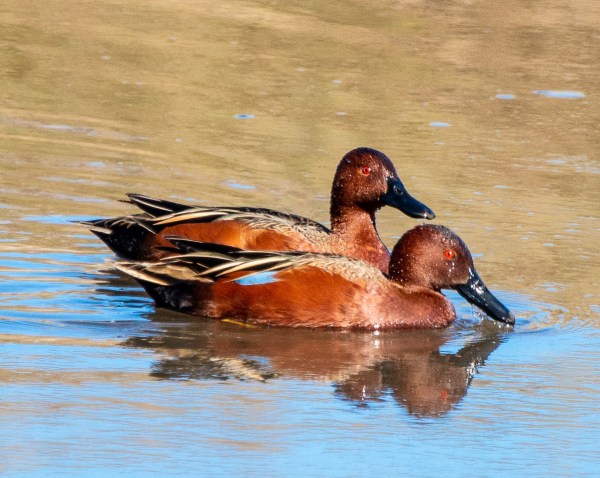
Cinnamon Teal have baby-blue speculums and (look closely) olive-green feathers on their back (Ray Juncosa 2-24-19)
We’ve been keeping track of the lagoon outlet location, and it’s moved about as far east as it can, now exiting close to the south fence of the Adamson House property. Occasionally the last 30-40 feet of downhill slope will swing farther east, almost to the lifeguard station just east of Adamson house, but often the outlet stops moving and closes after the springtime rains cease. I mention this because I recently got into a “discussion” with a long-time local surfer who maintained that once the opening appeared, it never moved. The left photo below (2/24/19) shows the opening disappearing off to the left, whereas the 11-30-18 photo shows it well to the west. The movement was actually greater than it appears from these photos, as the earlier photo was taken from the east end of the Pacific Coast Hwy bridge, but the later (right) photo was taken from the west end. Had the earlier photo been taken from this location, the opening probably would have been out-of-view to the right.
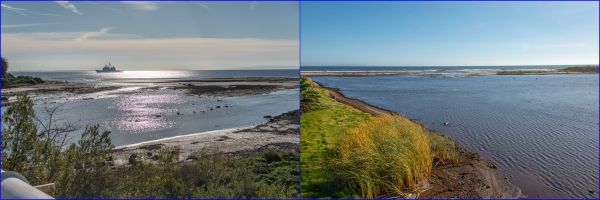
Lagoon outlet movement: Left 2-24-19, Right 11-30-18, 86 days earlier (Ray Juncosa both photos)
Below we have two aerial views. Left view is from 2004 and shows the extreme left exit. This exit was almost certainly dug by the “Surfers midnight bucket & shovel brigade,” as this was their preferred outlet location because it would (they said) help reinforce the offshore wave-making reefs with silt from the creek. (Photo from CaliforniaCoastline.org, found on the Surfrider.org website with the description “West is Best: Relocation of the Malibu Lagoon Inlet.”) Right view is from Google Satellite views and is almost certainly from mid-2013, following the 2012-13 lagoon reconfiguration project but before the revegetation project had begun to bloom. This shows the end stage of outlet movement when it curves around Adamson House and bends ENE towards Malibu Pier. We have many times witnessed outlet movement from extreme west to extreme east, a process taking 2-4 months. This happens because when the outlet stream hits the ocean it is pushed east by the prevailing eastward flow of the offshore current. This erodes the east bank faster than the west bank, so the outlet gradually moves eastward until stopped by the higher, more solid ground on which Adamson House sits.

Lagoon aerial views Left 2004 Right 2013
Malibu was having it’s irregularly-scheduled “Navy Days.” The navy sent Guided Missile Cruiser USS Lake Champlain to visit. It was quite imposing, sitting in the bay not far from the end of Malibu Pier.

Guided Missile Cruiser USS Lake Champlain visits Malibu for “Navy Days” (Larry Loeher 2-24-19)
Crewmen come ashore to mingle with the natives and have a good time, and (probably) people could go on board, poke around, perhaps fire off a few missiles as a warning to those pesky Topanga cannibal-pirates just down the coast.
Malibu Times Report 2/28/19
ABC Channel7 Report 2/23/19
Malibu Times Report 2/20/19

Two young Red-tailed Hawks (Ray Juncosa 2-24-19)
We found a young Red-tailed Hawk sitting high in one of the Colony’s cypress trees, which was soon joined by a second young Red-tailed Hawk. They were easy to locate because the local American Crow family found them first and repeatedly dived on them, cawing loudly all the while.
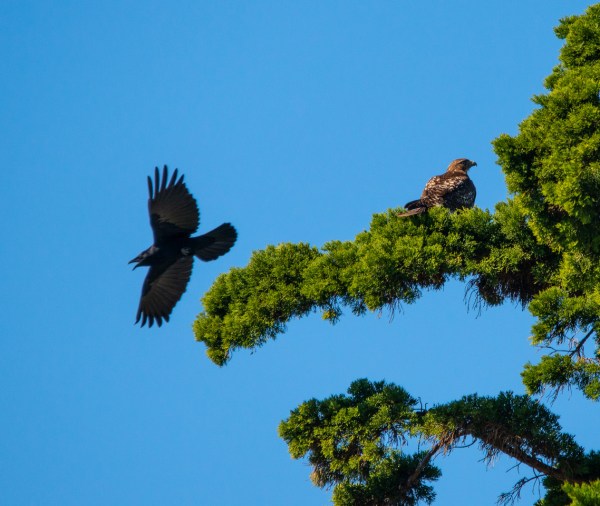
Our local crows strove mightily to drive off the Red-tailed Hawks (Ray Juncosa 2-24-19)
A group of Double-crested Cormorants, accompanied by a couple of Western Grebes, seemed fascinated by the colorful accessory one of their number was sporting.

Cormorants and grebes admire the ‘ankle bling’ (Ray Juncosa 2-24-19)
It turned out to be a leg band, or perhaps an felon’s-ankle-bracelet, mysteriously coded as “EN3.”
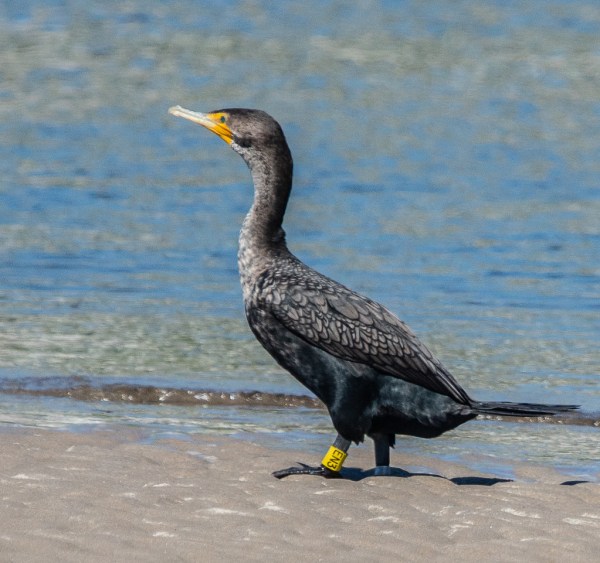
Double-crested Cormorant wearing his ‘EN3’ ankle ring (Ray Juncosa 2-24-19)

Song Sparrows like water, reeds and singing, not necessarily in that order (Larry Loeher 2-24-19)
As we were crossing PCH to go have lunch at John’s Cafe, three Nanday Parakeets flew in and lit on a branch overhead. These birds have become well-established in the riparian canyons along the Santa Monica Mountains where they nest in old woodpecker holes. They occasionally come by the lagoon, calling loudly as parrots in flight tend to do. Unfortunately none of us had a camera.
Birds new for the season were: Cinnamon Teal, Clark’s Grebe, Turkey Vulture, Nanday Parakeet, Dark-eyed Junco, Red-winged Blackbird.
Many thanks to our photographers: Ray Juncosa, Larry Loeher & Grace Murayama.

First-year White-crowned Sparrow, his corwn stripes just starting to molt to black & white (Ray Juncosa 2-24-19)
Our next three scheduled field trips: Sycamore Canyon, 8am 9 Mar; Malibu Lagoon 8:30 & 10am, 24 March; Malibu Creek State Park (or thereabouts) 8am, 13 Apr.
Our next program: “Member’s Slide Show,” MC’d by the inimitable Chuck Bragg. Tuesday, 5 March, 7:30 p.m., Chris Reed Park, 1133 7th St., NE corner of 7th and Wilshire Blvd. in Santa Monica.
NOTE: Our 10 a.m. Parent’s & Kids Birdwalk meets at the shaded viewpoint just south of the parking area. Watch for Willie the Weasel. He’ll be watching for you and your big floppy feet.
Links: Unusual birds at Malibu Lagoon recently updated with new photos
9/23/02 Aerial photo of Malibu Lagoon
Prior checklists:
2017: Jan-June, July-Dec 2018: Jan-June, July-Dec
2016: Jan-June, July-Dec 2015: Jan-May, July-Dec
2014: Jan-July, July-Dec 2013: Jan-June, July-Dec
2012: Jan-June, July -Dec 2011: Jan-June, July-Dec
2010: Jan-June, July-Dec 2009: Jan-June, July-Dec.
The 10-year comparison summaries created during the Lagoon Reconfiguration Project period, despite numerous complaints, remain available on our Lagoon Project Bird Census Page. Very briefly summarized, the results unexpectedly indicate that avian species diversification and numbers improved slightly during the period Jun’12-June’14.
Many thanks to Femi Faminu & Chris Lord for their contributions to the checklist below. [Chuck Almdale]
| Malibu Census 2018-19 | 9/23 | 10/28 | 11/25 | 12/23 | 1/27 | 2/24 |
| Temperature | 63-70 | 61-67 | 64-75 | 55-62 | 65-75 | 54-60 |
| Tide Lo/Hi Height | L+4.88 | H+5.83 | H+6.46 | H+6.87 | L+1.36 | L+0.84 |
| Tide Time | 0923 | 1143 | 0944 | 0850 | 0913 | 0708 |
| Cackling Goose | 1 | |||||
| Canada Goose | 1 | |||||
| Blue-winged Teal | 2 | |||||
| Cinnamon Teal | 2 | |||||
| Northern Shoveler | 2 | |||||
| Gadwall | 4 | 8 | 6 | 12 | ||
| American Wigeon | 12 | 5 | 4 | 8 | ||
| Mallard | 2 | 17 | 14 | 12 | 27 | 18 |
| Northern Pintail | 2 | |||||
| Green-winged Teal | 2 | 4 | 2 | 2 | ||
| Ring-necked Duck | 2 | |||||
| Greater Scaup | 2 | |||||
| Lesser Scaup | 2 | |||||
| Surf Scoter | 14 | |||||
| Bufflehead | 6 | |||||
| Red-breasted Merganser | 4 | 2 | 3 | 1 | ||
| Ruddy Duck | 61 | 95 | 2 | 3 | 5 | |
| Pied-billed Grebe | 1 | 2 | 1 | |||
| Horned Grebe | 1 | 1 | ||||
| Eared Grebe | 4 | 4 | 4 | |||
| Western Grebe | 4 | 2 | 2 | 22 | ||
| Clark’s Grebe | 1 | 1 | ||||
| Rock Pigeon | 47 | 23 | 12 | 22 | 13 | 17 |
| Mourning Dove | 4 | 2 | 2 | 2 | ||
| Anna’s Hummingbird | 2 | 1 | ||||
| Allen’s Hummingbird | 4 | 4 | 2 | 2 | 4 | 2 |
| American Coot | 27 | 17 | 85 | 58 | 38 | 36 |
| Black-necked Stilt | 2 | |||||
| Black-bellied Plover | 95 | 82 | 79 | 70 | 99 | 35 |
| Snowy Plover | 41 | 5 | 7 | 32 | 31 | |
| Killdeer | 8 | 2 | 7 | 14 | 17 | 10 |
| Whimbrel | 15 | 7 | 9 | 2 | 7 | 4 |
| Marbled Godwit | 14 | 13 | 15 | 14 | 17 | 23 |
| Ruddy Turnstone | 4 | 5 | 2 | 3 | 4 | 3 |
| Sanderling | 15 | 110 | 60 | 72 | 32 | |
| Least Sandpiper | 15 | 17 | 23 | 16 | ||
| Western Sandpiper | 9 | 2 | ||||
| Short-billed Dowitcher | 1 | |||||
| Spotted Sandpiper | 2 | 1 | 1 | 2 | ||
| Willet | 23 | 11 | 13 | 12 | 20 | 12 |
| Red-necked Phalarope | 9 | |||||
| Heermann’s Gull | 11 | 25 | 14 | 14 | 13 | 5 |
| Ring-billed Gull | 13 | 30 | 95 | 50 | 85 | |
| Western Gull | 81 | 20 | 45 | 75 | 127 | 98 |
| California Gull | 43 | 90 | 700 | 460 | 140 | |
| Herring Gull | 1 | 2 | ||||
| Glaucous-winged Gull | 1 | 1 | ||||
| Caspian Tern | 1 | |||||
| Royal Tern | 7 | 1 | 4 | 12 | ||
| Elegant Tern | 1 | |||||
| Red-throated Loon | 1 | |||||
| Pacific Loon | 2 | 1 | 1 | |||
| Common Loon | 2 | 2 | ||||
| Brandt’s Cormorant | 1 | 1 | 20 | |||
| Double-crested Cormorant | 22 | 23 | 34 | 42 | 31 | 24 |
| Pelagic Cormorant | 1 | 1 | 2 | 2 | ||
| Brown Pelican | 35 | 11 | 8 | 29 | 15 | 37 |
| Great Blue Heron | 3 | 2 | 2 | 2 | 2 | 1 |
| Great Egret | 3 | 2 | 2 | 1 | ||
| Snowy Egret | 9 | 12 | 11 | 7 | 5 | |
| Green Heron | 1 | |||||
| Black-crowned Night-Heron | 1 | 2 | ||||
| Turkey Vulture | 9 | 1 | ||||
| Osprey | 1 | |||||
| Cooper’s Hawk | 1 | 1 | ||||
| Red-shouldered Hawk | 1 | |||||
| Red-tailed Hawk | 1 | 1 | 1 | 1 | 2 | |
| Belted Kingfisher | 1 | 1 | ||||
| Peregrine Falcon | 1 | |||||
| Nanday Parakeet | 3 | |||||
| Black Phoebe | 2 | 4 | 3 | 6 | 4 | 6 |
| Say’s Phoebe | 2 | 5 | 2 | 1 | 1 | |
| Cassin’s Kingbird | 1 | |||||
| Warbling Vireo | 1 | |||||
| California Scrub-Jay | 1 | 1 | ||||
| American Crow | 8 | 13 | 2 | 6 | 9 | 6 |
| Barn Swallow | 1 | |||||
| Oak Titmouse | 1 | |||||
| Bushtit | 75 | 60 | 6 | 8 | 2 | |
| Rock Wren | 1 | |||||
| House Wren | 1 | 2 | 1 | 1 | ||
| Marsh Wren | 2 | 1 | 3 | 1 | ||
| Bewick’s Wren | 4 | 1 | 3 | 3 | 1 | 1 |
| Blue-gray Gnatcatcher | 3 | 3 | 12 | 10 | 1 | 2 |
| Ruby-crowned Kinglet | 5 | 3 | 2 | |||
| Wrentit | 4 | 3 | ||||
| Hermit Thrush | 1 | 1 | 3 | 2 | ||
| Northern Mockingbird | 2 | 2 | 1 | 1 | 2 | |
| European Starling | 35 | 24 | 8 | 35 | 3 | |
| American Pipit | 1 | 1 | 1 | |||
| House Finch | 11 | 2 | 10 | 30 | 28 | 15 |
| Lesser Goldfinch | 1 | 5 | ||||
| Spotted Towhee | 1 | 2 | ||||
| California Towhee | 6 | 1 | ||||
| Savannah Sparrow | 2 | 1 | ||||
| Song Sparrow | 9 | 6 | 3 | 4 | 5 | 15 |
| White-crowned Sparrow | 4 | 4 | 27 | 15 | 18 | |
| Golden-crowned Sparrow | 1 | 1 | ||||
| Dark-eyed Junco | 2 | 2 | ||||
| Western Meadowlark | 2 | 2 | 3 | 2 | 2 | |
| Red-winged Blackbird | 25 | 1 | 3 | 4 | ||
| Great-tailed Grackle | 6 | 7 | 3 | 2 | 6 | 3 |
| Orange-crowned Warbler | 3 | 1 | ||||
| MacGillivray’s Warbler | 1 | |||||
| Common Yellowthroat | 6 | 4 | 3 | 10 | 5 | 5 |
| Yellow Warbler | 2 | |||||
| Yellow-rumped(Aud) Warbler | 38 | 18 | 27 | 20 | 16 | |
| Black-throated Gray Warbler | 2 | |||||
| Townsend’s Warbler | 1 | |||||
| Wilson’s Warbler | 1 | |||||
| Totals by Type | Sep | Oct | Nov | Dec | Jan | Feb |
| Waterfowl | 2 | 83 | 146 | 47 | 45 | 48 |
| Water Birds – Other | 89 | 56 | 139 | 139 | 90 | 146 |
| Herons, Egrets & Ibis | 17 | 2 | 18 | 15 | 10 | 6 |
| Quail & Raptors | 11 | 1 | 2 | 3 | 1 | 3 |
| Shorebirds | 234 | 125 | 261 | 193 | 294 | 168 |
| Gulls & Terns | 136 | 59 | 186 | 886 | 657 | 341 |
| Doves | 51 | 23 | 12 | 24 | 15 | 19 |
| Other Non-Passerines | 6 | 5 | 2 | 3 | 4 | 6 |
| Passerines | 210 | 187 | 96 | 149 | 150 | 107 |
| Totals Birds | 756 | 541 | 862 | 1459 | 1266 | 844 |
| Total Species | Sep | Oct | Nov | Dec | Jan | Feb |
| Waterfowl | 1 | 5 | 12 | 7 | 6 | 7 |
| Water Birds – Other | 5 | 5 | 9 | 9 | 7 | 10 |
| Herons, Egrets & Ibis | 5 | 1 | 4 | 3 | 3 | 2 |
| Quail & Raptors | 3 | 1 | 2 | 3 | 1 | 2 |
| Shorebirds | 11 | 7 | 11 | 9 | 11 | 10 |
| Gulls & Terns | 4 | 4 | 5 | 6 | 7 | 6 |
| Doves | 2 | 1 | 1 | 2 | 2 | 2 |
| Other Non-Passerines | 2 | 2 | 1 | 2 | 1 | 3 |
| Passerines | 24 | 25 | 25 | 20 | 20 | 19 |
| Totals Species – 110 | 57 | 51 | 70 | 61 | 58 | 61 |
Birds and the Gibraltar Neanderthals

The Neanderthal woman nicknamed Nana, reconstructed at the Gibraltar Museum, with feathers. (Credit: S. Finlayson/Gibraltar National Museum)
Clive Finlayson, his wife Geraldine and son Stewart are birdwatchers. They are also anthropological researchers specializing in our Homo sapiens sapiens (aka “human”) and Neanderthal (what most people now acknowledge as Homo sapiens neanderthalensis) ancestors, and Clive has been the director of the Gibraltar National Museum for almost 30 years. “The Rock” has turned out to be a trove of Neanderthal bones and discoveries about Neanderthal behavior. Especially their relationship with birds.
Sea levels were significantly lower when Neanderthals lived there, due to the large Ice Age ice caps. Bird bones representing 160 species, about 30% of European avian species of that time, have been found, including Pine Grosbeak, ducks, choughs, larks, gannets, eagles and vultures. Tool marks left on the bones indicate that some of the species on Gibraltar were processed for food or, more controversially, for their feathers. Finlayson reminds us that birds come in many shapes and sizes, with a variety of behaviors and responses to humans, which implies that their exploitation would have required sophisticated knowledge.
How much did the Neanderthals know about the birds? How might their relationships with birds have affected the development of their minds? Read the rest of this book review from Nature in Trail of Feathers to the Neanderthal Mind. The book is anthropologist Clive Finlayson’s The Smart Neanderthal: Bird Catching, Cave Art and the Cognitive Revolution, now out from Oxford University Press. [Chuck Almdale]



 SANTA MONICA BAY AUDUBON SOCIETY BLOG