Free email delivery
Please sign up for email delivery in the subscription area to the right.
No salesman will call, at least not from us. Maybe from someone else.
Blog News – Advertising
You may have noticed advertising appearing on the bottom of emailed blog postings, and on the blog itself. We noticed their appearance starting with the Sept. 28, 2018 posting. There is nothing SMBAS can do about these ads or “you might like” postings. We use a free version of WordPress for our blog and we would have to pay for the ads to go away. WordPress has always had the right to insert these ads which they say “offset the cost of supplying the program for free,” but they haven’t done so until now. Rumor has it that this has something to do with communicating with FaceBook, but we don’t know if that’s true.
We like WordPress and think it’s a very good webhost (and we’re used to it), so we’re going to stay with it. If you don’t like the ads at the bottom, please ignore them. If you save the emails from out blog, you can delete the ads from them while saving our critically important text and fabulous photos.
We’ve put a message permanently into the right sidebar which reads:
Advertising on this site and in the
emails sent to subscribers is inserted
by WordPress and not by SMBAS.
Thank you for your attention.
[Chuck Almdale]
How Evolution Turned A Possum Into A Wolf | PBS Science Video
Until the early 20th century, Tasmania was home to a very weird wolf-like creature. Except that it wasn’t a wolf. Even though it looked like a wolf. How did that happen? Here’s the science of convergent evolution! Want to see more of the interview with Rob? Click here.
After you’ve watched this video, you can go back to my Malibu Lagoon 9/23/18 trip blog, check out again the photo of the lobed toes of the Coot, and read my attempt at explaining convergent evolution.
This is an installment of the PBS – It’s OK to be Smart series. If no film or link appears in this email, go to the blog to view it by clicking on the blog title above. If the film stops & starts in an annoying manner, press pause (lower left double bars ||) to let it buffer and get ahead of you. [Chuck Almdale]
Voices: Willow Ptarmigan | Cornell Lab of Ornithology
There are few birds whose vocalizations are as comical as those of the Willow Ptarmigan. The Lab’s Charles Eldermire describes the experience of hearing this arctic grouse first hand.
A film from the Cornell Lab of Ornithology. If no film or link appears in this email, go to the blog to view it by clicking on the blog title above. If the film stops & starts in an annoying manner, press pause (lower left double bars ||) to let it buffer and get ahead of you. The Lab is a member-supported organization; they welcome your membership and support. [Chuck Almdale]
You shop – Amazon gives to SMBAS
NOTE: Advertisements (or “you might like” blurbs) began appearing 9/28/18 at the bottom of our emailed blogs. This particular posting, was written on 9/27 and posted on 9/29/18. It’s possible it has something to do with these ads. As an experiment, on 9/20/18, I de-linked it’s web addresses to Amazon and replaced them with the complete web address, which you can copy and paste into your browser. Needless to say, the appearance of these items was unexpected and annoying, but WordPress has long given us the warning that such ads may appear because we are using their free version. I have no idea if this de-linking will cure the problem. If it doesn’t, I am open to suggestions as to what to do to get rid of the ads in the emails. Sans solution, we’ll have to live with this. [Chuck Almdale, Blog Editor]
ATTENTION SHOPPERS!
Were you aware that your online shopping with Amazon could benefit
Santa Monica Bay Audubon Society?
Amazon donates 0.5% of the price of your eligible “AmazonSmile” purchases to the charitable organization of your choice, at no additional cost to you.
Simply start your shopping at smile[dot]amazon[dot]com/, select Santa Monica Bay Audubon Society as your charity of choice, and that’s it!
AmazonSmile is the same Amazon you know. Same products, same prices, same service.
Some SMBAS members have already done this. One commented:
“…all I did was to go to Smile[dot]Amazon[dot]com, use my usual Amazon log in and password and choose Santa Monica Bay Audubon Society as the charity. Very very easy.”
Link to: “AmazonSmile’ Program Details:
smile.amazon.com/gp/chpf/pd/ref=smi_ge_uaas_lpd_upd
In addition to additional details, you can click “Get Started”
Or you can go direct to Signin: smile.amazon.com/
You’ll be asked for the email address you use for Amazon, and your Amazon password.
If you don’t already have an Amazon account, you can create one here.
You’ll then be asked for the charitable organization you want the 0.5% to go to.
Enter: Santa Monica Bay Audubon Society
Then click “Search.”
This should pop up: “Santa Monica Bay Audubon Society Pacific Plsds CA”
Click “Select” and you’re done.
The black banner across the top of your screen now says “Amazon Smile” in the upper left corner, and “Supporting: Santa Monica Bay Audubon Society” near the middle.
Other than that, your shopping experience and the prices you pay are unchanged.
From now on, when you shop at Amazon:
- You have to do it through smile.amazon.com (there is no link from regular amazon.com)
- Enter your email and password
- SMBAS gets 0.5% of your purchase price at no cost to you
- We suggest you bookmark smile.amazon.com to always sign in through smile
[Chuck Almdale]
More Birds, Fewer Mullet: Malibu Lagoon, 23 September, 2018
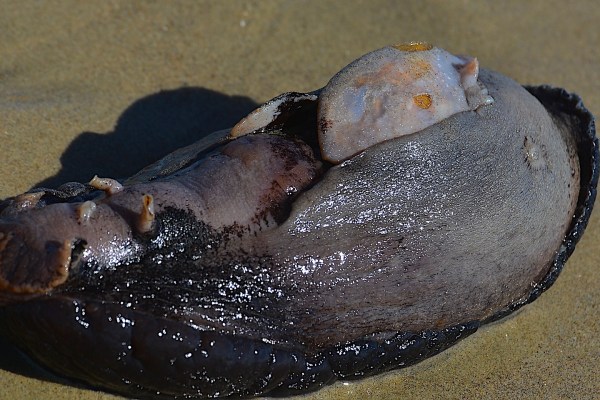
Seafood lovers alert! A mortified Sea Hare on the beach. It tastes just like Land Hare, or so I am told. (G. Murayama 9-21-18)
We didn’t have any shocks (later for the surprise) like last month when the lagoon and channel were covered with dead Striped Mullet. Somewhere between 3000 and 6000 dead fish were removed by lucky State Parks personnel during the final week of August. I for one was stunned that the lagoon held that many fish. More fish were removed during the past week (I assume) as on Sep. 15 I counted 289 dead mullet along the northwest lagoon/channel shoreline, and well under 100 today in the same area. Some research results point towards low dissolved oxygen (DO) in the water as the mortality culprit. This could interrelate with water temperature; as water temperature goes up, DO goes down.
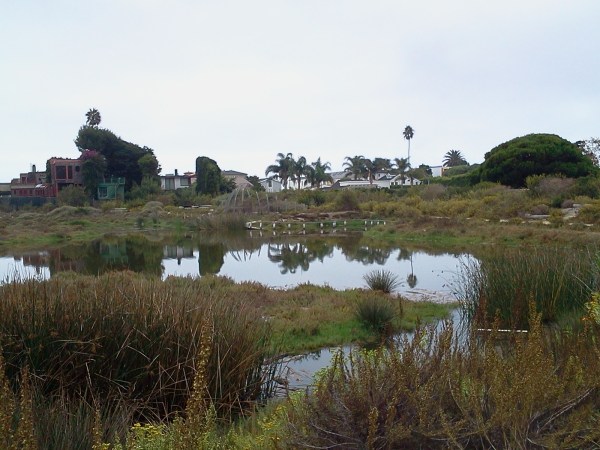
View across west channel towards Malibu Colony shows very few dead mullet.
Compare to last month. (L. Johnson 9-23-18)
Migrants are definitely returning. Very few birds are on or in the water of the lagoon or channel. The Red-necked Phalaropes, many twirling close to shore, were one of the few exceptions. Their twirling creates a vortex which brings edibles up the the surface where the birds can snap them up with their needle-like bills.
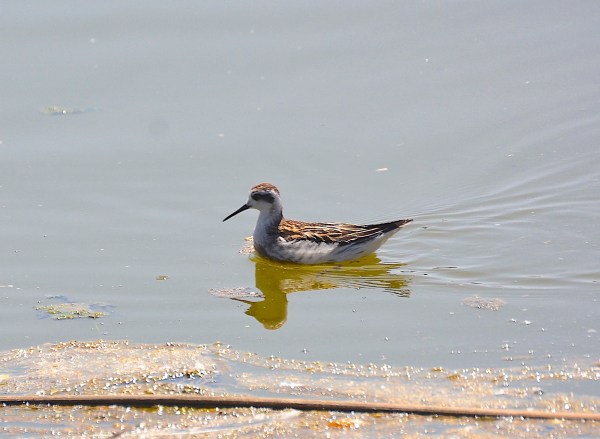
Red-necked Phalarope (G. Murayama 9-21-18)
Coot numbers are growing and they are busily paddling around the lagoon.

Coots have lobed toes, not webbed feet. Convergent evolution strikes again!
(G. Murayama 9-08-18)
Coots are common all across America and birders tend to ignore them. Non-birders usually assume coots are some sort of duck as they’re often out swimming with the ducks, but they’re actually far more closely related to cranes. This relationship is not obvious: Whooping Cranes, for example, are 52″ long, whereas the Coot is 15.5″ long. Unlike the wide duck bill, the coot bill is laterally compressed. Most interesting (to me) is their feet. Ducks have wide fully-webbed feet, great for swimming, lousy for walking. Coots have lobed toes, one lobe for every toe-bone. The lobes make them good swimmers – although probably a bit less efficient than ducks – and the lack of webbing allows them to easily walk on land. We often see flocks of them grazing across park lawns. This difference points to the separate evolutionary paths of ducks and coots. They now share their aquatic habitat, but natural selection solved their problems of efficiently swimming in different manners. In evolutionary biology, convergent evolution is the process whereby organisms not closely related (not monophyletic), independently evolve similar traits as a result of having to adapt to similar environments or ecological niches.
If my explanation of convergent evolution doesn’t work for you, watch this video from the “It’s OK to be Smart” PBS people.
There, that ought to hold you for a while.
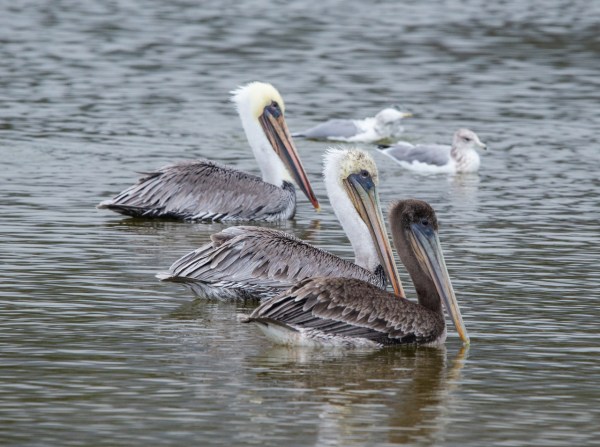
Brown Pelican trio (R. Juncosa 9-23-18)
Black-bellied Plover and Whimbrel numbers are down, but all the other shorebird, pelican, cormorant and gull numbers were up. The terns, save for one lonely Caspian, must have been off feeding somewhere out on the sea.
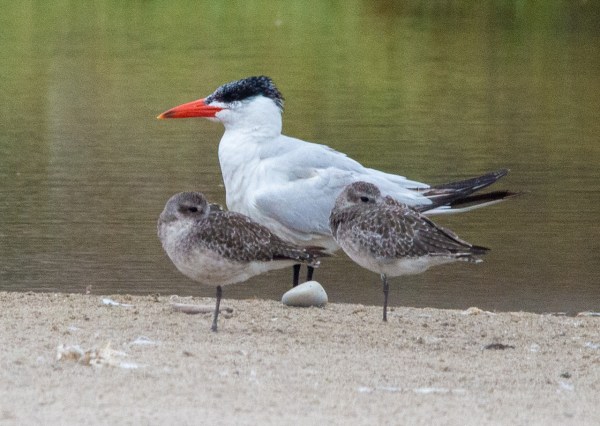
Caspian Tern, resting Black-bellied Plovers, and stone (R. Juncosa 9-23-18)
The Osprey was seen in the early morning in the large Aracaria evergreen tree on the Adamson House property. We’ve often seen them there in the past, concealed among the large shady branches.
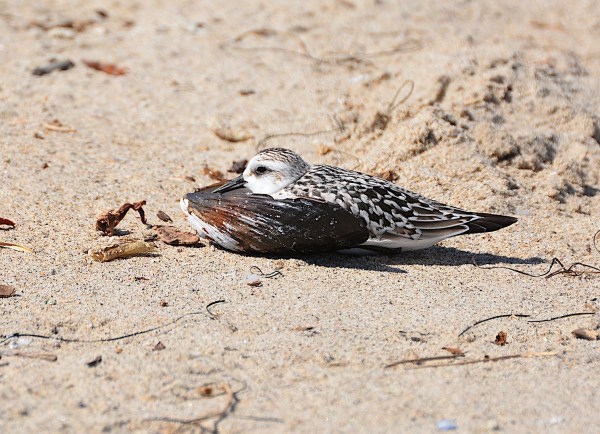
Sanderling emerges from a mussel shell. Perhaps aging Gooseneck Clams really do become Barnacle Geese, as once believed. (G. Murayama 9-21-18)
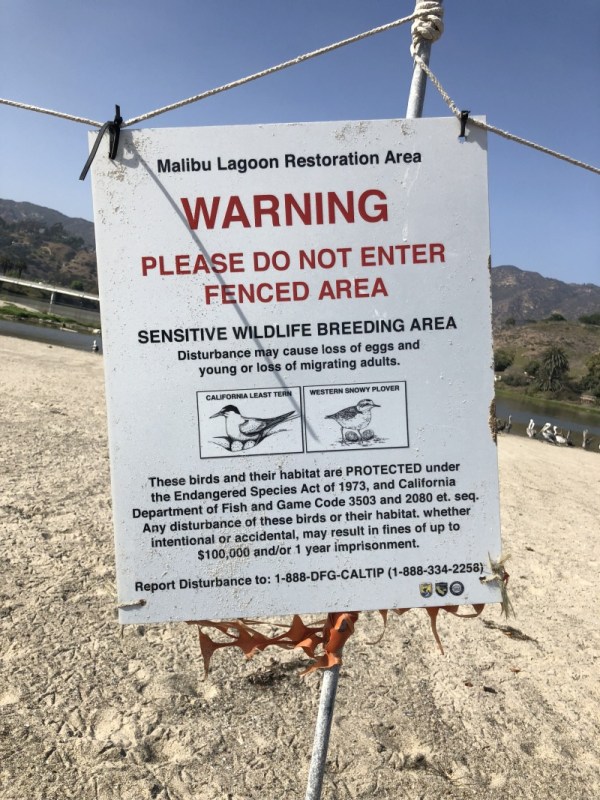
Plover sign on the virtual fence (D. Roberts 9-20-18)
Snowy Plover numbers continue to grow. We had 41 birds, including banded bird gg:pg (left: green over green, right pink over green). This bird was banded this summer at Oceano Dunes SVRA, near Pismo Beach on the central California coast. They were all resting together outside the east end of the virtual fence. The surf had eaten away the sand right up to the fencepoles, and it was moved inland on Sep. 20 about 3 pm. Now the beachwalkers don’t have to walk within the exclosure in order to stay out of the waves. I wonder how long this will last, as high surf, notorious for eating beaches, is heading north from the Baja hurricane.
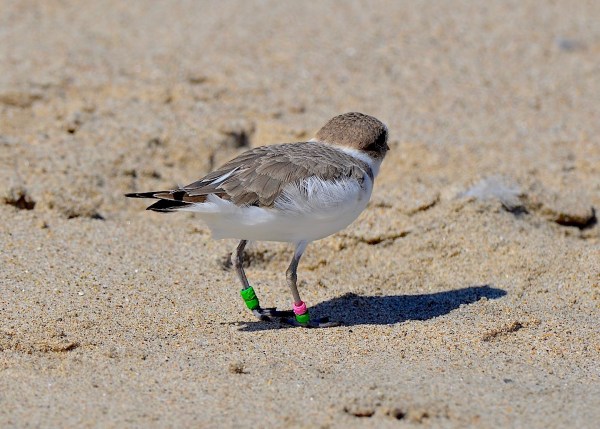
Snowy Plover gg:pg, born Summer 2018 at Oceano Dunes.
(G. Murayama 9-21-18)
Passerines were definitely passing through. Seventy-five Bushtits was an all-time lagoon high. Our common wintering warbler, the Yellow-rumped, has not arrived, but still we had four species of warbler.

Bushtit in – of all places – the bushes (G. Murayama 9-14-18)
Of greatest surprise among the passerines was a single MacGillivray’s Warbler, seen along the border fence between Adamson House and the easternmost section of lagoon, skulking low in the brush near the tree overhanging the lagoon. I (alone, unfortunately) watched it for several minutes before it disappeared into the brush to the west, below the palms south of the boathouse. This is the first new species for our 4th Sunday lagoon birdwalks since the White Pelicans showed up in October, 2017. We unfortunately can’t count the Magnificent Frigatebird from Aug. 10, 2018, as it was not there during our bird walk. The lagoon has hosted dozens of species whose visits fell outside our census dates. As of 10-1-18, eBird shows a total of 305 species reported for the lagoon, of which I have reported 236, or 77%.
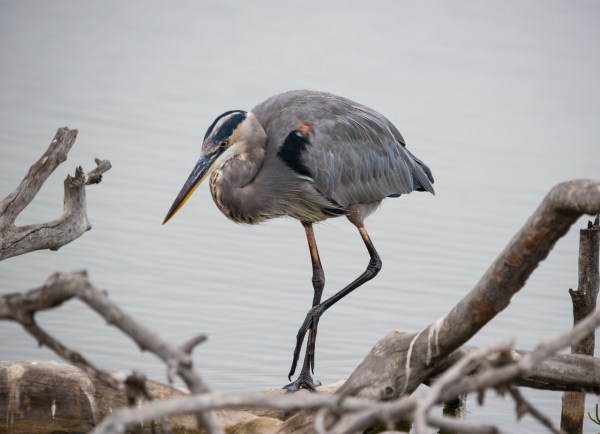
Great Blue Heron, still heavily colored on shoulder (R. Juncosa 9-23-18)
Birds new for the season were: Eared Grebe, Anna’s Hummingbird, Western Sandpiper, Short-billed Dowitcher, Green Heron, Osprey, Cooper’s Hawk, Say’s Phoebe, Warbling Vireo, California Scrub-Jay, House Wren, Blue-gray Gnatcatcher, Savannah Sparrow, Dark-eyed Junco, Western Meadowlark, Orange-crowned, MacGillivray’s & Yellow Warbler, Common Yellowthroat. Anna’s Hummingbird and California Scrub-Jay are always around somewhere, but sometimes we just miss them.
Many thanks to our photographers: Lillian Johnson, Ray Juncosa, Larry Loeher, Grace Murayama, & Diana Roberts.

Juvenile Black-crowned Night-Heron (R. Juncosa 9-23-18)
Our next three scheduled field trips: Huntington Beach Central Park, 8am, 13 October; Butterbredt Springs Fall Campout 8:30am, 27-28 October; Malibu Lagoon 8:30 & 10am, 28 October.
Our next program: Luke Tiller will present “Tails from the Platform: Hawks, Hawkwatchers and Hawkwatching”: Tuesday, 2 October, 7:30 p.m., Chris Reed Park, 1133 7th St., NE corner of 7th and Wilshire Blvd. in Santa Monica.
NOTE: Our 10 a.m. Parent’s & Kids Birdwalk meets at the shaded viewpoint just south of the parking area. Watch for Willie the Weasel. He’ll be watching for you and your big floppy feet.
Links: Unusual birds at Malibu Lagoon
9/23/02 Aerial photo of Malibu Lagoon
Prior checklists:
2017: Jan-June, July-Dec 2018: Jan-June
2016: Jan-June, July-Dec 2015: Jan-May, July-Dec
2014: Jan-July, July-Dec 2013: Jan-June, July-Dec
2012: Jan-June, July -Dec 2011: Jan-June, July-Dec
2010: Jan-June, July-Dec 2009: Jan-June, July-Dec.

The rope & pole “virtual fence” was moved. It had been where the beach berm is now. (L. Johnson 9-23-18)
The 10-year comparison summaries created during the project period, despite numerous complaints, remain available on our Lagoon Project Bird Census Page. Very briefly summarized, the results unexpectedly indicate that avian species diversification and numbers improved slightly during the period Jun’12-June’14.
Many thanks to Lillian Johnson, Chris Lord, Clyde Singleton and Chris Tosdevin for their contributions to the checklist below. [Chuck Almdale]
| Malibu Census 2018 | 4/22 | 5/27 | 6/24 | 7/22 | 8/26 | 9/23 |
| Temperature | 63-67 | 61-66 | 62-68 | 70-79 | 72-76 | 63-70 |
| Tide Lo/Hi Height | L-.15 | H+3.86 | H+3.50 | H+3.31 | H+4.36 | L+4.72 |
| Tide Time | 1028 | 0912 | 0826 | 0733 | 1030 | 0923 |
| Gadwall | 5 | 12 | 4 | 15 | ||
| Mallard | 4 | 15 | 12 | 12 | 6 | 2 |
| Pied-billed Grebe | 2 | |||||
| Eared Grebe | 4 | |||||
| Rock Pigeon | 1 | 3 | 2 | 6 | 30 | 47 |
| Eurasian Collard-Dove | 2 | |||||
| Mourning Dove | 1 | 2 | 2 | 4 | ||
| Anna’s Hummingbird | 1 | 1 | 2 | |||
| Allen’s Hummingbird | 3 | 1 | 2 | 4 | ||
| American Coot | 2 | 4 | 1 | 1 | 27 | |
| Black-necked Stilt | 1 | |||||
| Black-bellied Plover | 9 | 1 | 17 | 125 | 95 | |
| Snowy Plover | 9 | 3 | 4 | 9 | 33 | 41 |
| Semipalmated Plover | 4 | |||||
| Killdeer | 7 | 4 | 8 | 8 | 4 | 8 |
| Whimbrel | 3 | 6 | 3 | 113 | 39 | 15 |
| Marbled Godwit | 30 | 3 | 14 | |||
| Ruddy Turnstone | 6 | 4 | ||||
| Sanderling | 45 | 7 | 3 | 15 | ||
| Least Sandpiper | 12 | |||||
| Western Sandpiper | 4 | 9 | ||||
| Short-billed Dowitcher | 1 | |||||
| Willet | 6 | 4 | 18 | 2 | 23 | |
| Red-necked Phalarope | 1 | 9 | ||||
| Bonaparte’s Gull | 2 | |||||
| Heermann’s Gull | 1 | 5 | 28 | 8 | 11 | |
| Ring-billed Gull | 1 | |||||
| Western Gull | 18 | 112 | 75 | 95 | 85 | 81 |
| California Gull | 4 | 2 | 4 | 43 | ||
| Least Tern | 9 | 2 | ||||
| Caspian Tern | 8 | 11 | 4 | 1 | 15 | 1 |
| Forster’s Tern | 2 | 3 | ||||
| Royal Tern | 2 | 1 | 6 | |||
| Elegant Tern | 30 | 130 | 4 | 11 | 48 | |
| Brandt’s Cormorant | 1 | 7 | ||||
| Dble-crest Cormorant | 18 | 15 | 7 | 16 | 15 | 22 |
| Pelagic Cormorant | 1 | 1 | ||||
| Brown Pelican | 32 | 68 | 5 | 5 | 7 | 35 |
| Great Blue Heron | 1 | 1 | 2 | 3 | 3 | 3 |
| Great Egret | 3 | 3 | 3 | 4 | 3 | |
| Snowy Egret | 1 | 4 | 5 | 10 | 25 | 9 |
| Green Heron | 1 | 1 | ||||
| Black-crowned Night-Heron | 2 | 1 | 1 | |||
| Turkey Vulture | 4 | 5 | 9 | |||
| Osprey | 1 | |||||
| Cooper’s Hawk | 1 | |||||
| Red-tailed Hawk | 1 | |||||
| Peregrine Falcon | 1 | |||||
| Black Phoebe | 1 | 2 | 3 | 3 | 2 | |
| Say’s Phoebe | 2 | |||||
| Warbling Vireo | 1 | |||||
| California Scrub-Jay | 1 | |||||
| American Crow | 2 | 2 | 4 | 4 | 2 | 8 |
| Violet-green Swallow | 2 | |||||
| Rough-wnged Swallow | 5 | 1 | 4 | |||
| Cliff Swallow | 8 | 1 | 3 | |||
| Barn Swallow | 4 | 10 | 15 | 25 | 16 | 1 |
| Bushtit | 1 | 20 | 27 | 60 | 30 | 75 |
| House Wren | 1 | |||||
| Bewick’s Wren | 1 | 4 | ||||
| Blue-gray Gnatcatcher | 3 | |||||
| Western Bluebird | 1 | |||||
| American Robin | 1 | |||||
| Northern Mockingbird | 2 | 2 | 2 | 2 | 2 | |
| European Starling | 13 | 35 | ||||
| House Finch | 4 | 5 | 8 | 6 | 11 | |
| Spotted Towhee | 2 | |||||
| California Towhee | 1 | 2 | 1 | 6 | ||
| Savannah Sparrow | 1 | 2 | ||||
| Song Sparrow | 10 | 5 | 5 | 2 | 6 | 9 |
| Dark-eyed Junco | 2 | |||||
| Western Meadowlark | 2 | |||||
| Hooded Oriole | 4 | |||||
| Red-winged Blackbird | 1 | 7 | 30 | 25 | ||
| Brown-head Cowbird | 2 | 2 | ||||
| Brewer’s Blackbird | 1 | |||||
| Great-tailed Grackle | 4 | 4 | 3 | 4 | 7 | 6 |
| Orange-crowned Warbler | 1 | 3 | ||||
| MacGillivray’s Warbler | 1 | |||||
| Common Yellowthroat | 1 | 6 | ||||
| Yellow Warbler | 2 | |||||
| Totals by Type | Apr | May | Jun | Jul | Aug | Sep |
| Waterfowl | 9 | 27 | 16 | 27 | 6 | 2 |
| Water Birds – Other | 52 | 88 | 21 | 22 | 24 | 89 |
| Herons, Egrets & Ibis | 4 | 9 | 10 | 17 | 32 | 17 |
| Quail & Raptors | 0 | 5 | 1 | 0 | 5 | 11 |
| Shorebirds | 90 | 56 | 41 | 149 | 215 | 234 |
| Gulls & Terns | 57 | 269 | 95 | 137 | 169 | 136 |
| Doves | 3 | 4 | 4 | 8 | 30 | 51 |
| Other Non-Passerines | 3 | 1 | 1 | 1 | 2 | 6 |
| Passerines | 37 | 66 | 69 | 161 | 75 | 210 |
| Totals Birds | 255 | 525 | 258 | 522 | 558 | 756 |
| Total Species | Apr | May | Jun | Jul | Aug | Sep |
| Waterfowl | 2 | 2 | 2 | 2 | 1 | 1 |
| Water Birds – Other | 3 | 4 | 4 | 3 | 4 | 5 |
| Herons, Egrets & Ibis | 3 | 4 | 3 | 4 | 3 | 5 |
| Quail & Raptors | 0 | 2 | 1 | 0 | 1 | 3 |
| Shorebirds | 8 | 6 | 6 | 5 | 9 | 11 |
| Gulls & Terns | 4 | 8 | 7 | 5 | 7 | 4 |
| Doves | 2 | 2 | 2 | 2 | 1 | 2 |
| Other Non-Passerines | 1 | 1 | 1 | 1 | 1 | 2 |
| Passerines | 15 | 12 | 11 | 15 | 9 | 24 |
| Totals Species – 80 | 38 | 41 | 37 | 37 | 36 | 57 |



 SANTA MONICA BAY AUDUBON SOCIETY BLOG