Free email delivery
Please sign up for email delivery in the subscription area to the right.
No salesman will call, at least not from us. Maybe from someone else.
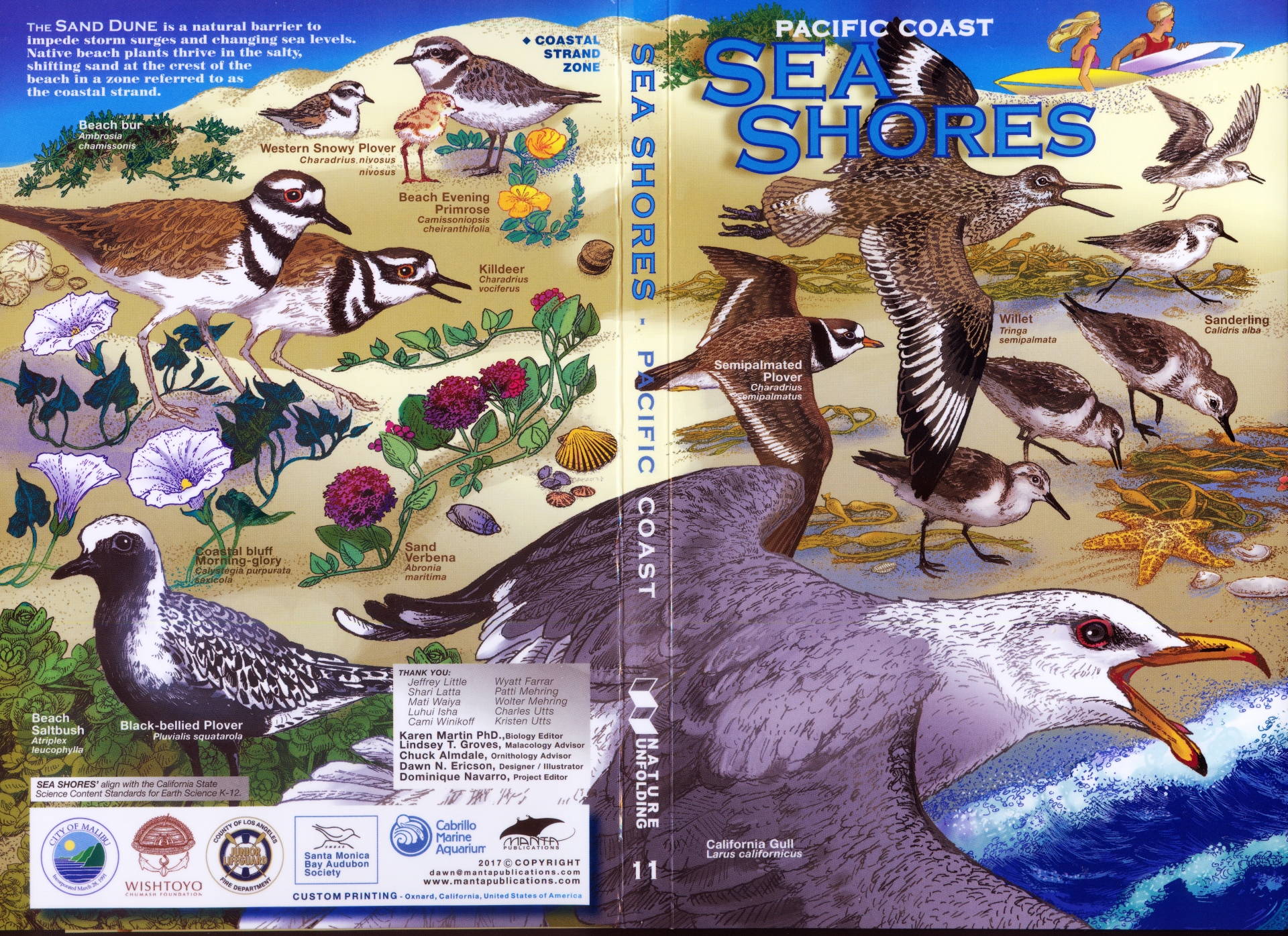
Pacific Coast Sea Shores science guide – front & back covers
Click photo to enlarge
On June 15, 2018, the City of Los Angeles, Los Angeles Fire Department’s Lifeguard Division – Junior Lifeguard Program began their 2018 season. The workshop included a presentation by Pepperdine Professor of Biology Karen Martin. Martin presented a slide show and a hands-on grunion fish hatchling demonstration, during which the Jr. Lifeguards watched tiny hatchlings take their first swim in small lab containers.
Each Junior Lifeguard also received a free copy of the Pacific Coast SEA SHORES science guide, created by Dawn Ericson of Manta Publications. Professor Martin wrote the text for the science guide. Our Santa Monica Bay Audubon Society contributed funding for this project and helped with the ornithological aspects. The science guide is a high-quality eight-page laminate which can be used in the field, and discusses birds, fish, invertebrates, kelp, tides and ecological zones.
Each Junior Lifeguard series lasts five weeks, and the enrollees get to keep the science guides and other materials after they finish. Participants are in three age groups: 9-11, 12-13 and 14-17 years old, with depth and format of instruction dependent upon the age and skill level of group. The program also includes instruction in water safety, swimming, body surfing, paddling, surfing, physical conditioning, competition skills, first aid, CPR and rescue techniques. The Junior Lifeguard program began fifty years ago with 150 enrollees. For 2018, it has grown to over 4,300 Junior Lifeguards enrolled. The second summer session ended August 17, but they’ll be doing it again next year.
For additional information visit:
Junior Lifeguard program slide show
Information and sign-up forms
Los Angeles County Junior Lifeguard page
Manta Publications blog on the science guide
[Chuck Almdale]

Pacific Coast Sea Shores science guide – seashores, kelp, ecological zones & tides – Click photo to enlarge
Display feathers are highly evolved versions of a basic feather. They no longer have the standard structure of a central quill and a vane made of tiny interlocking barbs. They’ve evolved into fluffy plumes or stiff wires, some with hard ornaments or tabs. These radical changes, and the muscles that let the bird move them, serve no purpose other than to improve the male’s chances during courtship. The Cornell Lab’s Ed Scholes explains. Filmed and photographed by Tim Laman.
There are currently seventy-two short films in the entire Birds-of-Paradise Project playlist, ranging from 26 seconds to 8:29. In the upcoming weeks, we will present some of our favorites.
A film from the Cornell Lab of Ornithology. If no film or link appears in this email, go to the blog to view it by clicking on the blog title above. If the film stops & starts in an annoying manner, press pause (lower left double bars ||) to let it buffer and get ahead of you. [Chuck Almdale]
Visit the La Brea Tar Pits, our favorite bilingual redundancy, both inside and out. 50,000 years of local prehistory can’t be wrong.
This comes from the Natural History Museum of Los Angeles County. If no film or link appears in this email, go to the blog to view it by clicking on the blog title above. If the film stops & starts in an annoying manner, press pause (lower left double bars ||) to let it buffer and get ahead of you. [Chuck Almdale]
Malibu Lagoon Field Trips: Sunday, 26 August, 8:30 & 10am.

Ho hum – Just another young Magnificent Frigatebird crusing o’er Malibu Lagoon (Larry Loeher, 8-10-18)
Yes, it’s true. Larry Loeher and Grace Murayama were exceedingly fortunate a few weeks ago, and not only (1) saw a Magnificant Frigatebird flying over the lagoon approaching “from inland,” but (2) got a photo of it in flight, and (3) it’s a good photo!, not a blurry “record shot.” In forty years, I’ve never seen this species in California, just to give you an idea of how uncommon they are around here.
I should add that several tropical pelagic species seem to be popping up more often, particularly frigatebirds and boobies: two Red-footed Boobies at Moss Landing way up north in Monterey County, and several Nazca and Nazca/Masked Boobies in the Los Angeles & Orange County areas. Oceanic water temperatures are very high right now; on August 1, Scripps Institution of Oceanography in La Jolla recorded 78.6°F off their pier., a 102-year record. Here’s the Sea Surface Temperature map from Aug, 20, 2018:
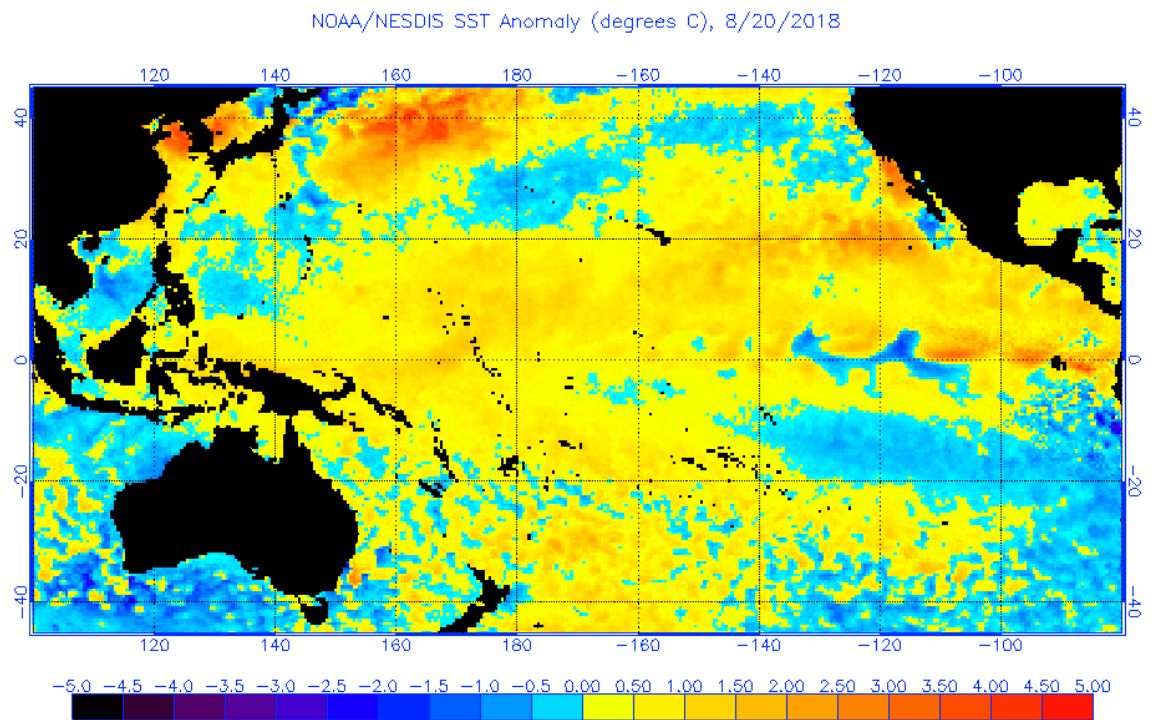
Water Temp Pacific 8-20-18 from NOAA
You can see that there’s a real hot spot from just west of Santa Barbara which runs south about 1/2 way down Baja California, plus a much larger one just south & southwest of it. You can access this map, plus a lot more, for any date here. So come to the lagoon this Sunday; maybe the frigatebird will cruise by again.
The migrating shorebirds are picking up in numbers and diversity as are gulls and terns. Many may still have their bright breeding plumages. Migrating Snowy Plovers are returning from breeding.
Some of the great birds we’ve had in August are: Green-winged Teal, Brandt’s & Pelagic Cormorant, Snowy Egret, White-faced Ibis, Osprey, White-tailed Kite, Red-tailed Hawk, Semipalmated Plover, Spotted Sandpiper, Ruddy & Black Turnstones, Sanderling, Western & Least Sandpipers, Pectoral Sandpiper, Short-billed Dowitcher, Least, Forster’s, Royal & Elegant Tern, Black Skimmer, White-throated Swift, Belted Kingfisher, Merlin, Western Wood-Pewee, Ash-throated Flycatcher, Western Kingbird, Oak Titmouse, House Wren, Orange-crowned, Warbler & Wilson’s Warbler, Common Yellowthroat, Savannah, Song & Lincoln’s Sparrow, Western Tanager, Red-winged Blackbird, Bullock’s Oriole.
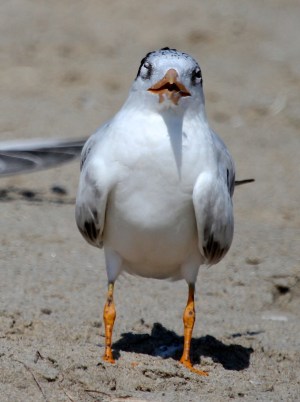
Royal Tern – drowsy, perhaps?
(J. Waterman 8-28-16)
Adult Walk 8:30 a.m. – Beginner and experienced, 2-3 hours. Species range from 40 in June to 60-75 during migrations and winter. We meet at the metal-shaded viewing area (see photo below) next to the parking lot and begin walking east towards the lagoon. We always check the offshore rocks and the ocean. When lagoon outlet is closed we continue east around the lagoon to Adamson House. We put out special effort to make our monthly Malibu Lagoon walks attractive to first-time and beginning birdwatchers. So please, if you are at all worried about coming on a trip and embarrassing yourself because of all the experts, we remember our first trips too. Someone showed us the birds; now it’s our turn.
Children and Parents Walk 10:00 a.m. One hour session, meeting at the metal-shaded viewing area between parking lot and channel. We start at 10:00 for a shorter walk and to allow time for families to get it together on a sleepy Sunday morning. Our leaders are experienced with kids so please bring them to the beach! We have an ample supply of binoculars that children can use without striking terror into their parents. We want to see families enjoying nature. (If you have a Scout Troop or other group of more than seven people, you must call Jean (310-472-7209) to make sure we have enough binoculars and docents.)
Map to Meeting Place
Directions: Malibu Lagoon is at the intersection of Pacific Coast Highway and Cross Creek Road, west of Malibu Pier and the bridge. Look around for people wearing binoculars.
Parking: Parking machine recently installed in the lagoon lot: 1 hr $3; 2 hrs $6; 3 hrs $9, all day $12 ($11 seniors); credit cards accepted. Annual passes accepted. You may also park (read the signs carefully) either along PCH west of Cross Creek Road, on Cross Creek Road, or on Civic Center Way north (inland) of the shopping center. Lagoon parking in shopping center lots is not permitted.
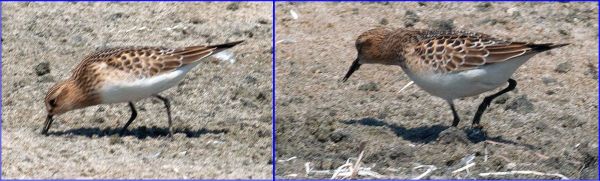
Baird’s Sandpipers repeatedly appear in August
(Kirsten Wahlquist, both photos 8-28-16)
Prior checklists:
2017: Jan-June, July-Dec 2018: Jan-June,
2016: Jan-June, July-Dec 2015: Jan-May, July-Dec
2014: Jan-July, July-Dec 2013: Jan-June, July-Dec
2012: Jan-June, July -Dec 2011: Jan-June, July-Dec
2010: Jan-June, July-Dec 2009: Jan-June, July-Dec.
[Chuck Almdale]
Spoon-billed Sandpiper: Hatch | Cornell Lab of Ornithology
Spoon-billed Sandpipers lay 4 eggs in a simple tundra nest comprised of a shallow depression, most often in mosses, lined with a few dwarf willow leaves. The nest is incubated by both adults on half-day shifts — the male most often during the day and the female at night. After 21 days of incubation the eggs begin to hatch in a process that takes a day or more to complete. When the young finally emerge from the nest they stumble about on well-developed legs and feet and begin to feed themselves. After the last chick emerges, the male begins his job of leading the chicks as they grow towards independence about 20 days later; the female soon departs and begins moving south. This piece captures the first moments of life at a wind swept Spoon-billed Sandpiper nest. Video includes commentary by The Cornell Lab’s Gerrit Vyn. Filmed July 7, 2011 near Meinypilgyno, Chukotka, Russia.
A film from the Cornell Lab of Ornithology. If no film or link appears in this email, go to the blog to view it by clicking on the blog title above. If the film stops & starts in an annoying manner, press pause (lower left double bars ||) to let it buffer and get ahead of you. The Lab is a member-supported organization; they welcome your membership and support. [Chuck Almdale]



 SANTA MONICA BAY AUDUBON SOCIETY BLOG