Free email delivery
Please sign up for email delivery in the subscription area to the right.
No salesman will call, at least not from us. Maybe from someone else.
The Tiny Key to Ageing | PBS BrainCraft Video
You’ll never grow younger and you can’t stay the same. What’s left?
This is an installment of the PBS – BrainCraft series. If no film or link appears in this email, go to the blog to view it by clicking on the blog title above. If the film stops & starts in an annoying manner, press pause (lower left double bars ||) to let it buffer and get ahead of you. [Chuck Almdale]
A Really Cool June – Malibu Lagoon, 24 June, 2018

View down north channel to Adamson House (Lillian Johnson 6-24-18)
The weather was quite pleasant for a December field trip: overcast, cool, a slight breeze riffling the lagoon. Several birders, lacking sufficient warm clothing, left early. Some might complain, I suppose, insisting, “But it’s June! It’s supposed to be hot and sunny!” Not I. Some might grumble and call it, “June Gloom.” I call it, “A welcome respite from intolerable heat.” But then I long ago gave up lying for hours in the baking sun, trying to develop the healthy glow of a deep tan. Live and learn.

Funny bunny – is it sitting on eggs? (Grace Murayama 5-27-18)
About twenty birders showed up, most of them new to the lagoon and its birds. I suspect that the regulars, knowing the avian paucity they would encounter, stayed away. I warned those present not to expect a lot, as June is the cruelest month with few birds and low diversity. On the other hand, it can only improve as we move towards winter.
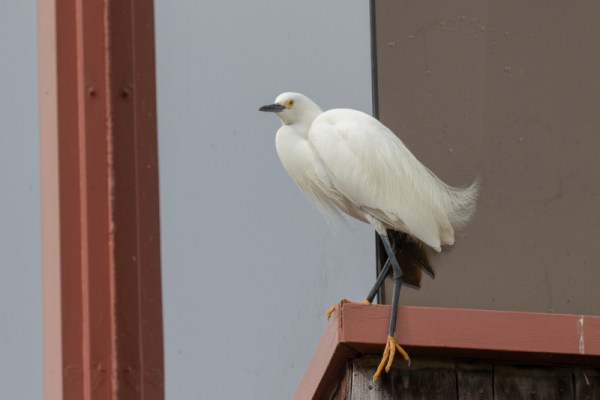
Everyone always wants to see the famous Western Roof-Egret
(Randy Ehler 5-27-18)
There were plenty of Barn Swallows cruising lagoon and beach, sipping water while on the wing, nabbing any insect foolish enough to leave the safety of the sand. I doubt that Swallows can easily process brackish water, as sea birds can safely drink sea water. However, as the lagoon is quite calm and stirring and mixing of the water may be minimal, it could be that salty water, more dense than fresh water, sinks and stays at the bottom, leaving the lighter fresh water at the surface.

Looking over the west channel to the Malibu Colony (L. Johnson 6-24-18)
The mullet were jumping. That Ph.D. is still available to anyone who can determine exactly why they jump. I’ve enquired of several fish people (shades of “The Shape of Water”) why they do this, and always receive the same set of possibilities: displaying to the opposite sex, displaying to the same sex, catching aerial insects, avoiding predators, dislodging skin parasites, gulping oxygen, it’s good exercise and stimulates the skin and circulation, it’s just plain fun. My money is on the last.

Heliotrope doesn’t follow the sun (L. Johnson 6-24-18)
Heliotrope is currently growing in numerous locations. Of Greek origin, the name means the sun (Helios) + to follow (trepein). Wikipedia says the flowers don’t actually follow the sun, as will sunflowers of many sorts. Did you know that heliotrope is a sign of – in the “language of flowers” (whatever that is) – eternal love, prophetic dreams, healing, wealth and invisibility? (Power Flowers) I’ll bet not. Possessing the power of invisibility rings true in the sense that the plant might kill you and you “shuffle off this mortal coil.” All parts of the plant are “poisonous…cause gastric distress in humans and animals…has slow acting liver toxin which causes liver damage (atrophic hepatosis)… sometimes has a high death rate in cattle…might cause photosensitization…sudden hemolytic jaundice as a response to the toxin and eventually death.” Just because something is natural doesn’t make it either good or safe to eat. (Poisonous Plants – Heliotrope)

Crow eating Killdeer chick (G. Murayama 6-22-18)
Song Sparrows were out and about. Several looked like recent fledglings: indistinct breast streaks, hopping on the open pathway where any crow could snatch them up instead of properly skulking in the bushes, and no tails. They looked like “crombec sparrows.”
For those keeping track, the crombecs – small, nearly tailless African warblers reminiscent of nuthatches – were recently split from the Sylviidae family of Old World Warblers, and – with a few other African warblers – given their own family Macrosphenidae. Hooray! Another new family of birds!
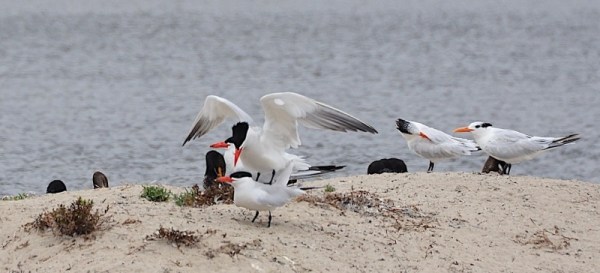
Mating Caspian Terns, Royal Tern on far right (G. Murayama 6-22-18)
As in May, the beach was unbreached and lagoon water was very high, above sea level at the 8:26 AM high tide. I’d guess that about 8-12” of sand clearance remains. Sand height is lowest towards the east side of the lagoon, and here the sand was smooth and vegetation appeared wave-washed. Full moon is on Wednesday, June 27 at 9:53 PM, and I wouldn’t be surprised if waves come over the beach at this time. When this happens, backwash from the lagoon occasionally cuts a channel back to the sea. So the lagoon water level may rise, or it may drop, which just about covers it. Take your pick.
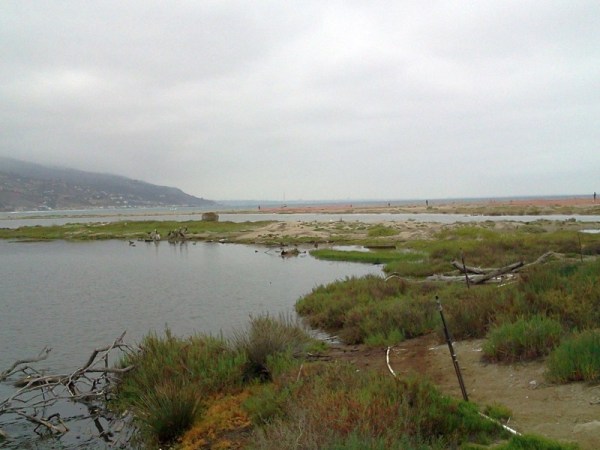
South edge of Malibu Lagoon, Santa Monica disappearing into the far foggy distance (L. Johnson 6-24-18)
Snowy Plovers have been busy. Another pair is sitting on two eggs, under the protection of the metal mobile enclosure. The two chicks we saw last month on May 27, which then had just started to fly short distances, appear (to me) to still be there, as two of the four birds present looked like juveniles.

Western Snowy Plover mom on nest inside enclosure (G. Murayama 6-22-18)
When the birding group came right up to the edge of the protective fence, the adult ran away from the nest and through the orange plastic fencing. I backed the group off about 20 ft. and she returned. The eggs are a pale gray-olive-green color with dark spots and very difficult to see even through a spotting scope. The eggs’ smooth curvature – unlike all the other objects on the beach – is what gives them away, and not the color.
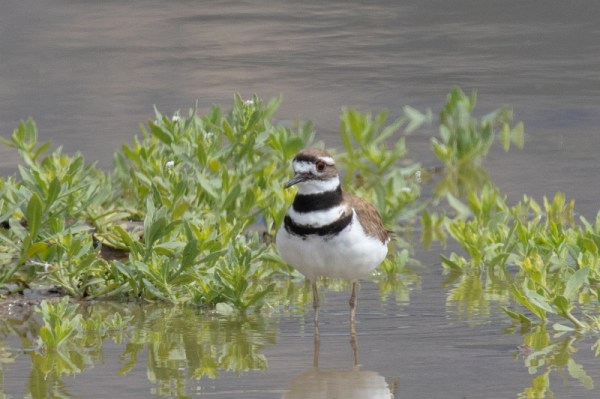
Killdeer nesting at the lagoon (Randy Ehler 5-27-18)
Willets were in all varieties of plumage, from smooth winter gray to almost reddish-brown and heavily barred. They mostly slept, accompanied by a few nodding Whimbrels.

Five days later the Willets and Whimbrels still hadn’t moved
(G. Murayama 6-29-18)
Least Terns repeatedly dropped to the sand, quickly to rise, catch a small fish, then fly about, fish in mouth and calling. The small group of Terns slowly grew throughout the morning, from none at all to four species totalling eleven birds. All the Heermann’s Gulls were adults, and we wondered how their breeding season at Isla de la Rasa in the Sea of Cortez went for them.
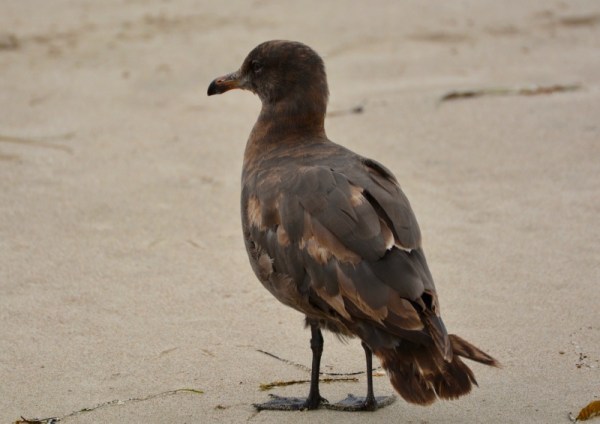
Young Heermann’s Gulls are not entirely absent, as this chocolate-brown bird, seen at Zuma Beach in west Malibu, demonstrates
(G. Murayama, 6-22-18)
I don’t know that it warrants the term “mobbing” – usually reserved for a mixed flock harassing a predator such as a small owl or cat – but two vigorous mockingbirds took turns diving on a crow which occupied their favorite perch, the electric pole at the NE corner of the Malibu Colony, a few feet from the footpath. The crow finally left. Some 10-20 minutes later we spotted two birds soaring very high. They turned out to be a crow, repeatedly diving onto the back of a Red-tailed Hawk. Can one crow constitute a “mob?”
We briefly discussed the fact that small birds will attack a larger bird they consider a predator, and they nearly always get away with it because they are faster and more maneuverable. Dropping down on their foe from behind to peck them on back or head is their favorite tactic. I’m not sure if I’ve ever seen finches or sparrows attack a mockingbird, but mockers will attack jays and crows (then again, mockers will attack anything), jays and crows will attack hawks, and hawks will attack eagles. Sort of a reverse pecking order.

Least Terns with metal leg bands on right leg (G. Murayama 6-22-18)
Birds new for the season were: Pied-billed Grebe, Sanderling, California Gull, Red-tailed Hawk, Black Phoebe, Red-winged and Brewer’s Blackbirds, Brown-headed Cowbird.
Many thanks to our photographers: Randy Ehler, Lillian Johnson, Larry Loeher & Grace Murayama.

Song Sparrow at work
(Larry Loeher 5-27-18)
Our next two scheduled field trips: Malibu Lagoon 8:30 & 10am, 22 July; Malibu Lagoon 8:30 & 10am, 26 August.
Our next program: Luke Tiller will present “Tails from the Platform: Hawks, Hawkwatchers and Hawkwatching”: Tuesday, 2 October, 7:30 p.m., Chris Reed Park, 1133 7th St., NE corner of 7th and Wilshire Blvd. in Santa Monica.
NOTE: Our 10 a.m. Parent’s & Kids Birdwalk meets at the shaded viewpoint just south of the parking area. Watch for Willie the Weasel. He’ll be watching for you and your big floppy feet.
Links: Unusual birds at Malibu Lagoon
9/23/02 Aerial photo of Malibu Lagoon
Prior checklists:
2017: Jan-June, July-Dec
2016: Jan-June, July-Dec 2015: Jan-May, July-Dec
2014: Jan-July, July-Dec 2013: Jan-June, July-Dec
2012: Jan-June, July -Dec 2011: Jan-June, July-Dec
2010: Jan-June, July-Dec 2009: Jan-June, July-Dec.
The 10-year comparison summaries created during the project period, despite numerous complaints, remain available on our Lagoon Project Bird Census Page. Very briefly summarized, the results unexpectedly indicate that avian species diversification and numbers improved slightly during the period Jun’12-June’14.
Many thanks to Lillian Johnson, and Lu Plauzoles for their contributions to the checklist below. [Chuck Almdale]
| Malibu Census 2018 | 1/28 | 2/25 | 3/25 | 4/22 | 5/27 | 6/24 |
| Temperature | 67-76 | 55-62 | 55-62 | 63-67 | 61-66 | 62-68 |
| Tide Lo/Hi Height | H+5.99 | H+5.21 | L-.16 | L-.15 | H+3.86 | H+3.50 |
| Tide Time | 0609 | 0459 | 1213 | 1028 | 0912 | 0826 |
| Cinnamon Teal | 1 | |||||
| Northern Shoveler | 2 | |||||
| Gadwall | 30 | 8 | 12 | 5 | 12 | 4 |
| American Wigeon | 36 | 4 | 8 | |||
| Mallard | 12 | 6 | 12 | 4 | 15 | 12 |
| Northern Pintail | 1 | |||||
| Green-winged Teal | 6 | 1 | 6 | |||
| Surf Scoter | 2 | |||||
| Bufflehead | 6 | 8 | 1 | |||
| Red-breasted Merganser | 3 | 4 | 6 | |||
| Ruddy Duck | 13 | 9 | 4 | |||
| Pied-billed Grebe | 1 | 2 | 1 | 2 | ||
| Eared Grebe | 2 | |||||
| Western Grebe | 25 | |||||
| Clark’s Grebe | 1 | |||||
| Rock Pigeon | 8 | 8 | 10 | 1 | 3 | 2 |
| Eurasian Collared-Dove | 1 | 2 | ||||
| Mourning Dove | 2 | 4 | 1 | 2 | ||
| Anna’s Hummingbird | 1 | 1 | 1 | 1 | ||
| Allen’s Hummingbird | 5 | 1 | 2 | 3 | ||
| Sora | 1 | |||||
| American Coot | 125 | 85 | 75 | 2 | 4 | |
| Black-bellied Plover | 22 | 25 | 10 | 9 | 1 | |
| Snowy Plover | 19 | 34 | 12 | 9 | 3 | 4 |
| Semipalmated Plover | 4 | |||||
| Killdeer | 4 | 10 | 12 | 7 | 4 | 8 |
| Whimbrel | 8 | 13 | 9 | 3 | 6 | 3 |
| Marbled Godwit | 18 | 30 | 7 | 30 | ||
| Ruddy Turnstone | 1 | 6 | 1 | |||
| Sanderling | 30 | 20 | 20 | 45 | 7 | |
| Least Sandpiper | 1 | 3 | 1 | 12 | ||
| Western Sandpiper | 10 | 4 | ||||
| Willet | 9 | 14 | 6 | 6 | 4 | 18 |
| Bonaparte’s Gull | 2 | |||||
| Heermann’s Gull | 5 | 3 | 1 | 5 | ||
| Ring-billed Gull | 35 | 70 | 10 | 1 | ||
| Western Gull | 95 | 92 | 120 | 18 | 112 | 75 |
| California Gull | 1550 | 550 | 20 | 4 | ||
| Herring Gull | 2 | |||||
| Glaucous-winged Gull | 5 | 3 | ||||
| Least Tern | 9 | 2 | ||||
| Caspian Tern | 2 | 8 | 11 | 4 | ||
| Forster’s Tern | 2 | |||||
| Royal Tern | 12 | 15 | 17 | 2 | 1 | |
| Elegant Tern | 3 | 30 | 130 | 4 | ||
| Black Skimmer | 1 | |||||
| Pacific Loon | 1 | 1 | 3 | |||
| Brandt’s Cormorant | 2 | 1 | 1 | 7 | ||
| Double-crested Cormorant | 73 | 37 | 27 | 18 | 15 | 7 |
| Pelagic Cormorant | 2 | 3 | ||||
| Brown Pelican | 6 | 14 | 37 | 32 | 68 | 5 |
| Great Blue Heron | 2 | 1 | 2 | 1 | 1 | 2 |
| Great Egret | 1 | 3 | 2 | 3 | 3 | |
| Snowy Egret | 8 | 8 | 6 | 1 | 4 | 5 |
| Green Heron | 1 | |||||
| Black-crowned Night-Heron | 4 | 2 | ||||
| Turkey Vulture | 1 | 1 | 4 | |||
| Osprey | 2 | 1 | 1 | |||
| Red-tailed Hawk | 1 | 1 | ||||
| Merlin | 1 | |||||
| Peregrine Falcon | 2 | 1 | ||||
| Nanday Parakeet | 4 | 4 | ||||
| Black Phoebe | 3 | 1 | 4 | 1 | 2 | |
| Say’s Phoebe | 3 | 3 | ||||
| Cassin’s Kingbird | 1 | |||||
| Western Kingbird | 2 | |||||
| American Crow | 3 | 5 | 4 | 2 | 2 | 4 |
| Common Raven | 2 | |||||
| Tree Swallow | 3 | |||||
| Violet-green Swallow | 6 | 2 | ||||
| Rough-winged Swallow | 3 | 5 | ||||
| Cliff Swallow | 5 | 8 | 1 | |||
| Barn Swallow | 15 | 4 | 10 | 15 | ||
| Oak Titmouse | 1 | |||||
| Bushtit | 20 | 35 | 6 | 1 | 20 | 27 |
| Marsh Wren | 1 | 2 | 2 | |||
| Bewick’s Wren | 3 | 2 | ||||
| Blue-gray Gnatcatcher | 8 | 6 | 2 | |||
| Ruby-crowned Kinglet | 3 | |||||
| Western Bluebird | 1 | |||||
| Northern Mockingbird | 2 | 1 | 3 | 2 | 2 | 2 |
| European Starling | 15 | 10 | 23 | |||
| House Finch | 20 | 8 | 24 | 4 | 5 | |
| Lesser Goldfinch | 1 | 8 | 2 | |||
| Spotted Towhee | 1 | 2 | ||||
| California Towhee | 1 | 2 | 1 | 2 | ||
| Savannah Sparrow | 1 | 2 | 1 | |||
| Song Sparrow | 4 | 5 | 2 | 10 | 5 | 5 |
| White-crowned Sparrow | 8 | 25 | 28 | |||
| Dark-eyed Junco | 2 | |||||
| Western Meadowlark | 2 | 4 | ||||
| Red-winged Blackbird | 6 | 15 | 1 | 7 | ||
| Brown-headed Cowbird | 2 | 2 | ||||
| Brewer’s Blackbird | 1 | |||||
| Great-tailed Grackle | 1 | 2 | 15 | 4 | 4 | 3 |
| Orange-crowned Warbler | 2 | 1 | 3 | 1 | ||
| Common Yellowthroat | 2 | 4 | 2 | 1 | ||
| Yellow-rumped(Aud) Warbler | 12 | 20 | 12 | |||
| Wilson’s Warbler | 1 | |||||
| Totals by Type | Jan | Feb | Mar | Apr | May | Jun |
| Waterfowl | 109 | 40 | 52 | 9 | 27 | 16 |
| Water Birds – Other | 211 | 142 | 172 | 52 | 88 | 21 |
| Herons, Egrets & Ibis | 11 | 12 | 14 | 4 | 9 | 10 |
| Quail & Raptors | 6 | 2 | 2 | 0 | 5 | 1 |
| Shorebirds | 112 | 155 | 88 | 90 | 56 | 41 |
| Gulls & Terns | 1704 | 727 | 179 | 57 | 269 | 95 |
| Doves | 8 | 10 | 15 | 3 | 4 | 4 |
| Other Non-Passerines | 6 | 6 | 6 | 3 | 1 | 1 |
| Passerines | 121 | 146 | 189 | 37 | 66 | 69 |
| Totals Birds | 2288 | 1240 | 717 | 255 | 525 | 258 |
| Total Species | Jan | Feb | Mar | Apr | May | Jun |
| Waterfowl | 9 | 7 | 9 | 2 | 2 | 2 |
| Water Birds – Other | 8 | 7 | 8 | 3 | 4 | 4 |
| Herons, Egrets & Ibis | 3 | 3 | 4 | 3 | 4 | 3 |
| Quail & Raptors | 4 | 2 | 2 | 0 | 2 | 1 |
| Shorebirds | 9 | 9 | 10 | 8 | 6 | 6 |
| Gulls & Terns | 7 | 4 | 9 | 4 | 8 | 7 |
| Doves | 1 | 2 | 3 | 2 | 2 | 2 |
| Other Non-Passerines | 2 | 3 | 2 | 1 | 1 | 1 |
| Passerines | 22 | 21 | 27 | 15 | 12 | 11 |
| Totals Species – 90 | 65 | 58 | 74 | 38 | 41 | 37 |
We continue the PBS explanation of evolution in twelve short episodes, suitable for all.
This is an installment of the PBS – It’s OK to be Smart series. If no film or link appears in this email, go to the blog to view it by clicking on the blog title above. If the film stops & starts in an annoying manner, press pause (lower left double bars ||) to let it buffer and get ahead of you.
Watch all 18 minutes of this 12-part series at once and avoid the Dropbox ads here.
[Chuck Almdale]
ADDITIONAL PHOTOS IN THE SLIDESHOW ON THE WEBSITE
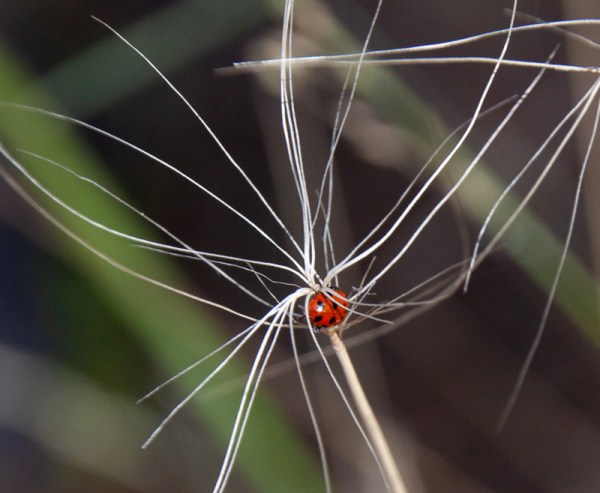
Ladybug…or Lady-Long-Legs? Mt. Piños (Roxy Seidner 6-9-18)
It’s easy to forget how quickly the chill sets in at 7500 ft. when the sun goes behind a cloud or the breeze stiffens. Our favorite campsites at McGill Campground on Mt. Piños are open and sunny, great for catching the warming morning sun or viewing the nighttime stars, but they provide scant protection from blustery breezes. In the late afternoon as the sun drops, we go from tee-shirts, sandals and shorts to thermal underwear and hooded fleecy jackets in a matter of minutes.

Roxie laughs, Mary seems skeptical (Dan Seidner_6-9-18)
As usual we began the trip at the “triangle” – the dirt parking lot at the intersection of Cuddy Valley Rd. and Mt. Piños Rd. – twelve miles west of I-5. At 5500 ft. elevation, this was the lowest elevation we would bird.
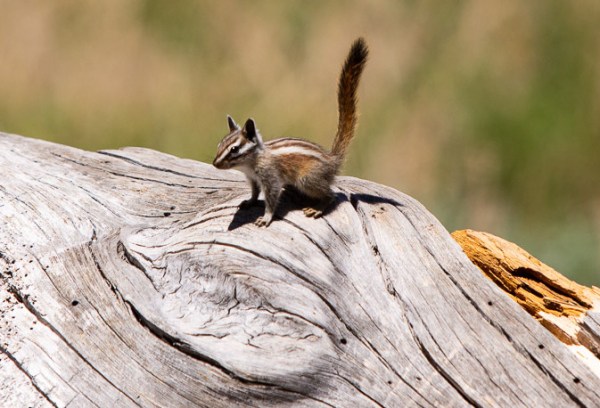
Lodgepole Chipmunk, Mt. Piños (Dan Seidner 6-9-18)
In the nearby mixed coniferous-hardwood forest we found: California Quail, Western Wood-Pewee, Western Bluebird and Chipping Sparrows. A special treat was the very actively feeding flock of Pygmy Nuthatches whom we watched for about 10 minutes. This group of about 15 birds was likely composed of two or three nuthatch families. After fledging from the nest, the young stay in a family group with their parents, and similarly foraging families join in. These groups can number into many dozens of birds as more families join up.
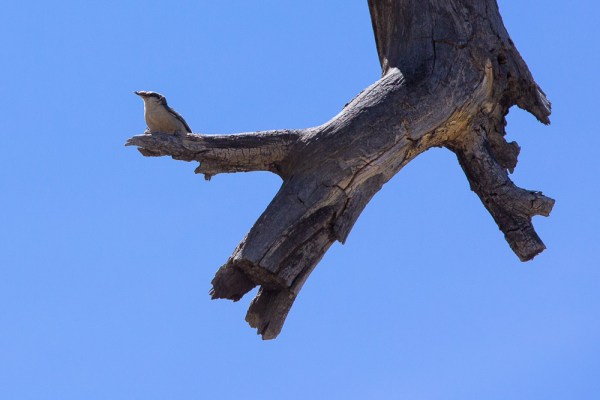
Pygmy Nuthatch – that may be sawdust on his face; Mt. Pinos
(Dan Seidner 6-9-18)
We also saw the coal-gray-crested Steller’s Jay and heard the crestless California Scrub-Jay. This is an altitudinal “blend zone” for these two species, as well as for House and Purple Finches. Violet-green Swallows, Ravens, Band-tailed Pigeons and – new to us for the Mt. Piños area – Eurasian Collared-Doves were visible from the parking area. On the forest edges we found blooming pinkish Currant – some say Gooseberry – and bright yellow Wallflower.
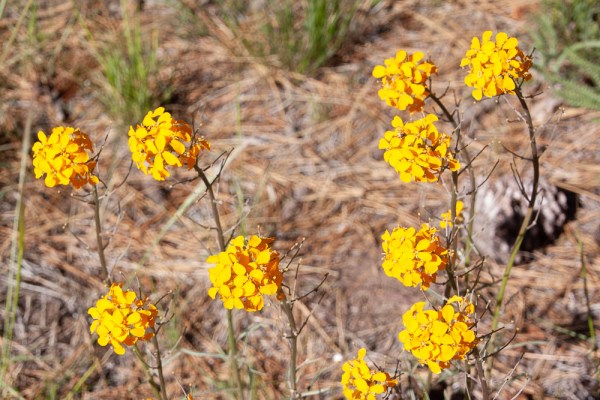
Wallflowers, Mt. Abel (Roxy Seidner 6-10-18)
NEWS FLASH! – Alert reader and California native plant maven Grace Murayama just informed me that currants and gooseberries are in the same genus of Ribes, and that we saw both on this trip. There are more than 150 species in the Ribes genus. In general, currants have no spines or thorns and flowers are in clusters; gooseberries have thorns and many small flowers. The photo below looks like currant (flowers in clusters). Your regular field trip report will now resume.
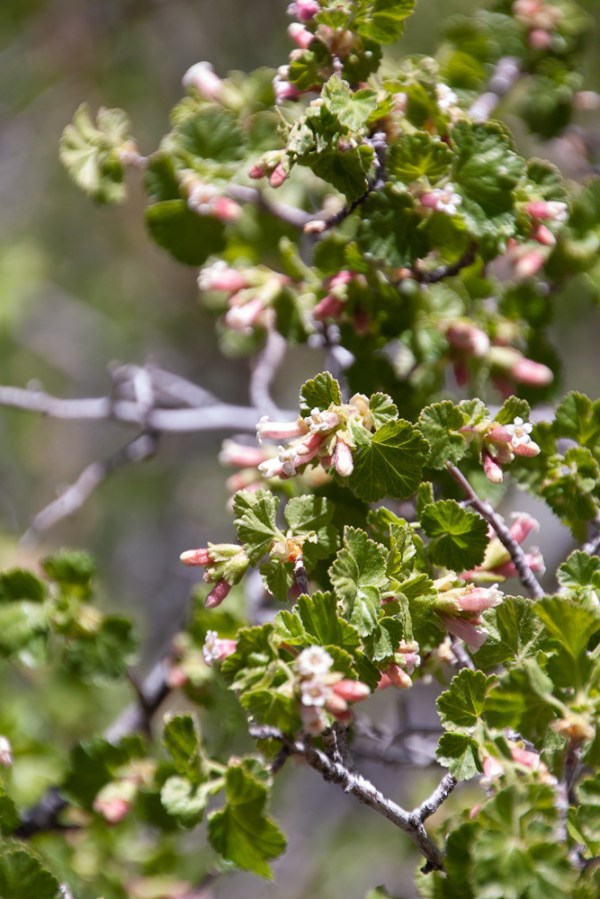
Currant flowers are in clusters (Roxy Seidner 6-9-18)
Five miles up Mt. Piños Rd. we passed McGill Campground (elev. 7500 ft.), stopped at a road pullout overlooking a stream, and walked a nearby trail. Water appears in this streambed only where underlying rock strata forces it to the surface. Compared to last year we found very little water and fewer birds. Two White-headed Woodpeckers alternated between drinks of water and whacking the base of a tree. A Fox Sparrow, of the Thick-billed P. stephensi subspecies, burbled his song from an overhead limb. All three Nuthatch species were present. A small, recently excavated hole on the top side of a narrow limb was repeatedly visited by a Red-breasted Nuthatch. The limb looked too narrow to allow a full nest hole to be dug, but the hole – about the same diameter as the bird – seemed too large to be the result of drilling for a single insect. The nuthatch’s visits to the hole were too brief to see exactly it was up to. Another mystery never to be solved.
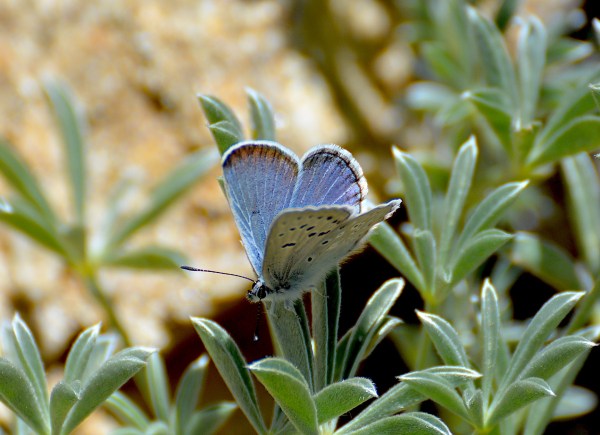
Male Boisduval’s Blue, Plebeius icarioides, on Lupine host plant, Mt. Piños (Grace Murayama 6-9-18)
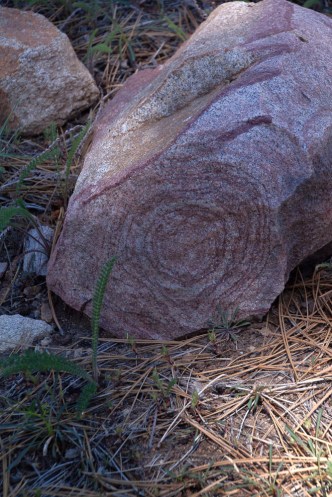
Odd rock, Mt. Piños (Roxy Seidner 6-9-18)
This trail is frequented by mountain bikers who have figured out how to never have to ride uphill, only down. Very fortunate for them, and the opposite of how we walked to school when we were kids: through deep snow or torrential rain and uphill in both directions. The riders shouted warnings at us – most of the time – often adding how many riders were yet to come. “Three more! Two more! One more!” No one was hit. Returning to the cars we noticed a curious rock which looked like a petrified tree with rings.
Iris Meadow (8300 ft,) lies just past the road-end parking area. This is the most reliable location for singing and viewable Fox Sparrows and Green-tailed Towhees, and they did not disappoint. Several birders were quite eager to see the towhee, and were greatly relieved when one appeared trailside even before we got to the picnic tables for lunch and were still burdened with foodstuffs. Irises bloomed in the meadow, something we’ve missed in recent years because we either arrived too early or too late in the season. Sorry – no photos.
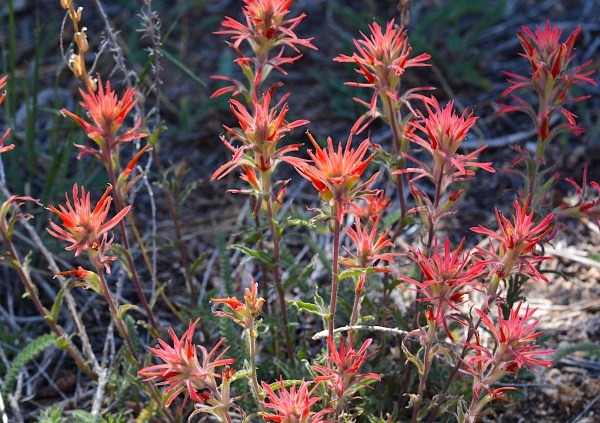
Paintbrush, Mt. Piños (Grace Murayama 6-9-10)
Both species sang intermittently during lunch, and as usual no one could quite figure out how to tell their songs apart. Just when you think you’ve nailed one bird’s song, they change it. Both have beautiful, bubbly and varied songs. We celebrated two birthdays while a White-headed Woodpecker worked a nearby tree, then searched some nearby patches of flowering currant bush for Calliope Hummingbird. No luck there, but several other species were seen: Mountain Chickadee, Chipping Sparrow and Western Wood-Pewee. A repeated two-note trill baffled us for a while until we remembered the song of the Dark-eyed Junco; soon we saw one singing.
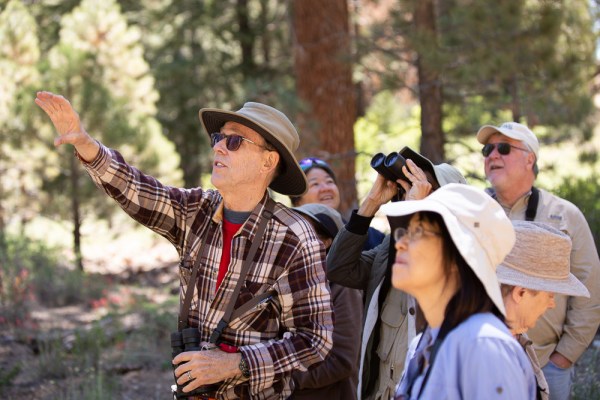
It’s right there in the green tree! No, no, the OTHER green tree. Thataway!
(Dan Seidner_6-10-18)
By this time it was mid-afternoon. We returned to McGill Campground for a few hours of conversation or reading as we watched local birds catch insects. A Western-wood Pewee was busy nest-building in the crook of a branch. It took us a while to figure out that the messy blob of vegetation was actually a nest, not just leaves stuck between branches.
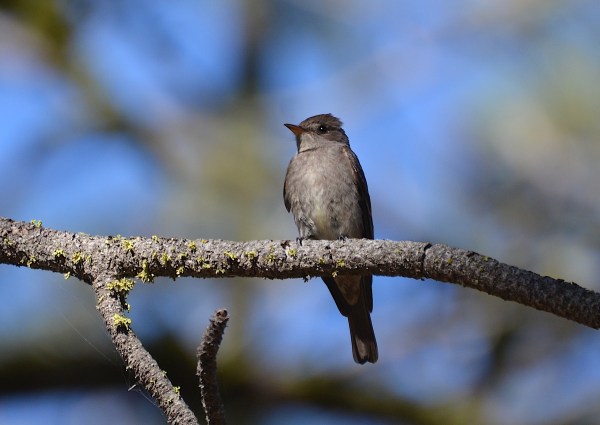
Western Wood-Pewee, Mt. Piños (Grace Murayama 6-9-18)
After awakening around 6 am, we hit the road by 8 and drove over to Mt. Abel to visit “Shirley’s Seep,” named for the local birder who discovered it many years ago. In dry years, this small but permanent source of water, located at altitude 6940 ft., can attract thirsty birds from miles around.
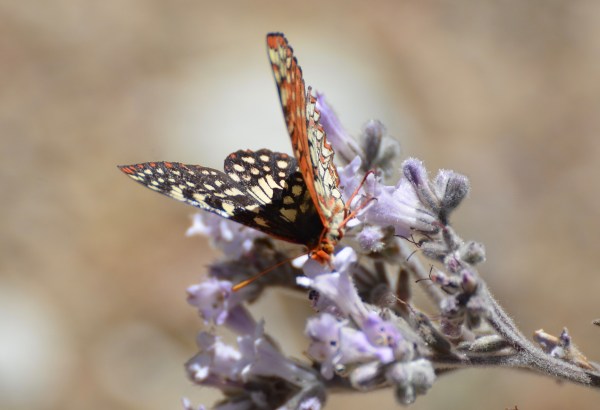
Variable or Chalcedon Checkerspot male, Euphydryas chalcedona; flower probably Eriodictyon crassifolia, Mt. Piños (Grace Murayama 6-9-18)
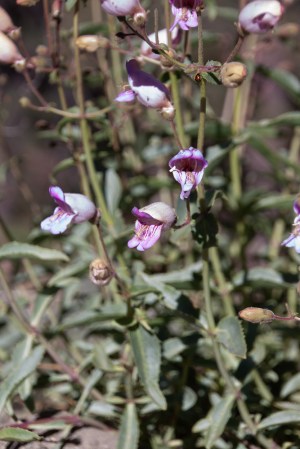
Grinnell’s Beardtongue, Penstemon grinnellii; reliable at Shirley’s Seep, Mt. Abel (Roxy Seidner 6-10-18)
Here’s how to find it. From the “triangle” drive 5.1 miles (9 minutes) to Pine Mountain Club (golf course). Continue 2.6 miles (5 minutes) to Cerro Noroeste Rd. Turn left and 2.6 miles (6 minutes) to the seep, located at a 90° right bend in the road. 100 yds. past the seep is a pull-out spot; park there, not at the seep itself. To reach Campo Alto Campground at the top of Mt. Abel, continue 4.6 miles, bearing right at all intersections. Stop at the several pullouts along the way to check for soaring birds. You’ll eventually come to a large dirt parking lot with good birding – usually – all around.
Mt. Abel, by the way, is now called Cerro Noroeste, and Cerro Noroeste Rd. used to be named Hudson Ranch Rd. Some on-line maps may confuse the unwary.
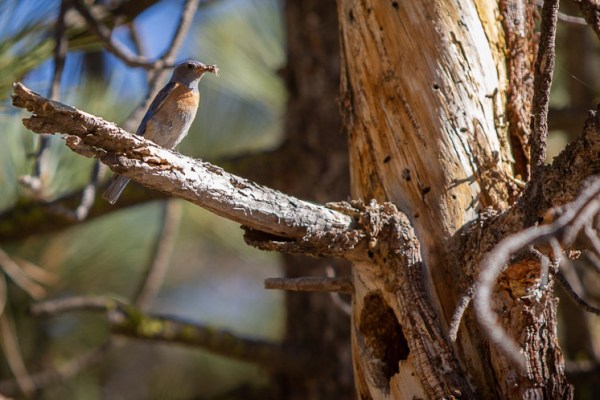
Western Bluebird male above nest hole with food, Mt. Piños
(Dan Seidner 6-9-18)
The seep was slowly flowing. We had many of the same species (see list below) we’d been seeing elsewhere, but the Lawrence’s Goldfinches, Northern Flicker, Western Tanager, Black-headed Grosbeak and Cassin’s Finches were all new.
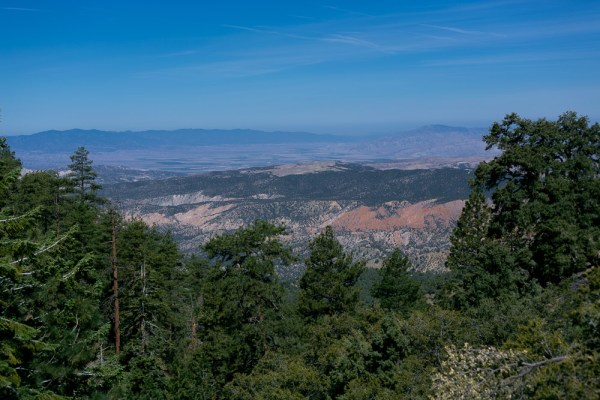
View of valley to west, Mt. Abel. See the Condor only 22 miles away?
(Dan Seidner 6-10-18)
In the far distance we saw a soaring raptor which I thought to be a Turkey Vulture because of its dihedral wing position (wingtips raised above the torso, forming a “V” shape). Lillian thought it to be a Condor, holding that the dihedral was minimal or absent. Neither of us could see any paleness on the underwing, but the bird was a loooong way away. This spot is about 30 miles due north of the Sespe Condor Sanctuary, where at least one pair of Condors breeds (Hutton’s Bowl, Sespe Condor Cam). An adult Condor could cover that distance in about 30-45 minutes, so to see a Condor here is not at all fanciful.
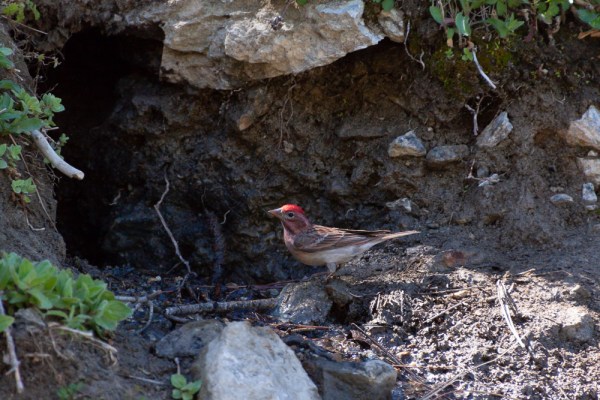
Cassin’s Finch male, Mt. Abel (Roxy Seidner 6-10-18)
After an hour of watching small birds drink and leave, and dodging Violet-green Swallows racing up and down the road, we headed to the top of the mountain.
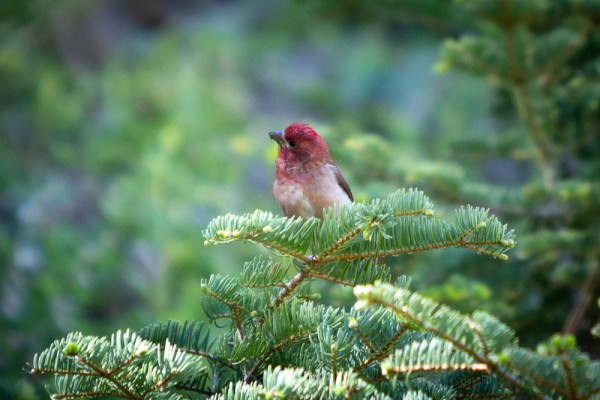
Male Purple Finch, Mt. Abel (Dan Seidner 6-10-18)
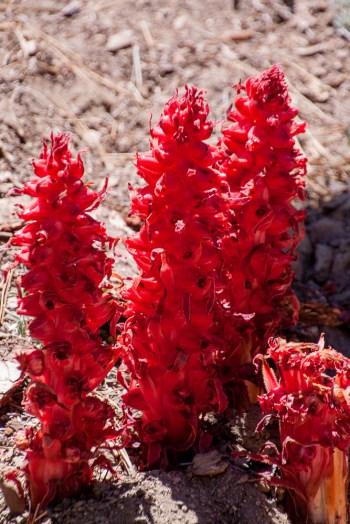
Snow Plant, Mt. Piños (Roxy Seidner 6-9-18)
At road’s end, about 8800 ft. altitude, we found a nice Snow Plant at the base of a very gnarly dead tree, but little else beyond the swallows, bluebirds, nuthatches and pewees we’d been seeing all along. No Clark’s Nutcrackers, a species we’ve previously seen nesting in the area.
On the way back down, while stopping at a pullout to scan for Condor, we found a beautiful Green-tailed Towhee just below us in the mountainside chaparral. Seen from above, and in full sunlight, they are a spectacular bird. This was probably my best-ever view of the bird, who even raised his crest for us while he sang his lovely song.
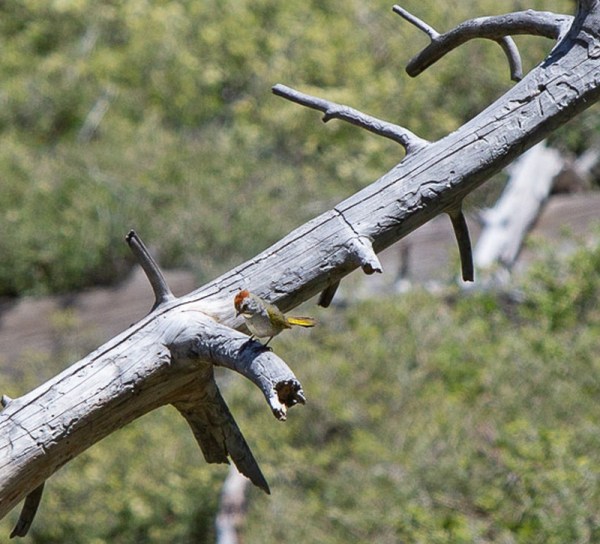
Green-tailed Towhee, crest still slightly erect and you can see that the tail truly is a shade of green; Mt-Abel (Dan Seidner 6-10-18)
The flowering and nesting at Mt. Piños and Cerro Noroeste should continue into early July. The irises at Iris Meadow will continue blooming, and perhaps Calliope Hummingbirds will eventually appear. It’s a nice place to camp (no water but clean pit toilets) and uncloudy nights are wonderful for star gazing & satellite spotting. 75% of campsites are now reservable, but campgrounds had plenty of spaces so you could probably just show up, as we did.
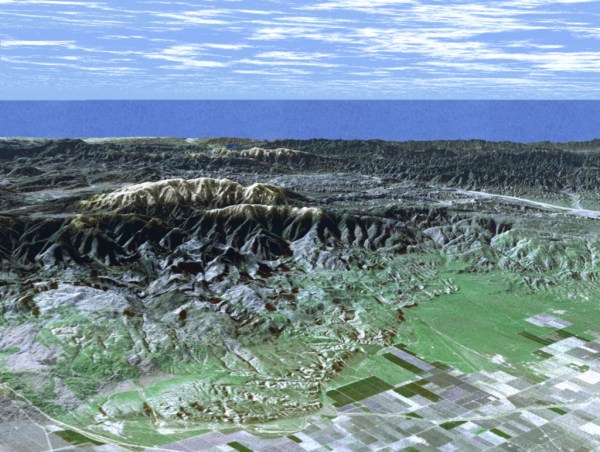
Northeastern view of Mt. Piños, 8,843 ft. high; 109 miles to horizon
(Shuttle Radar Topography Mission 2-16-00)
Mt. Pinos ranger district: 661-245-3731 ext. 0. 8-4:30 M – F
All campsites below: 877-444-6777. $20/night, $10/night with America the Beautiful or Golden Age Pass, $10 per extra car
McGill Campground: 73 sites, 54 reservable.
Mt. Piños Campground: 19 sites, 15 reservable.
Campo Alto Campground: 17 sites, 13 reservable.
| Trip List | All | Triangle | Overlook | Iris | Seep & | McGill | ||
| June 9-11, 2018 | Areas | Area | & Stream | Meadow | Mt. Abel | Campgrd | ||
| California Quail | 1 | 2 | ||||||
| Band-tailed Pigeon | 3 | 4 | 1 | 4 | ||||
| Eurasian Collared-Dove | 3 | 1 | 1 | 1 | ||||
| Mourning Dove | 2 | 2 | 3 | |||||
| White-throated Swift | 1 | 20 | ||||||
| Anna’s Hummingbird | 1 | 1 | ||||||
| Turkey Vulture | 1 | 1 | ||||||
| Red-tailed Hawk | 2 | 1 | 1 | |||||
| White-headed Woodpecker | 2 | 1 | 2 | |||||
| Northern Flicker | 1 | 1 | ||||||
| Western Wood-Pewee | 4 | 6 | 2 | 6 | 2 | |||
| Ash-throated Flycatcher | 1 | 1 | ||||||
| Steller’s Jay | 3 | 2 | 4 | 6 | ||||
| California Scrub-Jay | 1 | 3 | ||||||
| Clark’s Nutcracker | 1 | H | ||||||
| Common Raven | 3 | 4 | 2 | 3 | ||||
| Violet-green Swallow | 4 | 6 | 8 | 10 | 30 | |||
| Mountain Chickadee | 3 | 2 | 2 | 3 | ||||
| Bushtit | 1 | 2 | ||||||
| Red-breasted Nuthatch | 1 | 1 | ||||||
| White-breasted Nuthatch | 3 | 1 | 2 | 1 | ||||
| Pygmy Nuthatch | 4 | 15 | 4 | 6 | 5 | |||
| Brown Creeper | 1 | 1 | ||||||
| House Wren | 1 | 2H | ||||||
| Western Bluebird | 5 | 4 | 4 | 4 | 6 | 4 | ||
| American Robin | 2 | 1 | 1 | |||||
| California Thrasher | 1 | 1 | ||||||
| House Finch | 1 | 4 | ||||||
| Purple Finch | 3 | 2 | 2 | 3 | ||||
| Cassin’s Finch | 1 | 2 | ||||||
| Lawrence’s Goldfinch | 1 | 5 | ||||||
| Green-tailed Towhee | 2 | 2 | 2 | |||||
| Spotted Towhee | 2 | 1 | 1 | |||||
| Chipping Sparrow | 4 | 6 | 4 | 6 | 6 | |||
| Fox Sparrow | 3 | 1 | 2 | 2 | ||||
| Dark-eyed Junco | 4 | 8 | 4 | 5 | 4 | |||
| Orange-crowned Warbler | 1 | 1 | ||||||
| Western Tanager | 1 | 2 | ||||||
| Black-headed Grosbeak | 1 | 1 | ||||||
| Total | 39 | 20 | 11 | 16 | 21 | 12 | ||
| H = Heard | ||||||||
| Triangle = Intersection of Cuddy Valley Rd. & Mt. Piños Rd. 12 miles W. of I-5 | ||||||||
| Overlook = Streamside area & trail between McGill & Mt. Piños campgrounds | ||||||||
| Iris Meadow = Area around meadow at top of Mt. Piños Rd. | ||||||||
| Shirley’s Seep = Roadside seep 2.6 miles up Cerro Noroeste Rd. from Mil Portrero Rd. | ||||||||
| Mt. Abel Campground = End of Cerro Noroeste Rd. 4.6 miles past Shirley’s Seep | ||||||||
| McGill Campground = Campground on Mt. Piños Rd. 5 miles from triangle | ||||||||
You can find almost any color of the rainbow among the birds-of-paradise. Males advertise themselves with color—often several vivid colors combined—while females have brownish plumage whose main purpose is camouflage. This video explores the range of colors, two of the main ways birds produce colors, and how males display them to maximum effect. The Cornell Lab’s Ed Scholes explains. Filmed and photographed by Tim Laman.
There are currently seventy-two short films in the entire Birds-of-Paradise Project playlist, ranging from 26 seconds to 8:29. In the upcoming weeks, we will present some of our favorites.
A film from the Cornell Lab of Ornithology. If no film or link appears in this email, go to the blog to view it by clicking on the blog title above. If the film stops & starts in an annoying manner, press pause (lower left double bars ||) to let it buffer and get ahead of you. [Chuck Almdale]



 SANTA MONICA BAY AUDUBON SOCIETY BLOG