Free email delivery
Please sign up for email delivery in the subscription area to the right.
No salesman will call, at least not from us. Maybe from someone else.
Bird Song Opera | YouTube Video
This must be seen and heard to be believed.
Watch it at least twice. It gets better. 3 ½ minutes.
Music by W. A. Mozart, arranged and edited by Volker Pannes, www.shakeup.de
Many thanks to “Hollywood” Dave Surtees, aficionado of strange humor, for sending this in. [Chuck Almdale]
Does Evolution Violate the 2nd Law of Thermodynamics? – 12 Days of Evolution #8 | PBS Science Video
We continue the PBS explanation of evolution in twelve short episodes, suitable for all.
This is an installment of the PBS – It’s OK to be Smart series. If no film or link appears in this email, go to the blog to view it by clicking on the blog title above. If the film stops & starts in an annoying manner, press pause (lower left double bars ||) to let it buffer and get ahead of you.
Watch all 18 minutes of this 12-part series at once and avoid the Dropbox ads here.
[Chuck Almdale]
Snowy Plovers Again Nest on Surfrider Beach

Adult Snowy Plover, Malibu Lagoon (Randy Ehler 5-27-18)
Major Malibu Surfrider Beach news again this year are the nesting Snowy Plovers. Nesting behavior was first noted on April 8, 2018. As of our May 27 field trip, there were two large and well-plumaged young, attended by one adult, presumably the father (the mother leaves a few days after the last egg hatches).
Our diligent Snowy Plover (SNPL) mavens Grace Murayama and Larry Loeher supplied this Snowy Plover Activity timeline.
April 8, 2018: Volunteer Sandy Summer observes and reports possible nesting behavior.
April 9: Ornithologist Dan Cooper checks and agrees; observes adult picking at shells and settling on probable nest.

Snowy Plover mom fluffing up to sit on eggs, Malibu Lagoon
(Grace Murayama 04-10-18)
April 10: Larry & Grace confirm nesting behavior: adult repeatedly returning to same spot on sand; eggs not clearly seen at the time, but later examination of the photo below shows 3 eggs. Total of 6 adult SNPLs present, none with leg bands.

Three Snowy Plover eggs between the sticks, Malibu Lagoon
(Grace Murayama 04-10-18)
April 11: Metal mini-enclosure (ME) (see 5/21 photo below) is placed over nest by Tom Ryan.
April 17: 1 adult on nest, another foraging on sand east of nest site.
April 26: Stacey Vigallon confirms 3 Snowy Plover chicks at Malibu.
April 27: Grace & Larry observe 3 chicks, 5 adults. They also observe 1 of the adults repeated returning to a different spot, photos confirm eggs in a 2nd nest site at that spot.
April 28: Tom Ryan confirms two additional eggs on the 2nd nest; Tom moves ME from 1st nest site to 2nd nest site.
May 4: Larry & Grace again observe 3 chicks, 5 adults, and 1 adult sitting on nest inside ME.

Female Snowy Plover sitting, Malibu Lagoon (Grace Murayama 05-21-18)
May 10th: Enlarged virtual fence installed/moved. Larry observes 1 adult & 3 chicks foraging; 1 other adult on 2nd nest.

Snowy Plover dad & chick, Malibu Lagoon (Grace Murayama 05-21-18)
May 21: Grace & Larry observe 2 chicks, 2 adults. Lagoon water level, continually rising behind the closed barrier sandbar, has now inundated the ME and the 2nd nest.
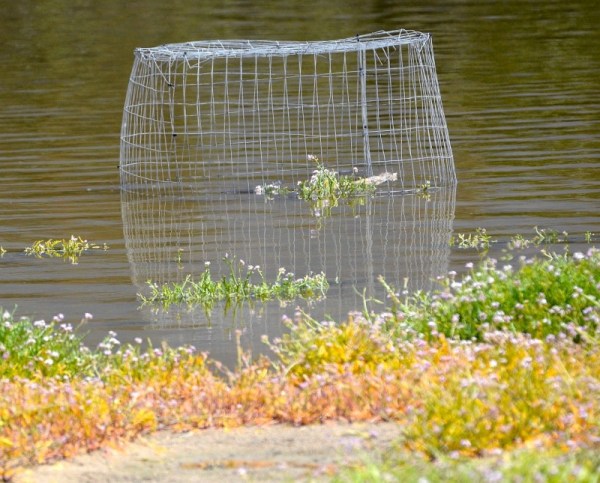
Snowy Plover metal enclosure under water! (Grace Murayama 5-21-18)
May 27: SMBAS field trip group observe 1 adult and 2 large well-plumaged juveniles, both of which fly about 30 feet after being alarmed.
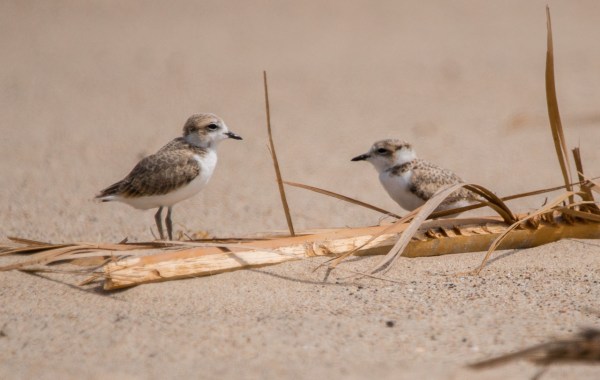
Snowy Plover juvenile pair (R. Juncosa 5-27-18)
May 31: Stacey Vigallon confirms another (3rd) nest with 1 egg.
June 1: Larry & Grace observe 2 chicks, 2 adults, 2 eggs in the new (3rd) nest. No Least Terns present on the beach.

Snowy Plover on 2 eggs, Malibu Lagoon nest #3 (Grace Murayama 6-1-18)
Malibu is not the only L.A. County location for nesting Snowy Plovers. On Sunday, May 27, three Snowy Plover puffball chicks were confirmed at Dockweiler where they nested last year.

Snowy Plover juvenile (L) & adult (R) at Malibu Lagoon (Randy Ehler 5-27-18)
As yet there are no Least Terns nesting on Surfrider Beach, but fish-bringing courting behavior has been seen. The beach seems slightly higher than last year by a couple of inches, so perhaps any tern nests that appear won’t be inundated by high tide surf as they were last year.
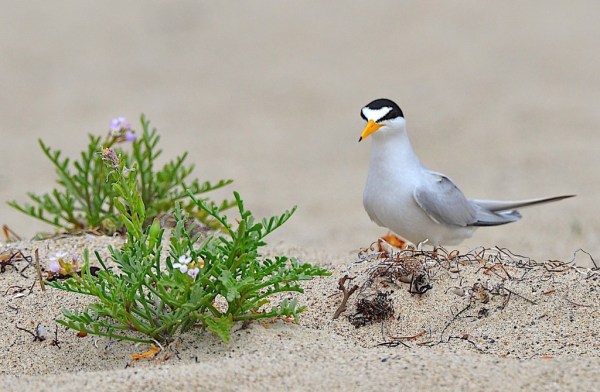
Least Tern, Malibu Lagoon (Larry Loeher 5-27-18)
[Chuck Almdale]
To add to their voices, some birds make nonvocal sounds as a form of communication. A familiar example is the drumming of woodpeckers, which takes the place of a song. Sicklebills and riflebirds make knocking and rustling sounds with their wings, and there are hints that the shapes they adopt as they display may help funnel these sounds toward females, like a megaphone. Filmed and photographed by Tim Laman, Ed Scholes and Eric Liner.
There are currently seventy-two short films in the entire Birds-of-Paradise Project playlist, ranging from 26 seconds to 8:29. In the upcoming weeks, we will present some of our favorites.
A film from the Cornell Lab of Ornithology. If no film or link appears in this email, go to the blog to view it by clicking on the blog title above. If the film stops & starts in an annoying manner, press pause (lower left double bars ||) to let it buffer and get ahead of you. [Chuck Almdale]

Immature Brown Pelican with emerging primary feathers p1 & p2.
(Ray Juncosa 5-27-18)
As we move on towards summer, numbers and diversity of the birds continues to drop. This month the decline in ducks was particularly noticeable with only Gadwall and Mallard present, and most of those were ducklings toodling along behind their mothers. The twenty or or thirty birders present enjoyed a nice day and some interesting sightings.

The Usual Suspects keep the haberdashers in business
(Grace Murayama 5-27-18)
The beach breach had closed and lagoon water was very high, well above sea level at the 9:12 AM high tide. The Jumping Mullet seemed to enjoy it, as they were leaping all over the lagoon and channel. There might be a foot of sand yet to clear before the water breaks over the beach into the sea, with the lowest clearance near Adamson house. Lots of little dunes and vegetation have appeared within the virtual fence erected in March to protect possible Snowy Plover and Least Tern nesting areas.

View across lagoon towards Pacific Coast Bridge & Adamson House
(Lillian Johnson 5-27-18)
We found 525 birds in 41 species, about average for May. Numbers for the prior five years range from 262 to 590 individual birds and species from 30 to 55. As always, not everyone sees every bird. I missed the Peregrine Falcon which – as usual – rocketed by in pursuit mode. The Green Heron flew in early, then hid in the reeds. Anna’s Hummingbird was elusive and no Allen’s Hummers were to be found anywhere. Highly unusual, that. Least, Royal and Forster’s Terns came and went, came and went. The solitary Western Bluebird was in a tree above the parking lot port-a-potties, seen only at trip’s end before it flew over the west wall into the private golf course.

Rough-winged Swallow – distinguished by its lack of distinguishing characteristics (R. Juncosa 5-27-18)
Few people saw all four swallow species either. It must be admitted that many birders ignore them, finding them difficult as they’re always zooming by, their plumage details difficult to discern while on the wing.

Barn Swallow’s glossy blue back and long outer tail feathers
(Randy Ehler 5-27-18)
Our trips are not all deadly seriousness. One birder – narrating a story – exclaimed, “That was no lady! That was my wife!” I leapt in with, “I spent a week in Philadelphia one night.” Here’s four more one-liner classics:
- My psychiatrist said, “You’re crazy.” “Doc,” I said, “I want a second opinion!” So he says, “Okay…you’re ugly too!”
- Worrying works! 90% of the things I worry about never happen.
- I know my wife cheats on me. Every time I come home the parrot says, “Quick, out the window.”
- When I read about the evils of drinking, I gave up reading.

Bonaparte’s Gulls, resting (R. Ehler 5-27-18)
The two Bonaparte’s Gulls stayed close together, well folded and obscure between two dunes. The sole Brandt’s Cormorant was out in the surf zone, continually diving under waves.

The excitable Elegant Terns (G. Murayama 5-27-18)
Every now and then the flock of Elegant Terns would spring into the air, squawking madly, swirl around the lagoon once or twice, then alight again on the sand. We looked for possible raptors diving on them, but never saw any. It’s likely they were just excitable; eager to stretch their wings, eager to get on with breeding season.
Everyone saw Song Sparrows (photo farther down) who continually sang pathside. They’re “Song” Sparrows not because their song is particularly beautiful – charming, but not beautiful – but because they sing a lot, year-round.

Snowy Egret hunting & stirring
(R. Juncosa 5-27-18)
A Snowy Egret was feeding nearby in the south channel shallows, stirring the bottom with its foot and peering intently at the water for any fish or invertebrates who might be literally stirred into action. This prompted a discussion (well, me mostly) of heron/egret feeding behavior.
All the “dancing” egrets with which I’m familiar are among the thirteen members of the genus Egretta. Snowy Egrets Egretta thula rarely “dance;” they may hop and chase a bit and frequently use the foot stirring technique. Reddish Egrets Egretta rufescens are real “dancers,” hopping and jumping all over the place and frequently flicking their wings out, creating a partial canopy which shades the water around their feet. There are 3-5 of them resident at Bolsa Chica in Orange County. It’s fun to watch them feed.
The most extreme egret behavior I’ve seen is that of the Black Heron Egretta ardesiaca of sub-Saharan Africa and Madagascar. They whip their wings out to form a complete canopy and may hold the position for many minutes. Small fish, lizards, amphibians and invertebrates seeking to escape the tropical sun and enjoy the shade of this handy black “bush” find themselves quickly snapped up. The canopied birds look like huge black mushrooms. The Slaty Egret is another notable “foot stirrer.” Other “dancers” are Pied Heron, Tricolored Heron, White-faced Heron, Little Egret, Chinese Egret, Pacific Reef-Heron and Western Reef-Heron.

Black Heron flock in Okavango Delta, Botswana, accompanied by Sacred and Glossy Ibis (R. Juncosa 10-6-12)
Snowy Plover Update! Major Malibu Surfrider Beach news again this year is the nesting Snowy Plovers. We saw two sizable and plumaged young, attended by one adult, presumably the father. Read the separate report on the plovers.
Snowy Plover juvenile (L) with patterned back & plain-backed adult (R) at Malibu Lagoon (R. Ehler 5-27-18)
As yet there are no Least Terns nesting on the beach, but fish-fetching courting behavior has been witnessed. The beach seems slightly higher than last year by a couple of inches, so perhaps any tern nests that appear won’t be inundated by high tide surf.
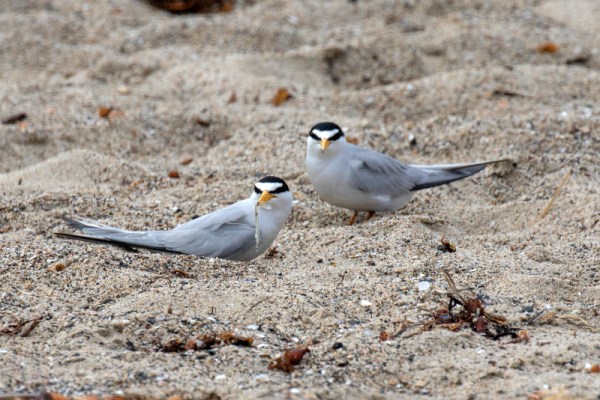
Least Terns courting with a fish watch the cameraman with suspicion
(R. Ehler 5-27-18)
Birds new for the season were: Anna’s Hummingbird, Bonaparte’s Gull, Least & Forster’s Terns, Green Heron, Peregrine Falcon, Western Bluebird.
Many thanks to our photographers: Randy Ehler, Lillian Johnson, Ray Juncosa, Larry Loeher, & Grace Murayama.

Song Sparrow at work
(Larry Loeher 5-27-18)
Our next three scheduled field trips: Mt. Piños, 8am, 9-10 June; Malibu Lagoon 8:30 & 10am, 24 June; Malibu Lagoon 8:30 & 10am, 22 July.
Our next program: To Be Announced: Tuesday, 2 October, 7:30 p.m., Chris Reed Park, 1133 7th St., NE corner of 7th and Wilshire Blvd. in Santa Monica.
NOTE: Our 10 a.m. Parent’s & Kids Birdwalk meets at the shaded viewpoint just south of the parking area. Watch for Willie the Weasel. He’ll be watching for you and your big floppy feet.
Links: Unusual birds at Malibu Lagoon
9/23/02 Aerial photo of Malibu Lagoon
Prior checklists:
2017: Jan-June, July-Dec
2016: Jan-June, July-Dec 2015: Jan-May, July-Dec
2014: Jan-July, July-Dec 2013: Jan-June, July-Dec
2012: Jan-June, July -Dec 2011: Jan-June, July-Dec
2010: Jan-June, July-Dec 2009: Jan-June, July-Dec.
The 10-year comparison summaries created during the project period, despite numerous complaints, remain available on our Lagoon Project Bird Census Page. Very briefly summarized, the results unexpectedly indicate that avian species diversification and numbers improved slightly during the period Jun’12-June’14.
Many thanks to Randy Ehler, Lillian Johnson, Chris Lord, and Lu Plauzoles for their contributions to the checklist below. [Chuck Almdale]
| Malibu Census 2017-18 | 12/24 | 1/28 | 2/25 | 3/25 | 4/22 | 5/27 |
| Temperature | 57-68 | 67-76 | 55-62 | 55-62 | 63-67 | 61-66 |
| Tide Lo/Hi Height | L+2.8 | H+5.99 | H+5.21 | L-.16 | L-.15 | H+3.86 |
| Tide Time | 0654 | 0609 | 0459 | 1213 | 1028 | 0912 |
| Cinnamon Teal | 1 | |||||
| Northern Shoveler | 2 | |||||
| Gadwall | 5 | 30 | 8 | 12 | 5 | 12 |
| American Wigeon | 15 | 36 | 4 | 8 | ||
| Mallard | 22 | 12 | 6 | 12 | 4 | 15 |
| Northern Pintail | 3 | 1 | ||||
| Green-winged Teal | 6 | 1 | 6 | |||
| Surf Scoter | 2 | 2 | ||||
| Bufflehead | 1 | 6 | 8 | 1 | ||
| Red-breasted Merganser | 8 | 3 | 4 | 6 | ||
| Ruddy Duck | 2 | 13 | 9 | 4 | ||
| Pied-billed Grebe | 5 | 1 | 2 | 1 | ||
| Eared Grebe | 2 | |||||
| Western Grebe | 5 | 25 | ||||
| Clark’s Grebe | 1 | |||||
| Rock Pigeon | 6 | 8 | 8 | 10 | 1 | 3 |
| Eurasian Collared-Dove | 1 | 2 | ||||
| Mourning Dove | 2 | 2 | 4 | 1 | ||
| Anna’s Hummingbird | 1 | 1 | 1 | 1 | ||
| Allen’s Hummingbird | 3 | 5 | 1 | 2 | 3 | |
| Sora | 1 | |||||
| American Coot | 72 | 125 | 85 | 75 | 2 | 4 |
| Black-bellied Plover | 28 | 22 | 25 | 10 | 9 | |
| Snowy Plover | 35 | 19 | 34 | 12 | 9 | 3 |
| Semipalmated Plover | 4 | |||||
| Killdeer | 3 | 4 | 10 | 12 | 7 | 4 |
| Whimbrel | 10 | 8 | 13 | 9 | 3 | 6 |
| Marbled Godwit | 57 | 18 | 30 | 7 | 30 | |
| Ruddy Turnstone | 12 | 1 | 6 | 1 | ||
| Sanderling | 11 | 30 | 20 | 20 | 45 | |
| Least Sandpiper | 6 | 1 | 3 | 1 | 12 | |
| Western Sandpiper | 10 | 4 | ||||
| Willet | 11 | 9 | 14 | 6 | 6 | 4 |
| Bonaparte’s Gull | 1 | 2 | ||||
| Heermann’s Gull | 4 | 5 | 3 | 1 | ||
| Mew Gull | 1 | |||||
| Ring-billed Gull | 42 | 35 | 70 | 10 | 1 | |
| Western Gull | 97 | 95 | 92 | 120 | 18 | 112 |
| California Gull | 560 | 1550 | 550 | 20 | ||
| Herring Gull | 1 | 2 | ||||
| Glaucous-winged Gull | 2 | 5 | 3 | |||
| Least Tern | 9 | |||||
| Caspian Tern | 2 | 8 | 11 | |||
| Forster’s Tern | 2 | |||||
| Royal Tern | 21 | 12 | 15 | 17 | 2 | |
| Elegant Tern | 3 | 30 | 130 | |||
| Black Skimmer | 1 | |||||
| Pacific Loon | 1 | 1 | 1 | 3 | ||
| Common Loon | 4 | |||||
| Brandt’s Cormorant | 2 | 2 | 1 | 1 | ||
| Double-crested Cormorant | 32 | 73 | 37 | 27 | 18 | 15 |
| Pelagic Cormorant | 2 | 3 | ||||
| Brown Pelican | 5 | 6 | 14 | 37 | 32 | 68 |
| Great Blue Heron | 5 | 2 | 1 | 2 | 1 | 1 |
| Great Egret | 1 | 3 | 2 | 3 | ||
| Snowy Egret | 18 | 8 | 8 | 6 | 1 | 4 |
| Green Heron | 1 | |||||
| Black-crowned Night-Heron | 3 | 4 | 2 | |||
| Turkey Vulture | 1 | 1 | 4 | |||
| Osprey | 1 | 2 | 1 | 1 | ||
| Cooper’s Hawk | 1 | |||||
| Red-tailed Hawk | 1 | |||||
| Nuttall’s Woodpecker | 1 | |||||
| American Kestrel | 1 | |||||
| Merlin | 1 | 1 | ||||
| Peregrine Falcon | 2 | 1 | ||||
| Nanday Parakeet | 4 | 4 | ||||
| Black Phoebe | 4 | 3 | 1 | 4 | 1 | |
| Say’s Phoebe | 3 | 3 | 3 | |||
| Cassin’s Kingbird | 1 | |||||
| Western Kingbird | 2 | |||||
| American Crow | 4 | 3 | 5 | 4 | 2 | 2 |
| Common Raven | 2 | |||||
| Tree Swallow | 3 | |||||
| Violet-green Swallow | 6 | 2 | ||||
| Rough-winged Swallow | 2 | 3 | 5 | |||
| Cliff Swallow | 5 | 8 | ||||
| Barn Swallow | 1 | 15 | 4 | 10 | ||
| Oak Titmouse | 1 | |||||
| Bushtit | 10 | 20 | 35 | 6 | 1 | 20 |
| House Wren | 1 | |||||
| Marsh Wren | 1 | 1 | 2 | 2 | ||
| Bewick’s Wren | 3 | 3 | 2 | |||
| Blue-gray Gnatcatcher | 7 | 8 | 6 | 2 | ||
| Ruby-crowned Kinglet | 1 | 3 | ||||
| Western Bluebird | 1 | |||||
| Northern Mockingbird | 2 | 2 | 1 | 3 | 2 | 2 |
| European Starling | 50 | 15 | 10 | 23 | ||
| House Finch | 41 | 20 | 8 | 24 | 4 | 5 |
| Lesser Goldfinch | 1 | 8 | 2 | |||
| Spotted Towhee | 1 | 2 | ||||
| California Towhee | 2 | 1 | 2 | 1 | 2 | |
| Savannah Sparrow | 1 | 2 | 1 | |||
| Song Sparrow | 9 | 4 | 5 | 2 | 10 | 5 |
| White-crowned Sparrow | 27 | 8 | 25 | 28 | ||
| Dark-eyed Junco | 2 | |||||
| Western Meadowlark | 2 | 2 | 4 | |||
| Red-winged Blackbird | 6 | 15 | 1 | |||
| Brown-headed Cowbird | 2 | |||||
| Great-tailed Grackle | 6 | 1 | 2 | 15 | 4 | 4 |
| Orange-crowned Warbler | 1 | 2 | 1 | 3 | 1 | |
| Common Yellowthroat | 5 | 2 | 4 | 2 | 1 | |
| Yellow-rumped(Aud) Warbler | 12 | 12 | 20 | 12 | ||
| Wilson’s Warbler | 1 | |||||
| Totals by Type | Dec | Jan | Feb | Mar | Apr | May |
| Waterfowl | 58 | 109 | 40 | 52 | 9 | 27 |
| Water Birds – Other | 126 | 211 | 142 | 172 | 52 | 88 |
| Herons, Egrets & Ibis | 26 | 11 | 12 | 14 | 4 | 9 |
| Quail & Raptors | 4 | 6 | 2 | 2 | 0 | 5 |
| Shorebirds | 173 | 112 | 155 | 88 | 90 | 56 |
| Gulls & Terns | 729 | 1704 | 727 | 179 | 57 | 269 |
| Doves | 8 | 8 | 10 | 15 | 3 | 4 |
| Other Non-Passerines | 5 | 6 | 6 | 6 | 3 | 1 |
| Passerines | 194 | 121 | 146 | 189 | 37 | 66 |
| Totals Birds | 1323 | 2288 | 1240 | 717 | 255 | 525 |
| Total Species | Dec | Jan | Feb | Mar | Apr | May |
| Waterfowl | 8 | 9 | 7 | 9 | 2 | 2 |
| Water Birds – Other | 8 | 8 | 7 | 8 | 3 | 4 |
| Herons, Egrets & Ibis | 3 | 3 | 3 | 4 | 3 | 4 |
| Quail & Raptors | 4 | 4 | 2 | 2 | 0 | 2 |
| Shorebirds | 9 | 9 | 9 | 10 | 8 | 6 |
| Gulls & Terns | 9 | 7 | 4 | 9 | 4 | 8 |
| Doves | 2 | 1 | 2 | 3 | 2 | 2 |
| Other Non-Passerines | 3 | 2 | 3 | 2 | 1 | 1 |
| Passerines | 22 | 22 | 21 | 27 | 15 | 12 |
| Totals Species – 104 | 68 | 65 | 58 | 74 | 38 | 41 |



 SANTA MONICA BAY AUDUBON SOCIETY BLOG