Free email delivery
Please sign up for email delivery in the subscription area to the right.
No salesman will call, at least not from us. Maybe from someone else.
Curling the Birds
Even bird mavens may not know this.

The rock, the house, the island, the birds (CurlingStone.com)
Americans love sports, especially winter sports, and above all, Americans love the winter sport of curling.
Didn’t know that, did you?
Who can not love the sound of the rock gliding houseward o’er the pebbled sheet, the sound of the sweepers brushing madly, like the guilty scrubbing blood from their clothes as police pound on the door – “Open up! We hear you in there!” The curler screaming invective at the sweepers. Ah, the soft camaraderie of teammates, bands of brothers and sisters in this gentle sport.

Well, maybe.
But this story is about those stones. These pucks weight 38 to 44 pounds each, and the World Curling Federation uses only stones made of blue hone granite, cut from the small island of Alisa Craig, found off the coast of Scotland. Why, of course it had to be Scotland, origin of many odd, yet beloved, ways to waste one’s time. Scotch and golf are two such pastimes.

Atlantic Puffin on Machias Seal Island, New Brunswick
(Judy Gallagher, Wikimedia Commons)
But the Atlantic Puffins disappeared from the island by the 1990s, their eggs eaten by rats introduced (accidentally, one hopes) by the stone miners. The government stepped in, the rats eliminated and the terrifically cute puffins (inspiration for the “porgs” in The Last Jedi) returned to nest. The RSBP now manages the island as a bird reserve, and Kays of Scotland – the company who owns the rights to blast loose the granite – is forbidden from doing so. They say they have enough granite in stock to last “a long time.”
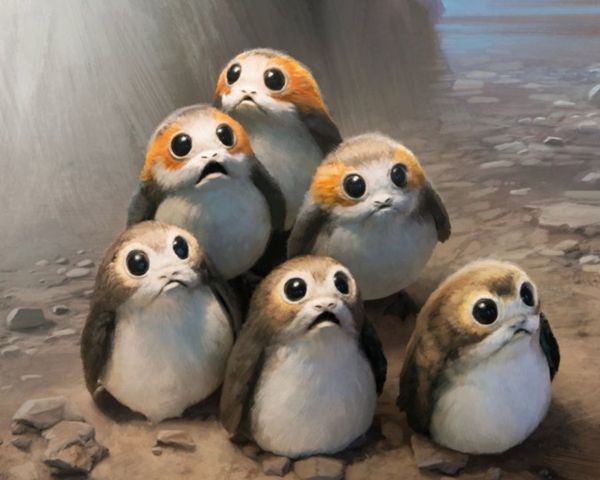
The unutterably cute porgs, apparently in their positions for the bowling tournament about to begin. (LucasFilms The Last Jedi – from Dark Side of the Force Blog)
And there’s more. Much more. Read all about it here.
Be warned. A single stone can cost up to $1400. A set of 16 competition quality stones will run around $4000. How much the shipping costs on over 700 pounds of granite, no man can say. [Chuck Almdale]
At first look, manucodes appear almost normal compared to other birds-of-paradise. Males and females look alike, live in pairs, and males help raise the young. But on the inside manucodes have an exotic secret, and you can hear it in their voices. Males have a greatly lengthened windpipe that works like a wind instrument, creating a long, mellow, fluting song. Filmed and photographed by Tim Laman.
There are currently seventy-two short films in the entire Birds-of-Paradise Project playlist, ranging from 26 seconds to 8:29. In the upcoming weeks, we will present some of our favorites.
A film from the Cornell Lab of Ornithology. If no film or link appears in this email, go to the blog to view it by clicking on the blog title above. If the film stops & starts in an annoying manner, press pause (lower left double bars ||) to let it buffer and get ahead of you. [Chuck Almdale]
Dumb-Sounding Birds Of North America | Skunk Bear
Blogging birder Nick Lund shared some of his favorite ridiculous bird songs with Skunk Bear.
This is an installment of the NPR – Skunk Bear series. If no film or link appears in this email, go to the blog to view it by clicking on the blog title above. If the film stops & starts in an annoying manner, press pause (lower left double bars ||) to let it buffer and get ahead of you. [Chuck Almdale]
New anti-drone technology in France
Where Eagles Dare: French military using winged warriors to hunt down rogue drones.
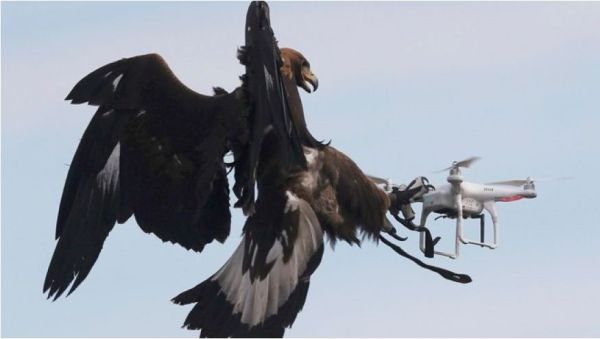
A golden eagle grabs a flying drone during a military training exercise at Mont-de-Marsan French Air Force base, Southwestern France.
Following incidents of drones flying over the presidential palace and restricted military sites — along with the deadly 2015 Paris terror attacks — the French Air Force has trained four golden eagles to intercept and destroy the rogue aircraft.
Aptly named d’Artagnan, Athos, Porthos and Aramis – an homage to Alexandre Dumas’ “The Three Musketeers” – the four birds of prey have been honing their attack skills at Mont-de-Marsan since mid-2016.
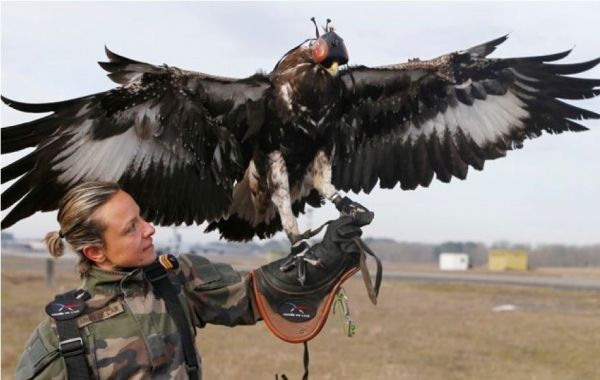
“A drone means food for these birds,” Gerald Machoukow, the military base’s falconer, told FRANCE 24. “Now they automatically go after them.”
The use of hunting birds — normally falcons and northern goshawks — by military organizations around the globe is common practice in the fight to scare other critters away from runways and so cut the risk of accidents during takeoff or landing. But it wasn’t until 2015 when the Dutch started using bald eagles to intercept drones that other military outfits started to see the benefit of these winged warriors.
The French bred the four golden eagles — three males and one female — using artificial insemination since eagles are a protected species and harvesting wild eggs is strictly forbidden. They chose the golden eagle because of the birds hooked beak and sharp eyesight.
Watch the Video
You’ll need to click through to watch it on APF / YouTube
Also weighing in around 11 pounds, the birds are in a similar weight class as the drones they’re sent to destroy and clocking in at a top air speed of 50 miles per hour, with the capability of spotting its target from over a mile away, the eagles are deft hunters.
To protect the eagles from drone blades and any explosive device that might be attached to them, the French military designed mittens of leather and Kevlar (an anti-blast material), to protect the bird’s talons.

A golden eagle carries a flying drone
“I love these birds,” Machoukow told Agence France-Presse. “I don’t want to send them to their death.”
The birds are first taught to attack in a straight line before graduating to diving from heights. Soon they’ll be patrolling the skies over the Pyrenees Mountains in southern France and could possibly be deployed at airports and special events, such as political summits and soccer tournaments.
The French air force already expects four more eagles to join the fleet.
[Submitted by Chris Lord who received it from Don Sterba]
Frankly, I’ve wondered if a spear gun with an attachment line – or even a hose squirting water – might not work well for the drone hovering over your swimming pool.
[Posted by Chuck Almdale]
Another Warm January: Malibu Lagoon, 28 January, 2018

Sanderlings seeking a place to land (Joyce Waterman 1-28-18)
We had close to forty birders for a warm (76°F) day of birding. The sixty-five species was above average for recent years, and – as usual – about 75% of the 2,208 birds were gulls, mostly California Gull, typical for this time of year.
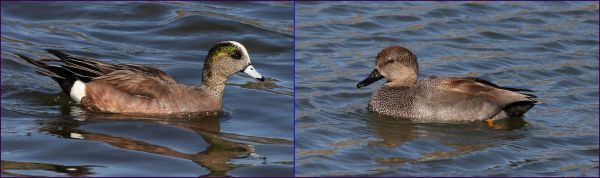
Wintering male ducks: American Wigeon and Gadwall (J. Waterman 1-28-18)
Probably the most uncommon bird was a single male Cinnamon Teal, sleeping among the wigeons. Over our 249 visits since October 1979 in which birds were censused, 153 Cinnamon Teal have been present on 24 total occasions. But the last sighting was a singleton on 12-26-10, seven years ago. Prior to that was in February and March, 2009. They’ve visited only thirteen times since January 2000, with the high count of only six birds. Contrast that to January – April, 1981 when they were present on four dates with a total of 101 birds. Of course, they likely were the same individual birds for that consecutive period. Still, that series accounts for 66% of total Cinnamon Teal ever present. So…bottom line…if you see a Cinnamon Teal at the lagoon, you’re lucky. It’s a very pretty bird.
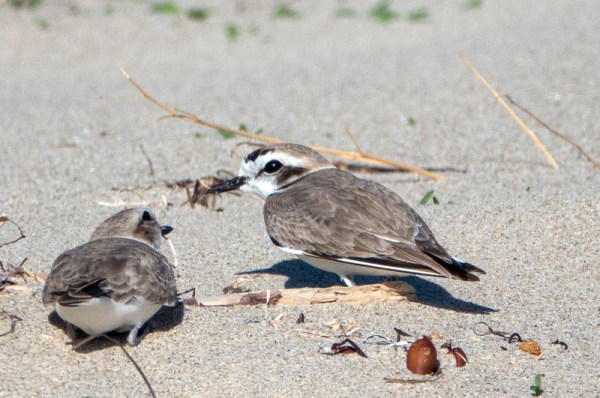
Two Snowy Plovers (Randy Ehler 1-28-18)
We were missing our Snowy Plovers until the very end of the visit, when nineteen suddenly shot in, accompanied by thirty Sanderlings. The Snowies immediately landed on the east end of the beach, almost at our feet, while the tight group of Sanderlings flew back and forth at least a dozen times before alighting among the exposed rocks at the beach’s west end.
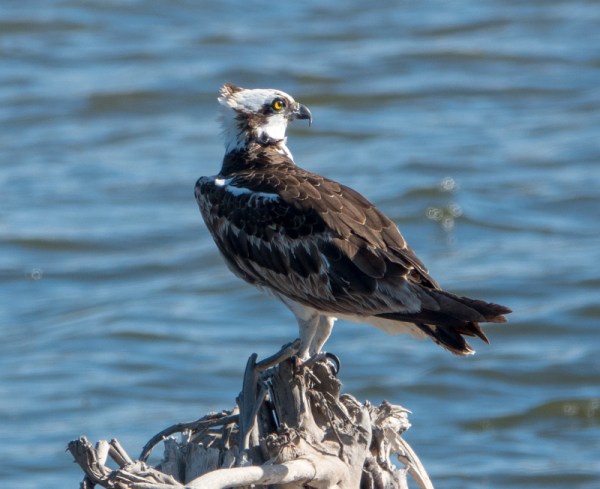
Osprey on a snag, waiting for a Jumping Mullet to jump into his mouth
(R. Ehler 1-28-18)
We had two Ospreys and two Peregrine Falcons, a bit unusual. The falcons raced around the lagoon, as usual, much to the annoyance of the shorebirds and ducks, while the Ospreys hunted in their more sedate manner – soaring high overhead, then plunging on a hapless Mullet. I didn’t see any of these raptors actually catch anything.
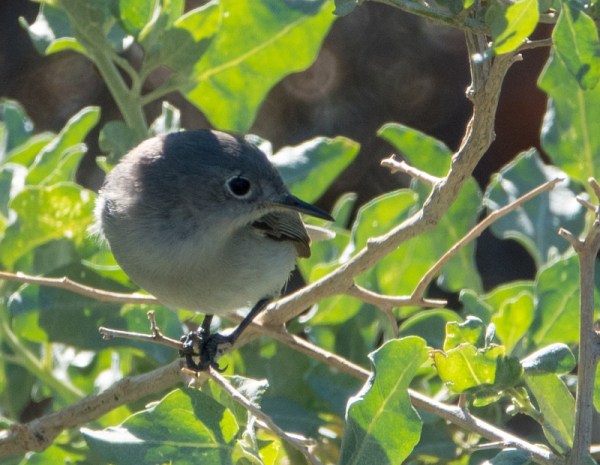
Blue-gray Gnatcatcher, gleaning invertebrates (R. Ehler 1-28-18)
The Blue-gray Gnatcatchers are still relatively abundant, as they’ve been since November. The Yellow-rumped Warblers are everywhere in the brush and trees, as they always are in winter. They’ll leave in the spring.
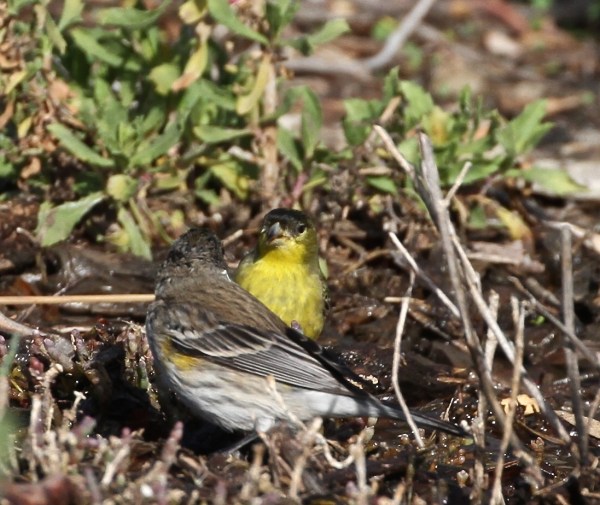
Yellow-rumped Warbler (L) faces off with a Lesser Goldfinch (R) (J. Waterman 1-28-18)
Birds new for the season were: Cinnamon Teal, Green-winged Teal, Eared Grebe, Turkey Vulture, Red-tailed Hawk, Peregrine Falcon, Lesser Goldfinch, Spotted Towhee, Red-winged Blackbird.
Many thanks to our photographers: Randy Ehler & Joyce Waterman.
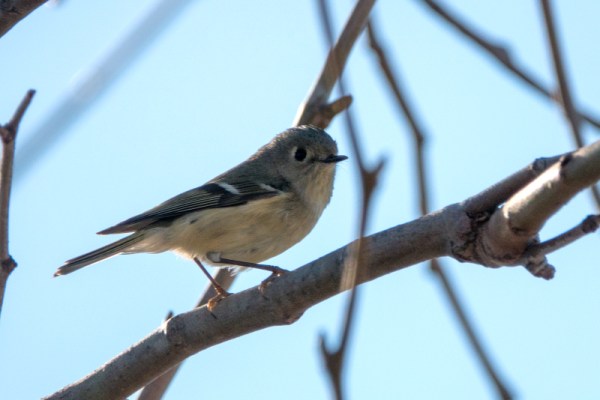
Ruby-crowned Kinglet pauses momentarily while flitting through the brush
(R. Ehler 1-28-18)
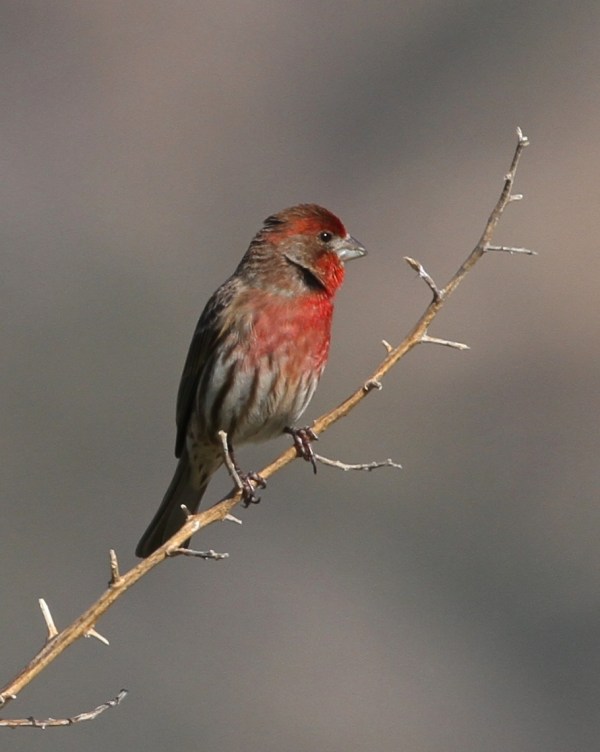
Male House Finch
(J. Waterman 1-28-18)
Our next three scheduled field trips: Malibu Lagoon 8:30 & 10am, 25 February; Sepulveda Basin, 8:30am, 10 March; Malibu Lagoon 8:30 & 10am, 25 March.
Our next program: Santa Cruz Island, with Larry Loeher – Evening Meeting: Tuesday, Mar. 6, 7:30 p.m., Chris Reed Park (we hope), 1133 7th St., NE corner of 7th and Wilshire Blvd. in Santa Monica.
NOTE: Our 10 a.m. Parent’s & Kids Birdwalk meets at the shaded viewpoint just south of the parking area. Watch for Willie the Weasel. He’ll be watching for you and your big floppy feet.
Links: Unusual birds at Malibu Lagoon
9/23/02 Aerial photo of Malibu Lagoon

Heermann’s Gull already in breeding (alternate) plumage (J. Waterman 1-28-18)
Prior checklists:
2017: Jan-June, July-Dec
2016: Jan-June, July-Dec 2015: Jan-May, July-Dec
2014: Jan-July, July-Dec 2013: Jan-June, July-Dec
2012: Jan-June, July -Dec 2011: Jan-June, July-Dec
2010: Jan-June, July-Dec 2009: Jan-June, July-Dec.
The 10-year comparison summaries created during the project period, despite numerous complaints, remain available on our Lagoon Project Bird Census Page. Very briefly summarized, the results unexpectedly indicate that avian species diversification and numbers improved slightly during the period Jun’12-June’14.
Many thanks to Randy Ehler, Lillian Johnson and Chris Lord for their contributions to the checklist below. [Chuck Almdale]
| Malibu Census 2017-18 | 8/27 | 9/24 | 10/22 | 11/26 | 12/24 | 1/28 |
| Temperature | 63-68 | 68-75 | 72-82 | 56-63 | 57-68 | 67-76 |
| Tide Lo/Hi Height | L+1.83 | L+1.86 | H+5.38 | L+2.94 | L+2.8 | H+5.99 |
| Tide Time | 0730 | 0559 | 1050 | 0946 | 0654 | 0609 |
| Canada Goose | 1 | |||||
| Cinnamon Teal | 1 | |||||
| Gadwall | 1 | 1 | 5 | 30 | ||
| American Wigeon | 1 | 3 | 15 | 36 | ||
| Mallard | 7 | 27 | 15 | 2 | 22 | 12 |
| Northern Pintail | 1 | 3 | ||||
| Green-winged Teal | 6 | |||||
| Surf Scoter | 2 | 2 | ||||
| Bufflehead | 1 | 6 | ||||
| Red-breasted Merganser | 4 | 8 | 3 | |||
| Ruddy Duck | 4 | 2 | 13 | |||
| Pied-billed Grebe | 1 | 3 | 5 | 8 | 5 | 1 |
| Eared Grebe | 1 | 2 | ||||
| Western Grebe | 2 | 9 | 15 | 5 | ||
| Clark’s Grebe | 2 | 2 | 1 | |||
| Rock Pigeon | 3 | 5 | 6 | 10 | 6 | 8 |
| Mourning Dove | 1 | 2 | 2 | 2 | 2 | |
| Vaux’s Swift | 40 | |||||
| Anna’s Hummingbird | 1 | 1 | 1 | |||
| Allen’s Hummingbird | 1 | 6 | 2 | 1 | 3 | 5 |
| American Coot | 20 | 62 | 140 | 60 | 72 | 125 |
| American Avocet | 1 | |||||
| Black-bellied Plover | 39 | 89 | 135 | 115 | 28 | 22 |
| Snowy Plover | 16 | 34 | 25 | 31 | 35 | 19 |
| Semipalmated Plover | 2 | 1 | ||||
| Killdeer | 2 | 8 | 10 | 4 | 3 | 4 |
| Whimbrel | 2 | 54 | 45 | 36 | 10 | 8 |
| Marbled Godwit | 8 | 45 | 80 | 135 | 57 | 18 |
| Ruddy Turnstone | 4 | 7 | 6 | 11 | 12 | 1 |
| Sanderling | 7 | 10 | 13 | 11 | 30 | |
| Baird’s Sandpiper | 3 | |||||
| Least Sandpiper | 4 | 3 | 10 | 6 | 1 | |
| Western Sandpiper | 2 | 1 | ||||
| Long-billed Dowitcher | 1 | |||||
| Spotted Sandpiper | 4 | |||||
| Willet | 6 | 55 | 120 | 85 | 11 | 9 |
| Bonaparte’s Gull | 1 | |||||
| Heermann’s Gull | 7 | 11 | 64 | 5 | 4 | 5 |
| Mew Gull | 1 | 1 | ||||
| Ring-billed Gull | 1 | 4 | 25 | 42 | 35 | |
| Western Gull | 52 | 96 | 145 | 105 | 97 | 95 |
| California Gull | 1 | 98 | 385 | 560 | 1550 | |
| Herring Gull | 1 | 2 | ||||
| Glaucous-winged Gull | 2 | 5 | ||||
| Least Tern | 23 | |||||
| Caspian Tern | 7 | 1 | ||||
| Royal Tern | 6 | 52 | 47 | 4 | 21 | 12 |
| Elegant Tern | 32 | 4 | ||||
| Pacific Loon | 1 | 1 | ||||
| Common Loon | 4 | |||||
| Brandt’s Cormorant | 1 | 2 | 2 | 2 | ||
| Double-crested Cormorant | 18 | 36 | 45 | 32 | 32 | 73 |
| Pelagic Cormorant | 1 | 1 | ||||
| American White Pelican | 2 | |||||
| Brown Pelican | 14 | 17 | 17 | 45 | 5 | 6 |
| Great Blue Heron | 3 | 5 | 4 | 8 | 5 | 2 |
| Great Egret | 5 | 3 | 8 | 1 | 1 | |
| Snowy Egret | 11 | 10 | 4 | 8 | 18 | 8 |
| Cattle Egret | 5 | |||||
| Green Heron | 3 | 2 | 2 | |||
| Black-crowned Night-Heron | 2 | 1 | 1 | 3 | ||
| Turkey Vulture | 1 | |||||
| Osprey | 1 | 1 | 1 | 2 | ||
| Cooper’s Hawk | 1 | |||||
| Red-tailed Hawk | 1 | |||||
| Belted Kingfisher | 1 | |||||
| Nuttall’s Woodpecker | 1 | |||||
| American Kestrel | 1 | |||||
| Merlin | 1 | |||||
| Peregrine Falcon | 2 | |||||
| Black Phoebe | 3 | 5 | 6 | 3 | 4 | 3 |
| Say’s Phoebe | 1 | 2 | 2 | 4 | 3 | 3 |
| Cassin’s Kingbird | 1 | |||||
| Western Kingbird | 1 | |||||
| American Crow | 6 | 6 | 5 | 5 | 4 | 3 |
| Rough-winged Swallow | 2 | |||||
| Barn Swallow | 6 | 1 | ||||
| Oak Titmouse | 1 | 1 | ||||
| Bushtit | 1 | 15 | 48 | 10 | 20 | |
| House Wren | 1 | 1 | 1 | |||
| Marsh Wren | 2 | 3 | 1 | 1 | ||
| Bewick’s Wren | 3 | 2 | 4 | 3 | 3 | |
| Blue-gray Gnatcatcher | 15 | 7 | 8 | |||
| Ruby-crowned Kinglet | 4 | 1 | 3 | |||
| Northern Mockingbird | 2 | 2 | 1 | 2 | 2 | |
| European Starling | 6 | 25 | 8 | 50 | 15 | |
| American Pipit | 4 | |||||
| House Finch | 2 | 8 | 16 | 40 | 41 | 20 |
| Lesser Goldfinch | 2 | 1 | 1 | |||
| Spotted Towhee | 1 | |||||
| California Towhee | 1 | 2 | 1 | |||
| Brewer’s Sparrow | 1 | |||||
| Savannah Sparrow | 8 | |||||
| Song Sparrow | 2 | 3 | 4 | 2 | 9 | 4 |
| White-crowned Sparrow | 20 | 45 | 27 | 8 | ||
| Golden-crowned Sparrow | 1 | |||||
| Dark-eyed Junco | 1 | |||||
| Western Meadowlark | 1 | 3 | 3 | 2 | 2 | |
| Hooded Oriole | 1 | |||||
| Bullock’s Oriole | 2 | |||||
| Red-winged Blackbird | 6 | |||||
| Brewer’s Blackbird | 12 | 1 | ||||
| Great-tailed Grackle | 2 | 3 | 6 | 12 | 6 | 1 |
| Orange-crowned Warbler | 1 | 5 | 2 | 1 | 1 | 2 |
| Nashville Warbler | 1 | |||||
| Common Yellowthroat | 2 | 8 | 5 | 9 | 5 | 2 |
| Yellow Warbler | 2 | |||||
| Yellow-rumped(Aud) Warbler | 12 | 3 | 12 | 12 | ||
| Wilson’s Warbler | 1 | |||||
| Totals by Type | Aug | Sep | Oct | Nov | Dec | Jan |
| Waterfowl | 7 | 27 | 19 | 14 | 58 | 109 |
| Water Birds – Other | 56 | 118 | 223 | 164 | 126 | 211 |
| Herons, Egrets & Ibis | 19 | 23 | 19 | 25 | 26 | 11 |
| Quail & Raptors | 1 | 1 | 0 | 0 | 4 | 6 |
| Shorebirds | 80 | 314 | 434 | 441 | 173 | 112 |
| Gulls & Terns | 128 | 161 | 363 | 524 | 729 | 1704 |
| Doves | 4 | 7 | 8 | 12 | 8 | 8 |
| Other Non-Passerines | 1 | 47 | 3 | 1 | 5 | 6 |
| Passerines | 48 | 86 | 115 | 211 | 194 | 121 |
| Totals Birds | 344 | 784 | 1184 | 1392 | 1323 | 2288 |
| Total Species | Aug | Sep | Oct | Nov | Dec | Jan |
| Waterfowl | 1 | 1 | 5 | 5 | 8 | 9 |
| Water Birds – Other | 6 | 4 | 10 | 7 | 8 | 8 |
| Herons, Egrets & Ibis | 3 | 5 | 5 | 6 | 3 | 3 |
| Quail & Raptors | 1 | 1 | 0 | 0 | 4 | 4 |
| Shorebirds | 9 | 14 | 9 | 10 | 9 | 9 |
| Gulls & Terns | 7 | 5 | 7 | 5 | 9 | 7 |
| Doves | 2 | 2 | 2 | 2 | 2 | 1 |
| Other Non-Passerines | 1 | 3 | 2 | 1 | 3 | 2 |
| Passerines | 15 | 24 | 19 | 19 | 22 | 22 |
| Totals Species – 109 | 45 | 59 | 59 | 55 | 68 | 65 |



 SANTA MONICA BAY AUDUBON SOCIETY BLOG