Free email delivery
Please sign up for email delivery in the subscription area to the right.
No salesman will call, at least not from us. Maybe from someone else.
Laurel Hoctor Jones – Outspoken Champion of Birds
Laurel Hoctor Jones joined the board of Santa Monica Bay Audubon Society in May, 2014. She immediately jumped right in, taking on the task of Education Chair, doing communication and outreach with local schools and various levels of government. She became avidly involved in our Snowy Plover protection efforts, censusing the birds at several locations and attending annual range-wide Snowy Plover conferences. This led to her becoming Conservation Co-chair, after which she represented us at several state and national Audubon conferences. She wrote blogs on Snowy Plovers, egrets and herons. She was very energetic and willing to share her opinions. Yet she was also a private person, and outside of her activities for the chapter, we didn’t know much about her personal life.
Over the months and years we gradually learned that her health was not good, but she rarely spoke of it to most of us and we assumed the problems would be resolved. The one thing we knew, she never let her illness slow her down.
So it was with surprise and dismay that on December 9, 2017, we received this message from two board members, Grace Murayama and Larry Loeher:
Fellow SMBAS Board members,
(in case you hadn’t already received this sad news)
Last night I received some devastating news from Laurel’s husband, Kevin.
This to let you know that Laurel died yesterday, a heart attack resulting from her long-term health problems. There’ll be some sort of commemoration but nothing’s set yet.This is so sad, awful, and and just plain unfair. Take care, Grace & Larry
We all were stunned. A great many messages quickly passed; some are included below. We asked Kevin, her husband, if he would write a few words we could share with our chapter members and readers.

Laurel & Kevin Hoctor-Jones
A native Californian, Laurel received a BA in theatre from UCLA School of Theatre, Film and Television and a masters in English Literature from the University of Glasgow in Scotland, where she was a Rotary Foundation scholar. While in Scotland she married Kevin.
She worked in the entertainment industry, variously as assistant to Hollywood agent Arnold Sank, as a reader/editor for Yorkshire TV in England and Universal studios in Hollywood, and in administration for the MPAA. She worked for 8 years as a writer/editor for the Shoah Foundation, Steven Spielberg’s Holocaust archive and documentary project, which she considered her most rewarding job. She also worked extensively as a freelance editor for screenplays and novels.
She had a love of the ocean and the wilderness dating from childhood vacations in Yosemite, Yellowstone, Colorado, Washington State’s Olympic Peninsula and California’s Central Coast. As a child she loved to get up before dawn to explore tide-pools. She was involved with various environmental groups over the years, including the American Oceans Campaign, the California Wildlife Center and the Audubon Society. Lately she worked extensively on shorebird monitoring and preservation programs. — Kevin Jones
It’s odd but true that we in the Audubon Society, who are so involved in our passion for birds, often know very little about the personal lives and histories of those with whom we share our passion. [Chuck Almdale]
Here are some of our thoughts and emotional reactions which ensued.
This is very sad news. Laurel had often discussed her medical situation with me although I never gave her my thoughts on its severity but I am sure she knew. When we get details of the memorial we should do something as a Board to recognize her contributions. She will be very much missed. — Adrian Douglas, M.D.

Laurel loved the egret colony across the street from the lagoon, and fought to save it. (From “Summer of Heron Love Part II,” Laurel Hoctor Jones, 9/14/14, Malibu)
(The next comment came from young birder Charlotte Maddela, whom SMBAS helped to start a Young Birder’s Club. After the club was formed, Laurel often worked with them at the beach.)
I appreciated the time that Laurel spent with me. She taught me a lot about Plovers and Laurel was the first person to inform me about the Snowy Plover citizen science program with Audubon. I enjoyed the time she spent with me at Malibu Lagoon, not only seeking out plovers, but also identifying all kinds of species. Laurel often told me that she didn’t only look at birds. She liked looking at everything! Laurel cared about the environment and conservation, and so do I. Since her Snow Plover training, I’ve been involved with volunteering for the citizen science program for the last three years. I’m glad she was able to pass her knowledge on to me. — Charlotte Maddela
Wow, that is shocking news. We agree with Adrian we should do something to recognize her contributions to the board and conservation in general. Grace and Larry, thanks for letting us know. — Lillian Johnson and Chuck Almdale
Very upsetting. She was truly committed to the cause of bird conservation. We could consider a Laurel Hoctor Jones Memorial Fund, for specific causes that she championed. — Liz Galton
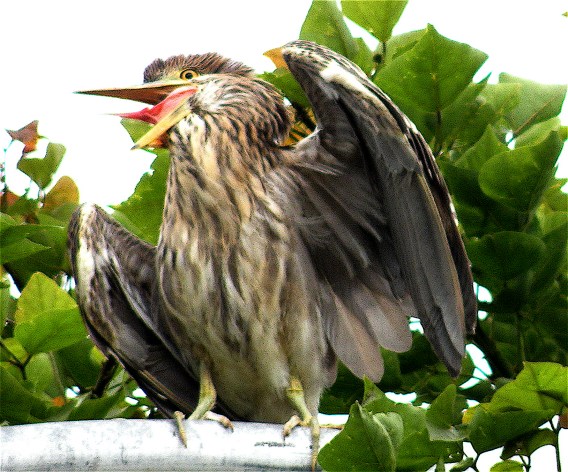
Juvenile Black-crowned Night-Heron in the egret-heron colony in Malibu (From “A Summer of Heron Love Draws to a Close,” Laurel Hoctor Jones, Malibu, 9/12/14)
WOW. Whenever I drove her to meetings, we talked quite a bit about her on-going health issues, but she seemed to be doing much better after recovering from her surgery. I’m so, so sorry to hear this. 😦 — Kirsten Wahlquist
Shocking and sad news. Although we did not know Laurel well, what we did know of her was that she was a fighter for that which she believed would better serve and benefit the birds, and wildlife. We were impressed by her passion, her tenacity. Doug and I are in favor of recognizing her contributions in some way as well. — Joyce and Doug Waterman
Very sad to hear this. Laurel found and worked with so many people and projects away from those of our immediate chapter. This terrible event makes us see her active schedule, work and dedication as even more admirable. A year and a half or so ago she recommended Rachel Carson’s “Under The Sea Wind.” If you read this you probably won’t be disappointed. It also speaks to Laurel’s love of the tough, beautiful and complex ocean and beach environment, and her dedicated work to help preserve it. — Chris Lord
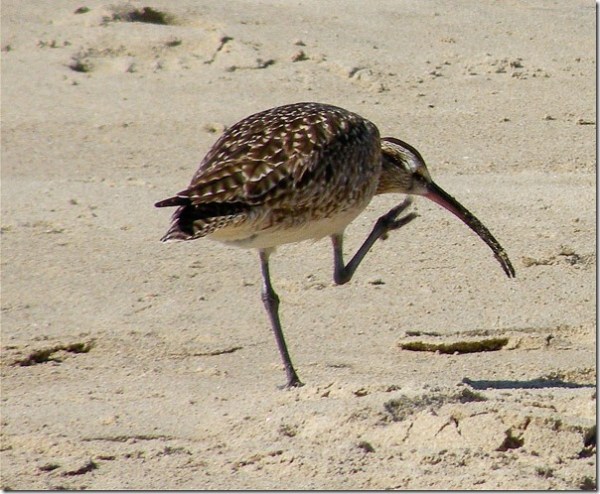
Whimbrel with an itch (From “Malibu Lagoon, April 27, 2014,” Laurel Hoctor Jones, 4/27/14)
Laurel’s very heavy schedule on behalf of the environment and our chapter gave me no indication of the depth of her health issues. Many of us are retired but Laurel also had a “real” job which made her efforts even more remarkable. I will miss her wide-ranging and educational reports at our board meetings. I will also miss our more prickly exchanges – Laurel had ideas and was not shy about expressing them. In short, she was the kind of truth-teller and friend we all hope to have. Ave atque vale, Laurel. — Chuck Bragg
I agree with all of you that losing Laurel is heart-breaking, especially for Laurel’s husband. I think we are all lucky to have known her and benefited from her passion for environmental education and advocacy. I think a Memorial Fund in her name would be an excellent way to honor her. — Cindy Schotte
We are laden with sorrow for one of our most active board members who, despite long-term physical handicaps, was constantly reaching outside our own little circle to find support for the birds and natural habitats in our area. I could not tell that Laurel was in any impending difficulty just a week ago when we last met at the Snowy Plover volunteer brunch. I looked forward to fighting the good fight with her for many seasons to come as we attempt to improve the fate of our shorebirds. A voice extinguished should not lessen our resolve, and we will remember Laurel with warmth and admiration as we continue the struggle for nature’s own. — Lu Plauzoles

Young & joyous Double-crested Cormorants (from “Creature from the Black Lagoon: Halloween Edition,” (Laurel Hoctor Jones 10/31/14)
L.A.’s Griffith Park Mountain Lion with Miguel Ordeñana | Natural History Museum’s Curiosity Show
In Los Angeles, our most heroic urban nature story is the journey of P-22, a male mountain lion who traveled across the city and two busy freeways to get to Griffith Park. P-22 was first observed in the park by our citizen science coordinator Miguel Ordenana. Miguel leads us through the exhibit and shows what P-22 had to conquer to make it all the way across town to reach his new home.
This comes from the Natural History Museum of Los Angeles County. If no film or link appears in this email, go to the blog to view it by clicking on the blog title above. If the film stops & starts in an annoying manner, press pause (lower left double bars ||) to let it buffer and get ahead of you. [Chuck Almdale]
SMBAS field class in bird ID
SMBAS field class in bird ID
SMBAS will offer a short field course in bird identification in the spring of 2018. The course is intended to help new or novice birders improve their birding skills while learning how to identify some of the species commonly found in the Los Angeles basin.
This year, the course will consist of 6 Saturday morning sessions, each of which will be held in a local park or natural area. Sessions will begin in late February.
Enrollment is limited to 8. A donation of $60 per SMBAS member or $90 per non-member will be requested.
For more information, send an e-mail to SMBAudubon[AT]gmail.com and put “Bird Class” in the subject line.
Winter’s Icy Chill Strikes Malibu Lagoon, 24 December, 2017
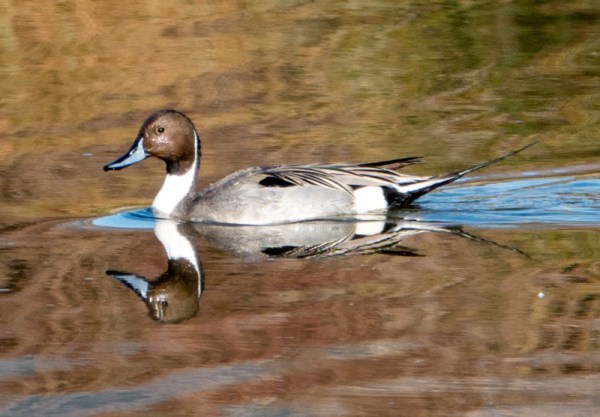
The elegant Pintail used to be more common in the late 1970’s. (R. Ehler 12-24-17)
A surprising number of birders appeared, considering that it was Christmas Eve Day, and it was chilly. (57°F or 14°C is considered chilly around here. This blog’s title is tongue-in-cheek). We had a good assortment of birds, although all did not appear at the same time nor did everyone see all of them. The Merlin, for example. The first I heard about it was when I was asked: “Wow! Didja see that Merlin! What a show!” Well…no I didn’t, but thanks for asking. Once gone, apparently, gone forever.
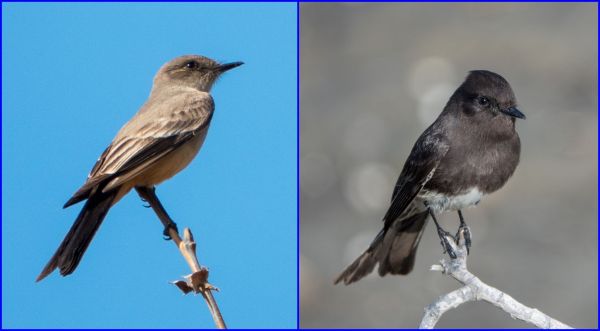
Congener Phoebes: Say’s and Black, typically over-winter at the lagoon
(R. Ehler 12-24-17)
We had some people new to birding, and some birders new to the lagoon. Thus, plenty of questions and plenty of new birds for some of us. A cluster of (three, I think) birders had just finished a beginning birder’s course with Pasadena Audubon, and the gulls and shorebirds seemed to be new to them. As a reminder to our readers, our chapter has a beginning birding class beginning soon, but it might already be full.

House Finches seed-eating in beach brush (R. Juncosa 12-24-17)
Some ducks showed up, finally, so I guess the weather up north became a bit more wintery. I’ve recently read that some West Coast sea counts (stand on a seaside high point and count birds flying by) of ducks were down about ninety percent from prior years. That sounded about right to me. But today we had eight species of duck, two of grebe and two of loon. Not large numbers of any particular species, but good diversity.
Snowy Plovers a-plenty on the beach. Thirty-five of them, scattered widely through the washed-up detritus and footprint-hollows landside of the beach berm, including banded birds AA:BG and RR:BB, the latter bird spotted by Chris Lord.

Double-crested Cormorants in the lagoon, Western Gull preening (R. Juncosa 12-24-17)
Gulls were numerous. Most were California Gull, which is to be expected, but we also had one Bonaparte’s, one Mew (reported to me), Two Heermann’s, one Herring and two Glaucous-winged. Royal Tern was the only tern species. Forster’s and Caspian Terns must be around, somewhere, but the Elegants have fled to Baja for the winter. The larger shorebirds – Willet, Whimbrel, Marbled Godwit – have dwindled in numbers by about 70% since last month.
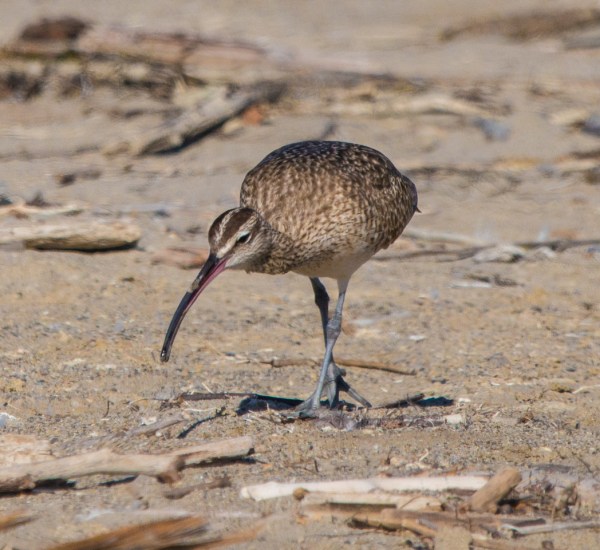
Whimbrel pokes around the beach (R. Juncosa 12-24-17)
One or two of the heavy-billed Common Loons were swimming around in the now-shallow lagoon waters. Shallow because the beach was breached during a recent high-tide, most of the water ran out, the water level dropped a couple of feet (estimated) and the water surface area is probably half of what it was a month ago.
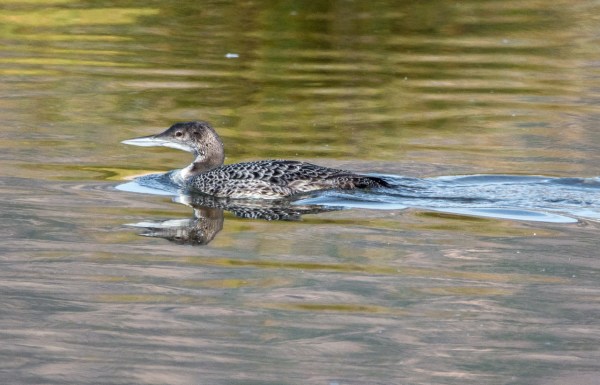
Common Loon toolin’ down the lagoon (R. Juncosa 12-24-17)
Speaking of water, the current drought and low humidity is really affecting plants and trees everywhere, causing them to dry out and encouraging all our recent wildfires. The “Thomas” fire had become the largest wildfire in recorded California history – over 280,000 acres (450 square miles), and many homes gone. Many of the bushes look extremely brown and wilted. The tree by the picnic area died and fell over. Someone dragged it out of the path. Downtown Los Angeles had 0.11 inches of rain for Nov-Dec, 94% below normal.

Bewick’s Wren – pronounce it “Buick” or he gets upset – are usually up in the chaparral (R. Ehler 12-24-17)

Western Meadowlark on his rainbird perch (R. Ehler 12-24-17)
On my way out I met a birder, who asked if I though the bird he was looking at was a Cooper’s Hawk. It was on the ground on the small island near our gathering spot. I do not expect to find Cooper’s Hawks on the ground, sitting quietly, doing nothing. I’ve seen them on the ground while eating some hapless bird or rodent, such as the one disassembling and scarfing a rat in my backyard one recent winter. But we agreed that it was a juvenile Cooper’s. Sometimes juvenile raptors haven’t quite figured out how to catch prey. I’ve seen juvenile Red-tailed Hawks chase squirrels by hopping around on the ground, and a juvenile Great Black Hawk in the Peruvian Amazon trying – completely unsuccessfully – to grab any one of over a dozen Hoatzins resting in a fallen riverside tree by jumping ungainly from limb to limb.
Nick, the birder, turned out to be an Ornithology student at San Diego State, visiting locally for Christmas. While I was making my best attempt to tell him how to get to the Ballona Creek jetties to see rocky shorebirds, we spotted a small falcon diving on the Cooper’s Hawk. It was a Kestrel. I haven’t seen a kestrel at the lagoon since 9/25/16, fifteen months ago. Then, to top even that, while talking to Lu Plauzoles in the parking lot about his waste fishing line collection efforts on the Malibu Pier, he spotted a Nuttall’s Woodpecker female whacking away in a nearby tree. This is only the seventh Nuttall’s we’ve spotted at the lagoon in almost forty years; the last one was in October 2015.

Blue-gray Gnatcatcher, another species usually up in the chaparral (R. Juncosa 12-24-17)
Apropos this unusual woodpecker coastal sighting, Lu commented that he had heard a conjecture from knowledgeable and local birder Dick Norton that the drought, dying trees and lack of invertebrate prey had forced many birds to flee local hills and chaparral and seek food elsewhere. Lu thought this might be why the woodpecker, the Blue-gray Gnatcatchers and Bewick’s Wrens were around the lagoon in larger than usual numbers this year. He may be right.
On the other hand, Chris Lord – SMBAS member, regular birder at Topanga Canyon and monthly bird census participant at Ballona Freshwater Marsh – had this comment after reading my original posting.
Concerning your Malibu Lagoon write-up and comment on Blue-gray Gnatcatchers [BGGN], my local experience is that many BGGN winter nearer sea level and are absent in winter up in Topanga State Park [TSP], at least in my counting area; then they reappear there in TSP for spring and summer. I have never learned if these are mostly local birds in vertical migration or not. At Ballona Freshwater Marsh (BFM) we count roughly 5 to 10 BGGN per monthly winter count, and I get 3 to 14 BGGN per Topanga State Park count, starting mid-March and peaking in mid-August. I don’t know why we don’t see more wintering at the Lagoon. Maybe there are more at Legacy Park [an inland park a short distance from the lagoon]? They sure like BFM, maybe for its larger habitat area.
Another mystery of nature as yet unsolved. [Sounds like a future PhD thesis to me.] Whatever is really going on, let’s hope there’s some rain in our near future.

A young White-crowned Sparrow (R. Ehler 12-24-17)
Birds new for the season were: Surf Scoter, Bufflehead, Bonaparte’s Gull, Herring & Glaucous-winged Gull, Pacific & Common Loons, Osprey, Cooper’s Hawk, Nuttall’s Woodpecker, American Kestrel, Merlin, Barn Swallow, California Towhee.
Many thanks to our photographers: Randy Ehler and Ray Juncosa.
Our next four scheduled field trips: Santa Monica portion of Los Angeles Christmas Count, 6:45 am, 2 January; Antelope Valley Raptors & Other Specialties, 7am carpool time, 13 January; Malibu Lagoon 8:30 & 10am, 28 January; Salton Sea & Imperial Valley, 9am, 10-11 February (a sign-up trip).
Our next program: The Salton Sea, with California Audubon – Evening Meeting: Tuesday, Feb. 6, 7:30 p.m., Chris Reed Park, 1133 7th St., NE corner of 7th and Wilshire Blvd. in Santa Monica.
NOTE: Our 10 a.m. Parent’s & Kids Birdwalk meets at the shaded viewpoint just south of the parking area. Watch for Willie the Weasel. He’ll be watching for you and your big floppy feet.
Links: Unusual birds at Malibu Lagoon
9/23/02 Aerial photo of Malibu Lagoon
Prior checklists:
2017: Jan-June
2016: Jan-June, July-Dec 2015: Jan-May, July-Dec
2014: Jan-July, July-Dec 2013: Jan-June, July-Dec
2012: Jan-June, July -Dec 2011: Jan-June, July-Dec
2010: Jan-June, July-Dec 2009: Jan-June, July-Dec.
The 10-year comparison summaries created during the project period, despite numerous complaints, remain available on our Lagoon Project Bird Census Page. Very briefly summarized, the results unexpectedly indicate that avian species diversification and numbers improved slightly during the period Jun’12-June’14.
Many thanks to Randy Ehler, Chris Lord and others for their contributions to the checklist below. [Chuck Almdale]
| Malibu Census 2017 | 7/23 | 8/27 | 9/24 | 10/22 | 11/26 | 12/24 |
| Temperature | 70-75 | 63-68 | 68-75 | 72-82 | 56-63 | 57-68 |
| Tide Lo/Hi Height | H+4.39 | L+1.83 | L+1.86 | H+5.38 | L+2.94 | L+2.8 |
| Tide Time | 1039 | 0730 | 0559 | 1050 | 0946 | 0654 |
| Canada Goose | 1 | |||||
| Gadwall | 15 | 1 | 1 | 5 | ||
| American Wigeon | 1 | 3 | 15 | |||
| Mallard | 30 | 7 | 27 | 15 | 2 | 22 |
| Northern Pintail | 1 | 3 | ||||
| Surf Scoter | 2 | |||||
| Bufflehead | 1 | |||||
| Red-breasted Merganser | 4 | 8 | ||||
| Ruddy Duck | 4 | 2 | ||||
| Pied-billed Grebe | 2 | 1 | 3 | 5 | 8 | 5 |
| Eared Grebe | 1 | |||||
| Western Grebe | 2 | 9 | 15 | 5 | ||
| Clark’s Grebe | 2 | 2 | ||||
| Rock Pigeon | 17 | 3 | 5 | 6 | 10 | 6 |
| Mourning Dove | 4 | 1 | 2 | 2 | 2 | 2 |
| Vaux’s Swift | 40 | |||||
| Anna’s Hummingbird | 1 | 1 | ||||
| Allen’s Hummingbird | 6 | 1 | 6 | 2 | 1 | 3 |
| American Coot | 6 | 20 | 62 | 140 | 60 | 72 |
| American Avocet | 1 | |||||
| Black-bellied Plover | 27 | 39 | 89 | 135 | 115 | 28 |
| Snowy Plover | 9 | 16 | 34 | 25 | 31 | 35 |
| Semipalmated Plover | 2 | 1 | ||||
| Killdeer | 4 | 2 | 8 | 10 | 4 | 3 |
| Whimbrel | 27 | 2 | 54 | 45 | 36 | 10 |
| Marbled Godwit | 8 | 8 | 45 | 80 | 135 | 57 |
| Ruddy Turnstone | 2 | 4 | 7 | 6 | 11 | 12 |
| Black Turnstone | 1 | |||||
| Sanderling | 7 | 10 | 13 | 11 | ||
| Baird’s Sandpiper | 3 | |||||
| Least Sandpiper | 4 | 3 | 10 | 6 | ||
| Western Sandpiper | 2 | 1 | ||||
| Long-billed Dowitcher | 1 | |||||
| Spotted Sandpiper | 4 | |||||
| Willet | 3 | 6 | 55 | 120 | 85 | 11 |
| Greater Yellowlegs | 1 | |||||
| Bonaparte’s Gull | 1 | |||||
| Heermann’s Gull | 19 | 7 | 11 | 64 | 5 | 4 |
| Mew Gull | 1 | 1 | ||||
| Ring-billed Gull | 1 | 4 | 25 | 42 | ||
| Western Gull | 52 | 52 | 96 | 145 | 105 | 97 |
| California Gull | 2 | 1 | 98 | 385 | 560 | |
| Herring Gull | 1 | |||||
| Glaucous-winged Gull | 2 | |||||
| Least Tern | 30 | 23 | ||||
| Caspian Tern | 12 | 7 | 1 | |||
| Royal Tern | 2 | 6 | 52 | 47 | 4 | 21 |
| Elegant Tern | 90 | 32 | 4 | |||
| Pacific Loon | 1 | |||||
| Common Loon | 4 | |||||
| Brandt’s Cormorant | 1 | 2 | 2 | |||
| Double-crested Cormorant | 22 | 18 | 36 | 45 | 32 | 32 |
| Pelagic Cormorant | 1 | 1 | ||||
| American White Pelican | 2 | |||||
| Brown Pelican | 35 | 14 | 17 | 17 | 45 | 5 |
| Great Blue Heron | 6 | 3 | 5 | 4 | 8 | 5 |
| Great Egret | 5 | 5 | 3 | 8 | 1 | |
| Snowy Egret | 12 | 11 | 10 | 4 | 8 | 18 |
| Cattle Egret | 5 | |||||
| Green Heron | 3 | 2 | 2 | |||
| Black-crowned Night-Heron | 1 | 2 | 1 | 1 | 3 | |
| Osprey | 1 | 1 | 1 | 1 | ||
| Cooper’s Hawk | 1 | |||||
| Belted Kingfisher | 1 | |||||
| Nuttall’s Woodpecker | 1 | |||||
| American Kestrel | 1 | |||||
| Merlin | 1 | |||||
| Peregrine Falcon | 1 | |||||
| Black Phoebe | 5 | 3 | 5 | 6 | 3 | 4 |
| Say’s Phoebe | 1 | 2 | 2 | 4 | 3 | |
| Cassin’s Kingbird | 1 | 1 | ||||
| Western Kingbird | 1 | 1 | ||||
| American Crow | 2 | 6 | 6 | 5 | 5 | 4 |
| Rough-winged Swallow | 2 | |||||
| Barn Swallow | 12 | 6 | 1 | |||
| Oak Titmouse | 1 | 1 | ||||
| Bushtit | 1 | 15 | 48 | 10 | ||
| House Wren | 1 | 1 | 1 | |||
| Marsh Wren | 2 | 3 | 1 | |||
| Bewick’s Wren | 3 | 2 | 4 | 3 | ||
| Blue-gray Gnatcatcher | 15 | 7 | ||||
| Ruby-crowned Kinglet | 4 | 1 | ||||
| Northern Mockingbird | 2 | 2 | 2 | 1 | 2 | |
| European Starling | 6 | 25 | 8 | 50 | ||
| American Pipit | 4 | |||||
| House Finch | 10 | 2 | 8 | 16 | 40 | 41 |
| Lesser Goldfinch | 2 | 1 | ||||
| California Towhee | 1 | 2 | ||||
| Brewer’s Sparrow | 1 | |||||
| Savannah Sparrow | 8 | |||||
| Song Sparrow | 6 | 2 | 3 | 4 | 2 | 9 |
| White-crowned Sparrow | 20 | 45 | 27 | |||
| Golden-crowned Sparrow | 1 | |||||
| Dark-eyed Junco | 1 | |||||
| Western Meadowlark | 1 | 1 | 3 | 3 | 2 | |
| Hooded Oriole | 1 | |||||
| Bullock’s Oriole | 2 | |||||
| Brewer’s Blackbird | 12 | 1 | ||||
| Great-tailed Grackle | 15 | 2 | 3 | 6 | 12 | 6 |
| Orange-crowned Warbler | 1 | 5 | 2 | 1 | 1 | |
| Nashville Warbler | 1 | |||||
| Common Yellowthroat | 2 | 2 | 8 | 5 | 9 | 5 |
| Yellow Warbler | 2 | |||||
| Yellow-rumped(Aud) Warbler | 12 | 3 | 12 | |||
| Wilson’s Warbler | 1 | |||||
| Totals by Type | Jul | Aug | Sep | Oct | Nov | Dec |
| Waterfowl | 45 | 7 | 27 | 19 | 14 | 58 |
| Water Birds – Other | 65 | 56 | 118 | 223 | 164 | 31 |
| Herons, Egrets & Ibis | 24 | 19 | 23 | 19 | 25 | 4 |
| Quail & Raptors | 2 | 1 | 1 | 0 | 0 | 137 |
| Shorebirds | 82 | 80 | 314 | 434 | 441 | 242 |
| Gulls & Terns | 207 | 128 | 161 | 363 | 524 | 633 |
| Doves | 21 | 4 | 7 | 8 | 12 | 21 |
| Other Non-Passerines | 6 | 1 | 47 | 3 | 1 | 3 |
| Passerines | 57 | 48 | 86 | 115 | 211 | 194 |
| Totals Birds | 509 | 344 | 784 | 1184 | 1392 | 1323 |
| Total Species | Jul | Aug | Sep | Oct | Nov | Dec |
| Waterfowl | 2 | 1 | 1 | 5 | 5 | 8 |
| Water Birds – Other | 4 | 6 | 4 | 10 | 7 | 6 |
| Herons, Egrets & Ibis | 4 | 3 | 5 | 5 | 6 | 2 |
| Quail & Raptors | 2 | 1 | 1 | 0 | 0 | 5 |
| Shorebirds | 9 | 9 | 14 | 9 | 10 | 10 |
| Gulls & Terns | 7 | 7 | 5 | 7 | 5 | 10 |
| Doves | 2 | 2 | 2 | 2 | 2 | 2 |
| Other Non-Passerines | 1 | 1 | 3 | 2 | 1 | 3 |
| Passerines | 11 | 15 | 24 | 19 | 19 | 22 |
| Totals Species – 105 | 42 | 45 | 59 | 59 | 55 | 68 |
DNA Doesn’t Look Like What You Think! | PBS Science Video
They used #badDNA once in this video. Can you find it?
Biology textbooks are full of drawings of DNA, but none of those show what DNA actually looks like. Sure, they’re good models for understanding how DNA works, but inside of real cells, it’s a whole lot more interesting. Learn why we can’t look directly at DNA, and find out how DNA is actually packed inside cells.
This is an installment of the PBS – It’s OK to be Smart series. If no film or link appears in this email, go to the blog to view it by clicking on the blog title above. If the film stops & starts in an annoying manner, press pause (lower left double bars ||) to let it buffer and get ahead of you. [Chuck Almdale]



 SANTA MONICA BAY AUDUBON SOCIETY BLOG