Free email delivery
Please sign up for email delivery in the subscription area to the right.
No salesman will call, at least not from us. Maybe from someone else.
Birds and forest fires; cozy
I thought our chapter members and friends would be interested in a recent New York Times article that extensively quotes Chad Hanson, who has spoken to our chapter about the effects of forest fires in California. How many of us have not yet seen the Black-backed Woodpecker?
You cannot open this article from this email announcement. Please go to the blog (smbasblog.com) and click on the title below the photo.
LucienP
Why Are We The Only Humans Left? | PBS Science Video
In part 2 of this special series on human ancestry, we ask why we are the only surviving branch on the human evolutionary tree. Just 50,000-100,000 years ago, Earth was home to three or four separate human species, including our most famous cousins: the Neanderthals. New research has shown that Neanderthals were not the brutish, unintelligent cavemen that cartoons make them out to be. They were creative, smart, social, and perhaps even had complex language. So why did they go extinct as soon as Homo sapiens moved into their territory? Does any trace of them live on today? Why don’t we have Neanderthal neighbors?
This part and the next two parts of the 4-part Human Ancestors series will run consecutively, 4 days apart.
This is an installment of the PBS – It’s OK to be Smart series. If no film or link appears in this email, go to the blog to view it by clicking on the blog title above. If the film stops & starts in an annoying manner, press pause (lower left double bars ||) to let it buffer and get ahead of you. [Chuck Almdale]
Those hundreds of powerful suckers on octopus arms do more than just stick. They actually smell and taste. This contributes to a massive amount of information for the octopus’s brain to process, so octopuses depend on their eight arms for help. (And no, it’s not ‘octopi.’)
This is another installment of the PBS Deep Look series. If no film or link appears in this email, go to the blog to view it by clicking on the blog title above. If the film stops & starts in an annoying manner, press pause (lower left double bars ||) to let it buffer and get ahead of you. [Chuck Almdale]
Where Did Humans Come From? | PBS Science Video
In part 1 of this special series on human ancestry, we tour through our family tree to meet our ancestors and distant cousins, and to find out what made us human along the way.
The story of human ancestry is not a simple progression from primitive apes to us, with all the ape/human intermediates in between. The real human story is much richer and more complex, full of branches, gaps, and shadowy parts. A century and a half of fossil finds tells us perhaps two dozen human species lived on Earth between now and the time when our ancestors split from chimpanzee ancestors. The new era of DNA and genetics is upending that story yet again.
This is an installment of the PBS – It’s OK to be Smart series. If no film or link appears in this email, go to the blog to view it by clicking on the blog title above. If the film stops & starts in an annoying manner, press pause (lower left double bars ||) to let it buffer and get ahead of you. [Chuck Almdale]

Malibu pier in eastern distance past the nesting area (G. Murayama 7-23-17)
Least Terns continue nesting on Surfrider Beach next to Malibu Lagoon. The semi-monthly high tides washed out most of their nests, forcing them to re-nest. Some may have re-nested more than once. Some adults were mating a few days ago, some are sitting on eggs. Some chicks are very young while others are older, and we have juveniles stretching their wings and flying around quite competently. These birds grow up fast: 20-22 days of egg incubation, then 19-21 days from hatching to fledging.

A very young Least Tern chick (J. Waterman 7-23-17)
The Snowy Plovers are done nesting, and the winter roosting colony continues to grow. Our hatched plover chick was not banded and is now a flying juvenile.With additional juveniles arriving on Malibu Beach from northerly nesting areas, we no longer can tell for sure which one it is or even if it’s still here.

Does this Snowy Plover make you need to yawn? (J. Waterman 7-23-17)
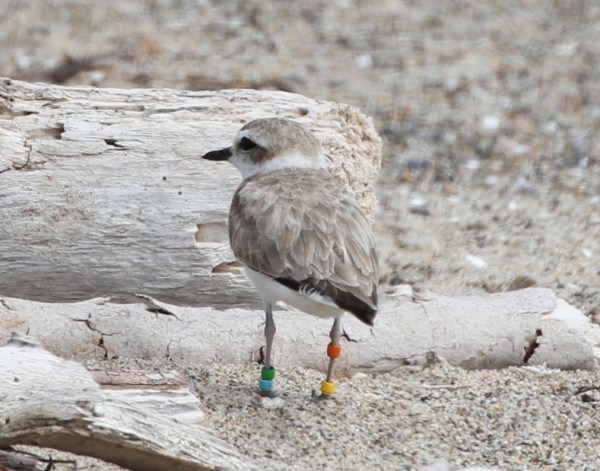
Snowy Plover GA:OY returns for the fourth winter (J. Waterman 7-23-17)
Our old friend, Snowy Plover GA:OY, one of two birds with this color combination banded at Oceano Dunes (near central coast Pismo Beach), has returned from breeding and is again on our beach. We’ve recorded it at Malibu on 23 prior occasions spread over three winters. GA:OY has also been recorded roosting and nesting at Bolsa Chica in Orange County, but we don’t know if it’s the same bird. It’s never been recorded in both locations on the same day. Maybe we can nail down this uncertainty this winter.
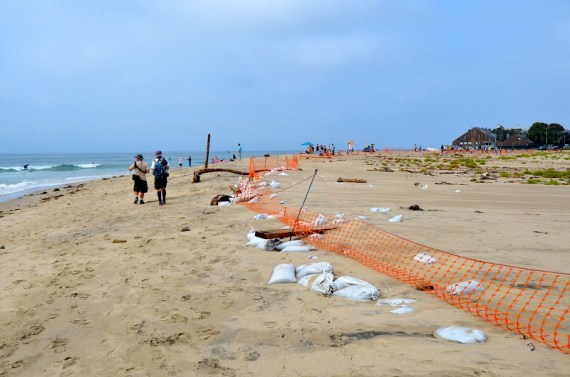
High tide made a mess of our sandbag wall (L. Loeher 7-23-17)
The high tides were unkind to our sandbag wall, and the photo tells the tale. The lesson to be learned, in my opinion, is that standing or even slightly leaning sandbags simply won’t stay in place against waves rushing up the rising beach. We have to lay them down. It probably takes more sandbags to cover the same distance to the same height when they’re lying down, but it seems to be far more solid.
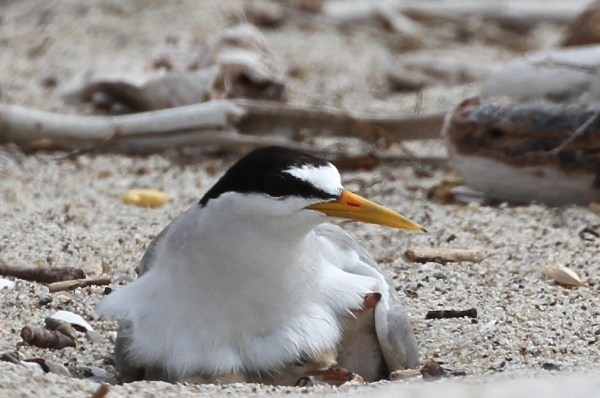
Least Tern on two chicks (J. Waterman 7-23-17)
We did not find the Reddish Egret as we had hoped, nor Western or Least Sandpipers or even Sanderlings, all of which have been passing through. The egret has appeared erratically over the past month. A few birders came this morning to see it within Los Angeles County, and they were very disappointed.
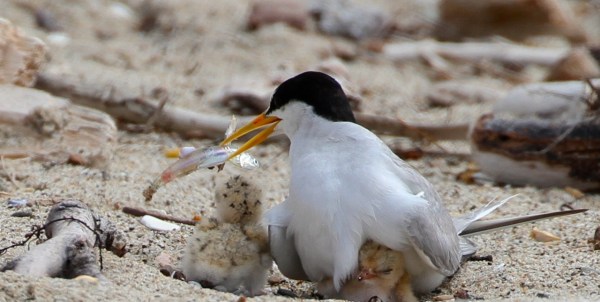
Least Tern, two chicks and a big fish (J. Waterman 7-23-17)
A useful object lesson on our walks comes to us complements of the Heermann’s Gull. Most people believe that migratory birds migrate north for the summer and south for the winter. In North America, this is usually but not always true. The Heermann’s Gull regularly spend the winter on west coast beaches, including Malibu, but can be found as far north as Seattle. They breed almost entirely well to the south in the Sea of Cortez, where 95% of the species nests on the tiny island of Isla Rasa, less than 150 acres in size. Nesting is in the early spring. It’s so hot there that if they nested later, they’d cook their brains. This applies to the Elegant Terns who nest there as well.
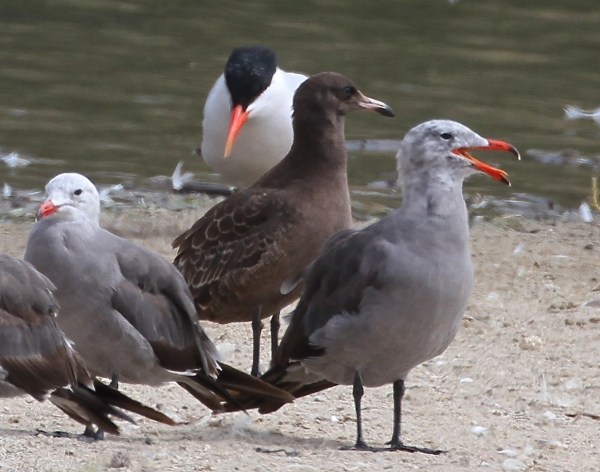
Chocolate-colored juvenile Heermann’s Gull among post-breeding adults
(J. Waterman 7-23-17)
These gulls have had massive breeding failures for several years due to lack of prey fish. I didn’t see any juvenile birds (born in most recent spring) last year at Malibu, and probably not the year before either. When we spotted one today on the beach I made sure someone got a photo, which I sent to Kimball Garrett, Ornithology Collections Manager of the Natural History Museum of Los Angeles County, who replied:
A few juvenile Heermann’s have shown up in the past 3 weeks or so, but generally only about 1 to 5 % of the [Heermann’s] flocks, which seems like a lower percentage than back in the “good old days” when they bred very successfully in the Gulf of California most years.
Our single juvenile Heermann’s at Malibu was among 18 post-breeding adults, making it 5.3% of the entire Heermann’s flock, which fits pretty well with Garrett’s estimate.

Western Gull with starfish-snack (G. Murayama 7-23-17)
This four minute film of Isla Raza is well worth watching.
Some additional resources on Heermann’s Gull and Isla Rasa.
The Auk, 1999. Heermann’s Gull breeding biology on Isla Rasa, Enriqueta Velarde
Western Birds, 1978. Breeding Birds of Isla Raza, Jeffery Boswall & Michael Barrett
San Diego Natural History Museum Ocean Oasis – Isla Rasa
San Diego Natural History Museum – Ocean Oasis – Heermann’s Gull
10,000 Birds – Heermann’s Gull, Near Threatened
Bird Watching Daily – Warming Seas, Overfishing, drive away Elegant Terns
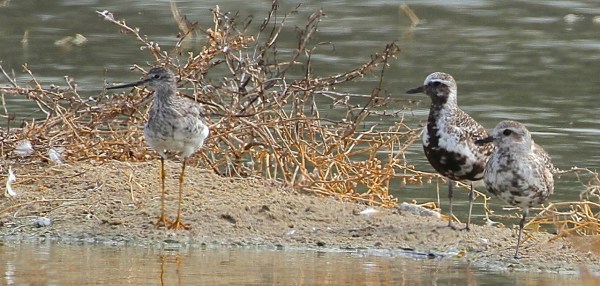
Greater Yellowlegs and two Black-bellied Plovers (J. Waterman 7-23-17)
Birds new for the season were: Pied-billed Grebe, Osprey, Greater Yellowlegs, Whimbrel, Marble Godwit, Ruddy Turnstone, Black Turnstone, Peregrine Falcon, Cassin’s Kingbird, Western Kingbird, Western Meadowlark.

Aaaaah – a good wing-stretch – Least Tern Juvenile (J. Waterman 7-23-17)
Many thanks to our photographers: Larry Loeher, Grace Murayama and Joyce Waterman.

Cabbage White Butterfly
(J. Waterman 7-23-17)
Our next four scheduled field trips: Possible Lower L.A. River in late August, Malibu Lagoon 8:30 & 10am, 27 August; Malibu Lagoon 8:30 & 10am, 24 September, To be announced 8:30am, Oct 14.
Our next program: To Be Announced, 3 October, 7:30 pm; Chris Reed Park, 1133 7th St., NE corner of 7th and Wilshire Blvd. in Santa Monica.
NOTE: Our 10 a.m. Parent’s & Kids Birdwalk meets at the shaded viewpoint just south of the parking area. Watch for Willie the Weasel. He’ll be watching for you and your big floppy feet.

Juvenile Least Tern has a lot of brownish plumage (J. Waterman 7-23-17)
Links: Unusual birds at Malibu Lagoon
9/23/02 Aerial photo of Malibu Lagoon
Prior checklists:
2017: Jan-June
2016: Jan-June, July-Dec 2015: Jan-May, July-Dec
2014: Jan-July, July-Dec 2013: Jan-June, July-Dec
2012: Jan-June, July -Dec 2011: Jan-June, July-Dec
2010: Jan-June, July-Dec 2009: Jan-June, July-Dec.
The 10-year comparison summaries created during the project period, despite numerous complaints, remain available on our Lagoon Project Bird Census Page. Very briefly summarized, the results unexpectedly indicate that avian species diversification and numbers improved slightly during the period Jun’12-June’14.
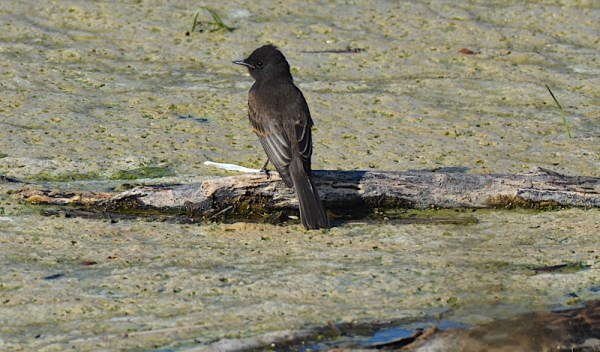
Black Phoebe on floating lagoon wood (L. Loeher 7-23-17)
Many thanks to Lillian Johnson, Chris Lord & Joyce Waterman for their contributions to the checklist below.
[Chuck Almdale]
| Malibu Census 2017 | 2/26 | 3/26 | 4/23 | 5/28 | 6/25 | 7/23 |
| Temperature | 46-52 | 55-68 | 63-70 | 63-68 | 68-81 | 70-75 |
| Tide Lo/Hi Height | H+5.6 | H+5.21 | H+4.54 | L+1.32 | H+4.18 | H+4.39 |
| Tide Time | 0845 | 0851 | 0749 | 0627 | 1147 | 1039 |
| Canada Goose | 2 | |||||
| Gadwall | 10 | 12 | 10 | 15 | 18 | 15 |
| American Wigeon | 6 | 18 | ||||
| Mallard | 24 | 14 | 20 | 25 | 35 | 30 |
| Northern Shoveler | 2 | 1 | ||||
| Green-winged Teal | 12 | 2 | ||||
| Surf Scoter | 8 | 30 | ||||
| Bufflehead | 1 | |||||
| Hooded Merganser | 2 | |||||
| Red-brstd Merganser | 1 | 2 | 4 | |||
| Ruddy Duck | 10 | |||||
| Pacific Loon | 2 | 80 | ||||
| Pied-billed Grebe | 1 | 2 | ||||
| Eared Grebe | 1 | 3 | ||||
| Western Grebe | 3 | 1 | ||||
| Black-vented Shearwater | 50 | |||||
| Dble-crstd Cormorant | 42 | 41 | 19 | 12 | 11 | 22 |
| Pelagic Cormorant | 1 | |||||
| Brown Pelican | 30 | 8 | 28 | 18 | 68 | 35 |
| Great Blue Heron | 4 | 2 | 3 | 5 | 6 | |
| Great Egret | 3 | 1 | 3 | 5 | ||
| Snowy Egret | 9 | 5 | 4 | 2 | 9 | 12 |
| Blk-crwnd N-Heron | 1 | 1 | 1 | |||
| Turkey Vulture | 1 | |||||
| Osprey | 1 | 1 | 1 | 1 | ||
| Red-tailed Hawk | 1 | |||||
| American Coot | 85 | 32 | 1 | 4 | 6 | |
| Blk-bellied Plover | 35 | 14 | 15 | 5 | 5 | 27 |
| Snowy Plover | 8 | 8 | 3 | 2 | 5 | 9 |
| Semipalmated Plover | 20 | |||||
| Killdeer | 4 | 8 | 12 | 14 | 8 | 4 |
| Greater Yellowlegs | 1 | |||||
| Willet | 12 | 13 | 4 | 2 | 3 | |
| Whimbrel | 5 | 4 | 4 | 27 | ||
| Long-billed Curlew | 1 | |||||
| Marbled Godwit | 8 | 23 | 1 | 8 | ||
| Ruddy Turnstone | 10 | 1 | 3 | 2 | ||
| Black Turnstone | 1 | |||||
| Dunlin | 1 | |||||
| Least Sandpiper | 4 | 2 | 30 | |||
| Western Sandpiper | 3 | 3 | 1 | |||
| Bonaparte’s Gull | 1 | 1 | 1 | |||
| Heermann’s Gull | 3 | 1 | 24 | 19 | ||
| Mew Gull | 1 | |||||
| Ring-billed Gull | 30 | 2 | 1 | |||
| Western Gull | 45 | 39 | 75 | 45 | 103 | 52 |
| California Gull | 1350 | 6 | 3 | 2 | ||
| Herring Gull | 1 | |||||
| Glaucous-wingd Gull | 2 | |||||
| Least Tern | 3 | 20 | 30 | |||
| Caspian Tern | 2 | 17 | 4 | 12 | 12 | |
| Royal Tern | 14 | 5 | 2 | 2 | ||
| Elegant Tern | 65 | 45 | 3 | 90 | ||
| Black Skimmer | 1 | |||||
| Rock Pigeon | 10 | 6 | 18 | 13 | 15 | 17 |
| Mourning Dove | 1 | 1 | 2 | 4 | 2 | 4 |
| Allen’s Hummingbird | 2 | 2 | 1 | 3 | 4 | 6 |
| Belted Kingfisher | 1 | |||||
| Peregrine Falcon | 1 | |||||
| Black Phoebe | 2 | 6 | 4 | 5 | 5 | 5 |
| Cassin’s Kingbird | 1 | |||||
| Western Kingbird | 1 | |||||
| California Scrub-Jay | 1 | |||||
| American Crow | 4 | 3 | 3 | 5 | 7 | 2 |
| Common Raven | 1 | |||||
| Violet-green Swallow | 1 | |||||
| Rough-wingd Swallow | 20 | 4 | 3 | 2 | ||
| Cliff Swallow | 16 | 3 | 15 | |||
| Barn Swallow | 5 | 10 | 10 | 9 | 12 | |
| Bushtit | 8 | 3 | 1 | |||
| House Wren | 1 | 1 | ||||
| Ruby-crowned Kinglet | 1 | |||||
| Hermit Thrush | 1 | |||||
| Northern Mockingbird | 2 | 4 | 8 | 4 | 2 | |
| European Starling | 1 | 1 | 1 | 12 | 7 | |
| Ornge-crwnd Warbler | 2 | |||||
| Common Yellowthroat | 3 | 4 | 3 | 4 | 1 | 2 |
| Yellow-rumped Warbler | 8 | |||||
| California Towhee | 1 | 1 | 3 | |||
| Savannah Sparrow | 1 | |||||
| Song Sparrow | 8 | 8 | 15 | 12 | 6 | 6 |
| White-crwnd Sparrow | 20 | 10 | ||||
| Red-winged Blackbird | 1 | 30 | ||||
| Western Meadowlark | 1 | 1 | ||||
| Great-tailed Grackle | 2 | 3 | 8 | 4 | 15 | |
| Hooded Oriole | 1 | |||||
| House Finch | 10 | 6 | 16 | 30 | 10 | 10 |
| Totals by Type | Feb | Mar | Apr | May | Jun | Jul |
| Waterfowl | 75 | 80 | 32 | 44 | 53 | 45 |
| Water Birds – Other | 165 | 132 | 130 | 31 | 83 | 65 |
| Herons, Egrets & Ibis | 16 | 8 | 4 | 6 | 18 | 24 |
| Quail & Raptors | 2 | 1 | 2 | 0 | 0 | 2 |
| Shorebirds | 86 | 76 | 96 | 21 | 22 | 82 |
| Gulls & Terns | 1445 | 58 | 160 | 97 | 167 | 207 |
| Doves | 11 | 7 | 20 | 17 | 17 | 21 |
| Other Non-Passerines | 3 | 2 | 1 | 3 | 4 | 6 |
| Passerines | 94 | 53 | 89 | 92 | 104 | 57 |
| Totals Birds | 1897 | 417 | 534 | 311 | 468 | 509 |
| Total Species | Feb | Mar | Apr | May | Jun | Jul |
| Waterfowl | 9 | 8 | 3 | 3 | 2 | 2 |
| Water Birds – Other | 8 | 5 | 4 | 3 | 3 | 4 |
| Herons, Egrets & Ibis | 3 | 3 | 1 | 3 | 4 | 4 |
| Quail & Raptors | 2 | 1 | 2 | 0 | 0 | 2 |
| Shorebirds | 8 | 9 | 11 | 3 | 6 | 9 |
| Gulls & Terns | 7 | 9 | 6 | 4 | 7 | 7 |
| Doves | 2 | 2 | 2 | 2 | 2 | 2 |
| Other Non-Passerines | 2 | 1 | 1 | 1 | 1 | 1 |
| Passerines | 18 | 13 | 16 | 10 | 14 | 11 |
| Totals Species – 87 | 59 | 51 | 46 | 29 | 39 | 42 |
a



 SANTA MONICA BAY AUDUBON SOCIETY BLOG